
Electric Potential and Charged-Particle Motion: HSC Physics Mock Exam
Test your understanding of electric potential and charged-particle motion with this original 40-mark NSW HSC Physics practice paper. Includes timed exam instructions, original questions, fully worked solutions, and a detailed marking guide.
This original tutorgum practice paper covers electric potential and charged-particle motion for the NSW HSC Physics 2017 syllabus. It tests potential difference, electric fields, equipotential lines, electric potential energy, work, and the motion of charged particles in uniform electric fields. It is a focused topic assessment, not a full-course examination or an official NESA paper.
01Exam instructions
Suggested working time: 60 minutes
Reading time: 5 minutes
Total marks: 40
Permitted equipment:
- Scientific calculator
- Ruler
- Pen, pencil, and eraser
General instructions:
- Attempt all five questions.
- Show all working for calculation questions. Answers without supporting working may not receive full marks.
- Include appropriate units in numerical answers.
- Give numerical answers to 2-3 significant figures unless otherwise indicated.
- Use signed potential differences when calculating changes in electric potential energy.
- Draw additional diagrams where they help explain your reasoning.
Assessed syllabus scope
This paper assesses only the supplied NSW HSC Physics 2017 syllabus scope:
- Electric field strength and potential difference between parallel plates.
- Electric potential and equipotential lines.
- Electric potential energy and work done by an electric field.
- Force and acceleration of charged particles in uniform electric fields.
- Charged-particle trajectories in uniform electric fields.
- The approximately uniform nature of fields between parallel plates and the effects of fringing near their edges.
Magnetic fields, electric circuit analysis, and content from other syllabus editions are excluded.
Constants and useful information
Use the following values throughout the paper:
| Quantity | Value |
|---|---|
| Elementary charge magnitude, \(e\) | \(1.60\times10^{-19}\,\mathrm C\) |
| Electron mass, \(m_e\) | \(9.11\times10^{-31}\,\mathrm{kg}\) |
| Proton mass, \(m_p\) | \(1.67\times10^{-27}\,\mathrm{kg}\) |
| Charge of an electron | \(-e\) |
| Charge of a proton | \(+e\) |
Remember:
- \(1\,\mu\mathrm C=1.0\times10^{-6}\,\mathrm C\).
- \(1\,\mathrm{nC}=1.0\times10^{-9}\,\mathrm C\).
- Electric field strength can be expressed in either \(\mathrm{V\,m^{-1}}\) or \(\mathrm{N\,C^{-1}}\).
- The potential difference is defined as \(\Delta V=V_{\mathrm{final}}-V_{\mathrm{initial}}\).
- The change in electric potential energy is defined as \(\Delta U=U_{\mathrm{final}}-U_{\mathrm{initial}}\).
- The work done by the electric field is \(W_{\mathrm{field}}=-\Delta U\).
Unless otherwise stated, assume electric fields are uniform, ignore edge effects in calculations, and neglect energy losses.
02Questions
Question 1 (7 marks)
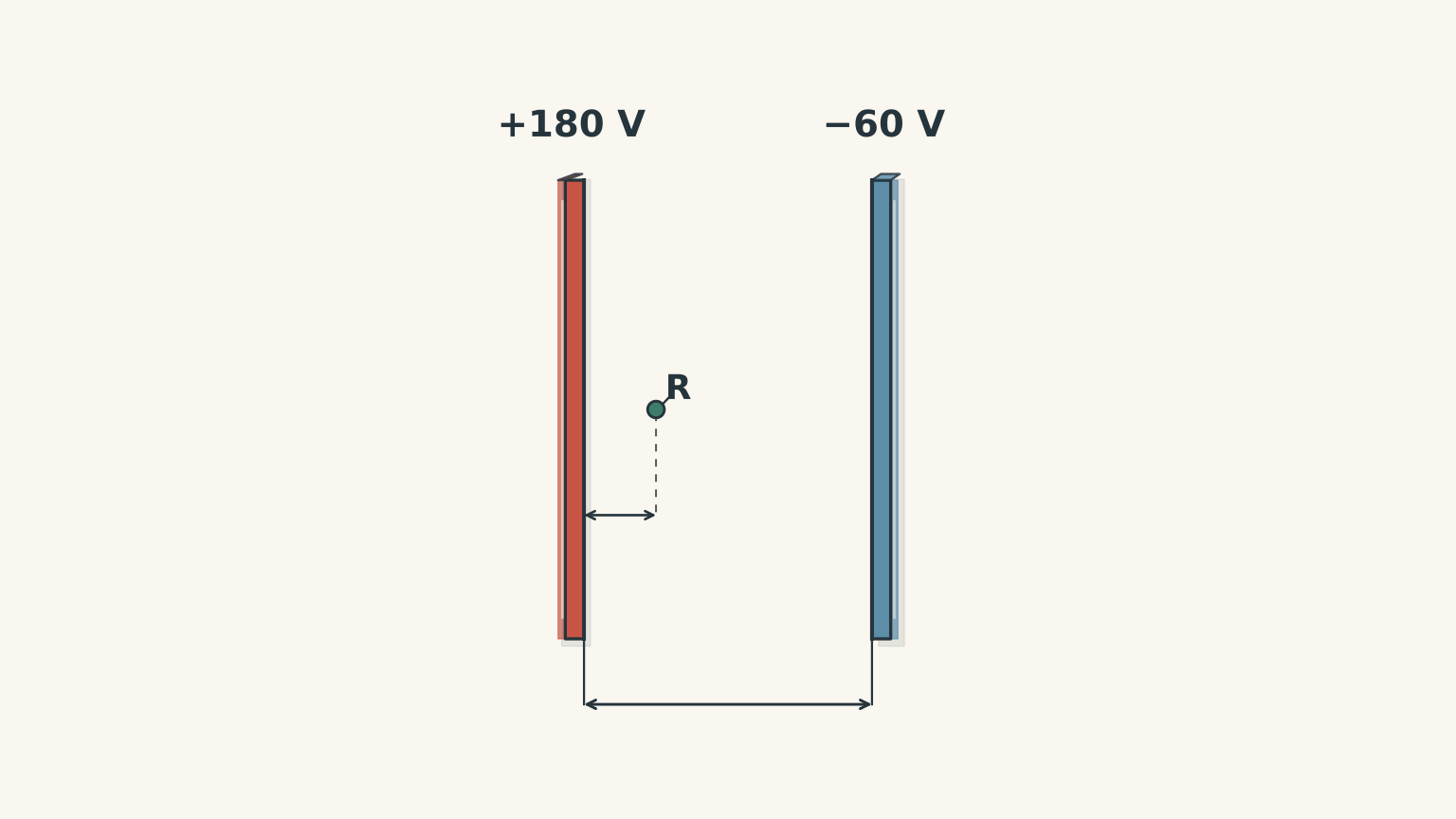
Two large, parallel metal plates are separated by a distance of \(8.0\,\mathrm{mm}\). The left plate is maintained at a potential of \(+180\,\mathrm V\), while the right plate is maintained at \(-60\,\mathrm V\).
Consider the region between the plates, sufficiently far from their edges for the electric field to be treated as uniform.
(a) Calculate the magnitude of the potential difference between the plates. (1 mark)
(b) Calculate the magnitude of the electric field strength between the plates. State its direction. (2 marks)
(c) Assuming the electric field is uniform, calculate the electric potential at point R. (2 marks)
(d) Explain why the electric field between parallel plates is approximately uniform in the central region but becomes non-uniform near the edges. (2 marks)
Question 2 (7 marks)
A charged object with a charge of \(-3.0\,\mu\mathrm C\) is moved from point A, which has an electric potential of \(+250\,\mathrm V\), to point B, which has an electric potential of \(-50\,\mathrm V\).
(a) Calculate the potential difference experienced by the object. (1 mark)
(b) Calculate the change in electric potential energy of the object as it moves from A to B. (2 marks)
(c) Calculate the work done by the electric field during this displacement. (1 mark)
(d) Explain what the sign of your answer to part (c) tells you about the relationship between the electric force and the object’s displacement. (2 marks)
(e) If the object were instead moved from B to A, determine the work done by the electric field. (1 mark)
Question 3 (6 marks)
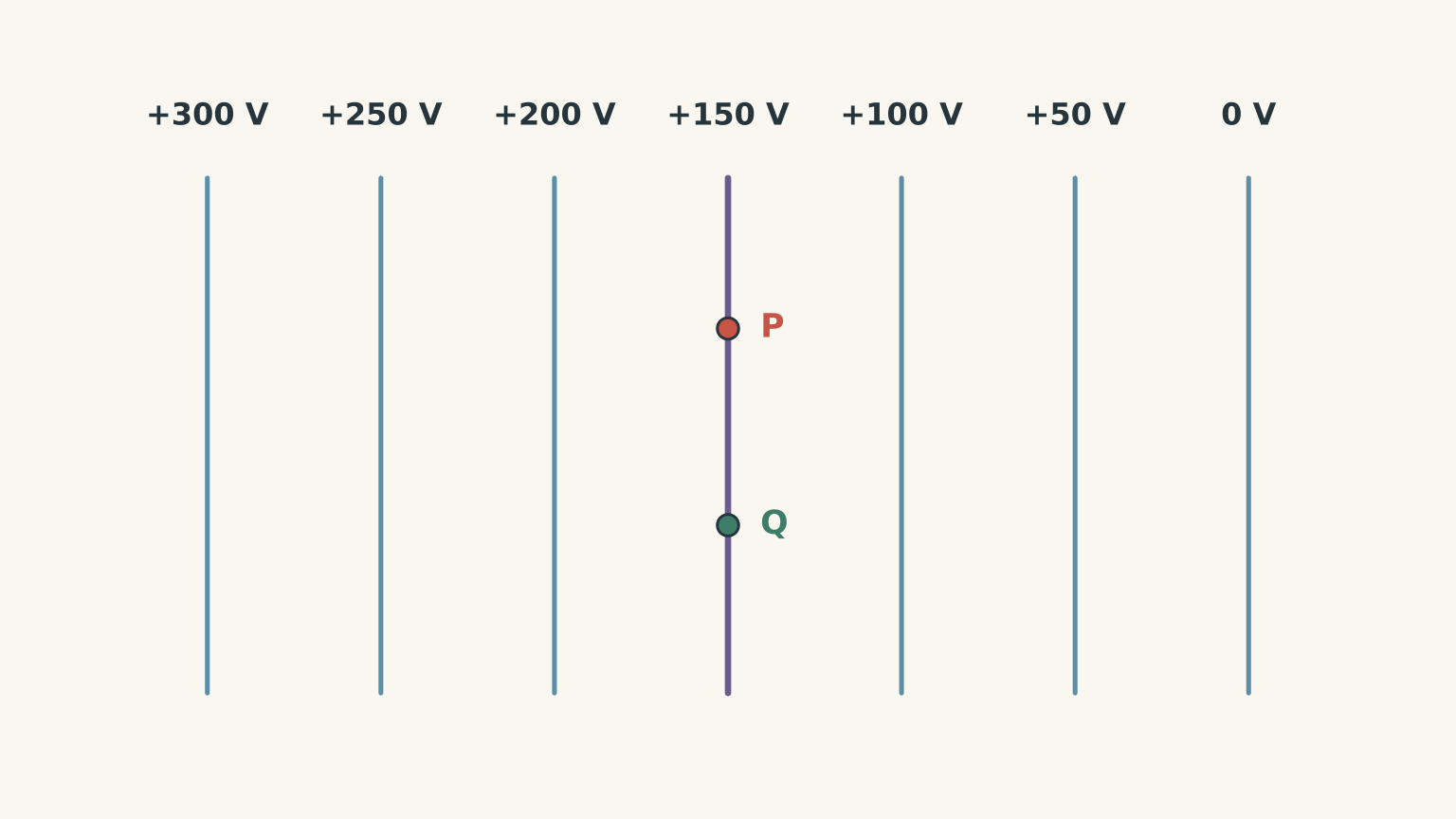
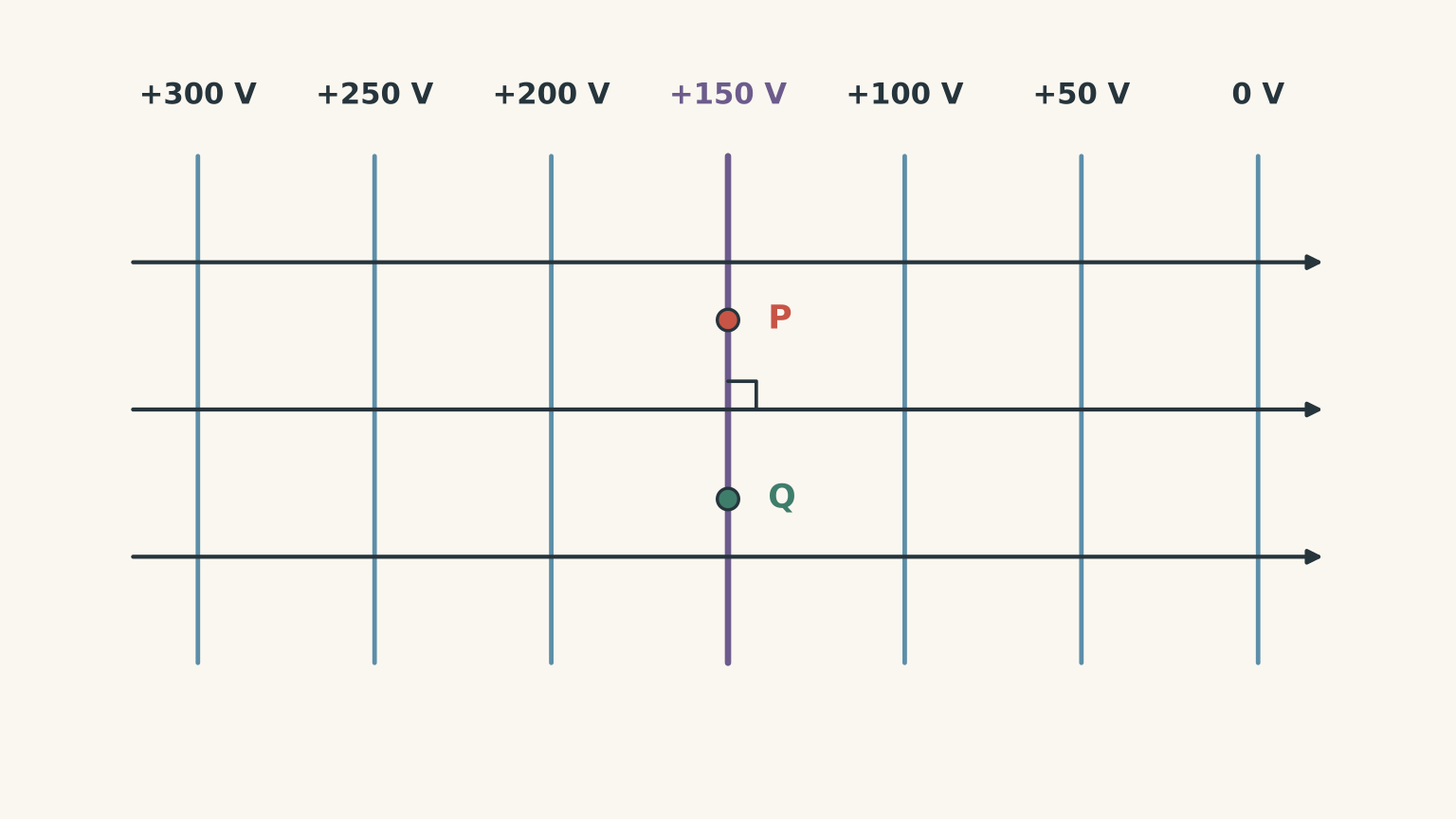
An electric field exists in a region where the equipotential lines are parallel and equally spaced. The lines have the following electric potentials:
\[ +300\,\mathrm V,\quad +250\,\mathrm V,\quad +200\,\mathrm V,\quad +150\,\mathrm V, \]
\[ +100\,\mathrm V,\quad +50\,\mathrm V,\quad 0\,\mathrm V. \]
The potential decreases from left to right.
Points P and Q are located at different positions along the same \(+150\,\mathrm V\) equipotential line.
(a) State the direction of the electric field relative to the equipotential lines. (1 mark)
(b) State the angle between an electric field line and an equipotential line. (1 mark)
(c) Explain why electric field lines must be perpendicular to equipotential lines. (2 marks)
(d) A positive charge of \(+4.0\,\mathrm{nC}\) is moved from P to Q.
Calculate:
- The change in electric potential energy.
- The work done by the electric field.
(2 marks)
Question 4 (10 marks)
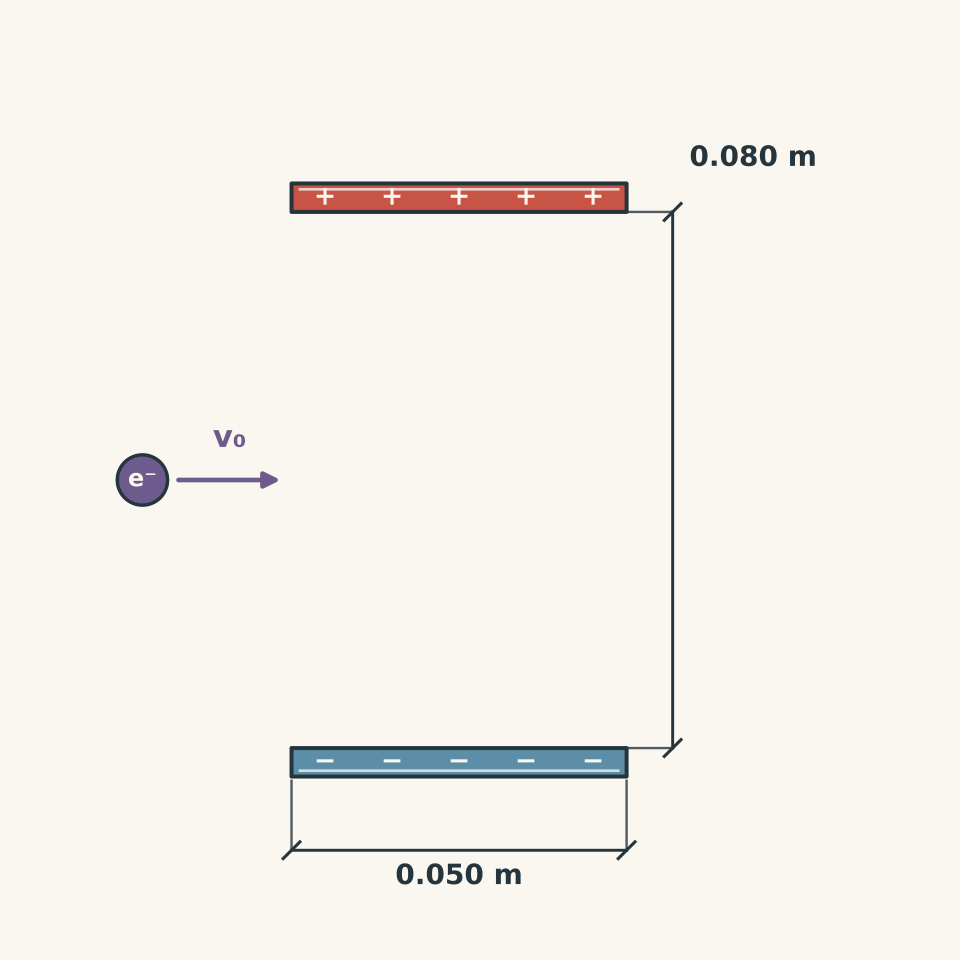
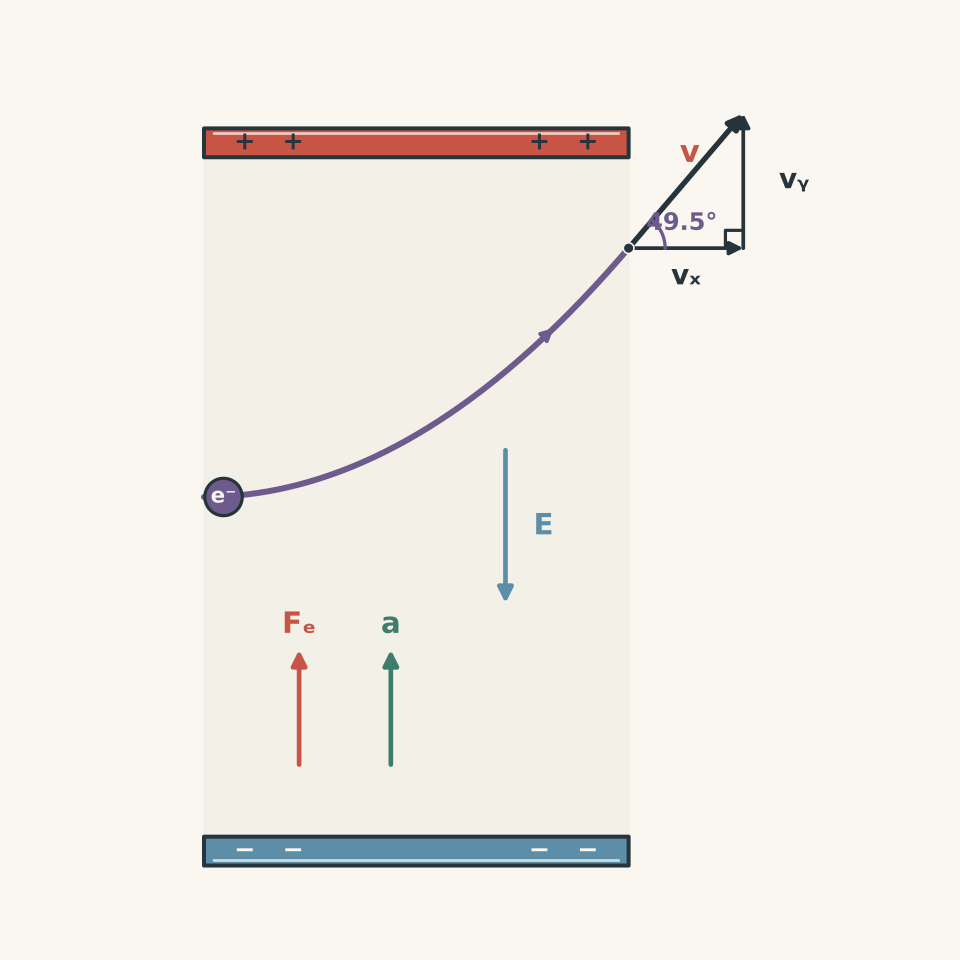
An electron enters the region between two parallel metal plates with a horizontal velocity of \(3.0\times10^6\,\mathrm{m\,s^{-1}}\).
The upper plate is positively charged, and the lower plate is negatively charged. The electric field between the plates is vertically downward, with a magnitude of \(1.2\times10^3\,\mathrm{N\,C^{-1}}\).
The plates have a horizontal length of \(0.050\,\mathrm m\) and are separated vertically by \(0.080\,\mathrm m\).
The electron enters halfway between the plates, with no initial vertical velocity.
Assume:
- The electric field is uniform throughout the electron’s motion between the plates.
- The horizontal velocity remains constant.
- Gravity and relativistic effects are negligible.
(a) Calculate the magnitude of the electric force acting on the electron and state its direction. (2 marks)
(b) Calculate the magnitude of the electron’s acceleration and state its direction. (2 marks)
(c) Calculate the time taken for the electron to travel from the entrance to the exit of the plates. (1 mark)
(d) Calculate the electron’s vertical displacement by the time it reaches the end of the plates. State whether it strikes the upper plate. (2 marks)
(e) Calculate:
- The vertical component of the electron’s velocity as it exits the plates.
- The angle of its exit velocity relative to the horizontal.
(3 marks)
Question 5 (10 marks)
A proton and an electron are separately released from rest and accelerated through a potential difference of magnitude \(300\,\mathrm V\).
The proton moves from a region at \(+300\,\mathrm V\) to a region at \(0\,\mathrm V\).
The electron moves from a region at \(0\,\mathrm V\) to a region at \(+300\,\mathrm V\).
Both particles move in the direction that decreases their electric potential energy. Assume all the lost electric potential energy is converted into kinetic energy.
(a) Calculate the change in electric potential energy for:
- The proton.
- The electron.
(2 marks)
(b) Calculate the speed of each particle after it has been accelerated from rest. (4 marks)
In a separate situation, the same proton and electron are placed in two separate uniform electric field regions. Both regions have an electric field strength of \(2.0\times10^3\,\mathrm{N\,C^{-1}}\), directed east.
(c) Calculate the magnitude of the electric force on each particle. State the direction of the force acting on each particle. (2 marks)
(d) Calculate the ratio of the magnitude of the electron’s acceleration to the magnitude of the proton’s acceleration.
Explain which particle experiences the greater acceleration. (2 marks)
03Worked solutions and marking guide
Solution 1
(a) Calculate the magnitude of the potential difference.
The potential difference is the difference between the potentials of the two plates.
\[ |\Delta V|=|V_{\mathrm{right}}-V_{\mathrm{left}}| \]
\[ =|-60-180| \]
\[ \boxed{|\Delta V|=240\,\mathrm V} \]
Marking:
- 1 mark for the correct potential difference magnitude.
(b) Calculate the electric field strength and direction.
For a uniform electric field between parallel plates:
\[ E=\frac{|\Delta V|}{d} \]
where \(E\) is electric field strength in \(\mathrm{V\,m^{-1}}\), \(\Delta V\) is potential difference in volts, and \(d\) is plate separation in metres.
Convert the separation:
\[ d=8.0\times10^{-3}\,\mathrm m \]
Substitute:
\[ E=\frac{240}{8.0\times10^{-3}} \]
\[ \boxed{E=3.0\times10^4\,\mathrm{V\,m^{-1}}} \]
The electric field points from higher electric potential towards lower electric potential.
Therefore, it points from the left plate towards the right plate.
\[ \boxed{\text{Direction: left to right}} \]
Marking:
- 1 mark for the correct magnitude.
- 1 mark for the correct direction.
(c) Calculate the potential at point R.
The potential decreases uniformly between the plates.
The total potential decrease is \(240\,\mathrm V\) over \(8.0\,\mathrm{mm}\).
Point R is \(2.0\,\mathrm{mm}\) from the left plate.
The fraction of the total distance is:
\[ \frac{2.0}{8.0}=0.25 \]
Therefore, the potential decreases by:
\[ \Delta V_R=0.25\times240 \]
\[ \Delta V_R=60\,\mathrm V \]
Starting from \(+180\,\mathrm V\):
\[ V_R=180-60 \]
\[ \boxed{V_R=+120\,\mathrm V} \]
Marking:
- 1 mark for correctly applying the proportional change in potential.
- 1 mark for the correct potential, including its sign.
(d) Explain the uniformity of the electric field.
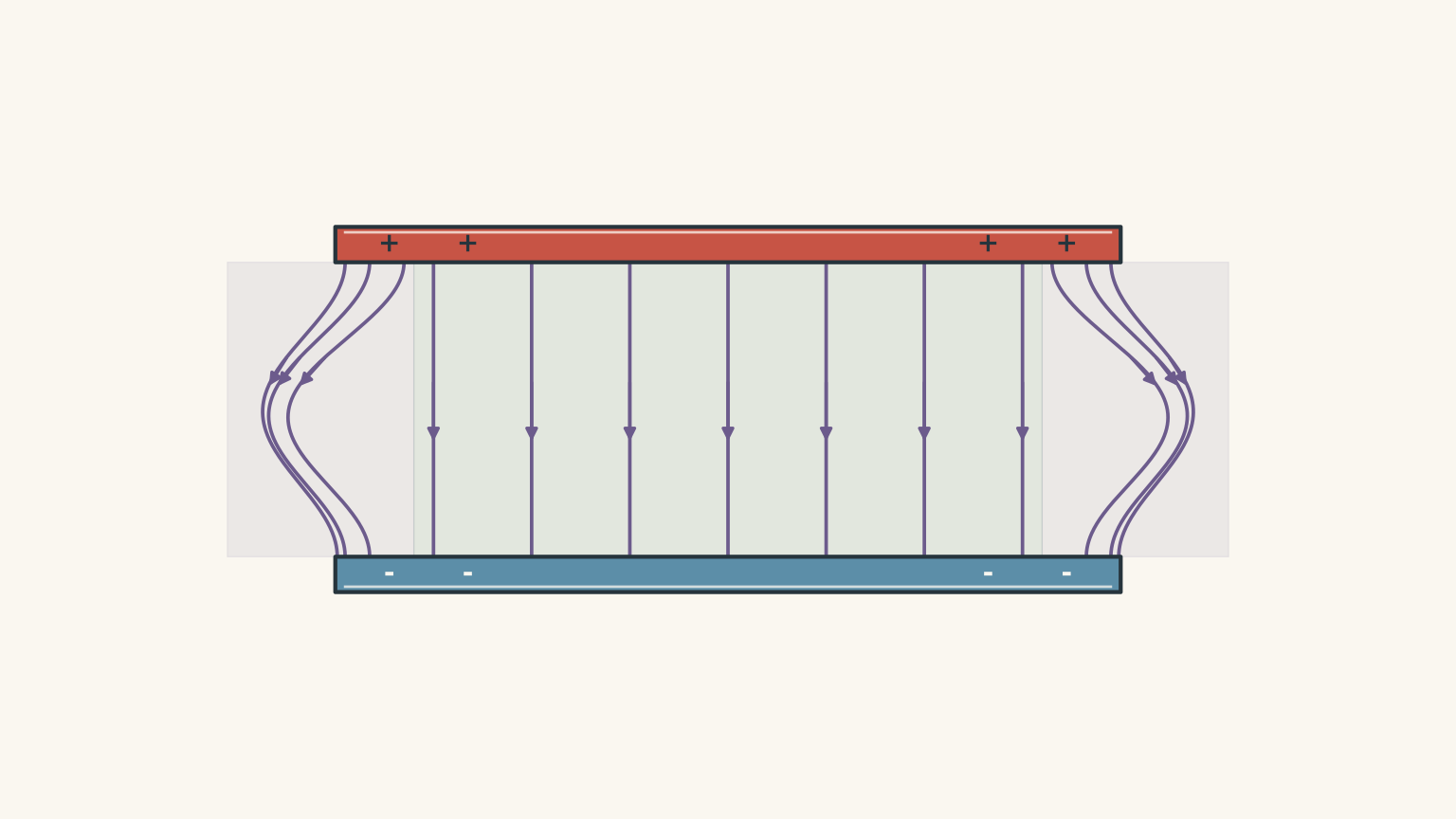
In the central region between large parallel plates, the electric field is approximately uniform.
The field lines are approximately straight, parallel, and equally spaced. This means the field has approximately constant magnitude and direction throughout that region.
Near the edges, the field lines curve outwards. This is called fringing.
The field therefore changes direction and magnitude near the edges, making it non-uniform.
Marking:
- 1 mark for explaining why the central field is approximately uniform.
- 1 mark for identifying fringing and explaining why the field becomes non-uniform near the edges.
Total: 7 marks
Solution 2
(a) Calculate the potential difference.
The potential difference is:
\[ \Delta V=V_B-V_A \]
Substitute:
\[ \Delta V=-50-250 \]
\[ \boxed{\Delta V=-300\,\mathrm V} \]
The negative sign indicates that the object moves to a region of lower electric potential.
Marking:
- 1 mark for the correct signed potential difference.
(b) Calculate the change in electric potential energy.
The relationship between electric potential energy and potential difference is:
\[ \Delta U=q\Delta V \]
where:
- \(\Delta U\) is the change in electric potential energy in joules.
- \(q\) is the object’s charge in coulombs.
- \(\Delta V\) is the potential difference in volts.
The charge is:
\[ q=-3.0\times10^{-6}\,\mathrm C \]
Substitute:
\[ \Delta U=(-3.0\times10^{-6})(-300) \]
\[ \boxed{\Delta U=+9.0\times10^{-4}\,\mathrm J} \]
Notice that both the charge and potential difference are negative.
Multiplying them gives a positive change in electric potential energy.
Marking:
- 1 mark for correctly applying \(\Delta U=q\Delta V\) with signed values.
- 1 mark for the correct numerical answer and unit.
(c) Calculate the work done by the electric field.
The work done by an electric field is the negative of the change in electric potential energy.
\[ W_{\mathrm{field}}=-\Delta U \]
\[ W_{\mathrm{field}}=-9.0\times10^{-4} \]
\[ \boxed{W_{\mathrm{field}}=-9.0\times10^{-4}\,\mathrm J} \]
Marking:
- 1 mark for the correct relationship and answer.
(d) Explain the sign of the work done.
The work done by the electric field is negative.
This means the electric force acts against the object’s displacement.
The object is moving in a direction opposite to the electric force, so the electric field does negative work.
As a result, the object’s electric potential energy increases.
Marking:
- 1 mark for identifying that the displacement is against the electric force.
- 1 mark for explaining that the electric potential energy increases.
(e) Determine the work done if the object moves from B to A.
Reversing the direction of motion reverses the sign of the work done by the electric field.
Therefore:
\[ \boxed{W_{\mathrm{field}}=+9.0\times10^{-4}\,\mathrm J} \]
The electric field now does positive work because the displacement is in the direction of the electric force.
Marking:
- 1 mark for the correct positive work value.
Total: 7 marks
Solution 3
(a) State the direction of the electric field.
The electric field points from higher electric potential towards lower electric potential.
The potential decreases from left to right.
Therefore:
\[ \boxed{\text{Electric field direction: left to right}} \]
Marking:
- 1 mark for the correct direction.
(b) State the angle between an electric field line and an equipotential line.
Electric field lines are perpendicular to equipotential lines.
Therefore:
\[ \boxed{\theta=90^\circ} \]
Marking:
- 1 mark for the correct angle.
(c) Explain why electric field lines are perpendicular to equipotential lines.
An equipotential line connects points with the same electric potential.
If a charge moves along an equipotential line, its potential difference is zero.
Therefore:
\[ \Delta V=0 \]
Since the change in electric potential energy is:
\[ \Delta U=q\Delta V \]
there is no change in electric potential energy when a charge moves along an equipotential line.
The electric field cannot have a component parallel to the equipotential line. Otherwise, it would do work on a charge moving along that line.
Therefore, the electric field must be perpendicular to the equipotential lines.
Marking:
- 1 mark for identifying that there is no potential difference along an equipotential line.
- 1 mark for explaining that the electric field has no component parallel to the equipotential line.
(d) Calculate the change in electric potential energy and work done.
Points P and Q lie on the same equipotential line.
Therefore, they have the same electric potential.
\[ \Delta V=V_Q-V_P \]
\[ \Delta V=150-150 \]
\[ \Delta V=0\,\mathrm V \]
The charge is:
\[ q=+4.0\times10^{-9}\,\mathrm C \]
Calculate the change in electric potential energy:
\[ \Delta U=q\Delta V \]
\[ \Delta U=(4.0\times10^{-9})(0) \]
\[ \boxed{\Delta U=0\,\mathrm J} \]
The work done by the electric field is:
\[ W_{\mathrm{field}}=-\Delta U \]
\[ \boxed{W_{\mathrm{field}}=0\,\mathrm J} \]
Moving a charge along an equipotential line requires no work by the electric field.
Marking:
- 1 mark for correctly identifying the zero change in potential energy.
- 1 mark for the correct work done by the electric field.
Total: 6 marks
Solution 4
(a) Calculate the electric force on the electron.
The electric force on a charged particle is:
\[ F=qE \]
where \(F\) is electric force in newtons, \(q\) is charge in coulombs, and \(E\) is electric field strength in \(\mathrm{N\,C^{-1}}\).
For an electron:
\[ q=-1.60\times10^{-19}\,\mathrm C \]
The electric field strength is:
\[ E=1.2\times10^3\,\mathrm{N\,C^{-1}} \]
Calculate the magnitude of the force:
\[ |F|=|q|E \]
\[ =(1.60\times10^{-19})(1.2\times10^3) \]
\[ \boxed{|F|=1.92\times10^{-16}\,\mathrm N} \]
The electric field points downwards.
However, an electron has a negative charge, so its force acts in the opposite direction to the electric field.
Therefore:
\[ \boxed{\text{Force direction: vertically upwards}} \]
Marking:
- 1 mark for the correct force magnitude.
- 1 mark for identifying the upward direction.
(b) Calculate the electron’s acceleration.
Newton’s second law gives:
\[ F=ma \]
Rearrange:
\[ a=\frac{F}{m} \]
The electron’s mass is:
\[ m_e=9.11\times10^{-31}\,\mathrm{kg} \]
Substitute:
\[ a=\frac{1.92\times10^{-16}} {9.11\times10^{-31}} \]
\[ \boxed{a=2.11\times10^{14}\,\mathrm{m\,s^{-2}}} \]
The acceleration is in the same direction as the net force.
Therefore, it is vertically upwards.
Marking:
- 1 mark for correctly applying \(a=F/m\).
- 1 mark for the correct acceleration magnitude and direction.
(c) Calculate the time taken to travel between the plates.
The electron travels horizontally at a constant speed.
The horizontal distance is the plate length:
\[ x=0.050\,\mathrm m \]
The horizontal velocity is:
\[ v_x=3.0\times10^6\,\mathrm{m\,s^{-1}} \]
Using:
\[ t=\frac{x}{v_x} \]
Substitute:
\[ t=\frac{0.050}{3.0\times10^6} \]
\[ \boxed{t=1.67\times10^{-8}\,\mathrm s} \]
Marking:
- 1 mark for the correct time.
(d) Calculate the vertical displacement and determine whether the electron strikes the upper plate.
The electron has no initial vertical velocity.
Its vertical acceleration is constant, so we can use:
\[ \Delta y=u_yt+\frac12at^2 \]
Since \(u_y=0\):
\[ \Delta y=\frac12at^2 \]
Substitute:
\[ \Delta y= \frac12(2.11\times10^{14}) (1.67\times10^{-8})^2 \]
\[ \boxed{\Delta y=0.0293\,\mathrm m} \]
The electron moves upwards by approximately \(2.9\,\mathrm{cm}\).
Now check whether it strikes the upper plate.
The electron starts halfway between the plates, so its initial vertical distance from the upper plate is:
\[ \frac{0.080}{2}=0.040\,\mathrm m \]
Its upward displacement is only \(0.0293\,\mathrm m\).
The remaining clearance is:
\[ 0.040-0.0293=0.0107\,\mathrm m \]
Therefore:
\[ \boxed{\text{The electron does not strike the upper plate.}} \]
It exits the plates approximately \(1.1\,\mathrm{cm}\) below the upper plate.
Marking:
- 1 mark for the correct vertical displacement.
- 1 mark for comparing the displacement with the available clearance and reaching the correct conclusion.
(e) Calculate the vertical velocity and exit angle.
First, calculate the vertical component of velocity.
Using:
\[ v_y=u_y+at \]
Since the initial vertical velocity is zero:
\[ v_y=at \]
Substitute:
\[ v_y=(2.11\times10^{14})(1.67\times10^{-8}) \]
\[ \boxed{v_y=3.52\times10^6\,\mathrm{m\,s^{-1}}} \]
The vertical velocity is upwards.
The horizontal velocity remains constant:
\[ v_x=3.0\times10^6\,\mathrm{m\,s^{-1}} \]
We can now calculate the angle of the resultant velocity relative to the horizontal.
Using trigonometry:
\[ \tan\theta=\frac{v_y}{v_x} \]
\[ \tan\theta= \frac{3.52\times10^6}{3.0\times10^6} \]
\[ \theta=\tan^{-1}(1.173) \]
\[ \boxed{\theta\approx49.5^\circ} \]
The electron exits at approximately \(49.5^\circ\) above the horizontal.
Marking:
- 1 mark for the correct vertical velocity component.
- 1 mark for correctly applying the tangent relationship to the velocity components.
- 1 mark for the correct exit angle and direction.
Total: 10 marks
Solution 5
(a) Calculate the change in electric potential energy for each particle.
We use:
\[ \Delta U=q\Delta V \]
For the proton:
\[ q=+1.60\times10^{-19}\,\mathrm C \]
Its potential difference is:
\[ \Delta V=0-300=-300\,\mathrm V \]
Therefore:
\[ \Delta U_p=(1.60\times10^{-19})(-300) \]
\[ \boxed{\Delta U_p=-4.80\times10^{-17}\,\mathrm J} \]
For the electron:
\[ q=-1.60\times10^{-19}\,\mathrm C \]
Its potential difference is:
\[ \Delta V=300-0=+300\,\mathrm V \]
Therefore:
\[ \Delta U_e=(-1.60\times10^{-19})(300) \]
\[ \boxed{\Delta U_e=-4.80\times10^{-17}\,\mathrm J} \]
Both particles experience the same decrease in electric potential energy.
This makes sense because both particles have the same charge magnitude and move in directions that lower their electric potential energy.
Marking:
- 1 mark for the correct proton result.
- 1 mark for the correct electron result, including signs.
(b) Calculate the final speed of each particle.
Both particles start from rest.
Since all the lost electric potential energy is converted into kinetic energy:
\[ \Delta K=-\Delta U \]
Therefore, the kinetic energy gained by each particle is:
\[ \Delta K=4.80\times10^{-17}\,\mathrm J \]
The kinetic energy equation is:
\[ K=\frac12mv^2 \]
Since the particles start from rest:
\[ \frac12mv^2=4.80\times10^{-17} \]
Rearrange to find speed:
\[ v=\sqrt{\frac{2(4.80\times10^{-17})}{m}} \]
Proton
The proton mass is:
\[ m_p=1.67\times10^{-27}\,\mathrm{kg} \]
Substitute:
\[ v_p= \sqrt{\frac{9.60\times10^{-17}} {1.67\times10^{-27}}} \]
\[ \boxed{v_p=2.40\times10^5\,\mathrm{m\,s^{-1}}} \]
Electron
The electron mass is:
\[ m_e=9.11\times10^{-31}\,\mathrm{kg} \]
Substitute:
\[ v_e= \sqrt{\frac{9.60\times10^{-17}} {9.11\times10^{-31}}} \]
\[ \boxed{v_e=1.03\times10^7\,\mathrm{m\,s^{-1}}} \]
The electron reaches a much greater speed than the proton.
Both particles gain the same kinetic energy, but the electron has a much smaller mass.
Marking:
- 1 mark for correctly relating the loss in electric potential energy to the gain in kinetic energy for the proton.
- 1 mark for the correct proton speed.
- 1 mark for correctly applying the energy relationship to the electron.
- 1 mark for the correct electron speed.
(c) Calculate the electric force on each particle and state its direction.
The magnitude of the electric force is:
\[ |F|=|q|E \]
Both particles have the same charge magnitude:
\[ |q|=1.60\times10^{-19}\,\mathrm C \]
The electric field strength is:
\[ E=2.0\times10^3\,\mathrm{N\,C^{-1}} \]
Therefore:
\[ |F|=(1.60\times10^{-19})(2.0\times10^3) \]
\[ \boxed{|F|=3.2\times10^{-16}\,\mathrm N} \]
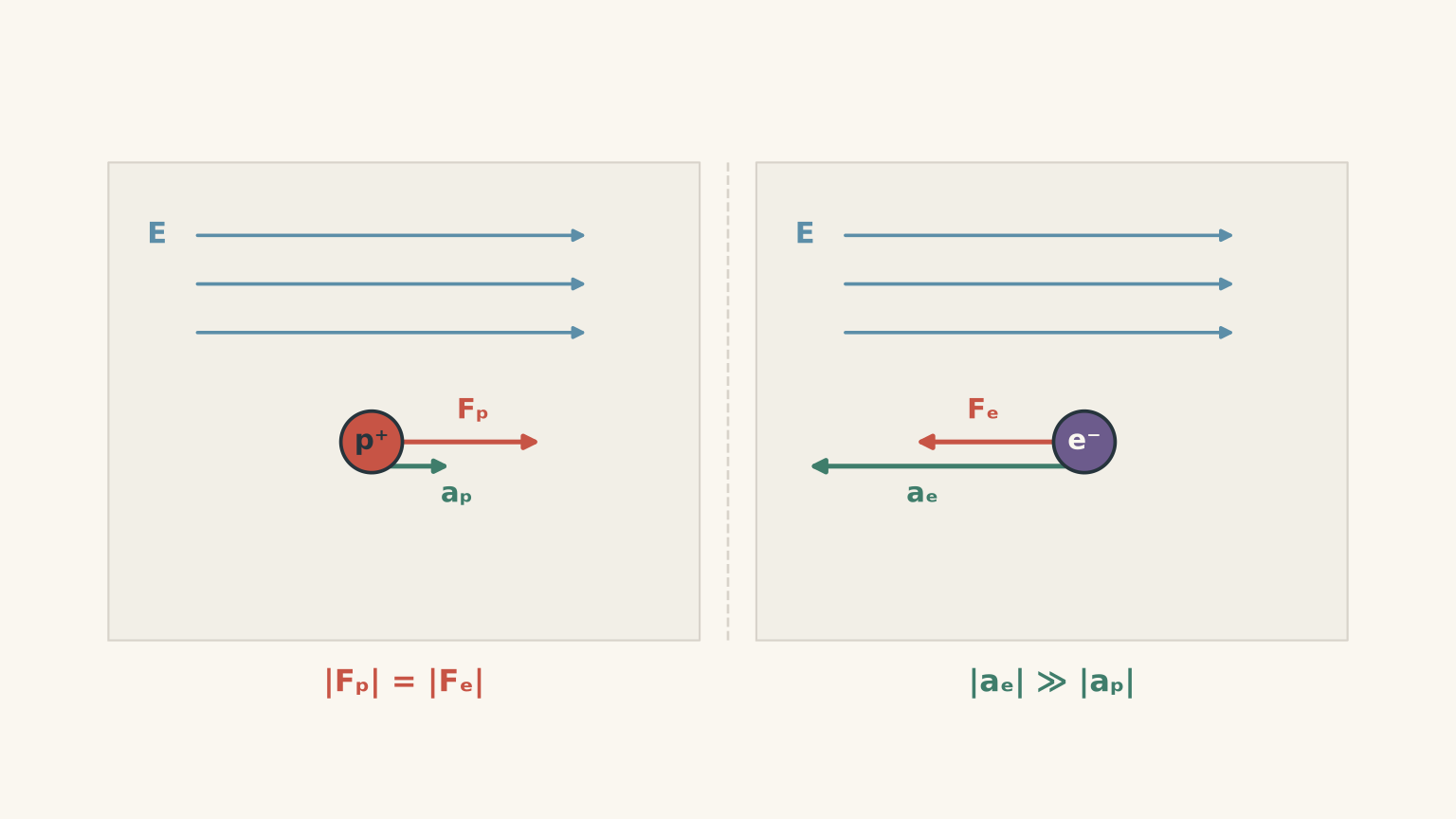
Both particles experience the same force magnitude.
However, their force directions are different.
- The proton is positively charged, so its force acts in the same direction as the electric field: east.
- The electron is negatively charged, so its force acts in the opposite direction to the electric field: west.
Therefore:
\[ \boxed{\text{Proton: }3.2\times10^{-16}\,\mathrm N \text{ east}} \]
\[ \boxed{\text{Electron: }3.2\times10^{-16}\,\mathrm N \text{ west}} \]
Marking:
- 1 mark for the correct force magnitude.
- 1 mark for both correct force directions.
(d) Calculate the ratio of their acceleration magnitudes.
Newton’s second law gives:
\[ a=\frac{F}{m} \]
Therefore, the ratio of the electron’s acceleration to the proton’s acceleration is:
\[ \frac{a_e}{a_p} = \frac{F_e/m_e}{F_p/m_p} \]
The force magnitudes are equal, so:
\[ \frac{a_e}{a_p}=\frac{m_p}{m_e} \]
Substitute:
\[ \frac{a_e}{a_p} = \frac{1.67\times10^{-27}} {9.11\times10^{-31}} \]
\[ \boxed{\frac{a_e}{a_p}=1.83\times10^3} \]
The electron experiences an acceleration approximately 1830 times greater than the proton.
This is because both particles experience the same force magnitude, but the electron has a much smaller mass.
Their accelerations also point in opposite directions because their electric forces point in opposite directions.
Marking:
- 1 mark for correctly deriving the acceleration ratio from the equal force magnitudes and different masses.
- 1 mark for the correct ratio and identifying the electron as having the greater acceleration.
Total: 10 marks
04Final mark summary
| Question | Assessed content | Marks |
|---|---|---|
| 1 | Parallel plates, electric field strength, potential difference, edge effects | 7 |
| 2 | Electric potential energy and work | 7 |
| 3 | Equipotential lines and electric potential energy | 6 |
| 4 | Electron motion in a uniform electric field | 10 |
| 5 | Particle energy, force, and acceleration | 10 |
| Total | 40 |
Suggested self-assessment: After completing the paper, pay particular attention to your treatment of positive and negative charges. Correctly identifying the direction of the electric field is only the first step. You must also account for the sign of the particle’s charge when determining its force, acceleration, and change in electric potential energy.