
The Magnetic Bottle: Particle Confinement and Loss Cones
Explore how magnetic mirrors trap charged particles, why some particles escape through the loss cone, and how pitch angle and magnetic field strength determine confinement. An accessible extension of Year 12 HSC Physics electromagnetism.
A charged particle enters a long magnetic field. The field is weak in the middle but becomes much stronger near both ends. The particle spirals along the field lines, apparently heading straight towards an open exit. Yet some particles turn around before reaching either end, bouncing backwards and forwards inside the region. Others escape.
Why do some particles get trapped while others don’t?
The answer depends on the direction of a particle’s velocity relative to the magnetic field. This is the principle behind a magnetic bottle, and it leads to an important idea in plasma physics called the loss cone.
Magnetic bottles and loss cones are extension physics, not required HSC assessment content. The starting point is the Year 12 Electromagnetism model for the force on a charged particle moving through a magnetic field. We will extend that model to non-uniform magnetic fields and particle confinement.
A syllabus clarification: the NSW Physics 11-12 Syllabus (2025) is scheduled for implementation from 2027, with the first HSC examination under the new syllabus in 2028. Its year is the publication year, not an indication that it became the examinable Year 12 course in 2025. See NESA’s implementation information.
01The starting point: charged particles in a magnetic field
Before building a magnetic bottle, recall what happens when a charged particle enters a magnetic field.
The magnetic force on a moving charge has magnitude
\[ F_B=|q|vB\sin\theta \]
where:
- \(F_B\) is the magnetic force, in newtons (N).
- \(q\) is the particle’s electric charge, in coulombs (C).
- \(v\) is its speed, in metres per second (m s\(^{-1}\)).
- \(B\) is the magnetic field strength, in tesla (T).
- \(\theta\) is the angle between the particle’s velocity and the magnetic field.
The force acts perpendicular to the particle’s instantaneous velocity.
This produces three possible situations:
- If the particle travels parallel to the magnetic field, the magnetic force is zero.
- If it travels perpendicular to the field, it follows a circular path.
- If it enters at an angle, it follows a helical path, combining circular motion with movement along the field.
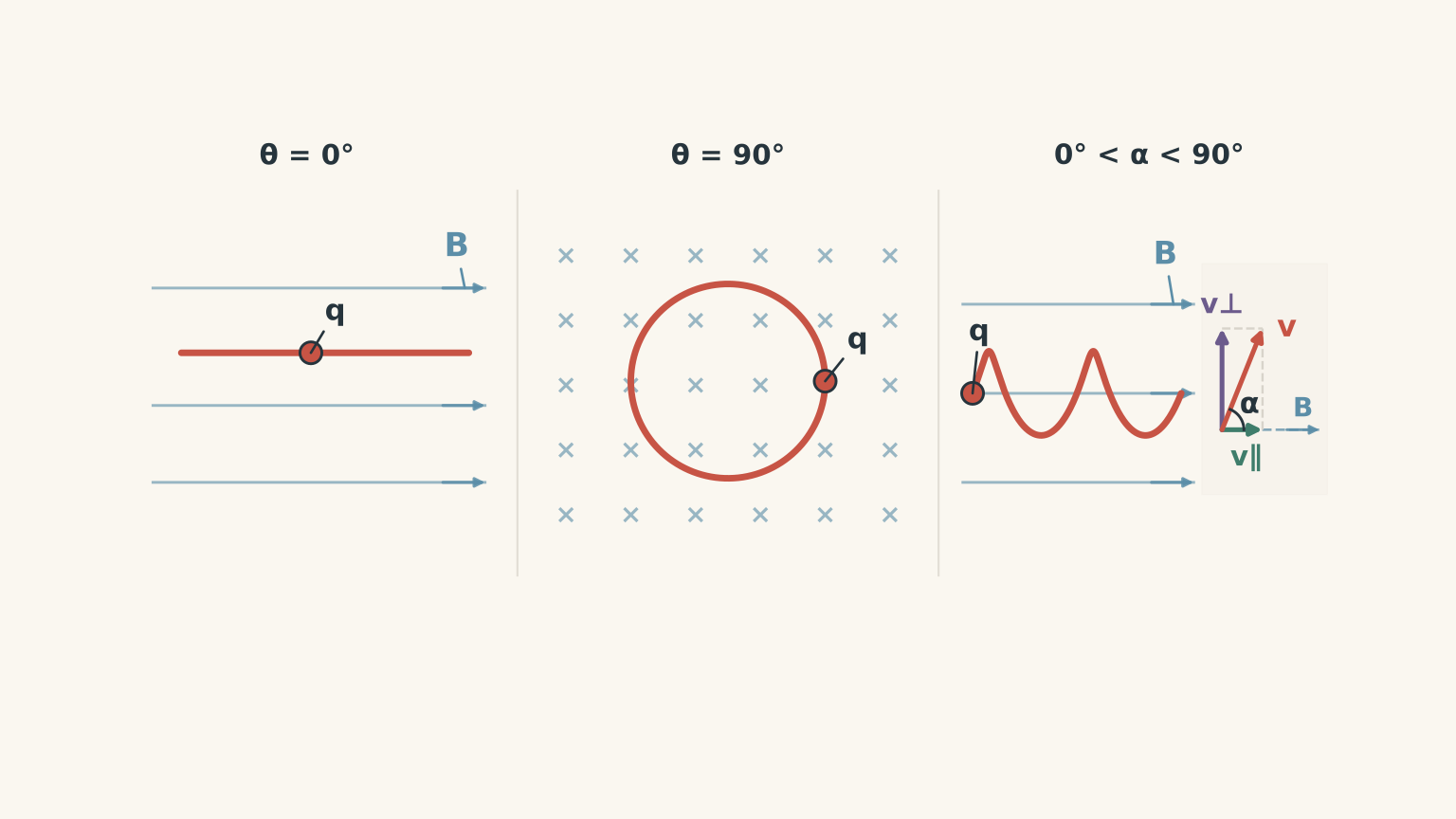
Due to technical limitations, this figure may display incorrectly or contain inaccuracies. Please check key details against your course materials.
The helical path is particularly important.
A particle moving in a helix has two velocity components:
- \(v_\parallel\): velocity parallel to the magnetic field.
- \(v_\perp\): velocity perpendicular to the magnetic field.
The total speed is
\[ v^2=v_\parallel^2+v_\perp^2 \]
The angle between the velocity and the magnetic field is called the pitch angle, represented by \(\alpha\).
For a particle moving towards a particular end of the bottle,
\[ v_\parallel=v\cos\alpha \]
\[ v_\perp=v\sin\alpha \]
A small pitch angle means most of the particle’s velocity is along the magnetic field. A large pitch angle means more of its velocity is perpendicular to the field.
Keep these components in mind. They determine whether a particle escapes or becomes trapped.
02Building a magnetic bottle
Imagine placing two magnetic coils along the same axis, with a space between them.
The coils produce magnetic fields that reinforce each other. The field is relatively weak in the central region but becomes stronger near each coil.
The resulting arrangement has three important features:
- A central region of relatively weak magnetic field.
- A stronger magnetic field towards the left-hand end.
- A stronger magnetic field towards the right-hand end.
The regions of stronger magnetic field act as two magnetic mirrors.
The particle is not bouncing off a physical surface. There is no solid wall at either end.
Instead, the changing magnetic field can reverse the particle’s motion along the field line.
This is a subtle distinction. The magnetic field doesn’t behave like a tennis racquet hitting a ball. The particle’s velocity changes direction because its perpendicular and parallel motion change as it enters the stronger field.
Let’s work out why.
03Why a stronger magnetic field can reflect a particle
First, make a prediction.
A particle moves from a region of weak magnetic field into a region of stronger magnetic field. What happens to its total speed?
You might predict that it slows down because the magnetic force opposes its forward motion.
That prediction is understandable, but it isn’t quite correct.
A magnetic force acts perpendicular to the instantaneous velocity of a charged particle. It therefore does no work on the particle.
In a static magnetic field, with no electric field or other energy-changing interactions, the particle’s total kinetic energy remains constant.
Its speed stays the same.
However, its velocity components can change.
The first adiabatic invariant
When a charged particle spirals around a magnetic field line, it has a small circular motion called its gyromotion.
As the particle moves into a stronger magnetic field, its gyromotion changes.
Under suitable conditions, a quantity called the first adiabatic invariant, or magnetic moment, remains approximately constant.
For a non-relativistic particle, it is written as
\[ \mu=\frac{mv_\perp^2}{2B} \]
where:
- \(\mu\) is the particle’s magnetic moment, in joules per tesla (J T\(^{-1}\)).
- \(m\) is the particle’s mass, in kilograms (kg).
- \(v_\perp\) is its perpendicular velocity component, in metres per second.
- \(B\) is the magnetic field strength, in tesla.
For this approximation to hold, the magnetic field must vary slowly over the particle’s circular orbit. We will return to this restriction later.
If \(\mu\) remains constant, then
\[ \frac{mv_\perp^2}{2B}=\text{constant} \]
Since the mass is unchanged,
\[ \frac{v_\perp^2}{B}=\text{constant} \]
This gives us an important relationship:
\[ v_\perp^2\propto B \]
As the magnetic field becomes stronger, the perpendicular component of the particle’s velocity increases.
But remember that its total speed remains constant.
Since
\[ v^2=v_\parallel^2+v_\perp^2 \]
an increase in \(v_\perp\) must be accompanied by a decrease in \(v_\parallel\).
Eventually, the parallel component can reach zero.
At that instant, the particle has reached its mirror point.
\[ v_\parallel=0 \]
Its entire velocity is now perpendicular to the magnetic field, so its pitch angle is \(90^\circ\).
The particle continues its circular motion, but its parallel motion reverses. It begins travelling back towards the weaker magnetic field.
You can picture this as a cyclist travelling uphill. Their forward motion slows as energy shifts into another form.
The analogy has a limit, though. A particle in a static magnetic field does not gain gravitational potential energy, and the magnetic field does no work. Its total kinetic energy stays constant. The change is between the parallel and perpendicular components of its motion.
The effective mirror force
The averaged effect of this changing magnetic field can be represented by an effective force along the field line:
\[ F_\parallel\approx-\mu\frac{dB}{ds} \]
Here:
- \(F_\parallel\) is the effective force parallel to the magnetic field.
- \(\mu\) is the approximately conserved magnetic moment.
- \(s\) is distance measured along the magnetic field line.
- \(dB/ds\) describes how quickly the magnetic field changes along that line.
The negative sign indicates that the effective force acts against motion towards increasing magnetic field strength.
Importantly, this is a guiding-centre description: it represents the averaged effect of the Lorentz force over the particle’s gyromotion. It does not mean that the magnetic force on an individual charge suddenly has a component parallel to the local magnetic field.
This is the mechanism that makes magnetic mirrors possible.
04The loss cone: why some particles escape
Not every particle entering a magnetic bottle is reflected.
Consider two particles starting at the centre of the same bottle.
- Particle A has a large perpendicular velocity component.
- Particle B has a large parallel velocity component.
Which is more likely to escape?
Particle B.
It has more velocity directed towards the open end of the bottle and less perpendicular motion available to increase as the magnetic field strengthens.
If the field at the end isn’t strong enough, its parallel velocity never reaches zero.
It simply travels out of the bottle.
This creates a range of pitch angles for which particles cannot be confined. That range is called the loss cone.
The loss cone is not a physical hole in the magnetic field. It is a range of particle velocity directions that allows escape.
Deriving the loss-cone angle
We can derive the critical pitch angle using the conservation of the magnetic moment.
Define two magnetic field strengths:
- \(B_0\): the minimum magnetic field strength at the centre of the bottle.
- \(B_m\): the maximum magnetic field strength at the mirror region.
Also define \(\alpha_0\) as the particle’s pitch angle at the central region, measured relative to the direction of travel along the field towards the end being considered.
At the centre,
\[ v_{\perp,0}=v\sin\alpha_0 \]
At the mirror point, the parallel component has fallen to zero.
Therefore,
\[ v_{\perp,m}=v \]
Apply conservation of the magnetic moment:
\[ \frac{m v_{\perp,0}^2}{2B_0} = \frac{m v_{\perp,m}^2}{2B_m} \]
Substitute the velocity components:
\[ \frac{m v^2\sin^2\alpha_0}{2B_0} = \frac{mv^2}{2B_m} \]
Cancel the common terms:
\[ \sin^2\alpha_0=\frac{B_0}{B_m} \]
This gives the critical pitch angle:
\[ \boxed{ \alpha_L= \sin^{-1}\sqrt{\frac{B_0}{B_m}} } \]
The angle \(\alpha_L\) is the half-angle of the loss cone.
It is often useful to introduce another quantity called the mirror ratio:
\[ R_m=\frac{B_m}{B_0} \]
The loss-cone equation becomes
\[ \boxed{ \alpha_L=\sin^{-1}\left(\frac{1}{\sqrt{R_m}}\right) } \]
This is the key relationship for understanding magnetic confinement.
What does the mirror ratio tell us?
The mirror ratio compares the strongest magnetic field at an end with the weakest field at the centre.
A larger mirror ratio produces a smaller loss-cone angle.
That means a greater range of particle pitch angles can be reflected.
The classification is:
| Pitch angle at the centre | Particle behaviour |
|---|---|
| \(\alpha_0<\alpha_L\) | Inside the loss cone; escapes |
| \(\alpha_0=\alpha_L\) | Marginal case; turns at the maximum field |
| \(\alpha_0>\alpha_L\) | Reflected before reaching the maximum field |
For a symmetric magnetic bottle, there are two loss cones in velocity space: one for particles travelling towards each end.
Particles outside both cones can bounce between the two magnetic mirrors.
A useful boundary check is a mirror ratio of 1. In that case, the field has no stronger mirror region, and the loss-cone half-angle is \(90^\circ\). There is no range of pitch angles that can be reflected by the mirror mechanism.
A useful extension: the same effect occurs around Earth
Earth’s magnetic field is stronger towards the polar regions and weaker around the magnetic equator.
Charged particles can bounce between two mirror points in opposite hemispheres. However, particles with sufficiently small equatorial pitch angles can enter the atmosphere instead of reflecting.
This is one way the loss-cone concept is used to understand Earth’s radiation belts.
The same basic physics appears in laboratory magnetic-mirror confinement systems, although real plasma behaviour involves additional effects such as collisions and collective interactions.
05When does the magnetic-mirror model work?
The equations so far are powerful, but they aren’t universally valid.
We have assumed:
- The magnetic field is approximately static.
- There is no significant electric field changing the particle’s energy.
- Collisions and radiation losses are negligible during the motion being considered.
- The particle is non-relativistic.
- The magnetic field varies slowly compared with the particle’s gyromotion.
The last condition deserves attention.
The particle must complete many gyrotations while experiencing only a relatively small change in magnetic field strength.
In other words, its circular orbit must be much smaller than the characteristic distance over which the magnetic field changes.
The radius of its circular motion is called the Larmor radius:
\[ r_L=\frac{mv_\perp}{|q|B} \]
For the magnetic-moment approximation to be reliable, we require
\[ r_L\ll L_B \]
where \(L_B\) is the characteristic length over which the magnetic field changes significantly.
If this condition fails, the simple mirror model may no longer accurately predict the particle’s trajectory.
There is another limitation.
Even if a particle starts outside the loss cone, collisions or interactions with plasma waves can change its pitch angle. It may eventually enter the loss cone and escape.
This means magnetic bottles do not provide perfect confinement.
The loss of particles through the loss cone is one of the important challenges in magnetic-mirror fusion research.
For a deeper treatment of the magnetic-moment approximation and mirror confinement, see the University of Texas at Austin plasma physics notes and Princeton Plasma Physics Laboratory’s magnetic-mirror research report.
06Worked examples
Worked example: calculating the loss-cone angle
A magnetic bottle has a central magnetic field strength of \(0.16\text{ T}\) and a maximum magnetic field strength of \(1.44\text{ T}\).
A charged particle enters the central region with a pitch angle of \(25^\circ\).
Calculate the loss-cone angle and determine whether the particle will be reflected.
Step 1
\[ R_m=\frac{B_m}{B_0} \]
\[ R_m=\frac{1.44}{0.16}=9 \]
Step 2
\[ \alpha_L=\sin^{-1}\left(\frac{1}{\sqrt{R_m}}\right) \]
\[ \alpha_L=\sin^{-1}\left(\frac{1}{3}\right) \]
\[ \alpha_L=19.5^\circ \]
Step 3
The particle has a pitch angle of \(25^\circ\).
Since
\[ 25^\circ>19.5^\circ \]
the particle is outside the loss cone.
It will be reflected.
Step 4
Using conservation of the magnetic moment,
\[ B_{\text{turn}}=\frac{B_0}{\sin^2\alpha_0} \]
Substitute:
\[ B_{\text{turn}}= \frac{0.16}{\sin^2 25^\circ} \]
\[ B_{\text{turn}}\approx0.896\text{ T} \]
The particle turns around when the field reaches approximately \(0.896\text{ T}\).
This is less than the maximum field of \(1.44\text{ T}\), so the particle reflects before reaching the strongest-field region.
Worked example: tracking a particle through the bottle
A charged particle enters a magnetic bottle at its central region.
The following information is known:
- Central magnetic field strength: \(B_0=0.12\text{ T}\).
- Maximum magnetic field strength: \(B_m=0.72\text{ T}\).
- Initial particle speed: \(v=2.4\times10^6\text{ m s}^{-1}\).
- Initial pitch angle: \(\alpha_0=35^\circ\).
At a particular point along the field line, the magnetic field strength is \(0.30\text{ T}\).
Calculate:
a) The mirror ratio and loss-cone angle.
b) The particle’s pitch angle and parallel velocity component at the \(0.30\text{ T}\) position.
c) The magnetic field strength at the mirror point.
Step 1
\[ R_m=\frac{B_m}{B_0} \]
\[ R_m=\frac{0.72}{0.12}=6 \]
Step 2
\[ \alpha_L= \sin^{-1}\left(\frac{1}{\sqrt{6}}\right) \]
\[ \alpha_L\approx24.1^\circ \]
The initial pitch angle is \(35^\circ\), which is greater than \(24.1^\circ\).
The particle is therefore initially outside the loss cone.
Step 3
Conservation of the magnetic moment gives
\[ \frac{v_{\perp,0}^2}{B_0} = \frac{v_\perp^2}{B} \]
Using \(v_{\perp,0}=v\sin\alpha_0\) and \(v_\perp=v\sin\alpha\),
\[ \sin^2\alpha = \frac{B}{B_0}\sin^2\alpha_0 \]
Substitute:
\[ \sin^2\alpha = \frac{0.30}{0.12}\sin^2 35^\circ \]
\[ \sin^2\alpha = 2.5(0.3290) \]
\[ \sin^2\alpha\approx0.8225 \]
Therefore,
\[ \alpha=\sin^{-1}(\sqrt{0.8225}) \]
\[ \boxed{\alpha\approx65.1^\circ} \]
Notice that the pitch angle has increased from \(35^\circ\) to approximately \(65.1^\circ\).
The particle’s motion has become much more perpendicular to the magnetic field.
Step 4
The total speed is unchanged, so
\[ v_\parallel=v\cos\alpha \]
\[ v_\parallel= 2.4\times10^6\cos65.1^\circ \]
\[ \boxed{ v_\parallel\approx1.01\times10^6\text{ m s}^{-1} } \]
The particle is still moving towards the mirror, but its parallel velocity has decreased significantly.
Step 5
At the mirror point, the pitch angle reaches \(90^\circ\).
Therefore,
\[ B_{\text{turn}}= \frac{B_0}{\sin^2\alpha_0} \]
\[ B_{\text{turn}}= \frac{0.12}{\sin^2 35^\circ} \]
\[ \boxed{ B_{\text{turn}}\approx0.365\text{ T} } \]
The maximum field strength is \(0.72\text{ T}\), which is greater than the required turning-point field.
The particle therefore reflects before reaching the end of the bottle.
The important result is that its total speed remains \(2.4\times10^6\text{ m s}^{-1}\) throughout this idealised motion, even though its parallel and perpendicular velocity components change.
07Questions and solutions
The following questions move beyond simply substituting values into the loss-cone equation. Pay attention to what is happening to the particle, where its pitch angle is measured, and which assumptions are being used.
Question 1
A charged particle enters the central region of a symmetric magnetic bottle.
The magnetic field strength at the centre is \(0.080\text{ T}\), while the maximum magnetic field strength at either end is \(0.320\text{ T}\).
The particle travels towards the right-hand mirror with a pitch angle of \(40^\circ\).
Calculate the loss-cone angle and determine whether the particle will escape or be reflected.
Solution 1
The particle will be reflected, and the loss-cone angle is \(30^\circ\).
Step 1: Calculate the mirror ratio.
\[ R_m=\frac{B_m}{B_0} \]
\[ R_m=\frac{0.320}{0.080}=4 \]
Step 2: Calculate the loss-cone angle.
\[ \alpha_L= \sin^{-1}\left(\frac{1}{\sqrt{4}}\right) \]
\[ \alpha_L=\sin^{-1}(0.5) \]
\[ \boxed{\alpha_L=30^\circ} \]
Step 3: Compare the pitch angles.
The particle has an initial pitch angle of \(40^\circ\).
Since
\[ 40^\circ>30^\circ \]
the particle is outside the loss cone.
It will be reflected.
We can confirm this by calculating the turning-point field:
\[ B_{\text{turn}}= \frac{0.080}{\sin^2 40^\circ} \]
\[ B_{\text{turn}}\approx0.194\text{ T} \]
This is below the maximum field strength of \(0.320\text{ T}\).
The particle therefore reaches its mirror point before reaching the end of the bottle.
Question 2
A particle enters a magnetic bottle at its central region, where the magnetic field strength is \(0.12\text{ T}\).
The maximum field strength at the right-hand mirror is \(0.60\text{ T}\).
The particle has an initial pitch angle of \(25^\circ\) and a constant speed of \(3.0\times10^6\text{ m s}^{-1}\).
As it moves towards the right-hand mirror, it reaches a position where the magnetic field strength is \(0.48\text{ T}\).
Calculate:
a) The particle’s pitch angle at the \(0.48\text{ T}\) position.
b) Its parallel velocity component at this position.
c) Whether the particle will reflect before reaching the maximum field.
Explain why an increase in pitch angle does not necessarily mean the particle will be trapped.
Solution 2
The particle escapes. Its pitch angle increases to approximately \(57.7^\circ\), but it never reaches \(90^\circ\) before reaching the end of the bottle.
Step 1: Use conservation of the magnetic moment.
At the central region,
\[ \frac{v_{\perp,0}^2}{B_0} = \frac{v_\perp^2}{B} \]
Therefore,
\[ \sin^2\alpha = \frac{B}{B_0}\sin^2\alpha_0 \]
Substitute:
\[ \sin^2\alpha = \frac{0.48}{0.12}\sin^2 25^\circ \]
\[ \sin^2\alpha = 4(0.1786) \]
\[ \sin^2\alpha\approx0.7144 \]
Hence,
\[ \alpha=\sin^{-1}(\sqrt{0.7144}) \]
\[ \boxed{\alpha\approx57.7^\circ} \]
Step 2: Calculate the parallel velocity.
\[ v_\parallel=v\cos\alpha \]
\[ v_\parallel= 3.0\times10^6\cos57.7^\circ \]
\[ \boxed{ v_\parallel\approx1.60\times10^6 \text{ m s}^{-1} } \]
The particle still has a substantial velocity component towards the mirror.
Step 3: Determine whether it reaches a mirror point.
Calculate the required magnetic field strength for reflection:
\[ B_{\text{turn}}= \frac{B_0}{\sin^2\alpha_0} \]
\[ B_{\text{turn}}= \frac{0.12}{\sin^2 25^\circ} \]
\[ \boxed{ B_{\text{turn}}\approx0.672\text{ T} } \]
However, the maximum field at the mirror is only \(0.60\text{ T}\).
Therefore,
\[ B_{\text{turn}}>B_m \]
The particle cannot reach the field strength required for reflection.
It escapes.
Why is the increasing pitch angle misleading?
It is tempting to assume that a particle with a pitch angle approaching \(90^\circ\) must be trapped.
However, the pitch angle alone does not tell us whether the particle will reflect. We must also consider the maximum magnetic field available.
Here, the particle’s pitch angle increases substantially, but its parallel velocity never reaches zero.
It remains inside the loss cone and escapes.
Question 3
A student makes the following statement:
“The magnetic field gets stronger near the end of a magnetic bottle, so the magnetic force increases and does work on the particle. This makes the particle speed up perpendicular to the field. When it reaches the mirror point, the particle stops completely before travelling backwards.”
Identify the two major errors in this explanation.
Then explain what actually happens to the particle’s velocity and kinetic energy as it approaches a magnetic mirror.
Assume the magnetic field is static and collisions are negligible.
Solution 3
The two errors are that the magnetic field does no work on the particle, and the particle does not stop completely at the mirror point.
Step 1: Explain what happens to the total kinetic energy.
The magnetic force is always perpendicular to the instantaneous velocity of a charged particle.
Consequently, it cannot change the particle’s total speed.
Since
\[ E_k=\frac12mv^2 \]
and the speed remains constant, the total kinetic energy also remains constant.
The student is incorrect to suggest that the particle speeds up because the magnetic field does work.
Step 2: Explain what happens to the velocity components.
As the particle moves towards stronger magnetic fields, conservation of the first adiabatic invariant gives
\[ \frac{v_\perp^2}{B}=\text{constant} \]
Therefore, as \(B\) increases, \(v_\perp\) increases.
Since the total speed remains constant,
\[ v^2=v_\parallel^2+v_\perp^2 \]
the parallel component must decrease.
The particle’s motion becomes increasingly perpendicular to the magnetic field.
Step 3: Explain what happens at the mirror point.
At the mirror point,
\[ v_\parallel=0 \]
and
\[ v_\perp=v \]
The particle has not stopped completely.
It continues its circular gyromotion around the magnetic field line. Its parallel motion then reverses, causing it to travel back towards the weaker magnetic field.
The distinction is that the particle stops moving along the field momentarily, not that its entire velocity becomes zero.
Question 4
A symmetric magnetic bottle has a central magnetic field strength of \(0.20\text{ T}\) and a maximum field strength of \(0.80\text{ T}\).
An electron and a proton each enter the bottle with:
- Speed \(v=1.0\times10^6\text{ m s}^{-1}\).
- Pitch angle \(\alpha_0=45^\circ\).
The characteristic magnetic-field variation length near the mirrors is \(L_B=0.020\text{ m}\).
Use the following particle properties:
| Property | Electron | Proton |
|---|---|---|
| Mass | \(9.11\times10^{-31}\text{ kg}\) | \(1.67\times10^{-27}\text{ kg}\) |
| Charge magnitude | \(1.60\times10^{-19}\text{ C}\) | \(1.60\times10^{-19}\text{ C}\) |
a) Using the ideal magnetic-mirror model, determine whether each particle should be trapped.
b) Calculate the Larmor radius of each particle at the central region.
c) Explain whether the ideal mirror prediction is equally reliable for both particles.
Solution 4
The ideal magnetic-mirror model predicts that both particles are trapped. However, the adiabatic approximation is reliable for the electron but not for the proton under the supplied conditions.
Step 1: Calculate the ideal loss-cone angle.
The mirror ratio is
\[ R_m=\frac{0.80}{0.20}=4 \]
Therefore,
\[ \alpha_L= \sin^{-1}\left(\frac{1}{\sqrt4}\right) \]
\[ \alpha_L=30^\circ \]
Both particles have pitch angles of \(45^\circ\).
Since
\[ 45^\circ>30^\circ \]
the ideal mirror model predicts that both particles will be reflected.
Notice that mass and charge do not appear in the loss-cone equation. In the ideal approximation, particles with the same pitch angle experience the same mirror-trapping criterion.
Step 2: Calculate the perpendicular velocity.
For both particles,
\[ v_\perp=v\sin45^\circ \]
\[ v_\perp= 1.0\times10^6(0.7071) \]
\[ v_\perp=7.071\times10^5 \text{ m s}^{-1} \]
Step 3: Calculate the electron’s Larmor radius.
The Larmor radius is
\[ r_L=\frac{mv_\perp}{|q|B} \]
Substitute the electron properties:
\[ r_{L,e}= \frac{ (9.11\times10^{-31})(7.071\times10^5) }{ (1.60\times10^{-19})(0.20) } \]
\[ \boxed{ r_{L,e}\approx2.01\times10^{-5}\text{ m} } \]
This is approximately \(20\) micrometres.
Step 4: Calculate the proton’s Larmor radius.
\[ r_{L,p}= \frac{ (1.67\times10^{-27})(7.071\times10^5) }{ (1.60\times10^{-19})(0.20) } \]
\[ \boxed{ r_{L,p}\approx0.0369\text{ m} } \]
This is approximately \(3.69\text{ cm}\).
Step 5: Compare both radii with the magnetic-field variation length.
The required adiabatic condition is
\[ r_L\ll L_B \]
For the electron:
\[ 2.01\times10^{-5}\ll0.020 \]
The electron’s Larmor radius is much smaller than the characteristic field-variation length.
The adiabatic approximation is therefore reasonable.
For the proton:
\[ 0.0369>0.020 \]
The proton’s Larmor radius is actually larger than the characteristic field-variation length.
The magnetic field changes significantly over the scale of its circular motion, so the assumption that its magnetic moment remains constant is not justified.
The ideal mirror equation predicts trapping, but we cannot confidently apply that prediction to the proton in this particular field configuration.
The important distinction: the mirror ratio determines the ideal trapping condition, but the validity of that condition depends on the particle’s motion relative to the magnetic-field geometry.
Two particles can have identical ideal loss-cone classifications without the approximation being equally reliable for both.
Question 5
A particle is initially trapped inside a symmetric magnetic bottle.
The central magnetic field strength is \(0.10\text{ T}\), and the maximum magnetic field strength at both ends is \(0.40\text{ T}\).
The particle starts at the central region with a pitch angle of \(35^\circ\), travelling towards the right-hand mirror.
As it moves towards the right-hand mirror, it reaches a location where the magnetic field strength is \(0.20\text{ T}\).
At this location, an idealised elastic scattering event changes its pitch angle to \(40^\circ\), without changing its total speed. The particle continues travelling towards the right-hand mirror.
Assume:
- The magnetic field is static.
- The particle follows the adiabatic approximation between scattering events.
- The scattering event changes the particle’s direction but not its speed.
- No further scattering occurs.
Determine whether the particle remains trapped or escapes.
Your explanation must consider:
a) Whether the particle was initially trapped.
b) Its pitch angle immediately before the scattering event.
c) The loss-cone angle at the location of the scattering event.
d) Whether it can reach a mirror point after the scattering event.
Solution 5
The particle escapes through the right-hand end after the scattering event, even though it was initially outside the loss cone.
The crucial point is that the loss-cone angle depends on the magnetic field strength at the particle’s current location, not just the field strength at the centre of the bottle.
Step 1: Determine whether the particle was initially trapped.
At the central region,
\[ B_0=0.10\text{ T} \]
The maximum field is
\[ B_m=0.40\text{ T} \]
Therefore, the mirror ratio is
\[ R_m=\frac{0.40}{0.10}=4 \]
The central loss-cone angle is
\[ \alpha_L= \sin^{-1}\left(\frac{1}{\sqrt4}\right) \]
\[ \alpha_L=30^\circ \]
The initial pitch angle is \(35^\circ\).
Since
\[ 35^\circ>30^\circ \]
the particle is initially trapped.
Without any scattering, it would reflect before reaching the end.
Step 2: Calculate the pitch angle immediately before scattering.
The particle has moved from a magnetic field of \(0.10\text{ T}\) to \(0.20\text{ T}\).
Conservation of the magnetic moment gives
\[ \sin^2\alpha= \frac{B}{B_0}\sin^2\alpha_0 \]
Substitute:
\[ \sin^2\alpha= \frac{0.20}{0.10}\sin^2 35^\circ \]
\[ \sin^2\alpha= 2(0.3290) \]
\[ \sin^2\alpha=0.6580 \]
Therefore,
\[ \alpha= \sin^{-1}(\sqrt{0.6580}) \]
\[ \boxed{\alpha\approx54.2^\circ} \]
Immediately before scattering, the particle’s pitch angle is approximately \(54.2^\circ\).
Step 3: Calculate the local loss-cone angle after scattering.
This is where the important change occurs.
The particle is now at a position where the magnetic field is \(0.20\text{ T}\).
The maximum remaining field towards the right-hand mirror is \(0.40\text{ T}\).
The local loss-cone angle is therefore
\[ \alpha_{L,\text{local}}= \sin^{-1}\sqrt{\frac{B_{\text{local}}}{B_m}} \]
Substitute:
\[ \alpha_{L,\text{local}}= \sin^{-1}\sqrt{\frac{0.20}{0.40}} \]
\[ \alpha_{L,\text{local}}= \sin^{-1}(\sqrt{0.5}) \]
\[ \boxed{ \alpha_{L,\text{local}}=45^\circ } \]
The scattering event changes the particle’s pitch angle to \(40^\circ\).
Therefore,
\[ 40^\circ<45^\circ \]
The particle is now inside the local loss cone.
Step 4: Confirm whether it reaches a mirror point.
Use the field strength at the scattering position as the new starting field.
The required field strength for reflection is
\[ B_{\text{turn}}= \frac{B_{\text{local}}}{\sin^2\alpha_{\text{local}}} \]
Substitute:
\[ B_{\text{turn}}= \frac{0.20}{\sin^2 40^\circ} \]
\[ \boxed{ B_{\text{turn}}\approx0.484\text{ T} } \]
However, the maximum field available at the right-hand mirror is only \(0.40\text{ T}\).
Therefore,
\[ B_{\text{turn}}>B_m \]
The particle cannot reach the required field strength.
It escapes through the right-hand end.
Why is this result surprising?
A student might compare the new pitch angle of \(40^\circ\) with the original central loss-cone angle of \(30^\circ\).
Since \(40^\circ>30^\circ\), they might conclude that the particle is still trapped.
That comparison is incorrect.
The \(30^\circ\) boundary applies at the central field strength of \(0.10\text{ T}\). At the scattering position, the magnetic field has already doubled to \(0.20\text{ T}\).
The remaining mirror ratio is now only
\[ R_{\text{local}}=\frac{0.40}{0.20}=2 \]
This produces a local loss-cone angle of \(45^\circ\), not \(30^\circ\).
The scattering event has moved the particle into this wider loss cone.
This demonstrates an important feature of magnetic confinement: being initially trapped does not guarantee permanent confinement. Interactions that change a particle’s pitch angle can move it into an escape region.
07Where this leads next
A magnetic bottle provides a way to confine charged particles without using physical walls. Its effectiveness depends on the magnetic-field geometry and the pitch angles of the particles inside it.
The central relationships are:
\[ \mu=\frac{mv_\perp^2}{2B} \]
\[ R_m=\frac{B_m}{B_0} \]
\[ \alpha_L= \sin^{-1}\left(\frac{1}{\sqrt{R_m}}\right) \]
Together, these explain how a particle can reverse its motion along a magnetic field line and why some particles escape.
But the ideal model leaves another important question: if collisions and plasma waves can change pitch angles, how quickly do particles move into the loss cone?
That question leads to pitch-angle scattering and plasma confinement stability. It is the next step in understanding why real magnetic-mirror systems are considerably more complicated than the simple bouncing-particle model.
For further reading:
- University of Texas at Austin – Magnetic Mirrors: an explanation of mirror points, the loss cone, and particle confinement.
- MIT OpenCourseWare – Effects of an Inhomogeneous Magnetic Field and Magnetic Mirrors: university lecture material developing the physics of non-uniform magnetic fields.
- Princeton Plasma Physics Laboratory – Analytic Approximations of the Steady State Particle Distribution Function in Rotating Magnetic Mirrors: further research into loss-cone behaviour and magnetic-mirror confinement.