
The Photoelectric Quantum Yield: How Photons Produce Electrons
Learn how photoelectric quantum yield measures the number of electrons emitted per incident photon. Explore how photon frequency, light intensity, and material properties affect electron emission, maximum kinetic energy, and photocurrent through worked examples and challenging HSC extension questions.
Turn up the brightness of a lamp shining on a metal surface. More electrons are emitted each second. But have the electrons become more energetic?
Not necessarily. If the frequency of the light stays constant, the maximum kinetic energy of the emitted electrons stays constant too. The brighter beam simply delivers more photons, creating more opportunities for electrons to escape.
This gives us two separate questions about the photoelectric effect:
- How much kinetic energy can the fastest emitted electron have?
- How many electrons are emitted for a given number of incident photons?
The first is answered by Einstein’s photoelectric equation. The second is described by the photoelectric quantum yield.
This article develops the second idea as an extension of the Year 12 Physics Nature of light content. The 2025 NSW Physics 11-12 syllabus provides the prerequisite knowledge of photon energy, frequency, intensity, photon number, and the photoelectric effect. Quantum yield is an additional concept, not a required syllabus assessment outcome. NESA schedules implementation of the 2025 syllabus from 2027.
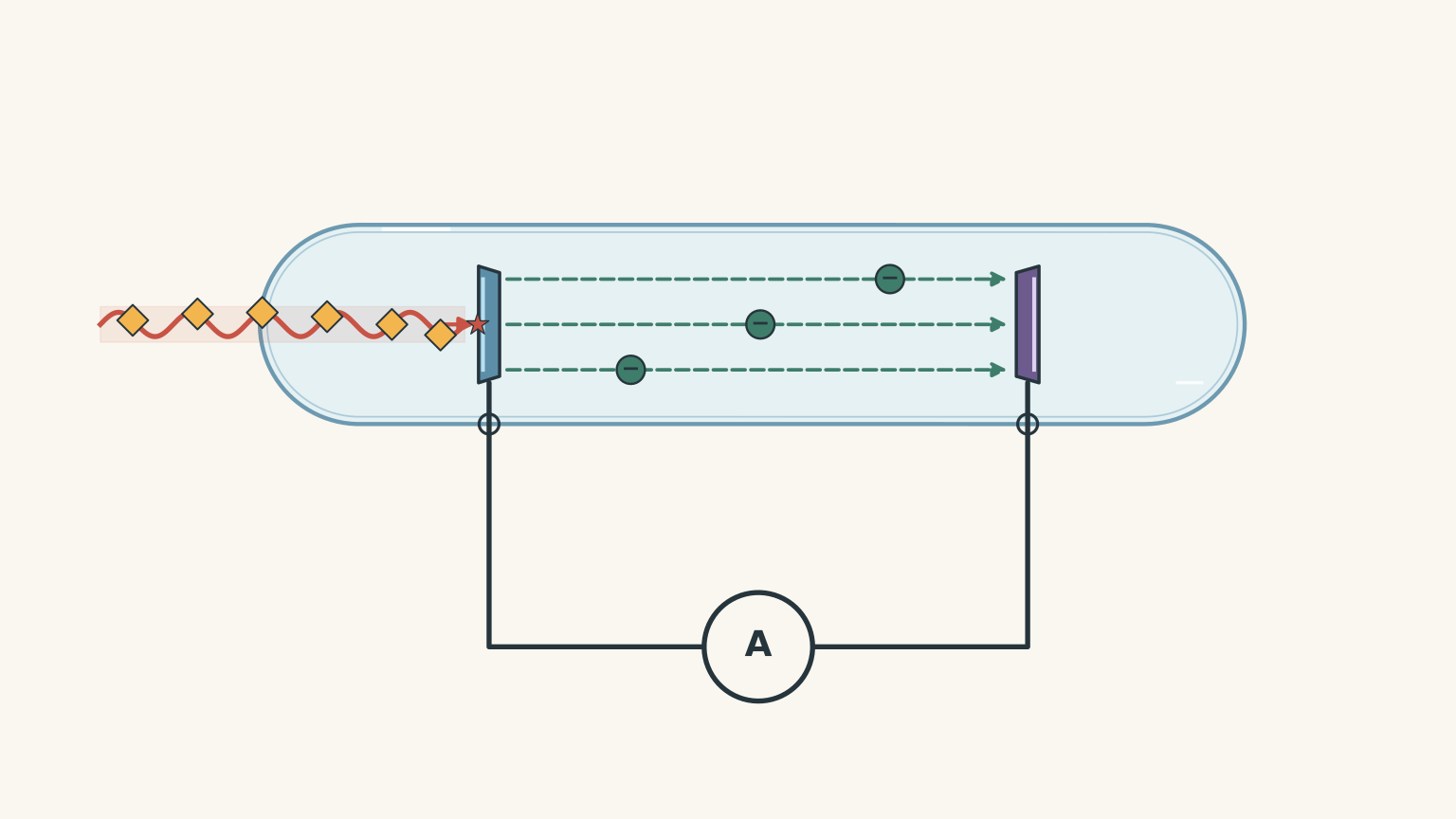
Due to technical limitations, this figure may display incorrectly or contain inaccuracies. Please check key details against your course materials.
01Start with the energy of an individual photon
Imagine a photon arriving at a metal surface. It transfers its energy to an electron within the metal.
However, the electron cannot simply leave with all that energy. It first needs enough energy to escape the metal.
The minimum energy required to remove an electron from a material’s surface is called the work function, represented by \(\phi\).
Think of the work function as an entry fee. A photon must supply enough energy to pay that fee before the electron can escape. Any remaining energy can become the electron’s kinetic energy.
The energy of an individual photon is:
\[ E_\gamma=hf \]
where:
- \(E_\gamma\) is photon energy, measured in joules (J).
- \(h\) is Planck’s constant, \(6.626\times10^{-34}\ \text{J s}\).
- \(f\) is the frequency of the light, measured in hertz (Hz).
Because the speed of light is \(c=f\lambda\), we can also write:
\[ E_\gamma=\frac{hc}{\lambda} \]
Here, \(c=3.00\times10^8\ \text{m s}^{-1}\) is the speed of light in a vacuum, and \(\lambda\) is wavelength in metres.
The maximum kinetic energy
Einstein’s photoelectric equation describes the maximum kinetic energy of an emitted electron:
\[ \boxed{K_{\max}=hf-\phi} \]
The maximum kinetic energy, \(K_{\max}\), is what remains after the electron has overcome the work function.
This equation applies when the photon has enough energy to cause photoemission.
If \(hf<\phi\), the photon cannot eject an electron in the ordinary single-photon photoelectric effect.
The minimum frequency needed for emission is called the threshold frequency:
\[ f_0=\frac{\phi}{h} \]
At exactly the threshold frequency, the maximum kinetic energy is zero.
Notice the word maximum in the equation.
Not every emitted electron has the same kinetic energy. Electrons within a metal occupy different energy states, and some lose energy through interactions before escaping. The equation describes the upper limit for the emitted electrons under the ideal metal model.
It does not tell us how many electrons escape.
That is a different problem.
02What is photoelectric quantum yield?
Suppose 100 photons strike a photocathode. If 12 electrons are emitted, the material has produced 12 electrons from those 100 incident photons.
Its external photoelectric quantum yield is:
\[ \boxed{Y_{\mathrm{ext}}=\frac{N_e}{N_\gamma}} \]
where:
- \(Y_{\mathrm{ext}}\) is the external photoelectric quantum yield.
- \(N_e\) is the number of photoelectrons emitted from the material.
- \(N_\gamma\) is the number of photons incident on the material.
Both quantities refer to the same observation period.
In photocathode physics, this ratio is also commonly called the external quantum efficiency (QE).
A yield of 0.12 means that, on average, 12 electrons are emitted for every 100 photons incident on the surface.
It does not mean that each electron receives 12% of a photon’s energy.
Why doesn’t every photon produce an electron?
You might predict that if a photon has more energy than the work function, it must eject an electron.
That sounds reasonable. The photon has enough energy, so why wouldn’t the electron escape?
The problem is that supplying enough energy is only one part of the process.
Consider what happens inside a real photocathode:
- A photon reaches the surface.
- Some photons are reflected rather than absorbed.
- An absorbed photon can excite an electron within the material.
- The excited electron must travel towards the surface without losing too much energy.
- It must then have enough energy to escape through the surface barrier.
A photon can therefore have sufficient energy for photoemission without actually producing an emitted electron.
The probability of successful emission depends on several factors:
- The fraction of photons absorbed rather than reflected.
- The probability that an absorbed photon excites an electron with sufficient energy.
- The probability that the electron reaches the surface without losing too much energy.
- The probability that the electron escapes through the surface barrier.
These factors depend on the material and the wavelength of the incident light.
The National Institute of Standards and Technology discusses this probabilistic description in its treatment of photocathodes and photomultiplier tubes.
An important terminology distinction is worth knowing. Some sources use internal quantum yield for the number of emitted electrons per absorbed photon. External quantum yield uses the number of incident photons.
If \(a\) is the fraction of incident photons absorbed, then:
\[ Y_{\mathrm{ext}}=aY_{\mathrm{int}} \]
For this article, quantum yield always means the external quantity unless stated otherwise.
Quantum yield and maximum kinetic energy are different measurements
This is the central distinction.
Einstein’s equation tells us the maximum energy available to an emitted electron. Quantum yield tells us how many electrons are emitted relative to the number of incident photons.
| Physical quantity | What determines it? | What does it describe? |
|---|---|---|
| Maximum kinetic energy | Photon frequency and work function | Energy of the fastest emitted electron |
| Quantum yield | Material properties, wavelength, absorption, and electron escape | Number of emitted electrons per incident photon |
| Photocurrent | Electron emission rate and collection | Electrical current produced by collected electrons |
A material can have a high quantum yield but relatively low maximum electron kinetic energy.
It can also have a low quantum yield while producing a small number of very energetic electrons.
There is no contradiction. These measurements describe different aspects of the same interaction.
03How does light intensity affect quantum yield?
We now need to connect the number of photons arriving at a surface to the number of electrons leaving it.
Remember that intensity is the power of electromagnetic radiation arriving per unit area.
\[ I=\frac{P}{A} \]
where:
- \(I\) is light intensity, measured in watts per square metre (\(\text{W m}^{-2}\)).
- \(P\) is incident optical power, measured in watts (W).
- \(A\) is the illuminated area, measured in square metres (\(\text{m}^2\)).
A brighter beam delivers more energy per second to each square metre.
But if its frequency stays constant, the energy of each individual photon does not change.
Instead, more photons arrive each second.
Calculating the photon arrival rate
Each photon carries energy \(hf\).
Therefore, dividing the total incident power by the energy of one photon gives the number of photons arriving per second:
\[ \boxed{\dot N_\gamma=\frac{P}{hf}} \]
The dot above \(N\) indicates a rate, measured in photons per second.
Since \(P=IA\):
\[ \boxed{\dot N_\gamma=\frac{IA}{hf}} \]
We can now combine this with the quantum yield equation.
The electron emission rate is:
\[ \dot N_e=Y_{\mathrm{ext}}\dot N_\gamma \]
Substituting the photon arrival rate:
\[ \boxed{\dot N_e=\frac{Y_{\mathrm{ext}}IA}{hf}} \]
This equation connects light intensity directly to the number of emitted electrons.
What happens when intensity doubles?
Assume the frequency, material, surface condition, and quantum yield remain constant.
If the intensity doubles:
- The energy of each photon stays the same.
- The number of incident photons per second doubles.
- The number of emitted electrons per second doubles.
- The maximum kinetic energy of the electrons stays the same.
This is the prediction of the simple one-photon photoelectric model.
A comparison of the different variables
| Change made | Photon energy | Photon arrival rate at fixed area | Maximum kinetic energy |
|---|---|---|---|
| Double intensity, fixed frequency | Unchanged | Doubles | Unchanged |
| Double frequency, fixed power | Doubles | Halves | Increases, if emission occurs |
| Increase frequency, fixed intensity | Increases | Unchanged | Increases, if emission occurs |
| Improve quantum yield without changing work function | Unchanged | Unchanged | Unchanged |
The final row is particularly important.
If a surface treatment improves the probability that an excited electron escapes, more electrons may be emitted without changing the maximum kinetic energy.
In reality, a surface treatment can also change the work function. If it does, the maximum kinetic energy may change as well. The table assumes the work function remains constant.
Connecting quantum yield to photocurrent
The photoelectric effect can produce an electrical current because electrons are moving through an external circuit.
The magnitude of the charge of one electron is:
\[ e=1.602\times10^{-19}\ \text{C} \]
If all emitted electrons are collected, the photocurrent is:
\[ i_{\mathrm{ph}}=e\dot N_e \]
Substituting our earlier expression:
\[ \boxed{i_{\mathrm{ph}}= \frac{eY_{\mathrm{ext}}IA}{hf}} \]
This equation makes the relationship particularly clear.
At fixed frequency, area, and quantum yield, photocurrent is directly proportional to intensity.
If intensity doubles, photocurrent doubles.
However, the maximum kinetic energy does not.
For another application of the photon model, see tutorgum’s Compton Scattering: Photon Momentum and Wavelength Shifts. It explores how photons transfer momentum as well as energy.
04Worked examples
Worked example: Calculating the number of emitted electrons
A metal photocathode has a work function of 2.20 eV. It is illuminated with monochromatic light of wavelength 400 nm.
The light has an intensity of \(15\ \text{W m}^{-2}\), and the illuminated area is \(2.0\ \text{cm}^2\).
The measured external quantum yield is 0.12.
Calculate:
(a) The energy of each photon.
(b) The maximum kinetic energy of an emitted electron.
(c) The number of incident photons per second.
(d) The number of emitted electrons per second.
(e) The photocurrent, assuming all emitted electrons are collected.
Step 1
We know the intensity and illuminated area.
First, convert the area:
\[ A=2.0\times10^{-4}\ \text{m}^2 \]
Using \(P=IA\):
\[ P=15\times2.0\times10^{-4} \]
\[ P=3.0\times10^{-3}\ \text{W} \]
Step 2
Use:
\[ E_\gamma=\frac{hc}{\lambda} \]
A convenient conversion is:
\[ hc\approx1240\ \text{eV nm} \]
Therefore:
\[ E_\gamma=\frac{1240}{400} \]
\[ \boxed{E_\gamma=3.10\ \text{eV}} \]
Step 3
Apply Einstein’s photoelectric equation:
\[ K_{\max}=hf-\phi \]
Using the photon energy already calculated:
\[ K_{\max}=3.10-2.20 \]
\[ \boxed{K_{\max}=0.90\ \text{eV}} \]
In joules:
\[ K_{\max}=0.90\times1.602\times10^{-19} \]
\[ K_{\max}=1.44\times10^{-19}\ \text{J} \]
The fastest emitted electrons have a maximum kinetic energy of 0.90 eV.
Step 4
We know the total power and the energy of one photon.
Convert the photon energy into joules:
\[ E_\gamma=3.10\times1.602\times10^{-19} \]
\[ E_\gamma=4.97\times10^{-19}\ \text{J} \]
Now divide the total power by the energy per photon:
\[ \dot N_\gamma=\frac{P}{E_\gamma} \]
\[ =\frac{3.0\times10^{-3}}{4.97\times10^{-19}} \]
\[ \boxed{\dot N_\gamma=6.04\times10^{15}\ \text{photons s}^{-1}} \]
Step 5
The quantum yield is 0.12.
Therefore:
\[ \dot N_e=Y_{\mathrm{ext}}\dot N_\gamma \]
\[ =0.12\times6.04\times10^{15} \]
\[ \boxed{\dot N_e=7.25\times10^{14}\ \text{electrons s}^{-1}} \]
Step 6
Use:
\[ i_{\mathrm{ph}}=e\dot N_e \]
Substitute:
\[ i_{\mathrm{ph}}= 1.602\times10^{-19} \times7.25\times10^{14} \]
\[ \boxed{i_{\mathrm{ph}}=1.16\times10^{-4}\ \text{A}} \]
Or:
\[ \boxed{i_{\mathrm{ph}}=116\ \mu\text{A}} \]
The photocathode emits approximately \(7.25\times10^{14}\) electrons each second, producing a photocurrent of 116 μA if every emitted electron is collected.
Notice that the yield determines the electron count, while the photon frequency and work function determine the maximum kinetic energy.
Worked example: Finding quantum yield from a measured photocurrent
A photocathode is illuminated with monochromatic light of wavelength 300 nm.
The incident optical power is 0.80 mW, and the measured photocurrent is 0.20 μA.
The work function of the photocathode is 2.50 eV.
Assume there is no background current and all emitted photoelectrons are collected.
Calculate:
(a) The incident photon rate.
(b) The emitted electron rate.
(c) The external quantum yield.
(d) The maximum kinetic energy of the emitted electrons.
Step 1
Use:
\[ E_\gamma=\frac{hc}{\lambda} \]
Substitute:
\[ E_\gamma=\frac{1240}{300} \]
\[ \boxed{E_\gamma=4.13\ \text{eV}} \]
Convert to joules:
\[ E_\gamma=4.13\times1.602\times10^{-19} \]
\[ E_\gamma=6.62\times10^{-19}\ \text{J} \]
Step 2
Convert the optical power:
\[ P=0.80\ \text{mW}=8.0\times10^{-4}\ \text{W} \]
Use:
\[ \dot N_\gamma=\frac{P}{E_\gamma} \]
\[ =\frac{8.0\times10^{-4}} {6.62\times10^{-19}} \]
\[ \boxed{\dot N_\gamma=1.21\times10^{15}\ \text{photons s}^{-1}} \]
Step 3
The photocurrent represents charge flowing per second.
Since each electron carries a charge of magnitude \(e\):
\[ \dot N_e=\frac{i_{\mathrm{ph}}}{e} \]
Convert the current:
\[ i_{\mathrm{ph}}=0.20\ \mu\text{A} =2.0\times10^{-7}\ \text{A} \]
Substitute:
\[ \dot N_e= \frac{2.0\times10^{-7}} {1.602\times10^{-19}} \]
\[ \boxed{\dot N_e=1.25\times10^{12}\ \text{electrons s}^{-1}} \]
Step 4
Use the ratio:
\[ Y_{\mathrm{ext}}=\frac{\dot N_e}{\dot N_\gamma} \]
\[ =\frac{1.25\times10^{12}} {1.21\times10^{15}} \]
\[ \boxed{Y_{\mathrm{ext}}=1.03\times10^{-3}} \]
As a percentage:
\[ \boxed{Y_{\mathrm{ext}}=0.103\%} \]
This means approximately one electron is emitted for every 970 incident photons.
Step 5
Return to Einstein’s equation:
\[ K_{\max}=E_\gamma-\phi \]
\[ =4.13-2.50 \]
\[ \boxed{K_{\max}=1.63\ \text{eV}} \]
The photocathode has a relatively low external quantum yield of 0.103%, but the fastest emitted electrons still have 1.63 eV of kinetic energy.
This is exactly why the two quantities must be treated separately.
05Important limitations and common misconceptions
Before applying these equations to more complicated situations, keep four points in mind.
A higher intensity does not mean more energetic electrons
For a fixed frequency, increasing intensity increases the number of photons arriving each second.
It does not increase the energy of an individual photon.
Therefore, in the ordinary single-photon model, the maximum kinetic energy remains unchanged.
A photon above threshold does not guarantee emission
The condition \(hf\geq\phi\) is necessary for photoemission in the simple model.
It does not guarantee that every incident photon produces an escaping electron.
Absorption, electron transport, and escape all affect the yield.
Quantum yield is not always constant
The equations above assume a low-intensity, linear photoemission regime.
In this regime, doubling the incident photon rate doubles the emitted electron rate if the yield remains constant.
At sufficiently high intensities, effects such as space-charge limitations, saturation, heating, and multiphoton processes can change the relationship.
The surface condition also matters. Contamination or changes in the material can affect its work function and emission probability.
Do not confuse photocathode yield with electron multiplication
Some light detectors, such as photomultiplier tubes, use additional stages to amplify the signal.
An incident photon can produce a photoelectron at the photocathode. That electron is then accelerated towards a secondary-emission electrode, where it can release several additional electrons.
The process can repeat through multiple stages.
The resulting signal may contain millions of electrons, but that does not mean millions of electrons were emitted directly by the photocathode for each incident photon.
The initial photocathode quantum yield and the later electron multiplication are different quantities.
06Questions and solutions
The following questions progress from standard HSC-style calculations to more demanding situations involving different wavelengths, mixed light, and competing contributions to photocurrent.
Assume the ordinary single-photon model unless a question states otherwise.
Question 1
A metal photocathode has a work function of 2.10 eV. It is illuminated with monochromatic light of wavelength 400 nm.
During one second, \(3.0\times10^{14}\) photons reach the photocathode. The external quantum yield is 0.060.
Calculate:
(a) The maximum kinetic energy of the emitted electrons.
(b) The number of electrons emitted per second.
(c) The photocurrent, assuming all emitted electrons are collected.
Solution 1
The maximum kinetic energy is 1.00 eV, and the emission rate is \(1.8\times10^{13}\) electrons per second. The corresponding photocurrent is approximately 2.88 μA.
Step 1: Calculate the photon energy.
Use:
\[ E_\gamma=\frac{1240}{\lambda} \]
\[ E_\gamma=\frac{1240}{400} \]
\[ E_\gamma=3.10\ \text{eV} \]
Step 2: Calculate the maximum kinetic energy.
\[ K_{\max}=E_\gamma-\phi \]
\[ K_{\max}=3.10-2.10 \]
\[ \boxed{K_{\max}=1.00\ \text{eV}} \]
Step 3: Calculate the number of emitted electrons per second.
The quantum yield is the number of emitted electrons divided by the number of incident photons.
Rearrange:
\[ \dot N_e=Y_{\mathrm{ext}}\dot N_\gamma \]
\[ =0.060\times3.0\times10^{14} \]
\[ \boxed{\dot N_e=1.8\times10^{13}\ \text{electrons s}^{-1}} \]
Step 4: Calculate the photocurrent.
\[ i_{\mathrm{ph}}=e\dot N_e \]
\[ =1.602\times10^{-19} \times1.8\times10^{13} \]
\[ \boxed{i_{\mathrm{ph}}=2.88\times10^{-6}\ \text{A}} \]
The photocurrent is 2.88 μA.
The important point is that the quantum yield determines the number of emitted electrons, while the photon energy and work function determine the maximum kinetic energy.
Question 2
A metal photocathode has a work function of 2.30 eV. It is illuminated with monochromatic light of wavelength 400 nm.
The incident optical power is initially 0.50 mW, and the external quantum yield is 0.10.
The optical power is then increased to 1.50 mW without changing the wavelength, illuminated area, or surface condition.
Assume the photocathode remains in the linear photoemission regime.
Calculate:
(a) The maximum kinetic energy of the emitted electrons.
(b) The initial photocurrent.
(c) The final photocurrent.
(d) The stopping potential before and after the intensity increase.
Explain why the stopping potential does or does not change.
Solution 2
The photocurrent increases from approximately 16.1 μA to 48.4 μA, while the maximum kinetic energy remains 0.80 eV. The stopping potential remains 0.80 V.
Step 1: Calculate the photon energy.
\[ E_\gamma=\frac{1240}{400} \]
\[ E_\gamma=3.10\ \text{eV} \]
Step 2: Calculate the maximum kinetic energy.
\[ K_{\max}=E_\gamma-\phi \]
\[ =3.10-2.30 \]
\[ \boxed{K_{\max}=0.80\ \text{eV}} \]
The frequency and work function have not changed, so the maximum kinetic energy remains constant.
Step 3: Calculate the initial photon arrival rate.
Convert the initial optical power:
\[ P=0.50\times10^{-3}\ \text{W} \]
Convert the photon energy:
\[ E_\gamma=3.10\times1.602\times10^{-19} \]
\[ E_\gamma=4.97\times10^{-19}\ \text{J} \]
Therefore:
\[ \dot N_\gamma= \frac{0.50\times10^{-3}} {4.97\times10^{-19}} \]
\[ \dot N_\gamma=1.01\times10^{15}\ \text{photons s}^{-1} \]
Step 4: Calculate the initial photocurrent.
First calculate the emitted electron rate:
\[ \dot N_e=0.10\times1.01\times10^{15} \]
\[ \dot N_e=1.01\times10^{14}\ \text{electrons s}^{-1} \]
Then:
\[ i_{\mathrm{ph}}=e\dot N_e \]
\[ =1.602\times10^{-19} \times1.01\times10^{14} \]
\[ \boxed{i_{\mathrm{initial}}=16.1\ \mu\text{A}} \]
Step 5: Calculate the final photocurrent.
The optical power increases by a factor of three:
\[ \frac{1.50}{0.50}=3 \]
Since the frequency and quantum yield remain constant, the electron emission rate also triples.
Therefore:
\[ i_{\mathrm{final}}=3\times16.1 \]
\[ \boxed{i_{\mathrm{final}}=48.4\ \mu\text{A}} \]
Step 6: Determine the stopping potential.
The stopping potential \(V_s\) is the reverse potential required to prevent even the fastest photoelectrons from reaching the collector.
The relationship is:
\[ K_{\max}=eV_s \]
When kinetic energy is expressed in electronvolts, the numerical value of the stopping potential in volts is the same.
Therefore:
\[ \boxed{V_s=0.80\ \text{V}} \]
This is unchanged after the intensity increase.
The tempting prediction is that a brighter beam produces more energetic electrons. However, the frequency has not changed, so the energy supplied by each photon is identical. Only the number of photons arriving each second has increased.
Question 3
A metal photocathode has a work function of 2.30 eV.
Two separate experiments are conducted using monochromatic light. Both beams have an incident optical power of 0.40 mW.
The measured properties are:
| Property | Beam A | Beam B |
|---|---|---|
| Wavelength | 400 nm | 500 nm |
| Optical power | 0.40 mW | 0.40 mW |
| External quantum yield | 0.10 | 0.25 |
Assume all emitted electrons are collected.
Calculate:
(a) The incident photon rate for each beam.
(b) The emitted electron rate for each beam.
(c) The photocurrent produced by each beam.
(d) The maximum kinetic energy of the emitted electrons for each beam.
(e) Which beam produces the greater photocurrent, and which produces the more energetic photoelectrons?
Solution 3
Beam B produces approximately 3.1 times as many electrons per second and a larger photocurrent. However, Beam A produces the more energetic photoelectrons, with a maximum kinetic energy of 0.80 eV compared with 0.18 eV for Beam B.
Step 1: Calculate the photon energy for each beam.
For Beam A:
\[ E_A=\frac{1240}{400} \]
\[ \boxed{E_A=3.10\ \text{eV}} \]
For Beam B:
\[ E_B=\frac{1240}{500} \]
\[ \boxed{E_B=2.48\ \text{eV}} \]
Convert these values to joules:
\[ E_A=4.97\times10^{-19}\ \text{J} \]
\[ E_B=3.97\times10^{-19}\ \text{J} \]
Step 2: Calculate the incident photon rate.
Both beams have an optical power of:
\[ P=0.40\times10^{-3}\ \text{W} \]
For Beam A:
\[ \dot N_{\gamma,A}= \frac{4.0\times10^{-4}} {4.97\times10^{-19}} \]
\[ \boxed{\dot N_{\gamma,A}=8.05\times10^{14}\ \text{s}^{-1}} \]
For Beam B:
\[ \dot N_{\gamma,B}= \frac{4.0\times10^{-4}} {3.97\times10^{-19}} \]
\[ \boxed{\dot N_{\gamma,B}=1.01\times10^{15}\ \text{s}^{-1}} \]
Beam B delivers more photons per second.
Why?
Each Beam B photon carries less energy, so the same total optical power can contain more photons.
Step 3: Calculate the emitted electron rates.
For Beam A:
\[ \dot N_{e,A}=0.10\times8.05\times10^{14} \]
\[ \boxed{\dot N_{e,A}=8.05\times10^{13}\ \text{s}^{-1}} \]
For Beam B:
\[ \dot N_{e,B}=0.25\times1.01\times10^{15} \]
\[ \boxed{\dot N_{e,B}=2.52\times10^{14}\ \text{s}^{-1}} \]
Beam B produces approximately 3.1 times as many electrons per second.
This happens for two reasons:
- It delivers more photons per second.
- It has a higher quantum yield.
Step 4: Calculate the photocurrents.
For Beam A:
\[ i_A=e\dot N_{e,A} \]
\[ =1.602\times10^{-19} \times8.05\times10^{13} \]
\[ \boxed{i_A=12.9\ \mu\text{A}} \]
For Beam B:
\[ i_B=e\dot N_{e,B} \]
\[ =1.602\times10^{-19} \times2.52\times10^{14} \]
\[ \boxed{i_B=40.3\ \mu\text{A}} \]
Step 5: Calculate the maximum kinetic energy.
For Beam A:
\[ K_{\max,A}=3.10-2.30 \]
\[ \boxed{K_{\max,A}=0.80\ \text{eV}} \]
For Beam B:
\[ K_{\max,B}=2.48-2.30 \]
\[ \boxed{K_{\max,B}=0.18\ \text{eV}} \]
Beam A produces the more energetic electrons.
This example exposes an important distinction. Beam B generates a larger current, but Beam A produces electrons with a higher maximum kinetic energy.
A larger photocurrent does not necessarily indicate more energetic photoelectrons.
Question 4
A metal photocathode has a work function of 2.00 eV.
It is illuminated simultaneously by two monochromatic light sources:
| Property | Red beam | Violet beam |
|---|---|---|
| Wavelength | 700 nm | 400 nm |
| Optical power | 0.60 mW | 0.40 mW |
| External quantum yield | 0 | 0.10 |
Assume the red photons are below the photoelectric threshold and cannot eject electrons in the single-photon model.
Calculate:
(a) The incident photon rate from each beam.
(b) The total incident photon rate.
(c) The total emitted electron rate.
(d) The overall external quantum yield, counting photons from both beams.
(e) The maximum kinetic energy of the emitted electrons.
Explain why the red beam contributes to the total incident photon count but not to the photocurrent.
Solution 4
The red beam produces no photoelectrons. The total external quantum yield is approximately 2.76%, and the maximum kinetic energy of the emitted electrons is 1.10 eV.
Step 1: Calculate the energy of each photon.
For the red beam:
\[ E_R=\frac{1240}{700} \]
\[ E_R=1.77\ \text{eV} \]
For the violet beam:
\[ E_V=\frac{1240}{400} \]
\[ E_V=3.10\ \text{eV} \]
Compare these energies with the work function:
\[ \phi=2.00\ \text{eV} \]
The red photons do not have sufficient energy to eject electrons.
The violet photons do.
Step 2: Calculate the photon rate from each beam.
Convert the photon energies into joules:
\[ E_R=2.84\times10^{-19}\ \text{J} \]
\[ E_V=4.97\times10^{-19}\ \text{J} \]
For the red beam:
\[ \dot N_R= \frac{0.60\times10^{-3}} {2.84\times10^{-19}} \]
\[ \boxed{\dot N_R=2.11\times10^{15}\ \text{photons s}^{-1}} \]
For the violet beam:
\[ \dot N_V= \frac{0.40\times10^{-3}} {4.97\times10^{-19}} \]
\[ \boxed{\dot N_V=8.05\times10^{14}\ \text{photons s}^{-1}} \]
Step 3: Calculate the total incident photon rate.
Add both contributions:
\[ \dot N_{\gamma,\mathrm{total}} = \dot N_R+\dot N_V \]
\[ =2.11\times10^{15} +8.05\times10^{14} \]
\[ \boxed{\dot N_{\gamma,\mathrm{total}} =2.92\times10^{15}\ \text{s}^{-1}} \]
Step 4: Calculate the total electron emission rate.
The red beam has zero quantum yield, so it produces no emitted electrons.
Only the violet beam contributes:
\[ \dot N_e=0.10\times8.05\times10^{14} \]
\[ \boxed{\dot N_e=8.05\times10^{13}\ \text{electrons s}^{-1}} \]
Step 5: Calculate the overall external quantum yield.
This is where the denominator matters.
The overall yield counts every incident photon, including the red photons that cannot cause emission.
Therefore:
\[ Y_{\mathrm{ext}}= \frac{N_e}{N_{\gamma,\mathrm{total}}} \]
\[ =\frac{8.05\times10^{13}} {2.92\times10^{15}} \]
\[ \boxed{Y_{\mathrm{ext}}=0.0276} \]
As a percentage:
\[ \boxed{Y_{\mathrm{ext}}=2.76\%} \]
Notice that the violet beam has an individual yield of 10%, but the combined beam has an overall yield of only 2.76%.
The red photons increase the denominator without increasing the number of emitted electrons.
Step 6: Calculate the maximum kinetic energy.
Only the violet beam produces photoelectrons.
Therefore:
\[ K_{\max}=E_V-\phi \]
\[ =3.10-2.00 \]
\[ \boxed{K_{\max}=1.10\ \text{eV}} \]
The tempting approach is to combine the two optical powers and treat the result as one beam with an average photon energy.
That approach fails because the two components have different photon energies and different emission probabilities. Each wavelength must be considered separately before combining the electron counts.
Question 5
A metal photocathode has a work function of 2.20 eV.
It receives two monochromatic beams simultaneously:
| Property | Green beam | Ultraviolet beam |
|---|---|---|
| Wavelength | 500 nm | 300 nm |
| Optical power | 0.80 mW | 0.010 mW |
| External quantum yield | 0.20 | 0.010 |
Assume:
- The two beams produce independent photoemission events.
- Both quantum yields remain constant at the stated illumination levels.
- All emitted electrons are collected.
- The system operates in the linear, single-photon regime.
- An ideal energy analyser can detect the small population of electrons produced by the ultraviolet beam.
A student argues:
“The green beam produces almost all the photoelectrons, so it must determine both the photocurrent and the maximum kinetic energy. Removing the ultraviolet beam should make very little difference.”
Evaluate this claim.
Calculate:
(a) The photon arrival rate from each beam.
(b) The electron emission rate from each beam.
(c) The total photocurrent.
(d) The overall external quantum yield.
(e) The maximum kinetic energy of the emitted electrons and the corresponding stopping potential.
(f) The percentage change in photocurrent if the ultraviolet beam is removed, and the new maximum kinetic energy.
Explain why the student is correct about the photocurrent contribution but incorrect about the maximum kinetic energy.
Solution 5
The student is correct that the green beam dominates the photocurrent, but incorrect about the maximum kinetic energy.
The green beam produces approximately 99.96% of the emitted electrons. However, the small ultraviolet contribution produces the most energetic electrons.
Removing the ultraviolet beam reduces the photocurrent by only about 0.038%, but reduces the maximum kinetic energy from approximately 1.93 eV to 0.28 eV.
Step 1: Calculate the photon energy for each beam.
For the green beam:
\[ E_G=\frac{1240}{500} \]
\[ \boxed{E_G=2.48\ \text{eV}} \]
For the ultraviolet beam:
\[ E_U=\frac{1240}{300} \]
\[ \boxed{E_U=4.13\ \text{eV}} \]
Both photon energies exceed the work function of 2.20 eV, so both beams can produce photoelectrons.
Step 2: Calculate the photon arrival rate from each beam.
Convert the photon energies into joules:
\[ E_G=3.97\times10^{-19}\ \text{J} \]
\[ E_U=6.62\times10^{-19}\ \text{J} \]
For the green beam:
\[ \dot N_G= \frac{0.80\times10^{-3}} {3.97\times10^{-19}} \]
\[ \boxed{\dot N_G=2.01\times10^{15}\ \text{photons s}^{-1}} \]
For the ultraviolet beam:
\[ \dot N_U= \frac{0.010\times10^{-3}} {6.62\times10^{-19}} \]
\[ \boxed{\dot N_U=1.51\times10^{13}\ \text{photons s}^{-1}} \]
The green beam delivers considerably more photons per second.
Step 3: Calculate the electron emission rate from each beam.
For the green beam:
\[ \dot N_{e,G}=Y_G\dot N_G \]
\[ =0.20\times2.01\times10^{15} \]
\[ \boxed{\dot N_{e,G}=4.03\times10^{14}\ \text{electrons s}^{-1}} \]
For the ultraviolet beam:
\[ \dot N_{e,U}=Y_U\dot N_U \]
\[ =0.010\times1.51\times10^{13} \]
\[ \boxed{\dot N_{e,U}=1.51\times10^{11}\ \text{electrons s}^{-1}} \]
Add the two contributions:
\[ \dot N_{e,\mathrm{total}} = 4.03\times10^{14} +1.51\times10^{11} \]
\[ \boxed{\dot N_{e,\mathrm{total}} \approx4.03\times10^{14}\ \text{electrons s}^{-1}} \]
The green beam overwhelmingly dominates the electron emission rate.
Step 4: Calculate the total photocurrent.
Use:
\[ i_{\mathrm{ph}}=e\dot N_{e,\mathrm{total}} \]
\[ =1.602\times10^{-19} \times4.030\times10^{14} \]
\[ \boxed{i_{\mathrm{ph}}\approx64.6\ \mu\text{A}} \]
The ultraviolet contribution alone is:
\[ i_U=e\dot N_{e,U} \]
\[ =1.602\times10^{-19} \times1.51\times10^{11} \]
\[ \boxed{i_U\approx24.2\ \text{nA}} \]
This is only approximately 0.038% of the total photocurrent.
So the student is correct about which beam dominates the current.
Step 5: Calculate the overall external quantum yield.
First, calculate the total incident photon rate:
\[ \dot N_{\gamma,\mathrm{total}} = 2.01\times10^{15} +1.51\times10^{13} \]
\[ \dot N_{\gamma,\mathrm{total}} \approx2.03\times10^{15}\ \text{photons s}^{-1} \]
The overall yield is:
\[ Y_{\mathrm{ext}}= \frac{\dot N_{e,\mathrm{total}}} {\dot N_{\gamma,\mathrm{total}}} \]
\[ =\frac{4.030\times10^{14}} {2.0297\times10^{15}} \]
\[ \boxed{Y_{\mathrm{ext}}\approx0.199} \]
Or:
\[ \boxed{Y_{\mathrm{ext}}\approx19.9\%} \]
Step 6: Determine the maximum kinetic energy.
This is where the student’s reasoning fails.
For the green beam:
\[ K_{\max,G}=2.48-2.20 \]
\[ \boxed{K_{\max,G}=0.28\ \text{eV}} \]
For the ultraviolet beam:
\[ K_{\max,U}=4.13-2.20 \]
\[ \boxed{K_{\max,U}=1.93\ \text{eV}} \]
The maximum kinetic energy of the combined population is therefore:
\[ \boxed{K_{\max}=1.93\ \text{eV}} \]
The ultraviolet beam produces relatively few electrons, but those electrons have substantially more kinetic energy than the electrons produced by the green beam.
The stopping potential is:
\[ K_{\max}=eV_s \]
Therefore:
\[ \boxed{V_s=1.93\ \text{V}} \]
The maximum energy is determined by the highest-energy photoelectrons, not by the electrons that make up the majority of the current.
Step 7: Remove the ultraviolet beam.
The ultraviolet beam contributes only approximately 0.038% of the total photocurrent.
Removing it therefore causes the photocurrent to decrease by approximately:
\[ \boxed{0.038\%} \]
The remaining photocurrent is approximately:
\[ i_{\mathrm{ph}}=64.5\ \mu\text{A} \]
However, the maximum kinetic energy changes.
Only the green beam remains, so:
\[ K_{\max}=2.48-2.20 \]
\[ \boxed{K_{\max}=0.28\ \text{eV}} \]
The stopping potential also decreases:
\[ \boxed{V_s=0.28\ \text{V}} \]
The ultraviolet beam barely affects the total current, but it determines the upper end of the photoelectron energy distribution.
This is the crucial distinction: the number of emitted electrons is determined by the combined emission rates, whereas the maximum kinetic energy is determined by the most energetic electrons that are actually emitted.
A weak component of light can therefore have a negligible effect on photocurrent while having a substantial effect on the stopping potential.
07Where to take this next
You can now interpret two important types of photoelectric experiment independently.
A graph of photocurrent against light intensity tells you about photon arrival rate and quantum yield. A graph of maximum kinetic energy or stopping potential against frequency tells you about photon energy and the work function.
Keeping those measurements separate is essential when analysing experiments involving multiple wavelengths, different photocathode materials, or changes to surface conditions.
The next useful step is to combine this understanding with the analysis of photoelectric experimental graphs, particularly when the incident light contains more than one frequency.