
How to Find pKa from a Weak-Acid Titration Curve
Learn why pH is approximately equal to pKa at half-equivalence and how to estimate pKa from a weak-acid titration curve. Worked examples explain how incorrect equivalence volumes and limited graph resolution affect your estimate.
A weak acid is titrated with sodium hydroxide. The pH rises gradually, then jumps sharply near the equivalence point. But you can estimate the acid’s \(pK_a\) from a point well before that jump. If equivalence occurs at \(24.0\ \text{mL}\), which volume should you inspect first?
Start at \(12.0\ \text{mL}\): half-equivalence. The reason is not that the pH has risen halfway. It is that half the original acid has been neutralised, leaving equal amounts of the weak acid and its conjugate base.
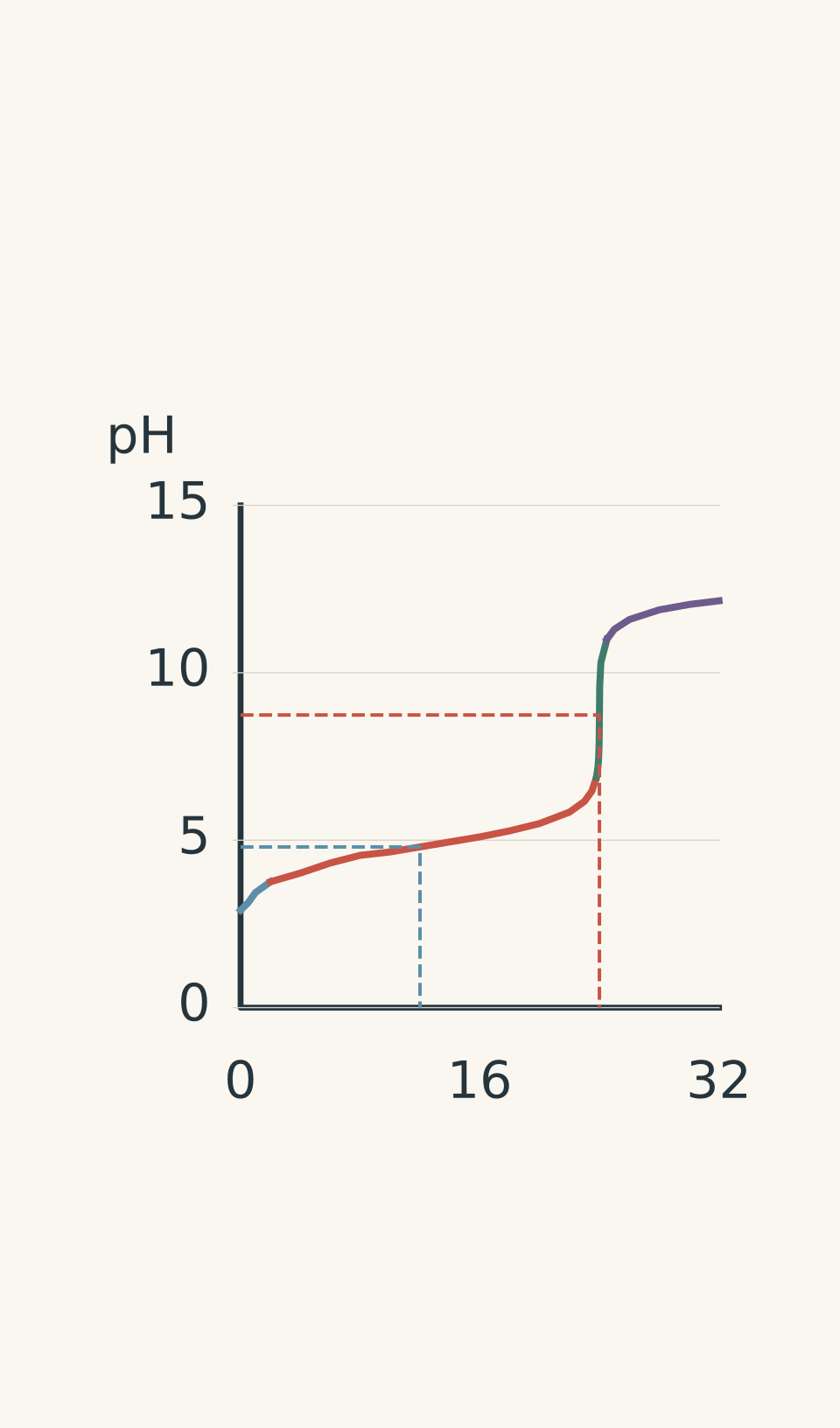
- Initial weak-acid region
- Buffer region
- Steep equivalence region
- Excess-base region
- Half-equivalence: 12.0 mL = ½Veq; pH ≈ pKa
- Equivalence: 24.0 mL; pH ≈ 8.7 (>7)
01Why half-equivalence is special
Consider a monoprotic weak acid, \(\ce{HA}\), being titrated with sodium hydroxide. The acid reacts with hydroxide ions according to
\[ \ce{HA(aq) + OH^-(aq) -> A^-(aq) + H2O(l)} \]
Here, \(\ce{HA}\) is the weak acid and \(\mathrm{A}^{-}\) is its conjugate base. A conjugate base is the species left when an acid loses a proton.
Notice the important feature of this reaction: one mole of acid reacts with one mole of hydroxide to produce one mole of conjugate base.
Imagine starting with 10 mmol of \(\ce{HA}\) and no added \(\mathrm{A}^{-}\). As you add NaOH, some of the acid becomes conjugate base.
- Before any NaOH is added, there are approximately 10 mmol of \(\ce{HA}\) and very little \(\mathrm{A}^{-}\).
- After 5 mmol of NaOH has reacted, approximately 5 mmol of \(\ce{HA}\) remain, and 5 mmol of \(\mathrm{A}^{-}\) have formed.
- At equivalence, all 10 mmol of the original acid have been neutralised stoichiometrically.
The middle situation is the one we want. Half the acid has reacted, so the remaining acid and the conjugate base formed by the reaction have equal amounts.
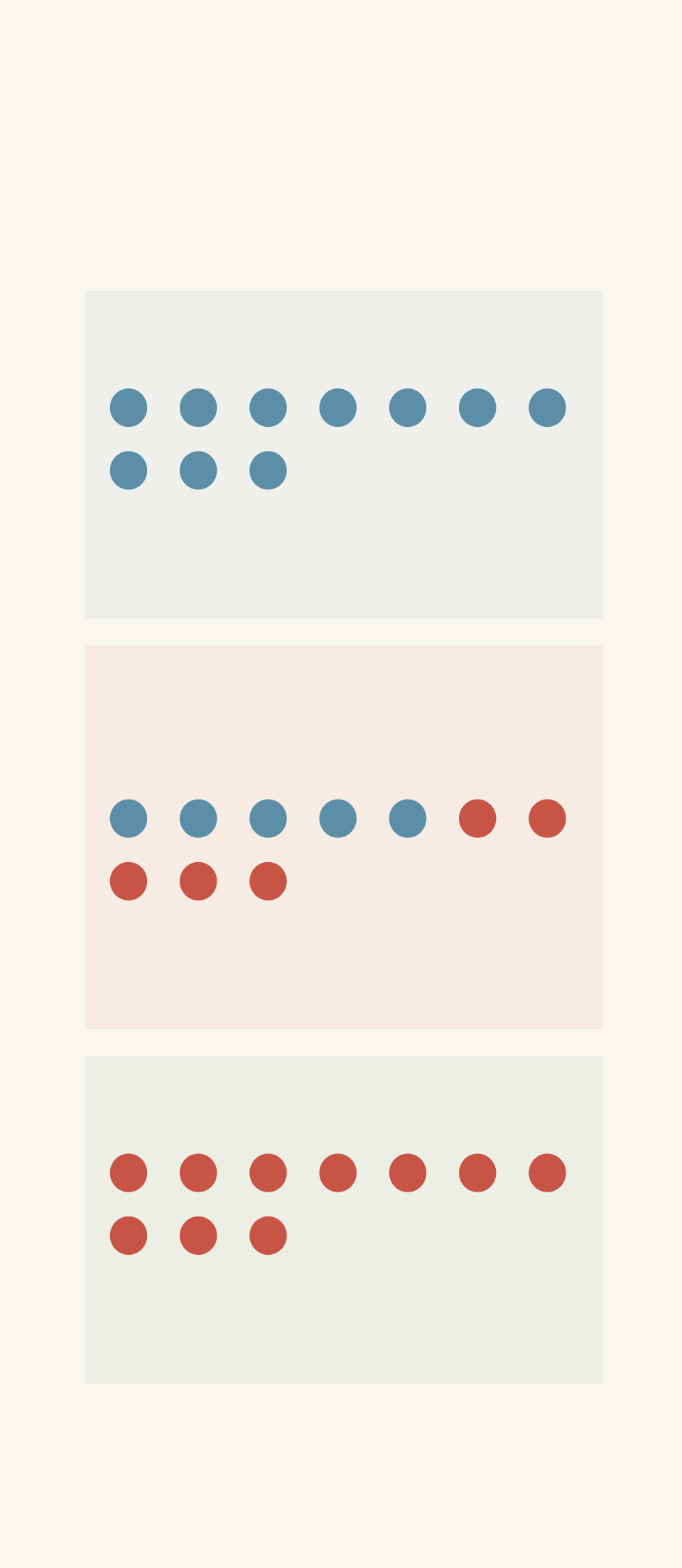
- HA
- A⁻
Connecting the mole count to volume
Let \(n_0\) represent the initial amount of weak acid, in moles, and let \(x\) represent the amount of hydroxide that has reacted.
Assuming the original sample contains only \(\ce{HA}\), the stoichiometric amounts are
\[ n(\ce{HA})=n_0-x \]
and
\[ n(\mathrm{A}^{-})=x \]
At equivalence, \(x=n_0\). At half-equivalence,
\[ x=\frac{n_0}{2} \]
Substituting this into the two expressions gives
\[ n(\ce{HA})=\frac{n_0}{2} \]
\[ n(\mathrm{A}^{-})=\frac{n_0}{2} \]
The amounts are equal.
Now connect this to the volume of NaOH added. If the NaOH concentration stays constant, the amount of hydroxide added is proportional to its volume:
\[ n(\ce{OH^-})=cV \]
where \(c\) is the NaOH concentration and \(V\) is the volume added.
Half as many moles of NaOH therefore require half the equivalence volume:
\[ \boxed{V_{\frac12}=\frac{V_e}{2}} \]
Here, \(V_e\) is the equivalence volume and \(V_{\frac12}\) is the half-equivalence volume.
This result assumes a monoprotic acid, a 1:1 neutralisation reaction, and an initial sample containing the weak acid without a significant amount of its conjugate base.
There is one technical detail worth knowing. These mole calculations describe the stoichiometric amounts. The actual equilibrium concentrations can differ slightly because the acid dissociates and the conjugate base reacts with water. Under the usual HSC approximation, those small shifts are negligible compared with the amounts of acid and conjugate base present.
02Why pH equals pKa at half-equivalence
We have established that the acid and conjugate base have equal amounts at half-equivalence. Now we need to connect that fact to pH.
A weak acid partially ionises in water:
\[ \ce{HA(aq) + H2O(l) <=> H3O+(aq) + A^-(aq)} \]
Its acid dissociation constant, \(K_a\), describes the equilibrium:
\[ K_a=\frac{[\ce{H3O+}][\mathrm{A}^{-}]}{[\ce{HA}]} \]
The square brackets represent equilibrium concentrations. A larger \(K_a\) indicates a stronger acid because the equilibrium favours ionisation more strongly.
We define
\[ pK_a=-\log_{10}K_a \]
Rearranging the equilibrium expression and taking negative base-10 logarithms gives the Henderson-Hasselbalch equation:
\[ \boxed{ \mathrm{pH}=pK_a+ \log_{10}\left( \frac{[\mathrm{A}^{-}]}{[\ce{HA}]} \right) } \]
This equation is useful throughout the buffer region of a weak-acid titration.
At half-equivalence, the usual approximation gives
\[ [\mathrm{A}^{-}]=[\ce{HA}] \]
Therefore,
\[ \frac{[\mathrm{A}^{-}]}{[\ce{HA}]}=1 \]
Substitute this into the Henderson-Hasselbalch equation:
\[ \begin{aligned} \mathrm{pH} &=pK_a+\log_{10}(1)\\ &=pK_a+0\\ &=pK_a \end{aligned} \]
So we obtain the key result:
\[ \boxed{\mathrm{pH}\approx pK_a \quad\text{at half-equivalence}} \]
The equality is approximate because the derivation uses the usual concentration-based equilibrium model. In real solutions, activity effects and small equilibrium shifts can cause slight differences.
How the concentration ratio sets pH
| More acid | [A⁻]/[HA] = 0.1 pH ≈ pKa − 1 HA concentration is 10 times [A⁻] |
|---|---|
| Equal amounts: key case | [A⁻]/[HA] = 1 pH ≈ pKa Equal acid and conjugate-base concentrations Occurs at half-equivalence for a weak acid initially without A⁻ |
| More conjugate base | [A⁻]/[HA] = 10 pH ≈ pKa + 1 [A⁻] concentration is 10 times that of HA |
A common misconception: the pH is not halfway between two pH values
Suppose the initial pH is 3.0 and the pH at equivalence is 8.8. You might predict that the half-equivalence pH is
\[ \frac{3.0+8.8}{2}=5.9 \]
That prediction is incorrect.
The half-equivalence point is halfway in volume, not halfway in pH. The pH scale is logarithmic, and a titration curve is not a straight line. The pH at half-equivalence is determined by the acid’s \(pK_a\), not by averaging the pH values at the beginning and end of the titration.
For example, if \(pK_a=4.75\), the pH at half-equivalence is approximately 4.75, regardless of whether the initial and equivalence-point pH values average to that number.
03How to estimate pKa from a titration curve
You can now read \(pK_a\) directly from a suitable weak-acid-strong-base titration curve.
Step 1: Find the equivalence volume.
Locate the steep vertical section of the curve. The equivalence point is near its inflection point, where the curve changes from bending one way to bending the other. On a well-resolved curve, this is approximately the middle of the steepest rise.
Do not automatically choose the volume where the sharp rise begins or where it finishes.
Step 2: Halve the equivalence volume.
Calculate
\[ V_{\frac12}=\frac{V_e}{2} \]
For example, if equivalence occurs at \(24.0\ \text{mL}\), half-equivalence occurs at \(12.0\ \text{mL}\).
Step 3: Read the pH at that volume.
Find the half-equivalence volume on the horizontal axis. Move vertically to the curve, then horizontally to the pH axis.
Step 4: Use that pH as your pKa estimate.
\[ \boxed{pK_a\approx \mathrm{pH}\text{ at }V_e/2} \]
If the question asks for \(K_a\), convert your answer using
\[ \boxed{K_a=10^{-pK_a}} \]
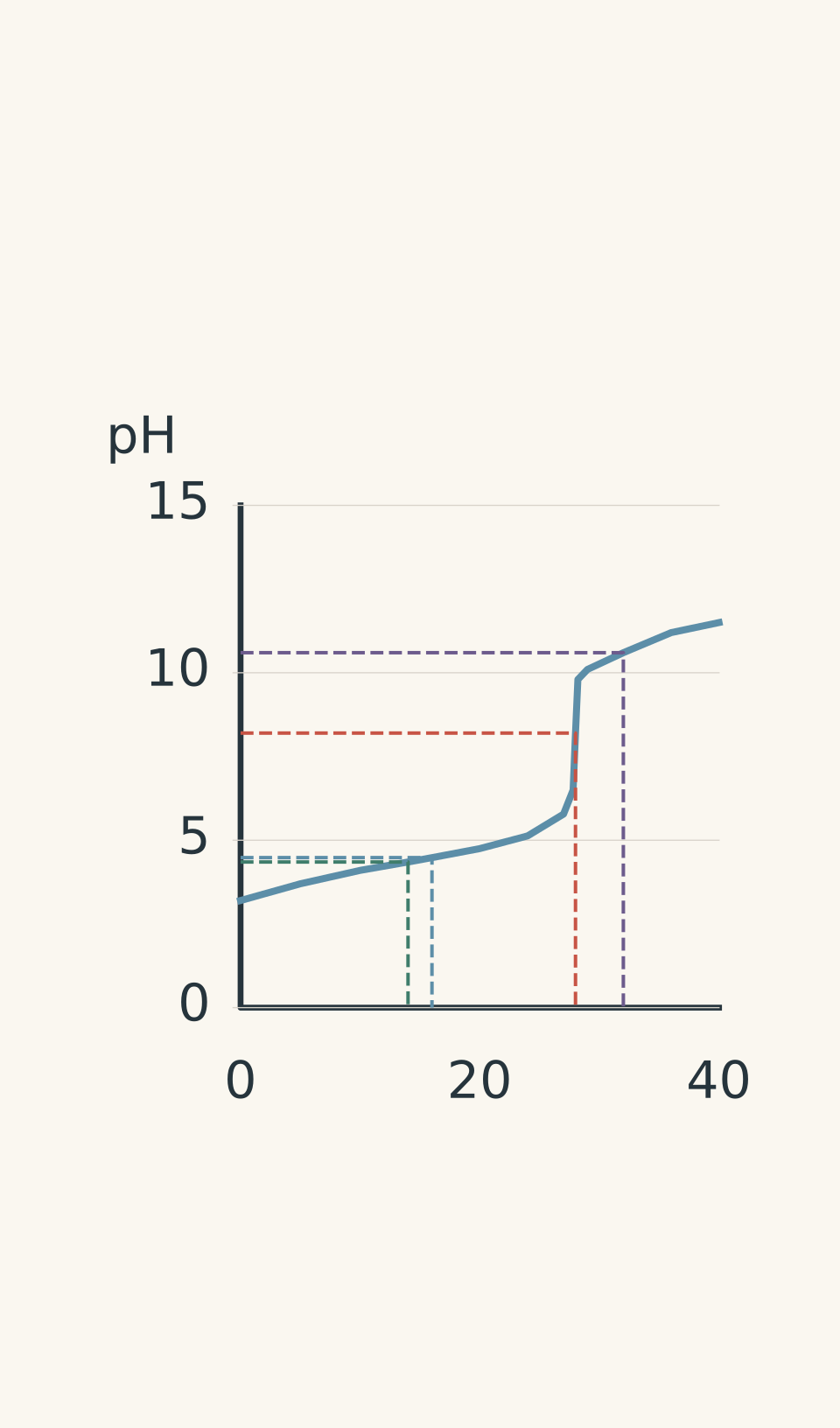
- Weak-acid titration curve (schematic)
- Correct Ve = 28.0 mL (inflection)
- Half-equivalence: 14.0 mL; pH = 4.35
- Incorrect Ve = 32.0 mL (upper jump edge)
- Wrong half-volume: 16.0 mL; pH ≈ 4.48
Worked example: Estimate pKa and Ka from a titration curve
A monoprotic weak acid is titrated with NaOH. The equivalence volume is \(24.0\ \text{mL}\), and the pH at \(12.0\ \text{mL}\) is 4.80. Estimate \(pK_a\) and \(K_a\).
Step 1
The equivalence volume is \(24.0\ \text{mL}\), so
\[ V_{\frac12}=\frac{24.0}{2} =12.0\ \text{mL} \]
The given pH reading is therefore at half-equivalence.
Step 2
At half-equivalence, pH is approximately equal to pKa.
\[ pK_a\approx4.80 \]
Step 3
Use \(K_a=10^{-pK_a}\):
\[ \begin{aligned} K_a&=10^{-4.80}\\ &=1.58\times10^{-5} \end{aligned} \]
Therefore,
\[ \boxed{pK_a\approx4.80} \]
\[ \boxed{K_a\approx1.6\times10^{-5}} \]
The curve gives an estimate of the acid’s strength without requiring you to calculate the equilibrium concentrations from scratch.
Worked example: What happens if you choose the wrong equivalence volume?
A weak acid is titrated with NaOH. The steepest rise is centred at \(28.0\ \text{mL}\). The graph gives a pH of 4.35 at \(14.0\ \text{mL}\) and a pH of 4.48 at \(16.0\ \text{mL}\).
A student chooses \(32.0\ \text{mL}\) as the equivalence volume because it lies near the top of the sharp rise. Estimate \(pK_a\) and \(K_a\) correctly, then calculate the effect of the student’s choice.
Step 1
The equivalence point is near the centre of the steepest rise, at \(28.0\ \text{mL}\). The upper edge of the rise is not the best estimate.
Step 2
\[ V_{\frac12}=\frac{28.0}{2} =14.0\ \text{mL} \]
Step 3
The pH at \(14.0\ \text{mL}\) is 4.35, so
\[ \boxed{pK_a\approx4.35} \]
Step 4
\[ \begin{aligned} K_a&=10^{-4.35}\\ &=4.47\times10^{-5} \end{aligned} \]
The correct estimate is \(K_a\approx4.5\times10^{-5}\).
Step 5
Using \(32.0\ \text{mL}\) gives
\[ V_{\frac12}=\frac{32.0}{2} =16.0\ \text{mL} \]
The student would read a pH of 4.48 and estimate
\[ K_a=10^{-4.48} =3.31\times10^{-5} \]
Their pKa estimate is too high by \(0.13\), and their Ka estimate is approximately 26% too low.
A higher pKa corresponds to a smaller Ka, so the student would make the acid appear weaker than it is. The error comes from choosing the wrong equivalence volume, not from the Henderson-Hasselbalch equation.
04How graph quality affects your estimate
The half-equivalence method is straightforward, but the graph must be good enough to locate the relevant points.
Suppose the steep rise occurs somewhere between two recorded volumes. You may not know the exact equivalence volume, particularly if measurements were taken at widely spaced intervals.
If your equivalence-volume estimate is uncertain by \(\pm 1.0\ \text{mL}\), the half-equivalence volume is uncertain by approximately \(\pm 0.5\ \text{mL}\).
That does not automatically mean your pKa estimate is poor. Look at the shape of the curve around half-equivalence. The buffer region is usually much flatter than the equivalence region, so a small error in the selected volume may produce only a small change in pH.
However, if the pH readings in the buffer region are also sparse or difficult to resolve, your estimate becomes less reliable. Report only as many significant figures as the graph supports.
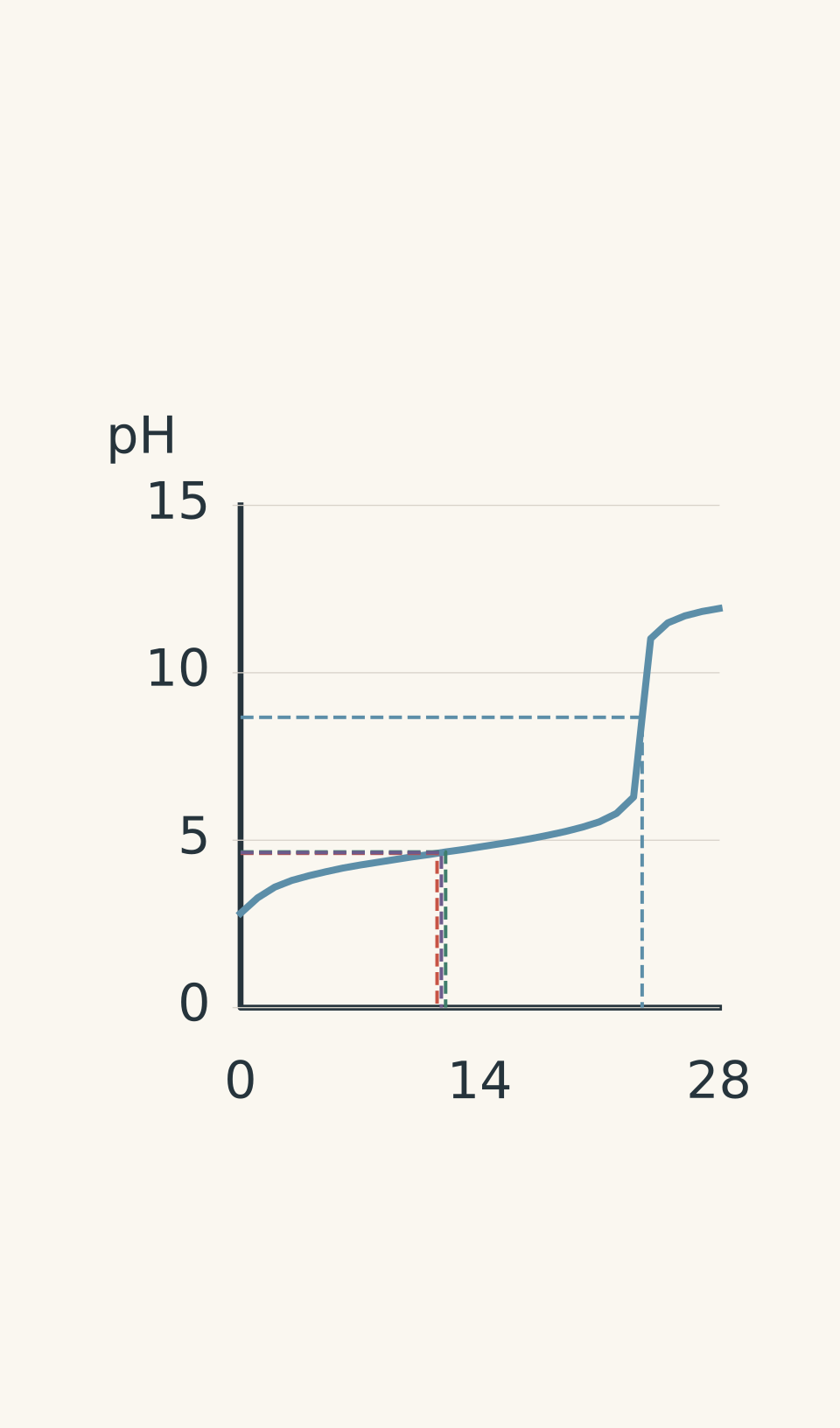
- Schematic titration curve
- Buffer reading: 11.5 mL, pH 4.61
- Buffer reading: 12.0 mL, pH 4.65
- Half-volume: 11.75 mL, pH approximately 4.63
- Estimated inflection: 23.5 mL (between 23 and 24 mL)
Keep these common errors in mind:
| Tempting mistake | What to do instead |
|---|---|
| Read pH at equivalence and call it pKa. | Read pH at half-equivalence. |
| Halve the equivalence-point pH. | Halve the equivalence volume. |
| Choose the top of the steep rise as equivalence. | Locate the inflection point near the middle of the steepest rise. |
| Report several decimal places from a rough graph. | Match your precision to the graph’s resolution. |
| Assume half-equivalence always means equal acid and conjugate-base amounts. | Check whether the original sample contained only the weak acid. |
That last point is especially important. If the sample already contains some conjugate base, the usual half-equivalence rule can fail. The final question explores why.
05Questions and solutions
Question 1
A \(20.0\ \text{mL}\) sample of a monoprotic weak acid is titrated with \(0.100\ \text{mol L}^{-1}\) NaOH. The equivalence volume is \(18.0\ \text{mL}\), and the pH at \(9.0\ \text{mL}\) is 4.25.
Estimate \(pK_a\) and \(K_a\).
Solution 1
The estimates are \(pK_a\approx4.25\) and \(K_a\approx5.6\times10^{-5}\).
The half-equivalence volume is
\[ V_{\frac12}=\frac{18.0}{2} =9.0\ \text{mL} \]
The given pH is therefore the half-equivalence pH. Assuming the original sample contained only the weak acid, the acid and conjugate base have approximately equal concentrations at this point.
Hence,
\[ pK_a\approx4.25 \]
Convert this value to \(K_a\):
\[ \begin{aligned} K_a&=10^{-pK_a}\\ &=10^{-4.25}\\ &=5.62\times10^{-5} \end{aligned} \]
Therefore,
\[ \boxed{pK_a\approx4.25,\quad K_a\approx5.6\times10^{-5}} \]
The key step is identifying half-equivalence before using the pH reading.
Question 2
An experimental titration curve gives the following readings around the steep rise.
| NaOH added (mL) | pH |
|---|---|
| 21.0 | 5.6 |
| 22.0 | 5.8 |
| 23.0 | 6.3 |
| 24.0 | 11.0 |
| 25.0 | 11.5 |
The largest rise occurs between \(23.0\) and \(24.0\ \text{mL}\). Elsewhere on the curve, the pH is 4.61 at \(11.5\ \text{mL}\) and 4.65 at \(12.0\ \text{mL}\). Assume pH readings from the graph have an uncertainty of approximately \(\pm0.03\).
Estimate the equivalence volume, the half-equivalence volume, and pKa. Explain whether reporting \(pK_a=4.63\) is justified.
Solution 2
The estimates are \(V_e\approx23.5\ \text{mL}\), \(V_{\frac12}\approx11.75\ \text{mL}\), and \(pK_a\approx4.63\). However, the graph does not justify treating 4.63 as an exact value.
Step 1: Estimate the equivalence volume.
The sharpest rise occurs between \(23.0\) and \(24.0\ \text{mL}\). Using the middle of that interval gives
\[ V_e\approx\frac{23.0+24.0}{2} =23.5\ \text{mL} \]
With these coarse readings, a reasonable volume uncertainty is approximately \(\pm0.5\ \text{mL}\).
Step 2: Calculate half-equivalence.
\[ V_{\frac12}=\frac{23.5}{2} =11.75\ \text{mL} \]
The uncertainty in the half-equivalence volume is approximately half the uncertainty in \(V_e\), or \(\pm0.25\ \text{mL}\).
Step 3: Read the pH.
The half-equivalence volume lies halfway between \(11.5\) and \(12.0\ \text{mL}\). Interpolating between the two pH readings gives
\[ \mathrm{pH}\approx\frac{4.61+4.65}{2} =4.63 \]
Thus,
\[ pK_a\approx4.63 \]
Step 4: Assess the precision.
The uncertainty in half-equivalence volume means the pH could be near 4.61 or 4.65 even before allowing for the stated pH-reading uncertainty. A conservative overall uncertainty is approximately \(\pm0.05\) pH units.
Reporting \(pK_a\approx4.63\) as a central estimate is reasonable, but reporting \(4.630\) as though the graph establishes that precision is not.
Notice something useful: if a student mistakenly chose \(24.0\ \text{mL}\) as equivalence, they would inspect \(12.0\ \text{mL}\) and read pH 4.65. The difference is only 0.02 pH units, smaller than the graph’s uncertainty.
A wrong equivalence volume does not always produce a large pKa error. The effect depends on how much the pH changes around the selected half-equivalence volume.
Question 3
A weak-acid titration curve gives \(pK_a=4.60\) at half-equivalence. At \(10.0\ \text{mL}\) of added NaOH, the pH is 4.30.
A student argues that because the pH is \(0.30\) below pKa, approximately 30% of the acid has reacted.
Assuming the original sample contained only \(\ce{HA}\), determine the fraction of acid neutralised and estimate the equivalence volume.
A second reading gives pH 4.78 at \(20.0\ \text{mL}\). Is this second reading consistent with the same model if graph readings are accurate to \(\pm0.03\) pH units?
Solution 3
One-third of the original acid has reacted, giving an equivalence-volume estimate of \(30.0\ \text{mL}\). However, the second reading is inconsistent with that model within the stated uncertainty.
Step 1: Use the pH difference to find the concentration ratio.
The Henderson-Hasselbalch equation gives
\[ \begin{aligned} \frac{[\mathrm{A}^{-}]}{[\ce{HA}]} &=10^{\mathrm{pH}-pK_a}\\ &=10^{4.30-4.60}\\ &=10^{-0.30}\\ &\approx0.50 \end{aligned} \]
This means there is approximately half as much conjugate base as remaining acid.
Step 2: Convert the ratio into a fraction neutralised.
Let \(x\) be the amount of acid neutralised and \(n_0\) the initial amount of acid.
The conjugate base formed is \(x\), while the acid remaining is \(n_0-x\). Therefore,
\[ \frac{x}{n_0-x}=0.50 \]
Rearranging,
\[ \begin{aligned} x&=0.50(n_0-x)\\ 1.50x&=0.50n_0\\ x&=\frac{n_0}{3} \end{aligned} \]
One-third of the acid has reacted.
The student’s mistake was treating a pH difference as a percentage. The pH scale is logarithmic, so a change of 0.30 does not mean 30% neutralisation.
Step 3: Estimate the equivalence volume.
If \(10.0\ \text{mL}\) corresponds to one-third of the acid neutralised, then
\[ V_e=3(10.0)=30.0\ \text{mL} \]
Step 4: Check the second reading.
At \(20.0\ \text{mL}\), the predicted fraction neutralised is
\[ \frac{20.0}{30.0}=\frac23 \]
The remaining acid is therefore one-third of the original amount, while the conjugate base is two-thirds. The concentration ratio is
\[ \frac{[\mathrm{A}^{-}]}{[\ce{HA}]}=\frac{2}{1}=2 \]
The predicted pH is
\[ \begin{aligned} \mathrm{pH} &=pK_a+\log_{10}(2)\\ &=4.60+0.301\\ &\approx4.90 \end{aligned} \]
The observed value is 4.78, a difference of 0.12 pH units. This exceeds the stated uncertainty of \(\pm0.03\).
The two readings therefore cannot both be reconciled with the same simple model at the stated precision. The graph readings, equivalence estimate, or assumptions about the sample need to be checked rather than forcing both values to fit.
Question 4
A weak acid, \(\ce{HA}\), is titrated with NaOH. The pH at the steepest point of the curve is 8.8.
A student rejects the curve because they expect the equivalence-point pH to be 7. They then use pH 8.8 as the acid’s pKa.
Explain why both conclusions are incorrect. Include the relevant equilibrium reaction and describe where pKa should be read.
Solution 4
A pH of 8.8 at equivalence is entirely plausible for a weak-acid-strong-base titration, but it is not the acid’s pKa. The pKa should be estimated from the pH at half-equivalence.
Why the equivalence solution is basic
At equivalence, the original weak acid has been neutralised stoichiometrically. Its conjugate base, \(\mathrm{A}^{-}\), remains in solution.
The conjugate base reacts with water:
\[ \ce{A^-(aq) + H2O(l) <=> HA(aq) + OH^-(aq)} \]
This reaction produces hydroxide ions, making the solution basic. The equivalence-point pH is therefore generally greater than 7 at \(25^\circ\text{C}\).
A pH above 7 does not, by itself, indicate an incorrectly identified equivalence point.
Why pH 8.8 is not pKa
The equivalence point and half-equivalence point are different locations on the curve. At equivalence, the acid has been neutralised stoichiometrically. At half-equivalence, the amounts of acid remaining and conjugate base formed are approximately equal.
It is this equal-ratio condition that makes
\[ \mathrm{pH}\approx pK_a \]
The pH at equivalence depends on factors including the conjugate base’s reaction with water and its concentration. It is not a direct reading of the acid dissociation constant.
To estimate pKa, find the equivalence volume, divide it by two, and read the pH at that half-equivalence volume.
Question 5
A \(25.0\ \text{mL}\) sample contains \(0.100\ \text{mol L}^{-1}\) of a monoprotic weak acid, \(\ce{HA}\), together with an unknown amount of its sodium salt, \(\ce{NaA}\).
The sample is titrated with \(0.100\ \text{mol L}^{-1}\) NaOH. The equivalence volume for neutralising the \(\ce{HA}\) is \(25.0\ \text{mL}\).
At \(12.5\ \text{mL}\) of added NaOH, the pH is 5.05. A separate titration of pure \(\ce{HA}\) gives \(pK_a=4.75\).
Assume ideal dilute-solution behaviour and no other acid-base species.
Calculate the initial amount and concentration of \(\mathrm{A}^{-}\) in the original sample. Explain why the usual half-equivalence rule does not allow you to set pH equal to pKa in this case.
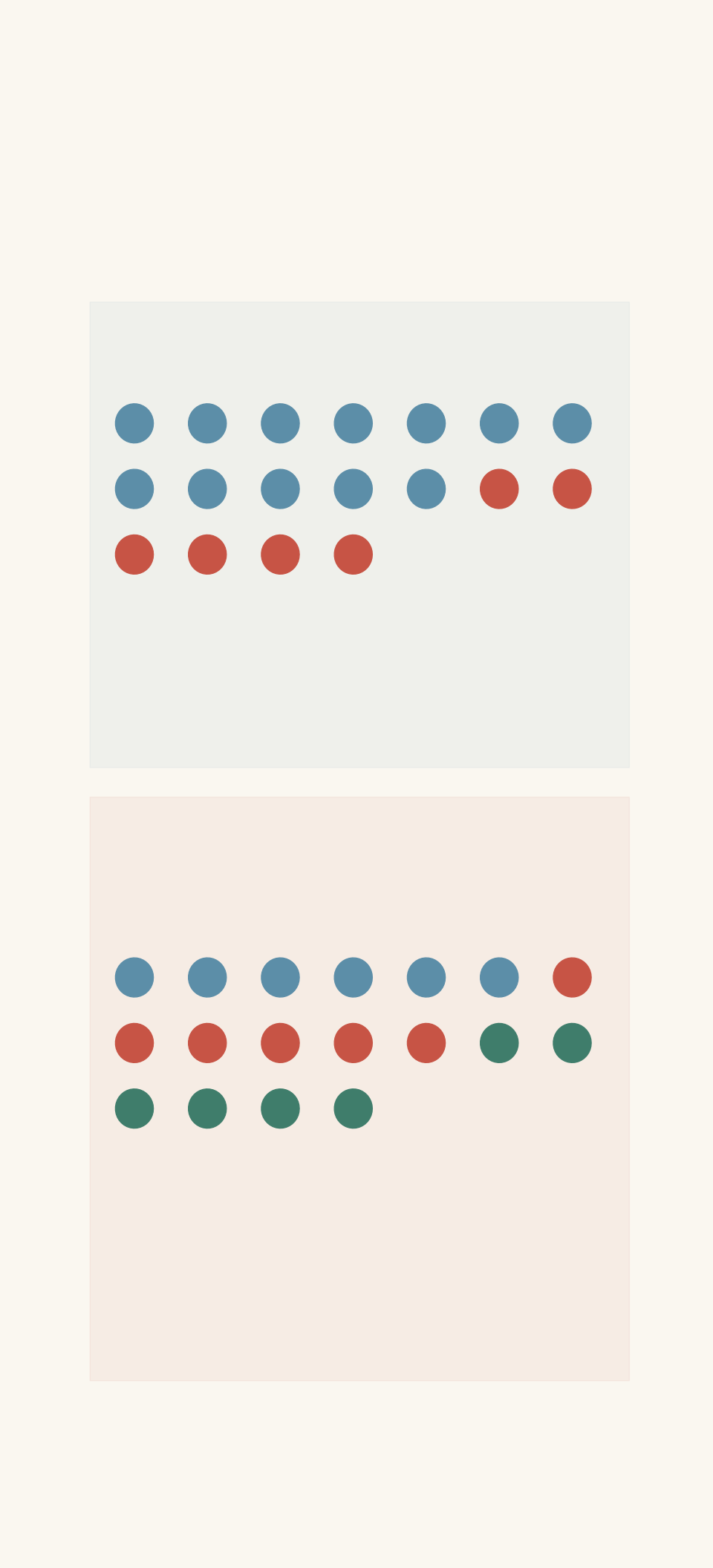
- HA
- A− (initial)
- A− (formed)
Solution 5
The original sample contained \(1.25\ \text{mmol}\) of \(\mathrm{A}^{-}\), corresponding to an initial concentration of \(0.0500\ \text{mol L}^{-1}\). Half-equivalence does not give pH equal to pKa here because the sample already contained conjugate base before the titration began.
Step 1: Calculate the initial amount of weak acid.
The original sample contains \(0.100\ \text{mol L}^{-1}\) of \(\ce{HA}\) in \(25.0\ \text{mL}\).
\[ \begin{aligned} n(\ce{HA})_0 &=cV\\ &=0.100\times0.0250\\ &=0.00250\ \text{mol}\\ &=2.50\ \text{mmol} \end{aligned} \]
The equivalence volume is \(25.0\ \text{mL}\), consistent with neutralising this amount of acid using \(0.100\ \text{mol L}^{-1}\) NaOH.
Step 2: Find how much acid remains at half-equivalence.
Half-equivalence occurs at \(12.5\ \text{mL}\).
The amount of hydroxide added is
\[ \begin{aligned} n(\ce{OH^-}) &=0.100\times0.0125\\ &=0.00125\ \text{mol}\\ &=1.25\ \text{mmol} \end{aligned} \]
This neutralises \(1.25\ \text{mmol}\) of \(\ce{HA}\), leaving
\[ n(\ce{HA})=2.50-1.25 =1.25\ \text{mmol} \]
The neutralisation also produces \(1.25\ \text{mmol}\) of new \(\mathrm{A}^{-}\).
However, unlike a sample containing pure \(\ce{HA}\), this sample already had some \(\mathrm{A}^{-}\) before any NaOH was added.
Step 3: Use the measured pH to find the total conjugate-base amount.
Apply the Henderson-Hasselbalch equation:
\[ \begin{aligned} \frac{[\mathrm{A}^{-}]}{[\ce{HA}]} &=10^{\mathrm{pH}-pK_a}\\ &=10^{5.05-4.75}\\ &=10^{0.30}\\ &\approx2.00 \end{aligned} \]
At \(12.5\ \text{mL}\), the concentration of \(\mathrm{A}^{-}\) is approximately twice the concentration of \(\ce{HA}\).
Both species are in the same solution, so their concentration ratio equals their mole ratio. With \(1.25\ \text{mmol}\) of \(\ce{HA}\) remaining,
\[ n(\mathrm{A}^{-})_{\text{total}} \approx2.00\times1.25 =2.50\ \text{mmol} \]
This is the total conjugate-base amount at half-equivalence, including the portion that existed before the titration.
Step 4: Calculate the initial amount of conjugate base.
The titration produced \(1.25\ \text{mmol}\) of \(\mathrm{A}^{-}\). Therefore, the amount present initially was
\[ \begin{aligned} n(\mathrm{A}^{-})_0 &=2.50-1.25\\ &=1.25\ \text{mmol} \end{aligned} \]
Step 5: Calculate its initial concentration.
The original sample volume was \(25.0\ \text{mL}\), or \(0.0250\ \text{L}\).
\[ \begin{aligned} [\mathrm{A}^{-}]_0 &=\frac{0.00125}{0.0250}\\ &=0.0500\ \text{mol L}^{-1} \end{aligned} \]
Hence,
\[ \boxed{n(\mathrm{A}^{-})_0=1.25\ \text{mmol}} \]
\[ \boxed{[\mathrm{A}^{-}]_0=0.0500\ \text{mol L}^{-1}} \]
The crucial assumption behind the familiar half-equivalence rule is that the original sample contains only \(\ce{HA}\). In that case, the conjugate base at half-equivalence has been formed entirely by neutralisation, so the remaining acid and total conjugate base have approximately equal amounts.
Here, some conjugate base was present from the beginning. At half-equivalence, the remaining \(\ce{HA}\) is \(1.25\ \text{mmol}\), but the total \(\mathrm{A}^{-}\) is \(2.50\ \text{mmol}\). The ratio is 2, not 1, so the pH is 0.30 units above pKa.
This is why the half-equivalence method is powerful but conditional: you must understand what was in the sample before titration began.
Once you can read pKa reliably, the same Henderson-Hasselbalch equation lets you predict pH anywhere in the buffer region from the ratio of conjugate base to acid. It also gives you a way to check whether a measured titration curve behaves as expected for a simple monoprotic weak acid.