
Why Industry Sometimes Accepts a Lower Equilibrium Yield
Explore why industrial chemists may prioritise product per hour over maximum equilibrium yield. Using the Haber process, learn how temperature, pressure, catalysts, and recycling affect production rates, operating costs, and equilibrium.
An ammonia plant can achieve a higher equilibrium yield at one operating temperature and still produce less ammonia per hour. A cooler reactor favours the formation of ammonia, but the reaction may be too slow to process much gas. A hotter reactor can produce a smaller fraction of ammonia in each equilibrium mixture while allowing more gas to pass through the plant each hour.
If you were choosing the operating conditions, would you maximise equilibrium yield or maximise product per hour? The answer depends on three things: equilibrium composition, reaction rate, and the cost of running the plant.
Equilibrium yield versus reaction rate
| Cooler conditions | N₂ + 3H₂ ⇌ 2NH₃ Higher equilibrium NH₃ fraction Slower reaction kinetics |
|---|---|
| Hotter conditions | N₂ + 3H₂ ⇌ 2NH₃ Lower equilibrium NH₃ fraction Faster reaction kinetics |
01Three quantities that are easy to confuse
Before comparing industrial conditions, separate three ideas.
Equilibrium yield describes the amount of product present when a reversible reaction reaches equilibrium under specified conditions. It depends on factors such as temperature, pressure, and the starting composition.
Reaction rate describes how quickly a reaction proceeds. Temperature, reactant concentrations, and catalysts can affect this rate.
Production rate describes how much product a plant actually produces per unit of time. Industrial plants commonly measure this in tonnes per hour.
These quantities are connected, but they are not interchangeable.
At equilibrium, the forward and reverse reaction rates are equal. The reaction has not stopped; the concentrations simply remain constant because the two opposing reactions balance each other.
Production rate is a different question. A plant may have a relatively low conversion of reactants in each pass through its reactor but process a much larger quantity of gas each hour.
Three different measures
| Equilibrium composition | Proportion of NH₃ in the equilibrium mixture. Measure: NH₃ mole fraction (%) at specified conditions. |
|---|---|
| Reaction rate | How quickly chemical change occurs. Measure: mol NH₃ L⁻¹ s⁻¹; at equilibrium, forward and reverse rates are equal. |
| Production rate | Total ammonia output from the plant over time. Measure: tonnes NH₃ per hour (t h⁻¹). |
One further distinction matters. Single-pass conversion is the fraction of a reactant entering a reactor that reacts during one pass. A gas mixture may leave the reactor before reaching equilibrium, so its actual conversion need not equal the equilibrium conversion predicted for those conditions.
This is one reason industry can accept a lower equilibrium yield in exchange for faster production. If the plant processes enough additional feed, it may produce more product overall.
02The Haber process: where the trade-off appears
The Haber process produces ammonia from nitrogen and hydrogen:
\[ \ce{N2(g) + 3H2(g) <=> 2NH3(g)} \]
The forward reaction is exothermic. Its enthalpy change is approximately \(-92\ \mathrm{kJ}\) per reaction as written, meaning that heat is released when nitrogen and hydrogen form ammonia.
The equation also tells us something important about pressure. Four moles of gaseous reactants form two moles of gaseous product.
These two features help explain why industrial operating conditions involve trade-offs.
Temperature: better equilibrium yield does not mean faster production
Suppose the reactor is running at a particular temperature and pressure. Predict what happens if the temperature is lowered.
For the Haber process, lowering the temperature favours ammonia formation at equilibrium. The forward reaction releases heat, so reducing the temperature favours the exothermic direction.
However, lowering the temperature also generally slows the reaction. The particles have less kinetic energy, and a smaller fraction of collisions have enough energy to overcome the activation energy barrier.
Raising the temperature reverses this trade-off:
- The reaction rate generally increases.
- The equilibrium composition contains a smaller proportion of ammonia.
- The plant may be able to process more gas per hour.
Neither temperature is automatically better. The cooler condition favours equilibrium yield, while the hotter condition may favour production rate.
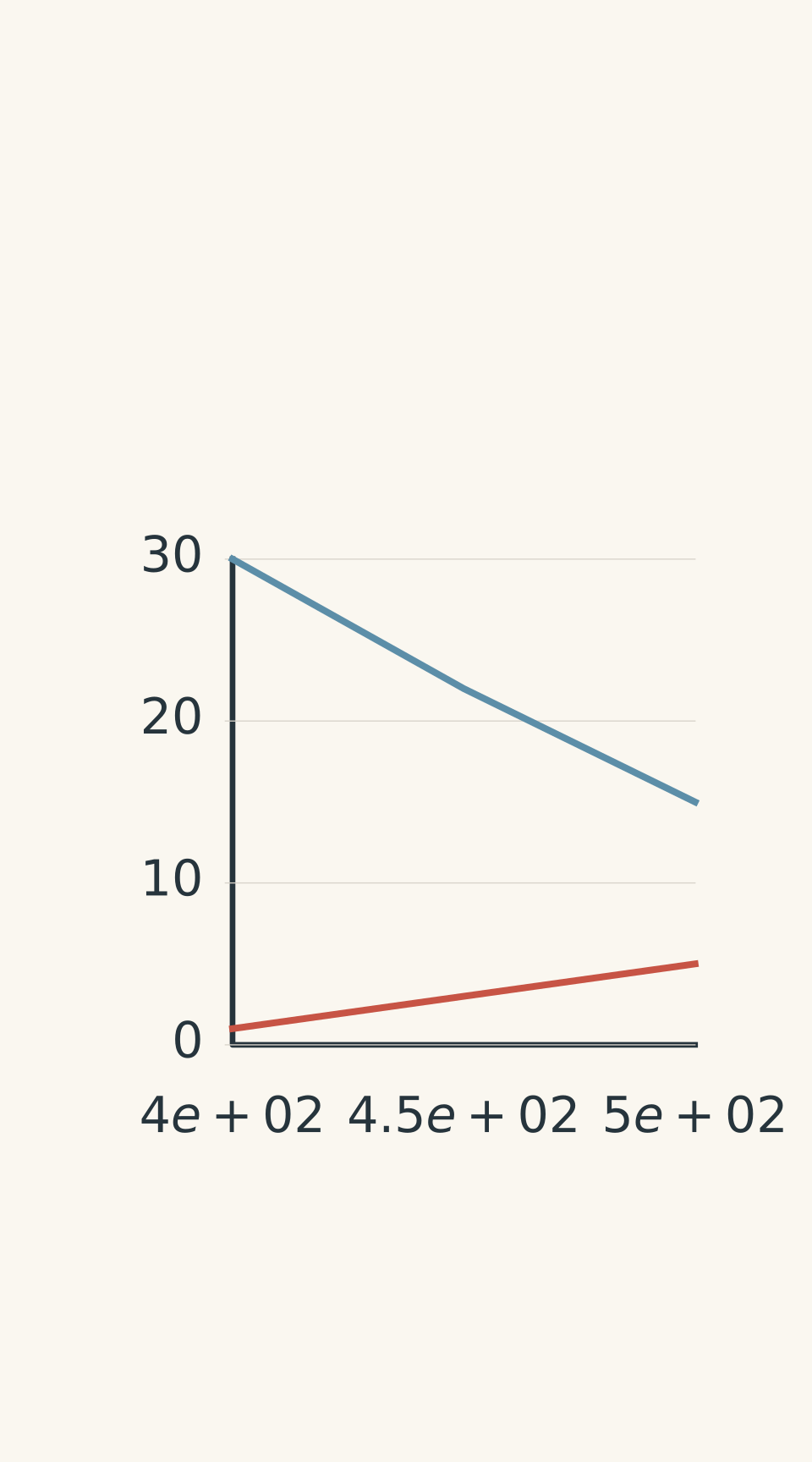
- Equilibrium NH₃ yield (%)
- Relative reaction-rate index (unitless)
The practical solution is a compromise. HSC Chemistry commonly uses approximately 450°C as a representative Haber-process operating temperature. The precise setting used by a real plant depends on its catalyst, equipment, feed, and operating objectives.
The key point is that the temperature giving the highest equilibrium yield is not necessarily the temperature giving the highest production rate.
Catalysts: faster reactions, unchanged equilibrium
An iron-based catalyst is used in the Haber process. A catalyst provides an alternative reaction pathway with a lower activation energy.
This allows the forward and reverse reactions to proceed more rapidly. The mixture reaches equilibrium sooner, but the equilibrium composition does not change.
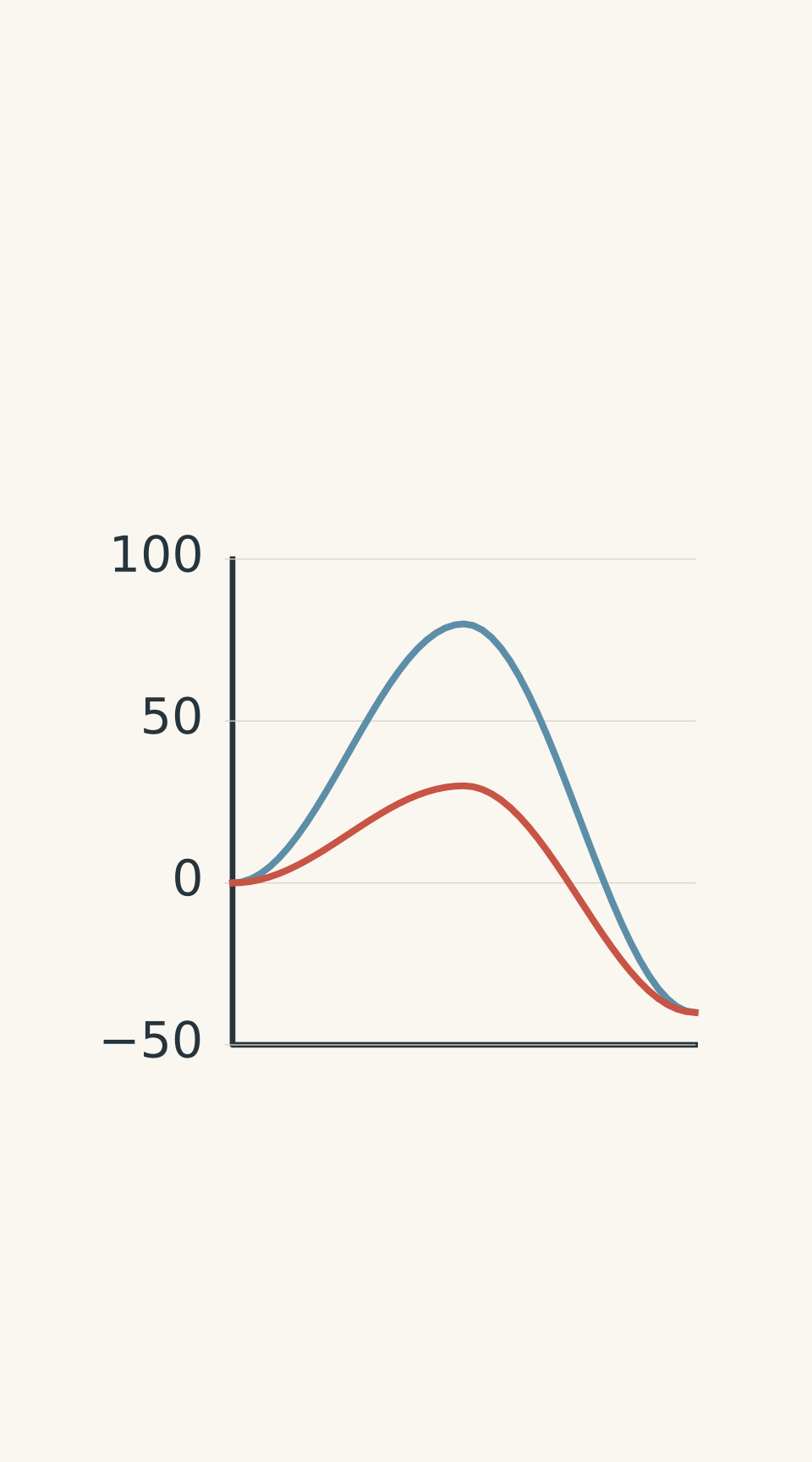
- Uncatalysed
- Catalysed
A catalyst does not increase the equilibrium constant, \(K_c\), or the maximum equilibrium yield at a fixed temperature and pressure.
So why is it useful?
A catalyst can make a lower operating temperature practical. At a lower temperature, equilibrium favours ammonia, but the uncatalysed reaction might be far too slow. With a suitable catalyst, the reaction can proceed at a useful rate while retaining the equilibrium advantage of the cooler conditions.
This is a particularly important industrial trade-off: a catalyst can help a plant obtain a useful combination of equilibrium yield and reaction rate without changing the equilibrium itself.
Pressure: favourable equilibrium, but expensive equipment
Now consider pressure.
For the Haber reaction, the left side contains four moles of gas for every stoichiometric reaction, while the right side contains two. Increasing the pressure by compressing the reacting gas mixture at constant temperature favours the side with fewer moles of gas.
Therefore, increasing pressure shifts the equilibrium towards ammonia.

- N₂
- H₂
- NH₃
Higher pressure can also increase reaction rate because the gaseous reactants are more concentrated, leading to more frequent collisions. The exact rate change depends on the reaction mechanism and rate law, however; it cannot be calculated from the balanced equation alone.
There is a cost.
Compressing gases requires energy. High-pressure reactors, pipes, valves, and seals must also be designed to withstand the operating conditions. Higher pressure brings engineering, maintenance, and safety considerations.
Increasing pressure can improve both equilibrium yield and reaction rate in the Haber process, but that does not mean the plant should operate at the highest pressure it can afford.
The best pressure is a practical decision based on the extra ammonia produced compared with the extra energy and equipment costs.
Concentration and product removal: keep the reaction moving
Temperature and pressure are not the only ways to influence an equilibrium mixture.
Increasing the partial pressure of nitrogen or hydrogen favours ammonia formation. Removing ammonia from a mixture at equilibrium also disturbs the equilibrium, causing a net forward reaction as the system responds.
The equilibrium constant does not change simply because a reactant is added or a product is removed. Instead, the composition changes, and the system moves towards a new equilibrium at the same temperature.
Industrial production can take advantage of this by separating ammonia from the outlet gas and returning unreacted nitrogen and hydrogen to the reactor.
Ammonia production with gas recycling
- Fresh feed
N₂ + 3H₂
Nitrogen and hydrogen enter the process.
- Reactor
N₂ + 3H₂ ⇌ 2NH₃
Single-pass conversion: fraction of nitrogen reacted in one pass.
- Outlet mixture
Contains NH₃ and unreacted N₂ and H₂.
- Separation
Ammonia is removed as product.
- Recycle stream
Unreacted N₂ and H₂ return to the reactor for another pass.
Recycling matters because a lower conversion in one pass does not necessarily mean a poor overall process. Unreacted gases can pass through the reactor again, allowing more of the original feed to react over time.
The trade-off is that recycling requires additional equipment and energy. Gas must be moved around the process, ammonia must be separated, and the system must be operated reliably.
A useful industrial strategy is therefore to combine a suitable temperature and pressure with a catalyst, product separation, and recycling. The aim is not necessarily to maximise the amount of ammonia formed in one pass. It is to produce ammonia continuously at a useful rate and acceptable cost.
03Comparing industrial operating conditions
The chemistry predicts how a change tends to affect equilibrium. Choosing the best operating conditions also requires information about the plant.
| Change | Effect on equilibrium | Likely effect on rate | Practical limitation |
|---|---|---|---|
| Lower temperature | Favours ammonia for the exothermic Haber reaction | Slower reaction | Throughput may fall |
| Higher temperature | Favours the reverse reaction, reducing equilibrium ammonia yield | Faster reaction in the usual operating range | Lower equilibrium yield and heating costs |
| Higher pressure by compression | Favours ammonia because fewer moles of gas are present on the product side | Often increases rate | Compression energy and equipment costs |
| Increase reactant partial pressures | Favours ammonia | May increase rate | More feed and gas-handling requirements |
| Remove ammonia | Favours further ammonia formation | Changes the net reaction rate | Separation and cooling costs |
| Add a catalyst | Does not change equilibrium composition | Speeds the approach to equilibrium | Catalyst cost, lifetime, and possible poisoning |
| Recycle unreacted gases | Does not change \(K_c\) at fixed temperature | Can improve overall production from the fresh feed | Extra equipment and energy |
The distinction between chemistry and commercial judgement is important. Chemistry can predict the direction of an equilibrium shift, but it cannot identify the most profitable operating condition without further information.
For example, a hotter condition might produce more ammonia per hour, but it could also require more energy or create additional maintenance costs. A cooler condition might produce less per hour but be cheaper to run. Neither conclusion follows from equilibrium yield alone.
A quick self-check before choosing conditions
When comparing two operating conditions, ask:
- Is the forward reaction exothermic or endothermic, and how does that affect equilibrium when temperature changes?
- Does changing pressure favour a side with fewer moles of gas?
- Is the plant limited by slow reaction kinetics, or can it process more feed per hour?
- Can the product be separated and the unreacted feed recycled?
- What additional energy, equipment, maintenance, and safety costs come with the proposed change?
The first two questions help predict the chemical behaviour. The remaining questions require information about the actual process.
04Worked examples
Worked example: comparing two operating temperatures
An idealised Haber plant has an equilibrium NH3 yield of 30% and a relative reaction-rate index of 1 at 400°C. At 450°C, the equilibrium yield is 22% and the relative rate index is 3. Both conditions use the same pressure and feed composition. Which condition gives the higher equilibrium yield, which has the faster reaction, and is there enough information to choose the better production setting? Treat the figures as illustrative data.
Step 1
At 400°C, the equilibrium yield is 30%. At 450°C, it is 22%.
The cooler condition therefore gives the higher equilibrium ammonia yield under the stated conditions.
Step 2
The relative rate index rises from 1 to 3. In this example, the reaction-rate index at 450°C is three times that at 400°C.
This indicates faster reaction kinetics at the higher temperature. It does not prove that the plant produces three times as much ammonia per hour.
Step 3
The table does not give the actual feed throughput, single-pass conversion, separation performance, or operating costs. Those quantities are needed to determine which condition is better for the plant.
The hotter condition could be preferable if the extra gas processed per hour more than compensates for the lower equilibrium yield. The data provided are insufficient to establish that it does.
Worked example: calculating ammonia production per hour
Two idealised plants use stoichiometric hydrogen and have no side reactions. Plant A sends 1,000 kmol of nitrogen per hour through its reactor and converts 25% of that nitrogen per pass. Plant B sends 1,600 kmol of nitrogen per hour through its reactor and converts 18% per pass.
Treat the quoted flow rates as total reactor inlet flows, including any recycle. Assume all nitrogen that reacts forms ammonia. Calculate the ammonia production rate for each plant and identify which produces more ammonia per hour.
Step 1
From the balanced equation,
\[ \ce{N2 + 3H2 -> 2NH3} \]
one mole of nitrogen produces two moles of ammonia.
Therefore,
\[ \dot n_{\ce{NH3}}=2F_{\ce{N2}}X_{\ce{N2}} \]
where:
- \(\dot n_{\ce{NH3}}\) is the ammonia production rate, in kmol h\(^{-1}\);
- \(F_{\ce{N2}}\) is the nitrogen flow through the reactor, in kmol h\(^{-1}\);
- \(X_{\ce{N2}}\) is the fraction of nitrogen converted per pass, expressed as a decimal.
Step 2
Plant A converts 25% of its nitrogen feed, so \(X_{\ce{N2}}=0.25\).
\[ \begin{aligned} \dot n_{\ce{NH3}} &=2(1000\ \mathrm{kmol\,h^{-1}})(0.25)\\ &=500\ \mathrm{kmol\,h^{-1}} \end{aligned} \]
Plant A produces 500 kmol of ammonia per hour.
Step 3
Plant B converts 18% of its nitrogen feed, so \(X_{\ce{N2}}=0.18\).
\[ \begin{aligned} \dot n_{\ce{NH3}} &=2(1600\ \mathrm{kmol\,h^{-1}})(0.18)\\ &=576\ \mathrm{kmol\,h^{-1}} \end{aligned} \]
Plant B produces 576 kmol of ammonia per hour.
Step 4
Plant B produces \(576-500=76\) kmol more ammonia per hour, despite having the lower single-pass conversion.
The reason is that Plant B processes enough additional nitrogen each hour to compensate for its lower conversion per pass. This demonstrates why maximising conversion alone is not sufficient.
It does not prove that Plant B is cheaper to operate. Its extra throughput could come with higher energy use, equipment costs, or other limitations.
Lower conversion, higher ammonia output
| Plant A | N₂ feed: 1,000 kmol/h Single-pass conversion: 25% N₂ consumed: 250 kmol/h NH₃ produced: 500 kmol/h |
|---|---|
| Plant B | N₂ feed: 1,600 kmol/h Single-pass conversion: 18% N₂ consumed: 288 kmol/h NH₃ produced: 576 kmol/h |
05One subtle pressure trap: adding an inert gas
There is a useful distinction between increasing the pressure of the reacting gases and increasing the total pressure by adding an inert gas.
Imagine an ideal-gas mixture at equilibrium in a sealed, rigid container. Argon is added while the volume and temperature remain constant.
The total pressure rises, but the amounts, volumes, and temperatures of nitrogen, hydrogen, and ammonia have not changed. Their individual concentrations and partial pressures remain unchanged.
Consequently, the equilibrium position does not shift under the ideal-gas assumption. The rise in total pressure alone is not enough.
Now consider a different situation. Argon is added while the total pressure and temperature are held constant in a flexible container. The volume increases, diluting the reacting gases. Their concentrations and partial pressures decrease, and the Haber equilibrium responds differently.
Adding argon: volume determines the effect
| Constant volume | Total pressure rises; reacting-gas concentrations and partial pressures stay unchanged. No equilibrium shift for ideal gases. |
|---|---|
| Constant total pressure | Volume doubles; each reacting-gas concentration and partial pressure halves. Haber equilibrium shifts left, towards more gaseous particles. |
This is why a statement such as “increasing pressure shifts equilibrium to the right” needs a condition attached to it. For the Haber process, that rule applies when the reacting gas mixture is compressed at constant temperature. It does not apply indiscriminately to every way of increasing total pressure.
06Questions and solutions
Question 1
A Haber mixture has reached equilibrium at a fixed temperature and pressure. A student claims that no more ammonia forms because the reaction has stopped.
Is the student correct? Explain what happens to the forward and reverse reaction rates at equilibrium.
Solution 1
No, the reaction has not stopped. At equilibrium, the forward and reverse reactions continue at equal rates, so the concentrations of nitrogen, hydrogen, and ammonia remain constant.
Ammonia continues to form in the forward reaction, while the reverse reaction decomposes ammonia into nitrogen and hydrogen at the same rate. The amounts of each substance therefore show no net change.
The common misconception is to interpret constant concentrations as evidence that reactions have ceased. Equilibrium is dynamic, not static.
Question 2
An engineer increases the pressure of a Haber mixture by compressing the reacting gases at constant temperature. A colleague argues that because four moles of gaseous reactants form two moles of gaseous product, doubling the pressure must double the equilibrium ammonia yield.
Explain the correct direction of the equilibrium shift, why the colleague’s numerical claim is unjustified, how the reaction rate may respond, and two practical reasons why pressure cannot simply be increased indefinitely.
Solution 2
Compressing the reacting gases shifts the Haber equilibrium towards ammonia, but doubling the pressure does not necessarily double the equilibrium yield.
The reactant side contains four moles of gas per stoichiometric reaction, compared with two on the product side. At constant temperature, increasing pressure by compressing the reacting mixture favours the side with fewer moles of gas.
However, Le Chatelier’s principle predicts the direction of the shift, not the exact new equilibrium composition. The equilibrium constant at a fixed temperature remains unchanged, and the resulting ammonia yield depends on the equilibrium constant and the mixture’s composition. There is no general rule that doubling pressure doubles yield.
The reaction rate will often increase because compression raises the concentrations of the gaseous reactants. The precise change in rate requires information about the reaction kinetics.
Two practical limitations are:
- Compression consumes energy, increasing operating costs.
- High-pressure equipment must withstand greater mechanical stress and meet demanding safety and maintenance requirements.
The correct decision is therefore to compare the additional ammonia produced with the extra costs and engineering requirements.
Question 3
A Haber reactor has reached equilibrium at a particular temperature and pressure. An engineer adds an iron catalyst and claims that it increases \(K_c\), allowing more ammonia to form at equilibrium.
Correct the engineer’s claim. Explain why the catalyst can still be valuable to a plant that wants to operate at a lower temperature while maintaining useful production.
Solution 3
The catalyst does not increase \(K_c\) or change the equilibrium composition at the stated temperature and pressure. It increases the rates of the forward and reverse reactions, allowing equilibrium to be reached more quickly.
The equilibrium constant depends on temperature, not on whether a catalyst is present. If the mixture was already at equilibrium, adding a catalyst does not cause a net shift towards ammonia.
The catalyst is still valuable because lowering the temperature favours ammonia formation but slows the reaction. By lowering the activation energy, the catalyst can help the reaction proceed at a useful rate at a lower temperature.
This may allow the plant to obtain a more favourable combination of equilibrium yield and production rate. The improvement comes from changing the kinetics, not the equilibrium constant.
Question 4
In a simplified ammonia-production loop, 20% of the nitrogen entering the reactor reacts during each pass. All unreacted nitrogen is recycled, ammonia is removed after each pass, and no nitrogen is lost. Assume the 20% conversion applies to the nitrogen entering each new pass.
What fraction of the original nitrogen has been converted after three passes? Explain why simply multiplying 20% by three gives the wrong answer, and identify one practical cost of recycling.
Solution 4
After three passes, 48.8% of the original nitrogen has been converted.
The key is that each pass converts 20% of the nitrogen remaining at that stage, not 20% of the original amount.
Step 1: Calculate the fraction remaining after one pass.
If 20% reacts, 80% remains:
\[ 1-0.20=0.80 \]
Step 2: Calculate the fraction remaining after three passes.
The remaining fraction is multiplied by 0.80 on every pass:
\[ \begin{aligned} \text{Fraction remaining} &=(0.80)^3\\ &=0.512 \end{aligned} \]
Therefore, 51.2% of the original nitrogen remains unreacted after three passes.
Step 3: Calculate the overall conversion.
\[ \begin{aligned} \text{Overall conversion} &=1-0.512\\ &=0.488\\ &=48.8\% \end{aligned} \]
Multiplying \(20\%\) by three would incorrectly assume that every pass converts 20% of the original nitrogen. In reality, the amount available to react becomes smaller after each pass.
Recycling can substantially increase overall conversion, but it requires additional equipment and energy to circulate the gases. The plant must weigh this cost against the benefit of recovering more of its nitrogen and hydrogen feed.
Question 5
An ideal-gas Haber mixture is initially at equilibrium at a fixed temperature. Let its original equilibrium concentrations be
\[ [\ce{N2}]_0=a,\qquad [\ce{H2}]_0=b,\qquad [\ce{NH3}]_0=c \]
where \(a\), \(b\), and \(c\) are positive molar concentrations. The equilibrium constant is
\[ K_c=\frac{c^2}{ab^3} \]
The following changes occur in sequence:
- The reactor volume doubles at constant temperature. Enough argon is added to keep the total pressure constant.
- The volume is then held fixed, and a selective separator removes 60% of the ammonia remaining after the expansion. Nitrogen and hydrogen are not removed, and the temperature remains constant.
Assume ideal-gas behaviour and that the reaction has not had time to respond between these changes.
(a) Express the final concentrations of nitrogen, hydrogen, and ammonia in terms of \(a\), \(b\), and \(c\).
(b) Calculate the ratio \(Q_c/K_c\) after both changes and predict the direction of the net reaction.
(c) Explain why a shift towards ammonia does not prove that the forward reaction rate is greater than it was before the changes.
(d) Explain what a catalyst would change in this situation.
Solution 5
The net reaction shifts towards ammonia after both changes, even though the volume expansion alone would favour the reactant side. The decisive point is that the subsequent ammonia removal changes the reaction quotient enough to reverse the direction of the net shift.
Step 1: Determine the concentrations after the volume doubles.
At constant temperature, doubling the volume halves the concentration of each reacting gas because the number of moles of each reacting substance has not yet changed.
Therefore,
\[ [\ce{N2}]=\frac a2,\qquad [\ce{H2}]=\frac b2,\qquad [\ce{NH3}]=\frac c2 \]
Adding argon maintains the total pressure, but it does not prevent the reacting gases from being diluted.
Step 2: Account for ammonia removal.
The separator removes 60% of the ammonia remaining after expansion, leaving 40%.
Thus,
\[ [\ce{NH3}]_{\text{final}} =0.40\left(\frac c2\right) =\frac c5 \]
Nitrogen and hydrogen are not removed, and the volume remains fixed during this step. Their concentrations stay at \(a/2\) and \(b/2\).
The final concentrations are therefore
\[ [\ce{N2}]=\frac a2,\qquad [\ce{H2}]=\frac b2,\qquad [\ce{NH3}]=\frac c5 \]
Step 3: Calculate the reaction quotient.
For the Haber reaction, the reaction quotient has the same concentration expression as the equilibrium constant:
\[ Q_c=\frac{[\ce{NH3}]^2} {[\ce{N2}][\ce{H2}]^3} \]
Substitute the final concentrations:
\[ \begin{aligned} Q_c &=\frac{(c/5)^2} {(a/2)(b/2)^3}\\[4pt] &=\frac{c^2/25}{ab^3/16}\\[4pt] &=\frac{16}{25}\frac{c^2}{ab^3}\\[4pt] &=0.64K_c \end{aligned} \]
Therefore,
\[ \frac{Q_c}{K_c}=0.64 \]
Step 4: Predict the direction of the net reaction.
Since \(Q_c<K_c\), the mixture contains less ammonia relative to nitrogen and hydrogen than the equilibrium composition requires at this temperature.
The net reaction proceeds to the right, consuming nitrogen and hydrogen and forming more ammonia until equilibrium is re-established.
Notice the interaction between the two changes. Immediately after the volume expansion, before ammonia is removed, the quotient is
\[ Q_c=4K_c \]
This is greater than \(K_c\), so expansion alone would favour the reverse reaction. Removing 60% of the remaining ammonia then reduces the quotient to \(0.64K_c\), reversing the predicted direction. Looking at only one change would give the wrong final conclusion.
Step 5: Distinguish the direction of the net reaction from the absolute reaction rate.
A net shift towards ammonia means the forward reaction rate exceeds the reverse reaction rate in the disturbed mixture. It does not mean the forward reaction rate is greater than it was initially.
The nitrogen and hydrogen concentrations have both fallen to half their original values, which may reduce the forward rate. Removing ammonia reduces the reverse reaction rate. Without the relevant rate law and kinetic information, the exact rates cannot be calculated.
Step 6: Explain the catalyst’s role.
A catalyst would help the mixture approach its new equilibrium more quickly. It would not change \(K_c\), the calculated value of \(Q_c/K_c\) immediately after the disturbance, or the final equilibrium composition at the fixed temperature.
This is the deeper distinction: the reaction quotient predicts the direction of the net shift, while kinetics determines how quickly the mixture responds.
To build on this method, revise how \(K_c\) and \(Q_c\) predict equilibrium changes in the tutorgum HSC Chemistry Module 5 Equilibrium: Complete Topic Summary. Then combine those predictions with rate and throughput data before recommending industrial operating conditions.