
Gravitational Field Strength at a Planet’s Surface
Learn how to calculate a planet’s surface gravitational field strength from its mass and radius, compare planets, and avoid common HSC Physics mistakes.
Suppose a newly discovered planet has twice Earth’s mass. Would you expect its surface gravity to be twice as strong?
That prediction is tempting, but you cannot answer yet. If the planet is also much larger, its surface is farther from all that mass. Gravitational field strength depends on both the planet’s mass and its radius.
That is the whole problem we need to solve: given a planet’s mass and radius, how strong is gravity at its surface?
01Why the radius matters
Picture yourself standing on a spherical planet. Gravity pulls you towards the planet’s centre.
For a spherically symmetric planet, the gravitational field outside the planet behaves as though all its mass were concentrated at its centre. So the important distance is not your height above the ground. It is your distance from the centre of the planet.
At the surface, that distance is simply the planet’s radius, \(R\).
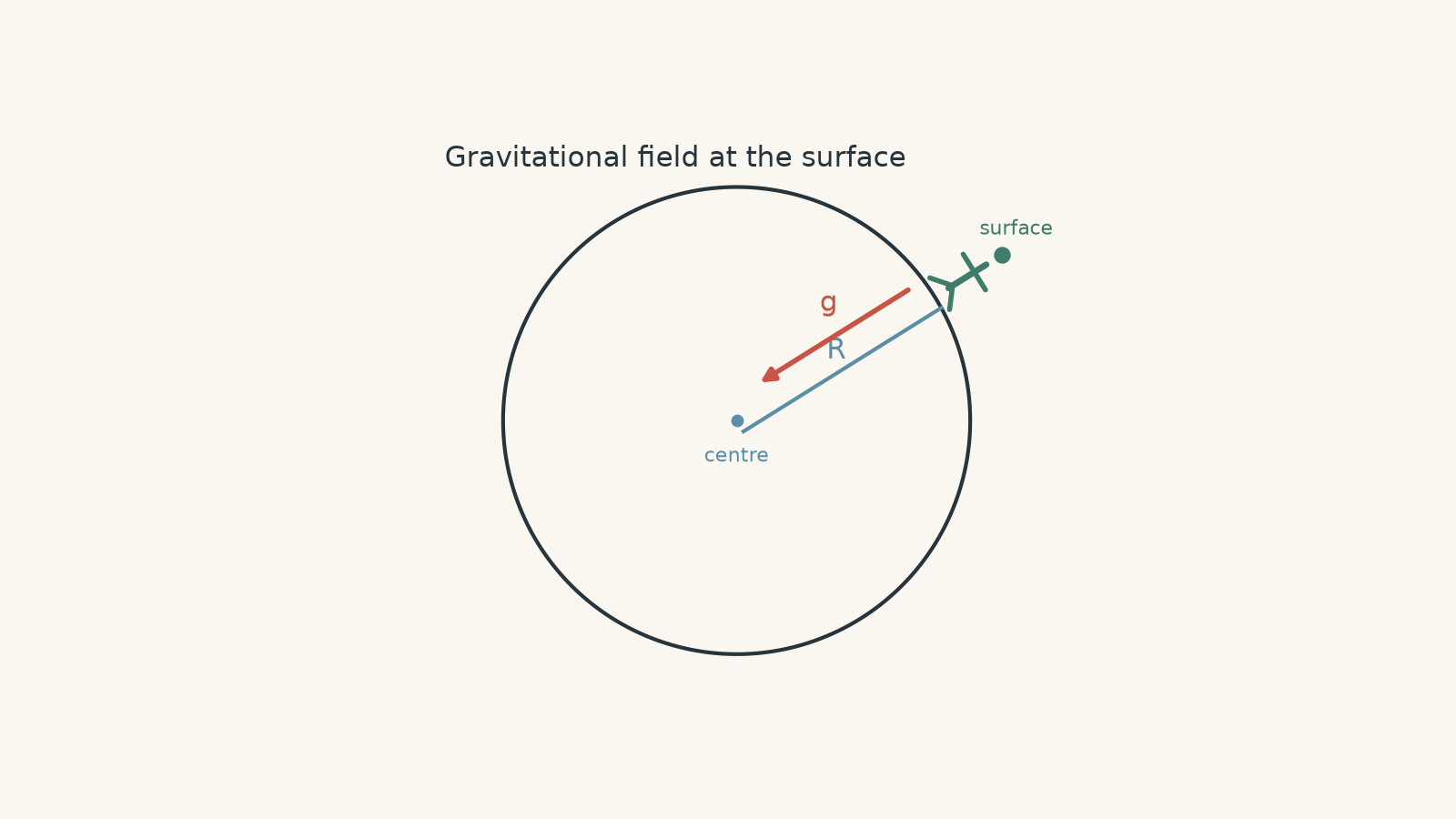
Now imagine keeping the planet’s mass unchanged but making the planet puffier. You are standing farther from its centre, so the gravitational field at the surface becomes weaker.
A useful picture is to imagine the same gravitational influence spread over larger and larger spherical surfaces. A sphere with twice the radius has four times the surface area, which hints at why the field falls with the square of distance. Gravity is not literally a substance being spread out, so that picture has limits, but it gives the right inverse-square pattern.
02From gravitational force to gravitational field strength
Newton’s law of universal gravitation gives the force between a planet of mass \(M\) and an object of mass \(m\):
\[
F = \frac{GMm}{r^2}
\]
where:
- \(F\) is the gravitational force in newtons, \(\mathrm{N}\),
- \(G = 6.67 \times 10^{-11}\ \mathrm{N\,m^2\,kg^{-2}}\) is the universal gravitational constant,
- \(M\) is the planet’s mass in kilograms,
- \(m\) is the mass of the object being attracted, in kilograms, and
- \(r\) is the distance between their centres of mass, in metres.
Gravitational field strength, \(g\), tells us the gravitational force acting per kilogram:
\[
g = \frac{F}{m}
\]
Substitute Newton’s gravitational force into this definition:
\[
g = \frac{1}{m}\left(\frac{GMm}{r^2}\right)
\]
The object’s mass cancels:
\[
g = \frac{GM}{r^2}
\]
At the surface of a planet, \(r=R\), so:
\[
\boxed{g = \frac{GM}{R^2}}
\]
Here, \(R\) must be the planet’s radius in metres.
This cancellation explains an important result. A \(2\ \mathrm{kg}\) object experiences twice the gravitational force of a \(1\ \mathrm{kg}\) object, but it also has twice the inertia. If gravity is the only force acting, both objects therefore have the same acceleration.
Gravitational field strength has units of \(\mathrm{N\,kg^{-1}}\). Because \(1\ \mathrm{N}=1\ \mathrm{kg\,m\,s^{-2}}\),
\[
1\ \mathrm{N\,kg^{-1}} = 1\ \mathrm{m\,s^{-2}}
\]
So a gravitational field strength of \(9.8\ \mathrm{N\,kg^{-1}}\) also means that a freely falling object accelerates at \(9.8\ \mathrm{m\,s^{-2}}\), provided gravity is the only significant force.
If you want to revisit where the force equation comes from, see Newton’s Law of Universal Gravitation for HSC Physics.
03What mass and radius actually do
The equation
\[
g=\frac{GM}{R^2}
\]
contains two competing effects.
| Change to the planet | Effect on surface \(g\) |
|---|---|
| Double \(M\), keep \(R\) unchanged | \(g\) doubles |
| Double \(R\), keep \(M\) unchanged | \(g\) becomes one-quarter |
| Double both \(M\) and \(R\) | \(g\) becomes one-half |
| Multiply \(M\) by 4 and \(R\) by 2 | \(g\) stays unchanged |
That final row is worth noticing.
A planet can be four times as massive as another planet and still have exactly the same surface gravity if its radius is twice as large.
So “more massive planet” does not automatically mean “stronger gravity at the surface”.
04A reliable calculation method
For an HSC calculation, use this sequence:
- Identify the planet’s mass \(M\).
- Identify its radius \(R\).
- Convert the radius to metres if necessary.
- Square the radius.
- Substitute into \(g=GM/R^2\).
- Give \(g\) in \(\mathrm{N\,kg^{-1}}\) or \(\mathrm{m\,s^{-2}}\).
- Check whether the result makes physical sense.
The most common calculator mistake is mishandling \(R^2\).
For example,
\[
(5.0\times10^6)^2
=
25\times10^{12}
=
2.5\times10^{13}
\]
Both the number and the power of ten are squared.
Worked example: Calculate the gravity on a planet
A spherical planet has a mass of \(5.20\times10^{24}\ \mathrm{kg}\) and a radius of \(5.80\times10^6\ \mathrm{m}\). Calculate its gravitational field strength at the surface.
Step 1
At the planet’s surface,
\[
g=\frac{GM}{R^2}
\]
Step 2
\[
g=
\frac{(6.67\times10^{-11})(5.20\times10^{24})}
{(5.80\times10^6)^2}
\]
Step 3
\[
\begin{aligned}
R^2 &= 3.364\times10^{13}\ \mathrm{m^2} \\
g &=
\frac{3.4684\times10^{14}}
{3.364\times10^{13}} \\
&=10.31\ \mathrm{N\,kg^{-1}}
\end{aligned}
\]
To three significant figures,
\[
g=10.3\ \mathrm{N\,kg^{-1}}
\]
Step 4
Every kilogram of mass at the surface experiences about \(10.3\ \mathrm{N}\) of gravitational force. An object falling freely near the surface would accelerate at about \(10.3\ \mathrm{m\,s^{-2}}\), ignoring effects such as air resistance and planetary rotation.
05Comparing planets without using \(G\)
Sometimes a question gives one planet’s mass and radius relative to another planet.
In that case, calculating each value separately is unnecessary.
For two planets,
\[
g_1=\frac{GM_1}{R_1^2}
\]
and
\[
g_2=\frac{GM_2}{R_2^2}
\]
Divide the second equation by the first:
\[
\frac{g_2}{g_1}
=
\frac{M_2}{M_1}
\left(\frac{R_1}{R_2}\right)^2
\]
The constant \(G\) cancels.
This ratio method is usually faster, and it makes the physics easier to see.
Worked example: A heavier planet with weaker gravity?
Planet X has \(3.20\) times Earth’s mass and \(1.80\) times Earth’s radius. Take Earth’s surface gravitational field strength as \(9.81\ \mathrm{N\,kg^{-1}}\). Calculate the surface gravitational field strength of Planet X.
Before calculating, make a prediction. Planet X has more than three times Earth’s mass, so should its surface gravity be dramatically stronger?
Not necessarily. Its larger radius puts its surface much farther from its centre.
Step 1
\[
\frac{g_X}{g_E}
=
\frac{M_X}{M_E}
\left(\frac{R_E}{R_X}\right)^2
\]
Step 2
\[
\frac{g_X}{g_E}
=
3.20\left(\frac{1}{1.80}\right)^2
=
\frac{3.20}{3.24}
=
0.988
\]
Step 3
\[
\begin{aligned}
g_X &=0.988(9.81)\\
&=9.69\ \mathrm{N\,kg^{-1}}
\end{aligned}
\]
Step 4
Despite having \(3.20\) times Earth’s mass, Planet X has slightly weaker surface gravity because its radius is also substantially larger.
The squared radius is doing serious work here.
06The misconception: “A more massive planet has stronger surface gravity”
This statement is incomplete.
Suppose Planet B has four times the mass of Planet A. You might immediately predict that its surface gravity is four times stronger.
Now suppose Planet B also has twice the radius.
Then
\[
\frac{g_B}{g_A}
=
4\left(\frac{1}{2}\right)^2
=
1
\]
Their surface gravitational field strengths are identical.
The problem is that “more massive” tells you only half the story. Surface gravity asks how much mass there is and how far the surface lies from that mass.
A slightly silly way to remember this is to imagine gravity as someone trying to get your attention across a room. Adding more people yelling makes the effect stronger, but moving much farther away weakens what reaches you. The analogy breaks because gravitational attraction follows a precise inverse-square law rather than the messy behaviour of sound in a room, but the competition between “more source” and “more distance” is useful.
07Be precise about what “surface” means
The equation
\[
g=\frac{GM}{R^2}
\]
uses the distance from the planet’s centre.
This matters when altitude appears in a question.
If a planet has radius \(R\) and a spacecraft is at altitude \(h\), its distance from the centre is
\[
r=R+h
\]
so the gravitational field there is
\[
g=\frac{GM}{(R+h)^2}
\]
Do not put \(h\) alone into the denominator.
For example, a spacecraft at an altitude equal to one planetary radius is not a distance \(R\) from the centre. It is a distance
\[
R+R=2R
\]
from the centre.
Its gravitational field strength is therefore
\[
g=\frac{GM}{(2R)^2}
=\frac{1}{4}\frac{GM}{R^2}
\]
so gravity is one-quarter of its surface value, not one-half.
That inverse-square behaviour becomes essential when you move from surface gravity to satellites and orbital motion.
08Where the surface-gravity model has limits
For normal HSC questions, a planet is usually treated as spherical, with a spherically symmetric mass distribution.
Under that model, the external field behaves as though the planet’s mass were concentrated at its centre.
A few limits are worth keeping straight:
- \(R\) is measured from the centre, not from the ground.
- The simple equation gives the gravitational field produced by the planet itself. A planet’s rotation can alter the effective weight measured by someone standing on its surface.
- The equation \(GM/r^2\) works outside a spherical planet. Inside the planet, you cannot simply pretend that the entire planetary mass remains concentrated at the centre and use the same calculation unchanged.
- Local variations in density, mountains, and irregular shape can cause small differences in real gravitational fields. HSC calculations normally ignore these unless the question says otherwise.
These are not reasons to avoid the model. They tell you exactly when the model is useful.
09Questions and solutions
Question 1
A spherical planet has a mass of \(4.80\times10^{24}\ \mathrm{kg}\) and a radius of \(5.50\times10^6\ \mathrm{m}\).
Calculate its gravitational field strength at the surface.
Solution 1
The surface gravitational field strength is \(10.6\ \mathrm{N\,kg^{-1}}\).
Use
\[
g=\frac{GM}{R^2}
\]
with \(G=6.67\times10^{-11}\ \mathrm{N\,m^2\,kg^{-2}}\).
\[
\begin{aligned}
g
&=
\frac{(6.67\times10^{-11})(4.80\times10^{24})}
{(5.50\times10^6)^2}\\
&=
\frac{3.2016\times10^{14}}
{3.025\times10^{13}}\\
&=10.58\ \mathrm{N\,kg^{-1}}
\end{aligned}
\]
To three significant figures,
\[
g=10.6\ \mathrm{N\,kg^{-1}}
\]
This means a \(1.00\ \mathrm{kg}\) object at the surface experiences about \(10.6\ \mathrm{N}\) of gravitational force.
A tempting error is to square only \(5.50\) or only \(10^6\). The entire radius \(5.50\times10^6\) must be squared.
Question 2
Planet B has a radius \(1.50\) times the radius of Planet A.
The gravitational field strength at the surface of Planet B is \(80.0\%\) of the field strength at the surface of Planet A.
Determine the ratio \(M_B/M_A\).
Explain how Planet B can have a greater mass than Planet A while still having weaker surface gravity.
Solution 2
Planet B has \(1.80\) times the mass of Planet A, despite having weaker surface gravity.
Start with the ratio:
\[
\frac{g_B}{g_A}
=
\frac{M_B}{M_A}
\left(\frac{R_A}{R_B}\right)^2
\]
The question gives
\[
\frac{g_B}{g_A}=0.800
\]
and
\[
\frac{R_B}{R_A}=1.50
\]
so
\[
\frac{R_A}{R_B}=\frac{1}{1.50}
\]
Therefore,
\[
0.800
=
\frac{M_B}{M_A}
\left(\frac{1}{1.50}\right)^2
\]
Rearranging,
\[
\begin{aligned}
\frac{M_B}{M_A}
&=0.800(1.50)^2\\
&=0.800(2.25)\\
&=1.80
\end{aligned}
\]
So
\[
\frac{M_B}{M_A}=1.80
\]
Planet B is more massive, but its surface is \(1.50\) times farther from its centre. Because distance is squared in the gravitational field equation, this larger radius more than offsets the effect of its additional mass.
The tempting route is to assume greater mass must mean greater surface gravity. That would be true only if the two planets had the same radius.
Question 3
A planet has a radius of \(7.00\times10^6\ \mathrm{m}\) and a surface gravitational field strength of \(9.53\ \mathrm{N\,kg^{-1}}\).
A \(75.0\ \mathrm{kg}\) probe rises to an altitude of \(7.00\times10^6\ \mathrm{m}\) above the surface.
Calculate:
a. the gravitational field strength at the probe’s new position, and
b. the probe’s gravitational force at the surface and at its new position.
A student claims that the field should be half as strong because the probe has moved upward by one planetary radius. Explain the error.
Solution 3
The field at the probe is \(2.38\ \mathrm{N\,kg^{-1}}\), and its gravitational force falls from about \(715\ \mathrm{N}\) to \(179\ \mathrm{N}\).
The altitude is one planetary radius, but gravitational distance is measured from the planet’s centre.
At the surface,
\[
r=R
\]
At the new position,
\[
r=R+h=R+R=2R
\]
Because gravitational field strength follows an inverse-square relationship,
\[
\frac{g_{\text{new}}}{g_{\text{surface}}}
=
\left(\frac{R}{2R}\right)^2
=
\frac14
\]
Therefore,
\[
\begin{aligned}
g_{\text{new}}
&=\frac{9.53}{4}\\
&=2.3825\ \mathrm{N\,kg^{-1}}\\
&\approx2.38\ \mathrm{N\,kg^{-1}}
\end{aligned}
\]
For the probe’s gravitational force, use
\[
F=mg
\]
At the surface,
\[
\begin{aligned}
F_{\text{surface}}
&=(75.0)(9.53)\\
&=714.75\ \mathrm{N}\\
&\approx715\ \mathrm{N}
\end{aligned}
\]
At the new position,
\[
\begin{aligned}
F_{\text{new}}
&=(75.0)(2.3825)\\
&=178.7\ \mathrm{N}\\
&\approx179\ \mathrm{N}
\end{aligned}
\]
The student’s half-strength prediction treats gravity as though it were inversely proportional to distance. It is inversely proportional to the square of distance. Doubling the distance from the centre therefore reduces the field to one-quarter.
The phrase “moved up by one radius” is the trap. The relevant distance has changed from \(R\) to \(2R\).
Question 4
A spherical planet initially has mass \(M\), radius \(R\), and surface gravitational field strength \(g_0\).
The planet contracts until its radius is \(R/2\), without losing any mass.
Two small objects are considered immediately after the contraction:
- Object A remains at its original position, a distance \(R\) from the planet’s centre.
- Object B is resting on the planet’s new surface, a distance \(R/2\) from the centre.
Ignore rotation and any effects caused by the contraction itself.
Determine the gravitational field strength at A and B in terms of \(g_0\).
Object A was originally hovering because a thruster supplied an upward force exactly equal to its weight. If the thruster force remains unchanged, determine whether A initially accelerates inward, accelerates outward, or continues hovering after the planet contracts.
Solution 4
Object A still experiences \(g_0\), Object B experiences \(4g_0\), and Object A continues hovering if its thruster force remains unchanged.
Originally,
\[
g_0=\frac{GM}{R^2}
\]
The planet contracts, but its mass remains \(M\).
Object A is still a distance \(R\) from the centre. Therefore,
\[
g_A=\frac{GM}{R^2}=g_0
\]
Its gravitational field has not changed.
Object B is on the new surface, where
\[
r=\frac{R}{2}
\]
so
\[
\begin{aligned}
g_B
&=
\frac{GM}{(R/2)^2}\\
&=
\frac{GM}{R^2/4}\\
&=
4\frac{GM}{R^2}\\
&=4g_0
\end{aligned}
\]
Before the contraction, Object A’s thruster supplied an upward force equal to
\[
F_{\text{thrust}}=mg_0
\]
After the contraction, A is still at the same distance from the same total mass, so its gravitational force is still
\[
F_g=mg_0
\]
The forces therefore remain balanced, giving zero initial acceleration.
The tempting prediction is that because the planet becomes denser, gravity must become stronger everywhere outside it. That is not what Newton’s model says for a spherical mass.
The contraction greatly increases gravity at the new surface because the new surface is closer to the centre. But at a fixed external distance \(r=R\), neither the total mass nor the distance has changed, so the gravitational field remains unchanged.
The key is to track distance from the centre rather than distance above the surface.
Question 5
Two spherical planets, A and B, have the same surface gravitational field strength \(g_0\).
Planet A has radius \(R\). Planet B has radius \(2R\).
An identical object is launched vertically upward from the surface of each planet with the same initial speed \(v\), where
\[
v^2=\frac12g_0R
\]
Ignore atmospheres and planetary rotation.
Using conservation of mechanical energy and gravitational potential energy
\[
U=-\frac{GMm}{r},
\]
determine which object reaches the greater maximum height above its planet’s surface.
A student argues that the heights must be equal because both objects start with the same speed and both planets have the same surface value of \(g\). Explain exactly why that reasoning fails.
Solution 5
The object launched from the smaller planet, Planet A, rises higher: it reaches \(R/3\) above the surface, compared with \(2R/7\) above Planet B’s surface.
The student’s equal-height argument would work only if gravitational field strength remained constant throughout each flight. It does not. Gravity weakens as the object moves away from each planet, and the rate of that change depends on the planet’s radius.
For Planet A, conservation of mechanical energy gives
\[
\frac12mv^2-\frac{GM_Am}{R}
=
-\frac{GM_Am}{R+h_A}
\]
where \(h_A\) is the maximum height above the surface.
Cancel \(m\):
\[
\frac12v^2
=
GM_A
\left(
\frac1R-\frac{1}{R+h_A}
\right)
\]
Because Planet A’s surface gravity is \(g_0\),
\[
g_0=\frac{GM_A}{R^2}
\]
so
\[
GM_A=g_0R^2
\]
The launch condition is
\[
v^2=\frac12g_0R
\]
and therefore
\[
\frac12v^2=\frac14g_0R
\]
Substitute these results:
\[
\frac14g_0R
=
g_0R^2
\left(
\frac1R-\frac1{R+h_A}
\right)
\]
Cancel \(g_0R\):
\[
\frac14
=
1-\frac{R}{R+h_A}
\]
Therefore,
\[
\frac{R}{R+h_A}=\frac34
\]
so
\[
R+h_A=\frac43R
\]
and
\[
h_A=\frac13R
\]
Now consider Planet B.
Its radius is
\[
R_B=2R
\]
and it has the same surface gravity \(g_0\). Therefore,
\[
GM_B=g_0R_B^2
=g_0(2R)^2
=4g_0R^2
\]
Conservation of energy gives
\[
\frac12v^2
=
GM_B
\left(
\frac1{2R}-\frac1{2R+h_B}
\right)
\]
Substituting \(\frac12v^2=\frac14g_0R\) and \(GM_B=4g_0R^2\),
\[
\frac14g_0R
=
4g_0R^2
\left(
\frac1{2R}-\frac1{2R+h_B}
\right)
\]
An equivalent, simpler form is
\[
\frac14g_0R
=
2g_0R\frac{h_B}{2R+h_B}
\]
Cancel \(g_0R\):
\[
\frac14
=
\frac{2h_B}{2R+h_B}
\]
Hence,
\[
\begin{aligned}
2R+h_B&=8h_B\\
2R&=7h_B\\
h_B&=\frac{2R}{7}
\end{aligned}
\]
Compare the heights:
\[
h_A=\frac{R}{3}\approx0.333R
\]
and
\[
h_B=\frac{2R}{7}\approx0.286R
\]
so Planet A gives the greater maximum height.
The tempting constant-\(g\) method would use
\[
v^2=2gh
\]
and predict the same height on both planets because \(v\) and \(g_0\) are identical. But that equation assumes \(g\) is effectively constant over the displacement.
Here, the object rises a substantial fraction of a planetary radius. The gravitational field changes significantly during the motion.
Planet A is smaller, so a given upward displacement represents a larger fractional increase in distance from its centre. Its gravitational field therefore weakens more rapidly during the climb. The object loses gravitational kinetic energy less rapidly than a constant-\(g\) model predicts, allowing it to rise farther.
This is the important result: equal surface gravity does not mean two planets have identical gravitational fields everywhere above their surfaces.
10What surface gravity lets you work out next
Once you can use
\[
g=\frac{GM}{R^2},
\]
surface gravity stops being a fact you have to memorise for each planet. It becomes something you can predict from the planet’s physical properties.
The next step is to replace the fixed surface distance \(R\) with a changing distance \(r\). That lets you analyse how gravitational fields weaken with altitude, how spacecraft move around planets, and why orbital motion depends on both distance and central mass.
That same inverse-square gravitational field leads directly into orbital speed, orbital period, and Kepler’s Three Laws of Planetary Motion for HSC Physics.