
Orbital Velocity: Derivation and Calculations for HSC Physics
Learn how gravity provides the centripetal force for circular orbits, derive the orbital-speed equation, and apply it to HSC-style calculations and reasoning.
Imagine a satellite 400 km above Earth. Its engines switch off. Gravity pulls it towards Earth the whole time, so why doesn’t it simply crash?
Before reading on, make a prediction: if you wanted the satellite to orbit even higher, would it need to move faster or slower?
The tempting answer is faster. After all, more speed sounds like it should help the satellite “fight” gravity. For a circular orbit, though, the answer is slower. Understanding why gives us the orbital-speed equation rather than just another formula to memorise.
01A satellite is falling without reaching the ground
Start with something familiar. Throw a ball horizontally and it moves sideways while gravity pulls it down. Throw it faster and it travels further before hitting the ground.
Now imagine three unrealistic but useful changes:
- there is no air resistance,
- Earth is perfectly spherical, and
- you can throw the ball ridiculously fast.
At a particular sideways speed, the ball falls towards Earth at exactly the rate that Earth’s curved surface falls away beneath it. It keeps missing the ground.
That is the basic picture of a circular orbit.
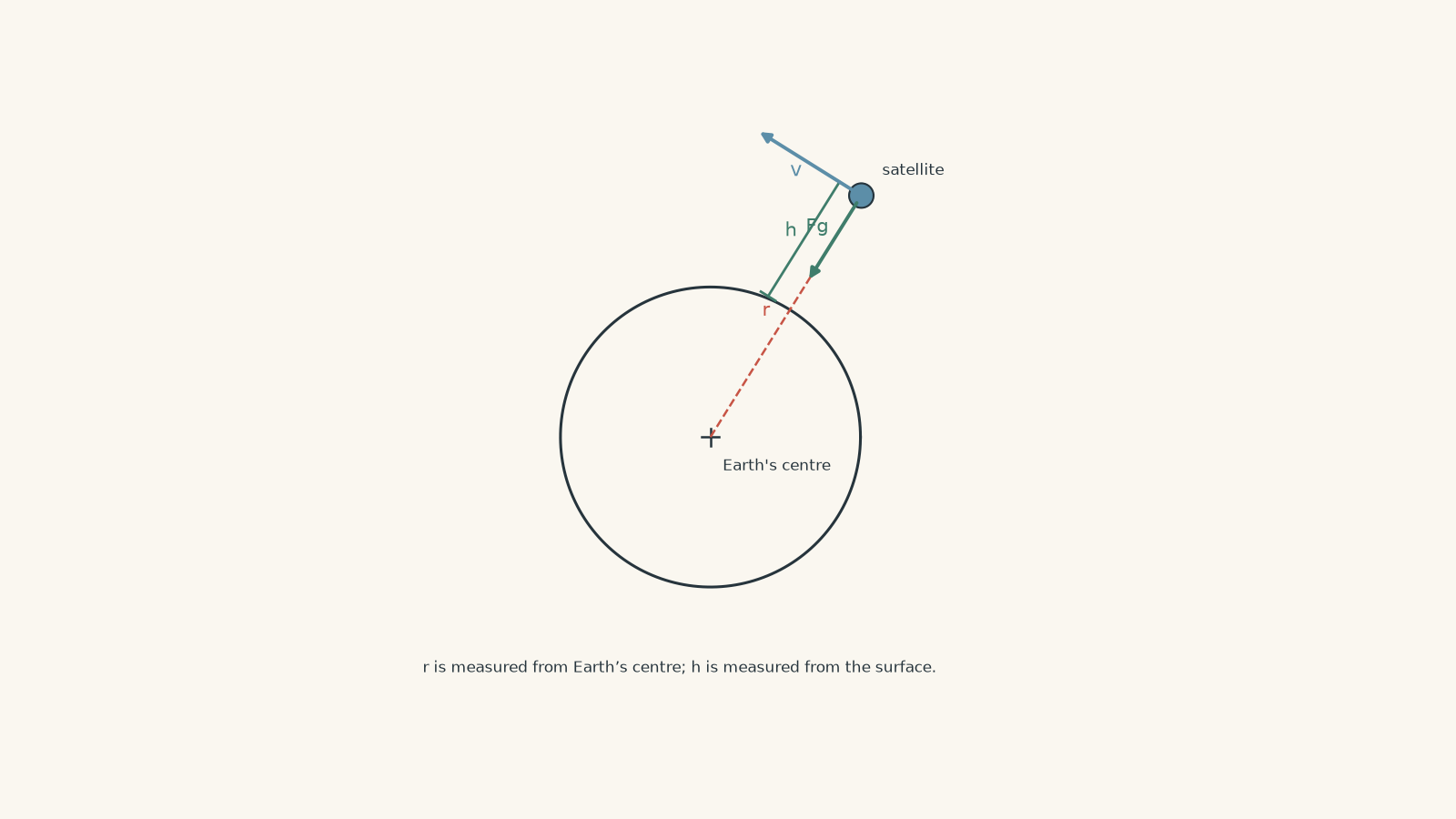
This picture is useful, but incomplete. A real orbit is not created simply by “going sideways quickly”. The speed has to have one particular value for a chosen circular radius. Too little or too much speed gives a different trajectory.
We need to find that particular value.
02Gravity does the turning
An object travelling in a circle is constantly changing direction. Even if its speed stays constant, its velocity does not, because velocity includes direction.
That change in velocity requires a centripetal acceleration directed towards the centre:
\[ a_c=\frac{v^2}{r} \]
where:
- \(a_c\) is centripetal acceleration in \(\text{m s}^{-2}\),
- \(v\) is orbital speed in \(\text{m s}^{-1}\), and
- \(r\) is the circular orbital radius in metres.
For a satellite orbiting a planet, what provides this inward acceleration?
Gravity.
This is worth being precise about. Gravity and “centripetal force” are not two separate forces pointing towards the planet. Centripetal force is the name for the net inward force required for circular motion. In this situation, gravity is doing that job.
Think of “centripetal force” as a job title rather than another employee. In a car turning on a flat road, friction may have the job. In an orbit, gravity has the job. The analogy stops there: the actual forces involved are very different.
The gravitational force between a planet of mass \(M\) and a satellite of mass \(m\) is
\[ F_g=\frac{GMm}{r^2} \]
where \(G=6.67\times10^{-11}\ \text{N m}^2\text{kg}^{-2}\) is the universal gravitational constant.
If you need to refresh where this equation comes from, see Newton’s Law of Universal Gravitation for HSC Physics.
03Deriving circular orbital speed
For a circular orbit, gravity must provide exactly the required centripetal force.
The required centripetal force is
\[ F_c=\frac{mv^2}{r} \]
so we set gravitational force equal to the required centripetal force:
\[ \frac{GMm}{r^2}=\frac{mv^2}{r} \]
Notice what this equation means physically. The left side tells us how strongly gravity pulls. The right side tells us how much inward force is required to bend the satellite’s motion into a circle of radius \(r\).
Now cancel the satellite mass \(m\):
\[ \frac{GM}{r^2}=\frac{v^2}{r} \]
Multiply both sides by \(r\):
\[ \frac{GM}{r}=v^2 \]
Therefore,
\[ v=\sqrt{\frac{GM}{r}} \]
This is the circular orbital-speed equation.
Here:
- \(v\) is the circular orbital speed in \(\text{m s}^{-1}\),
- \(G\) is the universal gravitational constant,
- \(M\) is the mass of the central body in kg, and
- \(r\) is the distance from the centre of the central body to the satellite in metres.
For HSC questions, “orbital velocity” is often used when the calculation is really asking for this speed magnitude. Strictly, velocity is a vector, and its direction changes continuously around the orbit.
04Radius is not altitude
This is probably the most common calculation error in orbital-speed questions.
Suppose a satellite is 400 km above Earth’s surface. You cannot put \(400\text{ km}\) into \(r\).
The equation uses distance from Earth’s centre:
\[ r=R_E+h \]
where \(R_E\) is Earth’s radius and \(h\) is the satellite’s altitude.
If
\[ R_E=6.37\times10^6\text{ m} \]
and
\[ h=400\text{ km}=4.00\times10^5\text{ m}, \]
then
\[ r=6.37\times10^6+4.00\times10^5 =6.77\times10^6\text{ m}. \]
Only then are you ready to use the orbital-speed equation.
Worked example: Find the speed of a low Earth satellite
A satellite travels in a circular orbit 400 km above Earth’s surface. Calculate its orbital speed. Use \(M_E=5.97\times10^{24}\text{ kg}\), \(R_E=6.37\times10^6\text{ m}\), and \(G=6.67\times10^{-11}\text{ N m}^2\text{kg}^{-2}\).
Step 1
\[ \begin{aligned} h&=400\text{ km}=4.00\times10^5\text{ m}\\ r&=R_E+h\\ &=6.37\times10^6+4.00\times10^5\\ &=6.77\times10^6\text{ m} \end{aligned} \]
Step 2
\[ v=\sqrt{\frac{GM_E}{r}} \]
Step 3
\[ \begin{aligned} v&=\sqrt{\frac{(6.67\times10^{-11})(5.97\times10^{24})} {6.77\times10^6}}\\ &=7.67\times10^3\text{ m s}^{-1} \end{aligned} \]
So,
\[ v\approx7.67\text{ km s}^{-1}. \]
The satellite is moving at roughly \(7.7\text{ km}\) every second. Gravity is still strong at that altitude; the satellite stays up because that gravity continuously bends its high sideways velocity into a circular path.
05Why a higher circular orbit is slower
Return to the prediction from the start. Why does a higher satellite move more slowly?
From
\[ v=\sqrt{\frac{GM}{r}}, \]
for the same planet, \(G\) and \(M\) are constant. Therefore,
\[ v\propto\frac{1}{\sqrt r}. \]
Increase \(r\), and the required circular speed decreases.
This can feel backwards because students often imagine speed as something holding a satellite up against gravity. That is not what is happening.
At a larger radius, gravity is weaker. The satellite therefore has a smaller inward acceleration. A slower sideways speed can curve at exactly the required rate to follow the larger circular path.
There is an important consequence:
| Change | Circular-orbit consequence |
|---|---|
| Increase central mass \(M\) | Orbital speed increases |
| Increase orbital radius \(r\) | Orbital speed decreases |
| Increase satellite mass \(m\) | No change in the HSC satellite model |
| Increase \(r\) | Orbital period increases |
The last row needs a little explanation.
One orbit has circumference \(2\pi r\), so
\[ v=\frac{2\pi r}{T}, \]
where \(T\) is the orbital period in seconds.
Rearranging,
\[ T=\frac{2\pi r}{v}. \]
A higher circular orbit has a longer distance to travel and a lower orbital speed. Both effects make its period longer.
Substituting \(v=\sqrt{GM/r}\) gives
\[ T=2\pi\sqrt{\frac{r^3}{GM}}, \]
and therefore
\[ T^2=\frac{4\pi^2}{GM}r^3. \]
That is the circular-orbit form of the relationship behind Kepler’s third law.
06You are not always given the planet’s mass
Sometimes a question gives the gravitational field strength at the planet’s surface instead of its mass.
At the surface,
\[ g_s=\frac{GM}{R^2}, \]
where \(g_s\) is the surface gravitational field strength and \(R\) is the planet’s radius.
Rearranging,
\[ GM=g_sR^2. \]
You can then insert this directly into
\[ v=\sqrt{\frac{GM}{r}}. \]
This is often cleaner than trying to calculate \(M\) separately.
Worked example: Find orbital speed without being given the planet’s mass
A spherical planet has radius \(4.00\times10^6\text{ m}\) and surface gravitational field strength \(6.00\text{ m s}^{-2}\). A satellite travels in a circular orbit \(2.00\times10^6\text{ m}\) above the surface.
Calculate the satellite’s orbital speed and period.
Step 1
Using
\[ g_s=\frac{GM}{R^2}, \]
we get
\[ \begin{aligned} GM&=g_sR^2\\ &=(6.00)(4.00\times10^6)^2\\ &=9.60\times10^{13}\text{ m}^3\text{s}^{-2}. \end{aligned} \]
Step 2
\[ \begin{aligned} r&=R+h\\ &=4.00\times10^6+2.00\times10^6\\ &=6.00\times10^6\text{ m}. \end{aligned} \]
Step 3
\[ \begin{aligned} v&=\sqrt{\frac{GM}{r}}\\ &=\sqrt{\frac{9.60\times10^{13}}{6.00\times10^6}}\\ &=\sqrt{1.60\times10^7}\\ &=4.00\times10^3\text{ m s}^{-1}. \end{aligned} \]
So the orbital speed is
\[ v=4.00\text{ km s}^{-1}. \]
Step 4
\[ \begin{aligned} T&=\frac{2\pi r}{v}\\ &=\frac{2\pi(6.00\times10^6)}{4.00\times10^3}\\ &=9.42\times10^3\text{ s}. \end{aligned} \]
Converting to hours,
\[ T=\frac{9.42\times10^3}{3600}=2.62\text{ h}. \]
The satellite travels at \(4.00\text{ km s}^{-1}\) and completes one orbit in about \(2.62\) hours.
07Why the satellite’s mass disappears
When we derived orbital speed, the satellite mass \(m\) cancelled:
\[ \frac{GMm}{r^2}=\frac{mv^2}{r}. \]
This tells us something physical, not just algebraic.
A satellite with twice the mass experiences twice the gravitational force:
\[ F_g\propto m. \]
But twice the mass also requires twice the force to produce the same centripetal acceleration:
\[ F_c\propto m. \]
The two effects increase together. Therefore, two small satellites at the same circular radius around the same planet require the same orbital speed, regardless of their masses.
This statement uses the normal HSC approximation that the satellite’s mass is tiny compared with the planet’s mass. If the two bodies have comparable masses, both orbit their common centre of mass, and the exact two-body treatment involves both masses. For an ordinary artificial satellite around Earth, that correction is absurdly small.
08Three equations that are really one idea
For a circular gravitational orbit, these equations describe the same motion from different angles:
\[ F_g=\frac{GMm}{r^2}, \]
\[ a_c=\frac{v^2}{r}, \]
and
\[ v=\sqrt{\frac{GM}{r}}. \]
A useful decision rule is to ask what the question actually gives you.
| If you know… | A useful route is… |
|---|---|
| \(M\) and \(r\) | \(v=\sqrt{GM/r}\) |
| Surface \(g_s\), planet radius \(R\), and orbital radius \(r\) | \(GM=g_sR^2\), then find \(v\) |
| \(v\) and \(r\) | \(M=v^2r/G\) |
| \(v\) and \(r\) and need the period | \(T=2\pi r/v\) |
| \(T\) and \(r\) | \(GM=4\pi^2r^3/T^2\) |
These are not separate tricks. They all come from gravity providing the centripetal acceleration.
For a fuller treatment of that connection, see Gravity as Centripetal Force in Circular Orbits for HSC Physics.
09The formula only describes circular orbits
There is one dangerous way to misuse
\[ v=\sqrt{\frac{GM}{r}}. \]
It does not mean that every object passing through radius \(r\) must have that speed.
It means:
An object in a circular orbit of radius \(r\) around a mass \(M\) requires this speed.
A spacecraft in an elliptical orbit can pass through the same radius with a different speed. A spacecraft escaping the planet can also pass through that radius with a different speed.
So if a spacecraft in a circular orbit briefly fires its engines, you cannot simply calculate a new radius from its new speed and declare that it has moved into another circle. At the instant the burn ends, its position has barely changed. If its speed is no longer the circular speed for that radius, its path cannot remain circular.
This is the deeper point behind the formula: circular orbital speed is a condition for a particular path, not a universal relationship between position and speed.
10Questions and solutions
Question 1
A satellite travels in a circular orbit 500 km above Earth.
Calculate its orbital speed using
\[ M_E=5.97\times10^{24}\text{ kg}, \]
\[ R_E=6.37\times10^6\text{ m}, \]
and
\[ G=6.67\times10^{-11}\text{ N m}^2\text{kg}^{-2}. \]
Solution 1
The satellite’s orbital speed is approximately \(7.61\times10^3\text{ m s}^{-1}\), or \(7.61\text{ km s}^{-1}\).
The main trap is using the 500 km altitude as the orbital radius. The orbital radius must be measured from Earth’s centre.
First convert the altitude:
\[ h=500\text{ km}=5.00\times10^5\text{ m}. \]
Then
\[ \begin{aligned} r&=R_E+h\\ &=6.37\times10^6+5.00\times10^5\\ &=6.87\times10^6\text{ m}. \end{aligned} \]
For a circular orbit,
\[ v=\sqrt{\frac{GM_E}{r}}. \]
Substituting,
\[ \begin{aligned} v&=\sqrt{\frac{(6.67\times10^{-11})(5.97\times10^{24})} {6.87\times10^6}}\\ &=7.61\times10^3\text{ m s}^{-1}. \end{aligned} \]
So,
\[ \boxed{v\approx7.61\text{ km s}^{-1}} \]
in magnitude.
The satellite is slightly slower than one at 400 km altitude because its larger orbital radius requires a lower circular speed.
Question 2
Satellites A and B travel in circular orbits around the same planet. Satellite A has an orbital period of \(2.00\) h.
Satellite B’s orbital speed is \(0.800\) times the orbital speed of A.
Determine:
- the ratio \(r_B/r_A\),
- the orbital period of B, and
- the ratio of gravitational field strengths \(g_B/g_A\) at the two orbital radii.
Solution 2
The results are
\[ \frac{r_B}{r_A}=1.5625, \]
\[ T_B=3.91\text{ h}, \]
and
\[ \frac{g_B}{g_A}=0.4096. \]
The tempting mistake is to think a 20% lower speed means a 20% larger radius. Orbital speed depends on the square root of radius, so the relationship is not linear.
For the same central mass,
\[ v=\sqrt{\frac{GM}{r}}, \]
so
\[ v\propto r^{-1/2}. \]
Therefore,
\[ \frac{v_B}{v_A} = \sqrt{\frac{r_A}{r_B}}. \]
Given \(v_B/v_A=0.800\),
\[ 0.800=\sqrt{\frac{r_A}{r_B}}. \]
Squaring,
\[ 0.640=\frac{r_A}{r_B}, \]
so
\[ \frac{r_B}{r_A}=\frac{1}{0.640}=1.5625. \]
For the period,
\[ T=\frac{2\pi r}{v}. \]
Therefore,
\[ \frac{T_B}{T_A} = \frac{r_B}{r_A}\frac{v_A}{v_B}. \]
Substituting,
\[ \begin{aligned} \frac{T_B}{T_A} &=(1.5625)\left(\frac{1}{0.800}\right)\\ &=1.953125. \end{aligned} \]
Hence,
\[ \begin{aligned} T_B&=(1.953125)(2.00\text{ h})\\ &=3.91\text{ h}. \end{aligned} \]
Finally,
\[ g=\frac{GM}{r^2}, \]
so
\[ \begin{aligned} \frac{g_B}{g_A} &=\left(\frac{r_A}{r_B}\right)^2\\ &=\left(\frac{1}{1.5625}\right)^2\\ &=0.4096. \end{aligned} \]
Satellite B therefore moves more slowly, takes almost twice as long to orbit, and experiences only about \(41\%\) of the gravitational field strength experienced by A.
Question 3
A spherical planet has radius \(5.00\times10^6\text{ m}\) and surface gravitational field strength \(8.00\text{ m s}^{-2}\).
A satellite is observed travelling in a circular orbit at \(5.00\times10^3\text{ m s}^{-1}\).
Calculate:
- the satellite’s orbital radius,
- its altitude above the planet’s surface, and
- its orbital period.
Solution 3
The orbital radius is \(8.00\times10^6\text{ m}\), the altitude is \(3.00\times10^6\text{ m}\), and the period is approximately \(1.01\times10^4\text{ s}\), or \(2.79\) h.
The key is that the planet’s mass is not given directly. The surface gravitational field gives us \(GM\).
At the surface,
\[ g_s=\frac{GM}{R^2}. \]
Therefore,
\[ \begin{aligned} GM&=g_sR^2\\ &=(8.00)(5.00\times10^6)^2\\ &=2.00\times10^{14}\text{ m}^3\text{s}^{-2}. \end{aligned} \]
For the circular satellite,
\[ v^2=\frac{GM}{r}. \]
Rearranging,
\[ r=\frac{GM}{v^2}. \]
Substituting,
\[ \begin{aligned} r&=\frac{2.00\times10^{14}} {(5.00\times10^3)^2}\\ &=\frac{2.00\times10^{14}}{2.50\times10^7}\\ &=8.00\times10^6\text{ m}. \end{aligned} \]
The altitude is not \(r\). We must subtract the planet’s radius:
\[ \begin{aligned} h&=r-R\\ &=8.00\times10^6-5.00\times10^6\\ &=3.00\times10^6\text{ m}. \end{aligned} \]
For the orbital period,
\[ T=\frac{2\pi r}{v}. \]
Therefore,
\[ \begin{aligned} T&=\frac{2\pi(8.00\times10^6)} {5.00\times10^3}\\ &=1.01\times10^4\text{ s}. \end{aligned} \]
In hours,
\[ T=\frac{1.01\times10^4}{3600}=2.79\text{ h}. \]
A plausible wrong route is to use the surface radius \(R\) in the orbital-speed equation. That would describe a circular orbit at the surface, not the observed satellite.
Question 4
Planets A and B are spherical. Planet B has three times the radius of planet A:
\[ R_B=3R_A. \]
A tiny satellite orbits just above the surface of each planet, so its orbital radius can be taken as the planet’s radius. The two satellites have exactly the same orbital period.
The mean density of a spherical planet is \(\rho\), so
\[ M=\frac{4}{3}\pi R^3\rho. \]
Determine:
- the ratio \(\rho_B/\rho_A\),
- the ratio of surface gravitational field strengths \(g_B/g_A\), and
- the ratio of the satellites’ orbital speeds \(v_B/v_A\).
Solution 4
The planets have equal mean densities, while planet B has three times the surface gravitational field strength and three times the surface-orbit speed:
\[ \frac{\rho_B}{\rho_A}=1, \qquad \frac{g_B}{g_A}=3, \qquad \frac{v_B}{v_A}=3. \]
A tempting prediction is that equal orbital periods must mean equal surface gravity. It does not. Radius changes the relationship.
For a circular orbit,
\[ T=2\pi\sqrt{\frac{R^3}{GM}} \]
because the orbital radius is approximately \(R\).
Now substitute
\[ M=\frac{4}{3}\pi R^3\rho. \]
Then
\[ \begin{aligned} T &=2\pi\sqrt{ \frac{R^3} {G(4\pi R^3\rho/3)} }\\ &=2\pi\sqrt{\frac{3}{4\pi G\rho}}. \end{aligned} \]
Simplifying,
\[ T=\sqrt{\frac{3\pi}{G\rho}}. \]
The planet’s radius has cancelled completely. For a satellite skimming the surface, the orbital period depends on the planet’s mean density, not directly on its radius.
Since the two periods are equal,
\[ \rho_A=\rho_B, \]
so
\[ \boxed{\frac{\rho_B}{\rho_A}=1}. \]
Now consider surface gravitational field strength:
\[ g=\frac{GM}{R^2}. \]
Using \(M=(4/3)\pi R^3\rho\),
\[ g=\frac{4}{3}\pi G\rho R. \]
The densities are equal, so \(g\propto R\). Since \(R_B=3R_A\),
\[ \boxed{\frac{g_B}{g_A}=3}. \]
Finally, because the two satellites have equal periods,
\[ v=\frac{2\pi R}{T}. \]
With the same \(T\), orbital speed is proportional to \(R\). Therefore,
\[ \boxed{\frac{v_B}{v_A}=3}. \]
The strange-looking result is consistent: planet B is larger and has stronger surface gravity, so its satellite can travel three times faster around a path with three times the circumference and still complete the orbit in exactly the same time.
Question 5
A spacecraft initially travels in a circular orbit of radius \(r\) around a planet of mass \(M\). Its circular speed is
\[ v_c=\sqrt{\frac{GM}{r}}. \]
At point P, the spacecraft makes a very brief burn exactly in its direction of travel. Its speed immediately becomes
\[ 1.20v_c. \]
Its position is effectively unchanged during the burn, and its engines then switch off.
At radius \(r\), the escape speed is
\[ v_{\text{esc}}=\sqrt{2}v_c. \]
Assume there is no atmosphere and no other significant body nearby.
Determine and explain:
- whether the spacecraft’s new path is circular, unbound, or bound but non-circular,
- why the spacecraft begins moving to greater radii rather than following the original circle,
- whether point P becomes the closest or furthest point of the new orbit, and
- whether finding, at some later instant, that its speed equals \(\sqrt{GM/r'}\) at radius \(r'\) would by itself prove that the spacecraft is then in a circular orbit.
Solution 5
The spacecraft enters a bound, non-circular orbit; it initially moves outward, P is the closest point of the new orbit, and merely matching the local circular-speed magnitude later would not prove that the orbit is circular.
The trap is treating
\[ v=\sqrt{\frac{GM}{r}} \]
as though it tells us the speed of every spacecraft at radius \(r\). It only gives the speed required for a circular orbit there.
Before the burn,
\[ v_c=\sqrt{\frac{GM}{r}}. \]
Immediately after the burn, the spacecraft is still at the same radius \(r\), but its speed is
\[ v'=1.20v_c. \]
A circular orbit at that same radius still requires \(v_c\), not \(1.20v_c\). The spacecraft therefore cannot remain on the original circle.
It also has not escaped. The local escape speed is
\[ v_{\text{esc}}=\sqrt2v_c\approx1.414v_c. \]
Since
\[ 1.20v_c<1.414v_c, \]
the spacecraft’s speed is below escape speed. Its new path remains gravitationally bound.
Therefore, the new trajectory is a bound, non-circular orbit.
To see why it moves outward, compare the available gravitational acceleration with the inward acceleration that would be required to maintain a circle of radius \(r\) at the new speed.
Gravity provides
\[ \begin{aligned} a_g &=\frac{GM}{r^2}\\ &=\frac{v_c^2}{r}. \end{aligned} \]
A circular path of radius \(r\) at \(1.20v_c\) would require
\[ \begin{aligned} a_{\text{required}} &=\frac{(1.20v_c)^2}{r}\\ &=\frac{1.44v_c^2}{r}. \end{aligned} \]
But gravity provides only
\[ \frac{v_c^2}{r}, \]
not
\[ \frac{1.44v_c^2}{r}. \]
So gravity cannot bend the new, faster velocity sharply enough to keep the spacecraft on the original circle. Its path curves less tightly and moves outside that circle.
Point P therefore becomes the closest point, or perigee, of the new bound orbit. At P the spacecraft has zero radial velocity because the burn was purely tangential. Immediately afterwards, its trajectory moves towards larger radii, so P is the minimum radius.
Finally, suppose that later the spacecraft happens to have speed magnitude
\[ v=\sqrt{\frac{GM}{r'}} \]
at some radius \(r'\).
That is not enough to prove that its motion is circular.
A circular orbit requires both the correct speed and the correct direction. The velocity must be entirely tangential, meaning perpendicular to the radius, with no inward or outward radial component.
A spacecraft moving through \(r'\) on a non-circular orbit could have the same speed magnitude as the circular value while still having a radial component of velocity. Matching one number does not magically erase that motion.
This is the real boundary of the orbital-speed formula. It tells you the precise speed needed once a circular path has been specified. It does not, by itself, tell you what path an arbitrary moving spacecraft must follow.
The natural next step is to connect this circular result to orbital period and the way different orbital radii scale. That leads directly to Kepler’s Three Laws of Planetary Motion for HSC Physics, where the relationship \(T^2\propto r^3\) becomes part of a broader description of planetary and satellite motion.