
Orbital Period: Radius and Central Mass for HSC Physics
Learn how orbital period depends on orbital radius and central mass, derive the key equation, and apply it to HSC-style problems.
Two satellites orbit the same planet. Satellite B is twice as far from the planet’s centre as satellite A. Before calculating anything, predict this: will B take twice as long to complete an orbit?
It won’t. Its orbital period is about \(2.83\) times longer.
That extra time comes from two effects happening together. The farther satellite has a bigger circle to travel around, and gravity is weaker there, so it also travels more slowly. Orbital period is really about how orbital radius and the central mass work together.
01What controls how long an orbit takes?
Picture a satellite moving in a circular orbit around Earth. Gravity continually pulls it towards Earth’s centre. The satellite keeps moving sideways, so instead of falling straight down, it continually falls around Earth.
This is the same idea developed in gravity as centripetal force in circular orbits.
Now make a prediction. If we move the satellite farther from Earth, what changes?
Two things matter:
- the satellite has a longer path to complete each orbit
- Earth’s gravitational pull is weaker, so the satellite’s orbital speed is lower
Both changes make the orbital period longer.
The orbital period, \(T\), is the time required for one complete orbit.
For a circular orbit, the important quantities are:
| Quantity | Symbol | Meaning | SI unit |
|---|---|---|---|
| Orbital period | \(T\) | Time for one complete orbit | s |
| Orbital radius | \(r\) | Distance from the centre of the central body to the orbiting object | m |
| Central mass | \(M\) | Mass of the body being orbited | kg |
| Gravitational constant | \(G\) | Constant in Newton’s law of gravitation | \(\text{N m}^2\text{kg}^{-2}\) |
Use
\[ G = 6.67\times10^{-11}\ \text{N m}^2\text{kg}^{-2}. \]
There is one detail that causes a lot of avoidable mistakes: \(r\) is an orbital radius, not an altitude.
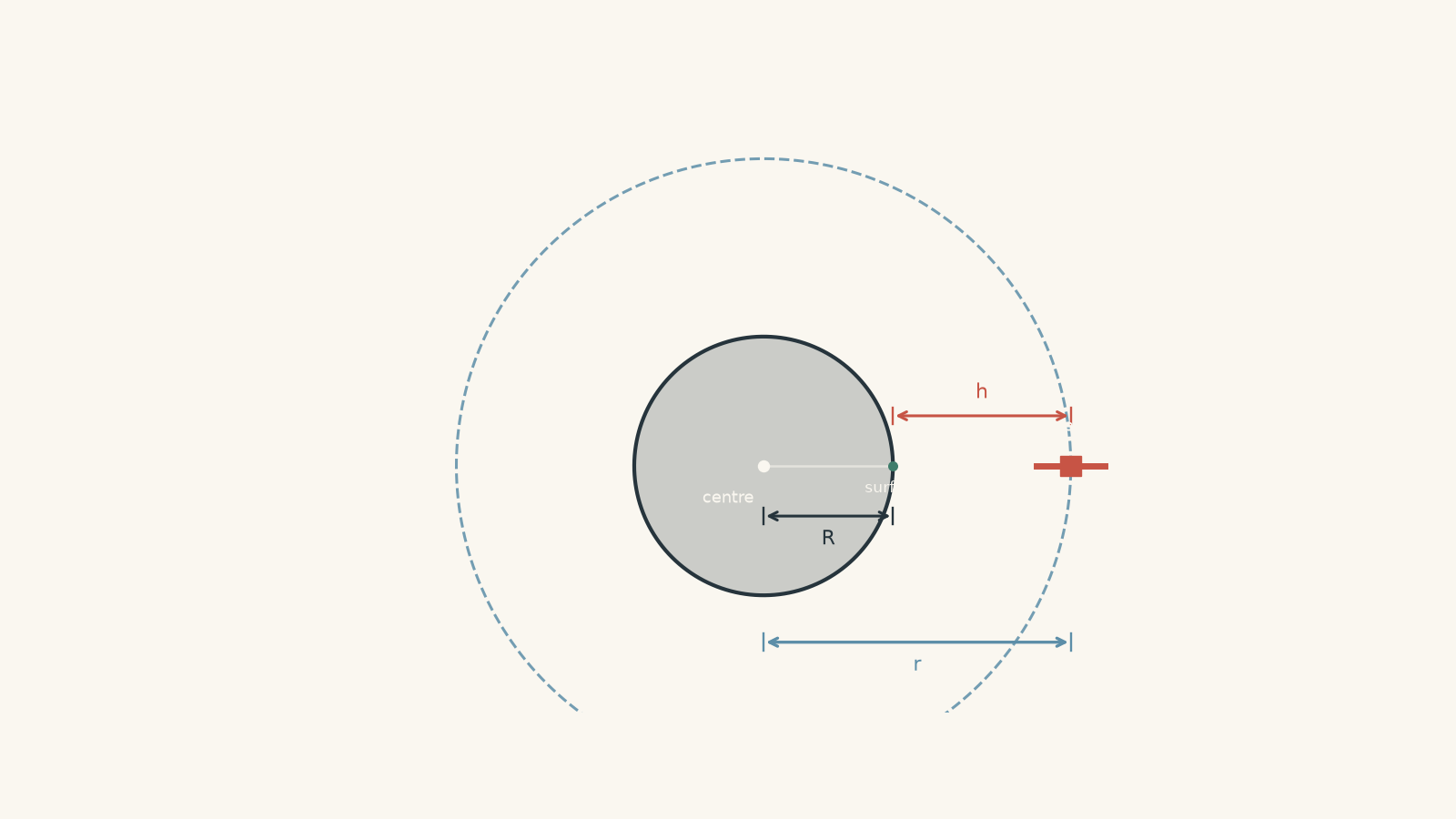
If a satellite is \(400\text{ km}\) above Earth’s surface, you cannot put \(400\text{ km}\) into an orbital-period equation. You first need
\[ r=R_{\text{Earth}}+h. \]
02Building the orbital-period equation
We can derive the relationship rather than memorising it as a mysterious formula.
For a satellite of mass \(m\), Newton’s law of universal gravitation gives
\[ F_g=\frac{GMm}{r^2}. \]
For circular motion, the required centripetal force is
\[ F_c=\frac{mv^2}{r}. \]
Gravity provides that centripetal force, so
\[ \frac{GMm}{r^2}=\frac{mv^2}{r}. \]
The satellite mass \(m\) cancels:
\[ \frac{GM}{r^2}=\frac{v^2}{r}. \]
This already tells us something useful. For the usual HSC model, the satellite’s own mass does not affect its orbital speed or period.
For one complete circular orbit, the satellite travels a circumference \(2\pi r\) in one period \(T\). Therefore,
\[ v=\frac{2\pi r}{T}. \]
Substitute this into the circular-motion equation:
\[ \frac{GM}{r^2} = \frac{1}{r}\left(\frac{2\pi r}{T}\right)^2. \]
Simplifying,
\[ \frac{GM}{r^2} = \frac{4\pi^2r}{T^2}, \]
so
\[ T^2=\frac{4\pi^2r^3}{GM}. \]
Therefore,
\[ T=2\pi\sqrt{\frac{r^3}{GM}}. \]
That is the central relationship for this topic.
03What the equation actually tells you
The equation
\[ T=2\pi\sqrt{\frac{r^3}{GM}} \]
contains two important dependencies.
A larger orbital radius gives a longer period
If the central mass stays constant,
\[ T\propto r^{3/2}. \]
That \(3/2\) power is important. Doubling the orbital radius does not double the period:
\[ \frac{T_2}{T_1} = \left(\frac{2r_1}{r_1}\right)^{3/2} = 2^{3/2} \approx 2.83. \]
Why more than double? The satellite has farther to travel and moves more slowly.
You can see the slower motion from the circular orbital-speed equation,
\[ v=\sqrt{\frac{GM}{r}}. \]
Increasing \(r\) decreases \(v\). The satellite gets the orbital equivalent of a longer commute while also being told to drive more slowly.
The analogy has limits: a satellite is not choosing its speed, and there is no road holding it in a circle. Its speed is the particular speed for which gravity produces the required centripetal acceleration.
A larger central mass gives a shorter period
If the orbital radius stays constant,
\[ T\propto \frac{1}{\sqrt{M}}. \]
A more massive central body produces a stronger gravitational field at the same \(r\). A circular orbit at that radius therefore requires a greater orbital speed, so the orbit is completed more quickly.
For example, if the central mass becomes four times larger while \(r\) remains unchanged,
\[ T_{\text{new}} = \frac{T_{\text{old}}}{\sqrt{4}} = \frac{T_{\text{old}}}{2}. \]
So the period halves.
04A useful comparison equation
Suppose object 1 orbits a central mass \(M_1\) at radius \(r_1\), while object 2 orbits mass \(M_2\) at radius \(r_2\).
Starting with
\[ T=2\pi\sqrt{\frac{r^3}{GM}}, \]
take the ratio:
\[ \frac{T_2}{T_1} = \left(\frac{r_2}{r_1}\right)^{3/2} \sqrt{\frac{M_1}{M_2}}. \]
This is often faster than calculating both periods separately.
Two special cases are worth recognising immediately:
| Situation | Relationship |
|---|---|
| Same central mass | \(\displaystyle \frac{T_2}{T_1}=\left(\frac{r_2}{r_1}\right)^{3/2}\) |
| Same orbital radius | \(\displaystyle \frac{T_2}{T_1}=\sqrt{\frac{M_1}{M_2}}\) |
For objects orbiting the same central body,
\[ \frac{T^2}{r^3}=\text{constant}. \]
This is the circular-orbit form of Kepler’s third law. For an elliptical orbit, the corresponding equation uses the semi-major axis \(a\) rather than a single constant orbital radius.
Worked example: Find the period of an Earth satellite
A satellite moves in a circular orbit \(7.00\times10^6\text{ m}\) from Earth’s centre. Calculate its orbital period. Use \(M_{\text E}=5.97\times10^{24}\text{ kg}\).
Step 1
The question already gives the distance from Earth’s centre, so
\[ r=7.00\times10^6\text{ m}. \]
Step 2
\[ T=2\pi\sqrt{\frac{r^3}{GM}}. \]
Substituting,
\[ \begin{aligned} T &=2\pi\sqrt{ \frac{(7.00\times10^6)^3} {(6.67\times10^{-11})(5.97\times10^{24})} }\\ &=2\pi\sqrt{8.61\times10^5}\\ &=5.83\times10^3\text{ s}. \end{aligned} \]
Step 3
\[ T=\frac{5.83\times10^3}{60}=97.2\text{ min}. \]
The satellite completes one orbit approximately every \(97.2\text{ min}\).
Notice that the satellite’s mass was not required.
Worked example: Use an orbit to find a planet’s mass
A moon moves in a circular orbit around a distant planet. Its orbital radius is \(2.40\times10^8\text{ m}\), and its orbital period is \(1.80\) days. Estimate the mass of the planet.
Step 1
Starting from
\[ T^2=\frac{4\pi^2r^3}{GM}, \]
we obtain
\[ M=\frac{4\pi^2r^3}{GT^2}. \]
Step 2
\[ T=1.80\times24\times3600 =1.5552\times10^5\text{ s}. \]
Step 3
\[ \begin{aligned} M &= \frac{4\pi^2(2.40\times10^8)^3} {(6.67\times10^{-11})(1.5552\times10^5)^2}\\ &=3.38\times10^{26}\text{ kg}. \end{aligned} \]
Step 4
The planet’s estimated mass is
\[ M\approx3.38\times10^{26}\text{ kg}. \]
This is an important use of orbital motion: we can determine the mass of an object without putting it on anything resembling a giant set of scales. We measure how another object moves under its gravity.
05The most tempting mistakes
Mistake 1: using altitude instead of orbital radius
Suppose a satellite is \(500\text{ km}\) above a planet with radius \(6400\text{ km}\).
Its orbital radius is not \(500\text{ km}\). It is
\[ r=6400+500=6900\text{ km}. \]
Then convert to metres:
\[ r=6.90\times10^6\text{ m}. \]
The gravitational force points towards the planet’s centre, so the centre is where \(r\) must be measured from.
Mistake 2: thinking period is proportional to radius
It is tempting to reason that a circle twice as large should take twice as long to travel around.
That would only work if orbital speed stayed constant. It doesn’t.
For the same central mass,
\[ v\propto r^{-1/2}, \]
so a farther satellite moves more slowly as well as travelling farther. The full relationship is
\[ T\propto r^{3/2}. \]
Mistake 3: assuming a heavier satellite orbits faster
The satellite mass \(m\) appears in both the gravitational force and the required centripetal force:
\[ \frac{GMm}{r^2}=\frac{mv^2}{r}. \]
It cancels.
A \(100\text{ kg}\) satellite and a \(1000\text{ kg}\) satellite can therefore have the same circular orbital period if they orbit the same central body at the same radius.
This assumes the satellite mass is small enough that treating the central body as fixed is a good approximation. If both masses are comparable, both objects orbit their common centre of mass, and the more complete two-body model is needed.
Mistake 4: assuming a bigger planet automatically means a longer period
Physical size is not enough information.
The circular-orbit equation contains central mass \(M\) and orbital radius \(r\). The planet’s physical radius only matters when it helps determine \(r\), such as when an altitude is given.
A physically larger planet may also be much more massive. Those two effects can compete.
06Questions and solutions
Question 1
A satellite moves in a circular orbit of radius \(4.20\times10^7\text{ m}\) around Earth. Calculate its orbital period in hours.
Use
\[ M_{\text E}=5.97\times10^{24}\text{ kg} \]
and
\[ G=6.67\times10^{-11}\text{ N m}^2\text{kg}^{-2}. \]
Solution 1
The satellite’s orbital period is approximately \(23.8\text{ h}\).
For a circular orbit,
\[ T=2\pi\sqrt{\frac{r^3}{GM}}. \]
Substitute the given values:
\[ \begin{aligned} T &=2\pi\sqrt{ \frac{(4.20\times10^7)^3} {(6.67\times10^{-11})(5.97\times10^{24})} }\\ &=8.57\times10^4\text{ s}. \end{aligned} \]
Convert seconds to hours:
\[ T=\frac{8.57\times10^4}{3600}=23.8\text{ h}. \]
The orbit therefore takes just under one day.
A common wrong route is to try to use \(T\propto r\). That assumes the satellite keeps the same speed as its radius changes. Circular orbital speed actually depends on radius, so the \(r^{3/2}\) relationship is required.
Question 2
Earth has radius \(6.37\times10^6\text{ m}\). Satellite A has a circular orbit \(400\text{ km}\) above Earth’s surface.
Satellite B orbits Earth with exactly twice the period of satellite A.
Determine the altitude of satellite B above Earth’s surface.
Solution 2
Satellite B must orbit at an altitude of approximately \(4.38\times10^3\text{ km}\).
Because both satellites orbit Earth, the central mass is the same. Therefore,
\[ \frac{T_B}{T_A} = \left(\frac{r_B}{r_A}\right)^{3/2}. \]
First find the orbital radius of satellite A:
\[ \begin{aligned} r_A &=R_{\text E}+h_A\\ &=6.37\times10^6+0.400\times10^6\\ &=6.77\times10^6\text{ m}. \end{aligned} \]
We know
\[ \frac{T_B}{T_A}=2, \]
so
\[ 2=\left(\frac{r_B}{r_A}\right)^{3/2}. \]
Raise both sides to the power \(2/3\):
\[ \frac{r_B}{r_A}=2^{2/3}. \]
Therefore,
\[ \begin{aligned} r_B &=(6.77\times10^6)2^{2/3}\\ &=1.075\times10^7\text{ m}. \end{aligned} \]
That is the distance from Earth’s centre. The question asks for altitude, so subtract Earth’s radius:
\[ \begin{aligned} h_B &=r_B-R_{\text E}\\ &=1.075\times10^7-6.37\times10^6\\ &=4.38\times10^6\text{ m}\\ &=4.38\times10^3\text{ km}. \end{aligned} \]
The tempting mistake is to double the \(400\text{ km}\) altitude. There are two problems with that: period is not proportional to radius, and altitude is not the \(r\) used by the orbital equation.
Question 3
Moon A orbits planet A with an orbital radius of \(3.00\times10^8\text{ m}\) and a period of \(4.00\) days.
Moon B orbits planet B with an orbital radius of \(2.00\times10^8\text{ m}\) and a period of \(2.00\) days.
Assume both moons have negligible mass compared with their planets.
- Determine the ratio \(M_B/M_A\).
- Determine the ratio of the moons’ orbital speeds, \(v_B/v_A\).
- A student argues that planet B must be less massive because its moon orbits closer to it. Explain why the measurements contradict this claim.
Solution 3
Planet B is about \(1.19\) times as massive as planet A, while moon B moves \(1.33\) times as fast as moon A. The smaller orbital radius by itself does not show that planet B has less mass.
For a circular orbit,
\[ T^2=\frac{4\pi^2r^3}{GM}. \]
Rearranging,
\[ M=\frac{4\pi^2r^3}{GT^2}. \]
Therefore,
\[ \frac{M_B}{M_A} = \left(\frac{r_B}{r_A}\right)^3 \left(\frac{T_A}{T_B}\right)^2. \]
Substitute the ratios:
\[ \begin{aligned} \frac{M_B}{M_A} &= \left(\frac{2.00}{3.00}\right)^3 \left(\frac{4.00}{2.00}\right)^2\\ &= \frac{8}{27}\times4\\ &=\frac{32}{27}\\ &\approx1.19. \end{aligned} \]
So
\[ M_B\approx1.19M_A. \]
For orbital speed,
\[ v=\frac{2\pi r}{T}. \]
Thus,
\[ \begin{aligned} \frac{v_B}{v_A} &= \frac{r_B/T_B}{r_A/T_A}\\ &= \frac{(2.00)/(2.00)}{(3.00)/(4.00)}\\ &=\frac{4}{3}\\ &\approx1.33. \end{aligned} \]
Moon B therefore moves about \(33\%\) faster.
The tempting argument looks only at orbital radius. But an orbit depends on both \(r\) and \(M\). Moon B completes a much shorter orbit in only half the time, and the combined measurements imply that planet B is actually more massive.
Question 4
Planets A and B are spherical and have the same average density. Planet B has twice the radius of planet A:
\[ R_B=2R_A. \]
Assume satellite masses are negligible.
- A satellite orbits just above the surface of each planet. Compare their orbital periods.
- Now place each satellite at the same absolute altitude \(h=R_A/4\) above its planet’s surface. Calculate \(T_B/T_A\).
- Explain why the answers to parts 1 and 2 are different even though the two planets have the same density.
Solution 4
The surface-skimming satellites have equal periods, but at the same absolute altitude the satellite around planet B has the shorter period, with
\[ \frac{T_B}{T_A}\approx0.854. \]
Because the planets have equal density \(\rho\),
\[ M=\rho\frac{4}{3}\pi R^3. \]
Since
\[ R_B=2R_A, \]
their masses are related by
\[ \frac{M_B}{M_A} = \left(\frac{R_B}{R_A}\right)^3 = 2^3 = 8. \]
So planet B has eight times the mass.
For satellites just above the surfaces,
\[ r_A\approx R_A \]
and
\[ r_B\approx R_B=2R_A. \]
Using
\[ \frac{T_B}{T_A} = \left(\frac{r_B}{r_A}\right)^{3/2} \sqrt{\frac{M_A}{M_B}}, \]
gives
\[ \begin{aligned} \frac{T_B}{T_A} &= 2^{3/2}\sqrt{\frac{1}{8}}\\ &=1. \end{aligned} \]
Their periods are equal.
Now give each satellite the same absolute altitude,
\[ h=\frac{R_A}{4}. \]
For planet A,
\[ r_A=R_A+\frac{R_A}{4}=1.25R_A. \]
For planet B,
\[ r_B=2R_A+\frac{R_A}{4}=2.25R_A. \]
Therefore,
\[ \begin{aligned} \frac{T_B}{T_A} &= \left(\frac{2.25}{1.25}\right)^{3/2} \sqrt{\frac{1}{8}}\\ &\approx0.854. \end{aligned} \]
The satellite around planet B takes only about \(85.4\%\) as long to complete an orbit.
A tempting route is to think that equal density must always produce equal orbital periods. That result only occurred in part 1 because the orbital radius scaled in exactly the same way as the planet’s physical radius. Doubling \(R\) multiplied \(r^3\) by \(8\), while the central mass also increased by \(8\), so the effects cancelled.
In part 2, the fixed altitude breaks that geometric scaling. Planet B still has eight times the mass, but its satellite is not eight times farther away in the \(r^3\) sense. Its stronger gravity wins the competition, giving the shorter period.
Question 5
A spherical planet has mass \(M\) and radius \(R\). A satellite is initially in a circular orbit at altitude \(R\), so its orbital radius is \(2R\).
The planet then contracts rapidly and symmetrically to radius \(R/2\). No mass is lost, and the satellite receives no thrust or other impulse during the contraction.
- Immediately after the contraction, does the satellite remain in the same circular orbit? State what happens to its period.
- What is its new altitude above the planet’s surface immediately after the contraction?
- Later, the satellite performs manoeuvres and enters a new circular orbit whose altitude is equal to the planet’s new radius. Find the ratio of its final orbital period to its original period.
- Compare its final circular orbital speed with its original orbital speed.
- Explain the error in the claim: “The planet became smaller, so the satellite’s period must immediately become shorter.”
Solution 5
The satellite initially remains in exactly the same circular orbit with exactly the same period. Its altitude increases because the surface moves inward. Only after the satellite is moved to a smaller orbital radius does its period decrease; its final period is \(1/(2\sqrt2)\), or about \(0.354\), of its original period, and its final orbital speed is \(\sqrt2\) times larger.
Initially,
\[ r_i=2R. \]
When the planet contracts, three important quantities at the satellite do not change instantaneously:
- the planet’s total mass remains \(M\)
- the satellite’s distance from the planet’s centre remains \(2R\)
- the satellite’s tangential velocity remains unchanged because it receives no impulse
Outside a spherical mass, the gravitational force is determined by the total central mass and the centre-to-centre distance:
\[ F_g=\frac{GMm}{r^2}. \]
Since neither \(M\) nor \(r\) has changed at the satellite, the gravitational force is unchanged.
Before the contraction, the satellite’s speed satisfied the circular-orbit condition
\[ v_i=\sqrt{\frac{GM}{2R}}. \]
Immediately afterwards, the required circular speed at \(r=2R\) is still
\[ v=\sqrt{\frac{GM}{2R}}. \]
Its existing velocity is therefore still exactly the velocity required for that same circular orbit. The orbital period also remains unchanged.
The planet’s new physical radius is
\[ R'=\frac{R}{2}. \]
The satellite is still \(2R\) from the centre, so its new altitude is
\[ \begin{aligned} h' &=2R-\frac{R}{2}\\ &=\frac{3R}{2}. \end{aligned} \]
Now consider the later manoeuvre. The satellite enters a circular orbit whose altitude equals the new planet radius:
\[ h_f=\frac{R}{2}. \]
Its final orbital radius is therefore
\[ \begin{aligned} r_f &=R'+h_f\\ &=\frac{R}{2}+\frac{R}{2}\\ &=R. \end{aligned} \]
The central mass has not changed, so
\[ \frac{T_f}{T_i} = \left(\frac{r_f}{r_i}\right)^{3/2}. \]
Thus,
\[ \begin{aligned} \frac{T_f}{T_i} &= \left(\frac{R}{2R}\right)^{3/2}\\ &= \left(\frac12\right)^{3/2}\\ &=\frac{1}{2\sqrt2}\\ &\approx0.354. \end{aligned} \]
The final period is about \(35.4\%\) of the original period.
For circular orbital speed,
\[ v=\sqrt{\frac{GM}{r}}. \]
Therefore,
\[ \begin{aligned} \frac{v_f}{v_i} &= \sqrt{\frac{r_i}{r_f}}\\ &= \sqrt{\frac{2R}{R}}\\ &=\sqrt2\\ &\approx1.41. \end{aligned} \]
The final circular orbital speed is about \(41\%\) greater.
The tempting claim confuses the planet’s physical radius with the satellite’s orbital radius. The equation
\[ T=2\pi\sqrt{\frac{r^3}{GM}} \]
does not contain the physical radius of the planet. Immediately after the contraction, \(M\) and the satellite’s centre-to-centre distance \(r\) are unchanged, so its period cannot suddenly change.
Only when the satellite itself moves to a new orbital radius does the period change.
07What this relationship lets you do next
The useful idea to carry forward is not just the formula. It is the competition between orbital radius and central mass:
\[ T\propto\frac{r^{3/2}}{\sqrt M}. \]
That lets you move in several directions. If \(M\) is known, an observed period can reveal orbital radius. If \(r\) and \(T\) are measured, the orbit can reveal an unknown central mass. And if two objects orbit the same body, their periods and radii can be compared without knowing that body’s mass at all.
The same gravitational model also gives the circular orbital speed,
\[ v=\sqrt{\frac{GM}{r}}, \]
which explains the second half of the story: farther satellites take longer not only because their paths are larger, but because they move more slowly. That connection is developed directly in orbital velocity.