
Gravitational Potential Energy in a Radial Field for HSC Physics
Learn how to use U = -GMm/r, interpret the zero of gravitational potential energy at infinity, and calculate energy changes in radial gravitational fields.
Suppose you lift a satellite higher and higher above Earth. Near the surface, you might reach for \(\Delta U = mgh\). But if that formula stayed exact forever, taking the satellite infinitely far away would require infinite energy.
It doesn’t. Gravity gets weaker as you move away, so the energy needed to escape Earth’s gravitational field is finite.
Before seeing the radial-field equation, make a prediction. If a satellite moves from distance \(r\) to \(2r\) from Earth’s centre, does its gravitational potential energy double, halve, or do something stranger?
It becomes half as negative. That sounds odd until the zero of gravitational potential energy is chosen carefully.
01Why \(mgh\) eventually fails
Close to Earth’s surface, gravitational field strength is nearly constant. That is why
\[ \Delta U \approx mg\Delta h \]
works well for small height changes.
Here:
- \(m\) is the object’s mass in kilograms,
- \(g\) is the local gravitational field strength in \(\text{N kg}^{-1}\), or equivalently \(\text{m s}^{-2}\),
- \(\Delta h\) is the change in height in metres,
- \(\Delta U\) is the change in gravitational potential energy in joules.
The important word is “nearly”.
In a radial gravitational field,
\[ g=\frac{GM}{r^2} \]
so \(g\) decreases as the distance \(r\) from the centre of the planet increases. If the inverse-square force itself needs refreshing, see Newton’s Law of Universal Gravitation for HSC Physics.
That means \(mgh\) cannot be the exact expression for large changes in altitude. It assumes gravity stays roughly constant while you move.
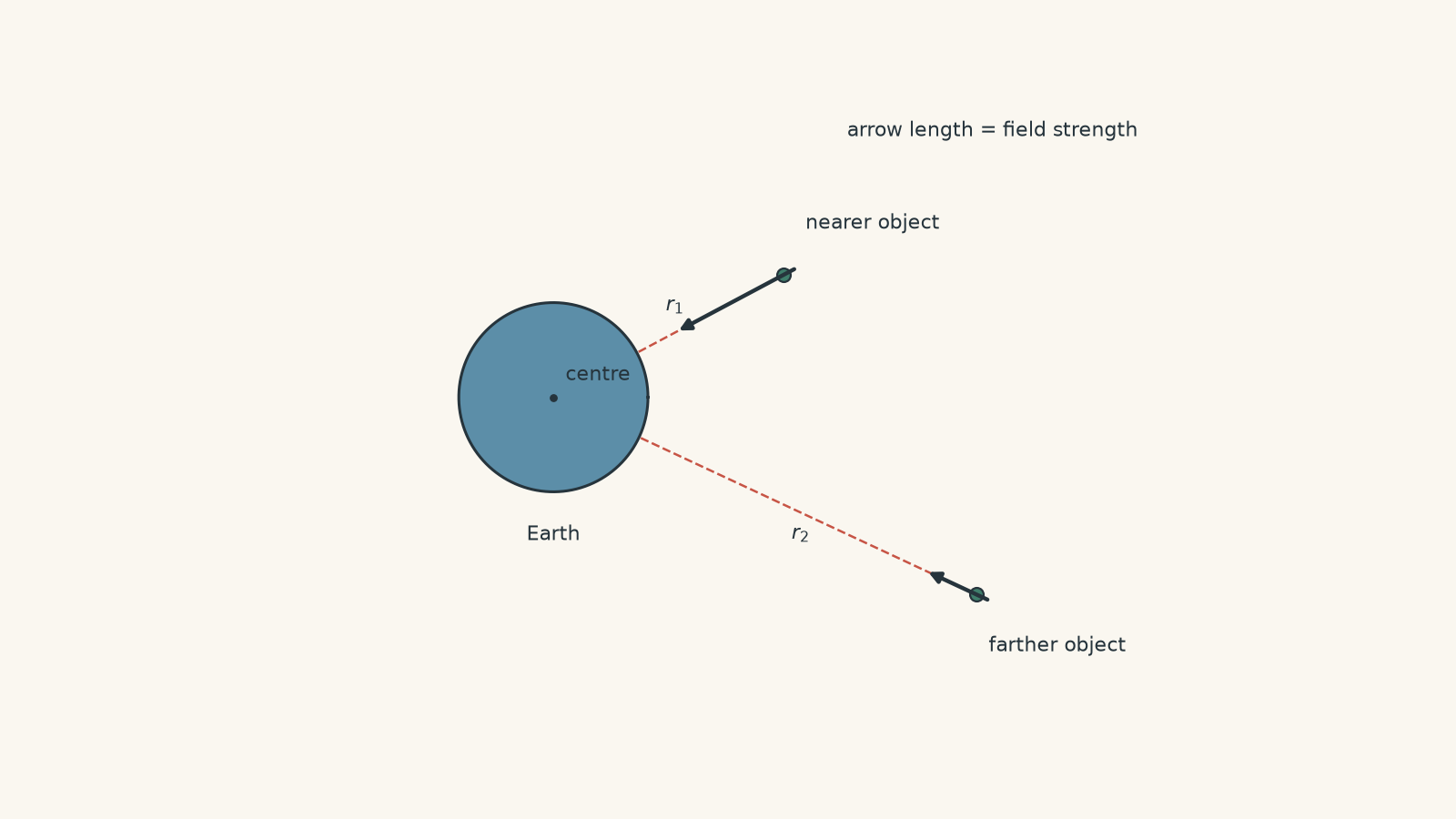
There is another important distinction. In the radial-field equation, \(r\) is not altitude above the surface. It is the distance from the centre of the central body.
For a satellite at altitude \(h\) above Earth,
\[ r=R_E+h \]
where \(R_E\) is Earth’s radius.
02Picture gravitational potential energy as a well
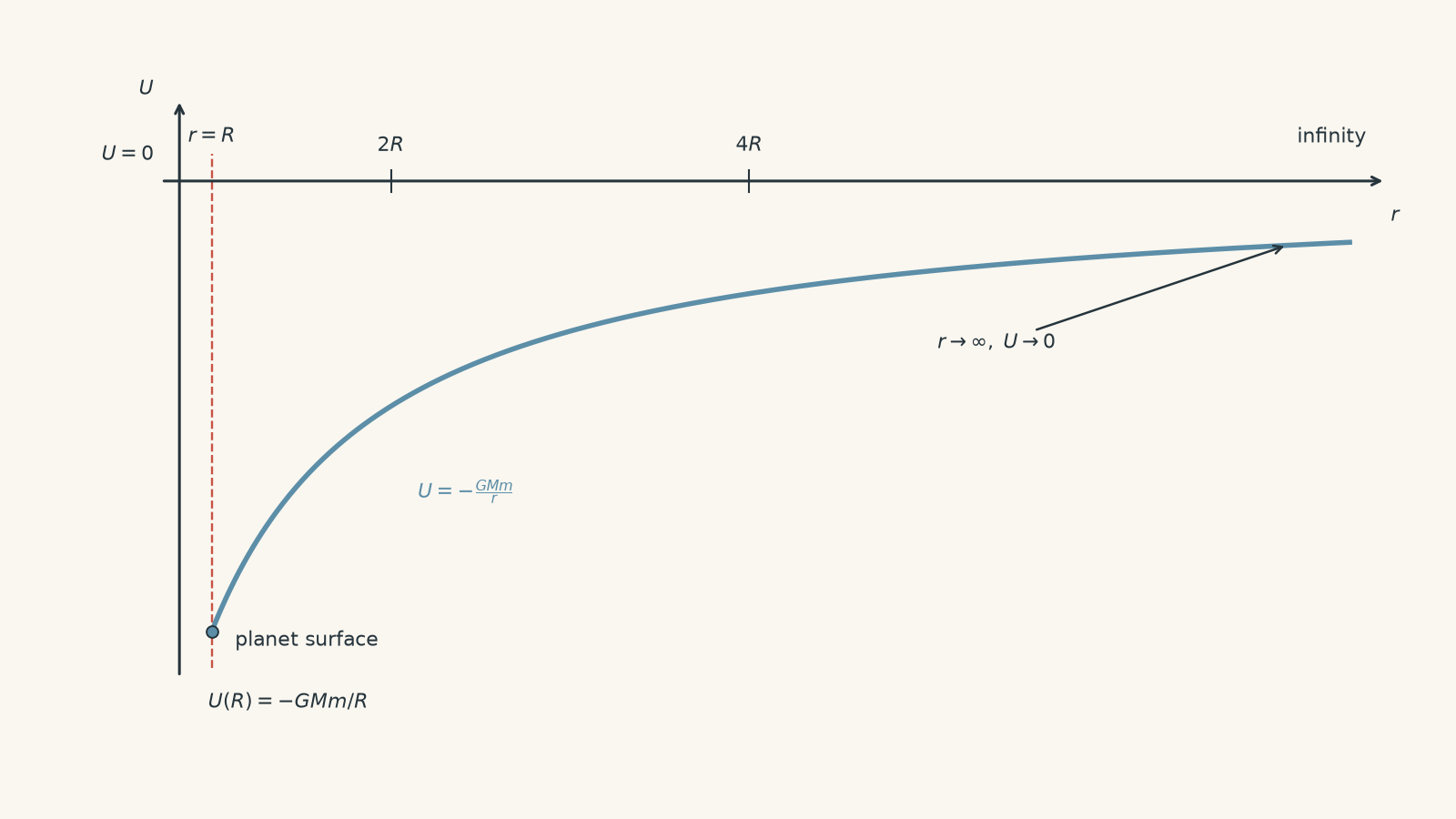
Imagine choosing a place where gravitational potential energy is zero. For an isolated planet, the most useful choice is infinitely far away:
\[ U(\infty)=0 \]
Now bring a small mass towards the planet.
Gravity pulls it inward. If you wanted to return that mass to infinity and have it arrive there with no kinetic energy, you would need to supply energy.
So at any finite distance from the planet, the mass has less gravitational potential energy than it has at infinity. With infinity defined as zero, its gravitational potential energy must therefore be negative.
You can picture this as an energy debt. At infinity, the balance is zero. Near the planet, the object is “in debt” because energy must be supplied to separate it completely from the planet.
The analogy has a limit: there is no literal store of negative money. More importantly, the zero level is a choice. What physics actually fixes are changes in potential energy.
03The radial gravitational potential energy equation
For a small mass \(m\) outside a spherical body of mass \(M\),
\[ U=-\frac{GMm}{r} \]
where:
- \(U\) is gravitational potential energy in joules,
- \(G=6.67\times10^{-11}\ \text{N m}^2\text{kg}^{-2}\) is the universal gravitational constant,
- \(M\) is the mass of the central body in kilograms,
- \(m\) is the mass of the smaller object in kilograms,
- \(r\) is the centre-to-centre separation in metres.
The equation assumes the zero of potential energy is at infinite separation.
It also treats the central body as spherically symmetric. Outside a spherical planet such as Earth, its gravitational field behaves as though all its mass were concentrated at its centre. The simple expression should not be blindly extended through the inside of a planet.
Now return to the opening prediction.
At distance \(r\),
\[ U_1=-\frac{GMm}{r} \]
and at \(2r\),
\[ U_2=-\frac{GMm}{2r}=\frac{1}{2}U_1 \]
If \(U_1=-100\ \text{MJ}\), then \(U_2=-50\ \text{MJ}\).
The potential energy has increased by \(50\ \text{MJ}\), even though its numerical value is still negative.
That distinction is one of the main traps in this topic.
| Motion | What happens to \(r\)? | What happens to \(U\)? | Work done by gravity |
|---|---|---|---|
| Moving away from the planet | Increases | Increases towards \(0\) | Negative |
| Moving towards the planet | Decreases | Becomes more negative | Positive |
| Remaining at the same radius | Unchanged | Unchanged | Depends on the path, but no change in \(U\) |
Notice that potential energy depends on position, not speed. Two satellites at the same radius have the same gravitational potential energy if their masses are equal, even if one is moving much faster than the other.
04Calculating a change in gravitational potential energy
Usually, the useful quantity is not \(U\) at one position but the change between two positions.
\[ \Delta U=U_f-U_i \]
Using \(U=-GMm/r\),
\[ \Delta U =-\frac{GMm}{r_f}+\frac{GMm}{r_i} =GMm\left(\frac{1}{r_i}-\frac{1}{r_f}\right) \]
where \(r_i\) is the initial radius and \(r_f\) is the final radius.
For an outward movement, \(r_f>r_i\). Therefore,
\[ \frac{1}{r_i}>\frac{1}{r_f} \]
and \(\Delta U\) is positive.
Gravity does the opposite amount of work:
\[ W_g=-\Delta U \]
This makes physical sense. If an object moves outward, gravity points inward, opposite to the displacement, so gravity does negative work.
Worked example: Lifting a satellite to 400 km altitude
A \(1000\ \text{kg}\) satellite is moved from Earth’s surface to an altitude of \(400\ \text{km}\). Calculate its change in gravitational potential energy.
Use:
\[ M_E=5.97\times10^{24}\ \text{kg} \]
and
\[ R_E=6.37\times10^6\ \text{m} \]
Step 1
Initially,
\[ r_i=R_E=6.37\times10^6\ \text{m} \]
The altitude is
\[ 400\ \text{km}=4.00\times10^5\ \text{m} \]
so
\[ r_f=6.37\times10^6+4.00\times10^5 =6.77\times10^6\ \text{m} \]
Step 2
\[ \begin{aligned} U_i &=-\frac{GM_Em}{r_i}\\ &=-\frac{(6.67\times10^{-11})(5.97\times10^{24})(1000)} {6.37\times10^6}\\ &=-6.25\times10^{10}\ \text{J} \end{aligned} \]
and
\[ \begin{aligned} U_f &=-\frac{GM_Em}{r_f}\\ &=-\frac{(6.67\times10^{-11})(5.97\times10^{24})(1000)} {6.77\times10^6}\\ &=-5.88\times10^{10}\ \text{J} \end{aligned} \]
Step 3
\[ \begin{aligned} \Delta U &=U_f-U_i\\ &=(-5.88\times10^{10})-(-6.25\times10^{10})\\ &=+3.69\times10^9\ \text{J} \end{aligned} \]
Step 4
The satellite gains \(3.69\times10^9\ \text{J}\) of gravitational potential energy.
Both potential energies are negative, but the final value is less negative. Moving outward has increased \(U\).
If the satellite were moved with no overall change in kinetic energy and there were no other energy transfers, an external agent would need to do \(+3.69\times10^9\ \text{J}\) of work. Gravity would do \(-3.69\times10^9\ \text{J}\).
05Why infinity can be infinitely far away but require finite energy
Here is a prediction worth making.
Suppose a probe is already at \(2R_E\). You move it to \(4R_E\). Have you supplied most of the energy required to reach infinity, or only a tiny fraction?
You have supplied exactly half of the energy needed to go from \(2R_E\) all the way to infinity.
The reason is that gravity weakens as \(1/r^2\). The remaining distance may be infinite, but the force becomes smaller and smaller.
Worked example: Moving a probe from \(2R_E\) to \(4R_E\)
A \(500\ \text{kg}\) probe is moved slowly from \(2R_E\) to \(4R_E\). Calculate the change in gravitational potential energy, the work done by gravity, and the fraction of the required escape energy that has been supplied.
Use \(R_E=6.37\times10^6\ \text{m}\) and \(M_E=5.97\times10^{24}\ \text{kg}\).
Step 1
\[ \begin{aligned} U_i &=-\frac{GM_Em}{2R_E}\\ &=-\frac{(6.67\times10^{-11})(5.97\times10^{24})(500)} {2(6.37\times10^6)}\\ &=-1.56\times10^{10}\ \text{J} \end{aligned} \]
Step 2
\[ \begin{aligned} U_f &=-\frac{GM_Em}{4R_E}\\ &=-7.81\times10^9\ \text{J} \end{aligned} \]
Step 3
\[ \begin{aligned} \Delta U &=U_f-U_i\\ &=(-7.81\times10^9)-(-1.56\times10^{10})\\ &=+7.81\times10^9\ \text{J} \end{aligned} \]
Therefore,
\[ W_g=-\Delta U=-7.81\times10^9\ \text{J} \]
The negative gravitational work makes sense because gravity opposes the outward displacement.
Step 4
At infinity,
\[ U_\infty=0 \]
so the total increase in potential energy required to go from \(2R_E\) to infinity is
\[ \begin{aligned} \Delta U_{\text{escape}} &=0-(-1.56\times10^{10})\\ &=1.56\times10^{10}\ \text{J} \end{aligned} \]
The move from \(2R_E\) to \(4R_E\) required
\[ \frac{7.81\times10^9}{1.56\times10^{10}} =0.500 \]
or \(50.0\%\) of that energy.
The probe is only at \(4R_E\), nowhere near infinity in distance, but it is already halfway to infinity in gravitational potential energy.
06How \(mgh\) comes from the radial model
The radial expression does not contradict \(mgh\). The familiar near-surface equation is an approximation of it.
Suppose an object rises from Earth’s surface \(R_E\) to altitude \(h\). Exactly,
\[ \Delta U =GM_Em\left(\frac{1}{R_E}-\frac{1}{R_E+h}\right) \]
Combining the fractions gives
\[ \Delta U =\frac{GM_Emh}{R_E(R_E+h)} \]
Near Earth’s surface, \(h\ll R_E\), so
\[ R_E+h\approx R_E \]
and therefore
\[ \Delta U\approx\frac{GM_Emh}{R_E^2} \]
But
\[ g=\frac{GM_E}{R_E^2} \]
so
\[ \Delta U\approx mgh \]
That is the important relationship: \(mgh\) is the small-height version of the radial expression.
For a large altitude change, using surface \(g\) in \(mgh\) overestimates the energy increase because it pretends gravity remains just as strong all the way up.
07The zero at infinity is a convention
A student will sometimes say, “But I thought gravitational potential energy was zero at the ground.”
It can be, in some problems.
Potential energy has no unique absolute zero. You may add the same constant to every value of \(U\) without changing any observable energy difference.
For example, if you chose Earth’s surface as zero, you could define
\[ U_{\text{surface zero}} =GM_Em\left(\frac{1}{R_E}-\frac{1}{r}\right) \]
At \(r=R_E\),
\[ U_{\text{surface zero}}=0 \]
But at infinity,
\[ U_{\text{surface zero}}(\infty) =\frac{GM_Em}{R_E} \]
which is positive.
Nothing physical has changed. You have simply moved the zero line.
This matters when discussing escape. The familiar statement
\[ E_{\text{mechanical}}\geq 0 \]
as the condition for escape only works when gravitational potential energy has been defined to be zero at infinity.
Change the zero of \(U\), and the numerical value of total mechanical energy changes by the same constant. The escape condition must move with it.
08Common traps
| Tempting idea | What actually happens |
|---|---|
| “Negative \(U\) means the object is losing energy.” | Negative \(U\) only tells you where the chosen zero is. An object moving outward gains \(U\) even while \(U\) remains negative. |
| “\(r\) is the altitude.” | \(r\) is measured from the centre of the planet. Use \(r=R+h\). |
| “Doubling \(r\) doubles \(U\).” | Because \(U\propto-1/r\), doubling \(r\) halves the magnitude of \(U\). |
| “If the satellite speeds up, its gravitational potential energy changes.” | Speed changes kinetic energy. \(U\) depends on position. |
| “\(mgh\) is always valid near Earth.” | It is an approximation for changes in height small compared with Earth’s radius. |
| “A positive total energy always means escape.” | Only if the potential-energy zero has been set at infinity. |
| “At infinity, gravity suddenly switches off.” | Infinity is a limiting idea. At every finite distance the gravitational force is non-zero, but it approaches zero as \(r\) becomes very large. |
09Questions and solutions
For the numerical questions, use
\[ G=6.67\times10^{-11}\ \text{N m}^2\text{kg}^{-2}, \qquad M_E=5.97\times10^{24}\ \text{kg}, \qquad R_E=6.37\times10^6\ \text{m} \]
unless stated otherwise.
Question 1
A \(300\ \text{kg}\) satellite is at an altitude of \(600\ \text{km}\) above Earth’s surface.
Calculate its gravitational potential energy relative to zero at infinity. Explain what the sign of your result means.
Solution 1
The satellite’s gravitational potential energy is approximately \(-1.71\times10^{10}\ \text{J}\); the negative sign means energy must be added to separate the satellite completely from Earth.
First convert the altitude to metres:
\[ h=600\ \text{km}=6.00\times10^5\ \text{m} \]
The radial distance is
\[ \begin{aligned} r &=R_E+h\\ &=6.37\times10^6+6.00\times10^5\\ &=6.97\times10^6\ \text{m} \end{aligned} \]
Now use
\[ U=-\frac{GM_Em}{r} \]
so
\[ \begin{aligned} U &=-\frac{(6.67\times10^{-11})(5.97\times10^{24})(300)} {6.97\times10^6}\\ &=-1.71\times10^{10}\ \text{J} \end{aligned} \]
A tempting interpretation is that “negative energy” means something is wrong or that the satellite has somehow lost \(1.71\times10^{10}\ \text{J}\).
That is not what the sign means. The zero has been chosen at infinity. The value tells us that the satellite would need an increase of \(1.71\times10^{10}\ \text{J}\) in gravitational potential energy to reach infinite separation.
Question 2
A \(750\ \text{kg}\) spacecraft travels from an altitude of \(300\ \text{km}\) to an altitude of \(2000\ \text{km}\).
During the transfer, its engines do \(1.20\times10^{10}\ \text{J}\) of net work on the spacecraft. Ignore all other non-gravitational forces.
Calculate:
- the change in gravitational potential energy,
- the work done by gravity, and
- the change in kinetic energy.
Solution 2
The spacecraft gains \(9.09\times10^9\ \text{J}\) of gravitational potential energy, gravity does \(-9.09\times10^9\ \text{J}\) of work, and its kinetic energy increases by \(2.91\times10^9\ \text{J}\).
The initial and final radii are
\[ \begin{aligned} r_i&=6.37\times10^6+3.00\times10^5 =6.67\times10^6\ \text{m}\\ r_f&=6.37\times10^6+2.00\times10^6 =8.37\times10^6\ \text{m} \end{aligned} \]
Use
\[ \Delta U =GM_Em\left(\frac{1}{r_i}-\frac{1}{r_f}\right) \]
Substituting,
\[ \begin{aligned} \Delta U &=(6.67\times10^{-11})(5.97\times10^{24})(750) \left( \frac{1}{6.67\times10^6} -\frac{1}{8.37\times10^6} \right)\\ &=9.09\times10^9\ \text{J} \end{aligned} \]
Therefore the work done by gravity is
\[ W_g=-\Delta U=-9.09\times10^9\ \text{J} \]
The engine adds mechanical energy to the system. Therefore,
\[ W_{\text{engine}}=\Delta K+\Delta U \]
so
\[ \begin{aligned} \Delta K &=W_{\text{engine}}-\Delta U\\ &=1.20\times10^{10}-9.09\times10^9\\ &=2.91\times10^9\ \text{J} \end{aligned} \]
The tempting route is to assume all the engine’s work becomes gravitational potential energy because the spacecraft moves upward. It does not. Some of that work increases \(U\), while the remainder increases \(K\).
Question 3
A \(100\ \text{kg}\) object is lifted from Earth’s surface to an altitude of \(1000\ \text{km}\).
Calculate the increase in gravitational potential energy using:
- the exact radial-field expression, and
- \(\Delta U=mgh\), using the value of \(g\) at Earth’s surface.
By what percentage does the \(mgh\) result overestimate the exact result?
Solution 3
The exact increase is \(8.48\times10^8\ \text{J}\), while \(mgh\) gives \(9.81\times10^8\ \text{J}\), an overestimate of about \(15.7\%\).
The final radius is
\[ r_f=6.37\times10^6+1.00\times10^6 =7.37\times10^6\ \text{m} \]
The exact result is
\[ \Delta U =GM_Em\left(\frac{1}{R_E}-\frac{1}{R_E+h}\right) \]
so
\[ \begin{aligned} \Delta U &=(6.67\times10^{-11})(5.97\times10^{24})(100) \left( \frac{1}{6.37\times10^6} -\frac{1}{7.37\times10^6} \right)\\ &=8.48\times10^8\ \text{J} \end{aligned} \]
Now calculate surface \(g\):
\[ \begin{aligned} g &=\frac{GM_E}{R_E^2}\\ &=\frac{(6.67\times10^{-11})(5.97\times10^{24})} {(6.37\times10^6)^2}\\ &=9.81\ \text{m s}^{-2} \end{aligned} \]
Using \(mgh\),
\[ \begin{aligned} \Delta U_{\text{approx}} &=mgh\\ &=(100)(9.81)(1.00\times10^6)\\ &=9.81\times10^8\ \text{J} \end{aligned} \]
The percentage overestimate, using the exact value as the reference, is
\[ \begin{aligned} \text{percentage overestimate} &=\frac{9.81\times10^8-8.48\times10^8} {8.48\times10^8}\times100\%\\ &=15.7\% \end{aligned} \]
The tempting assumption is that \(g=9.81\ \text{m s}^{-2}\) throughout the climb. But \(1000\ \text{km}\) is not tiny compared with Earth’s radius. Gravity weakens noticeably, so \(mgh\) counts too much force over the upper part of the journey.
Question 4
Two identical probes are at distance
\[ r_0=2R_E \]
from Earth’s centre.
Both have the same speed,
\[ v_0=\sqrt{\frac{GM_E}{r_0}} \]
but Probe A is moving perpendicular to the radial direction, while Probe B is moving directly away from Earth.
Ignore the Moon, atmosphere, and all other forces.
Describe the subsequent motion of each probe. For Probe B, determine its maximum distance from Earth’s centre.
Solution 4
Probe A remains in a circular orbit at \(2R_E\), while Probe B rises to \(4R_E\), momentarily stops, and then falls back towards Earth.
At first this can feel impossible. The probes begin at the same radius and have the same speed, so they have the same gravitational potential energy, the same kinetic energy, and the same total mechanical energy.
For either probe,
\[ U=-\frac{GM_Em}{r_0} \]
and
\[ \begin{aligned} K &=\frac12 mv_0^2\\ &=\frac12m\left(\frac{GM_E}{r_0}\right)\\ &=\frac{GM_Em}{2r_0} \end{aligned} \]
Therefore,
\[ \begin{aligned} E &=K+U\\ &=\frac{GM_Em}{2r_0} -\frac{GM_Em}{r_0}\\ &=-\frac{GM_Em}{2r_0} \end{aligned} \]
For Probe A, the velocity is tangential. Its speed satisfies
\[ v_0=\sqrt{\frac{GM_E}{r_0}} \]
which is exactly the circular orbital speed at \(r_0\). Gravity therefore provides the required centripetal force, continually turning the velocity without changing the orbital radius. Probe A stays at \(2R_E\).
Probe B has the same speed but points radially outward. Gravity acts directly opposite its motion, so the probe slows down.
At its maximum radius \(r_{\max}\), Probe B’s radial speed is zero, so
\[ K=0 \]
and conservation of mechanical energy gives
\[ -\frac{GM_Em}{r_{\max}} =-\frac{GM_Em}{2r_0} \]
Cancelling common factors,
\[ r_{\max}=2r_0 \]
Since \(r_0=2R_E\),
\[ r_{\max}=4R_E \]
The tempting route is to say that identical total mechanical energy must produce identical motion. Energy is not enough to specify an orbit by itself. The direction of the velocity matters. For Probe A, gravity bends the motion sideways. For Probe B, gravity opposes the motion and removes kinetic energy until the probe stops.
This is the same distinction used when treating gravity as the centripetal force in a circular orbit.
Question 5
A \(500\ \text{kg}\) probe begins at rest on the surface of an airless, non-rotating Earth. An engine gives it \(2.80\times10^{10}\ \text{J}\) of kinetic energy instantaneously, directed radially outward. The engine then switches off.
Two students describe its gravitational potential energy differently.
Student A uses
\[ U_A=-\frac{GM_Em}{r} \]
so that \(U_A=0\) at infinity.
Student B chooses the Earth’s surface as zero and uses
\[ U_B=GM_Em\left(\frac{1}{R_E}-\frac{1}{r}\right) \]
Student B notices that immediately after launch,
\[ E_B=K+U_B=2.80\times10^{10}\ \text{J}>0 \]
and concludes that the probe must escape.
Determine whether the probe actually escapes. If it does not, find its maximum distance from Earth’s centre. Explain why Student B’s positive-energy argument fails even though their potential-energy equation is valid.
Solution 5
The probe does not escape; it reaches a maximum radius of approximately \(6.12\times10^7\ \text{m}\), or \(9.60R_E\), before falling back.
Using Student A’s zero at infinity, the gravitational potential energy at Earth’s surface is
\[ \begin{aligned} U_A(R_E) &=-\frac{GM_Em}{R_E}\\ &=-\frac{(6.67\times10^{-11})(5.97\times10^{24})(500)} {6.37\times10^6}\\ &=-3.13\times10^{10}\ \text{J} \end{aligned} \]
Immediately after the engine fires,
\[ \begin{aligned} E_A &=K+U_A\\ &=2.80\times10^{10}-3.13\times10^{10}\\ &=-3.26\times10^9\ \text{J} \end{aligned} \]
With zero potential energy at infinity, escape requires total mechanical energy of at least zero.
Because
\[ E_A<0 \]
the probe is bound.
At the maximum radius, its radial speed is momentarily zero. Therefore,
\[ K=0 \]
and
\[ U_A(r_{\max})=E_A \]
so
\[ -\frac{GM_Em}{r_{\max}} =-3.26\times10^9 \]
Hence,
\[ \begin{aligned} r_{\max} &=\frac{GM_Em}{3.26\times10^9}\\ &\approx6.12\times10^7\ \text{m}\\ &\approx9.60R_E \end{aligned} \]
Now consider Student B’s convention.
Their equation is perfectly valid. At the surface,
\[ U_B(R_E)=0 \]
so after launch,
\[ E_B=2.80\times10^{10}\ \text{J} \]
The mistake is assuming that \(E_B>0\) is the escape condition.
Under Student B’s convention, gravitational potential energy at infinity is not zero:
\[ \begin{aligned} U_B(\infty) &=GM_Em\left(\frac{1}{R_E}-0\right)\\ &=\frac{GM_Em}{R_E}\\ &=3.13\times10^{10}\ \text{J} \end{aligned} \]
For the probe to reach infinity with zero final kinetic energy, its total energy under this convention must therefore reach
\[ E_B=3.13\times10^{10}\ \text{J} \]
But it has only
\[ 2.80\times10^{10}\ \text{J} \]
so it falls short by
\[ 3.13\times10^{10}-2.80\times10^{10} =3.26\times10^9\ \text{J} \]
This is exactly the same energy deficit found using Student A’s convention.
The hinge is that changing the zero of potential energy shifts every value of \(U\), and therefore every value of total mechanical energy, by a constant. It does not change the motion. The rule \(E\geq0\) for escape is not a universal law independent of reference choice; it is shorthand for the specific convention \(U(\infty)=0\).
10What this lets you do next
Once the negative sign and the zero at infinity make sense, gravitational potential energy becomes much more useful than a formula to substitute into.
You can combine
\[ U=-\frac{GMm}{r} \]
with kinetic energy,
\[ K=\frac12mv^2 \]
to analyse whether an object is gravitationally bound, how far a radial launch will travel, how much energy is required for escape, and how energy behaves in an orbit.
The next important step is circular orbital energy. Gravity can keep a satellite moving at constant radius while the satellite still has negative gravitational potential energy. Connecting the radial energy model with circular motion explains why orbital speed, escape speed, and orbital radius fit together rather than being separate formulas to memorise.