
Alcohol Substitution with Hydrogen Halides: HSC Chemistry
Learn how alcohols react with hydrogen halides to form haloalkanes, how to predict products, and why the hydroxyl group leaves as water.
Suppose propan-2-ol reacts with hydrogen bromide, \(\ce{HBr}\). The alcohol starts with an \(\ce{-OH}\) group and finishes with a \(\ce{-Br}\) group. Before going further, predict where the hydrogen from \(\ce{HBr}\) ends up: attached to carbon, attached to bromine, or in water?
It ends up in water. The carbon skeleton stays the same, bromine takes the place previously occupied by \(\ce{-OH}\), and the alcohol’s oxygen leaves as part of \(\ce{H2O}\). If you can track those atoms, most HSC product-prediction questions on this reaction become much easier.
01The useful first model: swap OH for a halogen
Picture the carbon bonded to \(\ce{-OH}\) as a seat. In this reaction, the carbon keeps its seat, but the occupant changes: \(\ce{-OH}\) is replaced by a halogen.
So:
\[
\ce{ROH + HX -> RX + H2O}
\]
Here:
- \(\ce{R}\) represents the rest of the carbon chain,
- \(\ce{X}\) represents a halogen, usually \(\ce{Cl}\), \(\ce{Br}\), or \(\ce{I}\),
- \(\ce{ROH}\) is the alcohol,
- \(\ce{RX}\) is the halogenated organic product.
For the usual HSC product-prediction questions:
| Reagent | Halogen replacing \(\ce{-OH}\) | Organic product |
|---|---|---|
| \(\ce{HCl}\) | \(\ce{Cl}\) | chloroalkane |
| \(\ce{HBr}\) | \(\ce{Br}\) | bromoalkane |
| \(\ce{HI}\) | \(\ce{I}\) | iodoalkane |
The reaction is called a substitution reaction because one group attached to carbon is replaced by another.
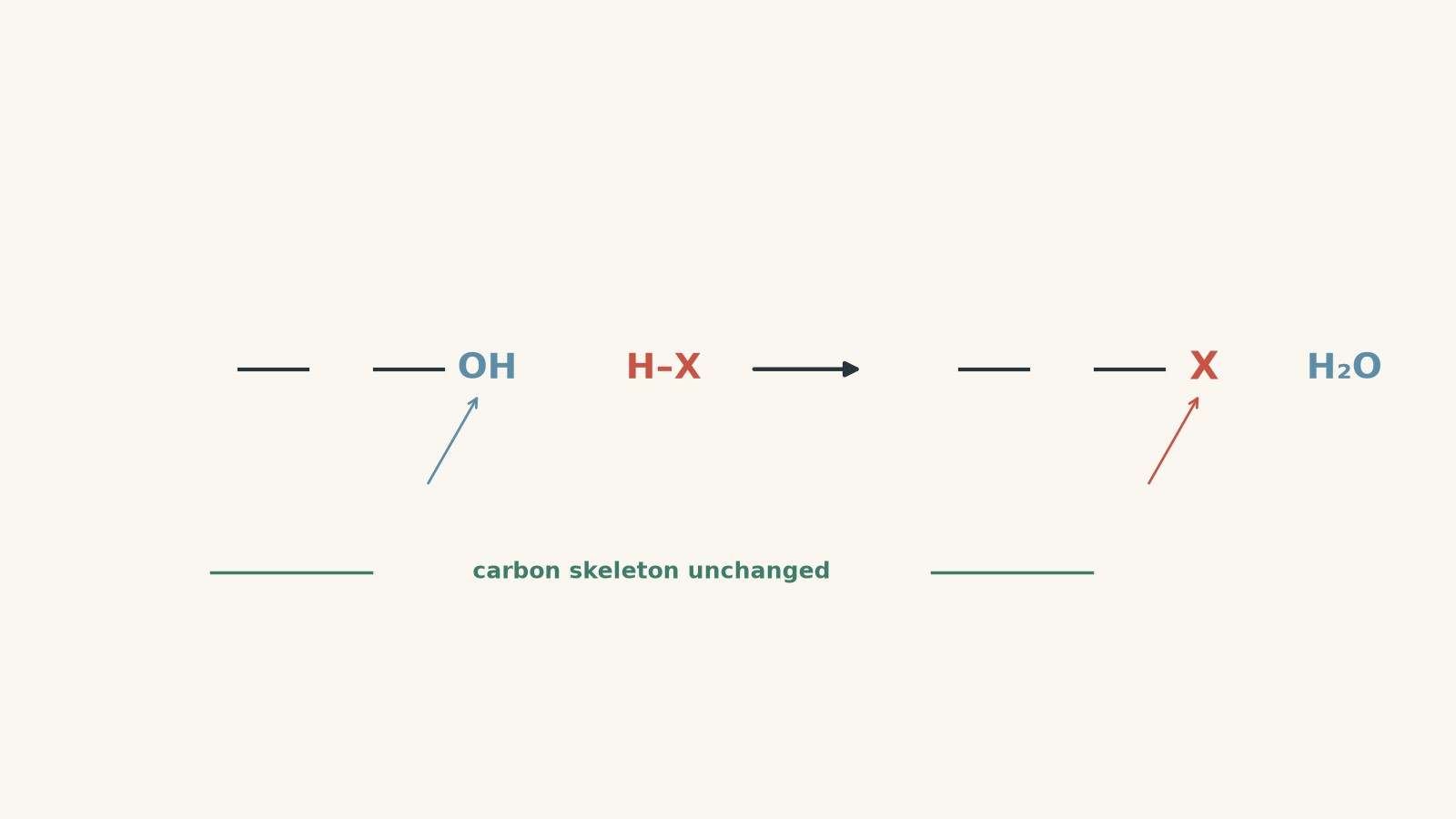
That seat-swap picture is excellent for predicting products. It is not, however, the complete mechanism. The \(\ce{-OH}\) group does not usually just fall off as \(\ce{OH^-}\).
02Why the hydrogen in HX matters
You might initially write:
\[
\ce{ROH + X^- -> RX + OH^-}
\]
The atoms and charge can be balanced, so it looks reasonable. Chemically, though, there is a problem: \(\ce{OH^-}\) is a poor leaving group.
A leaving group is an atom or group that departs from the carbon during a reaction. Hydroxide is strongly basic and is generally quite reluctant to leave an ordinary alcohol.
Hydrogen halides solve that problem because they provide \(\mathrm{H}^{+}\). The oxygen of the alcohol can accept a proton:
\[
\ce{ROH + H+ -> ROH2+}
\]
The group attached to carbon is now effectively \(\ce{-OH2+}\). If it leaves, it leaves as neutral water rather than as \(\ce{OH^-}\).
The overall change can then be represented as:
\[
\ce{ROH2+ + X^- -> RX + H2O}
\]
So the hydrogen from \(\ce{HX}\) is not an irrelevant extra atom. It helps turn a poor leaving group into a much better one.
A slightly silly analogy is someone refusing to leave a party because walking home alone is terrible. Give them a lift, and suddenly leaving becomes much easier. Protonation gives the oxygen a much better way out: it can leave as water.
The analogy breaks because molecules do not make decisions, and the exact order of bond breaking and bond making depends on the structure of the alcohol. For HSC product prediction, the important result is simpler: the halogen replaces the \(\ce{-OH}\) group on the same carbon.
03A reliable product-prediction method
When you see an alcohol reacting with \(\ce{HCl}\), \(\ce{HBr}\), or \(\ce{HI}\), use this sequence.
- Find the carbon directly bonded to \(\ce{-OH}\).
- Identify the halogen in \(\ce{HX}\).
- Keep the carbon skeleton unchanged.
- Replace \(\ce{-OH}\) with that halogen.
- Include \(\ce{H2O}\) as the other product.
- Name the finished haloalkane from its final structure. Do not automatically copy the numbering from the alcohol’s name.
That last step catches more mistakes than you might expect. The alcohol was numbered to give the \(\ce{-OH}\) group priority. Once the \(\ce{-OH}\) is gone, the product must be numbered using the naming rules for the new structure.
Worked example: propan-1-ol with HBr
Write a balanced equation and name the organic product when propan-1-ol reacts with hydrogen bromide.
Step 1
\(\ce{HBr}\) supplies bromine, so \(\ce{-OH}\) will be replaced by \(\ce{-Br}\).
Step 2
Propan-1-ol is:
\[
\ce{CH3CH2CH2OH}
\]
The \(\ce{-OH}\) group is on an end carbon.
Step 3
The organic product is:
\[
\ce{CH3CH2CH2Br}
\]
Step 4
\[
\ce{CH3CH2CH2OH + HBr -> CH3CH2CH2Br + H2O}
\]
Step 5
The product is 1-bromopropane.
The carbon chain has not changed. Only the group attached to carbon 1 has changed from \(\ce{-OH}\) to \(\ce{-Br}\).
04Don’t confuse substitution with dehydration
Alcohols can also lose water to form an alkene. That is an elimination reaction, not the substitution reaction we are studying here.
Compare the patterns:
\[
\ce{alcohol + HX -> haloalkane + H2O}
\]
versus
\[
\ce{alcohol -> alkene + H2O}
\]
In substitution, a halogen takes the place of \(\ce{-OH}\). In dehydration, atoms are removed from neighbouring carbons so that a carbon-carbon double bond can form.
The reagent and conditions therefore matter. Seeing “alcohol” and “acid” is not enough information to predict an alkene automatically. If the reagent is a hydrogen halide such as \(\ce{HBr}\), the expected HSC reaction is substitution. If you need to separate those two reaction patterns carefully, see tutorgum’s guide to dehydration of alcohols.
05Naming the product from the structure
Here is a more interesting case.
Worked example: a product that needs renumbering
4-bromopentan-2-ol reacts with hydrogen chloride. Write the equation and give the IUPAC name of the organic product.
Step 1
\[
\ce{CH3CH(OH)CH2CH(Br)CH3}
\]
Step 2
The reagent is \(\ce{HCl}\), so the \(\ce{-OH}\) group is replaced by \(\ce{-Cl}\).
\[
\ce{CH3CH(Cl)CH2CH(Br)CH3}
\]
Step 3
\[
\ce{CH3CH(OH)CH2CH(Br)CH3 + HCl -> CH3CH(Cl)CH2CH(Br)CH3 + H2O}
\]
Step 4
From one end, the substituents are chloro at carbon 2 and bromo at carbon 4.
From the other end, they are bromo at carbon 2 and chloro at carbon 4.
Both directions give the same set of locants, \(2,4\). In that tie, the substituent appearing first alphabetically receives the lower number. “Bromo” comes before “chloro”.
The product is therefore 2-bromo-4-chloropentane.
Notice what happened: the carbon on which substitution occurred has not moved, but its number in the final IUPAC name is different. Reaction prediction and compound naming are two separate jobs.
06What the simple equation hides
The equation
\[
\ce{ROH + HX -> RX + H2O}
\]
tells you the overall chemical change. It does not tell you how fast every alcohol reacts, or the exact sequence of elementary steps.
Different alcohol structures can undergo substitution by somewhat different microscopic pathways. In some cases, attack by the halide and departure of water are closely linked. In others, water can leave before the halide forms its bond.
You do not need to pretend those pathways are identical to predict the standard HSC product. The common chemical problem is the same: the original \(\ce{-OH}\) group is a poor leaving group, so acidic conditions convert it into a group that can leave as water.
Practical reaction rates also differ. \(\ce{HCl}\) is generally less effective than \(\ce{HBr}\) or \(\ce{HI}\) for many alcohols and may require stronger conditions or a catalyst such as \(\ce{ZnCl2}\). If an HSC question explicitly gives an alcohol reacting with \(\ce{HCl}\), however, the product-prediction rule remains: replace \(\ce{-OH}\) with \(\ce{-Cl}\), unless the question gives information indicating otherwise.
07The most tempting mistakes
One common mistake is putting both H and X onto the carbon skeleton. That would treat \(\ce{HX}\) as though it were adding across a double bond. There is no carbon-carbon double bond here. The hydrogen helps form water; the halogen becomes attached to carbon.
Another is deleting \(\ce{-OH}\) and forgetting \(\ce{H2O}\). If you are asked for the complete molecular equation, water must appear so that the hydrogen and oxygen atoms are accounted for.
A third is moving the halogen to whichever carbon gives the nicest-looking name. Reaction chemistry comes before naming. Put X on the carbon that originally carried \(\ce{-OH}\), then name the structure you actually made.
Finally, do not assume \(\mathrm{Br}^{-}\) alone makes an alcohol react readily. The acidic part of \(\ce{HBr}\) has an important job: it activates the \(\ce{-OH}\) group so that it can leave as water.
08Questions and solutions
Question 1
Pentan-1-ol reacts with hydrogen iodide.
Write a balanced equation for the reaction and name the organic product.
Solution 1
The product is 1-iodopentane, and water is the other product.
Hydrogen iodide supplies iodine for the substitution. Pentan-1-ol has its \(\ce{-OH}\) group on carbon 1, so iodine replaces that group on the same carbon:
\[
\ce{CH3CH2CH2CH2CH2OH + HI -> CH3CH2CH2CH2CH2I + H2O}
\]
The tempting mistake is to add H and I to different carbons. That would be an addition pattern. Here, the reaction is substitution: the carbon framework remains unchanged and \(\ce{-I}\) replaces \(\ce{-OH}\).
Question 2
3-methylbutan-2-ol reacts with hydrogen bromide.
Write the condensed structural formula of the organic product, write the complete equation, and give the product’s IUPAC name.
Solution 2
The organic product is 2-bromo-3-methylbutane.
The starting alcohol is:
\[
\ce{CH3CH(OH)CH(CH3)CH3}
\]
The \(\ce{-OH}\) group is bonded to carbon 2. Hydrogen bromide therefore replaces that group with bromine:
\[
\ce{CH3CH(OH)CH(CH3)CH3 + HBr -> CH3CH(Br)CH(CH3)CH3 + H2O}
\]
The product structure is:
\[
\ce{CH3CH(Br)CH(CH3)CH3}
\]
For naming, the longest chain contains four carbons. Numbering gives bromo and methyl substituents at carbons 2 and 3. The two possible directions both produce the set \(2,3\), so the alphabetical tie-break gives bromo the lower number.
The name is therefore 2-bromo-3-methylbutane.
A tempting route is to think the carbon skeleton might rearrange because the product needs a new name. It does not. In this standard substitution question, only the group attached to the alcohol carbon changes.
Question 3
The oxygen atom in a sample of ethanol is labelled with the isotope \(^{18}\mathrm{O}\). The labelled ethanol reacts completely with excess \(\ce{HBr}\).
The bromine atoms and hydrogen atoms have their usual isotopic composition.
Which reaction product contains the original \(^{18}\mathrm{O}\) atom? Explain your answer by tracking the relevant bonds.
Solution 3
The original \(^{18}\mathrm{O}\) atom ends up in the water, not in bromoethane.
The substitution changes ethanol into bromoethane:
\[
\ce{CH3CH2OH + HBr -> CH3CH2Br + H2O}
\]
The crucial bond change is that the carbon-oxygen bond in the alcohol is broken while a carbon-bromine bond forms. The alcohol oxygen is protonated and can leave together with hydrogen as water.
Therefore the water product contains the original \(^{18}\mathrm{O}\).
The tempting prediction is that the oxygen might somehow remain associated with the organic molecule because it started inside ethanol. But the organic product, bromoethane, contains no oxygen at all. Conservation of atoms then forces the labelled oxygen into the water product.
This is a useful way to test whether your reaction equation represents the mechanism sensibly: track individual atoms, rather than treating functional groups as labels that simply disappear.
Question 4
A student compares these two proposed reactions involving ethanol:
\[
\ce{CH3CH2OH + Br^- -> CH3CH2Br + OH^-}
\]
and
\[
\ce{CH3CH2OH + HBr -> CH3CH2Br + H2O}
\]
The student argues that the first reaction should work just as well because it is balanced and already contains the required bromide ion.
Explain why this conclusion is chemically flawed. Then predict whether mixing ethanol with a neutral aqueous solution of \(\ce{NaBr}\) should produce 1-bromoethane readily under ordinary conditions.
Solution 4
Neutral aqueous \(\ce{NaBr}\) should not convert ethanol readily into 1-bromoethane under ordinary conditions, because bromide alone does not solve the main problem: \(\ce{-OH}\) is a poor leaving group.
The first proposed equation is balanced:
\[
\ce{CH3CH2OH + Br^- -> CH3CH2Br + OH^-}
\]
but a balanced equation is not automatically a chemically favourable pathway. It requires the alcohol’s \(\ce{-OH}\) group to depart as \(\ce{OH^-}\), which is strongly basic and generally a poor leaving group.
In \(\ce{HBr}\), the acidic hydrogen changes the situation. A useful first step is:
\[
\ce{CH3CH2OH + H+ -> CH3CH2OH2+}
\]
The oxygen can then leave as neutral water while bromide forms the carbon-bromine bond. Overall:
\[
\ce{CH3CH2OH + HBr -> CH3CH2Br + H2O}
\]
The tempting argument focuses only on the presence of \(\mathrm{Br}^{-}\). Bromide is indeed the species that forms the new bond to carbon, but a successful substitution also needs the original group to leave. The acid is important because it turns a poor leaving group into water.
This is why reaction equations need chemical reasoning as well as atom counting.
Question 5
A sample of propan-2-ol contains \(^{18}\mathrm{O}\) only in the oxygen atom of its \(\ce{-OH}\) group. Assume there is no isotope exchange before the reactions described below.
The sample is divided into two portions.
In Route A, the labelled propan-2-ol reacts completely with \(\ce{HBr}\). The organic product is isolated and then reacted with excess aqueous \(\ce{NaOH}\) made using ordinary \(^{16}\mathrm{O}\).
In Route B, the labelled propan-2-ol is heated under conditions that dehydrate it to propene and water.
For each route:
- State where the original \(^{18}\mathrm{O}\) is found after the first reaction.
- For Route A, state whether the propan-2-ol formed after reaction with aqueous \(\ce{NaOH}\) contains the original \(^{18}\mathrm{O}\).
- Explain why the isotope evidence distinguishes atom conservation from the idea that a functional group simply “changes back”.
Solution 5
In both routes, the original \(^{18}\mathrm{O}\) leaves the organic molecule in water. In Route A, the propan-2-ol formed later by hydrolysis does not recover that original labelled oxygen.
For Route A, the first reaction is substitution:
\[
\ce{CH3CH(OH)CH3 + HBr -> CH3CH(Br)CH3 + H2O}
\]
The carbon-oxygen bond is broken, and the original alcohol oxygen leaves as part of water. Therefore the \(^{18}\mathrm{O}\) is in that water.
The isolated 2-bromopropane contains no oxygen from the original alcohol.
When 2-bromopropane then reacts with aqueous \(\ce{NaOH}\), a carbon-oxygen bond is formed again:
\[
\ce{CH3CH(Br)CH3 + OH^- -> CH3CH(OH)CH3 + Br^-}
\]
Under the stated assumption that the aqueous reagent contains ordinary \(^{16}\mathrm{O}\), the oxygen incorporated into the newly formed propan-2-ol comes from the new aqueous environment, not from the original alcohol. The original \(^{18}\mathrm{O}\) has already departed in water.
For Route B, dehydration gives propene and water:
\[
\ce{CH3CH(OH)CH3 -> CH3CH=CH2 + H2O}
\]
Again, the organic product contains no oxygen, so the original \(^{18}\mathrm{O}\) must be found in the water formed during dehydration.
The tempting idea is that Route A somehow “returns” the same \(\ce{-OH}\) group because the sequence begins and ends with propan-2-ol. Structurally, the starting and final organic molecules can be the same compound. Atom by atom, however, they are not necessarily identical molecules. The first oxygen left, and a different oxygen was incorporated later.
That is the deeper value of substitution equations: they are not just recipes for changing functional-group names. They let you track which bonds break, which bonds form, and where each atom can physically go.
09Where this idea leads next
Once you can predict alcohol substitution reliably, you can start following reaction pathways rather than treating each equation separately. An alcohol can be converted into a haloalkane, and that haloalkane can undergo further substitution or elimination reactions.
The same carbon carrying the original \(\ce{-OH}\) group is often the key reference point, but the reagent decides what happens next. With \(\ce{HX}\), that site undergoes substitution. Under dehydration conditions, neighbouring atoms are removed and a double bond forms instead. Being able to distinguish those two patterns is the next step towards predicting multi-stage HSC organic reaction pathways rather than memorising isolated equations.