
Keq, Ka and Kb for Acid, Base and Ionic Equilibria
Learn how equilibrium constants apply to weak acids, weak bases, and ionic solutions, and how to compare the extent of ionisation. Includes worked HSC-style calculations and challenging practice questions with solutions.
Two solutions can contain the same concentration of acid and still have wildly different pH values. Take \(0.100\ \mathrm{mol\,L^{-1}}\) hydrochloric acid and \(0.100\ \mathrm{mol\,L^{-1}}\) ethanoic acid. Should they produce the same \([\ce{H3O+}]\) because we added the same number of moles per litre?
No. Hydrochloric acid ionises essentially completely in water, while ethanoic acid only ionises partly. The missing information is not how much acid you started with. It is how far the reaction with water proceeds.
An equilibrium constant gives us a numerical way to describe that position. For acids, we call it \(K_a\). For bases, \(K_b\). For other equilibria, we may use \(K_\mathrm{eq}\), or a more specialised constant such as \(K_{sp}\). The names change, but the central idea does not: compare the equilibrium amount of products with the equilibrium amount of reactants.
01Start with the equilibrium, not the formula
Consider a general reversible reaction:
\[ \ce{aA + bB <=> cC + dD} \]
At equilibrium, particles are still reacting in both directions. The forward and reverse reaction rates are equal, so the concentrations stop changing overall.
For a homogeneous reaction in solution, the equilibrium constant can be written as:
\[ K_\mathrm{eq} = \frac{[\ce{C}]^c[\ce{D}]^d} {[\ce{A}]^a[\ce{B}]^b} \]
The square brackets mean equilibrium concentration. The lower-case letters \(a\), \(b\), \(c\), and \(d\) are the stoichiometric coefficients from the balanced equation.
A useful first picture is a reversible doorway between two rooms. If most people are found in the product room once the crowd settles, the equilibrium lies towards products. If most remain in the reactant room, it lies towards reactants.
That picture has limits. \(K_\mathrm{eq}\) is not simply a headcount ratio, because concentrations can be raised to powers set by the equation. Also, equilibrium is dynamic: particles are still crossing the doorway both ways.
The broad interpretation is:
| Value of \(K_\mathrm{eq}\) | Equilibrium position |
|---|---|
| \(K_\mathrm{eq} \gg 1\) | Products strongly favoured |
| \(K_\mathrm{eq} \approx 1\) | Appreciable amounts of both sides |
| \(K_\mathrm{eq} \ll 1\) | Reactants strongly favoured |
A large equilibrium constant does not mean the reaction is fast. It tells you where the equilibrium lies, not how quickly it gets there.
At a fixed temperature, the equilibrium constant has a fixed value. Changing concentrations can shift the system to a new equilibrium, but it does not change \(K_\mathrm{eq}\). Changing temperature can.
02Dissociation and ionisation are related, but not identical
These words are often used rather casually, so it helps to separate the ideas.
When a soluble ionic compound such as sodium chloride enters water, its existing ions separate:
\[ \ce{NaCl(s) -> Na+(aq) + Cl-(aq)} \]
This is dissociation. The sodium and chloride ions were already present in the ionic lattice.
A molecular acid such as ethanoic acid contains no free \(\ce{H3O+}\) ions waiting to fall out. Instead, an ethanoic acid molecule transfers a proton to water:
\[ \ce{CH3COOH(aq) + H2O(l) <=> H3O+(aq) + CH3COO-(aq)} \]
Ions are created by the reaction. This is more precisely called ionisation, although acid and base “dissociation” is also common terminology.
That distinction becomes useful when a salt contains an ion that can itself react with water. The salt may dissociate almost completely, then one of its ions may establish a second, weak equilibrium with water.
We will use that idea shortly.
03The same \(K_\mathrm{eq}\) logic appears in ionic equilibria
Suppose an aqueous species undergoes the simplified ionic dissociation:
\[ \ce{MX(aq) <=> M+(aq) + X-(aq)} \]
Its equilibrium expression would be:
\[ K_\mathrm{eq} = \frac{[\mathrm{M}^{+}][\mathrm{X}^{-}]} {[\ce{MX}]} \]
The expression follows directly from the balanced equation.
For a sparingly soluble ionic solid, the situation is slightly different:
\[ \ce{MX(s) <=> M+(aq) + X-(aq)} \]
The solid does not appear in the equilibrium expression, so:
\[ K_{sp}=[\mathrm{M}^{+}][\mathrm{X}^{-}] \]
Here \(K_{sp}\), the solubility product constant, is simply a specialised equilibrium constant for a dissolution equilibrium.
Do not automatically conclude that the compound with the larger \(K_{sp}\) is always “more soluble”. If two salts dissolve with different stoichiometric ratios, their \(K_{sp}\) expressions are different. You need to calculate molar solubility before making that comparison.
The same caution will matter for \(K_a\) and \(K_b\): the number itself means something only in relation to the equilibrium it describes.
04\(K_a\): equilibrium for acid ionisation
Take a generic weak monoprotic acid \(\ce{HA}\). “Monoprotic” means each molecule can donate one proton.
Its reaction with water is:
\[ \ce{HA(aq) + H2O(l) <=> H3O+(aq) + A-(aq)} \]
If we wrote the full equilibrium expression, water would appear in the denominator. However, liquid water is the solvent and its concentration is effectively constant, so it is incorporated into the equilibrium constant.
We therefore define the acid dissociation constant:
\[ K_a = \frac{[\ce{H3O+}][\mathrm{A}^{-}]} {[\ce{HA}]} \]
A larger \(K_a\) means the acid equilibrium lies further towards \(\ce{H3O+}\) and \(\mathrm{A}^{-}\). The acid is stronger.
A smaller \(K_a\) means more acid remains as \(\ce{HA}\). The acid is weaker.
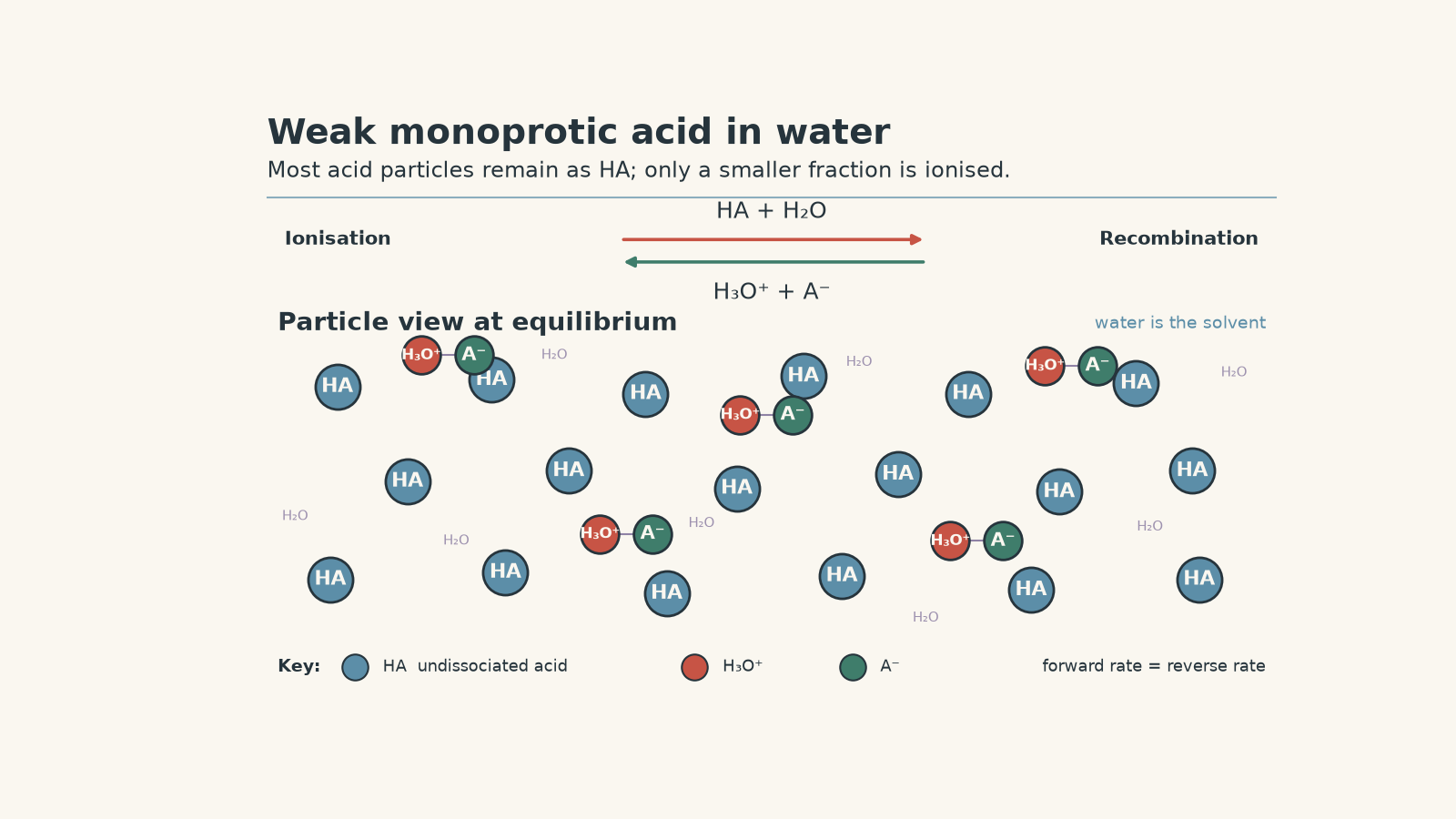
This gives us an important distinction:
- acid strength is described by \(K_a\) at a given temperature
- acid concentration tells us how much acid was put into a given volume
- percentage ionisation tells us what fraction of that acid ionises under those particular conditions
Those are three different ideas.
A concentrated weak acid is still weak. A dilute strong acid is still strong.
Worked example: How much of a weak acid ionises?
A \(0.100\ \mathrm{mol\,L^{-1}}\) solution of ethanoic acid has \(K_a=1.8\times10^{-5}\) at the stated temperature. Calculate its equilibrium \([\ce{H3O+}]\), pH, and percentage ionisation.
Step 1
\[ \ce{CH3COOH(aq) + H2O(l) <=> H3O+(aq) + CH3COO-(aq)} \]
Let \(x\ \mathrm{mol\,L^{-1}}\) of ethanoic acid ionise.
| \(\ce{CH3COOH}\) | \(\ce{H3O+}\) | \(\ce{CH3COO-}\) | |
|---|---|---|---|
| Initial | \(0.100\) | approximately \(0\) | \(0\) |
| Change | \(-x\) | \(+x\) | \(+x\) |
| Equilibrium | \(0.100-x\) | \(x\) | \(x\) |
The tiny amount of \(\ce{H3O+}\) supplied by water itself is negligible here.
Step 2
\[ K_a = \frac{[\ce{H3O+}][\ce{CH3COO-}]} {[\ce{CH3COOH}]} = \frac{x^2}{0.100-x} \]
Therefore:
\[ 1.8\times10^{-5} = \frac{x^2}{0.100-x} \]
Because \(K_a\) is small, we expect \(x\) to be much smaller than \(0.100\). As a first approximation, take \(0.100-x\approx0.100\):
\[ 1.8\times10^{-5} \approx \frac{x^2}{0.100} \]
\[ x^2=1.8\times10^{-6} \]
\[ x\approx1.34\times10^{-3}\ \mathrm{mol\,L^{-1}} \]
The exact quadratic solution is about \(1.33\times10^{-3}\ \mathrm{mol\,L^{-1}}\), so the approximation is reasonable.
Step 3
Since \(x=[\ce{H3O+}]\),
\[ \mathrm{pH} = -\log_{10}[\ce{H3O+}] = -\log_{10}(1.33\times10^{-3}) \approx2.88 \]
Step 4
\[ \%\text{ ionisation} = \frac{\text{amount ionised}}{\text{initial amount}}\times100 \]
Using concentrations:
\[ \%\text{ ionisation} = \frac{1.33\times10^{-3}}{0.100}\times100 \approx1.33\% \]
So only about \(1.33\%\) of the ethanoic acid molecules are ionised at equilibrium.
That explains our opening puzzle. A \(0.100\ \mathrm{mol\,L^{-1}}\) strong acid can produce close to \(0.100\ \mathrm{mol\,L^{-1}}\) hydronium ions, while this \(0.100\ \mathrm{mol\,L^{-1}}\) weak acid produces only about \(1.33\times10^{-3}\ \mathrm{mol\,L^{-1}}\).
The initial acid concentrations were equal. Their extents of ionisation were not.
05\(K_b\): the same idea for bases
A weak base accepts a proton from water.
For a generic molecular base \(\ce{B}\):
\[ \ce{B(aq) + H2O(l) <=> BH+(aq) + OH-(aq)} \]
Its base dissociation constant is:
\[ K_b = \frac{[\ce{BH+}][\ce{OH-}]} {[\ce{B}]} \]
A larger \(K_b\) means the equilibrium lies further towards the products. The base is stronger.
The same equilibrium can involve an ion rather than a neutral molecule. Suppose \(\mathrm{A}^{-}\) is the conjugate base of the weak acid \(\ce{HA}\):
\[ \ce{A-(aq) + H2O(l) <=> HA(aq) + OH-(aq)} \]
Then:
\[ K_b = \frac{[\ce{HA}][\ce{OH-}]} {[\mathrm{A}^{-}]} \]
This explains something that can look strange at first: a salt does not need to contain \(\ce{OH-}\) in its formula to produce a basic solution.
Worked example: Why can a salt solution be basic?
A \(0.0500\ \mathrm{mol\,L^{-1}}\) sodium ethanoate solution is prepared at \(25^\circ\mathrm{C}\). The \(K_a\) of ethanoic acid is \(1.8\times10^{-5}\). Calculate the approximate pH.
Use \(K_w=1.0\times10^{-14}\) at \(25^\circ\mathrm{C}\).
Step 1
Sodium ethanoate is a soluble ionic compound, so first:
\[ \ce{CH3COONa(aq) -> Na+(aq) + CH3COO-(aq)} \]
The sodium ion does not significantly affect the acid-base equilibrium. The ethanoate ion does:
\[ \ce{CH3COO-(aq) + H2O(l) <=> CH3COOH(aq) + OH-(aq)} \]
Step 2
For a conjugate acid-base pair at \(25^\circ\mathrm{C}\):
\[ K_aK_b=K_w \]
Therefore:
\[ K_b = \frac{K_w}{K_a} = \frac{1.0\times10^{-14}}{1.8\times10^{-5}} = 5.56\times10^{-10} \]
Step 3
Let \(x\ \mathrm{mol\,L^{-1}}\) of ethanoate react with water.
\[ K_b = \frac{[\ce{CH3COOH}][\ce{OH-}]} {[\ce{CH3COO-}]} = \frac{x^2}{0.0500-x} \]
Since \(K_b\) is very small, \(x\ll0.0500\), so:
\[ 5.56\times10^{-10} \approx \frac{x^2}{0.0500} \]
\[ x \approx \sqrt{(5.56\times10^{-10})(0.0500)} = 5.27\times10^{-6}\ \mathrm{mol\,L^{-1}} \]
Thus:
\[ [\ce{OH-}] \approx5.27\times10^{-6}\ \mathrm{mol\,L^{-1}} \]
Step 4
\[ \mathrm{pOH} = -\log_{10}(5.27\times10^{-6}) \approx5.28 \]
At \(25^\circ\mathrm{C}\):
\[ \mathrm{pH}+\mathrm{pOH}=14.00 \]
so:
\[ \mathrm{pH} = 14.00-5.28 = 8.72 \]
The solution is basic.
The important sequence is easy to miss: sodium ethanoate dissociates into ions essentially completely, then a small fraction of the ethanoate ions react with water. The first process supplies \(\ce{CH3COO-}\); the second produces \(\ce{OH-}\).
06Conjugate acids and bases link \(K_a\) and \(K_b\)
If \(\ce{HA}\) is an acid, then \(\mathrm{A}^{-}\) is its conjugate base.
Their constants are connected by:
\[ K_a(\ce{HA})K_b(\mathrm{A}^{-})=K_w \]
At \(25^\circ\mathrm{C}\):
\[ K_w = [\ce{H3O+}][\ce{OH-}] = 1.0\times10^{-14} \]
This creates a useful see-saw.
If \(\ce{HA}\) has a large \(K_a\), it is relatively good at donating a proton. Its conjugate base \(\mathrm{A}^{-}\) must therefore be relatively poor at taking that proton back, so \(K_b\) is small.
If \(\ce{HA}\) has a very small \(K_a\), its conjugate base is stronger.
A relationship analogy actually works reasonably well here. Imagine \(\ce{HA}\) is someone very keen to hand over their phone password. Once they have happily given it away, their partner \(\mathrm{A}^{-}\) is not especially desperate to grab it back. If \(\ce{HA}\) refuses to hand it over in the first place, \(\mathrm{A}^{-}\) represents the opposite tendency more strongly.
The analogy breaks because proton transfer is governed by molecular interactions and equilibrium thermodynamics, not questionable dating decisions. The useful part is simply the inverse relationship: a stronger acid has a weaker conjugate base.
07Acid strength is not the same as percentage ionisation
Here is the trap that causes a surprising number of equilibrium mistakes.
Suppose you dilute a weak acid. Predict what happens to:
- \([\ce{H3O+}]\)
- the percentage of acid molecules that are ionised
It is tempting to answer “both decrease”. After all, you added water.
Only the first one decreases.
For the simple weak-acid equilibrium:
\[ \ce{HA + H2O <=> H3O+ + A-} \]
dilution favours the side containing more dissolved particles. The equilibrium therefore shifts towards the ions. A greater fraction of the remaining acid ionises.
For a weak acid with initial concentration \(C\), if the ionised amount \(x\) is small:
\[ K_a\approx\frac{x^2}{C} \]
so:
\[ x\approx\sqrt{K_aC} \]
Since \(x\approx[\ce{H3O+}]\), dilution lowers \(C\), which lowers \([\ce{H3O+}]\).
But the fraction ionised is:
\[ \frac{x}{C} \approx \sqrt{\frac{K_a}{C}} \]
As \(C\) becomes smaller, this fraction becomes larger.
So dilution can simultaneously:
- decrease \([\ce{H3O+}]\)
- increase pH
- increase percentage ionisation
- leave \(K_a\) unchanged
There is no contradiction. These quantities measure different things.
Worked example: Can dilution increase ionisation?
A weak acid \(\ce{HA}\) has \(K_a=1.0\times10^{-6}\). Compare a \(0.100\ \mathrm{mol\,L^{-1}}\) solution with a \(0.00100\ \mathrm{mol\,L^{-1}}\) solution. Calculate \([\ce{H3O+}]\) and percentage ionisation for each.
Step 1
For \(C=0.100\ \mathrm{mol\,L^{-1}}\):
\[ 1.0\times10^{-6} = \frac{x^2}{0.100-x} \]
Solving gives approximately:
\[ x=3.16\times10^{-4}\ \mathrm{mol\,L^{-1}} \]
Therefore:
\[ [\ce{H3O+}] \approx3.16\times10^{-4}\ \mathrm{mol\,L^{-1}} \]
and:
\[ \%\text{ ionisation} = \frac{3.16\times10^{-4}}{0.100}\times100 \approx0.316\% \]
Step 2
For \(C=0.00100\ \mathrm{mol\,L^{-1}}\):
\[ 1.0\times10^{-6} = \frac{x^2}{0.00100-x} \]
The exact quadratic solution gives:
\[ x\approx3.11\times10^{-5}\ \mathrm{mol\,L^{-1}} \]
Therefore:
\[ [\ce{H3O+}] \approx3.11\times10^{-5}\ \mathrm{mol\,L^{-1}} \]
but:
\[ \%\text{ ionisation} = \frac{3.11\times10^{-5}}{0.00100}\times100 \approx3.11\% \]
The diluted solution has about one-tenth the hydronium concentration, yet roughly ten times the percentage ionisation.
The acid has not become stronger. Its \(K_a\) is still \(1.0\times10^{-6}\). The equilibrium composition changed because the concentration changed.
08A common ion can push ionisation the other way
Now imagine adding a soluble salt containing \(\mathrm{A}^{-}\) to the weak acid equilibrium:
\[ \ce{HA + H2O <=> H3O+ + A-} \]
The salt increases \([\mathrm{A}^{-}]\).
Because \(\mathrm{A}^{-}\) is already a product, the equilibrium responds by favouring the reverse reaction. Less \(\ce{HA}\) ionises.
This is the common-ion effect.
The sneaky part is that the final solution can contain much more \(\mathrm{A}^{-}\) overall even though the acid itself is ionising less. Most of that extra \(\mathrm{A}^{-}\) came directly from the salt.
So counting how much conjugate base is present is not automatically the same thing as measuring how much acid ionised.
This distinction becomes central when you later study buffers.
09A compact way to choose the right constant
Before calculating, identify the reaction you are actually describing.
| Situation | Typical equilibrium | Constant |
|---|---|---|
| General aqueous equilibrium | \(\ce{aA + bB <=> cC + dD}\) | \(K_\mathrm{eq}\) |
| Weak acid in water | \(\ce{HA + H2O <=> H3O+ + A-}\) | \(K_a\) |
| Weak base in water | \(\ce{B + H2O <=> BH+ + OH-}\) | \(K_b\) |
| Conjugate base ion in water | \(\ce{A- + H2O <=> HA + OH-}\) | \(K_b\) |
| Conjugate acid ion in water | \(\ce{BH+ + H2O <=> B + H3O+}\) | \(K_a\) |
| Sparingly soluble ionic solid | \(\ce{MX(s) <=> M+ + X-}\) | \(K_{sp}\) |
Then apply the same routine:
- Write and balance the equilibrium equation.
- Decide which species belong in the equilibrium expression.
- Use equilibrium concentrations, not automatically the initial concentrations.
- Raise each concentration to its stoichiometric coefficient.
- Use an ICE table when the equilibrium concentrations are not already known.
- Interpret the numerical result chemically, rather than stopping at the calculator answer.
The third step causes a lot of trouble. If a question gives \(0.100\ \mathrm{mol\,L^{-1}}\) weak acid initially, you cannot simply put \(0.100\) into the denominator of \(K_a\) and call it the equilibrium concentration unless an approximation has been justified.
10The most tempting misconceptions
| Tempting idea | What actually happens |
|---|---|
| “A \(0.10\ \mathrm{mol\,L^{-1}}\) acid gives \(0.10\ \mathrm{mol\,L^{-1}}\) \(\ce{H3O+}\).” | Only if ionisation is effectively complete. Weak acids ionise partly. |
| “A larger acid concentration means a stronger acid.” | Strength is described by \(K_a\), not concentration. |
| “Dilution makes a weak acid weaker.” | \(K_a\) stays constant at constant temperature. Dilution usually increases percentage ionisation. |
| “More \(\mathrm{A}^{-}\) means more \(\ce{HA}\) must have ionised.” | Not if \(\mathrm{A}^{-}\) was added from a salt. |
| “A salt without \(\ce{OH-}\) cannot make a basic solution.” | An anion can accept a proton from water and generate \(\ce{OH-}\). |
| “Large \(K\) means a fast reaction.” | \(K\) describes equilibrium position, not reaction rate. |
| “\(K_a\) and \(K_b\) can be compared casually as if they describe the same reaction.” | Each constant belongs to a particular equilibrium. Compare the reactions and species first. |
11Questions and solutions
Question 1
At a fixed temperature, hydrofluoric acid establishes the equilibrium:
\[ \ce{HF(aq) + H2O(l) <=> H3O+(aq) + F-(aq)} \]
Its acid dissociation constant is \(K_a=6.8\times10^{-4}\).
a. Write the \(K_a\) expression.
b. A second monoprotic acid \(\ce{HX}\) has \(K_a=2.0\times10^{-6}\) at the same temperature. If equal concentrations of \(\ce{HF}\) and \(\ce{HX}\) are compared, which acid has the greater extent of ionisation?
c. Explain why liquid water does not appear in the \(K_a\) expression.
Solution 1
\(\ce{HF}\) has the greater extent of ionisation, and its equilibrium expression is \(K_a=[\ce{H3O+}][\mathrm{F}^{-}]/[\ce{HF}]\).
For part a:
\[ K_a = \frac{[\ce{H3O+}][\mathrm{F}^{-}]} {[\ce{HF}]} \]
For part b:
\[ 6.8\times10^{-4}>2.0\times10^{-6} \]
so the equilibrium for \(\ce{HF}\) lies further towards its ions than the equilibrium for \(\ce{HX}\). At equal initial concentrations and the same temperature, \(\ce{HF}\) therefore has the greater extent of ionisation.
The tempting mistake is to read both substances simply as “weak acids” and assume their behaviour is essentially identical. Weak acids can differ greatly in strength. \(K_a\) provides the quantitative comparison.
For part c, liquid water is the solvent and its concentration changes negligibly during the ionisation. Its effectively constant contribution is incorporated into the numerical value of \(K_a\), so it is omitted from the working expression.
Question 2
A weak monoprotic acid \(\ce{HA}\) has \(K_a=3.2\times10^{-5}\). A solution initially contains \(0.0800\ \mathrm{mol\,L^{-1}}\) \(\ce{HA}\).
Calculate:
a. the equilibrium \([\ce{H3O+}]\)
b. the pH
c. the percentage ionisation.
Assume the temperature remains constant and water’s own contribution to \([\ce{H3O+}]\) is negligible.
Solution 2
The equilibrium hydronium concentration is approximately \(1.58\times10^{-3}\ \mathrm{mol\,L^{-1}}\), giving a pH of \(2.80\) and about \(1.98\%\) ionisation.
The equilibrium is:
\[ \ce{HA(aq) + H2O(l) <=> H3O+(aq) + A-(aq)} \]
Let \(x\ \mathrm{mol\,L^{-1}}\) ionise.
Then:
\[ [\ce{HA}]=0.0800-x \]
and:
\[ [\ce{H3O+}]=[\mathrm{A}^{-}]=x \]
Substitute into the \(K_a\) expression:
\[ 3.2\times10^{-5} = \frac{x^2}{0.0800-x} \]
Rearranging:
\[ x^2+(3.2\times10^{-5})x-2.56\times10^{-6}=0 \]
Solving the quadratic and taking the physically meaningful positive root gives:
\[ x=1.58\times10^{-3}\ \mathrm{mol\,L^{-1}} \]
Therefore:
\[ [\ce{H3O+}] = 1.58\times10^{-3}\ \mathrm{mol\,L^{-1}} \]
The pH is:
\[ \mathrm{pH} = -\log_{10}(1.58\times10^{-3}) \approx2.80 \]
The percentage ionisation is:
\[ \%\text{ ionisation} = \frac{1.58\times10^{-3}}{0.0800}\times100 \approx1.98\% \]
The tempting route is to treat the initial \(0.0800\ \mathrm{mol\,L^{-1}}\) as the hydronium concentration. That would assume complete ionisation, which contradicts the small \(K_a\). The equilibrium expression forces us to distinguish the initial acid concentration from the amount that actually ionises.
Question 3
At \(25^\circ\mathrm{C}\), a \(0.100\ \mathrm{mol\,L^{-1}}\) solution of sodium ethanoate is prepared. The acid dissociation constant of ethanoic acid is:
\[ K_a=1.8\times10^{-5} \]
Use \(K_w=1.0\times10^{-14}\).
a. Explain why the solution is basic even though sodium ethanoate contains no hydroxide ion in its formula.
b. Calculate \(K_b\) for the ethanoate ion.
c. Calculate the approximate pH of the solution.
Solution 3
The solution is basic because \(\ce{CH3COO-}\) accepts a proton from water and produces \(\ce{OH-}\); \(K_b=5.56\times10^{-10}\), and the pH is approximately \(8.87\).
First, sodium ethanoate dissociates:
\[ \ce{CH3COONa(aq) -> Na+(aq) + CH3COO-(aq)} \]
The sodium ion is effectively a spectator in this acid-base equilibrium. The ethanoate ion reacts with water:
\[ \ce{CH3COO-(aq) + H2O(l) <=> CH3COOH(aq) + OH-(aq)} \]
This explains part a. Hydroxide does not need to be present in the original formula; it can be produced by proton transfer from water.
For part b, ethanoic acid and ethanoate are a conjugate pair:
\[ K_aK_b=K_w \]
Therefore:
\[ K_b = \frac{1.0\times10^{-14}}{1.8\times10^{-5}} = 5.56\times10^{-10} \]
For part c, let \(x=[\ce{OH-}]\) produced at equilibrium:
\[ 5.56\times10^{-10} = \frac{x^2}{0.100-x} \]
Because \(K_b\) is small:
\[ 0.100-x\approx0.100 \]
so:
\[ x \approx \sqrt{(5.56\times10^{-10})(0.100)} = 7.46\times10^{-6}\ \mathrm{mol\,L^{-1}} \]
Thus:
\[ \mathrm{pOH} = -\log_{10}(7.46\times10^{-6}) \approx5.13 \]
and:
\[ \mathrm{pH} = 14.00-5.13 = 8.87 \]
The tempting route is to decide that a salt must be neutral because it is neither labelled an acid nor a hydroxide base. That ignores the behaviour of the individual ions after dissociation. An ion can itself be a Brønsted-Lowry acid or base.
Question 4
At \(25^\circ\mathrm{C}\), a weak acid \(\ce{HA}\) has:
\[ K_a(\ce{HA})=4.0\times10^{-6} \]
A weak base \(\ce{B}\) has:
\[ K_b(\ce{B})=2.5\times10^{-5} \]
Consider the proton-transfer equilibrium:
\[ \ce{HA(aq) + B(aq) <=> A-(aq) + BH+(aq)} \]
Use \(K_w=1.0\times10^{-14}\).
a. Calculate \(K_a\) for \(\ce{BH+}\).
b. Hence determine the equilibrium constant for the proton-transfer reaction.
c. Equal volumes are mixed so that, immediately after mixing but before reaction, both \(\ce{HA}\) and \(\ce{B}\) have concentrations of \(0.100\ \mathrm{mol\,L^{-1}}\). Estimate the equilibrium concentrations of all four species, assuming this proton-transfer equilibrium dominates.
d. Explain why saying “the acid and base are both weak, so little reaction occurs” is incorrect.
Solution 4
The proton transfer is strongly product-favoured: \(K=1.0\times10^4\), and about \(99.0\%\) of the initial \(\ce{HA}\) and \(\ce{B}\) are converted to \(\mathrm{A}^{-}\) and \(\ce{BH+}\) under the stated assumptions.
For part a, \(\ce{B}\) and \(\ce{BH+}\) are a conjugate pair:
\[ K_a(\ce{BH+})K_b(\ce{B})=K_w \]
Therefore:
\[ K_a(\ce{BH+}) = \frac{1.0\times10^{-14}} {2.5\times10^{-5}} = 4.0\times10^{-10} \]
For part b, compare the acid donation of \(\ce{HA}\) with that of the product acid \(\ce{BH+}\).
The net equilibrium constant is:
\[ K = \frac{K_a(\ce{HA})} {K_a(\ce{BH+})} \]
so:
\[ K = \frac{4.0\times10^{-6}} {4.0\times10^{-10}} = 1.0\times10^4 \]
The same result can be written as:
\[ K = \frac{K_a(\ce{HA})K_b(\ce{B})}{K_w} \]
A value of \(10^4\) means the products are strongly favoured.
For part c, let \(x\ \mathrm{mol\,L^{-1}}\) react:
| \(\ce{HA}\) | \(\ce{B}\) | \(\mathrm{A}^{-}\) | \(\ce{BH+}\) | |
|---|---|---|---|---|
| Initial | \(0.100\) | \(0.100\) | \(0\) | \(0\) |
| Change | \(-x\) | \(-x\) | \(+x\) | \(+x\) |
| Equilibrium | \(0.100-x\) | \(0.100-x\) | \(x\) | \(x\) |
Therefore:
\[ 1.0\times10^4 = \frac{x^2}{(0.100-x)^2} \]
Take the positive square root:
\[ 100 = \frac{x}{0.100-x} \]
Thus:
\[ 100(0.100-x)=x \]
\[ 10.0-100x=x \]
\[ x=\frac{10.0}{101} =0.0990\ \mathrm{mol\,L^{-1}} \]
Hence approximately:
\[ [\ce{HA}] = [\ce{B}] = 0.100-0.0990 = 9.90\times10^{-4}\ \mathrm{mol\,L^{-1}} \]
and:
\[ [\mathrm{A}^{-}] = [\ce{BH+}] \approx0.0990\ \mathrm{mol\,L^{-1}} \]
The tempting argument in part d is that “weak acid” means reluctant to react and “weak base” also means reluctant to react, so mixing them should do little. That is the wrong comparison.
Equilibrium depends on the relative strengths of both sides. The reactant acid \(\ce{HA}\), with \(K_a=4.0\times10^{-6}\), is much stronger than the product acid \(\ce{BH+}\), with \(K_a=4.0\times10^{-10}\). Proton transfer therefore produces the weaker acid-base pair and is strongly favoured.
“Weak” is not another word for “unreactive”.
Question 5
A weak monoprotic acid \(\ce{HA}\) has \(K_a=1.0\times10^{-5}\) at \(25^\circ\mathrm{C}\).
Three solutions are prepared:
- Solution P contains \(0.100\ \mathrm{mol\,L^{-1}}\) \(\ce{HA}\) only.
- Solution Q contains \(0.00100\ \mathrm{mol\,L^{-1}}\) \(\ce{HA}\) only.
- Solution R initially contains \(0.100\ \mathrm{mol\,L^{-1}}\) \(\ce{HA}\) and \(0.0500\ \mathrm{mol\,L^{-1}}\) \(\ce{NaA}\). Assume \(\ce{NaA}\) dissociates completely and does not significantly change the volume.
For all three solutions, assume water’s own contribution to \([\ce{H3O+}]\) is negligible.
a. Determine the approximate equilibrium \([\ce{H3O+}]\) and percentage ionisation of \(\ce{HA}\) in each solution.
b. Rank P, Q, and R from highest to lowest pH.
c. Rank them from greatest to smallest percentage ionisation.
d. Rank them from greatest to smallest total equilibrium \([\mathrm{A}^{-}]\).
e. A student concludes that the acid is “strongest” in whichever solution has the greatest percentage ionisation. Explain the flaw in this conclusion.
Solution 5
All three solutions contain the same acid with exactly the same \(K_a\), so the acid has the same intrinsic strength in P, Q, and R. Nevertheless, the pH, percentage ionisation, and total \([\mathrm{A}^{-}]\) have three different rankings because concentration and the common-ion effect change the equilibrium composition.
For solution P:
\[ \ce{HA + H2O <=> H3O+ + A-} \]
Let \(x\) ionise:
\[ 1.0\times10^{-5} = \frac{x^2}{0.100-x} \]
The positive solution is approximately:
\[ x=9.95\times10^{-4}\ \mathrm{mol\,L^{-1}} \]
Therefore:
\[ [\ce{H3O+}]_\mathrm{P} = 9.95\times10^{-4}\ \mathrm{mol\,L^{-1}} \]
and:
\[ \%\text{ ionisation}_\mathrm{P} = \frac{9.95\times10^{-4}}{0.100}\times100 = 0.995\% \]
The pH is:
\[ \mathrm{pH_P} = -\log_{10}(9.95\times10^{-4}) \approx3.00 \]
Since the acid is the only significant source of \(\mathrm{A}^{-}\):
\[ [\mathrm{A}^{-}]_\mathrm{P} \approx9.95\times10^{-4}\ \mathrm{mol\,L^{-1}} \]
For solution Q:
\[ 1.0\times10^{-5} = \frac{x^2}{0.00100-x} \]
Here, assuming \(x\ll0.00100\) is not very accurate, so solving the quadratic is safer. It gives:
\[ x=9.51\times10^{-5}\ \mathrm{mol\,L^{-1}} \]
Therefore:
\[ [\ce{H3O+}]_\mathrm{Q} = 9.51\times10^{-5}\ \mathrm{mol\,L^{-1}} \]
and:
\[ \%\text{ ionisation}_\mathrm{Q} = \frac{9.51\times10^{-5}}{0.00100}\times100 = 9.51\% \]
The pH is:
\[ \mathrm{pH_Q} = -\log_{10}(9.51\times10^{-5}) \approx4.02 \]
and:
\[ [\mathrm{A}^{-}]_\mathrm{Q} = 9.51\times10^{-5}\ \mathrm{mol\,L^{-1}} \]
Now consider solution R.
The sodium salt first dissociates:
\[ \ce{NaA(aq) -> Na+(aq) + A-(aq)} \]
so before the weak acid establishes equilibrium:
\[ [\mathrm{A}^{-}]_\text{initial}=0.0500\ \mathrm{mol\,L^{-1}} \]
Let an additional \(x\ \mathrm{mol\,L^{-1}}\) of \(\ce{HA}\) ionise:
\[ [\ce{HA}]=0.100-x \]
\[ [\ce{H3O+}]=x \]
\[ [\mathrm{A}^{-}]=0.0500+x \]
Then:
\[ 1.0\times10^{-5} = \frac{x(0.0500+x)} {0.100-x} \]
Solving gives approximately:
\[ x=2.00\times10^{-5}\ \mathrm{mol\,L^{-1}} \]
Therefore:
\[ [\ce{H3O+}]_\mathrm{R} \approx2.00\times10^{-5}\ \mathrm{mol\,L^{-1}} \]
The percentage ionisation is:
\[ \%\text{ ionisation}_\mathrm{R} = \frac{2.00\times10^{-5}}{0.100}\times100 \approx0.0200\% \]
Its pH is:
\[ \mathrm{pH_R} = -\log_{10}(2.00\times10^{-5}) \approx4.70 \]
The total equilibrium conjugate-base concentration is:
\[ [\mathrm{A}^{-}]_\mathrm{R} = 0.0500+2.00\times10^{-5} \approx0.05002\ \mathrm{mol\,L^{-1}} \]
For part b, the pH ranking from highest to lowest is:
\[ \boxed{\mathrm{R>Q>P}} \]
R has the lowest \([\ce{H3O+}]\), so it has the highest pH.
For part c, the percentage-ionisation ranking is:
\[ \boxed{\mathrm{Q>P>R}} \]
Dilution causes a larger fraction of the acid in Q to ionise. In R, the common \(\mathrm{A}^{-}\) ion strongly suppresses ionisation.
For part d, the total \([\mathrm{A}^{-}]\) ranking is:
\[ \boxed{\mathrm{R>P>Q}} \]
This is the hinge in the question. R has by far the greatest total concentration of \(\mathrm{A}^{-}\), yet it has the smallest percentage ionisation of \(\ce{HA}\). Most of R’s \(\mathrm{A}^{-}\) came from sodium \(\ce{A}\), not from acid ionisation.
For part e, percentage ionisation does not define the intrinsic strength of an acid. Acid strength at a given temperature is represented by \(K_a\), and \(K_a\) is \(1.0\times10^{-5}\) in all three solutions.
The tempting route is to treat “more ionised” as automatically meaning “stronger”. Solution Q exposes the problem: dilution increases its percentage ionisation even though the acid molecule itself has not changed. Solution R exposes it again from the opposite direction: adding the common ion suppresses percentage ionisation, but does not turn \(\ce{HA}\) into a weaker acid.
The equilibrium constant belongs to the chemical reaction. The equilibrium composition also depends on the conditions.
12Where this idea goes next
Once \(K_\mathrm{eq}\), \(K_a\), and \(K_b\) all look like versions of the same idea, several later topics become much easier.
Buffers are weak-acid or weak-base equilibria with a deliberately added common ion. \(K_{sp}\) uses the same equilibrium-law reasoning to decide whether ionic solids dissolve or precipitate. Reaction quotients compare the current concentration ratio with \(K_\mathrm{eq}\) to predict which direction a system must move.
The useful question is no longer just “is this acid weak?” It becomes: what equilibrium is operating, what constant describes it, and which concentrations actually belong in that expression?