
Neutralisation in Everyday and Industrial Processes
Learn how neutralisation controls acidity and basicity in antacids, soils, and industrial wastewater, with worked HSC Chemistry examples.
An industrial wastewater tank is sitting at pH 2. A technician adds base to raise the pH. The obvious plan seems to be: calculate how much \(\ce{OH-}\) is needed to remove the \(\ce{H3O+}\), add that amount, and finish at pH 7.
That can work for a simple strong acid. In real water, it can fail badly. Weak acids can release more \(\ce{H3O+}\) as the first lot is removed. Metal ions can consume \(\ce{OH-}\) by forming precipitates. A slightly excessive dose can push the solution from acidic to strongly basic.
So here is the useful question: what does neutralisation actually control, and why isn’t “add acid or base until pH 7” a complete strategy?
01Neutralisation removes acidity or basicity
Picture an acidic solution containing hydronium ions, \(\ce{H3O+}\). If hydroxide ions, \(\ce{OH-}\), are added, they react:
\[
\ce{H3O+(aq) + OH-(aq) -> 2H2O(l)}
\]
One mole of \(\ce{H3O+}\) reacts with one mole of \(\ce{OH-}\).
A slightly silly mental model is a party where \(\ce{H3O+}\) and \(\ce{OH-}\) leave in pairs. If there are ten of each, everyone pairs off. If there are ten \(\ce{H3O+}\) but only eight \(\ce{OH-}\), two acidic guests are still hanging around.
The analogy breaks once weak acids, weak bases, solids, and equilibria become important. A weak acid can effectively have more acidic guests waiting outside, ready to enter as the first ones disappear.
That is why neutralisation is better understood as a reaction that removes acidic or basic species by proton transfer, rather than simply memorising “acid + base gives salt + water”.
For example, hydrochloric acid and sodium hydroxide react as:
\[
\ce{HCl(aq) + NaOH(aq) -> NaCl(aq) + H2O(l)}
\]
But carbonate bases also produce carbon dioxide:
\[
\ce{CaCO3(s) + 2HCl(aq) -> CaCl2(aq) + CO2(g) + H2O(l)}
\]
The chemistry is still neutralisation. The products just aren’t limited to salt and water.
02Neutralisation is not automatically the same as pH 7
Suppose equal chemical amounts of a strong acid and strong base react completely. Would you predict that the final pH must be 7?
For a strong acid reacting with a strong base in dilute aqueous solution at about \(25^\circ\text{C}\), that is a good prediction at the equivalence point.
It is not a universal rule.
pH is defined by the hydronium ion concentration:
\[
\text{pH}=-\log_{10}[\ce{H3O+}]
\]
where \([\ce{H3O+}]\) is measured in \(\text{mol L}^{-1}\).
A solution with pH 2 has:
\[
[\ce{H3O+}]=10^{-2}=0.010\ \text{mol L}^{-1}
\]
A solution with pH 6 has:
\[
[\ce{H3O+}]=10^{-6}\ \text{mol L}^{-1}
\]
So the pH 2 solution has \(10\,000\) times the hydronium concentration of the pH 6 solution.
This logarithmic scale explains why dosing becomes touchy near the desired endpoint. Once most of the acid has been consumed, a relatively small extra amount of strong base can cause a large pH change.
There is another complication. If a weak acid is neutralised by a strong base, its conjugate base remains in solution and can react with water. The equivalence-point pH can therefore be above 7. A weak base neutralised by a strong acid can give an equivalence-point pH below 7.
Stoichiometric neutralisation and pH 7 are related ideas, but they are not identical.
03The amount that reacts depends on chemical ratios
The safest starting point for neutralisation calculations is the balanced equation.
Consider magnesium hydroxide:
\[
\ce{Mg(OH)2(s) + 2HCl(aq) -> MgCl2(aq) + 2H2O(l)}
\]
One mole of \(\ce{Mg(OH)2}\) neutralises two moles of \(\ce{HCl}\). The reason is visible in the formula: each formula unit contains two hydroxide ions.
Similarly:
\[
\ce{H2SO4(aq) + Ca(OH)2(s) -> CaSO4(s) + 2H2O(l)}
\]
One mole of sulfuric acid can ultimately provide two acidic protons, while one mole of calcium hydroxide supplies two hydroxide ions. The mole ratio between \(\ce{H2SO4}\) and \(\ce{Ca(OH)2}\) is therefore \(1:1\).
A common mistake is to look only at the words “acid” and “base” and assume a \(1:1\) mole ratio. Always get the ratio from the balanced equation.
04Everyday application: antacids
The stomach normally contains acid. That acidity is useful for digestion, so an antacid is not supposed to turn the stomach into a beaker of neutral water.
Its job is to neutralise some excess acidity.
Different antacids use different bases. Two simple examples are magnesium hydroxide and calcium carbonate.
\[
\ce{Mg(OH)2(s) + 2HCl(aq) -> MgCl2(aq) + 2H2O(l)}
\]
and
\[
\ce{CaCO3(s) + 2HCl(aq) -> CaCl2(aq) + CO2(g) + H2O(l)}
\]
The carbonate reaction produces carbon dioxide, which explains why carbonate-containing products can produce gas as they react with acid.
Worked example: Can this calcium carbonate neutralise the acid?
A sample contains \(0.400\ \text{g}\) of \(\ce{CaCO3}\). It reacts with \(100.0\ \text{mL}\) of \(0.0500\ \text{mol L}^{-1}\) hydrochloric acid. Determine whether there is enough calcium carbonate to neutralise all of the hydrochloric acid.
Use \(M(\ce{CaCO3})=100.09\ \text{g mol}^{-1}\).
Step 1
\[
n(\ce{CaCO3})
=\frac{m}{M}
=\frac{0.400\ \text{g}}{100.09\ \text{g mol}^{-1}}
=3.996\times10^{-3}\ \text{mol}
\]
Step 2
\[
\ce{CaCO3 + 2HCl -> CaCl2 + CO2 + H2O}
\]
One mole of \(\ce{CaCO3}\) neutralises two moles of \(\ce{HCl}\).
\[
n(\ce{HCl})_{\text{neutralised}}
=2(3.996\times10^{-3})
=7.99\times10^{-3}\ \text{mol}
\]
Step 3
Convert \(100.0\ \text{mL}\) to \(0.1000\ \text{L}\).
\[
n(\ce{HCl})
=cV
=(0.0500\ \text{mol L}^{-1})(0.1000\ \text{L})
=5.00\times10^{-3}\ \text{mol}
\]
Step 4
The calcium carbonate can neutralise \(7.99\times10^{-3}\ \text{mol}\) of \(\ce{HCl}\), but only \(5.00\times10^{-3}\ \text{mol}\) is present.
So there is more than enough \(\ce{CaCO3}\).
The important point is not that the mixture should necessarily finish at pH 7. We have only established which reactant is in excess using stoichiometry.
05Everyday application: reducing soil acidity
Many plants grow poorly if soil becomes too acidic. One way to raise soil pH is to add limestone containing calcium carbonate.
A simplified reaction is:
\[
\ce{CaCO3(s) + 2H+(aq) -> Ca^2+(aq) + CO2(g) + H2O(l)}
\]
The carbonate consumes acidity, so the soil pH rises.
This equation is useful, but the real soil system is more complicated. Soil is not just water containing free \(\mathrm{H}^{+}\). Hydrogen ions can be associated with soil particles, and other species, including aluminium ions, can contribute to acidic behaviour. Soil also resists sudden pH change because several equilibria operate at once.
That gives us an important practical idea: the measured pH does not tell you the whole amount of acid that a material can neutralise.
Two soils could initially have the same pH but require different amounts of limestone because their acid reserves and buffering capacities are different.
Adding too much base is also not harmless. Plant nutrient availability depends on pH, so liming aims to reach a suitable range rather than to make the soil as basic as possible.
06Industrial application: treating acidic wastewater
Industrial processes can produce water that is too acidic or too basic for the next treatment stage, for equipment, or for a particular discharge requirement.
An acidic stream can be treated with bases such as sodium hydroxide or calcium hydroxide. An alkaline stream can be treated with an acid, with the exact reagent depending on the process.
The chemistry seems simple:
\[
\text{acid}+\text{base}\rightarrow\text{neutralised products}
\]
The engineering problem is harder.
A treatment system needs to consider:
| Question | Why it matters |
|---|---|
| How many moles of acidic or basic species are present? | Determines the theoretical reagent requirement. |
| Is the acid or base strong or weak? | Weak species can act as reservoirs and respond through equilibrium. |
| Are other ions present? | They may react with the treatment chemical. |
| Is the reagent pure? | An impure solid requires a larger total mass. |
| Has the tank mixed properly? | A pH probe only measures the solution around it. |
| Is the dose close to the endpoint? | A small extra dose can cause a large pH change. |
| Can solids precipitate? | Precipitation may consume ions and change the required dose. |
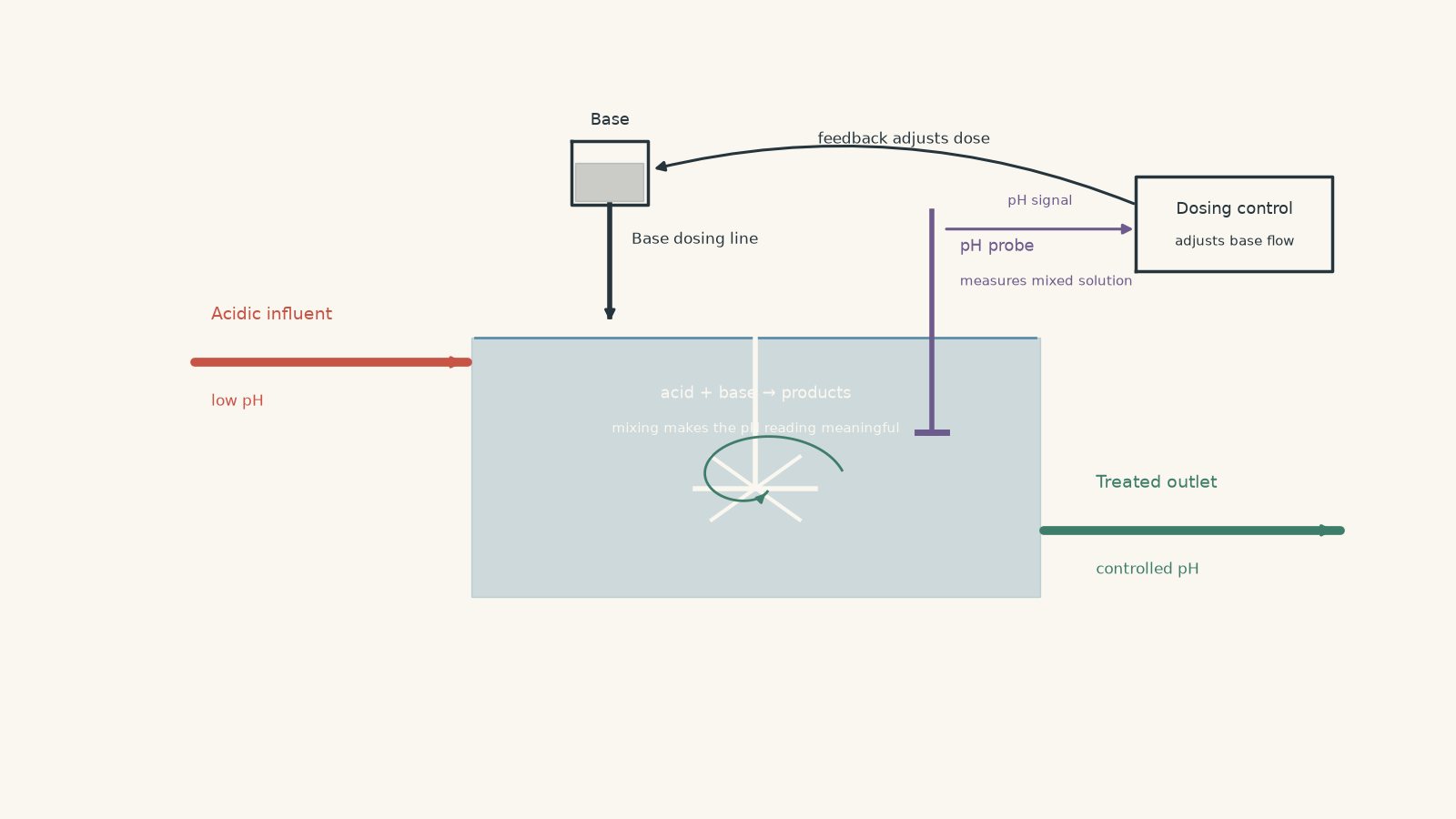
A sensible control system therefore does not usually rely on one enormous calculated dose and hope for the best. A calculation gives the approximate requirement. Mixing and pH measurements then allow the dose to be adjusted.
Worked example: How much calcium hydroxide is required?
A treatment tank contains \(2.50\ \text{kL}\) of wastewater with a sulfuric acid concentration of \(0.0180\ \text{mol L}^{-1}\). The treatment chemical is solid calcium hydroxide that is \(90.0\%\) pure by mass.
Calculate the mass of the commercial calcium hydroxide mixture required for complete stoichiometric neutralisation.
Use \(M(\ce{Ca(OH)2})=74.09\ \text{g mol}^{-1}\).
Step 1
\[
2.50\ \text{kL}=2.50\times10^3\ \text{L}
\]
Step 2
\[
n(\ce{H2SO4})
=cV
=(0.0180\ \text{mol L}^{-1})(2.50\times10^3\ \text{L})
=45.0\ \text{mol}
\]
Step 3
\[
\ce{H2SO4 + Ca(OH)2 -> CaSO4 + 2H2O}
\]
The mole ratio is \(1:1\).
Therefore:
\[
n(\ce{Ca(OH)2})=45.0\ \text{mol}
\]
Step 4
\[
m=nM
=(45.0\ \text{mol})(74.09\ \text{g mol}^{-1})
=3.33\times10^3\ \text{g}
\]
So the process requires \(3.33\ \text{kg}\) of pure \(\ce{Ca(OH)2}\).
Step 5
If \(m_{\text{mixture}}\) is the required mass of commercial material:
\[
0.900m_{\text{mixture}}=3.33\ \text{kg}
\]
\[
m_{\text{mixture}}
=\frac{3.33}{0.900}
=3.70\ \text{kg}
\]
The theoretical requirement is therefore \(3.70\ \text{kg}\) of the commercial mixture.
In an actual treatment system, that calculation is a starting dose rather than proof that the final pH will be exactly 7. Other dissolved species, incomplete mixing, equilibria, and precipitation can all change the observed result.
07Why pH alone can be misleading
Suppose two tanks both have pH 3.
Would they need the same amount of sodium hydroxide to reach a chosen higher pH?
Not necessarily.
pH tells you the concentration of \(\ce{H3O+}\) present at that moment. It does not automatically tell you how much additional acidity is stored in weak acids or other equilibria.
Imagine Tank A contains only a dilute strong acid. As \(\ce{OH-}\) removes \(\ce{H3O+}\), there may be little extra acid waiting to replace it.
Tank B contains a weak acid, \(\ce{HA}\):
\[
\ce{HA(aq) + H2O(l) <=> H3O+(aq) + A-(aq)}
\]
If hydroxide removes some \(\ce{H3O+}\), the equilibrium shifts to the right. More \(\ce{HA}\) dissociates, replacing some of the hydronium that was just consumed.
The base therefore has to deal with both the hydronium already present and part of the acid reservoir.
This is the same reason buffered systems resist sudden pH changes.
08A second trap: other reactions can consume your base
Suppose acidic industrial water also contains metal ions.
Adding hydroxide may first neutralise the acid:
\[
\ce{H3O+ + OH- -> 2H2O}
\]
but hydroxide can also form metal hydroxide precipitates. For copper(II):
\[
\ce{Cu^2+(aq) + 2OH-(aq) -> Cu(OH)2(s)}
\]
Now the treatment chemical has two jobs.
Some \(\ce{OH-}\) removes acidity. More \(\ce{OH-}\) may be consumed by precipitation.
A calculation based only on the initial pH can therefore underestimate the required dose.
This is a recurring HSC idea: before doing arithmetic, identify every reaction that can consume the species you are tracking.
09Questions and solutions
Question 1
An antacid contains \(0.350\ \text{g}\) of magnesium hydroxide, \(\ce{Mg(OH)2}\).
Calculate the maximum amount, in moles, of hydrochloric acid that this magnesium hydroxide can neutralise.
Use \(M(\ce{Mg(OH)2})=58.32\ \text{g mol}^{-1}\).
Solution 1
The antacid can neutralise \(1.20\times10^{-2}\ \text{mol}\) of \(\ce{HCl}\).
First calculate the amount of magnesium hydroxide:
\[
n(\ce{Mg(OH)2})
=\frac{m}{M}
=\frac{0.350\ \text{g}}{58.32\ \text{g mol}^{-1}}
=6.00\times10^{-3}\ \text{mol}
\]
The reaction is:
\[
\ce{Mg(OH)2 + 2HCl -> MgCl2 + 2H2O}
\]
One mole of \(\ce{Mg(OH)2}\) neutralises two moles of \(\ce{HCl}\).
\[
n(\ce{HCl})
=2(6.00\times10^{-3})
=1.20\times10^{-2}\ \text{mol}
\]
The tempting mistake is to use a \(1:1\) ratio simply because one substance is an acid and one is a base. The formula \(\ce{Mg(OH)2}\) supplies two hydroxide ions per mole, so the balanced equation requires a \(1:2\) ratio.
Question 2
A treatment tank contains \(1200\ \text{L}\) of \(0.00500\ \text{mol L}^{-1}\) hydrochloric acid. A technician adds \(5.50\ \text{L}\) of \(1.00\ \text{mol L}^{-1}\) sodium hydroxide.
Assume complete mixing, additive volumes, and complete dissociation of both solutes.
Calculate the final pH.
Solution 2
The final solution has a pH of approximately \(3.38\), so it remains acidic.
The reaction has a \(1:1\) mole ratio:
\[
\ce{HCl + NaOH -> NaCl + H2O}
\]
Calculate the initial amount of acid:
\[
n(\ce{HCl})
=(0.00500\ \text{mol L}^{-1})(1200\ \text{L})
=6.00\ \text{mol}
\]
Calculate the amount of sodium hydroxide:
\[
n(\ce{NaOH})
=(1.00\ \text{mol L}^{-1})(5.50\ \text{L})
=5.50\ \text{mol}
\]
The acid is in excess:
\[
n(\ce{H3O+})_{\text{remaining}}
=6.00-5.50
=0.500\ \text{mol}
\]
The final volume is:
\[
V_{\text{total}}=1200+5.50=1205.5\ \text{L}
\]
Therefore:
\[
[\ce{H3O+}]
=\frac{0.500\ \text{mol}}{1205.5\ \text{L}}
=4.15\times10^{-4}\ \text{mol L}^{-1}
\]
So:
\[
\text{pH}
=-\log_{10}(4.15\times10^{-4})
=3.38
\]
A tempting shortcut is to compare the original pH with the amount of base added without first doing the mole calculation. Near neutralisation, pH does not change linearly with the amount of base. The correct sequence is moles first, excess reagent second, concentration third, and pH last.
Question 3
A \(250.0\ \text{mL}\) sample of \(0.100\ \text{mol L}^{-1}\) ethanoic acid, \(\ce{CH3COOH}\), is completely neutralised stoichiometrically by \(250.0\ \text{mL}\) of \(0.100\ \text{mol L}^{-1}\) sodium hydroxide.
A student states, “Equal moles of acid and base have reacted, so the pH must now be 7.”
Evaluate the student’s claim and calculate the approximate pH of the solution.
Use:
\[
K_a(\ce{CH3COOH})=1.8\times10^{-5}
\]
and
\[
K_w=1.0\times10^{-14}
\]
at \(25^\circ\text{C}\).
Solution 3
The student’s claim is incorrect. The equivalence-point solution is basic, with a pH of approximately \(8.72\).
The neutralisation reaction is:
\[
\ce{CH3COOH + OH- -> CH3COO- + H2O}
\]
Initially:
\[
n(\ce{CH3COOH})
=(0.100\ \text{mol L}^{-1})(0.2500\ \text{L})
=0.0250\ \text{mol}
\]
The same amount of \(\ce{OH-}\) is added, so all the ethanoic acid is converted into ethanoate ions, \(\ce{CH3COO-}\).
The total volume is:
\[
V=0.2500+0.2500=0.5000\ \text{L}
\]
Therefore:
\[
[\ce{CH3COO-}]
=\frac{0.0250}{0.5000}
=0.0500\ \text{mol L}^{-1}
\]
Ethanoate is the conjugate base of a weak acid, so it reacts with water:
\[
\ce{CH3COO- + H2O <=> CH3COOH + OH-}
\]
Calculate \(K_b\):
\[
K_b
=\frac{K_w}{K_a}
=\frac{1.0\times10^{-14}}{1.8\times10^{-5}}
=5.56\times10^{-10}
\]
Let \(x=[\ce{OH-}]\). For this weak-base equilibrium:
\[
K_b\approx\frac{x^2}{0.0500}
\]
Therefore:
\[
x
=\sqrt{(5.56\times10^{-10})(0.0500)}
=5.27\times10^{-6}\ \text{mol L}^{-1}
\]
So:
\[
\text{pOH}
=-\log_{10}(5.27\times10^{-6})
=5.28
\]
and:
\[
\text{pH}
=14.00-5.28
=8.72
\]
The tempting argument is that “neutralisation means neutral”. The exact constraint that breaks that argument is the ethanoate ion left behind. It is a weak base, so it produces some \(\ce{OH-}\) in water.
Equal stoichiometric amounts therefore tell us that the reactants have reached equivalence. They do not guarantee pH 7.
Question 4
A \(500.0\ \text{L}\) industrial wastewater tank contains \(0.0200\ \text{mol L}^{-1}\) hydrochloric acid and \(0.00500\ \text{mol L}^{-1}\) \(\mathrm{Cu}^{2+}\).
Sodium hydroxide is added.
Assume:
- hydrochloric acid reacts completely with hydroxide,
- all \(\mathrm{Cu}^{2+}\) is eventually precipitated as \(\ce{Cu(OH)2}\),
- no other reactions consume hydroxide, and
- enough \(\ce{NaOH}\) is added for both processes to finish, but there is no excess hydroxide afterwards.
Calculate the minimum amount of \(\ce{NaOH}\), in moles, required. Explain why a treatment calculation based only on the initial acidity would fail.
Solution 4
A minimum of \(15.0\ \text{mol}\) of \(\ce{NaOH}\) is required: \(10.0\ \text{mol}\) for neutralisation and another \(5.00\ \text{mol}\) for copper(II) hydroxide precipitation.
First calculate the amount of hydrochloric acid:
\[
n(\ce{HCl})
=(0.0200\ \text{mol L}^{-1})(500.0\ \text{L})
=10.0\ \text{mol}
\]
Neutralisation is \(1:1\):
\[
\ce{H3O+ + OH- -> 2H2O}
\]
so the acid consumes:
\[
10.0\ \text{mol OH-}
\]
Now calculate the amount of copper(II):
\[
n(\mathrm{Cu}^{2+})
=(0.00500\ \text{mol L}^{-1})(500.0\ \text{L})
=2.50\ \text{mol}
\]
Copper(II) ions precipitate according to:
\[
\ce{Cu^2+ + 2OH- -> Cu(OH)2(s)}
\]
Each mole of \(\mathrm{Cu}^{2+}\) therefore consumes two moles of hydroxide:
\[
n(\ce{OH-})_{\text{precipitation}}
=2(2.50)
=5.00\ \text{mol}
\]
The total hydroxide requirement is:
\[
n(\ce{OH-})_{\text{total}}
=10.0+5.00
=15.0\ \text{mol}
\]
Because sodium hydroxide supplies one mole of \(\ce{OH-}\) per mole of \(\ce{NaOH}\):
\[
n(\ce{NaOH})=15.0\ \text{mol}
\]
The tempting route is to calculate \(10.0\ \text{mol}\) of acid and conclude that \(10.0\ \text{mol}\) of sodium hydroxide is enough. That calculation quietly assumes neutralisation is the only sink for \(\ce{OH-}\).
It isn’t. The dissolved \(\mathrm{Cu}^{2+}\) also removes hydroxide from solution by forming a precipitate.
This is why industrial pH adjustment can connect directly to solubility chemistry. A reagent may be controlling acidity and causing another chemical change at the same time.
Question 5
Two \(1000\ \text{L}\) wastewater tanks are both initially at pH \(2.00\).
Tank A contains only a strong acid.
Tank B also contains \(100.0\ \text{mol}\) of a monoprotic weak acid \(\ce{HA}\), with:
\[
K_a=1.0\times10^{-5}
\]
Enough strong acid is present in Tank B for its measured pH to remain \(2.00\).
A technician argues:
“Both tanks have the same volume and the same pH, so they should need about the same amount of sodium hydroxide to reach pH 7.”
Assume volume changes during treatment are negligible.
Determine approximately how much \(\ce{OH-}\) is required for each tank to reach pH 7, accounting for the change in protonation of \(\ce{HA}\). Evaluate the technician’s argument.
Solution 5
The technician’s argument is wrong. Tank A requires about \(10.0\ \text{mol}\) of \(\ce{OH-}\), while Tank B requires approximately \(109\ \text{mol}\). The two tanks begin at the same pH but have very different acid capacities.
For Tank A:
\[
\text{pH}=2.00
\]
so:
\[
[\ce{H3O+}]
=10^{-2.00}
=0.0100\ \text{mol L}^{-1}
\]
In \(1000\ \text{L}\):
\[
n(\ce{H3O+})
=(0.0100)(1000)
=10.0\ \text{mol}
\]
At pH 7, the remaining hydronium concentration is only:
\[
10^{-7}\ \text{mol L}^{-1}
\]
corresponding to:
\[
(10^{-7})(1000)
=1.0\times10^{-4}\ \text{mol}
\]
So approximately:
\[
n(\ce{OH-})_{\text{A}}
=10.0\ \text{mol}
\]
is required.
Tank B starts with the same free hydronium concentration, but it also contains the weak-acid equilibrium:
\[
\ce{HA <=> H+ + A-}
\]
For a monoprotic weak acid:
\[
K_a
=\frac{[\mathrm{H}^{+}][\mathrm{A}^{-}]}{[\ce{HA}]}
\]
so:
\[
\frac{[\mathrm{A}^{-}]}{[\ce{HA}]}
=\frac{K_a}{[\mathrm{H}^{+}]}
\]
At pH 2:
\[
\frac{[\mathrm{A}^{-}]}{[\ce{HA}]}
=\frac{1.0\times10^{-5}}{1.0\times10^{-2}}
=1.0\times10^{-3}
\]
Let the total amount of weak-acid species be \(100.0\ \text{mol}\).
The fraction initially deprotonated is:
\[
\frac{0.001}{1+0.001}
=9.99\times10^{-4}
\]
Therefore the initial amount of \(\mathrm{A}^{-}\) is approximately:
\[
100.0(9.99\times10^{-4})
=0.0999\ \text{mol}
\]
Almost all of the weak acid is still present as \(\ce{HA}\).
Now consider pH 7:
\[
[\mathrm{H}^{+}]=1.0\times10^{-7}\ \text{mol L}^{-1}
\]
Therefore:
\[
\frac{[\mathrm{A}^{-}]}{[\ce{HA}]}
=\frac{1.0\times10^{-5}}{1.0\times10^{-7}}
=100
\]
The fraction deprotonated is now:
\[
\frac{100}{101}
=0.9901
\]
so approximately:
\[
n(\mathrm{A}^{-})_{\text{final}}
=(100.0)(0.9901)
=99.01\ \text{mol}
\]
The weak acid has therefore released approximately:
\[
99.01-0.0999
=98.91\ \text{mol}
\]
of additional protons while the pH is raised.
Those protons must also be consumed by hydroxide.
Adding this to the approximately \(10.0\ \text{mol}\) required to remove the initial free acidity gives:
\[
n(\ce{OH-})_{\text{B}}
\approx10.0+98.91
=108.91\ \text{mol}
\]
or about:
\[
109\ \text{mol}
\]
The tempting argument treats pH as though it measures the total quantity of acid in the tank. It does not.
Both tanks begin with the same \([\ce{H3O+}]\), so a pH probe initially gives the same reading. But Tank B contains a large reservoir of weak acid. As hydroxide removes \(\ce{H3O+}\), the equilibrium shifts and \(\ce{HA}\) releases more protons.
That is the deeper reason industrial neutralisation cannot always be designed from one pH reading. pH measures the present hydronium concentration; it does not directly measure the total amount of acidity waiting to react.
10What neutralisation lets you understand next
Neutralisation calculations start with balanced equations and mole ratios, but real pH control quickly leads into equilibrium.
Weak acids explain why equivalence does not always mean pH 7. Buffers explain why some solutions resist changes in pH. Solubility equilibria explain why added hydroxide can disappear into precipitates instead of simply raising the pH.
Those ideas come together in titrations and industrial treatment systems: you are not merely asking, “How acidic is this solution now?” You are asking the more useful chemical question: what reactions and equilibria will respond when I try to change it?