
Limitations of Acid-Base Models: HSC Chemistry Explained
Compare Arrhenius, Brønsted-Lowry, and Lewis acid-base models, including what each explains and where each model reaches its limits.
Dry hydrogen chloride gas and dry ammonia gas can react to form ammonium chloride. No water is needed.
Now make a prediction. If an acid is simply “a substance that produces \(\mathrm{H}^{+}\) in water”, can that definition explain this reaction?
\[
\ce{HCl(g) + NH3(g) -> NH4Cl(s)}
\]
Not very well. The definition works beautifully for many reactions in water, but this reaction is happening without water at all.
That is the reason acid-base models changed over time. Chemists did not keep inventing new definitions because the old ones were useless. They changed the model when they found reactions that the existing model could not describe cleanly.
The useful question is therefore not “Which acid-base model is correct?” It is:
What can each model explain, and where does it stop working?
01Acid-base models changed when the evidence stopped fitting
Early chemists knew acids shared recognisable properties. They tasted sour, reacted with some metals and carbonates, and changed the colours of indicators. The problem was explaining why.
Antoine Lavoisier noticed that many known acids contained oxygen. Sulfuric acid, \(\ce{H2SO4}\), and nitric acid, \(\ce{HNO3}\), both fitted. It was reasonable to suspect that oxygen caused acidity.
Then substances such as hydrochloric acid caused trouble. Hydrogen chloride, \(\ce{HCl}\), forms an acidic solution but contains no oxygen.
Humphry Davy’s work helped establish that oxygen was not required for acidity and drew attention instead to hydrogen. But composition alone still was not enough. Methane, \(\ce{CH4}\), contains hydrogen and is certainly not behaving like hydrochloric acid.
That failure points to an important change in scientific thinking: instead of asking only what an acid contains, chemists began asking what it does during a reaction.
02Arrhenius: look at the ions formed in water
The Arrhenius model focuses on aqueous solutions.
At HSC level, the useful form is:
- an Arrhenius acid increases the concentration of \(\mathrm{H}^{+}\) in water
- an Arrhenius base increases the concentration of \(\ce{OH-}\) in water
In water, writing a bare \(\mathrm{H}^{+}\) is shorthand. A proton does not sit alone in an aqueous solution. We usually show its interaction with water by writing hydronium, \(\ce{H3O+}\).
For hydrochloric acid:
\[
\ce{HCl(aq) + H2O(l) -> H3O+(aq) + Cl-(aq)}
\]
The concentration of \(\ce{H3O+}\) increases, so HCl behaves as an Arrhenius acid.
For sodium hydroxide:
\[
\ce{NaOH(s) -> Na+(aq) + OH-(aq)}
\]
The concentration of \(\ce{OH-}\) increases, so NaOH is an Arrhenius base.
This model is extremely useful when the question is about aqueous solutions, pH, or neutralisation.
Worked example: How does Arrhenius theory explain hydrochloric acid?
A \(0.0200\ \mathrm{mol\,L^{-1}}\) solution of HCl is prepared in water. Assume HCl ionises completely. Explain its acidic behaviour using the Arrhenius model, and determine the concentration of hydronium ions.
Step 1
We need to see whether HCl increases the concentration of \(\ce{H3O+}\) in water.
\[
\ce{HCl(aq) + H2O(l) -> H3O+(aq) + Cl-(aq)}
\]
Step 2
One mole of HCl produces one mole of \(\ce{H3O+}\).
Therefore,
\[
[\ce{H3O+}] = 0.0200\ \mathrm{mol\,L^{-1}}
\]
Step 3
HCl is an Arrhenius acid because its reaction with water increases \([\ce{H3O+}]\). The calculation also shows why the Arrhenius model is so practical for aqueous chemistry: it connects the acid directly to a measurable solution property.
03Where the Arrhenius model runs into trouble
Imagine the Arrhenius model as a bouncer with a very specific guest list.
It asks, “Are we in water, and are \(\ce{H3O+}\) or \(\ce{OH-}\) being produced?”
That works at the water-themed party. The problem is that acid-base reactions do not all happen there.
Return to:
\[
\ce{HCl(g) + NH3(g) -> NH4Cl(s)}
\]
HCl transfers a proton to ammonia even though there is no aqueous solution. Arrhenius theory is not designed to describe that reaction.
Ammonia also exposes a smaller problem with oversimplified versions of Arrhenius theory. Ammonia contains no \(\ce{OH-}\), yet in water it produces hydroxide ions:
\[
\ce{NH3(aq) + H2O(l) <=> NH4+(aq) + OH-(aq)}
\]
A broader Arrhenius description can still call ammonia a base because it increases \([\ce{OH-}]\). However, the simple rule “bases contain and dissociate to form \(\ce{OH-}\)” does not explain what is actually happening.
The reaction makes more sense if we track the proton itself.
04Brønsted-Lowry: follow the proton
In 1923, Johannes Brønsted and Thomas Lowry independently proposed a broader way to describe acid-base reactions.
A Brønsted-Lowry acid is a proton donor.
A Brønsted-Lowry base is a proton acceptor.
Here, a proton means \(\mathrm{H}^{+}\).
Now reconsider ammonia in water:
\[
\ce{NH3 + H2O <=> NH4+ + OH-}
\]
Which particle actually moves?
A proton moves from \(\ce{H2O}\) to \(\ce{NH3}\).
So:
- \(\ce{H2O}\) donates \(\mathrm{H}^{+}\), making it the Brønsted-Lowry acid
- \(\ce{NH3}\) accepts \(\mathrm{H}^{+}\), making it the Brønsted-Lowry base
The reaction products are connected to the reactants by proton transfer:
\[
\ce{H2O -> OH-}
\]
and
\[
\ce{NH3 -> NH4+}
\]
These related species are called conjugate acid-base pairs.
The pairs are:
- \(\ce{H2O/OH-}\)
- \(\ce{NH4+/NH3}\)
If you need more practice identifying these pairs, the tutorgum guide to Brønsted-Lowry acids and bases develops the method in more detail.
Worked example: An acid-base reaction with no water
Hydrogen chloride gas reacts with ammonia gas:
\[
\ce{HCl(g) + NH3(g) -> NH4Cl(s)}
\]
Explain why the Brønsted-Lowry model can describe this reaction more successfully than the Arrhenius model.
Step 1
HCl can lose a proton:
\[
\ce{HCl -> H+ + Cl-}
\]
Ammonia can accept that proton:
\[
\ce{NH3 + H+ -> NH4+}
\]
Step 2
HCl donates the proton, so HCl is the acid.
\(\ce{NH3}\) accepts the proton, so \(\ce{NH3}\) is the base.
The conjugate species are \(\mathrm{Cl}^{-}\) and \(\ce{NH4+}\).
Step 3
There is no aqueous solution. The reaction therefore sits outside the normal scope of the Arrhenius model.
Step 4
Brønsted-Lowry theory does not require water. It describes the actual event connecting the reacting particles: transfer of a proton from HCl to \(\ce{NH3}\).
This is a broader model, not evidence that Arrhenius theory suddenly became wrong.
05Acid and base are roles, not permanent name tags
The Brønsted-Lowry model introduces another important idea. A particle’s role can depend on what it is reacting with.
Consider the hydrogen carbonate ion, \(\ce{HCO3-}\).
With hydronium:
\[
\ce{HCO3- + H3O+ -> H2CO3 + H2O}
\]
Here, \(\ce{HCO3-}\) accepts a proton and becomes \(\ce{H2CO3}\). It acts as a base.
But with hydroxide:
\[
\ce{HCO3- + OH- -> CO3^2- + H2O}
\]
Now \(\ce{HCO3-}\) donates a proton. It acts as an acid.
A species that can both donate and accept a proton is called amphiprotic.
Water is another important example.
With HCl:
\[
\ce{HCl + H2O -> H3O+ + Cl-}
\]
water accepts a proton, so it acts as a base.
With ammonia:
\[
\ce{NH3 + H2O <=> NH4+ + OH-}
\]
water donates a proton, so it acts as an acid.
A common mistake is to memorise “water is neutral” and conclude that it cannot be an acid or base. Neutrality refers to the overall concentrations of acidic and basic species in pure water. It does not prevent an individual water molecule from donating or accepting a proton during a reaction.
06Brønsted-Lowry is broader, but it still has a boundary
Suppose ammonia reacts with boron trifluoride:
\[
\ce{BF3 + NH3 -> BF3NH3}
\]
Try to find the transferred proton.
There isn’t one.
That means the Brønsted-Lowry model cannot classify this as an acid-base reaction. Yet something very similar to acid-base behaviour is happening: ammonia donates a lone pair of electrons to electron-deficient boron.
This is where the Lewis model becomes useful.
07Lewis theory: follow the electron pair
Gilbert Lewis proposed another acid-base model in 1923.
A Lewis acid accepts an electron pair.
A Lewis base donates an electron pair.
In the reaction
\[
\ce{BF3 + NH3 -> BF3NH3}
\]
the nitrogen atom in \(\ce{NH3}\) has a lone pair. It donates that pair to boron.
Therefore:
- \(\ce{NH3}\) is the Lewis base
- \(\ce{BF3}\) is the Lewis acid
No proton transfer is required.
For HSC chemistry, Arrhenius and Brønsted-Lowry theory are usually the most useful models for analysing aqueous acid-base reactions. Lewis theory is valuable here because it makes the boundary of the proton-transfer model obvious.
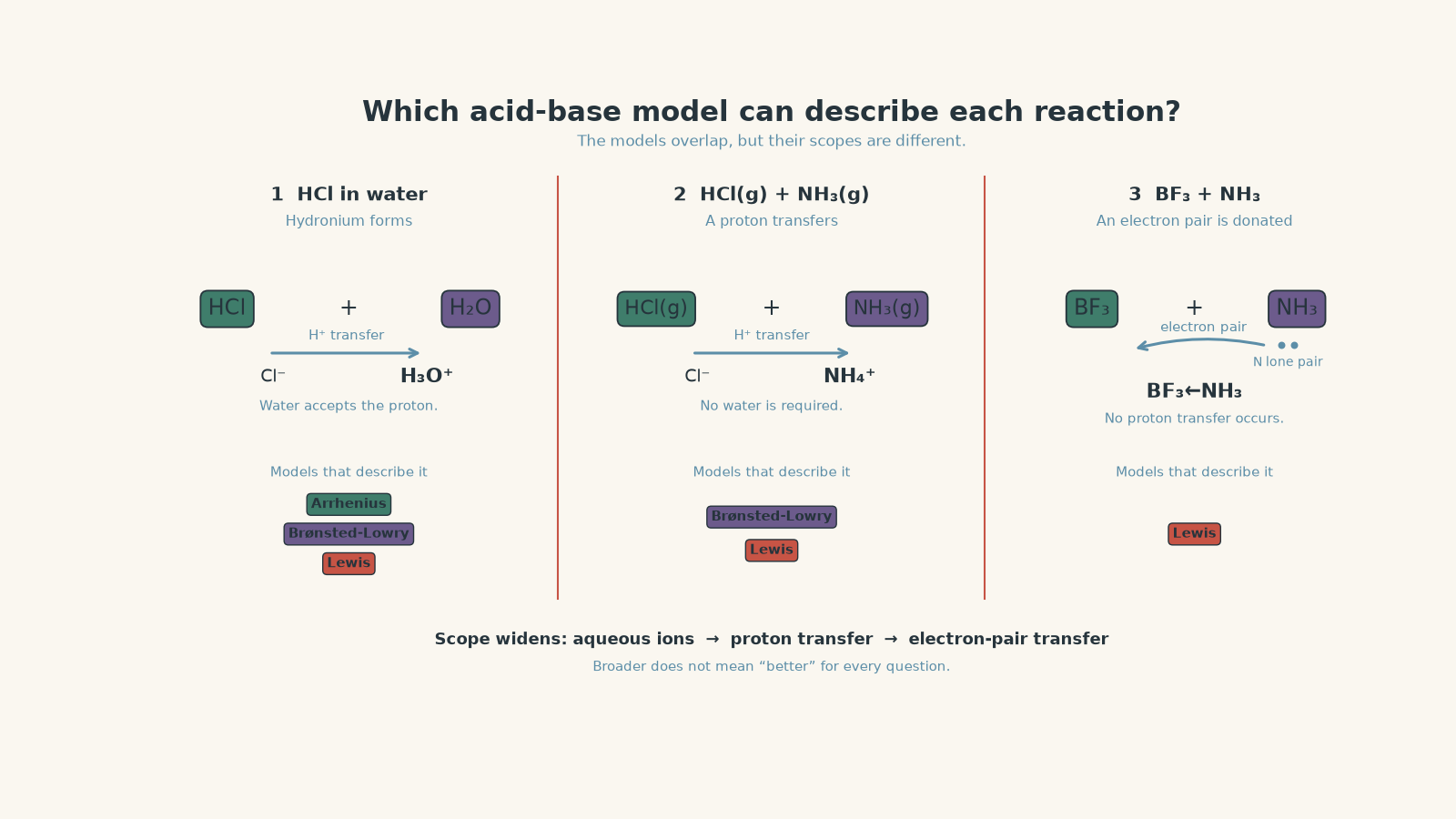
08How the models fit together
For the usual reactions considered in HSC chemistry, you can picture the models as having progressively broader scopes.
| Model | Main question | Acid | Base | Major strength | Important limitation |
|---|---|---|---|---|---|
| Early composition ideas | What is the substance made from? | Linked to particular elements such as oxygen or hydrogen | No general modern definition | Gave testable explanations for known substances | Composition alone could not account for all acidic behaviour |
| Arrhenius | What happens to ions in water? | Increases \(\ce{H3O+}\) in water | Increases \(\ce{OH-}\) in water | Very useful for aqueous solutions, pH, and neutralisation | Restricted to aqueous behaviour and gives a limited picture of proton transfer |
| Brønsted-Lowry | Who transfers a proton? | Proton donor | Proton acceptor | Explains conjugate pairs, amphiprotic species, and reactions outside water | Cannot describe acid-base reactions involving no proton transfer |
| Lewis | Who transfers an electron pair? | Electron-pair acceptor | Electron-pair donor | Includes proton-free acid-base interactions | So broad that it is often less direct for questions about aqueous pH and proton-transfer equilibria |
The bouncer analogy now needs one correction. These models are not competing clubs where a reaction is allowed through only one door.
The same reaction can satisfy several models at once.
For example:
\[
\ce{HCl + H2O -> H3O+ + Cl-}
\]
can be described using Arrhenius theory because \([\ce{H3O+}]\) increases.
It can also be described using Brønsted-Lowry theory because HCl transfers a proton to water.
At an even broader level, it can be interpreted using Lewis theory because water uses an electron pair to bond to the incoming proton.
The analogy breaks because scientific models overlap. Each one chooses a different feature of the same event to focus on.
09A broader model does not automatically make an older model useless
It is tempting to write:
Lewis is newer and broader, so it is the best acid-base model.
“Broader” is defensible. “Best” without saying what problem you are solving is not.
Suppose you want to predict the pH of an HCl solution. Arrhenius language gets you quickly to the relevant quantity: \([\ce{H3O+}]\).
Suppose you want to identify conjugate acid-base pairs. Brønsted-Lowry theory is much more revealing because it makes you track proton transfer.
Suppose \(\ce{BF3}\) reacts with \(\ce{NH3}\) and no proton is involved. Lewis theory can describe something the first two models cannot.
A model is useful when its assumptions match the question.
That is a general scientific habit worth keeping: do not ask only whether a model is simple or sophisticated. Ask what evidence it explains and what assumptions it needs.
10Acid-base models classify behaviour, not acid strength
Another easy mistake is to confuse the definition of an acid with the strength of an acid.
Brønsted-Lowry theory tells you that both HCl and ethanoic acid can donate protons.
It does not, by itself, tell you that they donate those protons to the same extent in water.
For example:
\[
\ce{HCl + H2O -> H3O+ + Cl-}
\]
is essentially complete under normal dilute aqueous conditions.
Ethanoic acid establishes an equilibrium:
\[
\ce{CH3COOH + H2O <=> H3O+ + CH3COO-}
\]
Only a fraction of the ethanoic acid molecules donate their proton at any one time.
Both substances fit the Brønsted-Lowry definition of an acid. Their different strengths require an equilibrium description, usually involving \(K_a\).
This is another limitation worth stating clearly: an acid-base model tells you what counts as acid-base behaviour. Extra quantitative ideas are needed to say how far a reaction proceeds.
11A practical model-selection rule
When an exam question gives you an acid-base reaction, do not immediately hunt for a memorised definition. Look at what changes.
- If the focus is aqueous \(\ce{H3O+}\), \(\ce{OH-}\), pH, or ordinary neutralisation, Arrhenius language may be enough.
- If a proton moves from one species to another, use Brønsted-Lowry theory. Track the proton and identify the conjugate pairs.
- If no proton moves but one species accepts an electron pair from another, Brønsted-Lowry has reached its limit. A Lewis description may work.
- If you are being asked about acid strength, a definition alone is not enough. You need equilibrium information such as \(K_a\), pH, or extent of ionisation.
That decision process is more useful than memorising a timeline and hoping the question happens to match it.
12Questions and solutions
Question 1
A student dissolves \(5.00 \times 10^{-3}\ \mathrm{mol}\) of HCl in enough water to make \(250.0\ \mathrm{mL}\) of solution. Assume complete ionisation.
Calculate \([\ce{H3O+}]\), then explain how both Arrhenius and Brønsted-Lowry theory describe the acidic behaviour of HCl.
Solution 1
The hydronium concentration is \(2.00 \times 10^{-2}\ \mathrm{mol\,L^{-1}}\); Arrhenius theory describes the increase in \(\ce{H3O+}\), while Brønsted-Lowry theory describes the proton transfer from HCl to water.
First convert the volume to litres:
\[
250.0\ \mathrm{mL} = 0.2500\ \mathrm{L}
\]
The concentration of HCl is
\[
c=\frac{n}{V}
=\frac{5.00\times10^{-3}\ \mathrm{mol}}{0.2500\ \mathrm{L}}
=2.00\times10^{-2}\ \mathrm{mol\,L^{-1}}
\]
HCl ionises completely:
\[
\ce{HCl + H2O -> H3O+ + Cl-}
\]
The mole ratio of HCl to \(\ce{H3O+}\) is \(1:1\), so
\[
[\ce{H3O+}] = 2.00\times10^{-2}\ \mathrm{mol\,L^{-1}}
\]
In Arrhenius terms, HCl is an acid because it increases \([\ce{H3O+}]\) in water.
In Brønsted-Lowry terms, HCl is the acid because it donates a proton, while \(\ce{H2O}\) is the base because it accepts that proton.
A tempting shortcut is to say that Arrhenius and Brønsted-Lowry give two different explanations and one must therefore be wrong. They are instead describing different levels of the same reaction. Arrhenius focuses on the aqueous ions produced; Brønsted-Lowry focuses on the particle transfer that produces them.
Question 2
Two \(0.100\ \mathrm{mol\,L^{-1}}\) solutions are prepared, one containing HCl and the other containing ethanoic acid, \(\ce{CH3COOH}\).
For ethanoic acid, \(K_a=1.8\times10^{-5}\).
Assume HCl ionises completely and, for ethanoic acid, let \(x=[\ce{H3O+}]\) at equilibrium.
Calculate the approximate \([\ce{H3O+}]\) in each solution. Then explain why Brønsted-Lowry theory can classify both substances as acids without predicting that large difference in hydronium concentration.
Solution 2
HCl gives approximately \(0.100\ \mathrm{mol\,L^{-1}}\) \(\ce{H3O+}\), while the ethanoic acid solution gives approximately \(1.33\times10^{-3}\ \mathrm{mol\,L^{-1}}\); both are Brønsted-Lowry acids, but acid strength requires equilibrium information beyond the definition.
For HCl:
\[
\ce{HCl + H2O -> H3O+ + Cl-}
\]
Complete ionisation gives
\[
[\ce{H3O+}] = 0.100\ \mathrm{mol\,L^{-1}}
\]
For ethanoic acid:
\[
\ce{CH3COOH + H2O <=> H3O+ + CH3COO-}
\]
Let \(x\) be the equilibrium concentration of both \(\ce{H3O+}\) and \(\ce{CH3COO-}\).
Then
\[
K_a=\frac{[\ce{H3O+}][\ce{CH3COO-}]}{[\ce{CH3COOH}]}
=\frac{x^2}{0.100-x}
\]
Because \(K_a\) is small, try the approximation \(0.100-x\approx0.100\):
\[
1.8\times10^{-5}
\approx\frac{x^2}{0.100}
\]
Therefore,
\[
x^2=1.8\times10^{-6}
\]
and
\[
x\approx1.34\times10^{-3}\ \mathrm{mol\,L^{-1}}
\]
Using sensible significant figures,
\[
[\ce{H3O+}]\approx1.3\times10^{-3}\ \mathrm{mol\,L^{-1}}
\]
Both HCl and \(\ce{CH3COOH}\) donate protons to water, so both satisfy the Brønsted-Lowry definition of an acid.
The tempting conclusion is that anything classified as an acid should produce similar amounts of \(\ce{H3O+}\). The definition does not say that. It describes the direction of proton transfer, not its extent.
The \(K_a\) value supplies the missing information. Ethanoic acid reaches an equilibrium heavily favouring the un-ionised acid compared with HCl, so its hydronium concentration is much lower.
Question 3
Hydrogen carbonate ions undergo the following reactions:
\[
\ce{HCO3- + H3O+ -> H2CO3 + H2O}
\]
and
\[
\ce{HCO3- + OH- -> CO3^2- + H2O}
\]
For each reaction:
- identify the Brønsted-Lowry acid and base
- identify the conjugate acid-base pairs
- explain why assigning \(\ce{HCO3-}\) a permanent label of “acid” or “base” gives the wrong mental model
Solution 3
\(\ce{HCO3-}\) acts as a base in the first reaction and as an acid in the second, so its Brønsted-Lowry role depends on the reaction partner.
In the first reaction,
\[
\ce{HCO3- + H3O+ -> H2CO3 + H2O}
\]
\(\ce{H3O+}\) donates a proton and is therefore the acid.
\(\ce{HCO3-}\) accepts that proton and is therefore the base.
The conjugate pairs are:
\[
\ce{H3O+/H2O}
\]
and
\[
\ce{H2CO3/HCO3-}
\]
In the second reaction,
\[
\ce{HCO3- + OH- -> CO3^2- + H2O}
\]
\(\ce{HCO3-}\) loses a proton, so it is now the acid.
\(\ce{OH-}\) accepts the proton, so it is the base.
The conjugate pairs are:
\[
\ce{HCO3-/CO3^2-}
\]
and
\[
\ce{H2O/OH-}
\]
The tempting approach is to examine \(\ce{HCO3-}\) once, decide that it “looks acidic” because it contains hydrogen, and keep that label permanently.
Brønsted-Lowry theory does not work that way. Acid and base are roles in a particular proton-transfer reaction.
\(\ce{HCO3-}\) has both a proton it can donate and the ability to accept another proton. It is therefore amphiprotic.
The exact reaction partner determines which possibility occurs.
Question 4
Consider three reactions:
\[
\ce{HCl(aq) + H2O(l) -> H3O+(aq) + Cl-(aq)}
\]
\[
\ce{HCl(g) + NH3(g) -> NH4Cl(s)}
\]
\[
\ce{BF3(g) + NH3(g) -> BF3NH3(s)}
\]
A student argues:
“Each new model replaced the model before it. Therefore the oldest model that can explain a reaction should never be used.”
Evaluate this claim by determining which of the Arrhenius, Brønsted-Lowry, and Lewis models can describe each reaction. Then explain why model choice should depend on the question being asked rather than simply choosing the broadest model available.
Solution 4
The student’s claim is incorrect: the models have different scopes, and a broader model does not make a narrower but useful model scientifically worthless.
For the first reaction,
\[
\ce{HCl + H2O -> H3O+ + Cl-}
\]
Arrhenius theory applies because HCl increases \([\ce{H3O+}]\) in water.
Brønsted-Lowry theory also applies because HCl donates a proton and water accepts it.
A Lewis description is also possible at a broader level because the oxygen atom in water supplies an electron pair to bond to the proton.
For the second reaction,
\[
\ce{HCl(g) + NH3(g) -> NH4Cl(s)}
\]
the standard Arrhenius model is unsuitable because the reaction is not occurring in aqueous solution.
Brønsted-Lowry theory works. HCl donates a proton and \(\ce{NH3}\) accepts it.
Lewis theory can also describe the bond formation associated with that transfer.
For the third reaction,
\[
\ce{BF3 + NH3 -> BF3NH3}
\]
there is no aqueous \(\ce{H3O+}\) or \(\ce{OH-}\) formation, so Arrhenius theory does not describe it.
No proton is transferred, so it is not a Brønsted-Lowry acid-base reaction.
Lewis theory does describe it. \(\ce{NH3}\) donates an electron pair and \(\ce{BF3}\) accepts it.
The tempting argument is that because Lewis theory covers more reactions, it must always be the most useful language.
But usefulness depends on the task. If the question asks why aqueous HCl has a low pH, Arrhenius theory points directly to increasing \([\ce{H3O+}]\). If the question asks for conjugate pairs, Brønsted-Lowry theory exposes exactly the relationship you need. If the reaction contains no proton transfer, Lewis theory may be required.
Scientific progress often produces broader models without erasing every useful feature of earlier ones.
Question 5
A student compares two observations:
- \(0.100\ \mathrm{mol\,L^{-1}}\) HCl ionises essentially completely in water.
- \(\ce{BF3}\) reacts readily with \(\ce{NH3}\) by accepting the nitrogen lone pair.
They conclude:
“\(\ce{BF3}\) must be a stronger acid than HCl because Lewis theory is broader than Brønsted-Lowry theory, and \(\ce{BF3}\) can do something that the Brønsted-Lowry model cannot explain.”
Is that conclusion justified?
In your answer, distinguish model scope from acid strength, identify the acid-base process occurring in each observation, and state what additional evidence would be needed before a meaningful strength comparison could be made.
Solution 5
No. The observations do not justify ranking \(\ce{BF3}\) and HCl on one universal acid-strength scale because they involve different acid-base definitions and different reactions.
For HCl in water,
\[
\ce{HCl + H2O -> H3O+ + Cl-}
\]
HCl acts as a Brønsted-Lowry acid by donating a proton.
Its near-complete ionisation tells us something about its strength as a proton donor in aqueous solution.
It also fits the Arrhenius model because the reaction increases \([\ce{H3O+}]\).
For the reaction involving \(\ce{BF3}\),
\[
\ce{BF3 + NH3 -> BF3NH3}
\]
\(\ce{BF3}\) is a Lewis acid because it accepts an electron pair from \(\ce{NH3}\).
No proton is transferred.
The tempting route is to imagine the models as levels in a video game: Lewis theory is the “higher level”, so any Lewis acid must somehow be more acidic than a Brønsted-Lowry acid.
That mixes up two completely different ideas.
Model scope asks, “What kinds of interactions does this definition classify as acid-base reactions?”
Acid strength asks, “How favourable or extensive is a particular acid-base process under specified conditions?”
A broader definition does not imply a stronger substance.
Even within one model, strength depends on the reaction and conditions. For Brønsted-Lowry acids in water, quantities such as \(K_a\) allow meaningful comparisons because the acids are being compared through the same type of equilibrium in the same solvent.
The given \(\ce{BF3}\) observation instead tells us that electron-pair donation from \(\ce{NH3}\) to \(\ce{BF3}\) is favourable. It does not provide a \(K_a\), and \(\ce{BF3}\) is not donating a proton at all.
A meaningful comparison would first require a clearly defined common measure of acidity and common reaction conditions. Without that, “Which is the stronger acid?” is not a well-defined question.
That is the deeper limitation of acid-base models: they tell us what behaviour counts within a chosen framework. They do not automatically create one universal ranking of every substance called an acid.
13What this idea lets you understand next
Once you can see the boundary of each model, neutralisation stops being just “acid plus base makes salt and water”. You can ask what particles are actually reacting, which species transfer protons, and why some acid-base processes do not fit that simple equation at all.
That becomes especially useful when analysing neutralisation in everyday and industrial processes, and when you move from simply classifying an acid to predicting its equilibrium position, \(K_a\), pH, and behaviour in buffer systems.