
Energy Changes When Satellites Change Orbit: HSC Physics
Learn how kinetic, gravitational potential, and total mechanical energy change when satellites move between orbits. Includes worked examples, transfer-orbit reasoning, and challenging HSC-style questions.
An engine burn raises a satellite into a higher circular orbit. Once the satellite settles there, it is moving more slowly than before. So did the engine add energy or remove it?
Predict before reading on. It is tempting to say the satellite lost energy because its kinetic energy fell. The opposite is true. A satellite in a higher circular orbit has greater total orbital energy, even though it has less kinetic energy.
Understanding why means keeping three energy quantities separate: gravitational potential energy, kinetic energy, and total mechanical energy.
01Why a higher orbit can have a lower speed
Picture Earth sitting at the bottom of a gravitational well. A satellite close to Earth is deeper in that well. Move the satellite farther away, and it climbs to a shallower part of the well, so its gravitational potential energy increases.
That picture is useful, but Earth is not surrounded by a literal bowl. The exact gravitational potential energy of a satellite of mass \(m\) at distance \(r\) from the centre of a much larger body of mass \(M\) is
\[
U=-\frac{GMm}{r}
\]
where:
- \(U\) is gravitational potential energy in joules, \(\mathrm{J}\),
- \(G\) is the universal gravitational constant, \(6.67\times10^{-11}\,\mathrm{N\,m^2\,kg^{-2}}\),
- \(M\) is the mass of the central body in kilograms,
- \(m\) is the satellite mass in kilograms, and
- \(r\) is the distance between their centres in metres.
The negative sign often causes trouble. Zero gravitational potential energy is defined at infinite separation. A satellite bound to Earth therefore has \(U<0\).
Think of it like an overdrawn bank account. Moving from \(-100\) dollars to \(-60\) dollars is an increase of \(40\) dollars, even though the balance is still negative. Likewise, moving away from Earth makes \(U\) less negative, which means \(U\) has increased. The bank analogy only helps with the signs; gravitational potential energy still follows the exact inverse-\(r\) equation above.
For a fuller treatment of the negative sign and the choice of zero, see gravitational potential energy in a radial field.
Now consider the satellite’s speed.
For a circular orbit, gravity supplies the required centripetal force:
\[
\frac{GMm}{r^2}=\frac{mv^2}{r}
\]
Cancelling \(m\) and one factor of \(r\),
\[
v^2=\frac{GM}{r}
\]
so
\[
v=\sqrt{\frac{GM}{r}}
\]
This tells us something important before we do any energy calculations: as circular-orbit radius increases, orbital speed decreases.
That result is developed in more detail in orbital velocity: derivation and calculations.
02The total energy of a circular orbit
Kinetic energy is
\[
K=\frac{1}{2}mv^2
\]
For a circular orbit, substitute \(v^2=GM/r\):
\[
K=\frac{GMm}{2r}
\]
The total orbital mechanical energy is
\[
E=K+U
\]
so
\[
E=\frac{GMm}{2r}-\frac{GMm}{r}
=-\frac{GMm}{2r}
\]
This gives three useful relationships for any circular orbit:
\[
U=-\frac{GMm}{r},\qquad
K=\frac{GMm}{2r},\qquad
E=-\frac{GMm}{2r}
\]
Therefore,
\[
U=-2K
\]
and
\[
E=-K=\frac{U}{2}
\]
These relationships are only guaranteed for a circular orbit. Do not automatically use them at an arbitrary point on an elliptical transfer orbit.
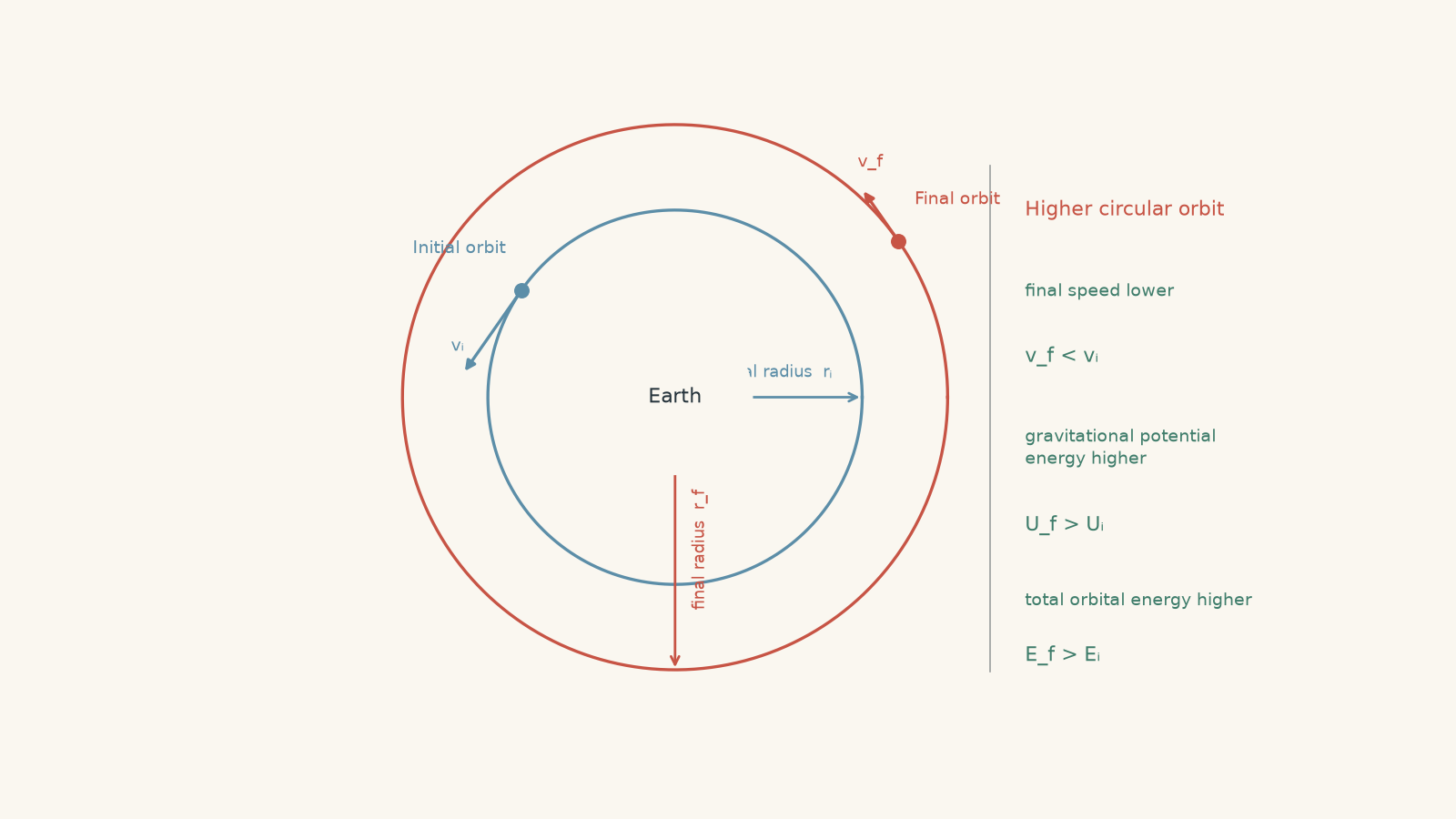
The pattern for circular orbits is worth learning as a connected idea rather than four isolated facts.
| Quantity | If circular-orbit radius increases |
|---|---|
| Orbital speed \(v\) | decreases |
| Kinetic energy \(K\) | decreases |
| Gravitational potential energy \(U\) | increases, becoming less negative |
| Total mechanical energy \(E\) | increases, becoming less negative |
So where does the added energy go when a satellite is raised?
For two circular orbits, \(U=-2K\). The increase in gravitational potential energy is twice as large as the decrease in kinetic energy. The leftover increase appears as an increase in total mechanical energy.
That is the part a speed-only argument misses.
03Calculating the energy change between circular orbits
Suppose a satellite begins in a circular orbit of radius \(r_i\) and finishes in another circular orbit of radius \(r_f\).
Its initial energy is
\[
E_i=-\frac{GMm}{2r_i}
\]
and its final energy is
\[
E_f=-\frac{GMm}{2r_f}
\]
Therefore,
\[
\Delta E=E_f-E_i
\]
which gives
\[
\Delta E
=
\frac{GMm}{2}
\left(
\frac{1}{r_i}-\frac{1}{r_f}
\right)
\]
The sign tells you the direction of the energy transfer.
- If \(r_f>r_i\), then \(\Delta E>0\). Orbital energy has been added.
- If \(r_f<r_i\), then \(\Delta E<0\). Orbital energy has been removed.
Here, an orbital “energy level” simply means the mechanical energy associated with an orbit. These are not discrete quantum energy levels.
Do not use altitude as \(r\)
This is one of the easiest ways to lose marks.
If a satellite is \(400\,\mathrm{km}\) above Earth’s surface, its orbital radius is not \(400\,\mathrm{km}\). You need the distance from Earth’s centre:
\[
r=R_E+h
\]
where \(R_E\) is Earth’s radius and \(h\) is the satellite’s altitude.
For the examples below, we will use
\[
R_E=6.37\times10^6\,\mathrm{m}
\]
and
\[
GM_E=3.99\times10^{14}\,\mathrm{m^3\,s^{-2}}
\]
where \(M_E\) is Earth’s mass.
Worked example: Raising a satellite to a higher orbit
An Earth satellite of mass \(1200\,\mathrm{kg}\) is moved from a circular orbit \(300\,\mathrm{km}\) above Earth’s surface to a circular orbit \(900\,\mathrm{km}\) above Earth’s surface. Calculate the change in its total orbital mechanical energy.
Step 1
\[
\begin{aligned}
r_i&=6.37\times10^6+0.300\times10^6\\
&=6.67\times10^6\,\mathrm{m}
\\[4pt]
r_f&=6.37\times10^6+0.900\times10^6\\
&=7.27\times10^6\,\mathrm{m}
\end{aligned}
\]
Step 2
\[
\begin{aligned}
\Delta E
&=
\frac{GM_Em}{2}
\left(
\frac{1}{r_i}-\frac{1}{r_f}
\right)\\
&=
\frac{(3.99\times10^{14})(1200)}{2}
\left(
\frac{1}{6.67\times10^6}
–
\frac{1}{7.27\times10^6}
\right)\\
&=2.96\times10^9\,\mathrm{J}
\end{aligned}
\]
Step 3
The positive result means the satellite’s orbital mechanical energy has increased by \(2.96\times10^9\,\mathrm{J}\).
Its final speed is lower, but that does not make \(\Delta E\) negative.
In fact, because both the initial and final states are circular,
\[
\Delta K=-\Delta E=-2.96\times10^9\,\mathrm{J}
\]
while
\[
\Delta U=2\Delta E=+5.92\times10^9\,\mathrm{J}
\]
The satellite gains \(5.92\,\mathrm{GJ}\) of gravitational potential energy while losing \(2.96\,\mathrm{GJ}\) of kinetic energy. The net increase is \(2.96\,\mathrm{GJ}\).
04What actually happens while the orbit changes?
The equation for \(\Delta E\) compares the initial and final circular states. It does not mean a satellite somehow jumps directly from one circle to another.
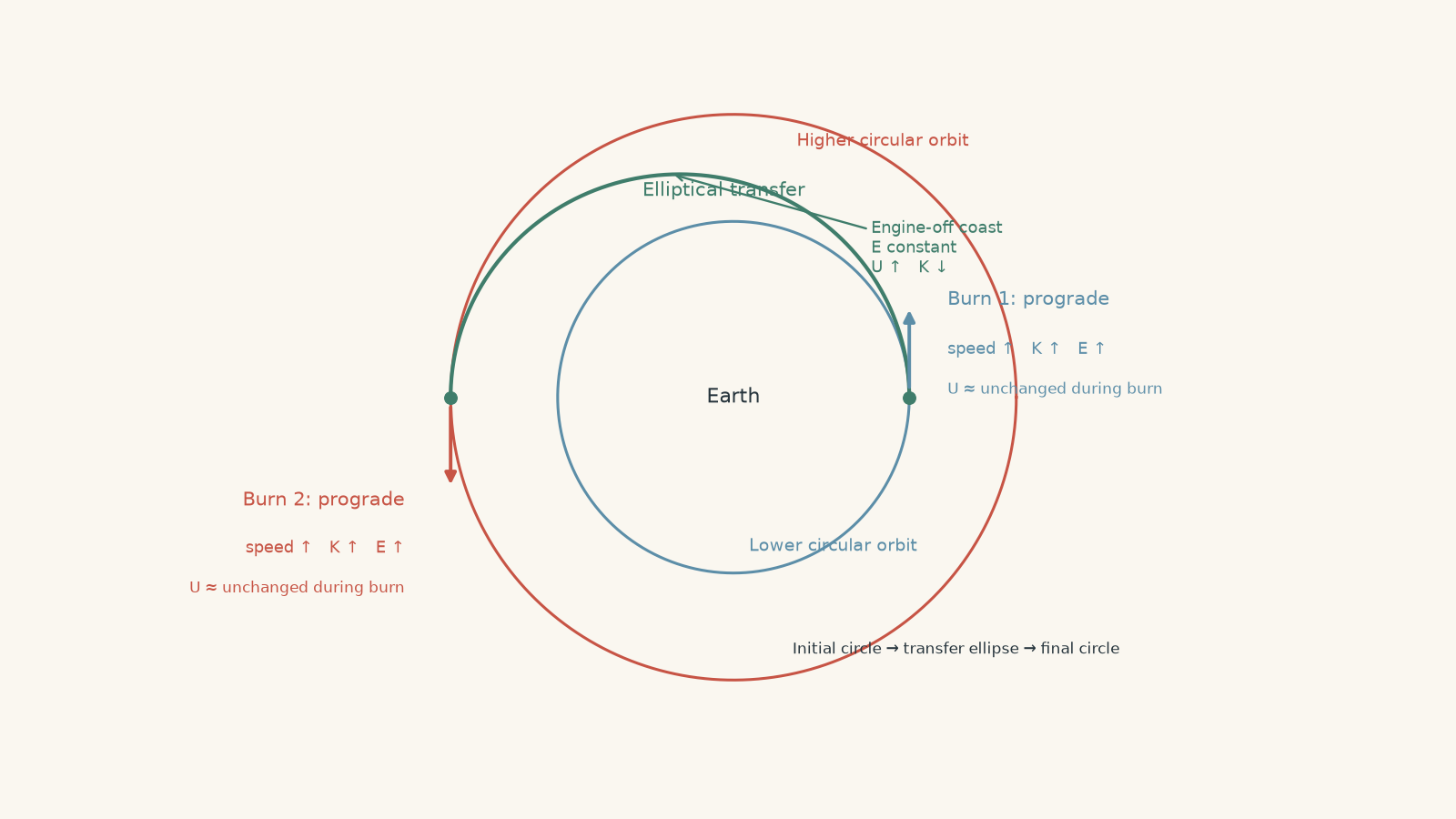
Consider a common two-burn transfer from a lower circular orbit to a higher one.
At the lower orbit, the satellite first fires its engine in the direction it is already travelling. This is a prograde burn.
During a short burn, we normally approximate the satellite’s position as unchanged. That means \(r\), and therefore \(U\), barely changes during the burn. The immediate effect is an increase in speed, kinetic energy, and total mechanical energy.
The satellite is now moving too quickly to remain on its original circular path. It enters a transfer orbit and begins moving farther from Earth.
What happens while the engine is off?
Predict before continuing. Does its total energy keep increasing because it is getting higher?
No. During the engine-off coast, gravity is conservative, so total mechanical energy remains constant. As the satellite moves outward:
- \(U\) increases,
- \(K\) decreases,
- \(E\) stays constant, and
- the satellite slows down.
At the high point of the transfer, another prograde burn can increase its speed enough to circularise the orbit. That second burn increases \(K\) and \(E\) again.
Here is the apparent paradox:
The satellite speeds up during both burns, yet its final speed in the higher circular orbit can still be lower than its original speed in the lower circular orbit.
There is no contradiction. The burns and the final states are different comparisons.
05Lowering an orbit produces the opposite-looking paradox
Suppose instead that a satellite moves from a high circular orbit to a lower circular orbit.
Its final circular speed will be greater:
\[
v=\sqrt{\frac{GM}{r}}
\]
Smaller \(r\) means larger \(v\).
Yet the satellite’s total mechanical energy must decrease because
\[
E=-\frac{GMm}{2r}
\]
becomes more negative as \(r\) decreases.
A typical transfer begins with a retrograde burn, meaning the engine reduces the satellite’s speed. That lowers its kinetic energy and total mechanical energy.
The satellite then falls inward. During this engine-off part, total energy is constant, but gravitational potential energy decreases and kinetic energy increases. Gravity accelerates the satellite.
A second retrograde burn can then circularise the lower orbit.
So a satellite can finish moving faster even though its engines have removed orbital mechanical energy overall.
Worked example: Lower orbit, higher final speed
An \(850\,\mathrm{kg}\) Earth satellite moves from a circular orbit at an altitude of \(1600\,\mathrm{km}\) to a circular orbit at an altitude of \(400\,\mathrm{km}\). Find the changes in total mechanical energy, kinetic energy, and gravitational potential energy, then compare the initial and final orbital speeds.
Step 1
\[
\begin{aligned}
r_i&=6.37\times10^6+1.60\times10^6\\
&=7.97\times10^6\,\mathrm{m}
\\[4pt]
r_f&=6.37\times10^6+0.400\times10^6\\
&=6.77\times10^6\,\mathrm{m}
\end{aligned}
\]
Step 2
\[
\begin{aligned}
\Delta E
&=
\frac{(3.99\times10^{14})(850)}{2}
\left(
\frac{1}{7.97\times10^6}
–
\frac{1}{6.77\times10^6}
\right)\\
&=-3.77\times10^9\,\mathrm{J}
\end{aligned}
\]
The negative sign means the satellite has lost \(3.77\,\mathrm{GJ}\) of orbital mechanical energy.
Step 3
For circular endpoints,
\[
\Delta K=-\Delta E
\]
so
\[
\Delta K=+3.77\times10^9\,\mathrm{J}
\]
Also,
\[
\Delta U=2\Delta E
\]
giving
\[
\Delta U=-7.54\times10^9\,\mathrm{J}
\]
The gravitational potential energy falls by \(7.54\,\mathrm{GJ}\). Half of that net decrease appears as additional kinetic energy, while the satellite’s total mechanical energy decreases by \(3.77\,\mathrm{GJ}\).
Step 4
Initially,
\[
v_i
=
\sqrt{\frac{3.99\times10^{14}}{7.97\times10^6}}
=
7.08\times10^3\,\mathrm{m\,s^{-1}}
\]
Finally,
\[
v_f
=
\sqrt{\frac{3.99\times10^{14}}{6.77\times10^6}}
=
7.68\times10^3\,\mathrm{m\,s^{-1}}
\]
The satellite ends about \(0.60\,\mathrm{km\,s^{-1}}\) faster, even though its total mechanical energy has decreased.
The missing idea is gravitational potential energy. Looking only at speed gives the wrong conclusion.
06Circular-orbit energy is not a formula for every point in an orbit
The equation
\[
E=-\frac{GMm}{2r}
\]
contains \(r\), but that does not mean you may use it whenever a satellite happens to be at distance \(r\).
It was derived using the circular-orbit condition
\[
v^2=\frac{GM}{r}
\]
so it applies when the satellite is actually in a circular orbit of radius \(r\).
On an elliptical transfer orbit, use the general mechanical-energy expression if you know the satellite’s speed and position:
\[
E=\frac{1}{2}mv^2-\frac{GMm}{r}
\]
This distinction matters especially at the highest and lowest points of a transfer orbit. A satellite can momentarily be at exactly the same radius as a circular orbit while travelling at the wrong speed for that circle.
The radius alone does not identify the orbit.
07A practical decision rule
When an orbital-energy question appears, first decide what state the satellite is actually in.
| Situation | What to use |
|---|---|
| Satellite is in a circular orbit of known radius | \(E=-GMm/(2r)\) |
| Comparing two circular-orbit endpoints | \(\Delta E=\frac{GMm}{2}\left(\frac{1}{r_i}-\frac{1}{r_f}\right)\) |
| Satellite has known \(r\) and \(v\), but the orbit is not known to be circular | \(E=\frac12mv^2-GMm/r\) |
| Satellite is coasting with only gravity acting | \(E\) is constant |
| Satellite undergoes an idealised brief burn | \(r\) is approximately unchanged, so the immediate change in \(E\) comes from the change in \(K\) |
There is one more distinction worth making. The change in the satellite’s orbital mechanical energy is not the same thing as the chemical energy consumed by a rocket.
For example, if
\[
\Delta E=+3.0\times10^9\,\mathrm{J}
\]
then the satellite-Earth orbital system has gained \(3.0\,\mathrm{GJ}\) of mechanical energy. A real propulsion system also sends energy into exhaust, heat, and other places. You cannot infer fuel use directly from \(\Delta E\).
The usual HSC model also assumes the central body’s mass is much larger than the satellite’s, ignores atmospheric drag and other celestial bodies, and treats short burns as effectively instantaneous.
08Questions and solutions
Question 1
A \(600\,\mathrm{kg}\) satellite is raised from a circular orbit \(400\,\mathrm{km}\) above Earth’s surface to another circular orbit \(1000\,\mathrm{km}\) above Earth’s surface.
Use \(R_E=6.37\times10^6\,\mathrm{m}\) and \(GM_E=3.99\times10^{14}\,\mathrm{m^3\,s^{-2}}\).
Calculate the change in the satellite’s total orbital mechanical energy and state whether energy has been added or removed.
Solution 1
The satellite’s total orbital mechanical energy increases by \(1.44\times10^9\,\mathrm{J}\), so orbital energy has been added.
First convert altitude to distance from Earth’s centre:
\[
\begin{aligned}
r_i&=6.37\times10^6+0.400\times10^6
=6.77\times10^6\,\mathrm{m}\\
r_f&=6.37\times10^6+1.00\times10^6
=7.37\times10^6\,\mathrm{m}
\end{aligned}
\]
For circular endpoints,
\[
\Delta E
=
\frac{GM_Em}{2}
\left(
\frac{1}{r_i}-\frac{1}{r_f}
\right)
\]
Substituting,
\[
\begin{aligned}
\Delta E
&=
\frac{(3.99\times10^{14})(600)}{2}
\left(
\frac{1}{6.77\times10^6}
–
\frac{1}{7.37\times10^6}
\right)\\
&=1.44\times10^9\,\mathrm{J}
\end{aligned}
\]
A tempting mistake is to use \(400\,\mathrm{km}\) and \(1000\,\mathrm{km}\) directly as \(r\). Gravitational equations require distance from Earth’s centre, not altitude above its surface.
The final circular speed is lower than the initial speed, but the satellite’s increase in gravitational potential energy is larger than its loss of kinetic energy. Its total mechanical energy therefore increases.
Question 2
A \(1000\,\mathrm{kg}\) satellite is initially in a circular Earth orbit of radius \(8.00\times10^6\,\mathrm{m}\). A brief prograde burn increases its speed by \(5.0\%\) while its distance from Earth’s centre is effectively unchanged.
Use \(GM_E=3.99\times10^{14}\,\mathrm{m^3\,s^{-2}}\).
Determine:
- its speed before and immediately after the burn,
- the change in its orbital mechanical energy during the burn,
- whether it remains gravitationally bound immediately after the burn, and
- what happens to \(K\), \(U\), and \(E\) as it subsequently coasts outward with its engine off.
Solution 2
The speed increases from \(7.06\,\mathrm{km\,s^{-1}}\) to \(7.42\,\mathrm{km\,s^{-1}}\), the burn adds \(2.56\times10^9\,\mathrm{J}\) of orbital mechanical energy, and the satellite remains bound. During the outward coast, \(K\) decreases, \(U\) increases, and \(E\) remains constant.
The initial circular speed is
\[
\begin{aligned}
v_i
&=\sqrt{\frac{GM_E}{r}}\\
&=\sqrt{\frac{3.99\times10^{14}}{8.00\times10^6}}\\
&=7.06\times10^3\,\mathrm{m\,s^{-1}}
\end{aligned}
\]
A \(5.0\%\) increase gives
\[
v_f=1.05v_i
=7.42\times10^3\,\mathrm{m\,s^{-1}}
\]
Because the burn is brief, \(r\) is essentially unchanged. The gravitational potential energy therefore does not change appreciably during the burn, so
\[
\Delta E=\Delta K
\]
and
\[
\begin{aligned}
\Delta E
&=\frac12m(v_f^2-v_i^2)\\
&=\frac12(1000)
\left[
(7.415\times10^3)^2-(7.062\times10^3)^2
\right]\\
&=2.56\times10^9\,\mathrm{J}
\end{aligned}
\]
Before the burn, the circular-orbit energy is
\[
E_i
=
-\frac{GM_Em}{2r}
=
-\frac{(3.99\times10^{14})(1000)}
{2(8.00\times10^6)}
=
-2.49\times10^{10}\,\mathrm{J}
\]
Therefore,
\[
E_{\text{after}}
=
-2.49\times10^{10}
+
2.56\times10^9
=
-2.24\times10^{10}\,\mathrm{J}
\]
The total energy is still negative, so the satellite remains gravitationally bound.
A tempting argument is that the satellite must keep gaining energy as it climbs because its potential energy is increasing. The missing constraint is that the engine is now off. Gravity is conservative, so total mechanical energy remains fixed. The increase in \(U\) comes from a decrease in \(K\).
Question 3
A \(900\,\mathrm{kg}\) satellite moves from a circular Earth orbit of radius \(1.20\times10^7\,\mathrm{m}\) to a lower circular orbit of radius \(7.00\times10^6\,\mathrm{m}\).
Use \(GM_E=3.99\times10^{14}\,\mathrm{m^3\,s^{-2}}\).
Calculate:
- \(\Delta U\),
- \(\Delta K\),
- \(\Delta E\), and
- the initial and final circular speeds.
A mission report states that the propulsion system removed orbital mechanical energy during the manoeuvre even though the satellite finished at a higher speed. Explain why both statements can be correct.
Solution 3
The satellite loses \(1.07\times10^{10}\,\mathrm{J}\) of total orbital mechanical energy while its kinetic energy increases by the same magnitude. Its speed rises from \(5.77\,\mathrm{km\,s^{-1}}\) to \(7.55\,\mathrm{km\,s^{-1}}\) because its gravitational potential energy decreases by \(2.14\times10^{10}\,\mathrm{J}\).
For gravitational potential energy,
\[
\begin{aligned}
\Delta U
&=
-\frac{GM_Em}{r_f}
+\frac{GM_Em}{r_i}\\
&=
(3.99\times10^{14})(900)
\left(
\frac{1}{1.20\times10^7}
–
\frac{1}{7.00\times10^6}
\right)\\
&=-2.14\times10^{10}\,\mathrm{J}
\end{aligned}
\]
For circular orbits,
\[
K=\frac{GMm}{2r}
\]
so
\[
\begin{aligned}
\Delta K
&=
\frac{GM_Em}{2}
\left(
\frac{1}{r_f}-\frac{1}{r_i}
\right)\\
&=+1.07\times10^{10}\,\mathrm{J}
\end{aligned}
\]
Therefore,
\[
\begin{aligned}
\Delta E
&=\Delta K+\Delta U\\
&=
1.07\times10^{10}
–
2.14\times10^{10}\\
&=-1.07\times10^{10}\,\mathrm{J}
\end{aligned}
\]
Now compare the circular speeds:
\[
\begin{aligned}
v_i
&=
\sqrt{\frac{3.99\times10^{14}}{1.20\times10^7}}
=
5.77\times10^3\,\mathrm{m\,s^{-1}}\\
v_f
&=
\sqrt{\frac{3.99\times10^{14}}{7.00\times10^6}}
=
7.55\times10^3\,\mathrm{m\,s^{-1}}
\end{aligned}
\]
The tempting route is to treat kinetic energy as though it were the satellite’s entire energy account. It is not.
As the satellite moves inward, its gravitational potential energy drops by \(2.14\times10^{10}\,\mathrm{J}\). The kinetic energy rises by only \(1.07\times10^{10}\,\mathrm{J}\). The remaining \(1.07\times10^{10}\,\mathrm{J}\) corresponds to the decrease in total mechanical energy.
A lower circular orbit can therefore have both a larger kinetic energy and a smaller total mechanical energy.
Question 4
A \(1000\,\mathrm{kg}\) satellite reaches the highest point of an elliptical transfer orbit at a distance \(1.40\times10^7\,\mathrm{m}\) from Earth’s centre. At that instant its velocity is tangential and has magnitude \(4.00\times10^3\,\mathrm{m\,s^{-1}}\).
A student substitutes \(r=1.40\times10^7\,\mathrm{m}\) into
\[
E=-\frac{GMm}{2r}
\]
and claims that this gives the satellite’s current total energy.
Use \(GM_E=3.99\times10^{14}\,\mathrm{m^3\,s^{-2}}\) to:
- calculate the satellite’s actual total mechanical energy,
- calculate the total energy of a circular orbit at the same radius,
- determine the direction of the burn required to circularise the orbit there, and
- calculate the increase in orbital mechanical energy required.
Solution 4
The student’s method is invalid: the satellite’s actual energy is \(-2.05\times10^{10}\,\mathrm{J}\), while a circular orbit at that radius has energy \(-1.43\times10^{10}\,\mathrm{J}\). A prograde circularisation burn must therefore add \(6.25\times10^9\,\mathrm{J}\) of orbital mechanical energy.
The satellite is not yet in a circular orbit, so use the general expression
\[
E=\frac12mv^2-\frac{GMm}{r}
\]
Its kinetic energy is
\[
\begin{aligned}
K
&=\frac12(1000)(4.00\times10^3)^2\\
&=8.00\times10^9\,\mathrm{J}
\end{aligned}
\]
Its gravitational potential energy is
\[
\begin{aligned}
U
&=
-\frac{(3.99\times10^{14})(1000)}
{1.40\times10^7}\\
&=-2.85\times10^{10}\,\mathrm{J}
\end{aligned}
\]
Therefore,
\[
E_{\text{transfer}}
=
8.00\times10^9-2.85\times10^{10}
=
-2.05\times10^{10}\,\mathrm{J}
\]
For a circular orbit at this radius,
\[
\begin{aligned}
E_{\text{circ}}
&=
-\frac{GM_Em}{2r}\\
&=
-\frac{(3.99\times10^{14})(1000)}
{2(1.40\times10^7)}\\
&=-1.425\times10^{10}\,\mathrm{J}
\end{aligned}
\]
The circular-orbit speed would be
\[
\begin{aligned}
v_{\text{circ}}
&=
\sqrt{\frac{GM_E}{r}}\\
&=
\sqrt{\frac{3.99\times10^{14}}{1.40\times10^7}}\\
&=5.34\times10^3\,\mathrm{m\,s^{-1}}
\end{aligned}
\]
The satellite is travelling at only \(4.00\times10^3\,\mathrm{m\,s^{-1}}\), so it must speed up. The required burn is prograde.
The required increase in mechanical energy is
\[
\begin{aligned}
\Delta E
&=
E_{\text{circ}}-E_{\text{transfer}}\\
&=
-1.425\times10^{10}
–
(-2.05\times10^{10})\\
&=6.25\times10^9\,\mathrm{J}
\end{aligned}
\]
The tempting route is to think that knowing \(r\) automatically determines orbital energy. It does only after you also know the orbit is circular. The circular-energy equation contains a hidden condition: the speed must satisfy \(v^2=GM/r\).
At the highest point of this transfer orbit, the satellite is at the correct radius but moving too slowly to stay on a circle. That is why another burn is required.
Question 5
At a distance
\[
r=1.00\times10^7\,\mathrm{m}
\]
from Earth’s centre, a satellite is measured to have total orbital mechanical energy exactly equal to the energy of a circular orbit at that radius:
\[
E=-\frac{GM_Em}{2r}
\]
However, tracking data show that its velocity has an outward radial component of
\[
v_r=2.00\times10^3\,\mathrm{m\,s^{-1}}
\]
Use \(GM_E=3.99\times10^{14}\,\mathrm{m^3\,s^{-2}}\).
Determine:
- the satellite’s total speed,
- its tangential speed,
- whether it is actually in a circular orbit,
- the magnitude of the ideal instantaneous change in velocity required to put it into a circular orbit at that same radius, and
- the corresponding change in orbital mechanical energy.
Explain how a non-zero velocity change can occur even if the orbital mechanical energy does not change.
Solution 5
The satellite is not in a circular orbit. Its total speed is \(6.32\,\mathrm{km\,s^{-1}}\), its tangential component is \(5.99\,\mathrm{km\,s^{-1}}\), and an ideal velocity change of about \(2.03\,\mathrm{km\,s^{-1}}\) could circularise the orbit while producing zero net change in its orbital mechanical energy.
Start with the measured energy:
\[
\frac12mv^2-\frac{GM_Em}{r}
=
-\frac{GM_Em}{2r}
\]
Move the potential-energy term to the other side:
\[
\frac12mv^2
=
\frac{GM_Em}{2r}
\]
so
\[
v^2=\frac{GM_E}{r}
\]
Therefore,
\[
\begin{aligned}
v
&=
\sqrt{\frac{3.99\times10^{14}}{1.00\times10^7}}\\
&=6.32\times10^3\,\mathrm{m\,s^{-1}}
\end{aligned}
\]
That is exactly the magnitude of the circular-orbit speed at this radius.
This is where the tempting argument appears: correct radius, correct total energy, and correct speed magnitude seem to guarantee a circular orbit.
They do not.
A circular orbit also requires the velocity to be entirely tangential. This satellite has an outward radial component of \(2.00\times10^3\,\mathrm{m\,s^{-1}}\).
The radial and tangential components are perpendicular, so
\[
v^2=v_r^2+v_t^2
\]
Hence,
\[
\begin{aligned}
v_t
&=
\sqrt{v^2-v_r^2}\\
&=
\sqrt{
(6.316\times10^3)^2
–
(2.00\times10^3)^2
}\\
&=5.99\times10^3\,\mathrm{m\,s^{-1}}
\end{aligned}
\]
To circularise immediately at this radius, the final velocity must have
\[
v_{r,f}=0
\]
and
\[
v_{t,f}=6.316\times10^3\,\mathrm{m\,s^{-1}}
\]
The required changes in the two components are therefore
\[
\Delta v_r=-2.00\times10^3\,\mathrm{m\,s^{-1}}
\]
and
\[
\Delta v_t
=
6.316\times10^3-5.992\times10^3
=
0.325\times10^3\,\mathrm{m\,s^{-1}}
\]
The magnitude of the required velocity change is
\[
\begin{aligned}
|\Delta\vec v|
&=
\sqrt{(\Delta v_r)^2+(\Delta v_t)^2}\\
&=
\sqrt{
(2.00\times10^3)^2
+
(0.325\times10^3)^2
}\\
&=2.03\times10^3\,\mathrm{m\,s^{-1}}
\end{aligned}
\]
Yet the orbital mechanical energy change is
\[
\Delta E=0
\]
Why?
The satellite begins and ends the idealised burn at the same radius, so its gravitational potential energy is unchanged. Its initial and final speed magnitudes are also the same, so its kinetic energy is unchanged.
The burn changes the direction of the velocity vector rather than its magnitude overall.
This exposes an important limitation of using energy alone. Mechanical energy is a scalar. It can tell you how much energy a state has, but it does not contain the direction of motion. Two orbital states can have the same \(r\), the same speed magnitude, and the same total energy while having different velocity directions and therefore different trajectories.
A real rocket would still consume propellant to produce the required impulse. Zero change in the satellite’s orbital mechanical energy does not mean zero fuel consumption.
09What this idea lets you do next
Once you can separate \(K\), \(U\), and \(E\), orbital transfers become much easier to reason about.
For circular orbits, the key relationship is
\[
E=-\frac{GMm}{2r}
\]
A higher circular orbit has greater total energy but lower kinetic energy. A lower circular orbit has smaller total energy but greater kinetic energy. During an engine-off transfer, total mechanical energy stays constant as kinetic and gravitational potential energy exchange.
The next useful boundary is \(E=0\). Circular and elliptical bound orbits have negative total energy. Add enough energy for the total to reach zero, and the satellite is at the threshold of escaping the central body’s gravitational field rather than moving to another bound orbital energy level.