
Fermentation Production of Ethanol: HSC Chemistry Guide
Learn how fermentation produces ethanol from glucose, how to write and use the balanced equation, and how reaction conditions affect the process.
A flask contains glucose solution and yeast. For the first few minutes, nothing dramatic happens. Then bubbles begin rising through the liquid. Suppose you test the gas and find carbon dioxide. Where did the carbon atoms in that gas come from, and what else must be forming in the flask?
Before reading on, make a prediction: if the glucose is being converted into ethanol, should the mass of ethanol produced be greater than, equal to, or less than the mass of glucose consumed?
The answer is less. Some of the atoms from glucose leave as carbon dioxide. Fermentation is the pathway that lets us track exactly where those atoms go.
01What fermentation is doing
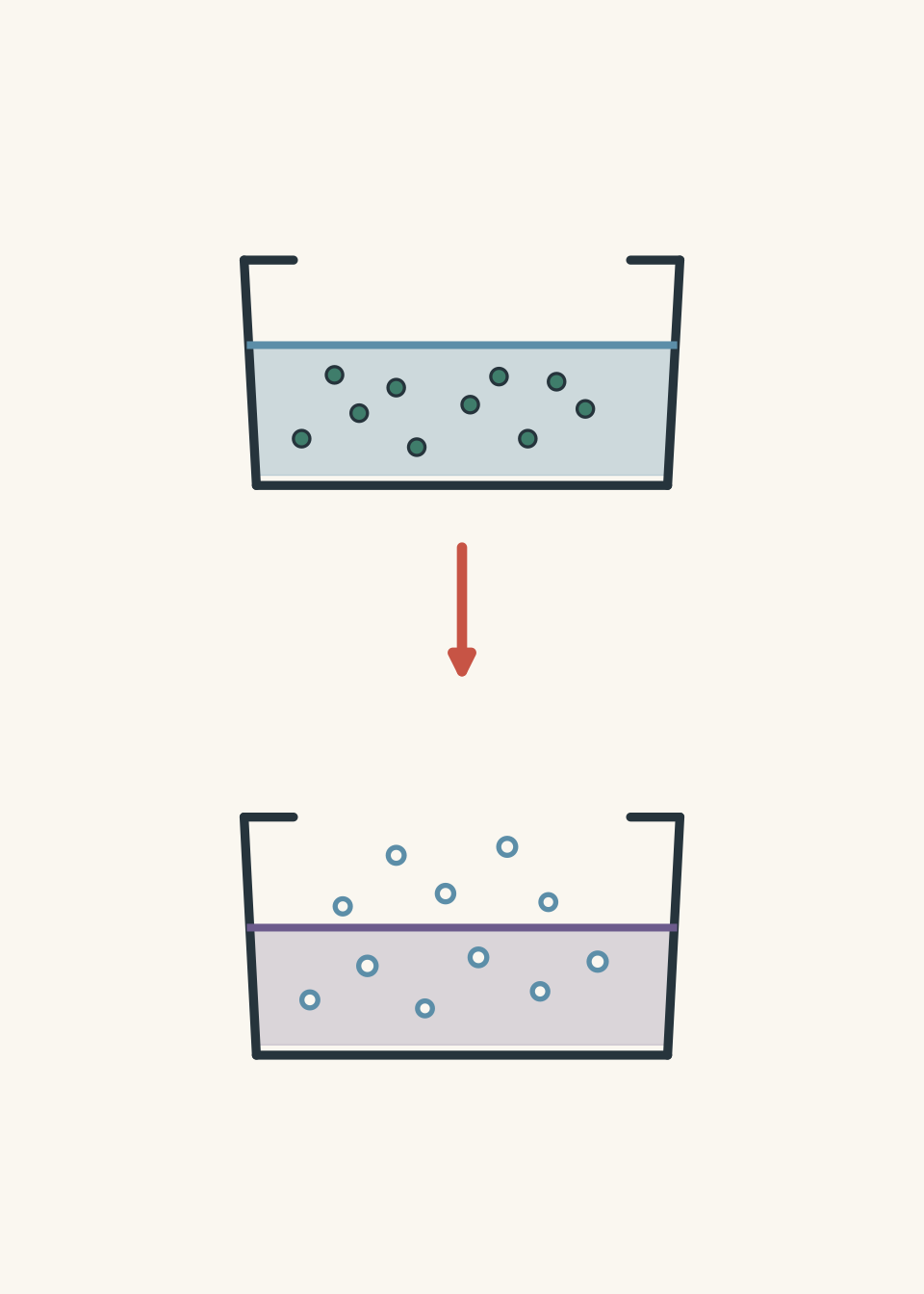
Yeast can obtain energy from glucose without using oxygen. Under suitable conditions, enzymes inside the yeast catalyse a series of reactions that convert glucose into ethanol and carbon dioxide.
At HSC level, we usually represent the overall process as one reaction:
\[ \ce{C6H12O6(aq) -> 2C2H5OH(aq) + 2CO2(g)} \]
The reactant is glucose, \(\ce{C6H12O6}\). The alcohol product is ethanol, \(\ce{C2H5OH}\), and carbon dioxide is released as a gas.
This equation is an overall equation. It does not mean a glucose molecule simply bumps into something and instantly splits into two ethanol molecules and two carbon dioxide molecules. Yeast carries out fermentation through multiple enzyme-controlled steps. For HSC questions about producing ethanol, however, the overall equation is normally the useful level of description.
02Why the equation has those coefficients
The coefficients are not arbitrary. They conserve atoms.
Start with one glucose molecule:
- 6 carbon atoms
- 12 hydrogen atoms
- 6 oxygen atoms
Two ethanol molecules contain:
\[ 2 \times \ce{C2H6O} = \ce{C4H12O2} \]
That accounts for four of the six carbon atoms. The remaining two carbon atoms appear in two molecules of carbon dioxide:
\[ 2\ce{CO2} \]
Now count everything on the product side:
| Element | In glucose | In \(2\ce{C2H5OH} + 2\ce{CO2}\) |
|---|---|---|
| Carbon | 6 | \(4+2=6\) |
| Hydrogen | 12 | 12 |
| Oxygen | 6 | \(2+4=6\) |
So the balanced equation is:
\[ \ce{C6H12O6(aq) -> 2C2H5OH(aq) + 2CO2(g)} \]
There is an important mole relationship hidden inside it:
\[ 1\text{ mol glucose} : 2\text{ mol ethanol} : 2\text{ mol carbon dioxide} \]
That ratio is the key to fermentation calculations.
03The conditions matter
Writing the equation without considering the yeast is a bit like writing “food \(\rightarrow\) dinner” and ignoring the chef. The overall change may be right, but it does not tell you what conditions make the process work.
Fermentation requires living yeast with functioning enzymes, a source of glucose or another fermentable sugar, and conditions that allow those enzymes to operate.
For the HSC, the important conditions are:
| Condition | Why it matters |
|---|---|
| Yeast | Provides the enzymes that catalyse fermentation |
| Glucose solution | Supplies the carbohydrate reactant |
| Little or no oxygen | Favours fermentation rather than aerobic respiration |
| Moderate temperature, commonly around \(30\text{-}40^\circ\text{C}\) | Allows yeast enzymes to function effectively |
| Suitable aqueous conditions | Yeast cells and their enzymes operate in water |
Temperature needs a little precision. “Hotter means faster” is only useful up to a point.
Imagine increasing the temperature from \(10^\circ\text{C}\) towards \(35^\circ\text{C}\). Molecular motion increases, and enzyme-controlled reactions generally become faster. It is tempting to predict that \(80^\circ\text{C}\) would therefore be even better.
It would not. At sufficiently high temperatures, proteins involved in the yeast’s metabolism lose the structure needed to function properly, and the yeast cells are damaged or killed. So fermentation has a useful temperature range rather than a rule of “the hotter, the better”.
04Why oxygen is restricted
A common shortcut is to say that yeast “cannot use oxygen during fermentation”. That is not quite the right mental model.
Yeast can carry out aerobic respiration when oxygen is available. Aerobic respiration extracts considerably more energy from glucose and produces carbon dioxide and water rather than ethanol as the main products represented by the fermentation equation.
For ethanol production, oxygen is therefore restricted so that the metabolic pathway favours fermentation.
The simplified comparison is:
With sufficient oxygen:
\[ \ce{C6H12O6 + 6O2 -> 6CO2 + 6H2O} \]
Fermentation:
\[ \ce{C6H12O6 -> 2C2H5OH + 2CO2} \]
Notice the important difference. In aerobic respiration, all six carbon atoms from glucose can end up in carbon dioxide. In fermentation, four carbon atoms remain in the two ethanol molecules.
That gives you a useful experimental clue. Carbon dioxide production by itself does not prove that ethanol fermentation is occurring. You would also need evidence that ethanol has formed, or that the conditions and products are consistent with the fermentation pathway.
05Why fermentation eventually slows down
Suppose you leave a glucose-yeast mixture for much longer. Will the ethanol concentration keep increasing until nearly all the liquid is pure ethanol?
No.
As ethanol accumulates, it becomes harmful to yeast cells and interferes with their biological processes. Fermentation therefore becomes inhibited and eventually stops at a relatively low ethanol concentration compared with pure ethanol.
This has an industrial consequence: fermentation produces ethanol mixed with a large amount of water. If concentrated ethanol is needed, separation processes such as distillation must follow.
The fermentation reaction and the separation step are different jobs:
- fermentation chemically converts glucose into ethanol,
- distillation physically separates substances because they have different volatilities.
Do not put distillation into the fermentation equation. It does not create the ethanol.
Worked example: How much ethanol can glucose produce?
A sample contains \(45.0\text{ g}\) of glucose. Assume all of the glucose ferments completely. Calculate the theoretical mass of ethanol produced.
The molar mass of glucose is \(180.16\text{ g mol}^{-1}\), and the molar mass of ethanol is \(46.07\text{ g mol}^{-1}\).
Step 1
\[ \ce{C6H12O6 -> 2C2H5OH + 2CO2} \]
One mole of glucose produces two moles of ethanol.
Step 2
Using \(n=\frac{m}{M}\), where \(n\) is amount in moles, \(m\) is mass in grams, and \(M\) is molar mass in \(\text{g mol}^{-1}\):
\[ n(\ce{C6H12O6}) = \frac{45.0}{180.16} = 0.2498\text{ mol} \]
Step 3
\[ n(\ce{C2H5OH}) = 2(0.2498) = 0.4996\text{ mol} \]
Step 4
\[ m=nM = 0.4996\times46.07 = 23.0\text{ g} \]
The theoretical mass of ethanol is therefore \(23.0\text{ g}\).
This is less than the original \(45.0\text{ g}\) of glucose because some of the glucose mass ends up in carbon dioxide.
Worked example: Fermentation with an imperfect yield
A fermentation vessel contains \(180.0\text{ g}\) of glucose. Only \(82.0\%\) of the theoretical ethanol yield is obtained. Calculate the mass of ethanol actually produced.
Step 1
\[ n(\ce{C6H12O6}) = \frac{180.0}{180.16} = 0.9991\text{ mol} \]
Step 2
\[ n_{\text{theoretical}}(\ce{C2H5OH}) = 2(0.9991) = 1.998\text{ mol} \]
Step 3
\[ m_{\text{theoretical}} = 1.998\times46.07 = 92.05\text{ g} \]
Step 4
Percentage yield is
\[ \text{percentage yield} = \frac{\text{actual yield}}{\text{theoretical yield}}\times100 \]
so
\[ m_{\text{actual}} = 92.05\times\frac{82.0}{100} = 75.5\text{ g} \]
The vessel produces \(75.5\text{ g}\) of ethanol.
The important distinction is that the balanced equation still gives a \(1:2\) mole ratio. An \(82.0\%\) yield does not change the equation. It tells us that the real process produced less ethanol than the theoretical maximum.
06The most tempting fermentation mistakes
The chemistry is short enough that small errors matter.
| Tempting statement | What is wrong with it? | Better statement |
|---|---|---|
| Fermentation converts glucose only into ethanol | Carbon dioxide is also formed | Glucose forms ethanol and carbon dioxide |
| Oxygen is a reactant in ethanol fermentation | It does not appear in the fermentation equation | Ethanol fermentation occurs under anaerobic or oxygen-limited conditions |
| Yeast is consumed in the balanced equation | Yeast supplies biological catalysts | Yeast enables the reaction but is not written as a stoichiometric reactant |
| Increasing temperature always increases ethanol production | High temperature damages yeast and enzymes | A suitable moderate temperature is required |
| Carbon dioxide bubbles prove ethanol has formed | Other reactions can also produce \(\ce{CO2}\) | Product evidence and reaction conditions must be considered together |
| Distillation produces ethanol | Distillation only separates substances already present | Fermentation forms ethanol; distillation can concentrate it |
One more point catches students in calculations. The equation says that one mole of glucose produces two moles of ethanol. It does not say one gram of glucose produces two grams of ethanol. Chemical equations compare numbers of particles, and therefore moles, not equal masses.
07Questions and solutions
Question 1
Write the balanced equation for the fermentation of aqueous glucose to produce ethanol, and state two conditions required for the process.
Solution 1
The balanced equation is
\[ \ce{C6H12O6(aq) -> 2C2H5OH(aq) + 2CO2(g)} \]
and suitable conditions include yeast and anaerobic or oxygen-limited conditions at a moderate temperature.
Yeast supplies the enzymes that catalyse the biochemical pathway. Restricting oxygen favours fermentation rather than aerobic respiration. A temperature commonly around \(30\text{-}40^\circ\text{C}\) allows the biological catalysts to operate effectively without exposing the yeast to damaging temperatures.
A tempting mistake is to place yeast over on the reactant side of the balanced equation. Yeast enables the reaction, but its amount is not related to ethanol through the stoichiometric coefficients, so it is not written as a reactant in the overall equation.
Question 2
A student ferments \(72.0\text{ g}\) of glucose completely.
Calculate:
a. the theoretical amount, in moles, of ethanol produced
b. the theoretical mass of ethanol produced
c. the amount, in moles, of carbon dioxide produced.
Use \(M(\ce{C6H12O6})=180.16\text{ g mol}^{-1}\) and \(M(\ce{C2H5OH})=46.07\text{ g mol}^{-1}\).
Solution 2
The fermentation theoretically produces \(0.799\text{ mol}\) of ethanol, \(36.8\text{ g}\) of ethanol, and \(0.799\text{ mol}\) of carbon dioxide.
The governing equation is
\[ \ce{C6H12O6 -> 2C2H5OH + 2CO2} \]
First find the amount of glucose:
\[ n(\ce{C6H12O6}) = \frac{72.0}{180.16} = 0.3996\text{ mol} \]
The mole ratio of glucose to ethanol is \(1:2\), so
\[ n(\ce{C2H5OH}) = 2(0.3996) = 0.7993\text{ mol} \]
The ethanol mass is therefore
\[ m = nM = 0.7993\times46.07 = 36.8\text{ g} \]
The glucose-to-carbon-dioxide ratio is also \(1:2\), so
\[ n(\ce{CO2}) = 2(0.3996) = 0.7993\text{ mol} \]
A common wrong route is to assume \(72.0\text{ g}\) of glucose gives \(144\text{ g}\) of ethanol because the coefficient doubles from 1 to 2. Coefficients give mole ratios, not mass ratios. Much of the glucose’s mass is accounted for by the carbon dioxide product.
Question 3
Two sealed experimental vessels initially contain the same amount of glucose solution and the same amount of yeast.
Vessel A is kept under oxygen-limited conditions at \(35^\circ\text{C}\).
Vessel B is supplied continuously with oxygen at \(35^\circ\text{C}\).
After some time, both vessels have produced carbon dioxide.
A student concludes that both vessels must therefore have produced the same amount of ethanol.
Evaluate the student’s conclusion.
Solution 3
The conclusion is not justified: carbon dioxide production alone does not show that the two vessels produced the same amount of ethanol.
Under oxygen-limited conditions, Vessel A can favour fermentation:
\[ \ce{C6H12O6 -> 2C2H5OH + 2CO2} \]
so carbon dioxide production can accompany ethanol production.
In Vessel B, oxygen allows yeast to carry out aerobic respiration, represented overall by
\[ \ce{C6H12O6 + 6O2 -> 6CO2 + 6H2O} \]
Aerobic respiration also produces carbon dioxide, but it does not have ethanol as the product represented by this equation.
The tempting route is to treat carbon dioxide as a unique fingerprint for fermentation. It is not. The decisive constraint is that both fermentation and aerobic respiration can generate \(\ce{CO2}\). To compare ethanol production, the student would need evidence about the ethanol itself or other evidence that distinguishes the metabolic pathways.
Question 4
A fermentation vessel initially contains glucose and yeast under suitable anaerobic conditions. After several hours, measurements show that exactly \(0.600\text{ mol}\) of glucose has disappeared, but only \(0.900\text{ mol}\) of ethanol is present.
A student argues:
“The equation says one mole of glucose gives two moles of ethanol, so the reaction equation must be wrong.”
Assume no ethanol was present initially.
Is the observation necessarily inconsistent with the fermentation equation? Explain what can and cannot be concluded from the information given.
Solution 4
No. The observation is not necessarily inconsistent with the fermentation equation; it shows only that the measured amount of ethanol is below the theoretical amount predicted if all \(0.600\text{ mol}\) of consumed glucose followed the represented fermentation pathway and all ethanol formed remained measurable in the vessel.
The equation predicts
\[ n_{\text{theoretical}}(\ce{C2H5OH}) = 2(0.600) = 1.200\text{ mol} \]
but only \(0.900\text{ mol}\) is measured.
The apparent yield is therefore
\[ \text{percentage yield} = \frac{0.900}{1.200}\times100 = 75.0\% \]
This does not require the balanced equation to be changed. A balanced equation specifies the stoichiometric relationship for the reaction it represents. An actual biological process may give a lower measured yield because not all consumed glucose necessarily becomes the desired product, material may be used in other biological processes, or some product may not be recovered or measured.
The tempting argument treats “glucose disappeared” as identical to “glucose underwent only the idealised reaction written on the page”. That extra assumption was never established.
There is also an important limit on what can be concluded. From the information given, we cannot identify the exact cause of the missing theoretical ethanol. We can conclude that the actual ethanol yield relative to the simple stoichiometric maximum is \(75.0\%\), but we would need further evidence to explain why.
Question 5
A student wants to determine whether glucose in a yeast mixture has mainly undergone ethanol fermentation or aerobic respiration.
After the experiment, the student knows that \(0.500\text{ mol}\) of glucose has been consumed and \(1.80\text{ mol}\) of carbon dioxide has been collected. Assume, for this question, that every consumed glucose molecule underwent only one of these two pathways:
Fermentation:
\[ \ce{C6H12O6 -> 2C2H5OH + 2CO2} \]
Aerobic respiration:
\[ \ce{C6H12O6 + 6O2 -> 6CO2 + 6H2O} \]
Determine how many moles of the consumed glucose underwent each pathway and predict the amount of ethanol formed.
Then explain why simply observing “more than \(1.00\text{ mol}\) of carbon dioxide” would not, by itself, be enough to determine the amounts.
Solution 5
Of the \(0.500\text{ mol}\) of glucose consumed, \(0.300\text{ mol}\) underwent fermentation and \(0.200\text{ mol}\) underwent aerobic respiration, producing \(0.600\text{ mol}\) of ethanol.
Let \(x\) be the amount of glucose, in moles, that fermented. Let \(y\) be the amount that underwent aerobic respiration.
All consumed glucose must be accounted for:
\[ x+y=0.500 \]
Each mole of fermented glucose produces \(2\text{ mol}\) of carbon dioxide, while each mole undergoing aerobic respiration produces \(6\text{ mol}\) of carbon dioxide. Therefore,
\[ 2x+6y=1.80 \]
From the first equation,
\[ x=0.500-y \]
Substitute this into the carbon dioxide equation:
\[ \begin{aligned} 2(0.500-y)+6y&=1.80\\ 1.00-2y+6y&=1.80\\ 4y&=0.80\\ y&=0.200\text{ mol} \end{aligned} \]
Therefore,
\[ x=0.500-0.200=0.300\text{ mol} \]
Only fermented glucose produces ethanol in the two pathways given. Since one mole of fermented glucose produces two moles of ethanol,
\[ n(\ce{C2H5OH}) = 2(0.300) = 0.600\text{ mol} \]
The tempting first answer is that \(1.80\text{ mol}\) of carbon dioxide must mean “lots of fermentation”, because fermentation is being studied and carbon dioxide bubbles are strongly associated with it. The crucial interaction is that the two possible pathways produce different amounts of the same gas. Fermentation produces \(2\text{ mol}\) of \(\ce{CO2}\) per mole of glucose, while aerobic respiration produces \(6\text{ mol}\).
If all \(0.500\text{ mol}\) of glucose fermented, the carbon dioxide amount would be
\[ 2(0.500)=1.00\text{ mol} \]
and if all of it underwent aerobic respiration, it would be
\[ 6(0.500)=3.00\text{ mol} \]
So observing an amount above \(1.00\text{ mol}\) tells us that fermentation alone cannot explain the result under the stated assumptions, but it does not tell us the exact mixture of pathways. The measured value \(1.80\text{ mol}\), together with the total glucose consumed and the two stoichiometric equations, provides the second constraint needed for a unique answer.
08What fermentation lets you understand next
Fermentation gives you a way to produce ethanol from a carbohydrate feedstock, but once ethanol exists, a much larger piece of organic chemistry opens up.
You can ask how ethanol behaves as a fuel, including its enthalpy of combustion, or what happens when water is removed from an alcohol during dehydration to form an alkene.
The useful chain of reasoning is now clear: fermentation explains where the ethanol comes from, stoichiometry tells you how much can form, and the reactions of alcohols tell you what that ethanol can do next.