
Alcohol Production from Haloalkanes: HSC Chemistry Guide
Learn how substitution reactions convert halogenated organic compounds into alcohols. This HSC Chemistry guide explains the mechanism, equations, and common misconceptions.
A chemist needs a way to turn a halogenated organic compound into something more useful. Imagine you have bromoethane, \(\ce{CH3CH2Br}\). It contains a carbon chain that could be valuable, but the bromine atom makes the molecule behave very differently from an alcohol such as ethanol.
A student might predict: “If I want ethanol, I should just add an oxygen atom somehow.” That feels reasonable because alcohols contain oxygen. But the reaction is more specific. The bromine atom must be replaced by a hydroxyl group, \(\ce{-OH}\).
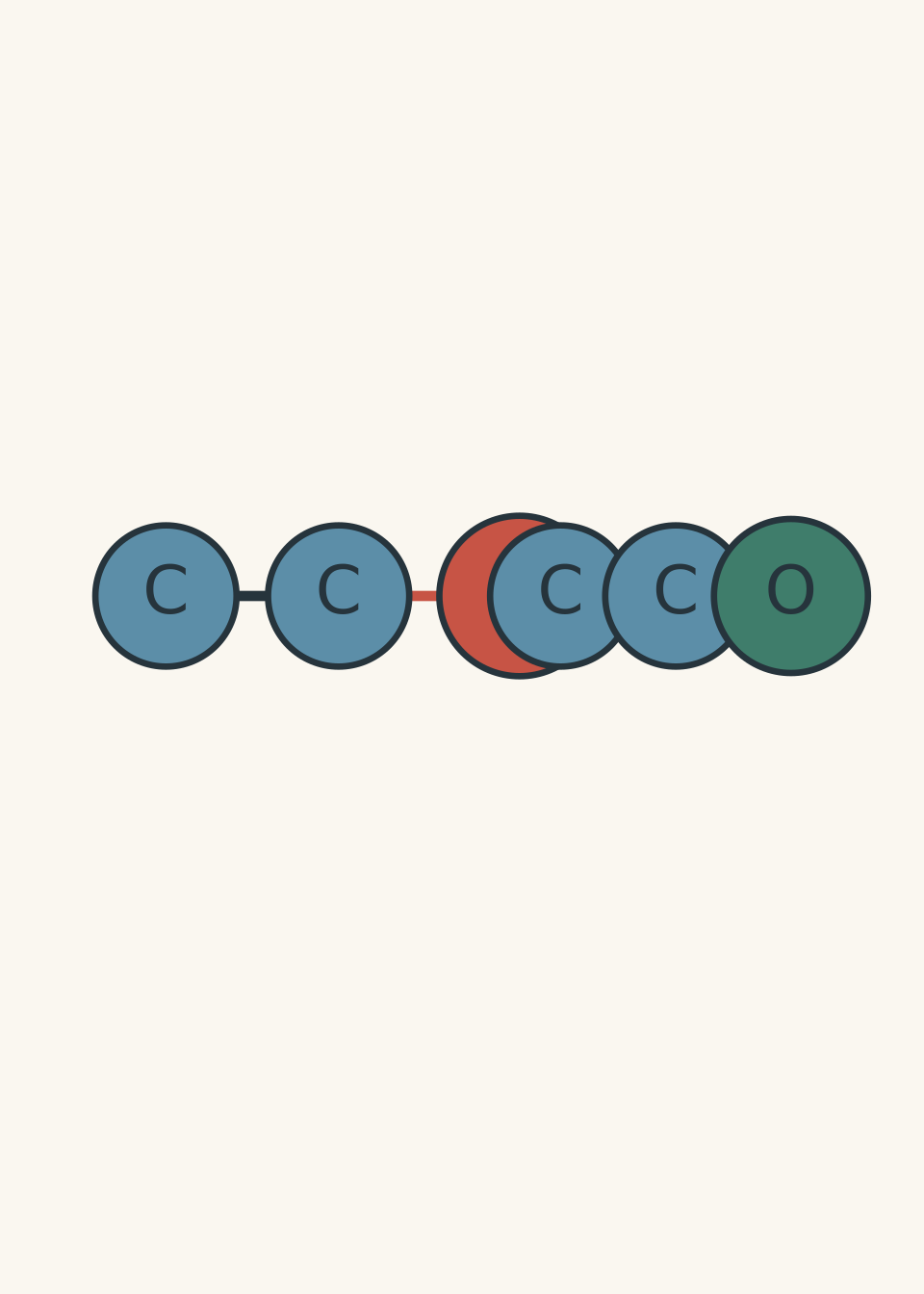
The key idea is simple:
A halogenated organic compound can produce an alcohol through a substitution reaction, where a halogen atom is replaced by a hydroxyl group.
The reaction is not about adding a new carbon chain or breaking the molecule apart. It is a controlled swap.
01The substitution idea: replacing one part of a molecule
Think of a molecule like a group project where one person leaves and another person takes their role. The project stays mostly the same, but the behaviour changes because a different person is involved.
In this analogy:
- the carbon chain is the main project,
- the halogen atom is the person leaving,
- the hydroxyl group becomes the replacement.
The analogy helps you picture the swap, but it is not the exact chemistry. Molecules do not “choose” replacements. The change happens because the bonds between atoms can break and form, and the reacting particles have suitable charges and energy.
Before looking at equations, predict this:
If bromoethane reacts with hydroxide ions, \(\ce{OH^-}\), what should happen to the bromine atom?
The bromine should leave and be replaced by the hydroxyl group. The products are ethanol and a bromide ion.
\[ \ce{CH3CH2Br + OH^- -> CH3CH2OH + Br^-} \]
The carbon chain stays the same. Only the functional group attached to the carbon changes.
02Building the reaction model
Halogenated organic compounds are also called haloalkanes when the halogen is attached to an alkane chain.
A general haloalkane formula can be written as:
\[ \ce{R-X} \]
where:
- \(\ce{R}\) represents the hydrocarbon chain,
- \(\ce{X}\) represents a halogen atom such as fluorine, chlorine, bromine, or iodine.
In substitution reactions that produce alcohols:
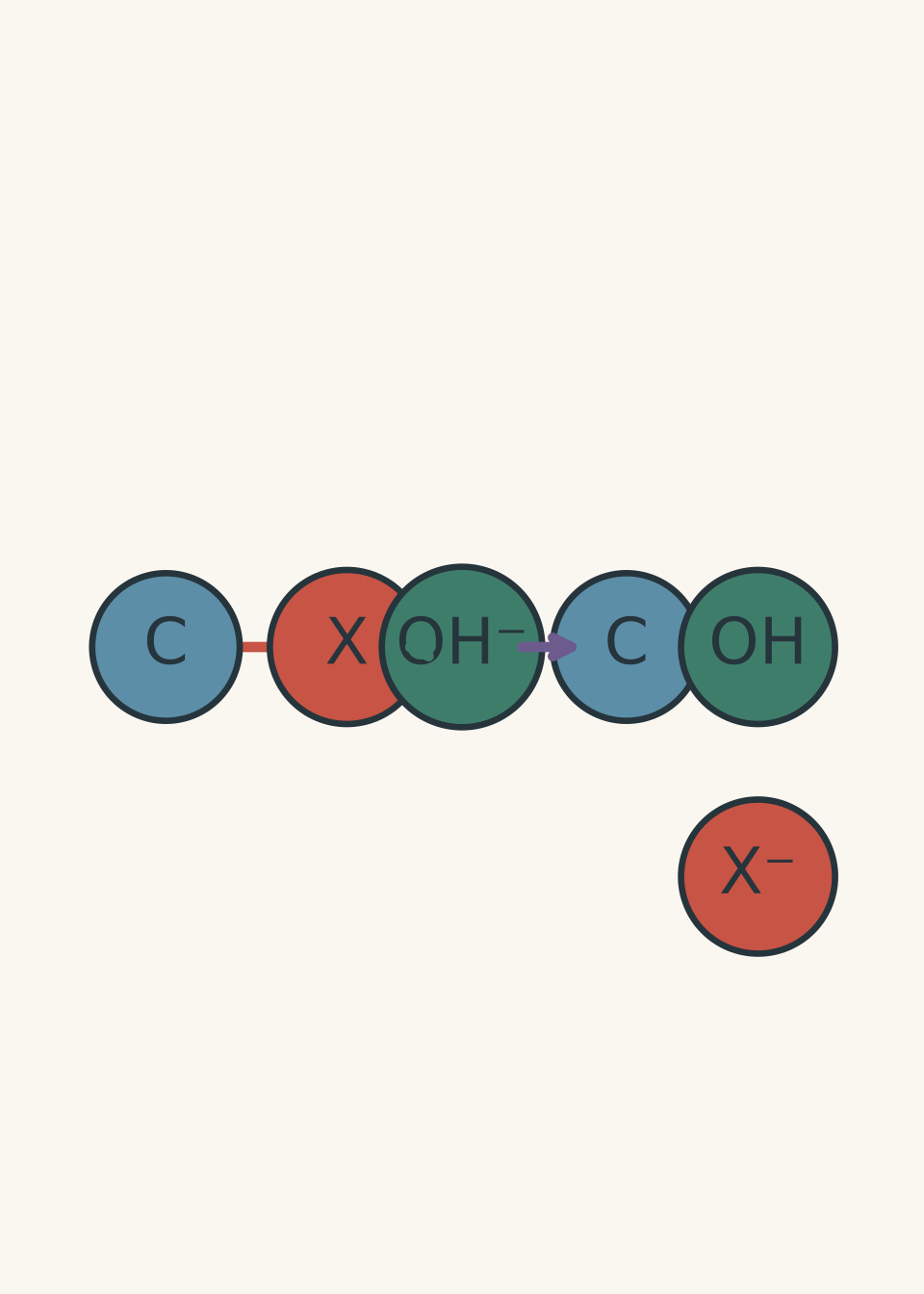
\[ \ce{R-X + OH^- -> R-OH + X^-} \]
The hydroxide ion acts as the nucleophile. A nucleophile is a particle that donates a pair of electrons to form a new bond.
For HSC Chemistry, the important pattern is:
\[ \text{haloalkane} + \text{hydroxide ion} \rightarrow \text{alcohol} + \text{halide ion} \]
03Why does the halogen leave?
At first, it might seem strange that a halogen can simply disappear from the molecule.
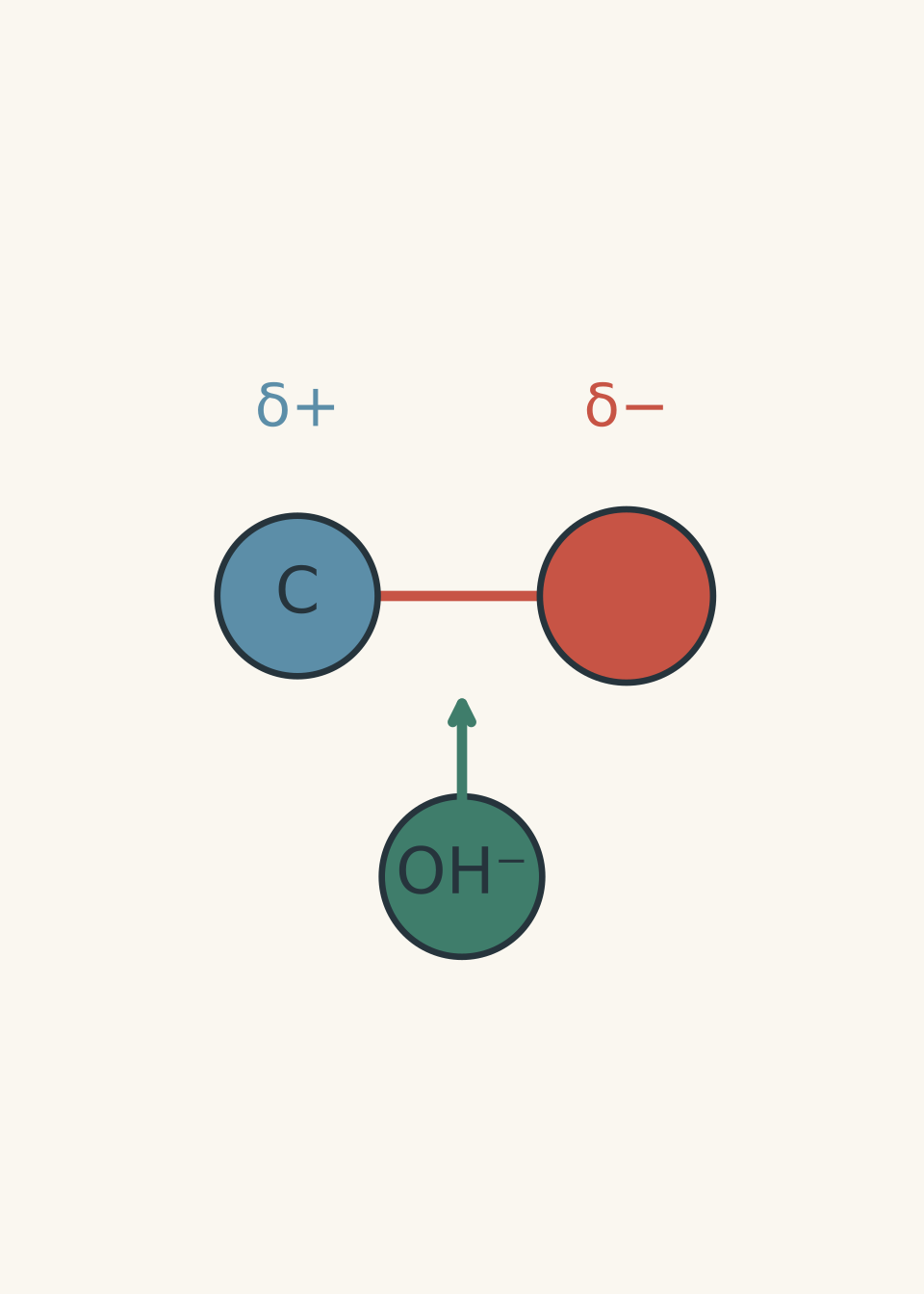
The reason is the carbon-halogen bond is polar. The halogen is more electronegative than carbon, so it attracts the bonding electrons more strongly.
For example, in bromoethane:
\[ \ce{CH3CH2^{\delta+}-Br^{\delta-}} \]
The carbon attached to bromine has a partial positive charge. The hydroxide ion has a negative charge, so it is attracted to this carbon.
The hydroxide ion forms a new carbon-oxygen bond while the carbon-bromine bond breaks.
The first model is useful, but it is simplified. It makes it look like every haloalkane reacts in exactly the same way. In reality, reaction rate depends on factors such as:
- the type of halogen present,
- the structure of the carbon chain,
- temperature,
- the solvent,
- the concentration of reactants.
For example, iodoalkanes generally react more easily than fluoroalkanes because the carbon-iodine bond is weaker.
04Producing alcohols in the laboratory
A common method is heating a haloalkane with an aqueous hydroxide solution.
For example:
\[ \ce{CH3CH2Br + NaOH(aq) -> CH3CH2OH + NaBr(aq)} \]
The sodium ion, \(\mathrm{Na}^{+}\), does not take part in the substitution. It simply remains in solution with the bromide ion.
The conditions matter.
An aqueous hydroxide solution encourages substitution because hydroxide ions are available to attack the haloalkane. In contrast, alcoholic hydroxide solutions often favour elimination reactions, where an alkene forms instead.

This connects to another alcohol reaction pathway: alcohols can undergo dehydration to form alkenes. You can explore that related process here: Dehydration of Alcohols: HSC Chemistry Product Prediction.
05Worked example: Producing ethanol from bromoethane
Question
Write the balanced equation for the substitution reaction between bromoethane and aqueous sodium hydroxide. Identify the organic product.
Step 1
Bromoethane is a haloalkane, and hydroxide ions are replacing bromine, so this is a substitution reaction.
Step 2
Bromoethane:
\[ \ce{CH3CH2Br} \]
becomes ethanol:
\[ \ce{CH3CH2OH} \]
Step 3
The bromine leaves as a bromide ion and combines with sodium ions.
\[ \ce{CH3CH2Br + NaOH(aq) -> CH3CH2OH + NaBr(aq)} \]
Step 4
The carbon skeleton has not changed. The reaction has converted a haloalkane into an alcohol by replacing bromine with a hydroxyl group.
06Worked example: Calculating alcohol production from a haloalkane amount
Question
A student reacts \(0.250\ \text{mol}\) of chloroethane, \(\ce{CH3CH2Cl}\), with excess aqueous sodium hydroxide. Calculate the maximum amount of ethanol produced.
Step 1
\[ \ce{CH3CH2Cl + NaOH(aq) -> CH3CH2OH + NaCl(aq)} \]
The mole ratio between chloroethane and ethanol is \(1:1\).
Step 2
\[ n(\ce{ethanol}) = n(\ce{chloroethane}) \]
\[ n(\ce{ethanol}) = 0.250\ \text{mol} \]
Step 3
The maximum amount of ethanol produced is:
\[ \boxed{0.250\ \text{mol}} \]
This assumes sodium hydroxide is in excess, so chloroethane is the limiting reactant.
07The most common misconception: “the carbon chain changes”
A common mistake is thinking that substitution changes the identity of the organic molecule completely.
For example, students may see:
\[ \ce{CH3CH2Br -> CH3CH2OH} \]
and think the two-carbon chain has changed.
It has not.
The carbon atoms are still arranged as an ethyl group. The functional group attached to that chain has changed.
A useful exam habit is to circle the carbon skeleton first. If the same carbon framework appears on both sides, the reaction has probably changed the functional group rather than the chain length.
08Connecting substitution reactions to other alcohol reactions
Once a haloalkane becomes an alcohol, the alcohol can undergo further reactions.
For example:
- alcohols can be oxidised to produce carbonyl compounds and carboxylic acids,
- alcohols can undergo combustion,
- alcohols can undergo dehydration to form alkenes.
The starting material may change, but the key question stays the same:
What part of the molecule is being replaced, added, removed, or rearranged?
You can compare this substitution pathway with another way ethanol is produced, fermentation, here: Fermentation Production of Ethanol: HSC Chemistry Guide.
09Questions and solutions
Question 1
Chloroethane reacts with aqueous potassium hydroxide.
Write the balanced equation and name the organic product.
Solution 1
The organic product is ethanol because the chlorine atom is replaced by a hydroxyl group.
The reaction is:
\[ \ce{CH3CH2Cl + KOH(aq) -> CH3CH2OH + KCl(aq)} \]
Chloroethane is converted into ethanol through substitution. The carbon chain remains unchanged, and chlorine leaves as a chloride ion.
Question 2
A student compares the reactions of fluoroethane and iodoethane with hydroxide ions. They predict fluoroethane will react faster because fluorine is more electronegative.
Is the prediction correct? Explain.
Solution 2
The prediction is incorrect because reaction rate depends strongly on bond strength, not only electronegativity.
Although fluorine is more electronegative, the carbon-fluorine bond is very strong. The carbon-iodine bond is weaker, so iodoethane usually undergoes substitution more readily.
The tempting route is to focus only on the polarity of the bond. The important extra constraint is that the halogen must leave, so the ease of breaking the carbon-halogen bond affects the reaction.
Question 3
A student reacts \(0.150\ \text{mol}\) of 1-bromopropane with excess aqueous sodium hydroxide.
Calculate the amount of propan-1-ol produced and explain why the carbon chain is unchanged.
Solution 3
The amount of propan-1-ol produced is \(0.150\ \text{mol}\).
The balanced equation is:
\[ \ce{CH3CH2CH2Br + NaOH(aq) -> CH3CH2CH2OH + NaBr(aq)} \]
Step 1: Identify the mole ratio.
The ratio between 1-bromopropane and propan-1-ol is:
\[ 1:1 \]
Step 2: Calculate the alcohol amount.
\[ n(\ce{propan-1-ol}) = 0.150 \times 1 \]
\[ n(\ce{propan-1-ol}) = 0.150\ \text{mol} \]
The carbon chain is unchanged because substitution replaces bromine with hydroxyl. No carbon-carbon bonds are broken or formed.
Question 4
Two students propose different explanations for the reaction:
Student A: “The hydroxide ion removes bromine from bromoethane.”
Student B: “The hydroxide ion bonds to carbon while bromide leaves.”
Which explanation better describes the substitution reaction?
Solution 4
Student B gives the better explanation because substitution involves forming a new carbon-oxygen bond while the carbon-bromine bond breaks.
Student A’s explanation is tempting because bromine does leave the molecule. However, it misses the key interaction: the hydroxide ion is not simply removing bromine; it is actively becoming part of the organic product.
The overall change is:
\[ \ce{CH3CH2Br + OH^- -> CH3CH2OH + Br^-} \]
The hydroxyl group becomes attached to the carbon chain.
Question 5
A chemist has two possible starting materials: bromoethane and ethanol. They want to produce bromoethane from ethanol and then convert it back into ethanol using substitution.
Explain why this two-step cycle is chemically possible, and identify the role of each reaction type.
Solution 5
The cycle is possible because ethanol and bromoethane can be converted into each other by different reactions, but the two steps are not the same process.
First, ethanol can react with a hydrogen halide to replace the hydroxyl group with a halogen:
\[ \ce{CH3CH2OH + HBr -> CH3CH2Br + H2O} \]
This is a substitution reaction involving the alcohol.
Then bromoethane can react with aqueous hydroxide ions:
\[ \ce{CH3CH2Br + OH^- -> CH3CH2OH + Br^-} \]
This is also substitution, but in the opposite direction.
The tempting assumption is that the second reaction simply “undoes” the first automatically. The important constraint is that different reactants and conditions control which group leaves and which group replaces it. The hydroxyl group does not appear by magic; it comes from the hydroxide ion in the second reaction.
Understanding this exchange between functional groups is the foundation for predicting many organic reaction pathways in HSC Chemistry.