
IUPAC Naming of Common Inorganic Acids and Bases Explained
Learn how to name common inorganic acids and bases, write their formulae, and avoid common HSC Chemistry nomenclature mistakes.
When a chemist writes “sulfuric acid”, the name gives you a clue about the particles involved. But what if you are given only the formula \(\ce{H2SO3}\)? Is it sulfuric acid, sulfurous acid, or something else? A small change in the formula changes the name, the number of hydrogen ions produced, and the reactions the substance can undergo.
Try to predict this: if \(\ce{HCl}\) and \(\ce{HClO}\) both contain hydrogen and chlorine, why are they not named the same way? The answer comes from the other element attached to hydrogen. In inorganic acid naming, the oxygen-containing ion (the oxyanion) controls the ending of the acid name.

This skill is not just about memorising a list. It is a translation skill:
- formula → identify ions → apply naming rules
- name → identify ions → write the formula
This is the same kind of thinking used when balancing acid reactions and applying acid-base theories. You can build on this by reviewing Arrhenius acid-base theory and balanced equations for acid reactions.
01The first model: acids are hydrogen attached to an anion
Start with the idea that most common inorganic acids can be viewed as:
\[ \text{acid} = \text{hydrogen ions} + \text{anion} \]
For example:
\[ \ce{HCl -> H+ + Cl-} \]
The hydrogen is the part that can become \(\mathrm{H}^{+}\). The remaining ion is called the conjugate base or anion.
For naming, focus on the anion first.
| Anion | Acid name |
|---|---|
| \(\mathrm{Cl}^{-}\) chloride | hydrochloric acid |
| \(\ce{NO3-}\) nitrate | nitric acid |
| \(\ce{SO4^2-}\) sulfate | sulfuric acid |
| \(\ce{CO3^2-}\) carbonate | carbonic acid |
Notice the pattern:
- anions ending in -ide usually become acids ending in -hydric acid
- anions ending in -ate usually become acids ending in -ic acid
- anions ending in -ite usually become acids ending in -ous acid
The names are not random. They preserve the relationship between the acid and its anion.
02Naming binary acids: hydrogen plus a non-metal
A binary acid contains:
- hydrogen
- one other non-metal element
- no oxygen
The general pattern is:
\[ \text{hydro} + \text{non-metal root} + \text{ic acid} \]
Examples:
| Formula | Anion | Acid name |
|---|---|---|
| \(\ce{HF}\) | fluoride | hydrofluoric acid |
| \(\ce{HCl}\) | chloride | hydrochloric acid |
| \(\ce{HBr}\) | bromide | hydrobromic acid |
| \(\ce{HI}\) | iodide | hydroiodic acid |
A common trap is forgetting the word “hydro”.
A student might see \(\ce{HCl}\) and think “hydrogen chloride”, because that is the name of the molecular compound \(\ce{HCl(g)}\). However, when \(\ce{HCl}\) is dissolved in water as an acid, its name changes to hydrochloric acid.
The state and context matter.

03Naming oxyacids: the oxygen-containing acids
Oxyacids contain hydrogen, oxygen, and another element.
Here the oxygen-containing ion decides the ending.
The “-ate becomes -ic” rule
Examples:
\[ \ce{NO3-} \rightarrow \ce{HNO3} \]
Nitrate becomes nitric acid.
\[ \ce{SO4^2-} \rightarrow \ce{H2SO4} \]
Sulfate becomes sulfuric acid.
\[ \ce{PO4^3-} \rightarrow \ce{H3PO4} \]
Phosphate becomes phosphoric acid.
The “-ite becomes -ous” rule
Examples:
\[ \ce{SO3^2-} \rightarrow \ce{H2SO3} \]
Sulfite becomes sulfurous acid.
\[ \ce{NO2-} \rightarrow \ce{HNO2} \]
Nitrite becomes nitrous acid.
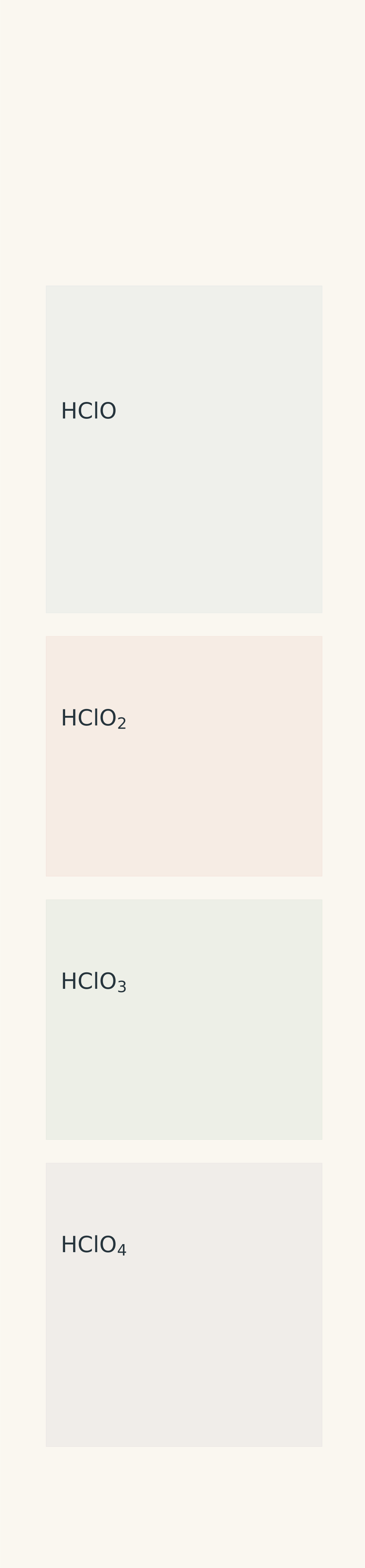
The oxygen count often changes between related acids.
04The tricky oxyacid family: chlorine
Chlorine creates a useful pattern:
| Formula | Ion name | Acid name |
|---|---|---|
| \(\ce{HClO}\) | hypochlorite | hypochlorous acid |
| \(\ce{HClO2}\) | chlorite | chlorous acid |
| \(\ce{HClO3}\) | chlorate | chloric acid |
| \(\ce{HClO4}\) | perchlorate | perchloric acid |
The prefixes tell you the oxygen amount:
- hypo- … -ous = least oxygen
- … -ous = one more oxygen
- … -ic = one more oxygen again
- per- … -ic = most oxygen
A useful memory trick is that the “-ate” and “-ite” versions are neighbours. Chlorate has more oxygen than chlorite, so chloric acid has more oxygen than chlorous acid.
05Naming common bases
Bases are often metal hydroxides.
The general structure is:
\[ \text{metal ion} + \ce{OH-} \]
The hydroxide ion has a fixed name:
\[ \ce{OH-} = \text{hydroxide} \]
Examples:
| Formula | Name |
|---|---|
| \(\ce{NaOH}\) | sodium hydroxide |
| \(\ce{KOH}\) | potassium hydroxide |
| \(\ce{Ca(OH)2}\) | calcium hydroxide |
| \(\ce{Mg(OH)2}\) | magnesium hydroxide |
For metals with multiple possible charges, include the charge using Roman numerals.
Examples:
\[ \ce{Fe^2+ + 2OH- -> Fe(OH)2} \]
iron(II) hydroxide
\[ \ce{Fe^3+ + 3OH- -> Fe(OH)3} \]
iron(III) hydroxide
The Roman numeral does not describe the number of hydroxide ions. It describes the charge of the metal ion.
06Writing formulae from names
The reverse process is just as important.
To write a formula:
- Identify the positive ion.
- Identify the negative ion.
- Balance charges so the total charge is zero.
- Write the simplest whole-number ratio.
For acids, the hydrogen number matches the charge of the anion.
Example:
Sulfate is \(\ce{SO4^2-}\).
It needs two hydrogen ions:
\[ \ce{2H+ + SO4^2- -> H2SO4} \]
Therefore:
\[ \ce{H2SO4} \]
is sulfuric acid.
For hydroxides, the number of hydroxide ions matches the metal charge.
Example:
Aluminium is \(\mathrm{Al}^{3+}\).
Hydroxide is \(\ce{OH-}\).
Three hydroxide ions are needed:
\[ \ce{Al^3+ + 3OH- -> Al(OH)3} \]
So aluminium hydroxide is \(\ce{Al(OH)3}\).
07Worked example: Name the acid \(\ce{H2SO3}\)
Step 1
The hydrogen ions are separated mentally:
\[ \ce{H2SO3 -> 2H+ + SO3^2-} \]
The anion is sulfite.
Step 2
Sulfite ends in -ite, so the acid ends in -ous acid.
Step 3
\[ \boxed{\ce{H2SO3} \text{ is sulfurous acid}} \]
The important reasoning is that the name comes from the anion, not simply from the elements present.
08Worked example: Write the formula for nitric acid
Step 1
Nitric acid comes from nitrate:
\[ \ce{NO3-} \]
Step 2
Nitrate has a \(1-\) charge, so one hydrogen ion is needed.
\[ \ce{H+ + NO3- -> HNO3} \]
Step 3
\[ \boxed{\ce{HNO3}} \]
The formula contains one hydrogen because nitrate only requires one positive charge.
09Worked example: Name and write the formula for iron(III) hydroxide
Step 1
Iron(III) means:
\[ \mathrm{Fe}^{3+} \]
Step 2
Hydroxide is:
\[ \ce{OH-} \]
Three hydroxide ions are needed to balance the \(3+\) charge.
\[ \ce{Fe^3+ + 3OH- -> Fe(OH)3} \]
Step 3
\[ \boxed{\ce{Fe(OH)3} \text{ is iron(III) hydroxide}} \]
The bracket is needed because the hydroxide ion stays together as a group.
10Common mistakes to avoid
| Mistake | Why it happens | Fix |
|---|---|---|
| Calling \(\ce{H2SO4}\) “sulfurous acid” | Confusing sulfate and sulfite | Check the anion: sulfate → sulfuric |
| Forgetting “hydro” in \(\ce{HCl}\) | Mixing molecular and acid naming | Binary acid → hydro + root + ic acid |
| Writing \(\ce{CaOH}\) | Forgetting calcium has a \(2+\) charge | Calcium needs two hydroxide ions |
| Using Roman numerals for every metal | Thinking all metals have multiple charges | Only use them when the metal can have different charges |

11Questions and solutions
Question 1
Name the acid \(\ce{HNO3}\).
Solution 1
The answer is nitric acid. The anion in \(\ce{HNO3}\) is nitrate, \(\ce{NO3-}\). Since nitrate ends in -ate, the acid name changes to -ic acid.
The tempting mistake is to focus on the nitrogen and call it something involving “nitrogen acid”. Acid names are controlled by the ion attached to hydrogen, not the element name alone.
Question 2
Write the formula for sulfurous acid.
Solution 2
The answer is \(\ce{H2SO3}\). Sulfurous acid comes from the sulfite ion:
\[ \ce{SO3^2-} \]
The ion has a \(2-\) charge, so two hydrogen ions are required:
\[ \ce{2H+ + SO3^2- -> H2SO3} \]
The common trap is writing \(\ce{HSO3}\). That would only balance a \(1-\) ion, not sulfite’s \(2-\) charge.
Question 3
A student is given two acids: \(\ce{HClO2}\) and \(\ce{HClO3}\). They predict that the second acid should be called chlorous acid because it contains chlorine and oxygen. Explain whether this is correct and name both acids.
Solution 3
The answer is that the prediction is incorrect. \(\ce{HClO2}\) is chlorous acid, while \(\ce{HClO3}\) is chloric acid.
The reasoning comes from the oxyanion names:
\[ \ce{ClO2-} = \text{chlorite} \]
so:
\[ \ce{HClO2} = \text{chlorous acid} \]
and:
\[ \ce{ClO3-} = \text{chlorate} \]
so:
\[ \ce{HClO3} = \text{chloric acid} \]
The student’s prediction feels reasonable because both acids contain chlorine and oxygen. The missing detail is that oxygen count changes the anion name, which changes the acid ending.
Question 4
A compound is named iron(III) hydroxide. A student writes its formula as \(\ce{FeOH3}\). Explain the error and give the correct formula.
Solution 4
The answer is \(\ce{Fe(OH)3}\). Iron(III) means the ion is:
\[ \mathrm{Fe}^{3+} \]
Hydroxide is:
\[ \ce{OH-} \]
Three hydroxide ions are needed:
\[ \ce{Fe^3+ + 3OH- -> Fe(OH)3} \]
The student has the correct numbers of atoms but the wrong structure. The hydroxide ion is a charged group that must remain together, so brackets are required.
Question 5
A chemist finds an unknown acid formula \(\ce{H3XO4}\). The acid is known to contain the oxyanion \(\ce{XO4^3-}\), and another sample contains the related oxyanion \(\ce{XO3^3-}\). Predict the names of the two acids and explain which rule allows you to distinguish them.
Solution 5
The answer is that \(\ce{H3XO4}\) is the acid formed from an -ate ion, so it follows the -ic acid naming rule, while \(\ce{H3XO3}\) would be the acid formed from an -ite ion, following the -ous acid naming rule.
The reasoning is:
\[ \ce{XO4^3-} \rightarrow \ce{H3XO4} \]
The anion ends in -ate, so the acid ending becomes -ic.
\[ \ce{XO3^3-} \rightarrow \ce{H3XO3} \]
The anion ends in -ite, so the acid ending becomes -ous.
The tempting route is to compare only the number of oxygen atoms and invent a new naming pattern. The real constraint is that acid names are inherited from the oxyanion naming system. The oxygen difference matters because it changes the anion’s name first, and the acid name follows from that.
Being able to move confidently between names and formulae is the foundation for the next step: predicting how these acids and bases react, including writing and balancing neutralisation equations.