
HSC Chemistry: How to Identify Organic Functional Groups
Learn how to recognise and draw aldehydes, ketones, amines, amides, and carboxylic acids from structural formulae. Build a reliable method for identifying functional groups in HSC Chemistry questions.
When a chemist sees the formula \( \ce{C2H4O2} \), there is an immediate problem: what molecule is it?
A student might say, “It must be one compound, because the molecular formula is fixed.” That feels reasonable. But organic chemistry has a trap: the same atoms can be arranged in different ways, and those different structures can behave like completely different substances.
So how would you predict whether a molecule is an acid that reacts with a base, a carbonyl compound with a different reaction pattern, or an amine that can accept a proton?
The answer starts with structure. In HSC Chemistry, you are not just memorising names. You are learning to look at a structural formula and identify the functional group that controls the molecule’s behaviour.

01The first idea: the functional group is the “reactive part”
Imagine an organic molecule as a person wearing different accessories. The carbon chain is the basic outfit, but the accessory changes how that person interacts with others.
A carboxylic acid and an alcohol might both contain an oxygen atom, but the arrangement of atoms around that oxygen changes everything. The functional group is the specific group of atoms responsible for the characteristic reactions of a molecule.
This analogy helps, but it breaks down quickly. Molecules do not “choose” reactions like people choose friends. Their behaviour comes from electron distribution, bond strength, and the atoms involved.
Before looking at names, try this prediction:
A molecule contains a carbon atom double bonded to oxygen. Does that single feature tell you exactly what functional group it is?
Not quite. A carbonyl group (\(\ce{C=O}\)) appears in several important functional groups. You need to look at what is attached to the carbonyl carbon.

02Building the structural formula step by step
Organic structures are often easier to recognise if you follow a decision process.
Step 1: Find the important carbon atom
Look for unusual bonding patterns:
- A carbon double bonded to oxygen: \(\ce{C=O}\), called a carbonyl group.
- A nitrogen attached to carbon atoms: possible amine or amide.
- A carbon bonded to both an oxygen double bond and a hydroxyl group: carboxylic acid.
Step 2: Identify what is attached to the key atom
The same carbonyl group can create different families.
| Functional group | General structure | Key feature |
|---|---|---|
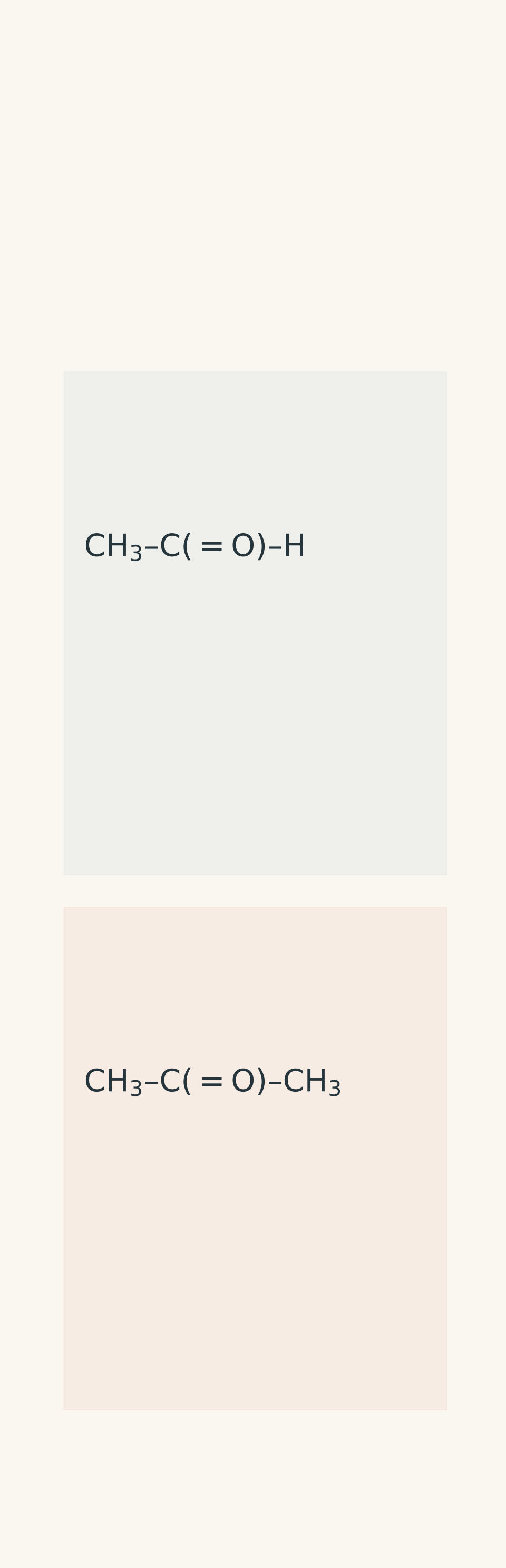
| Aldehyde | \(\ce{R-CHO}\) | Carbonyl carbon attached to at least one hydrogen |
| Ketone | \(\ce{R-CO-R'}\) | Carbonyl carbon attached to two carbon groups |
| Carboxylic acid | \(\ce{R-COOH}\) | Carbonyl and hydroxyl on the same carbon |
| Amine | \(\ce{R-NH2}\), \(\ce{R2NH}\), or \(\ce{R3N}\) | Nitrogen bonded to carbon groups |
| Amide | \(\ce{R-CONH2}\), \(\ce{R-CONHR}\), or \(\ce{R-CONR2}\) | Nitrogen directly attached to a carbonyl carbon |
Here, \(R\) represents a carbon-containing group. It is a shortcut chemists use when the exact carbon chain is not the important part.
03Aldehydes and ketones: the carbonyl family
A carbonyl group is a carbon atom double bonded to oxygen.
\[ \ce{C=O} \]
The difference between an aldehyde and a ketone is what sits beside that carbonyl carbon.
Aldehydes
An aldehyde has the carbonyl carbon at the end of the carbon chain.
General structure:
\[ \ce{R-CHO} \]
The hydrogen attached to the carbonyl carbon is the clue.
Example:
\[ \ce{CH3CHO} \]
This is ethanal.
The carbonyl carbon is attached to:
- \(\ce{CH3}\)
- \(\ce{H}\)
That makes it an aldehyde.
Ketones
A ketone has the carbonyl carbon inside the carbon chain.
General structure:
\[ \ce{R-CO-R'} \]
Example:
\[ \ce{CH3COCH3} \]
This is propanone.
The carbonyl carbon is attached to two carbon groups, so it is a ketone.
A common mistake is thinking every \(\ce{C=O}\) is an aldehyde because carbonyl chemistry is often introduced through aldehydes first. The location of the carbonyl carbon matters.
04Carboxylic acids: why the extra oxygen changes everything
A carboxylic acid contains both:
- a carbonyl group, \(\ce{C=O}\)
- a hydroxyl group, \(\ce{-OH}\)
together on the same carbon.
General structure:
\[ \ce{R-COOH} \]
Example:
\[ \ce{CH3COOH} \]
This is ethanoic acid.
The \(\ce{-OH}\) group is not just an alcohol attached somewhere else. It is directly connected to the carbonyl carbon, creating a carboxyl group.
This arrangement allows the molecule to donate a proton:
\[ \ce{RCOOH <=> RCOO^- + H^+} \]
That is why carboxylic acids behave as acids.
You can see the connection to other HSC chemistry ideas in topics such as organic acids and organic bases.
05Amines and amides: the nitrogen decision
Nitrogen creates another common source of confusion.
Amines
An amine contains nitrogen bonded to carbon groups.
Example:
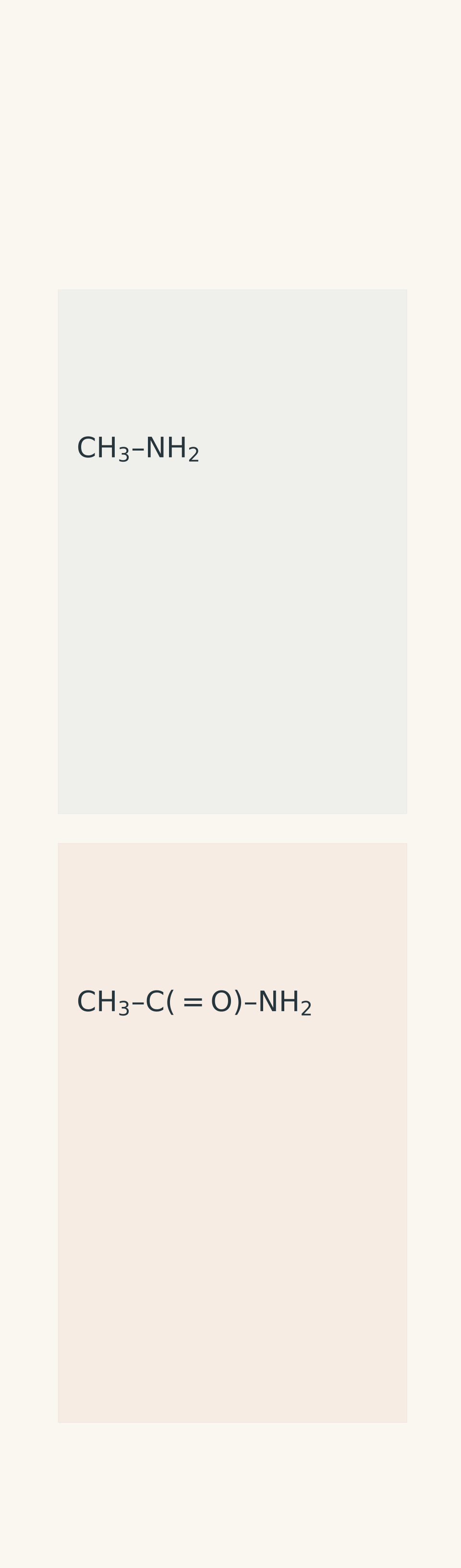
\[ \ce{CH3NH2} \]
This is methylamine.
The nitrogen is not attached to a carbonyl carbon, so it is an amine.
Amines can act as bases because nitrogen has a lone pair of electrons available to accept a proton.
\[ \ce{RNH2 + H^+ -> RNH3^+} \]
Amides
An amide looks similar, but the nitrogen is directly attached to a carbonyl carbon.
Example:
\[ \ce{CH3CONH2} \]
This is ethanamide.
The key pattern is:
\[ \ce{-CONH2} \]
If you see nitrogen immediately after a carbonyl carbon, think amide.
06A reliable HSC method for drawing structures
When you are asked to draw a structural formula:
- Write the carbon chain.
- Place the functional group in the correct position.
- Add missing hydrogens so each carbon has four bonds.
- Check the functional group again.
For example, to draw butanoic acid:
- “but” means four carbons.
- “anoic acid” means the carboxyl carbon is included as carbon 1.
- Add three more carbons after the \(\ce{-COOH}\) group.
The structure is:
\[ \ce{CH3CH2CH2COOH} \]
The carbon count includes the carbon inside \(\ce{COOH}\).
07Worked example: Identify the functional group
A molecule has the structural formula:
\[ \ce{CH3CH2COCH3} \]
Identify the functional group.
Step 1
The structure contains:
\[ \ce{C=O} \]
so it contains a carbonyl group.
Step 2
The carbonyl carbon is attached to two carbon groups:
\[ \ce{CH3-CO-CH2CH3} \]
There is no hydrogen attached to the carbonyl carbon.
Step 3
The molecule contains a ketone functional group.
The structure is butan-2-one, and the carbonyl group is inside the carbon chain.
08Worked example: Draw and classify an organic molecule
Draw the structural formula of propanamide and identify its functional group.
Step 1
“Prop” means three carbon atoms.
The amide group contains the carbonyl carbon:
\[ \ce{-CONH2} \]
Step 2
The three-carbon amide is:
\[ \ce{CH3CH2CONH2} \]
Step 3
The nitrogen is directly attached to the carbonyl carbon.
Therefore, the molecule is an amide.
The important observation is that the nitrogen is not simply attached to a carbon chain. Its connection to the carbonyl carbon changes the functional group.
09The misconception that costs marks
A frequent mistake is identifying compounds by the atoms they contain rather than the way those atoms are arranged.
For example:
- “It contains oxygen, so it is an alcohol.”
- “It contains nitrogen, so it is an amine.”
- “It contains \(\ce{C=O}\), so it is an aldehyde.”
These shortcuts fail because functional groups depend on bonding patterns.
A better question is:
“What is this atom connected to?”
That single habit prevents many structure-identification errors.

10Questions and solutions
Question 1
Identify the functional group in the molecule:
\[ \ce{CH3CH2CHO} \]
Solution 1
The answer is that the molecule contains an aldehyde functional group.
The structure contains a carbonyl group, \(\ce{C=O}\), at the end of the carbon chain. The carbonyl carbon is bonded to a hydrogen atom:
\[ \ce{-CHO} \]
That hydrogen is the feature that separates aldehydes from ketones.
The molecule is propanal.
Question 2
Draw the structural formula of pentanoic acid and identify the atoms that make it a carboxylic acid.
Solution 2
The answer is:
\[ \ce{CH3CH2CH2CH2COOH} \]
It is a carboxylic acid because the end of the molecule contains the carboxyl group:
\[ \ce{-COOH} \]
The carbon has a double bond to oxygen and a single bond to a hydroxyl group. The total carbon count is five, including the carbon inside the carboxyl group.
Question 3
Two molecules have the formula \(\ce{C3H6O}\).
Molecule A has the structure:
\[ \ce{CH3CH2CHO} \]
Molecule B has the structure:
\[ \ce{CH3COCH3} \]
Explain why they have different functional groups despite having the same molecular formula.
Solution 3
The answer is that they are different functional groups because the carbonyl group is positioned differently.
Both molecules contain a carbonyl group, but the carbonyl carbon has different attachments.
For molecule A:
\[ \ce{CH3CH2-CHO} \]
the carbonyl carbon is attached to hydrogen, so it is an aldehyde.
For molecule B:
\[ \ce{CH3-CO-CH3} \]
the carbonyl carbon is attached to two carbon groups, so it is a ketone.
The tempting mistake is assuming the same molecular formula must mean the same structure. Organic molecules can be isomers: compounds with the same formula but different arrangements of atoms.
Question 4
A student is given the structure:
\[ \ce{CH3CONHCH3} \]
They claim it is an amine because it contains nitrogen. Evaluate this claim.
Solution 4
The answer is that the claim is incorrect; the molecule is an amide.
The nitrogen is directly bonded to the carbonyl carbon:
\[ \ce{-CONH-} \]
That arrangement defines an amide.
The student’s reasoning feels sensible because amines do contain nitrogen. However, the surrounding bonds determine the functional group. Nitrogen attached to a carbonyl carbon is treated differently from nitrogen attached only to carbon or hydrogen.
The molecule is N-methylethanamide.
Question 5
A compound has the molecular formula \(\ce{C4H8O2}\). A student suggests it must be a carboxylic acid because it contains two oxygen atoms.
The compound is later found to have this structure:
\[ \ce{CH3CH2COOCH3} \]
Explain why the student’s prediction fails and identify what additional structural feature would have been needed to confirm a carboxylic acid.
Solution 5
The answer is that the compound is not a carboxylic acid; it is an ester, and the student’s prediction fails because oxygen count alone does not identify a functional group.
The structure:
\[ \ce{CH3CH2COOCH3} \]
contains:
- a carbonyl group, \(\ce{C=O}\)
- an oxygen linking to another carbon group, \(\ce{-O-CH3}\)
but it does not contain the carboxylic acid group:
\[ \ce{-COOH} \]
The tempting route is to see two oxygen atoms and think “acid”, because carboxylic acids commonly contain two oxygens. The missing constraint is the hydroxyl hydrogen attached directly to the carbonyl carbon.
A molecule with:
\[ \ce{R-COOH} \]
would be a carboxylic acid. This example shows why functional groups are identified from connections between atoms, not just the atoms present.
Understanding these structures is the foundation for predicting reactions. Once you can recognise functional groups quickly, you can move on to the next step: using those structures to build and analyse organic reaction pathways, including synthesis sequences and transformations between functional groups. You can continue with constructing organic synthesis pathways for HSC Chemistry.