
Newton’s Model of Light: Predictions, Evidence and Limits
Learn how Newton's corpuscular model explained reflection and refraction, where experiments challenged it, and why wave evidence changed the model.
Shine a laser through two narrow slits. If light were simply a stream of tiny particles travelling in straight lines, where should the light land on the screen? You would expect two bright bands, one behind each slit. Instead, you get a whole sequence of bright and dark bands. That mismatch is the key to Newton’s model: it explained several familiar observations very well, but experiments eventually produced results that its basic particle picture could not explain.

01The basic idea: light as corpuscles
In the late seventeenth century, Isaac Newton proposed the corpuscular model of light. The idea was simple: a source emits tiny particles called corpuscles, and those particles travel in straight lines unless a force changes their motion.
Think of a very obedient swarm of tiny ball bearings. If nothing gets in their way, they keep moving forwards. Put a wall in their path, and they bounce or are deflected.
The analogy is useful for understanding the model’s mechanics. It breaks down when we reach phenomena such as interference, because light does not behave like a collection of ordinary ball bearings.
Newton’s model made testable predictions. That is what makes it a scientific model rather than just a story about what light might be.
The NSW Physics syllabus specifically asks students to:
“analyse the experimental evidence that supported the models of light that were proposed by Newton and Huygens”
That means an HSC response should not simply list experiments. You need to connect model → prediction → observation → conclusion. :chatgpt-content-reference{index=”0″}
02What Newton’s model predicted
The core predictions are easiest to understand by following a corpuscle through different situations.
1. Light should travel in straight lines
If corpuscles are moving freely, Newtonian mechanics says they should continue in straight-line motion.
This gives a straightforward explanation for rectilinear propagation: light appears to travel in straight rays.
It also explains why an opaque object can cast a sharp shadow. Corpuscles travelling towards the object are stopped, while corpuscles travelling around it continue onwards.

At the time, this was useful evidence for the particle model. But there is an important HSC distinction:
Explaining an observation is not the same as uniquely supporting a model.
A wave model can also produce approximately straight-line propagation when the wavelength is much smaller than the objects involved. So sharp shadows do not decisively distinguish particles from waves.
2. Reflection should look like a collision
Newton could treat reflection mechanically. A corpuscle hits a smooth surface and rebounds.
For a flat reflecting surface, this gives the familiar relationship
\[ \theta_i=\theta_r \]
where \(\theta_i\) is the angle of incidence, measured from the normal to the surface, and \(\theta_r\) is the angle of reflection.
Imagine firing a perfectly elastic ball at a wall. Its component of velocity parallel to the wall stays the same, while the component perpendicular to the wall reverses. The result is equal angles on either side of the normal.

Again, this is a strength of the model, but not strong evidence that particles must be the correct description. The wave model also explains the law of reflection.
So if an exam asks for evidence that distinguishes the models, spending your whole response on reflection is a trap.
03Refraction is where the model makes a dangerous prediction
Now consider light passing from air into glass.
You already know the observation: the ray bends towards the normal when it enters a medium with a higher refractive index.
Newton could explain the change in direction by proposing an attractive force between the light corpuscles and the material.
Here is the crucial prediction. If the force attracts the corpuscle into the denser medium, it accelerates the corpuscle towards the normal. Its velocity component perpendicular to the boundary increases.
So the total speed should increase.

This is a clever explanation of the direction of bending. It gets an important part of the observation right.
But it predicts the wrong speed.
For modern light propagation, the refractive index \(n\) is related to the speed \(v\) of light in the medium by
\[ n=\frac{c}{v} \]
Here:
- \(n\) is the refractive index, which has no units.
- \(c\) is the speed of light in vacuum, approximately \(3.00\times10^8\ \text{m s}^{-1}\).
- \(v\) is the speed of light in the material, measured in \(\text{m s}^{-1}\).
Rearranging gives
\[ v=\frac{c}{n} \]
So a larger refractive index means a lower speed.
Be careful with the word “denser”. In this context, we mean optically denser, not necessarily more massive per cubic metre. Refractive index is the useful quantity.
Foucault’s experiment: testing the risky prediction
By the nineteenth century, scientists could directly compare the speed of light in different media.
In Léon Foucault’s 1850 experiment, light was reflected from a rotating mirror towards a distant mirror and then back again. During the tiny travel time of the light, the rotating mirror moved slightly. That caused a measurable displacement of the returning image.
Foucault could then compare the displacement when the light travelled through air with the displacement when it travelled through water.
The result was decisive for this particular prediction: light travelled more slowly through water than through air. :chatgpt-content-reference{index=”1″}
The important logic is:
Newton: attraction into the denser medium → corpuscles speed up.
Experiment: light slows down in water.
Therefore, the experimental result contradicts Newton’s predicted speed change.

Worked example: Does water make light faster?
A transparent liquid has refractive index \(n=1.50\). Take the speed of light in vacuum as \(3.00\times10^8\ \text{m s}^{-1}\). Calculate the speed of light in the liquid and explain whether this agrees with Newton’s corpuscular prediction.
Step 1
\[ v=\frac{c}{n} \]
Here, \(v\) is the speed in the liquid, \(c\) is the speed in vacuum, and \(n\) is the refractive index.
Step 2
\[ v= \frac{3.00\times10^8\ \text{m s}^{-1}} {1.50} \]
\[ v=2.00\times10^8\ \text{m s}^{-1} \]
Step 3
The light travels at \(2.00\times10^8\ \text{m s}^{-1}\), which is slower than \(3.00\times10^8\ \text{m s}^{-1}\) in vacuum.
So the result does not agree with Newton’s prediction. Newton’s corpuscular explanation of refraction required light to speed up when entering an optically denser medium.
The important point is not just the number. The measurement tests a specific prediction of the model.
04Young’s experiment: the two-slit problem
Refraction exposed a wrong prediction about speed. Young’s interference experiments exposed a more basic problem: what happens when two paths of light overlap.
Consider the familiar double-slit arrangement.
A light source illuminates two closely spaced slits. Light then travels towards a screen.
Under Newton’s simple corpuscular model, each corpuscle goes through one slit and continues in a straight line. So the obvious prediction is two bright regions.
But the observed pattern contains alternating bright and dark regions. This is interference.

Why is that such a problem?
For waves, the answer is natural. The disturbances from the two slits overlap. At some positions they reinforce each other, producing bright fringes. At other positions they cancel, producing dark fringes.
The simple corpuscular model has no equivalent mechanism for this regular reinforcement and cancellation.
This is much stronger evidence against the model than a sharp shadow. A sharp shadow can be explained by both pictures. A stable interference pattern requires behaviour that the simple corpuscular picture does not provide.
A real HSC question has tested exactly this prediction. In the 2022 HSC Physics examination, students were asked to show the pattern expected from Newton’s model in a double-slit experiment. NESA’s feedback specifically noted the need to apply features of Newton’s model to the sketch. :chatgpt-content-reference{index=”2″}
For the interference mechanism itself, see Double-Slit Interference and Fringe Evidence for HSC Physics.
05Diffraction creates another problem
Now shrink the opening.
If particles travel in straight lines, a narrow slit should simply allow a narrow stream of corpuscles through. The beam should remain fairly confined behind the slit.
But when the slit becomes comparable in size to the wavelength of light, the light spreads out.
That spreading is diffraction.

This also explains an historical trap.
Newton argued that the lack of obvious bending around everyday obstacles supported the particle model. That seemed reasonable because sound waves, which were familiar as waves, could bend around obstacles.
But diffraction depends strongly on the relationship between the opening and the wavelength. Visible light has a very small wavelength, so a large everyday obstacle can produce an almost perfectly ray-like shadow.
A wave can therefore look like a ray.
That means the absence of obvious diffraction around a large object is weak evidence for particles. Make the opening small enough, and the wave behaviour becomes obvious.
06Polarisation: a later clue about the type of wave
Polarisation gives another important piece of evidence.
A polariser can restrict the orientation of the oscillation of light. Two polarising filters can therefore change the transmitted intensity depending on their relative angle.
A simple stream of Newtonian corpuscles has no natural oscillation direction that behaves like this.
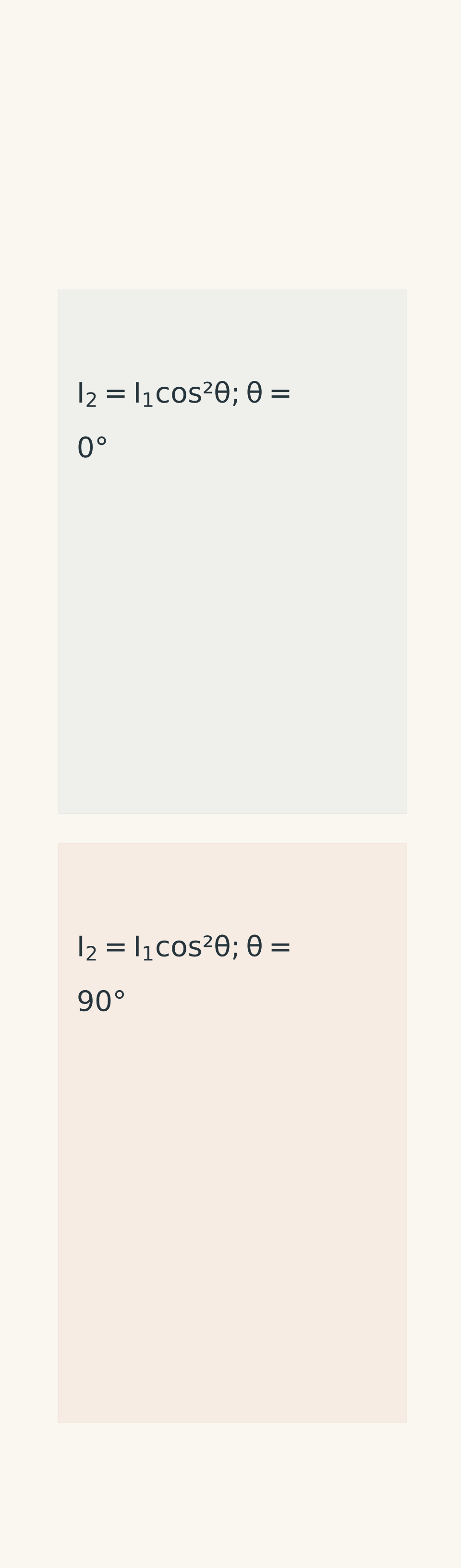
There is a useful historical subtlety here. Saying “the wave model explained everything” is too simple.
Huygens’s original wave model treated light as a longitudinal wave, so it could not fully account for polarisation either. The later electromagnetic model described light as a transverse electromagnetic wave, which provided the missing mechanism.
For a fuller treatment of Huygens’ model, see Huygens’ Wave Model of Light: HSC Physics Explained.
07What counts as strong evidence?
The easiest way to organise Newton’s model is to separate observations it could accommodate from observations that distinguished it from the competing wave model.
| Observation | Newton’s prediction | Verdict |
|---|---|---|
| Straight-line propagation | Corpuscles travel in straight lines | Compatible |
| Reflection | Corpuscles rebound from a surface | Compatible |
| Refraction direction | Surface force bends corpuscles towards the normal | Partly compatible |
| Speed in water | Light should speed up in the denser medium | Contradicted |
| Double-slit interference | No mechanism for regular bright and dark fringes | Contradicted |
| Diffraction | No adequate spreading mechanism | Contradicted |
| Polarisation | No natural mechanism in the simple particle model | Contradicted |
Notice the difference between the first two rows and the later rows.
If both models can explain an observation, that observation does not tell you which model is better.
If two models make different predictions and an experiment clearly agrees with one while disagreeing with the other, you have much stronger evidence.
That is the reasoning an HSC “analyse” question is looking for.
A useful HSC response structure
For an evidence question, build each paragraph around four moves:
- State Newton’s prediction.
- Describe the experimental observation.
- Compare the observation with the prediction.
- State what this does to the model.
For example:
Newton’s corpuscular model explained refraction by proposing an attractive force that accelerated light corpuscles into a denser medium. Therefore, it predicted that light would travel faster in the denser medium. Foucault measured the speed of light in air and water and found that it was slower in water. This contradicted Newton’s prediction and provided evidence against the corpuscular model.
That is much stronger than writing “Foucault proved Newton wrong”. It shows the chain of reasoning.
08The most tempting misconceptions
“Newton’s model was useless.”
No. It successfully described straight-line propagation and reflection, and it gave a mechanical explanation for several familiar optical observations.
Its problem was that a scientific model has to keep surviving experimental tests. Once experiments revealed reliable observations that the model could not explain, it was no longer adequate as a complete model of light.
“The refraction problem is that Newton got the angle wrong.”
Not quite.
Newton could account for light bending towards the normal by proposing an attractive force. The serious problem was the speed prediction.
Newton’s mechanism required an increase in speed. Experiments found a decrease.
“Straight-line light proves that light is made of particles.”
No.
Straight-line propagation is compatible with the particle model, but it is also compatible with wave propagation when diffraction is negligible.
This is why double-slit interference and diffraction are much more useful evidence for distinguishing the models.
“Newton’s corpuscles were photons.”
No.
A Newtonian corpuscle belongs to a classical particle model of light. A photon belongs to the later quantum model.
NESA’s HSC marking feedback has explicitly warned students to distinguish the Einsteinian photon model from Newton’s corpuscular model. :chatgpt-content-reference{index=”3″}
Modern physics did not simply decide that “particles were wrong”. Instead, it eventually showed that light has both wave-like and quantum particle behaviour.
“Huygens proved Newton wrong, so Huygens’ original model must be completely correct.”
Also no.
Huygens’ wave model explained important phenomena such as diffraction and the correct direction of refraction, but the original version had its own limitations, including its treatment of light as a longitudinal wave.
Scientific models get improved as new evidence arrives. The history of light is a particularly good example of this.
09Worked example: how a wave prediction changes in water
A \(600\ \text{nm}\) laser is used in a double-slit experiment. The slit separation is \(0.30\ \text{mm}\), and the screen is \(1.50\ \text{m}\) away. The entire region between the slits and screen is then filled with water of refractive index \(1.33\).
Calculate the fringe spacing in air and in water.
For the wave model, the fringe spacing is
\[ \Delta y=\frac{\lambda L}{d} \]
where:
- \(\Delta y\) is the distance between adjacent bright fringes, in metres;
- \(\lambda\) is the wavelength, in metres;
- \(L\) is the slit-to-screen distance, in metres;
- \(d\) is the slit separation, in metres.
Step 1
Convert the quantities to SI units:
\[ \lambda=600\times10^{-9}\ \text{m} \]
\[ d=0.30\times10^{-3}\ \text{m} \]
Then
\[ \Delta y= \frac{(600\times10^{-9})(1.50)} {0.30\times10^{-3}} \]
\[ \Delta y=3.00\times10^{-3}\ \text{m} \]
So the fringe spacing in air is
\[ \boxed{3.00\ \text{mm}} \]
Step 2
The frequency of light does not change when it enters a different medium. The speed decreases, so the wavelength also decreases.
For water,
\[ \lambda_{\text{water}} = \frac{\lambda_{\text{air}}}{n} \]
Therefore,
\[ \lambda_{\text{water}} = \frac{600\ \text{nm}}{1.33} \]
\[ \lambda_{\text{water}} \approx451\ \text{nm} \]
Step 3
\[ \Delta y_{\text{water}} = \frac{(451\times10^{-9})(1.50)} {0.30\times10^{-3}} \]
\[ \Delta y_{\text{water}} \approx2.26\times10^{-3}\ \text{m} \]
So the new fringe spacing is
\[ \boxed{2.26\ \text{mm}} \]
Step 4
The fringes become closer together in water because the wavelength is shorter.
This is a useful example of how a model makes a chain of linked predictions: changing the medium changes the speed, which changes the wavelength, which changes the interference pattern.
Newton’s simple corpuscular model has no equivalent interference calculation. Its prediction for the double slit is simply two straight-through bands.
10Questions and solutions
Question 1
A monochromatic laser is directed through two narrow slits. According to Newton’s corpuscular model, what pattern should appear on a screen behind the slits? Explain why.
Solution 1
Newton’s model predicts two bright bands, one corresponding to each slit.
The model treats light as corpuscles travelling in straight lines. A corpuscle passes through one slit and continues towards the screen, so the two slits produce two main regions of arriving corpuscles.
The model does not provide a mechanism for the corpuscles from the two slits to combine and produce alternating constructive and destructive interference. Therefore, a regular pattern of many bright and dark fringes would not be a successful prediction of the simple corpuscular model.
Question 2
A transparent material has refractive index \(n=1.33\). Take the speed of light in vacuum as \(3.00\times10^8\ \text{m s}^{-1}\).
Calculate the speed of light in the material. Explain why this result is important when evaluating Newton’s model of refraction.
Solution 2
The speed is \(2.26\times10^8\ \text{m s}^{-1}\), and this contradicts Newton’s predicted increase in speed.
Use
\[ v=\frac{c}{n} \]
where \(v\) is the speed in the material, \(c\) is the speed in vacuum, and \(n\) is the refractive index.
Substitute:
\[ v= \frac{3.00\times10^8\ \text{m s}^{-1}} {1.33} \]
\[ v=2.26\times10^8\ \text{m s}^{-1} \]
The result is lower than the speed in vacuum.
Newton’s corpuscular explanation of refraction required the attractive force of a denser medium to accelerate the corpuscles, so his model predicted that light should speed up when entering the medium. The measured decrease in speed therefore contradicts a specific prediction of Newton’s model.
Question 3
A student shines a \(600\ \text{nm}\) laser through a \(2.0\ \text{cm}\)-wide opening and observes a fairly narrow beam on the other side. The student argues that this is strong evidence that light is made of particles.
The same experiment is then performed with an opening of \(1.0\ \mu\text{m}\).
Assess the student’s argument.
Solution 3
The first observation is not strong evidence for particles, while the much narrower opening should reveal significant wave behaviour.
The wavelength is \(600\ \text{nm}\), whereas the first opening is \(2.0\ \text{cm}\), or \(20\,000\ \mu\text{m}\). The opening is therefore vastly larger than the wavelength.
A wave passing through such a large opening experiences very little diffraction, so it can travel in an approximately straight, ray-like pattern. A wave model can therefore explain the narrow beam too.
The second opening is \(1.0\ \mu\text{m}\), which is much closer in scale to the \(600\ \text{nm}\) wavelength. Stronger diffraction should occur, causing the light to spread after the opening.
The tempting mistake is to treat “straight-looking” light as proof of particles. The real constraint is the scale of the opening compared with the wavelength. Ray-like behaviour does not rule out waves.
Question 4
Two experiments are used to compare Newton’s corpuscular model with the wave model of light.
- Experiment A produces a stable pattern of alternating bright and dark fringes from two narrow slits.
- Experiment B measures the speed of light in air and water and finds that light travels more slowly in water.
Explain how each experiment tests a different feature of Newton’s model. Also explain why straight-line propagation and reflection are weaker evidence for distinguishing the two models.
Solution 4
The two experiments provide strong evidence against different predictions of Newton’s model: Experiment A contradicts its inability to produce interference, while Experiment B contradicts its prediction that light should speed up in a denser medium.
In Experiment A, Newton’s corpuscles should pass through the two slits and continue in straight lines, giving two main bright regions. The observed alternating bright and dark fringes require regular reinforcement and cancellation between the two paths. The simple corpuscular model contains no mechanism for this interference pattern.
In Experiment B, Newton explained refraction using an attractive force that accelerates corpuscles into a denser medium. Therefore, he predicted that light would travel faster in water than in air. The experimental result is the opposite: light slows down in water. This directly contradicts the speed prediction.
Straight-line propagation is weaker evidence because both particle and wave models can produce approximately straight rays when diffraction is small.
Reflection is also weaker evidence because both models can explain the law of reflection. Newton can treat the interaction as a collision, while the wave model can explain reflection through the behaviour of wavefronts at a boundary.
Therefore, the strongest evidence is not simply an observation Newton can explain. It is an observation where the competing models make different predictions.
Question 5
A very dim light source is placed in a double-slit experiment so that the detector records only one light detection at a time.
After many detections, the same stable bright and dark interference pattern appears. When either slit is closed, the pattern changes to the corresponding single-slit distribution. Repeating the experiment produces the same fringe positions.
A student argues:
“Every detection is a single particle-like hit, so Newton’s corpuscular model is still correct. The dark bands are just places where fewer particles happened to land.”
A separate measurement also shows that the light travels more slowly in water than in air.
Assume that the proposed Newtonian model requires each corpuscle to travel independently along a definite trajectory after passing through a slit. It cannot introduce a wave-like phase, field, or interference rule.
Is the student’s argument valid? Explain why the observations cannot be accounted for by this modified corpuscular model, and why observing individual point-like detections does not by itself prove Newton’s model.
Solution 5
The argument is not valid. Individual point-like detections do not rescue Newton’s model because the repeated distribution of those detections contains information that the independent-corpuscle model cannot reproduce.
The tempting argument is understandable: each detector event occurs at one location, so each event looks particle-like. But the question is not whether individual detections can look like particles. The question is whether the pattern of many detections follows the prediction of the model.
If corpuscles pass independently through one slit or the other and then follow definite trajectories, opening both slits should produce the combined distribution of the two particle streams. There is no mechanism in the stated model for two paths to produce positions where detections are systematically enhanced and other positions where detections repeatedly disappear.
The dark fringes are especially important. They are not just random gaps. The experiment is repeated, and the same positions remain dark. Changing the slit arrangement changes the fringe positions in a predictable way. This shows that the distribution depends on the relationship between the two possible paths.
A wave model has precisely the required mechanism: the contributions from the two slits have a relative phase. At some positions they interfere constructively, increasing the probability of detection. At others they interfere destructively, reducing it to zero or close to zero.
The separate speed measurement creates a second, independent problem. Newton’s corpuscular explanation of refraction predicts that light should speed up in a denser medium, whereas the measurement shows that it slows down.
So the proposed model fails in two linked ways. It cannot produce the stable two-slit interference distribution under the stated constraints, and its refraction mechanism makes the wrong speed prediction.
The deeper point is that particle-like detection and wave-like behaviour are not mutually exclusive. Modern quantum physics describes light using photons, which are detected as individual events, while the probabilities of those events can form an interference pattern. That is not Newton’s corpuscular model; it is a later quantum model.
Newton’s model therefore failed not because “nothing about light can ever look particle-like”, but because its particular assumptions about independent classical corpuscles could not account for the full set of observations.
Newton’s model is useful because it shows exactly how a scientific model is tested: start with its physical assumptions, work out what those assumptions predict, and then compare those predictions with measurements. The next step is to see how Huygens’ wave model uses wavefronts to explain refraction, diffraction, and interference, before the later electromagnetic and quantum models extend the picture further.