
HSC Command Verbs: How to Explain, Analyse, Evaluate and Justify
Learn what common HSC command verbs require, how to match your reasoning to the question, and why correct knowledge can still lead to lost marks. Includes worked examples, response outlines, and practice questions with complete solutions.
You know the content, write a sensible paragraph, and still lose marks because your answer doesn’t do what the question asks. The question says explain, but you describe. It says analyse, but you identify a feature and stop. It says evaluate, but you give an opinion without weighing the evidence. Or it says justify, and you simply repeat your answer.
This is a common HSC exam problem: the knowledge is there, but the reasoning the marker needs to see is missing. The fix isn’t to write more. It’s to make the right kind of thinking visible.
01Why a correct answer can still lose marks
Consider these four common responses to an exam question.
| What you write | What the problem is |
|---|---|
| “The temperature stays at 100°C.” | This describes an observation but doesn’t explain why it happens. |
| “The graph shows that the reaction rate increases.” | This reports a pattern but may not analyse the relationship or its significance. |
| “Method B is better.” | This makes a judgement without stating the criteria or supporting evidence. |
| “I used this formula because it gives the answer.” | This repeats the decision without justifying why the method is appropriate. |
None of these statements is necessarily false. Each is incomplete for the task it is trying to answer.
One dataset, four command verbs
| Describe | Rate rises from 10 to 30 cm³ min⁻¹ as temperature rises from 20 to 40°C. Next: add a mechanism. |
|---|---|
| Explain | Higher temperature means more particles exceed activation energy, raising the reaction rate. Next: quantify the pattern. |
| Analyse | Rate rises by 10 cm³ min⁻¹ per 10°C step in these results. Next: weigh evidence and limitations. |
| Evaluate | The trend is supported, but missing repeats and uncertainties limit confidence. To justify: defend a judgement with evidence. |
The important distinction is between knowing something and demonstrating that knowledge in the form the question requires.
A useful way to think about HSC command verbs is that they tell you what to do with your knowledge. The rest of the question tells you what knowledge to use, which evidence matters, and how far your reasoning needs to go.
02Read the whole question, not just the verb
Before writing, take about 20 seconds to break the question into four parts.
Step 1: Circle the command verb.
Find the main instruction: explain, analyse, evaluate, justify, compare, or another verb.
If the question contains two verbs, identify both. You may need to perform two different tasks.
Step 2: Underline the target.
What exactly must you explain, analyse, evaluate, or justify?
For example, consider:
“Evaluate whether the experimental method is suitable for measuring low concentrations, using the results in Table 2.”
The target is not simply whether the method is good. You must judge its suitability for measuring low concentrations.
Step 3: Mark the constraints.
Look for phrases that narrow the task or tell you what evidence to use.
- “Using the data” means your response must refer to specific results.
- “With reference to the source” means you must use details from that source.
- “In the context of the experiment” means you must apply your knowledge to the particular experiment.
- “To what extent” asks you to judge degree, not simply answer yes or no.
- “Using two examples” sets a requirement that one example cannot satisfy.
Step 4: Check the mark allocation.
Marks give you a rough indication of how much evidence and reasoning to demonstrate.
| Marks | A useful starting point |
|---|---|
| 1-2 | Give the direct answer and the essential fact, feature, calculation, or link. |
| 3-4 | Develop the reasoning, use specific evidence, or make the required comparison. |
| 5+ | Build a connected response with multiple relevant elements, developed reasoning, and a supported conclusion where required. |
These are guidelines, not a universal marking formula. A two-mark calculation may require working, while a two-mark identification may need only a precise answer. The actual question and its marking criteria take precedence.
From question to response
- Identify the verb
What kind of reasoning is required?
- Identify the target
Which concept, result or relationship?
- Check constraints
Use the required source, context or comparison.
- Check marks
Match the depth and detail to the marks.
- Select evidence
Choose relevant facts, data or calculations.
- Construct the response
Answer directly and show the reasoning.
If you’re unsure what your assessment is testing, How to Read an HSC Assessment Notification Effectively explains how to connect assessment requirements with outcomes and marking criteria.
03What the common HSC command verbs require
The following are dependable working meanings across HSC subjects. They aren’t rigid definitions that override every subject’s conventions. A verb can have a more specific meaning in Mathematics than in English, for example, and the wording of the question can change what evidence is needed.
Your subject’s syllabus, task-specific criteria, and applicable marking guidelines take precedence over any general definition.
| Command verb | What you need to demonstrate | A useful response structure |
|---|---|---|
| Identify / Name | Select the relevant feature, quantity, factor, or concept. | Give the specific answer directly. |
| State | Provide a fact, result, or conclusion without unnecessary elaboration. | Answer the question precisely; include a unit or condition when needed. |
| Outline | Give the main features, stages, or steps. | Present the essential points in a clear sequence. |
| Describe | Report characteristics, observations, changes, or patterns. | State what happens and support it with relevant details or data. |
| Explain | Show why something occurs or how a process works. | Identify the result, explain the mechanism or principle, and connect it to the result. |
| Compare | Establish similarities and differences where required by the question and subject conventions. | Discuss both items using the same criteria. |
| Contrast | Show how two things differ. | Identify the relevant differences directly. |
| Distinguish | Separate two concepts, processes, or cases by identifying their decisive differences. | State the feature that differentiates them. |
| Analyse | Examine information, evidence, or components to reveal patterns, relationships, or significance. | Use specific evidence, identify the relationship, and explain what it indicates. |
| Assess | Make a reasoned judgement about importance, value, extent, or impact. | Establish a basis for judgement, use evidence, and state the extent of the conclusion. |
| Evaluate | Judge effectiveness, quality, validity, or significance against relevant criteria. | Weigh relevant evidence and limitations, then reach a supported overall judgement. |
| Discuss | Explore relevant issues, arguments, or interpretations and develop a reasoned position. | Examine the relevant perspectives and reach a supported conclusion. |
| Justify | Demonstrate why a conclusion, method, or decision is warranted. | State the conclusion or choice, identify the relevant principle or evidence, and show how it supports your answer. |
| Account for | Explain the reason for an observation or result. | Link a cause or mechanism to the observed outcome. |
| Deduce / Infer | Reach a conclusion from supplied evidence and relevant principles. | Identify the evidence and show how it supports the inference. |
| Interpret | Explain the meaning of data, a representation, or a source in context. | Translate what is shown into a meaningful conclusion. |
| Calculate / Determine | Obtain a numerical result using an appropriate method. | Show the relevant working, units, and final result as required. |
| Recommend | Select a suitable option for a particular goal or set of constraints. | State the recommendation and justify why it best meets the stated requirements. |
Some of these verbs overlap. Assess and evaluate, for instance, can both require a judgement supported by evidence. Don’t waste exam time trying to enforce a distinction that your subject’s marking guidelines don’t make.
Instead, pay attention to the object of the verb and the rest of the question.
Four verbs worth separating carefully
These are particularly easy to confuse.
Explain: Why or how does it happen?
You need a causal or logical link. Describing the observation is only the starting point.
Analyse: What relationships or significance can you establish?
You need to examine evidence and show what the pattern, relationship, or features indicate. Analysis does not always require a causal explanation; that depends on the task.
Evaluate: How good, effective, valid, or significant is it?
You need a judgement based on relevant criteria. A list of advantages and disadvantages without an overall conclusion may not complete the task.
Justify: Why is this answer, choice, or method warranted?
You need to show why the evidence or governing principle supports your decision. Merely stating that your method works is not enough.
Short response outlines you can adapt
Use these as thinking structures, not scripts to memorise.
- Explain: Observation or result → relevant principle or mechanism → link to the result.
- Analyse: Specific evidence → pattern or relationship → meaning or significance.
- Evaluate: Relevant criteria → supporting evidence and limitations → overall judgement.
- Justify: Claim or choice → relevant rule or evidence → why it supports the claim or choice.
- Compare: Item A and item B → shared criteria → explicit similarities and differences, as required.
- Discuss: Relevant arguments or interpretations → supporting evidence → reasoned conclusion.
The arrows are the important part. They remind you to connect your statements rather than simply place facts beside one another.
04Description is not explanation
This is one of the easiest distinctions to understand and one of the easiest to forget under exam pressure.
Imagine a graph showing the temperature of pure water heated steadily at atmospheric pressure.
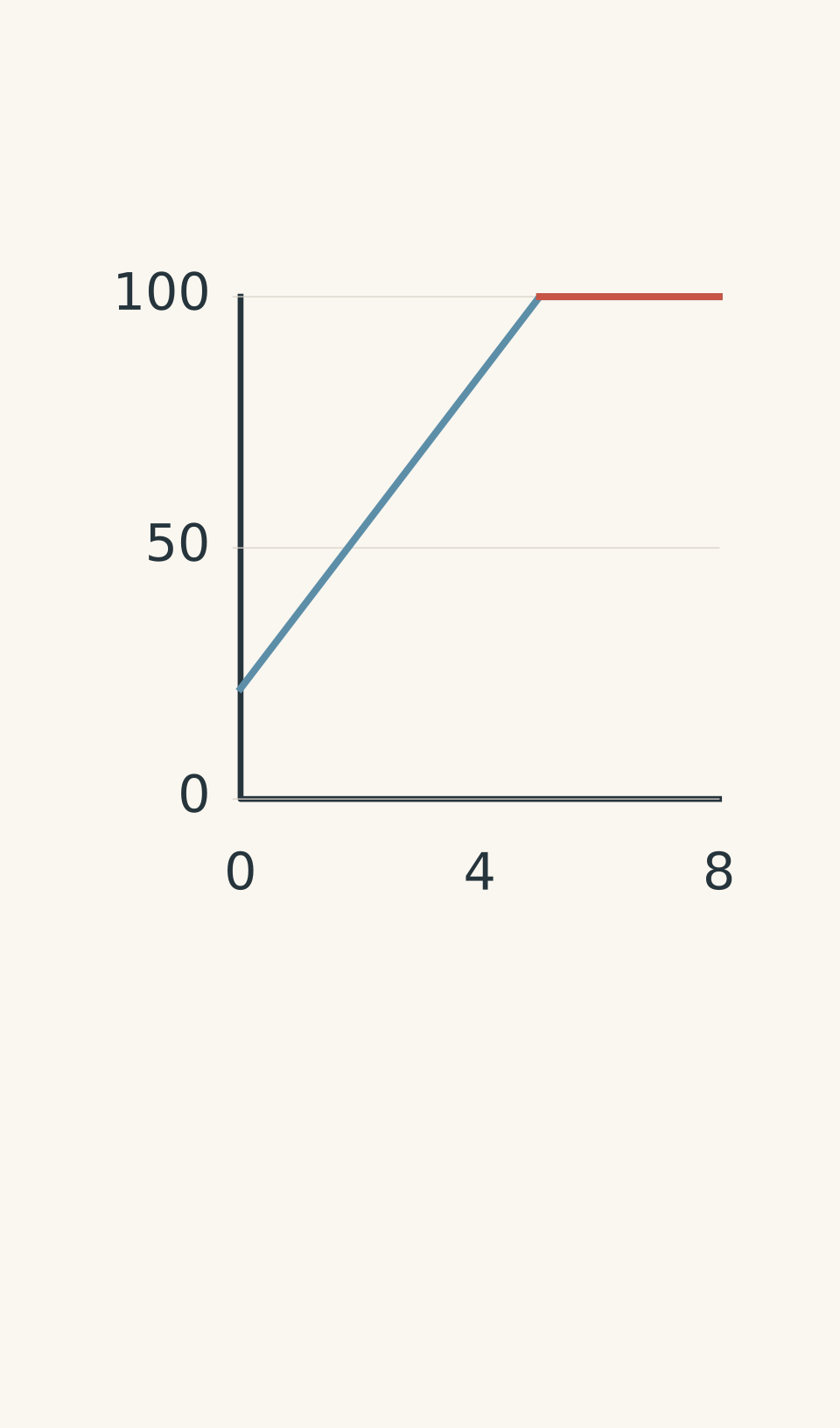
Suppose the question asks you to describe the graph.
A suitable response is:
“The temperature increases from 22°C to 100°C, then remains approximately constant at 100°C while heating continues.”
That reports the pattern accurately.
Now suppose the question asks you to explain the plateau.
You need another layer of reasoning:
“At the boiling point, the energy supplied is used to overcome intermolecular attractions as the liquid changes into gas. It therefore does not produce a corresponding increase in the particles’ average kinetic energy, so the temperature remains approximately constant while boiling continues.”
The second answer explains the physical reason for the observation.
Notice the difference. The explanation doesn’t just add more words to the description. It adds the mechanism connecting the energy supplied to the temperature observed.
A common incomplete answer is:
“The temperature stays constant because the water is boiling.”
This names the process but doesn’t fully explain why the temperature stays constant. The causal link is still missing.
The same distinction applies outside science.
- In English, describing a metaphor identifies a language feature. Analysing it requires you to connect that feature to meaning, tone, or another relevant effect.
- In Mathematics, describing a graph’s shape is not necessarily enough to explain why a function has that behaviour.
- In History, describing an event’s sequence does not automatically explain the factors that caused it.
The content changes. The need to connect evidence to reasoning remains.
05Worked example: Analyse a data pattern without overclaiming
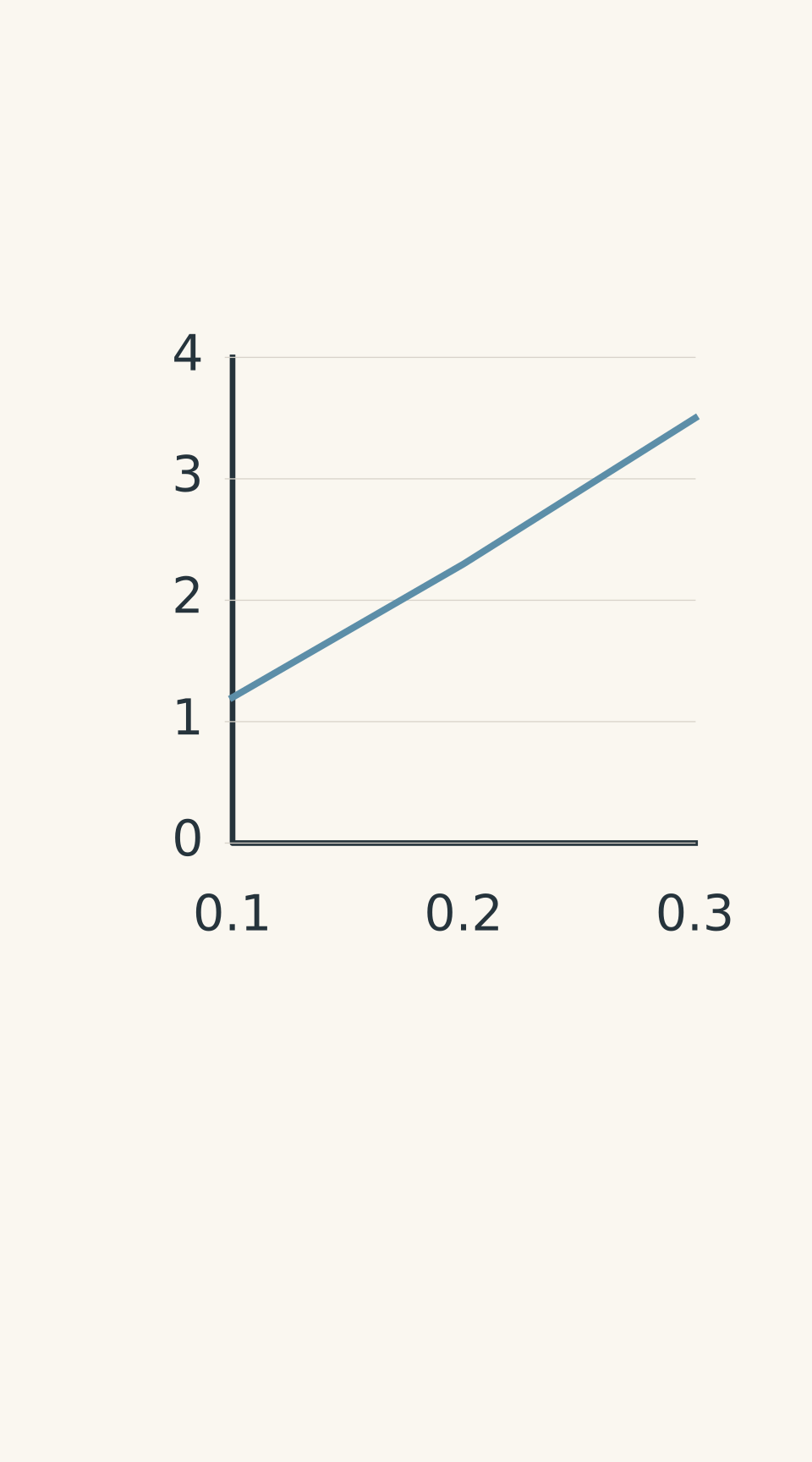
A chemistry experiment measures the initial reaction rate at three reactant concentrations. The relative rates are shown below.
| Concentration (mol L⁻¹) | Relative initial rate (units) |
|---|---|
| 0.10 | 1.2 |
| 0.20 | 2.3 |
| 0.30 | 3.5 |
Assume the temperature and other experimental conditions were held constant.
The question asks: “Analyse the relationship between reactant concentration and initial reaction rate.”
Step 1
The question asks you to analyse the relationship, not merely report whether the rate rises. You need to use the numerical evidence and explain what relationship it suggests.
Step 2
As concentration increases from 0.10 to 0.30 mol L⁻¹, the relative initial rate rises from 1.2 to 3.5 units.
The concentration triples, and the measured rate increases by a factor of approximately \(3.5/1.2 \approx 2.92\).
Step 3
The rate increases by approximately 1.1-1.2 units for each increase of 0.10 mol L⁻¹ in concentration. The results suggest an approximately proportional relationship over the tested range.
However, three measurements without uncertainty information are not enough to establish an exact rate law or reaction order.
Step 4
A strong response would be:
“As reactant concentration increases from 0.10 to 0.30 mol L⁻¹, the relative initial rate increases from 1.2 to 3.5 units, almost tripling. The approximately equal increases in rate for each 0.10 mol L⁻¹ increase in concentration suggest an approximately proportional relationship over the tested range. However, the data alone do not establish an exact rate law.”
Why the weaker approach fails: “The reaction rate increases with concentration” identifies the trend, but leaves the numerical relationship unexplored. At the other extreme, claiming an exact proportional relationship goes beyond what these measurements establish.
Analysis requires you to say what the evidence shows, not less than it shows and not more.
06Worked example: Evaluate a claim without relying on one number
Two groups follow different six-week revision plans. Their mean scores are recorded at the beginning and end of the period.
| Group | Starting mean | Final mean |
|---|---|---|
| Plan A | 65 | 74 |
| Plan B | 76 | 78 |
A teacher claims that Plan B is more effective because its final mean score is higher.
The question asks: “Evaluate this claim using the data provided.”
Step 1
The claim is that Plan B is more effective. The teacher’s stated reason is its higher final mean.
But effectiveness could refer to final attainment or improvement during the six weeks. The data allow you to examine both.
Step 2
Change in mean score = final mean − starting mean.
For Plan A:
\(74-65=9\) points.
For Plan B:
\(78-76=2\) points.
Step 3
Plan B finishes with the higher mean: 78 compared with 74.
However, Plan A shows the larger improvement: 9 points compared with 2 points. Looking only at final scores overlooks the groups’ different starting positions.
There is another limitation. We are not told how students were allocated to the groups, how many students participated, or how much the individual scores varied. The figures therefore cannot establish that either revision plan caused the observed results.
Step 4
A strong response would be:
“The claim that Plan B is more effective is not established by these data alone. Although Plan B has the higher final mean of 78 compared with 74 for Plan A, Plan A improves by 9 points, whereas Plan B improves by only 2 points. If improvement is the criterion, Plan A performs better on the reported means. However, the data do not establish which plan caused greater improvement because the groups’ allocation, sizes, and score variation are unknown.”
Why the tempting approach fails: Choosing Plan B because its final mean is higher uses relevant evidence, but ignores another relevant measure. Choosing Plan A solely because its gain is larger would also overstate what the data prove about cause and effect.
Evaluation means reaching a judgement that accounts for the relevant evidence and the limits of that evidence. It doesn’t mean automatically giving both options equal weight.
Higher final attainment does not mean greater improvement
| Plan A | Starting mean: 65 Final mean: 74 Gain: +9 points |
|---|---|
| Plan B | Starting mean: 76 Final mean: 78 Gain: +2 points |
07When memorised shortcuts break
A definition can help you recognise a command verb. It cannot replace reading the actual question.
Watch for these common complications.
“To what extent” requires a degree of judgement
A question asking “To what extent did the policy achieve its objectives?” does not simply ask whether the policy succeeded.
You must judge how far it achieved the objectives. Depending on the evidence, your conclusion might be that it succeeded substantially, partly, or only to a limited extent.
A response that lists successes and failures but never answers to what extent leaves the central judgement unresolved.
“Using the data” changes what counts as evidence
Suppose a physics question asks you to analyse an experimental graph.
A memorised explanation of the relevant physical law may be scientifically correct, but it does not replace analysis of the supplied graph. You should refer to the actual pattern, values, or relationships before drawing your conclusion.
Subject knowledge helps you interpret evidence. It doesn’t excuse you from using that evidence.
“Explain how” and “explain why” are related, but not identical
“Explain why the reaction rate increases” directs you towards the reason for the change.
“Explain how increasing temperature affects reaction rate” may require you to describe the process through which the change occurs, such as changes in particle energy and the proportion of collisions exceeding the activation energy.
Both require reasoning, but the emphasis differs.
“Compare” doesn’t mean write two separate descriptions
If you describe item A in one paragraph and item B in another, the marker may have to infer the comparison for you.
Instead, organise your response around shared criteria. For example, compare two experimental methods by accuracy, repeatability, cost, or suitability for the intended measurement.
Use explicit comparative language and follow any subject-specific definition of the verb.
“Justify” requires more than naming a rule
In Mathematics, writing “the discriminant is negative” may be only part of a justification.
You need to connect that result to the relevant principle: a quadratic with a negative discriminant has no real roots.
Likewise, in Physics, naming Newton’s second law does not automatically justify a conclusion. You must show how the law applies to the forces and motion described in the question.
“Show that” and “hence” place demands on your working
In Mathematics, a “show that” question asks you to demonstrate the stated result, not merely write it down.
A question using “hence” usually expects you to use a preceding result or established relationship. Starting an unrelated method may reach the correct answer but fail to demonstrate the requested reasoning.
Read these words as instructions about the evidence and method your response must show.
More marks don’t automatically mean more paragraphs
A six-mark question does not necessarily need six sentences. A compact, logically connected calculation may be more effective than a long explanation.
Likewise, a six-mark evaluation may require several connected elements: criteria, relevant evidence, consideration of limitations, and a supported judgement.
Aim for sufficient reasoning, not a predetermined word count.
08A 15-second self-check
Before moving to the next question, run through this checklist.
- [ ] Verb: Have I done what the question asks, rather than a neighbouring task?
- [ ] Target: Have I addressed the specific thing I was asked about?
- [ ] Constraints: Have I used the required data, source, examples, or context?
- [ ] Evidence: Have I included the relevant values, observations, textual details, or mathematical results?
- [ ] Reasoning: Have I shown the link between my evidence and my conclusion?
- [ ] Judgement: If I was asked to assess, evaluate, or justify, have I reached a supported conclusion?
- [ ] Completeness: Have I answered every part, included units where needed, and met the question’s specific requirements?
You don’t need every item in every response. An identify question may need no extended reasoning, while a five-mark evaluation will usually need much more than a direct statement. Use the checklist to match the response to the task.
09Questions and solutions
Question 1
A table records the following values:
| \(x\) | \(y\) |
|---|---|
| 1 | 5 |
| 2 | 8 |
| 3 | 11 |
| 4 | 14 |
The question asks: “Describe the relationship shown.”
Write a suitable one-sentence response and state one conclusion the table alone cannot establish.
Solution 1
The measured value of \(y\) increases by 3 for every increase of 1 in \(x\), rising from 5 to 14 across the table.
This is a description because it reports the observed pattern precisely. However, the table alone cannot establish that changing \(x\) causes the change in \(y\). That conclusion would require information about how the data were generated and whether other variables could explain the relationship.
The key is to describe the pattern without claiming more than the evidence supports.
Question 2
A car moves around a circular track at constant speed. A student writes:
“The speed is constant, so the velocity is constant and the acceleration is zero.”
Explain the error and state the direction of the car’s acceleration.
Solution 2
The student’s conclusion is incorrect because constant speed does not mean constant velocity. Speed describes how quickly the car moves, whereas velocity includes both its speed and direction.
As the car travels around the track, its direction changes continuously. Its velocity therefore changes, meaning it has non-zero acceleration directed towards the centre of the circular path.
For motion at constant speed \(v\) around a circle of radius \(r\), the acceleration magnitude is \(v^2/r\). This centripetal acceleration changes the direction of the velocity, even though the speed remains constant.
The answer explains the governing principle and connects it to the motion described. Simply stating that the car has acceleration would not explain why.
Question 3
A short line of text reads:
“We waited, we watched, we wondered.”
An English question asks: “Analyse how the writer creates tension.”
A student writes:
“The writer uses repetition to emphasise tension.”
Rewrite this as a stronger two-sentence response and explain what additional reasoning it contains.
Solution 3
The repeated “we” and the sequence of parallel verbs place the reader within a group’s shared anticipation. The progression from waiting to watching to wondering prolongs the sense of uncertainty, creating tension by delaying any resolution.
This is analysis because it connects specific language choices to their effect on the reader. The weaker response merely identifies repetition and asserts an effect without explaining how the language creates it.
The interpretation should still fit the wider text if more context is supplied. A language feature does not automatically produce the same effect in every passage.
Question 4
A Mathematics question asks:
“Justify whether \(x^2+2x+5=0\) has any real solutions.”
A student writes:
“No, because the parabola opens upwards.”
Is this sufficient? Give a complete justification.
Solution 4
No. The fact that a parabola opens upwards does not establish whether it crosses the \(x\)-axis. For example, \(y=x^2-4\) also opens upwards but has two real roots.
Complete the square:
\[ x^2+2x+5=(x+1)^2+4 \]
For every real \(x\), the square \((x+1)^2\) is greater than or equal to zero. Therefore,
\[ (x+1)^2+4\geq 4 \]
The expression cannot equal zero for any real \(x\), so the equation has no real solutions.
This is a justification because it states the conclusion, applies a mathematical principle, and shows why the principle guarantees that conclusion. The direction in which a parabola opens is not enough on its own.
Consistency is not the same as accuracy
| Method A — accurate, small variation | Accepted 10: readings 9.8, 10.0, 10.2 Accepted 20: readings 19.8, 20.0, 20.2 Accepted 30: readings 29.8, 30.0, 30.2 Small variation; readings cluster around accepted values. |
|---|---|
| Method B — consistent, systematic bias | Accepted 10: readings 10, 10, 10 Accepted 20: readings 19, 19, 19 Accepted 30: readings 28, 28, 28 Identical repeats; readings are 0, 1 and 2 units low. |
Question 5
A laboratory tests two measurement methods against three accepted standards. Each method is used three times at each standard.
| Accepted value (units) | Method A readings (units) | Method B readings (units) |
|---|---|---|
| 10 | 9.8, 10.0, 10.2 | 10, 10, 10 |
| 20 | 19.8, 20.0, 20.2 | 19, 19, 19 |
| 30 | 29.8, 30.0, 30.2 | 28, 28, 28 |
An exam question asks:
“Analyse the results, evaluate the claim that Method B is superior because its readings are perfectly consistent, and justify which method should be used to measure unknown samples between 10 and 30 units.”
Assume the accepted standards are correct. The laboratory is allowed to calibrate either method using these standards, and any linear calibration relationship established for a method remains valid across the stated range. The aim is to obtain the most accurate results after any permitted calibration.
What should a strong response conclude, and why?
Solution 5
Method B is the better choice after a valid calibration is applied, but the student’s reasoning that identical readings automatically make it superior is incomplete. The correct decision depends on both the quality of the raw measurements and the calibration permitted by the question.
Analyse the results.
Method A has some variation between repeated readings, but its mean matches each accepted standard:
- At 10 units, its mean is 10.0 units.
- At 20 units, its mean is 20.0 units.
- At 30 units, its mean is 30.0 units.
Method B gives identical readings each time, so its repeatability is higher. However, its raw readings increasingly underestimate the accepted values: it reads 19 rather than 20 units, and 28 rather than 30 units at the two higher standards.
This reveals two different properties. Repeatability concerns the consistency of repeated measurements; accuracy concerns how close the measurements are to the accepted values. A method can perform well on one property and poorly on the other.
Evaluate the claim.
The claim that Method B is superior simply because its readings are consistent is not justified. If the laboratory had to report raw readings without calibration, Method A would be the stronger choice on the supplied evidence because its mean readings match the accepted standards.
However, the question explicitly allows calibration. This condition changes the decision.
Justify the final choice.
Let \(x\) represent the accepted value in units and \(m\) represent Method B’s measured reading in the same units.
The three standards fit the linear relationship
\[ m=0.9x+1 \]
Rearranging to estimate the accepted value from a measured reading gives
\[ x=\frac{m-1}{0.9} \]
Under the stated assumption that this relationship remains valid across the range, the calibration corrects Method B’s systematic underestimation. Its readings are also perfectly repeatable in the supplied tests.
Method B is therefore the better choice for the stated purpose after calibration, because the corrected results can be accurate while retaining the consistency of the raw readings.
The crucial point is that the conclusion depends on the calibration condition. Without permission to calibrate, Method A would be the more defensible choice. With calibration allowed and its validity guaranteed, Method B becomes preferable.
This is what a strong evaluation and justification must do: analyse the evidence, recognise the limitation of the initial claim, account for the condition that changes the decision, and explain why the final recommendation follows.
When reviewing a trial paper, use the same reasoning in reverse: for each lost mark, decide whether the problem was missing knowledge, an incorrect method, insufficient evidence, or a mismatch with the command verb. How to Review a Trial HSC Paper Without Wasting Time can help you turn those mistakes into a more targeted revision plan.