
Keq Calculations and Reaction Direction | HSC Chemistry
Learn how to calculate equilibrium constants, find unknown equilibrium concentrations using ICE tables, and predict reaction direction by comparing Qc with Keq. Includes worked examples and challenging HSC-style questions with detailed solutions.
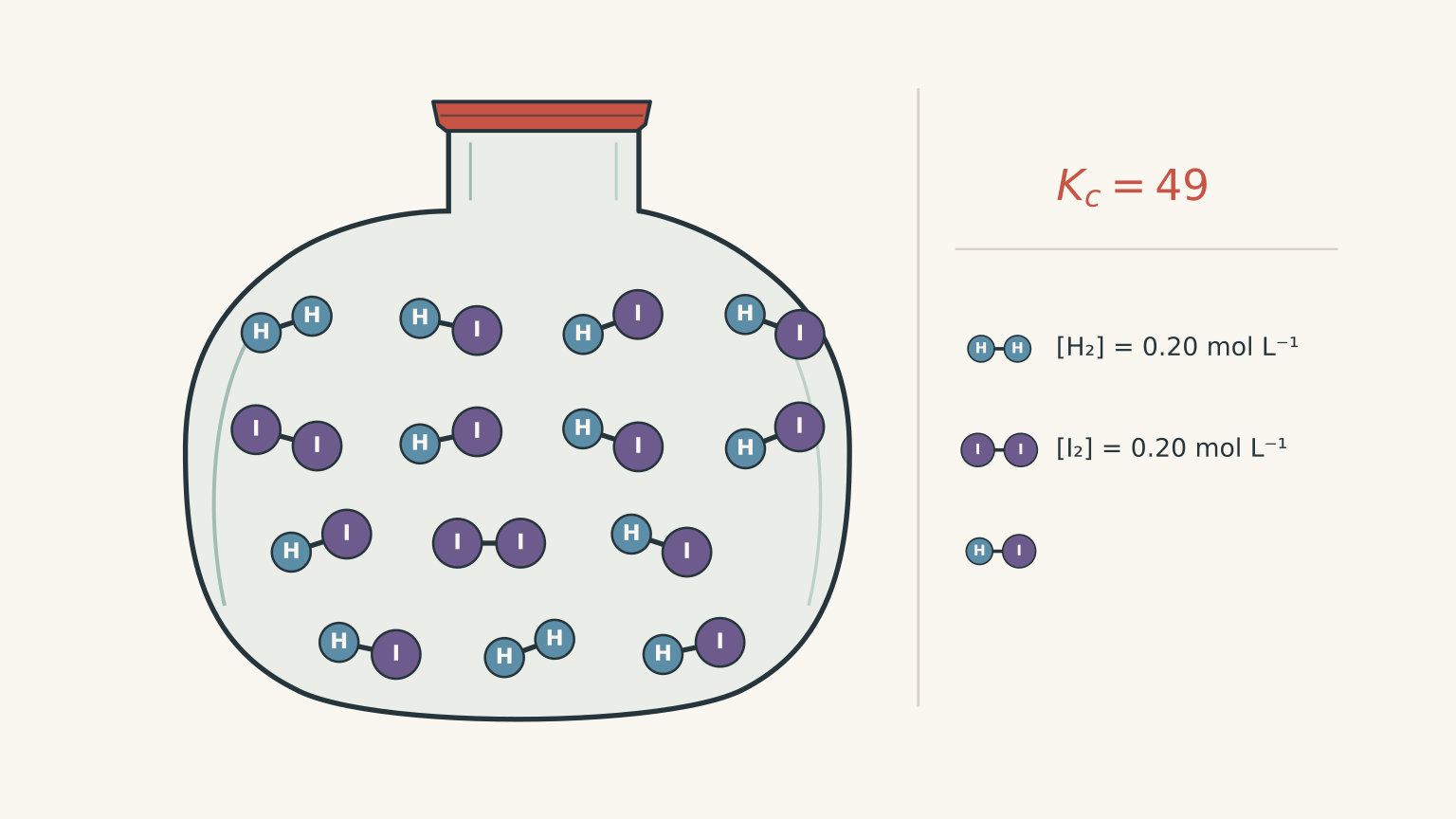
A sealed flask contains hydrogen, iodine, and hydrogen iodide. At this temperature, the equilibrium constant is \(K_c=49\). At one instant, the concentrations are:
- \([\ce{H2}]=0.20\ \mathrm{mol\,L^{-1}}\)
- \([\ce{I2}]=0.20\ \mathrm{mol\,L^{-1}}\)
- \([\ce{HI}]=1.0\ \mathrm{mol\,L^{-1}}\)
There is more hydrogen iodide than either reactant. Would you predict that hydrogen iodide will break down to form more hydrogen and iodine?
Actually, the reaction moves forwards, producing more hydrogen iodide.
The reason is that equilibrium depends on a particular ratio of concentrations, not on which substance has the highest concentration. For this reaction, hydrogen iodide is squared:
\[ \frac{[\ce{HI}]^2}{[\ce{H2}][\ce{I2}]} = \frac{(1.0)^2}{(0.20)(0.20)} =25 \]
The ratio is currently 25, but it needs to reach 49 for the mixture to be at equilibrium. The forward reaction increases this ratio, moving the system towards equilibrium.
This is the central idea behind calculating \(K_{eq}\) and predicting reaction direction. You need to know what ratio the reaction requires, calculate the ratio you currently have, and compare the two.
01What does the equilibrium constant actually measure?
Imagine making a cordial drink. A recipe might require one part cordial to four parts water. Simply knowing that there is more water than cordial doesn’t tell you whether the mixture has the correct strength. You need to compare the ratio with the recipe.
An equilibrium constant works in a similar way. It describes the particular ratio of product and reactant concentrations that exists when a reaction reaches equilibrium.
For a general reversible reaction:
\[ aA+bB\rightleftharpoons cC+dD \]
the equilibrium constant expression is:
\[ K_c=\frac{[C]^c[D]^d}{[A]^a[B]^b} \]
Each symbol has a specific meaning:
- \(K_c\) is the equilibrium constant calculated using concentrations.
- Square brackets represent equilibrium concentrations, measured in \(\mathrm{mol\,L^{-1}}\).
- \(a,b,c,d\) are the coefficients from the balanced chemical equation.
- Products appear in the numerator.
- Reactants appear in the denominator.
The important detail is that the balanced equation determines the powers in the expression.
A coefficient of 2 means the concentration is squared. A coefficient of 3 means it is cubed.
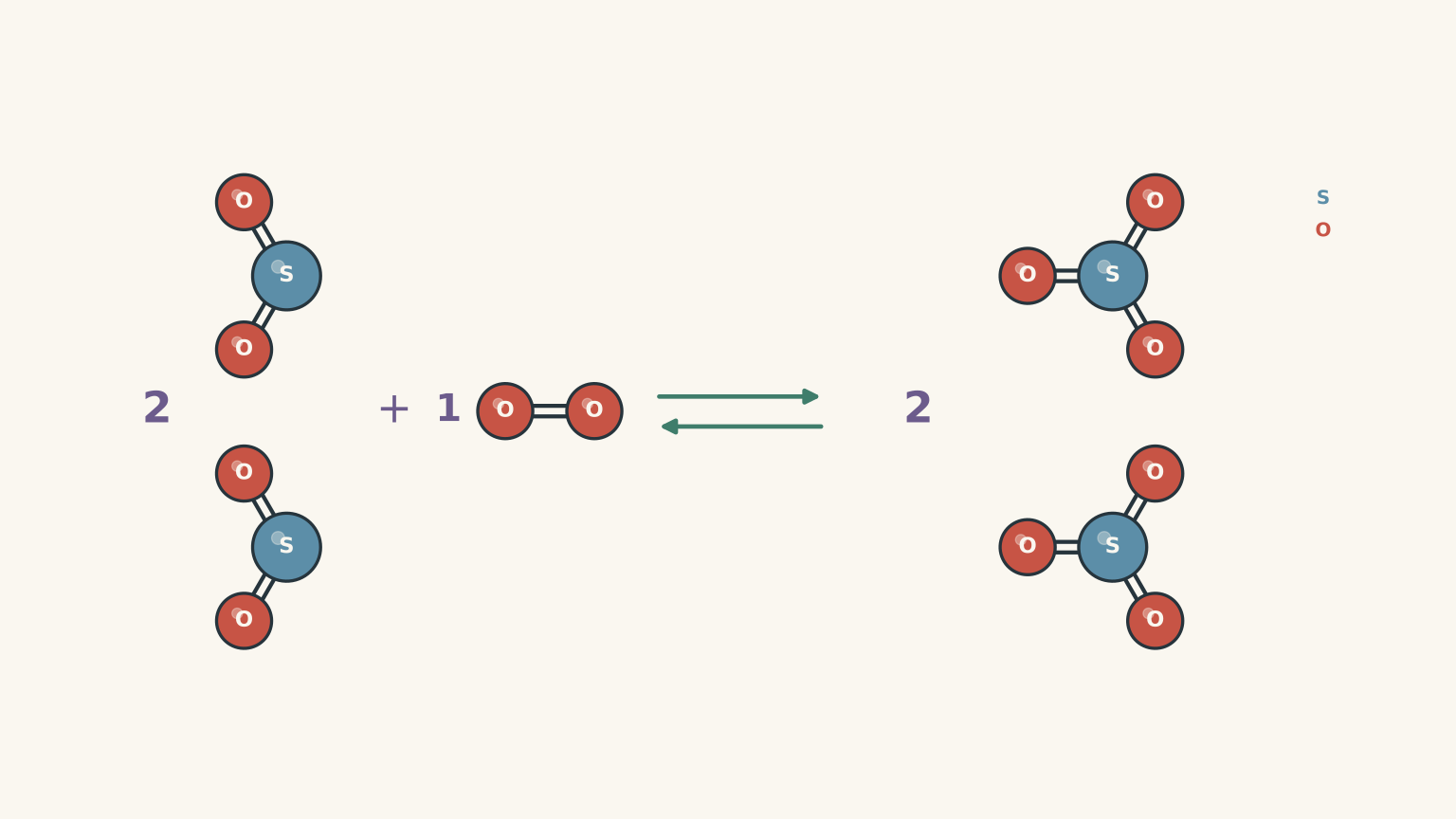
For example, consider:
\[ \ce{2SO2(g) + O2(g) <=> 2SO3(g)} \]
Its equilibrium expression is:
\[ K_c=\frac{[\ce{SO3}]^2} {[\ce{SO2}]^2[\ce{O2}]} \]
Notice that the coefficient of 2 for \(\ce{SO2}\) and \(\ce{SO3}\) becomes an exponent. You do not multiply their concentrations by 2.
There are two other rules worth remembering:
- Pure solids and pure liquids are excluded from equilibrium expressions. Their concentrations are effectively constant.
- Only equilibrium concentrations can be substituted into \(K_c\). If you are given starting concentrations instead, you must first calculate the equilibrium concentrations.
For HSC calculations, use concentrations in \(\mathrm{mol\,L^{-1}}\). The equilibrium constant is normally reported as a numerical value without a universal fixed unit.
If writing expressions from balanced equations is still a little unfamiliar, revise Equilibrium Expressions for Homogeneous Reactions.
02Calculating Keq from equilibrium concentrations
When a question gives you the concentrations of all substances at equilibrium, calculating \(K_{eq}\) is relatively straightforward.
You need to:
- Write the balanced chemical equation.
- Construct the equilibrium expression.
- Substitute the equilibrium concentrations.
- Calculate the numerical value.
Worked example: Calculate Keq for the formation of sulfur trioxide
For the reaction:
\[ \ce{2SO2(g) + O2(g) <=> 2SO3(g)} \]
the equilibrium concentrations are:
- \([\ce{SO2}]=0.20\ \mathrm{mol\,L^{-1}}\)
- \([\ce{O2}]=0.10\ \mathrm{mol\,L^{-1}}\)
- \([\ce{SO3}]=0.40\ \mathrm{mol\,L^{-1}}\)
Calculate \(K_c\).
Step 1
\[ K_c=\frac{[\ce{SO3}]^2} {[\ce{SO2}]^2[\ce{O2}]} \]
Step 2
\[ K_c=\frac{(0.40)^2} {(0.20)^2(0.10)} \]
Step 3
\[ K_c=\frac{0.160}{0.0040} \]
\[ \boxed{K_c=40.0} \]
A value of 40 indicates that products are favoured at equilibrium at this temperature.
However, it does not mean that the reaction has gone to completion. Some sulfur dioxide and oxygen will still be present.
Also, notice how important the exponents were. Forgetting to square either concentration would give you an incorrect answer.
03Finding an unknown equilibrium concentration using an ICE table
Sometimes a question gives you the starting concentrations and the value of \(K_{eq}\), but asks you to calculate the concentration of a substance at equilibrium.
You cannot substitute the starting concentrations directly into the equilibrium expression.
Instead, you need to work out how the concentrations change as the reaction proceeds.
This is where an ICE table becomes useful.
ICE stands for:
- I – Initial: the starting concentrations.
- C – Change: how each concentration changes as the reaction proceeds.
- E – Equilibrium: the final concentrations after equilibrium is reached.
The key is to use the coefficients in the balanced equation when writing the change row.
For example:
\[ \ce{H2(g) + I2(g) <=> 2HI(g)} \]
For every 1 mole of hydrogen consumed, 1 mole of iodine is consumed and 2 moles of hydrogen iodide are produced.
Therefore, if hydrogen decreases by \(x\), iodine also decreases by \(x\), while hydrogen iodide increases by \(2x\).
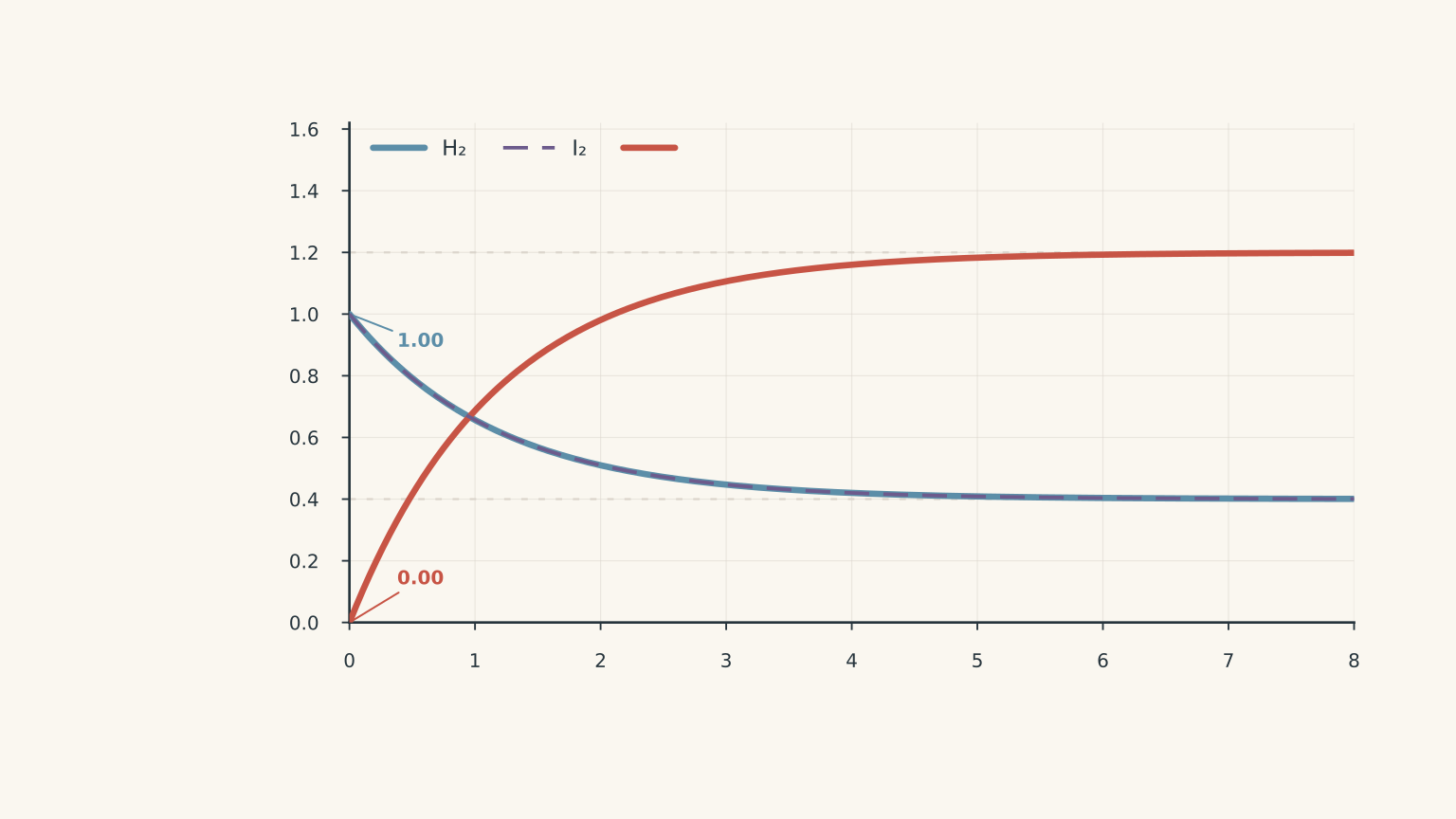
Worked example: Calculate the equilibrium concentrations using Keq
At a particular temperature, the equilibrium constant for:
\[ \ce{H2(g) + I2(g) <=> 2HI(g)} \]
is \(K_c=9.0\).
Initially, the concentrations are:
- \([\ce{H2}]=1.00\ \mathrm{mol\,L^{-1}}\)
- \([\ce{I2}]=1.00\ \mathrm{mol\,L^{-1}}\)
- \([\ce{HI}]=0.00\ \mathrm{mol\,L^{-1}}\)
Calculate the equilibrium concentration of each substance.
Step 1
The reaction moves forwards because there is initially no hydrogen iodide.
Let \(x\) represent the concentration of hydrogen consumed.
| \(\ce{H2}\) | \(\ce{I2}\) | \(\ce{HI}\) | |
|---|---|---|---|
| Initial (M) | 1.00 | 1.00 | 0.00 |
| Change (M) | \(-x\) | \(-x\) | \(+2x\) |
| Equilibrium (M) | \(1.00-x\) | \(1.00-x\) | \(2x\) |
The \(+2x\) is important. The balanced equation produces twice as much hydrogen iodide as the amount of hydrogen consumed.
Step 2
For this reaction:
\[ K_c=\frac{[\ce{HI}]^2} {[\ce{H2}][\ce{I2}]} \]
Substituting the ICE table values:
\[ 9.0=\frac{(2x)^2} {(1.00-x)(1.00-x)} \]
Simplifying:
\[ 9.0=\frac{4x^2}{(1-x)^2} \]
Step 3
Taking the positive square root:
\[ 3=\frac{2x}{1-x} \]
Rearranging:
\[ 3(1-x)=2x \]
\[ 3-3x=2x \]
\[ 5x=3 \]
\[ x=0.60 \]
Step 4
Substitute \(x=0.60\) into the equilibrium row.
For hydrogen:
\[ [\ce{H2}]=1.00-0.60=0.40\ \mathrm{M} \]
For iodine:
\[ [\ce{I2}]=1.00-0.60=0.40\ \mathrm{M} \]
For hydrogen iodide:
\[ [\ce{HI}]=2(0.60)=1.20\ \mathrm{M} \]
Therefore:
\[ \boxed{[\ce{H2}]=0.40\ \mathrm{M}} \]
\[ \boxed{[\ce{I2}]=0.40\ \mathrm{M}} \]
\[ \boxed{[\ce{HI}]=1.20\ \mathrm{M}} \]
You can check the answer by substituting these values back into the equilibrium expression:
\[ K_c=\frac{(1.20)^2}{(0.40)(0.40)} =\frac{1.44}{0.16}=9.0 \]
The calculated concentrations satisfy the supplied equilibrium constant.
One final point: equilibrium does not mean the reaction has stopped. The forward and reverse reactions are still occurring, but at equal rates. This is why the concentrations remain constant.
04Predicting reaction direction using Q and Keq
Now consider a different type of question.
You are given the equilibrium constant and the current concentrations of a reaction mixture. You need to decide whether the reaction will proceed forwards or backwards.
This is where the reaction quotient, \(Q_c\), comes in.
The reaction quotient uses exactly the same expression as \(K_c\), but there is one important difference:
- \(K_c\) uses equilibrium concentrations.
- \(Q_c\) uses the concentrations at the current moment, whether or not the system is at equilibrium.
For a general reaction:
\[ aA+bB\rightleftharpoons cC+dD \]
the reaction quotient is:
\[ Q_c=\frac{[C]^c[D]^d}{[A]^a[B]^b} \]
Once you calculate \(Q_c\), compare it with \(K_c\).
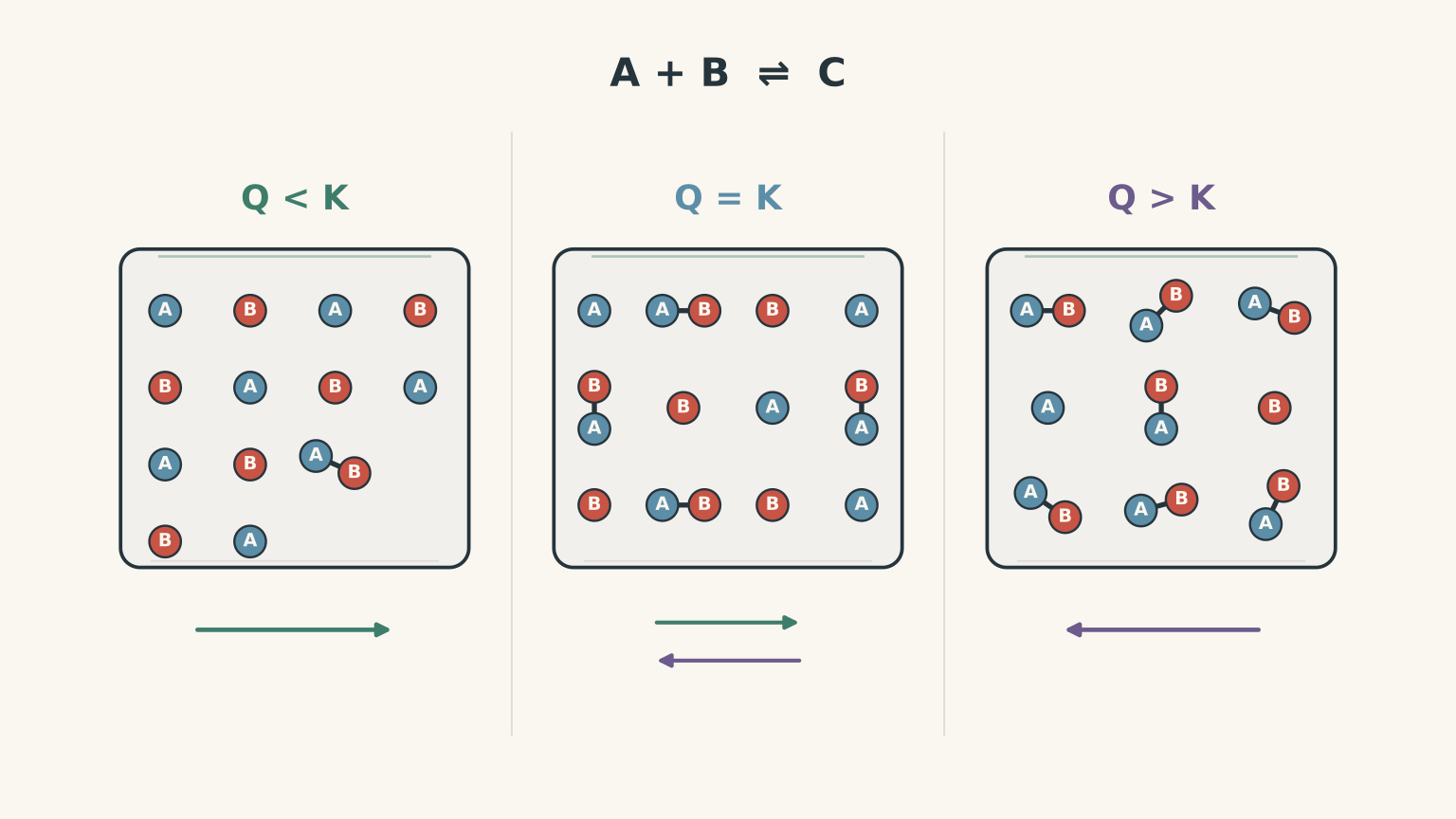
There are three possible outcomes.
| Comparison | Net reaction direction | What happens? |
|---|---|---|
| \(Q_c<K_c\) | Forward (right) | More products form. |
| \(Q_c>K_c\) | Reverse (left) | More reactants form. |
| \(Q_c=K_c\) | No net change | The system is at equilibrium. |
The reasoning is simple.
If \(Q_c\) is smaller than \(K_c\), the current mixture has a lower product-to-reactant ratio than the equilibrium mixture requires. The forward reaction increases that ratio.
If \(Q_c\) is larger than \(K_c\), the mixture has a higher ratio than required. The reverse reaction decreases it.
If they are equal, the system is already at equilibrium.
Worked example: Determine the direction of a reaction
Consider:
\[ \ce{CO(g) + Cl2(g) <=> COCl2(g)} \]
At a particular temperature, \(K_c=5.0\).
The current concentrations are:
- \([\ce{CO}]=0.20\ \mathrm{mol\,L^{-1}}\)
- \([\ce{Cl2}]=0.10\ \mathrm{mol\,L^{-1}}\)
- \([\ce{COCl2}]=0.30\ \mathrm{mol\,L^{-1}}\)
Determine the direction in which the reaction will proceed.
Step 1
\[ Q_c=\frac{[\ce{COCl2}]} {[\ce{CO}][\ce{Cl2}]} \]
Step 2
\[ Q_c=\frac{0.30}{(0.20)(0.10)} \]
Step 3
\[ Q_c=\frac{0.30}{0.020} \]
\[ Q_c=15 \]
Step 4
\[ Q_c=15>K_c=5.0 \]
Therefore, the reaction proceeds in the reverse direction.
The system produces more carbon monoxide and chlorine gas while consuming carbonyl chloride.
Notice something interesting: carbonyl chloride has the highest individual concentration, but the reaction still proceeds backwards. The direction depends on the ratio in the equilibrium expression, not on a simple comparison of individual concentrations.
05What happens to Keq when concentrations or volume change?
This is another common source of confusion in HSC questions.
Suppose a system is initially at equilibrium. You add more reactant, remove some product, or change the volume of a gas mixture.
The concentrations change, so the reaction quotient changes.
However, provided the temperature stays constant, the equilibrium constant does not change.
This gives you a reliable approach:
- Work out the new concentrations immediately after the disturbance.
- Substitute those concentrations into the reaction quotient expression.
- Compare the new \(Q_c\) with the unchanged \(K_c\).
- Predict the net reaction direction.
For example, compressing a gaseous equilibrium mixture to half its original volume doubles the concentration of every gas, assuming no reaction occurs during compression.
But this does not necessarily leave \(Q_c\) unchanged.
Why? Because concentrations appear with different powers in the numerator and denominator.
For \(\ce{2NO2(g) <=> N2O4(g)}\):
\[ Q_c=\frac{[\ce{N2O4}]}{[\ce{NO2}]^2} \]
Doubling both concentrations doubles the numerator but quadruples the denominator. Therefore, the reaction quotient becomes half its original value.
This is why calculating \(Q_c\) is often more reliable than trying to predict a shift using a verbal shortcut alone.
06Common Keq calculation mistakes
| Mistake | What to do instead |
|---|---|
| Using starting concentrations to calculate \(K_c\) | Use equilibrium concentrations, or calculate them first with an ICE table. |
| Multiplying concentrations by their coefficients | Raise concentrations to the powers of their coefficients. |
| Comparing individual concentrations to predict direction | Calculate \(Q_c\) and compare it with \(K_c\). |
| Assuming a large \(K_c\) means the reaction is complete | Remember that reactants and products can both remain at equilibrium. |
| Changing \(K_c\) after adding a reactant or changing volume | Keep \(K_c\) constant unless the temperature changes. |
| Using the original concentrations after a disturbance | Calculate the new concentrations before evaluating \(Q_c\). |
07Questions and solutions
The following questions progress from straightforward equilibrium calculations to more involved problems combining ICE tables, reaction quotients, and changes to an equilibrium system.
Question 1
Consider the equilibrium:
\[ \ce{PCl5(g) <=> PCl3(g) + Cl2(g)} \]
At a particular temperature, the equilibrium concentrations are:
- \([\ce{PCl5}]=0.40\ \mathrm{mol\,L^{-1}}\)
- \([\ce{PCl3}]=0.20\ \mathrm{mol\,L^{-1}}\)
- \([\ce{Cl2}]=0.20\ \mathrm{mol\,L^{-1}}\)
Calculate \(K_{eq}\) and state which side of the reaction is favoured at equilibrium.
Solution 1
\(K_{eq}=0.10\), so the reactant side is favoured at equilibrium.
Start by writing the equilibrium expression:
\[ K_c=\frac{[\ce{PCl3}][\ce{Cl2}]} {[\ce{PCl5}]} \]
Substitute the equilibrium concentrations:
\[ K_c=\frac{(0.20)(0.20)}{0.40} \]
\[ K_c=\frac{0.040}{0.40} \]
\[ \boxed{K_c=0.10} \]
Since the equilibrium constant is less than 1, the equilibrium favours the reactants.
This does not mean that no phosphorus trichloride or chlorine is present. It means that the equilibrium position favours the reactant side.
Question 2
Consider the equilibrium:
\[ \ce{CO(g) + Cl2(g) <=> COCl2(g)} \]
At a fixed temperature, \(K_c=5.0\).
A reaction vessel initially contains:
- \([\ce{CO}]=0.60\ \mathrm{mol\,L^{-1}}\)
- \([\ce{Cl2}]=0.40\ \mathrm{mol\,L^{-1}}\)
- \([\ce{COCl2}]=0.20\ \mathrm{mol\,L^{-1}}\)
Calculate the equilibrium concentration of each substance.
Solution 2
The equilibrium concentrations are \(0.40\ \mathrm{mol\,L^{-1}}\) for CO, \(0.20\ \mathrm{mol\,L^{-1}}\) for Cl2, and \(0.40\ \mathrm{mol\,L^{-1}}\) for COCl2.
First, determine the initial reaction quotient:
\[ Q_c=\frac{0.20}{(0.60)(0.40)} \]
\[ Q_c=0.833 \]
Since \(Q_c<K_c\), the reaction proceeds forwards.
Let \(x\) represent the concentration of CO and Cl2 consumed.
Construct the ICE table:
| \(\ce{CO}\) | \(\ce{Cl2}\) | \(\ce{COCl2}\) | |
|---|---|---|---|
| Initial (M) | 0.60 | 0.40 | 0.20 |
| Change (M) | \(-x\) | \(-x\) | \(+x\) |
| Equilibrium (M) | \(0.60-x\) | \(0.40-x\) | \(0.20+x\) |
Substitute the equilibrium concentrations into the expression:
\[ 5.0=\frac{0.20+x} {(0.60-x)(0.40-x)} \]
Expand the denominator:
\[ 5.0=\frac{0.20+x} {0.24-x+x^2} \]
Rearranging:
\[ 0.20+x=1.20-5x+5x^2 \]
\[ 5x^2-6x+1=0 \]
Factorise:
\[ (5x-1)(x-1)=0 \]
Therefore:
\[ x=0.20\quad\text{or}\quad x=1.00 \]
The second solution is physically impossible because it would produce negative concentrations of CO and Cl2.
Therefore:
\[ x=0.20 \]
Substitute this value into the equilibrium row:
\[ [\ce{CO}]=0.60-0.20=0.40\ \mathrm{M} \]
\[ [\ce{Cl2}]=0.40-0.20=0.20\ \mathrm{M} \]
\[ [\ce{COCl2}]=0.20+0.20=0.40\ \mathrm{M} \]
Check the equilibrium constant:
\[ K_c=\frac{0.40}{(0.40)(0.20)} =5.0 \]
The calculated concentrations satisfy the supplied equilibrium constant.
Question 3
Consider the Haber process:
\[ \ce{N2(g) + 3H2(g) <=> 2NH3(g)} \]
At \(450^\circ\mathrm{C}\), the equilibrium constant is \(K_c=8.0\).
A reaction mixture currently contains:
- \([\ce{N2}]=0.25\ \mathrm{mol\,L^{-1}}\)
- \([\ce{H2}]=0.50\ \mathrm{mol\,L^{-1}}\)
- \([\ce{NH3}]=0.40\ \mathrm{mol\,L^{-1}}\)
Calculate \(Q_c\) and determine the net direction of the reaction.
Explain why comparing the concentration of ammonia directly with the concentration of nitrogen would give an unreliable prediction.
Solution 3
The reaction proceeds forwards, producing more ammonia.
First, write the reaction quotient expression:
\[ Q_c=\frac{[\ce{NH3}]^2} {[\ce{N2}][\ce{H2}]^3} \]
Substitute the current concentrations:
\[ Q_c=\frac{(0.40)^2} {(0.25)(0.50)^3} \]
Calculate:
\[ Q_c=\frac{0.160}{(0.25)(0.125)} \]
\[ Q_c=\frac{0.160}{0.03125} \]
\[ Q_c=5.12 \]
Compare this with the equilibrium constant:
\[ 5.12<8.0 \]
Therefore:
\[ \boxed{Q_c<K_c} \]
The net reaction proceeds forwards, forming more ammonia.
The tempting mistake is to notice that the ammonia concentration is greater than the nitrogen concentration and assume that the system contains too much product.
However, the equilibrium expression includes the hydrogen concentration raised to the third power. All three concentrations contribute to the ratio.
The system must be judged using the complete expression, not by comparing two individual concentrations.
Question 4
Consider the equilibrium:
\[ \ce{2NO2(g) <=> N2O4(g)} \]
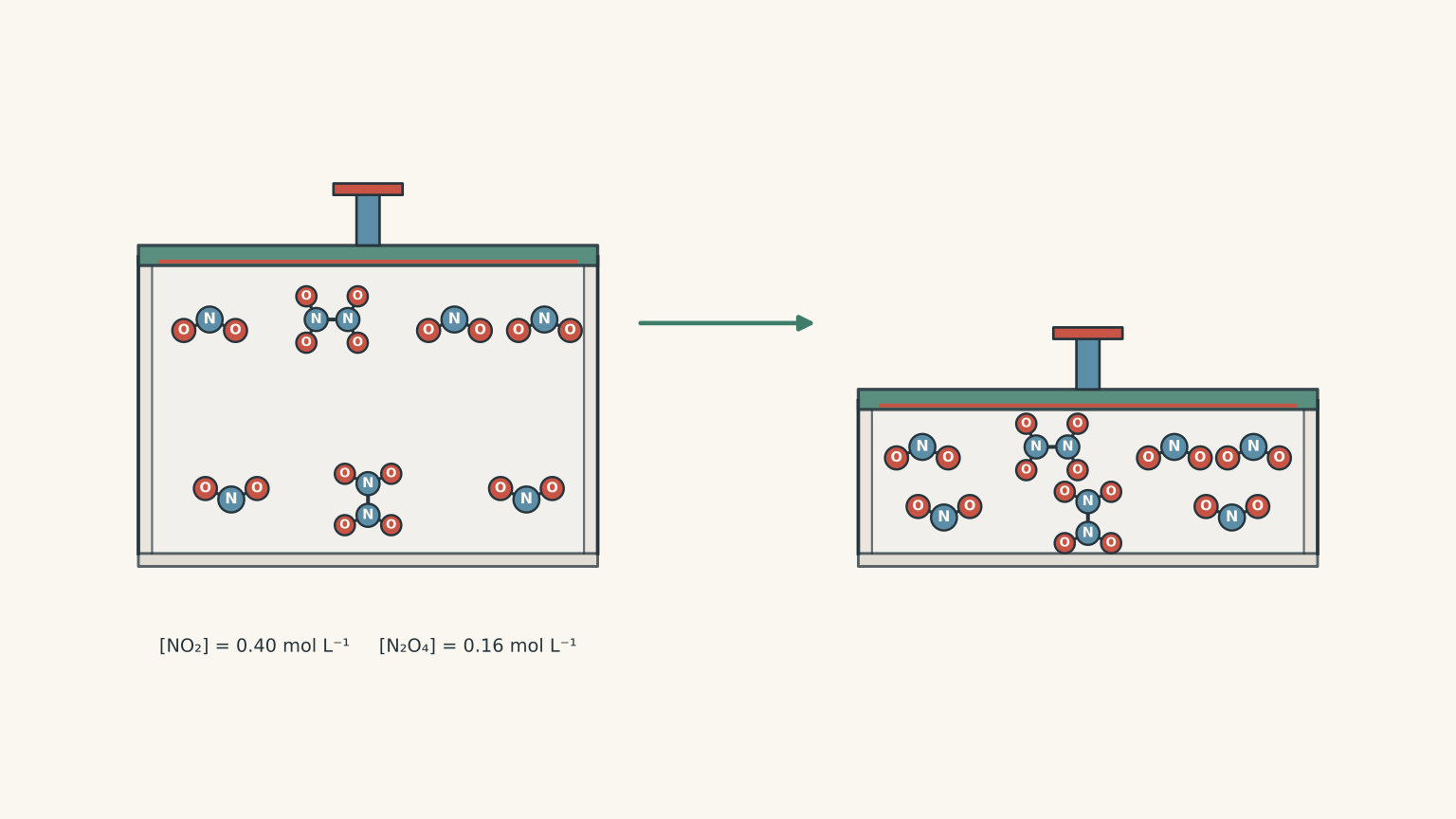
At a fixed temperature, a reaction vessel is initially at equilibrium with:
- \([\ce{NO2}]=0.40\ \mathrm{mol\,L^{-1}}\)
- \([\ce{N2O4}]=0.16\ \mathrm{mol\,L^{-1}}\)
The volume of the vessel is suddenly compressed to half its original value before the reaction has time to respond.
Determine the new reaction quotient and predict the direction in which the reaction will proceed.
Explain why the compression changes the reaction quotient even though the concentration of every gas doubles.
Solution 4
The reaction shifts forwards, producing more \(\ce{N2O4}\).
First, calculate the original equilibrium constant:
\[ K_c=\frac{[\ce{N2O4}]}{[\ce{NO2}]^2} \]
\[ K_c=\frac{0.16}{(0.40)^2} \]
\[ K_c=\frac{0.16}{0.16}=1.0 \]
The temperature remains constant, so \(K_c\) stays at 1.0.
When the volume is halved, the concentration of each gas doubles immediately.
Therefore:
\[ [\ce{NO2}]=0.80\ \mathrm{M} \]
\[ [\ce{N2O4}]=0.32\ \mathrm{M} \]
Calculate the new reaction quotient:
\[ Q_c=\frac{0.32}{(0.80)^2} \]
\[ Q_c=\frac{0.32}{0.64} \]
\[ Q_c=0.50 \]
Compare the values:
\[ Q_c=0.50<K_c=1.0 \]
Therefore, the reaction proceeds forwards.
The important detail is that doubling every concentration does not necessarily leave the reaction quotient unchanged.
The numerator doubles because \([\ce{N2O4}]\) has a coefficient of 1.
However, the denominator increases by a factor of four because \([\ce{NO2}]\) is squared.
Consequently, \(Q_c\) decreases to half its original value.
The forward reaction consumes two molecules of nitrogen dioxide to produce one molecule of dinitrogen tetroxide. This also agrees with the prediction that compression favours the side containing fewer gas particles.
Question 5
Consider the equilibrium:
\[ \ce{2NO2(g) <=> N2O4(g)} \]
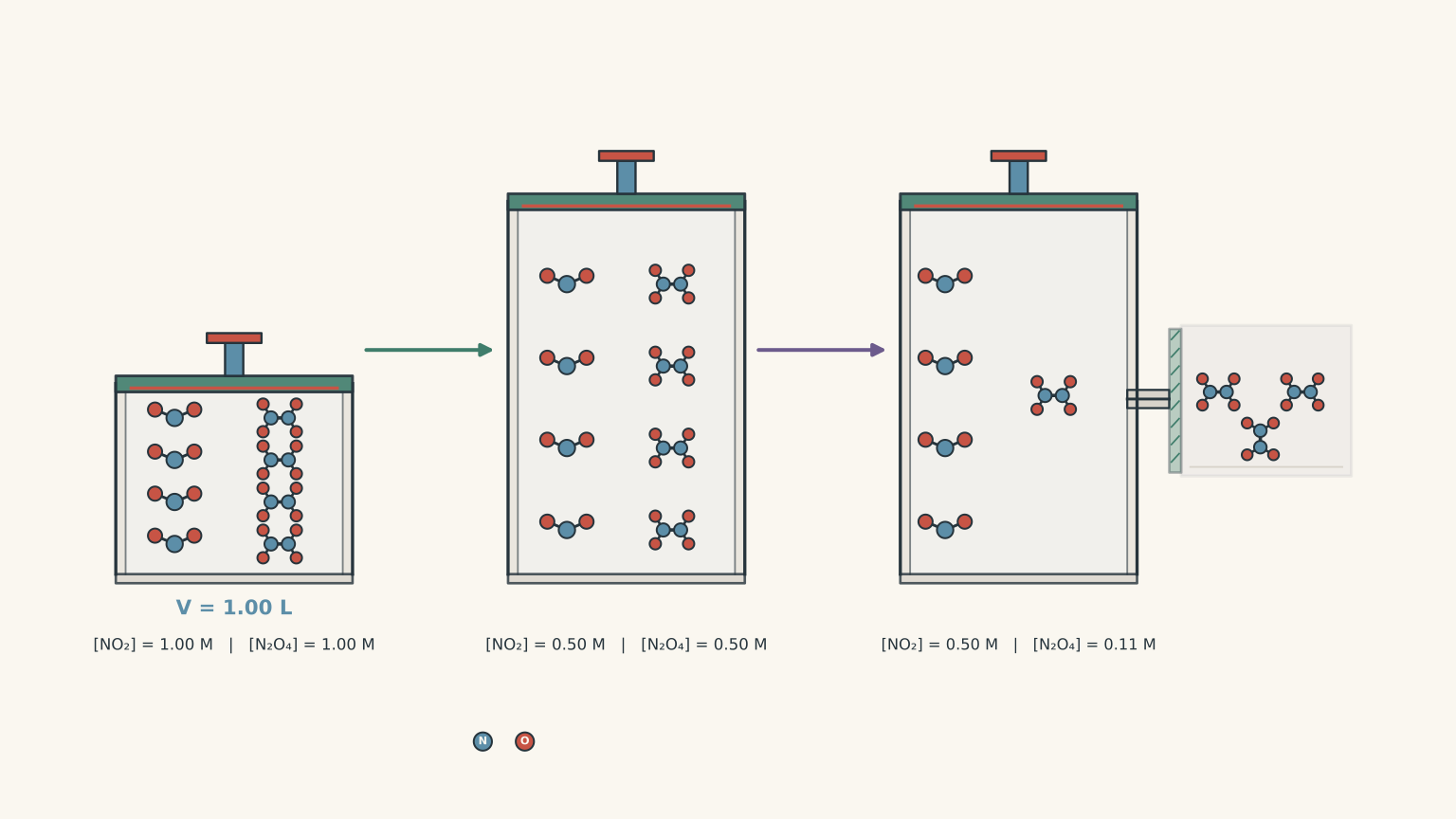
A sealed vessel with an initial volume of \(1.00\ \mathrm{L}\) is at equilibrium at a constant temperature.
Its equilibrium concentrations are:
\[ [\ce{NO2}]=1.00\ \mathrm{mol\,L^{-1}} \]
\[ [\ce{N2O4}]=1.00\ \mathrm{mol\,L^{-1}} \]
The vessel undergoes the following changes:
- A piston rapidly expands the vessel to \(2.00\ \mathrm{L}\). The piston is then clamped, and no reaction occurs during this expansion.
- An ideal selective trap removes \(\ce{N2O4}\) until its concentration is \(0.11\ \mathrm{mol\,L^{-1}}\). The trap does not remove any \(\ce{NO2}\).
The reaction is now allowed to re-establish equilibrium at the fixed volume of \(2.00\ \mathrm{L}\).
Answer the following:
(a) Calculate the equilibrium constant, \(K_c\), using the original concentrations.
(b) Calculate \(Q_c\) immediately after the expansion but before the selective trap operates. Predict the reaction direction at this stage.
(c) Calculate the new \(Q_c\) after the selective trap has operated. Predict the net reaction direction now.
(d) Calculate the final equilibrium concentrations of \(\ce{NO2}\) and \(\ce{N2O4}\). Explain why only one of the two mathematical solutions is physically possible.
Solution 5
After the selective trap operates, the reaction proceeds forwards. The final equilibrium concentrations are \([\ce{NO2}]=0.40\ \mathrm{mol\,L^{-1}}\) and \([\ce{N2O4}]=0.16\ \mathrm{mol\,L^{-1}}\).
This question is more difficult because two consecutive changes affect the reaction quotient in opposite ways.
You must calculate \(Q_c\) after each change rather than assuming that the first disturbance determines the final direction.
Part (a): Calculate the original equilibrium constant.
The equilibrium expression is:
\[ K_c=\frac{[\ce{N2O4}]}{[\ce{NO2}]^2} \]
Substitute the original equilibrium concentrations:
\[ K_c=\frac{1.00}{(1.00)^2} \]
\[ \boxed{K_c=1.00} \]
This value remains constant because the temperature does not change.
Part (b): Calculate Q immediately after expansion.
The volume increases from \(1.00\ \mathrm{L}\) to \(2.00\ \mathrm{L}\).
Since the number of moles of each reactive gas has not yet changed, both concentrations are halved.
Therefore:
\[ [\ce{NO2}]=0.50\ \mathrm{M} \]
\[ [\ce{N2O4}]=0.50\ \mathrm{M} \]
Calculate the reaction quotient:
\[ Q_c=\frac{0.50}{(0.50)^2} \]
\[ Q_c=2.00 \]
Compare:
\[ Q_c=2.00>K_c=1.00 \]
Immediately after expansion, the reaction proceeds backwards, producing more nitrogen dioxide.
This makes sense because expansion favours the side containing more gas particles.
However, this is not yet the final direction of the reaction.
Part (c): Calculate Q after the selective trap operates.
The trap removes only \(\ce{N2O4}\), reducing its concentration to \(0.11\ \mathrm{mol\,L^{-1}}\).
The nitrogen dioxide concentration remains unchanged at \(0.50\ \mathrm{mol\,L^{-1}}\).
Therefore:
\[ Q_c=\frac{0.11}{(0.50)^2} \]
\[ Q_c=\frac{0.11}{0.25} \]
\[ Q_c=0.44 \]
Compare:
\[ Q_c=0.44<K_c=1.00 \]
The reaction now proceeds forwards, producing more dinitrogen tetroxide.
This is the crucial change in the question.
The expansion initially favoured the reverse reaction, but removing enough product lowered the reaction quotient below the equilibrium constant.
The direction of the net reaction is determined by the current concentrations, not by the direction predicted immediately after an earlier disturbance.
Part (d): Calculate the final equilibrium concentrations.
After the trap operates, the starting concentrations for the next equilibrium calculation are:
\[ [\ce{NO2}]=0.50\ \mathrm{M} \]
\[ [\ce{N2O4}]=0.11\ \mathrm{M} \]
The reaction proceeds forwards:
\[ \ce{2NO2(g) <=> N2O4(g)} \]
Let \(x\) represent the concentration of \(\ce{N2O4}\) formed.
Construct the ICE table:
| \(\ce{NO2}\) | \(\ce{N2O4}\) | |
|---|---|---|
| Initial (M) | 0.50 | 0.11 |
| Change (M) | \(-2x\) | \(+x\) |
| Equilibrium (M) | \(0.50-2x\) | \(0.11+x\) |
Substitute the equilibrium concentrations into the expression:
\[ 1.00=\frac{0.11+x}{(0.50-2x)^2} \]
Rearrange:
\[ (0.50-2x)^2=0.11+x \]
Expand:
\[ 0.25-2x+4x^2=0.11+x \]
Collect terms:
\[ 4x^2-3x+0.14=0 \]
Use the quadratic formula:
\[ x=\frac{3\pm\sqrt{(-3)^2-4(4)(0.14)}}{2(4)} \]
\[ x=\frac{3\pm\sqrt{6.76}}{8} \]
\[ x=\frac{3\pm2.60}{8} \]
This gives two mathematical solutions:
\[ x=0.050\quad\text{or}\quad x=0.70 \]
The second solution is impossible.
If \(x=0.70\), the equilibrium concentration of nitrogen dioxide would be:
\[ [\ce{NO2}]=0.50-2(0.70) \]
\[ [\ce{NO2}]=-0.90\ \mathrm{M} \]
A negative concentration is physically impossible. It would also require more nitrogen dioxide to react than was available in the vessel.
Therefore, the only valid solution is:
\[ x=0.050 \]
Calculate the final equilibrium concentrations.
For nitrogen dioxide:
\[ [\ce{NO2}]=0.50-2(0.050) \]
\[ \boxed{[\ce{NO2}]=0.40\ \mathrm{mol\,L^{-1}}} \]
For dinitrogen tetroxide:
\[ [\ce{N2O4}]=0.11+0.050 \]
\[ \boxed{[\ce{N2O4}]=0.16\ \mathrm{mol\,L^{-1}}} \]
Finally, check the equilibrium constant:
\[ K_c=\frac{0.16}{(0.40)^2} \]
\[ K_c=\frac{0.16}{0.16}=1.00 \]
The final concentrations satisfy the original equilibrium constant.
The important lesson is that an equilibrium system can change direction as successive disturbances alter its composition. You cannot simply remember what happened after the first change. Recalculate \(Q_c\) using the concentrations that exist at the point you are investigating.
08What to learn next
You can now use equilibrium expressions to calculate \(K_{eq}\), solve for unknown equilibrium concentrations, and predict the direction of a reaction using \(Q_c\).
The next important distinction is understanding what happens when temperature changes.
Adding a reactant or changing the volume changes the reaction quotient, but changing temperature can change the equilibrium constant itself. Understanding why requires connecting equilibrium calculations with the enthalpy of the forward and reverse reactions.
Continue with How Temperature Changes Keq in Endothermic and Exothermic Reactions.