
The Photoelectric Effect: Understanding the Photon Model
Explore how photoelectric experiments challenged the classical wave model and provided evidence for light behaving as photons. Learn the key equations, threshold frequency, intensity and stopping potential through worked examples and HSC-style questions.
A metal plate is placed under light, and something strange happens: electrons can leave the metal almost instantly. That seems reasonable at first. Light carries energy, so perhaps brighter light should eventually knock electrons free.
But experiments created a puzzle. Very dim ultraviolet light could eject electrons immediately, while extremely bright red light could fail completely. If light was just a continuous wave of energy spread out over time, this result should not happen.
What should a brighter light do if the wave model is correct? It should deliver more energy each second, so after waiting long enough, electrons should escape. That prediction sounds sensible. The experiments showed that nature was following a different rule.
The photoelectric effect became one of the key pieces of evidence that light can behave as packets of energy called photons. The important part is not just knowing the photon model. HSC questions often ask what each experiment proved, and what it did not prove.
01The problem: why did the wave model fail?
Before the photoelectric experiments, many physicists described light as a wave. This model explained many observations:
- light could interfere, creating bright and dark patterns,
- light could diffract around obstacles,
- different colours had different wavelengths.
The wave model was useful, but it made a specific prediction about the photoelectric effect.
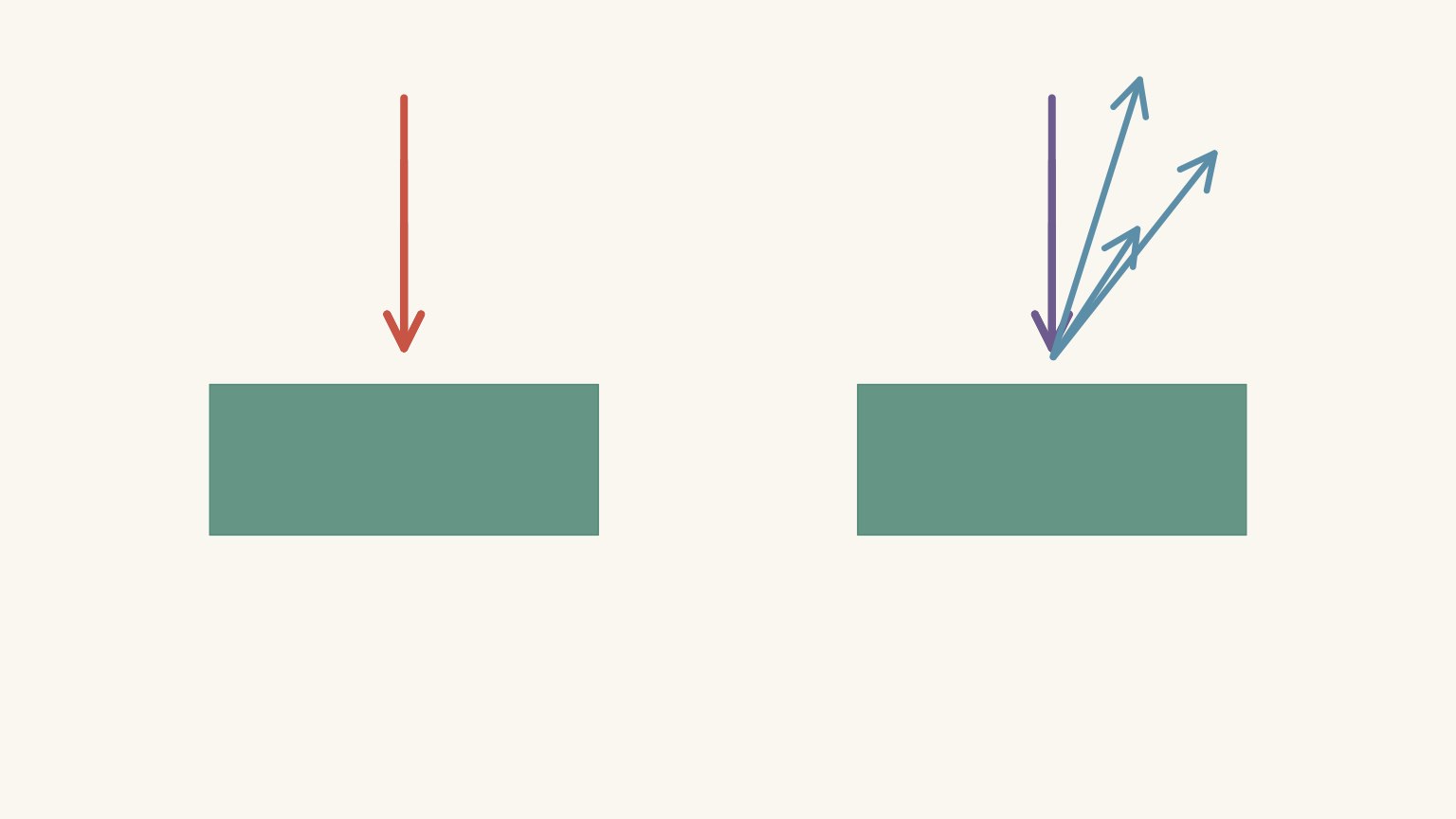
Imagine light as a continuous stream of energy spread across a wave. A brighter light means a larger wave amplitude, so more energy arrives each second. An electron in the metal should be able to collect this energy gradually.
The prediction was:
- increasing intensity should increase the energy given to electrons,
- a weak light should eventually eject electrons if you wait long enough,
- colour should not matter much, because enough total energy could arrive over time.
The experiments did not match this.
02The first observation: electrons appeared immediately
The photoelectric effect was investigated using a simple apparatus.
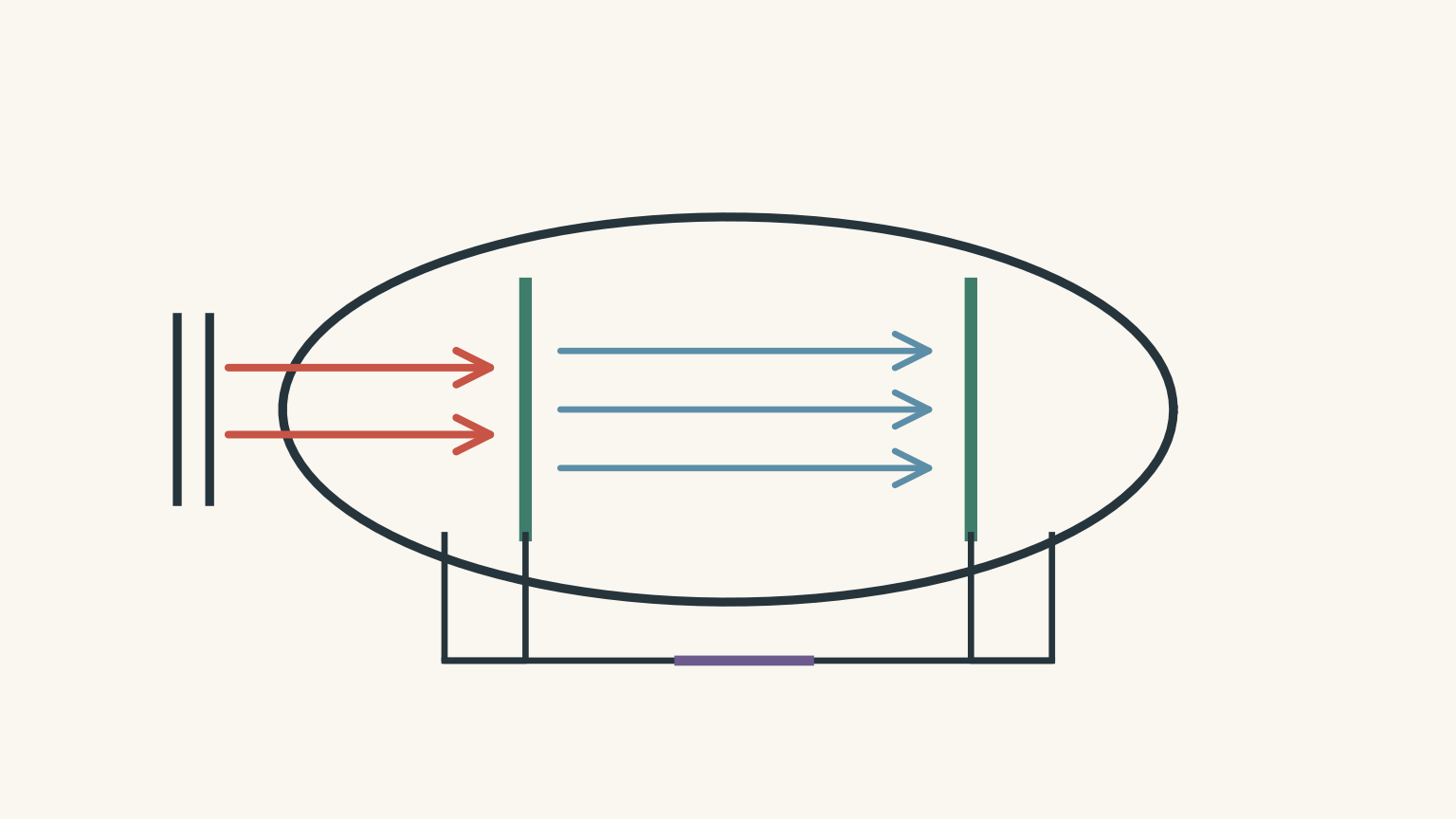
Picture a sealed glass tube containing two metal electrodes. One electrode is the photosensitive metal plate, called the cathode. A second electrode, called the anode, collects electrons that are emitted from the cathode. A circuit measures the current caused by moving electrons.
Light enters through a window and hits the cathode. If electrons are released, they travel through the vacuum towards the anode, creating a measurable current.
The key question was:
If light energy is delivered continuously, how long should an electron need to absorb enough energy to escape?
For low-intensity light, the wave model suggested there might be a delay. An electron would need time to collect enough energy.
The observation was different. Above a certain frequency of light, electrons were emitted almost immediately.
This did not prove the photon model by itself. It showed that the continuous energy-transfer idea had a serious problem.
03Einstein’s photon explanation
In 1905, Albert Einstein proposed that light energy is not always spread continuously. Instead, light can arrive as individual packets called photons.
Each photon has an energy:
\[ E = hf \]
where:
- \(E\) is the photon energy in joules (J),
- \(h\) is Planck’s constant, \(6.63 \times 10^{-34}\ \text{J s}\),
- \(f\) is the frequency of the light in hertz (Hz).
A photon hitting the metal gives its energy to one electron.
Some of this energy is used to remove the electron from the metal. This minimum required energy is called the work function.
The remaining energy becomes the kinetic energy of the emitted electron:
\[ hf = \phi + KE_{\text{max}} \]
where:
- \(\phi\) is the work function of the metal in joules,
- \(KE_{\text{max}}\) is the maximum kinetic energy of the emitted electrons in joules.
This equation is the heart of the photoelectric effect.
It explains the observations:
- higher frequency means higher photon energy,
- higher intensity means more photons arriving each second,
- electrons cannot escape unless each individual photon has enough energy.
A useful analogy is a person trying to enter a club with a cover charge. More people arriving at the door does not help if each person has too little money. The number of people is like light intensity. The money each person carries is like photon energy.
The analogy breaks down because photons are not little people, and electrons do not make decisions. The point is only that each incoming photon must individually satisfy the energy requirement.
04Threshold frequency: the minimum frequency that works
The experiments showed that every metal has a minimum frequency of light that can eject electrons. This is called the threshold frequency.
At the threshold frequency:
\[ hf_0 = \phi \]
where:
- \(f_0\) is the threshold frequency in hertz.
Below this frequency, increasing intensity does not help.
A common mistake is thinking:
“More red light should eventually eject electrons because the total energy becomes large.”
That feels reasonable because we often deal with objects absorbing energy over time. However, the photoelectric effect depends on individual photon energies. If each photon is below the required energy, no single electron receives enough energy to escape.
05Intensity changes the number of electrons, not their maximum energy
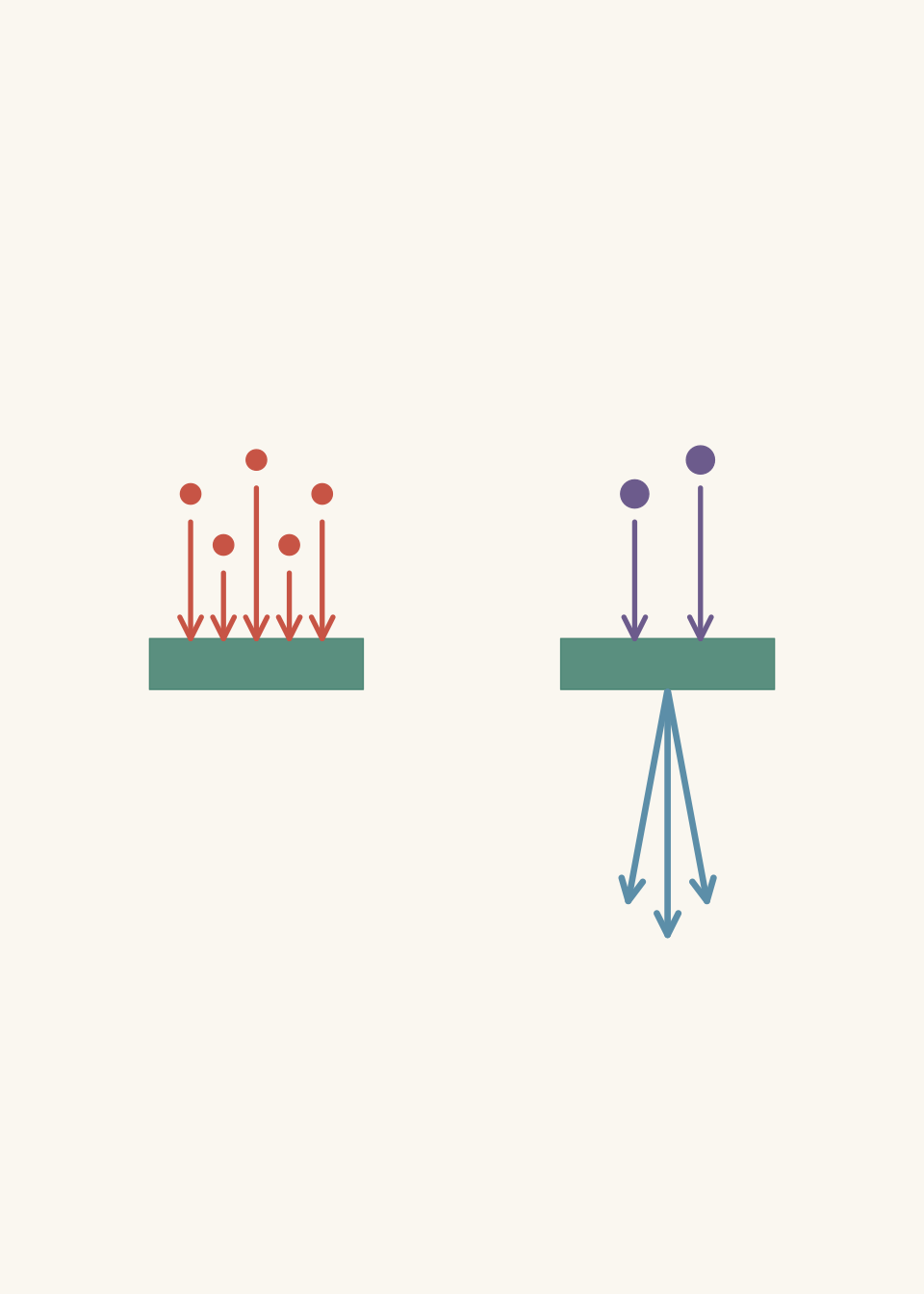
Once the frequency is above the threshold frequency, changing intensity changes the number of photons arriving each second.
More photons means:
- more electrons can be released each second,
- the current increases.
But the maximum kinetic energy depends on frequency:
\[ KE_{\text{max}} = hf - \phi \]
A brighter ultraviolet lamp produces more emitted electrons, but the fastest electrons do not become faster.
This distinction is one of the most tested ideas in the photoelectric effect.
| Change | What happens? | Why? |
|---|---|---|
| Increase frequency | Maximum electron energy increases | Each photon carries more energy |
| Increase intensity above threshold | Current increases | More photons arrive each second |
| Increase intensity below threshold | No electrons emitted | Each photon is still below the required energy |
| Increase stopping potential | Measures greater electron kinetic energy | More voltage is needed to stop faster electrons |
06Measuring electron energy: stopping potential
The apparatus could be modified to measure how much kinetic energy electrons had.
Instead of helping electrons reach the anode, the voltage could oppose their motion. This is called the stopping potential.
The voltage is increased until even the fastest electrons are stopped.
The electrical energy gained or lost by an electron is:
\[ KE_{\text{max}} = eV_s \]
where:
- \(e\) is the charge of an electron, \(1.60 \times 10^{-19}\ \text{C}\),
- \(V_s\) is the stopping potential in volts.
This measurement was important because it linked the frequency of light to electron energy.
Increasing intensity changed the current but did not change the stopping potential. Increasing frequency changed the stopping potential.
That observation strongly supported the photon model.
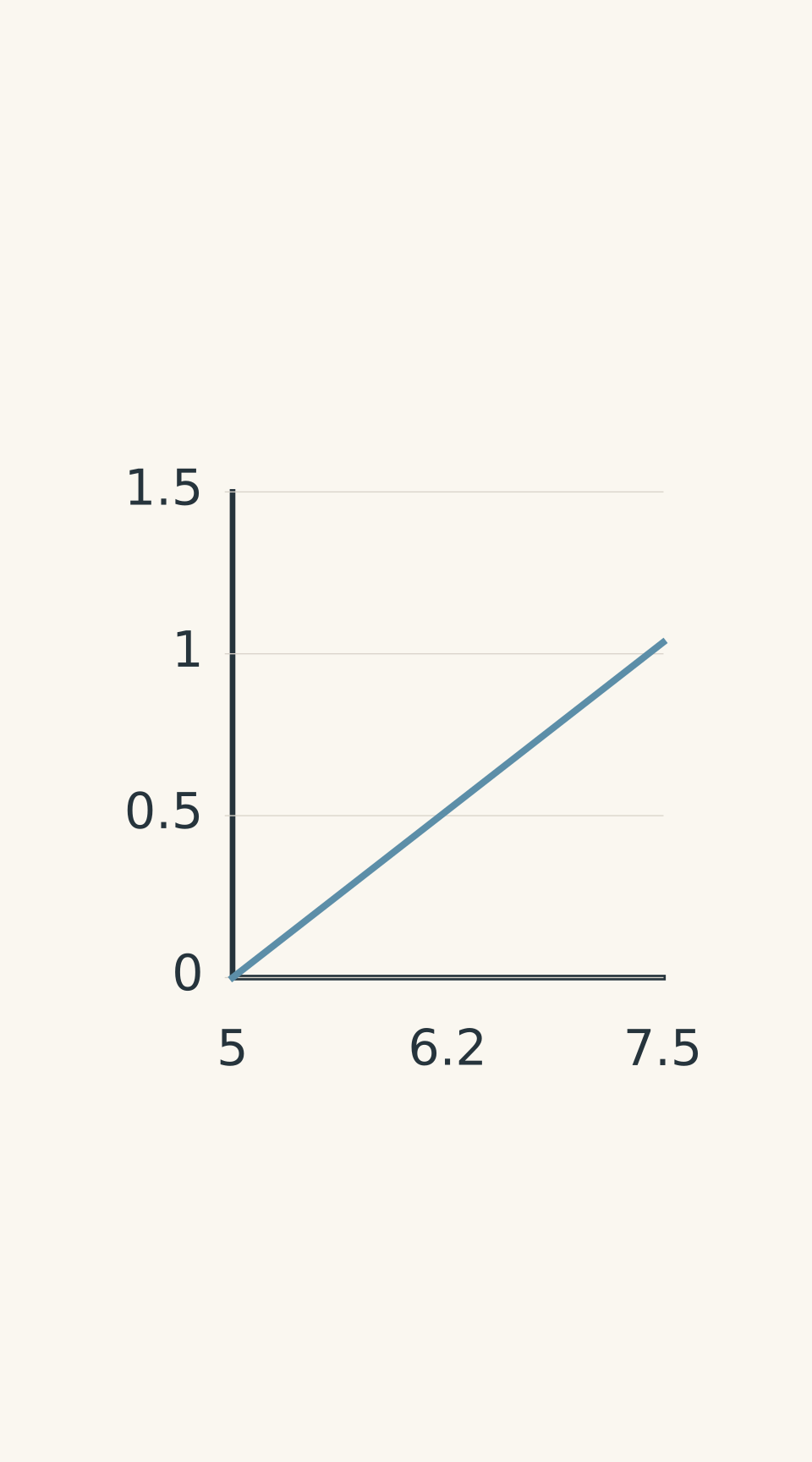
- Linear relationship (schematic)
- Threshold frequency f₀
07What each experiment actually proved
It is tempting to say “the photoelectric effect proved photons exist.” That is close, but a strong HSC response is more precise.
Different observations supported different conclusions.
Immediate emission
Observation:
Electrons were emitted without a noticeable delay.
Supported idea:
Energy is transferred in concentrated packets rather than slowly accumulated.
Threshold frequency
Observation:
No electrons are emitted below a certain frequency.
Supported idea:
Each photon must have enough energy to overcome the work function.
Intensity experiments
Observation:
Increasing intensity increased the number of electrons but not their maximum kinetic energy.
Supported idea:
Intensity controls photon number, while frequency controls photon energy.
Stopping potential experiments
Observation:
Stopping potential increased with frequency.
Supported idea:
Electron kinetic energy depends on photon energy.
No single measurement answered every question. The strength came from several observations agreeing with the same model.
08Worked example: finding the energy of a photon
A laser produces light with a frequency of \(6.0 \times 10^{14}\ \text{Hz}\). Calculate the energy of one photon.
Step 1
Use:
\[ E = hf \]
where \(h = 6.63 \times 10^{-34}\ \text{J s}\) and \(f = 6.0 \times 10^{14}\ \text{Hz}\).
Step 2
\[ E = (6.63 \times 10^{-34})(6.0 \times 10^{14}) \]
Step 3
\[ E = 3.98 \times 10^{-19}\ \text{J} \]
The energy of each photon is therefore:
\[ \boxed{3.98 \times 10^{-19}\ \text{J}} \]
This is a tiny amount of energy, but remember that individual photons interact with individual electrons.
09Worked example: finding the maximum kinetic energy of an electron
A metal has a work function of \(2.5 \times 10^{-19}\ \text{J}\). Light with frequency \(7.0 \times 10^{14}\ \text{Hz}\) shines on the metal. Find the maximum kinetic energy of emitted electrons.
Step 1
\[ E = hf \]
\[ E = (6.63 \times 10^{-34})(7.0 \times 10^{14}) \]
\[ E = 4.64 \times 10^{-19}\ \text{J} \]
Step 2
\[ hf = \phi + KE_{\text{max}} \]
Rearrange:
\[ KE_{\text{max}} = hf - \phi \]
Step 3
\[ KE_{\text{max}} = (4.64 \times 10^{-19})-(2.5 \times 10^{-19}) \]
\[ KE_{\text{max}} = 2.14 \times 10^{-19}\ \text{J} \]
The maximum kinetic energy is:
\[ \boxed{2.14 \times 10^{-19}\ \text{J}} \]
The important reasoning step is not the subtraction. It is recognising that the photon energy must first pay the work function before any energy remains for motion.
10Questions and solutions
Question 1
A metal surface has a threshold frequency of \(5.0 \times 10^{14}\ \text{Hz}\). Light with frequency \(6.0 \times 10^{14}\ \text{Hz}\) shines on the surface.
Calculate the maximum kinetic energy of emitted electrons if the work function is \(3.3 \times 10^{-19}\ \text{J}\).
Solution 1
The maximum kinetic energy is \(6.8 \times 10^{-20}\ \text{J}\).
The photon energy is:
\[ E = hf \]
\[ E=(6.63\times10^{-34})(6.0\times10^{14}) \]
\[ E=3.98\times10^{-19}\ \text{J} \]
The photoelectric equation gives:
\[ KE_{\text{max}}=hf-\phi \]
\[ KE_{\text{max}}=(3.98\times10^{-19})-(3.3\times10^{-19}) \]
\[ KE_{\text{max}}=6.8\times10^{-20}\ \text{J} \]
The tempting mistake is to use the threshold frequency as the frequency of the incoming light. The threshold frequency only tells us the minimum energy needed. The actual photon frequency determines the energy available.
Question 2
A student shines a very bright red light on a metal surface and observes no electrons being emitted. They then replace it with a dim ultraviolet light, and electrons are emitted immediately.
Explain why the second result occurs even though the ultraviolet light has a lower intensity.
Solution 2
The ultraviolet light ejects electrons because each ultraviolet photon has enough energy to overcome the work function, while each red photon does not.
Intensity describes the number of photons arriving each second. It does not increase the energy of each photon.
The red light may deliver more total energy per second, but that energy is divided among many photons that are each below the required energy. The ultraviolet photons have higher frequency, so each photon has greater energy according to \(E=hf\).
The key constraint is the energy of an individual photon, not the total energy arriving at the metal.
Question 3
A photoelectric experiment is performed using ultraviolet light. The intensity is doubled while the frequency stays constant.
Predict what happens to:
a) the photoelectric current,
b) the stopping potential,
c) the maximum kinetic energy of emitted electrons.
Solution 3
The current increases, but the stopping potential and maximum kinetic energy remain unchanged.
Doubling intensity means twice as many photons arrive each second. More photons means more electrons can be released, so the current increases.
However, the frequency has not changed, so each photon still has the same energy:
\[ E=hf \]
Therefore:
\[ KE_{\text{max}}=hf-\phi \]
also remains the same.
The common trap is assuming brighter light means more energetic electrons. That would match the old wave prediction, but the experiment shows frequency controls electron energy.
Question 4
Two different metals are tested with the same frequency of ultraviolet light. Metal A has a lower work function than Metal B.
Both metals emit electrons. Explain which metal produces electrons with the greater maximum kinetic energy and why.
Solution 4
Metal A produces electrons with the greater maximum kinetic energy because less photon energy is used to remove the electron.
For both metals:
\[ KE_{\text{max}}=hf-\phi \]
The photon energy \(hf\) is identical because the frequency is the same.
Metal A has a smaller \(\phi\), so more energy remains after overcoming the work function. Metal B uses more of the photon energy to release the electron.
A student might incorrectly focus on the fact that both metals receive identical light and expect identical electron energies. The missing idea is that the metal itself changes the energy cost of emission.
Question 5
A researcher wants to test whether increasing light intensity can make a below-threshold-frequency light source eject electrons from a metal.
They begin with light frequency \(f_1\), which is slightly below the threshold frequency \(f_0\). They increase the intensity by a factor of one million.
They observe no electrons.
They then slightly increase the frequency to \(f_2\), where \(f_2\) is only 1% greater than \(f_0\), and use a very low intensity. Electrons are emitted.
Explain why the second experiment works and the first cannot. Then describe what would happen to the maximum kinetic energy if the intensity of the second light source was increased while keeping \(f_2\) fixed.
Solution 5
The second experiment works because the individual photons have enough energy to exceed the work function, while the first experiment cannot work because each photon is still below the required energy.
For the first experiment:
\[ hf_1 < \phi \]
No individual photon can remove an electron. Increasing intensity only increases the number of unsuccessful photon interactions. A million weak photons do not combine their energies into one larger photon.
For the second experiment:
\[ hf_2 > \phi \]
Each photon has enough energy, so even a low number of photons can release electrons.
If the intensity of the second source increases, the maximum kinetic energy does not change. It remains:
\[ KE_{\text{max}}=hf_2-\phi \]
because the frequency, and therefore the energy of each photon, has not changed.
The subtle point is that the two experiments change different variables. Intensity changes how many opportunities electrons have to escape. Frequency changes whether each opportunity has enough energy.
11Where this leads next
The photoelectric effect changed the way physicists thought about light. It showed that light has particle-like behaviour, even though wave behaviour was still needed to explain interference and diffraction.
The next useful idea is wave-particle duality: understanding how the same thing can show wave-like and particle-like properties depending on the experiment being performed. This leads directly into ideas such as the de Broglie wavelength of matter and the broader quantum model of the atom.