
Why Brighter Light Doesn’t Increase Photoelectron Energy
Learn why brighter light increases photocurrent but does not increase the maximum kinetic energy of photoelectrons. Use Einstein’s photoelectric equation and stopping potential to distinguish the effects of intensity and frequency in HSC Physics.
You turn up the brightness of a lamp shining on a metal. The photocurrent increases, so you write that the emitted electrons must have greater maximum kinetic energy because the light is more intense. Your answer sounds reasonable, but it confuses two different things: how many photons arrive each second, and how much energy each photon carries.
Pause and predict: if the colour of the light stays exactly the same, should the stopping potential increase when you make the beam brighter? Keep your prediction in mind. The key is to separate the energy carried by one photon from the number of photons arriving at the metal.
01The mistake: confusing energy per photon with photons per second
Imagine each photon as a tiny courier carrying an energy parcel. The frequency of the light determines the size of each parcel. The intensity determines how much light energy arrives per second per unit area.
Sending twice as many couriers does not double the energy carried by each one. It simply gives the metal more opportunities to release electrons.
The analogy has a limit: photons are not little people, and an electron cannot normally collect energy from a crowd of individually insufficient photons in the standard HSC photoelectric model. A single photon must provide enough energy to release an electron from the metal.

- Photon (Eγ = hf)
- Photoelectron (Kmax = hf − φ)
This gives us the first distinction:
- Frequency determines the energy carried by each photon.
- Intensity, at a fixed frequency, determines how many photons arrive per second per unit area.
- The maximum kinetic energy of an emitted electron depends on the energy of an individual photon, not on how many other photons arrive alongside it.
Let’s make that precise.
02The equation that settles it
A photon carries energy according to
\[ E_\gamma = hf \]
where:
- \(E_\gamma\) is the energy of one photon, measured in joules (J).
- \(h\) is Planck’s constant, \(6.63\times10^{-34}\ \text{J s}\).
- \(f\) is the frequency of the light, measured in hertz (Hz).
Before an electron can escape a metal, it must overcome the metal’s work function, \(\phi\). This is the minimum energy needed to release an electron from the metal.
If the photon supplies more energy than the work function, the excess can become kinetic energy.
\[ K_{\max}=hf-\phi \]
Here, \(K_{\max}\) is the maximum kinetic energy of the emitted photoelectrons, measured in joules.
This is Einstein’s photoelectric equation, and it exposes the original mistake: intensity does not appear in the equation.
For a given metal, the work function stays fixed. If the frequency stays fixed, then \(hf\) stays fixed, too. Increasing intensity cannot change \(K_{\max}\).
What happens if the frequency increases?
Suppose the frequency increases from \(f_1\) to \(f_2\), with both frequencies above the threshold for emission.
For the same metal,
\[ \begin{aligned} K_{\max,1}&=hf_1-\phi\\ K_{\max,2}&=hf_2-\phi \end{aligned} \]
Subtracting gives
\[ \Delta K_{\max}=h\Delta f \]
So increasing frequency increases the maximum kinetic energy of the emitted electrons. The increase is proportional to the change in frequency.
Notice that this does not mean doubling the frequency necessarily doubles the maximum kinetic energy. The work function must still be subtracted.
The threshold frequency matters
A metal cannot emit photoelectrons unless an individual photon supplies at least the work function’s worth of energy in the standard HSC model.
The threshold frequency, \(f_0\), is the minimum frequency required for emission. At the threshold, the maximum kinetic energy is zero.
\[ hf_0=\phi \]
Therefore,
\[ f_0=\frac{\phi}{h} \]
Combining this with Einstein’s equation gives
\[ K_{\max}=h(f-f_0) \]
for frequencies at or above the threshold.
If \(f<f_0\), there is no photoelectric emission in this model, regardless of how intense the light becomes.
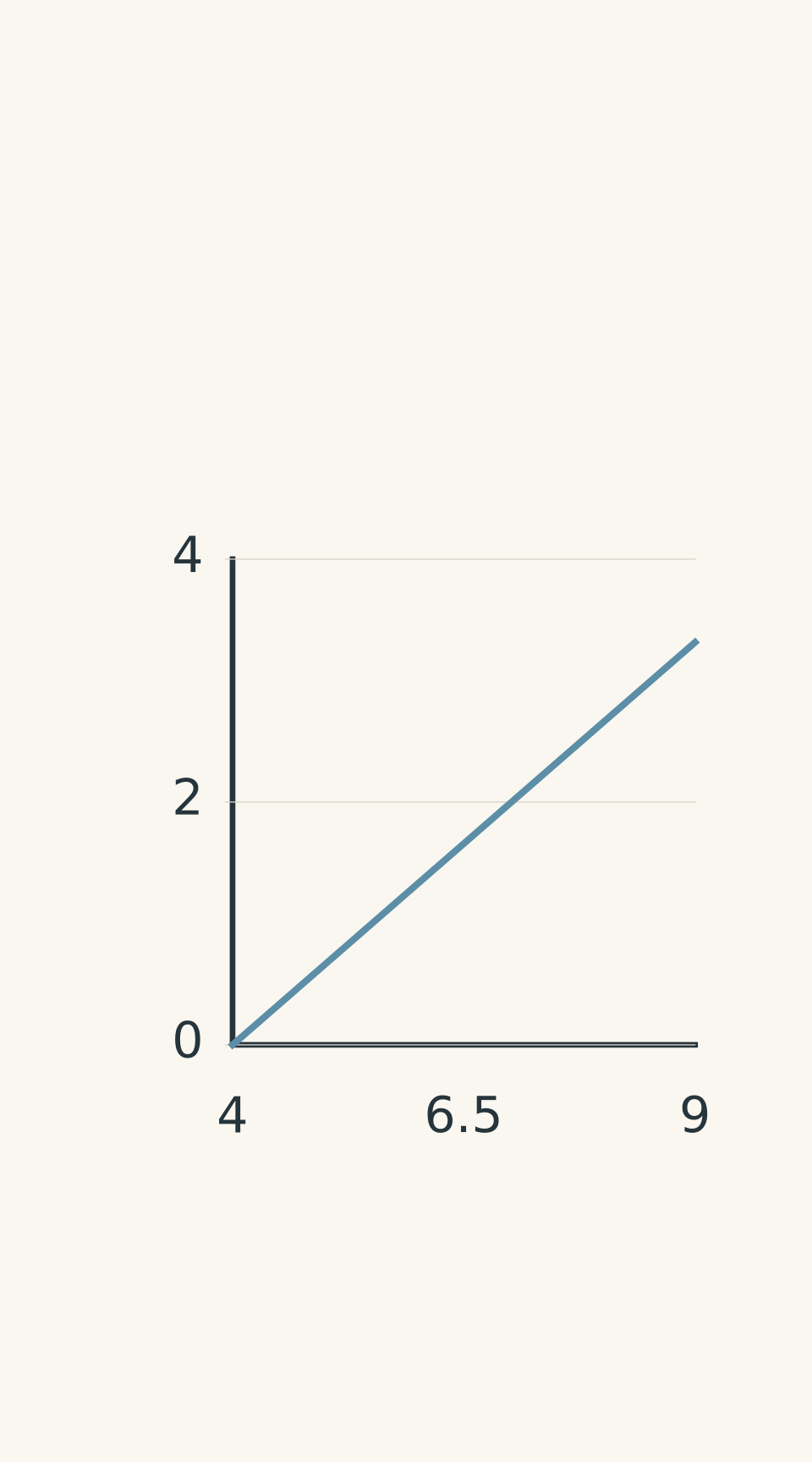
- Photoelectrons emitted
The graph makes an important point visible: maximum kinetic energy increases linearly with frequency, but the line does not pass through the origin. Its frequency-axis intercept is the threshold frequency.
That is why a memorised shortcut such as “double the frequency, double the kinetic energy” can fail.
03Intensity changes the rate of emission, not the maximum energy per electron
Now return to the original question. What happens when the light becomes brighter but its frequency stays constant?
The energy of each photon remains \(hf\). However, more photons arrive each second, assuming the illuminated area and frequency stay fixed.
Light intensity is the energy arriving per second per unit area. If we call the light intensity \(S\), the photon flux is
\[ \text{Photon flux}=\frac{S}{hf} \]
Photon flux is the number of photons arriving per unit area per second.
At a fixed frequency, doubling \(S\) doubles the photon flux. There are now twice as many opportunities for photons to release electrons.
Provided the emission efficiency and collection conditions remain unchanged, the photocurrent increases accordingly. The photocurrent measures the rate at which electric charge flows, so more emitted and collected electrons per second produce a larger current.
But each photon still carries the same energy. The maximum kinetic energy of the electrons therefore stays the same.
What the experiment measures
There are two different measurements to keep separate.
Photocurrent tells you about the rate of charge flow. It responds to how many photoelectrons are emitted and collected per second.
Stopping potential tells you about the maximum kinetic energy of the emitted electrons. It is the magnitude of the reverse voltage needed to prevent even the fastest photoelectrons from reaching the collector.
The relationship is
\[ K_{\max}=eV_0 \]
where:
- \(e=1.60\times10^{-19}\ \text{C}\) is the magnitude of the electron’s charge.
- \(V_0\) is the stopping potential, measured in volts (V).
- \(K_{\max}\) is expressed in joules when using this equation directly.
Some textbooks write \(K_{\max}=qV_0\), where \(q\) means the magnitude of the electron’s charge. Using \(e\) avoids confusion with the electron’s negative charge.
If the maximum kinetic energy is given in electronvolts (eV), its numerical value equals the stopping potential in volts. For example, a maximum kinetic energy of \(1.2\ \text{eV}\) corresponds to a stopping potential of \(1.2\ \text{V}\).
So, if intensity increases at a fixed frequency, the photocurrent can rise while the stopping potential stays unchanged.
Intensity and frequency affect different things
| Increase intensity at fixed frequency | Eγ = hf; Kₘₐₓ = hf − φ Photon energy, Kₘₐₓ, and stopping potential stay constant. Photon flux and photocurrent increase, assuming unchanged efficiency and collection. |
|---|---|
| Increase frequency above threshold | Eγ = hf; Kₘₐₓ = hf − φ Photon energy, Kₘₐₓ, and stopping potential increase. At fixed intensity, photon flux decreases; photocurrent depends on emission probability and collection. |
One qualification matters. The photocurrent does not have to increase in exact proportion to intensity in every real experiment. The simple proportional relationship assumes unchanged emission efficiency and suitable collection conditions. At fixed frequency, however, the central HSC prediction remains: intensity changes the emission rate, not the maximum kinetic energy.
04A decision method you can reuse in exams
When a question mentions brighter light, a different frequency, a stopping potential, or a photocurrent, work through these steps before substituting numbers.
Step 1: Identify what changed.
Did the question change the light intensity, the frequency, the wavelength, or the metal itself?
Do not treat these as interchangeable. If the metal changes, the work function may change. If the frequency changes, the energy per photon changes.
Step 2: Check whether photoemission is possible.
Use
\[ hf\geq\phi \]
If the photon energy is below the work function, no photoelectrons are emitted in the standard model. Making the light more intense does not fix this.
If wavelength is given instead, remember that
\[ f=\frac{c}{\lambda} \]
where \(c=3.00\times10^8\ \text{m s}^{-1}\) is the speed of light and \(\lambda\) is wavelength. A shorter wavelength means a higher frequency.
Step 3: If the question asks about maximum kinetic energy, use frequency.
\[ K_{\max}=hf-\phi \]
Do not multiply the answer by an intensity ratio. If the frequency and metal remain unchanged, the maximum kinetic energy remains unchanged.
Step 4: If the question asks about stopping potential, connect it to energy.
\[ V_0=\frac{K_{\max}}{e} \]
Calculate the maximum kinetic energy first, then determine the stopping potential. A larger photocurrent does not, by itself, imply a larger stopping potential.
Step 5: If the question asks about photocurrent, consider photon flux.
For light intensity \(S\),
\[ \text{Photon flux}=\frac{S}{hf} \]
At fixed frequency, greater intensity means more incident photons per second per unit area. This generally means a larger photocurrent if emission and collection conditions are unchanged.
If both frequency and intensity change, calculate how the photon flux changes before making a prediction about current. The emission efficiency can also vary with frequency, so the exact photocurrent may not be determined by intensity and frequency alone.
Photoelectric effect: exam decision process
- Identify what changes
Intensity S, frequency f, wavelength λ, or material work function φ.
Use f = c/λ when wavelength is given.
- Check the threshold
hf ≥ φ
Below threshold, no photoelectrons are emitted.
- Find maximum kinetic energy
Kₘₐₓ = hf − φ
Use photon energy minus work function.
- Find stopping potential
Kₘₐₓ = eV₀
V₀ = Kₘₐₓ/e; use joules and coulombs.
- Reason about photocurrent
Photon flux ∝ S/(hf)
Account for photon flux, emission probability, and collection.
- Final sanity check
Changing intensity alone at fixed frequency and material cannot change Kₘₐₓ or V₀.
Worked example: Brighten the beam without changing its colour
A metal has a work function of \(2.0\ \text{eV}\). Incident photons each have an energy of \(4.5\ \text{eV}\). The light intensity increases from \(4.0\ \text{W m}^{-2}\) to \(10.0\ \text{W m}^{-2}\), while the frequency and illuminated area remain unchanged.
Find the maximum kinetic energy and stopping potential before and after the change. Predict how the photocurrent changes, assuming constant emission efficiency and no collection limitations.
Step 1
The photon supplies \(4.5\ \text{eV}\), and \(2.0\ \text{eV}\) is needed to release the electron.
\[ \begin{aligned} K_{\max}&=hf-\phi\\ &=4.5-2.0\\ &=2.5\ \text{eV} \end{aligned} \]
A tempting but incorrect approach is to multiply \(2.5\ \text{eV}\) by the intensity ratio. That would give \(6.25\ \text{eV}\), but intensity does not determine the energy carried by each photon.
Step 2
First convert the maximum kinetic energy into joules.
\[ \begin{aligned} K_{\max}&=2.5(1.60\times10^{-19})\\ &=4.0\times10^{-19}\ \text{J} \end{aligned} \]
Using \(K_{\max}=eV_0\),
\[ \begin{aligned} V_0&=\frac{K_{\max}}{e}\\ &=\frac{4.0\times10^{-19}} {1.60\times10^{-19}}\\ &=2.5\ \text{V} \end{aligned} \]
Step 3
The intensity ratio is
\[ \frac{S_2}{S_1}=\frac{10.0}{4.0}=2.5 \]
Since the frequency is unchanged, the photon flux increases by a factor of \(2.5\). Under the stated assumptions, the photocurrent also increases by a factor of \(2.5\).
Step 4
The maximum kinetic energy remains \(2.5\ \text{eV}\), and the stopping potential remains \(2.5\ \text{V}\). The photocurrent increases by a factor of \(2.5\).
The beam delivers more photons per second, not more energy per photon.
Worked example: Increase the frequency and calculate the stopping potential
A metal has a threshold frequency of \(4.8\times10^{14}\ \text{Hz}\). It is illuminated with light of frequency \(6.8\times10^{14}\ \text{Hz}\).
Calculate the maximum kinetic energy and stopping potential. The frequency is then increased to \(7.8\times10^{14}\ \text{Hz}\), with the light intensity held constant. Find the new values and explain what can be concluded about the photocurrent.
Use \(h=6.63\times10^{-34}\ \text{J s}\) and \(e=1.60\times10^{-19}\ \text{C}\).
Step 1
The initial frequency exceeds the threshold frequency, so photoemission occurs.
\[ \begin{aligned} K_{\max,1}&=h(f_1-f_0)\\ &=(6.63\times10^{-34}) (2.0\times10^{14})\\ &=1.326\times10^{-19}\ \text{J} \end{aligned} \]
Convert to electronvolts:
\[ K_{\max,1} =\frac{1.326\times10^{-19}} {1.60\times10^{-19}} =0.829\ \text{eV} \]
Step 2
\[ \begin{aligned} V_{0,1}&=\frac{K_{\max,1}}{e}\\ &=\frac{1.326\times10^{-19}} {1.60\times10^{-19}}\\ &=0.829\ \text{V} \end{aligned} \]
Step 3
The new frequency is \(7.8\times10^{14}\ \text{Hz}\), so the difference from the threshold is \(3.0\times10^{14}\ \text{Hz}\).
\[ \begin{aligned} K_{\max,2}&=h(f_2-f_0)\\ &=(6.63\times10^{-34}) (3.0\times10^{14})\\ &=1.989\times10^{-19}\ \text{J}\\ &=1.24\ \text{eV} \end{aligned} \]
Step 4
\[ V_{0,2} =\frac{1.989\times10^{-19}} {1.60\times10^{-19}} =1.24\ \text{V} \]
The higher frequency has increased both the maximum kinetic energy and the stopping potential.
Step 5
The intensity is unchanged, but each photon now carries more energy. Since photon flux is proportional to \(S/(hf)\), the ratio of the new photon flux to the initial photon flux is
\[ \frac{F_2}{F_1} =\frac{f_1}{f_2} =\frac{6.8}{7.8} \approx0.872 \]
The incident photon flux has decreased by about \(13\%\). If the emission efficiency stays constant, the photocurrent decreases by about \(13\%\) as well. If the efficiency changes with frequency, the exact photocurrent cannot be determined from the information given.
This is the reverse of the common mistake: increasing frequency can increase the maximum kinetic energy even when the number of incident photons per second decreases.
05Common wording changes that catch students out
| Exam wording | Correct reasoning |
|---|---|
| Intensity doubles at fixed frequency. | Photon flux increases; \(K_{\max}\) and \(V_0\) stay constant. |
| Frequency doubles. | Photon energy doubles, but \(K_{\max}=hf-\phi\), so maximum kinetic energy does not generally double. |
| Wavelength halves. | Frequency doubles, so calculate the new maximum kinetic energy rather than doubling the old answer. |
| Very intense light is below the threshold frequency. | No photoelectrons are emitted in the standard single-photon model. |
| The photocurrent doubles. | More charge is flowing per second; this does not mean the maximum kinetic energy doubles. |
| Frequency increases at constant intensity. | Each photon carries more energy, but fewer photons arrive per second per unit area. The current is not determined by frequency alone. |
06Questions and solutions
Question 1
A metal has a work function of \(2.4\ \text{eV}\). It is illuminated by photons with energy \(3.1\ \text{eV}\).
(a) Calculate the maximum kinetic energy of the emitted electrons.
(b) Calculate the stopping potential.
(c) If the light intensity doubles while the frequency and illuminated area remain unchanged, what happens to the maximum kinetic energy, stopping potential, and photocurrent? Assume constant emission efficiency and no saturation or collection limitations.
Solution 1
The maximum kinetic energy is \(0.70\ \text{eV}\), and the stopping potential is \(0.70\ \text{V}\). Doubling the intensity leaves both unchanged but doubles the photocurrent under the stated assumptions.
(a) Maximum kinetic energy
\[ \begin{aligned} K_{\max}&=hf-\phi\\ &=3.1-2.4\\ &=0.70\ \text{eV} \end{aligned} \]
Converting to joules,
\[ K_{\max}=0.70(1.60\times10^{-19}) =1.12\times10^{-19}\ \text{J} \]
(b) Stopping potential
\[ \begin{aligned} V_0&=\frac{K_{\max}}{e}\\ &=\frac{1.12\times10^{-19}} {1.60\times10^{-19}}\\ &=0.70\ \text{V} \end{aligned} \]
(c) Effect of doubling intensity
At fixed frequency, the energy of each photon remains constant. The maximum kinetic energy therefore stays at \(0.70\ \text{eV}\), and the stopping potential stays at \(0.70\ \text{V}\).
The photon flux doubles. With constant emission efficiency and unchanged collection conditions, the number of collected electrons per second doubles, so the photocurrent doubles.
The trap is to confuse the number of electrons emitted with the energy carried by each electron.
Question 2
A metal has a threshold wavelength of \(620\ \text{nm}\). It is illuminated first with light of wavelength \(500\ \text{nm}\), then with light of wavelength \(250\ \text{nm}\).
Using \(hc\approx1240\ \text{eV nm}\), calculate the maximum kinetic energy and stopping potential in each case.
A student argues that halving the wavelength must double the maximum kinetic energy. Explain the error.
Solution 2
The maximum kinetic energies are \(0.48\ \text{eV}\) and \(2.96\ \text{eV}\), respectively. The stopping potentials are \(0.48\ \text{V}\) and \(2.96\ \text{V}\). The maximum kinetic energy does not double because the work function must be subtracted from the photon energy.
Step 1: Calculate the work function.
At the threshold wavelength, the photon energy equals the work function.
\[ \begin{aligned} \phi&=\frac{hc}{\lambda_0}\\ &=\frac{1240}{620}\\ &=2.00\ \text{eV} \end{aligned} \]
Step 2: Calculate the result at \(500\ \text{nm}\).
The photon energy is
\[ E_{\gamma,1}=\frac{1240}{500} =2.48\ \text{eV} \]
Therefore,
\[ K_{\max,1}=2.48-2.00 =0.48\ \text{eV} \]
Since kinetic energy in eV has the same numerical value as the stopping potential in volts,
\[ V_{0,1}=0.48\ \text{V} \]
Step 3: Calculate the result at \(250\ \text{nm}\).
The photon energy is
\[ E_{\gamma,2}=\frac{1240}{250} =4.96\ \text{eV} \]
Therefore,
\[ K_{\max,2}=4.96-2.00 =2.96\ \text{eV} \]
Hence,
\[ V_{0,2}=2.96\ \text{V} \]
Step 4: Explain the misconception.
Halving the wavelength doubles the frequency, so the photon energy doubles from \(2.48\ \text{eV}\) to \(4.96\ \text{eV}\).
However, the work function remains \(2.00\ \text{eV}\). The first beam has only \(0.48\ \text{eV}\) left after releasing an electron, whereas the second has \(2.96\ \text{eV}\) left.
The photon energy doubles, but the maximum kinetic energy does not. The work function is a fixed energy cost, not a quantity that scales with frequency.
Question 3
Stopping-potential measurements for the same metal give the following results:
- At \(f_1=6.0\times10^{14}\ \text{Hz}\), \(V_{0,1}=0.80\ \text{V}\).
- At \(f_2=8.0\times10^{14}\ \text{Hz}\), \(V_{0,2}=1.63\ \text{V}\).
(a) Use the data to estimate Planck’s constant from the slope of stopping potential against frequency.
(b) Estimate the work function and threshold frequency.
(c) Explain why changing the light intensity alone cannot account for the increase in stopping potential.
Use \(e=1.60\times10^{-19}\ \text{C}\).
Solution 3
The measurements give \(h\approx6.64\times10^{-34}\ \text{J s}\), a work function of approximately \(1.69\ \text{eV}\), and a threshold frequency of approximately \(4.07\times10^{14}\ \text{Hz}\). The stopping potential increases because the maximum kinetic energy increases with frequency, not because of intensity alone.
(a) Estimate Planck’s constant.
Start with the photoelectric equation and stopping-potential relationship:
\[ eV_0=hf-\phi \]
For two measurements of the same metal, the work function cancels when the equations are subtracted.
\[ e\Delta V_0=h\Delta f \]
Therefore,
\[ \begin{aligned} h&=\frac{e\Delta V_0}{\Delta f}\\ &=\frac{(1.60\times10^{-19})(1.63-0.80)} {(8.0-6.0)\times10^{14}}\\ &=6.64\times10^{-34}\ \text{J s} \end{aligned} \]
This is consistent with the accepted value of Planck’s constant, allowing for rounding in the measurements.
(b) Calculate the work function.
Rearrange the equation:
\[ \phi=hf-eV_0 \]
Using the first measurement,
\[ \begin{aligned} \phi&=(6.64\times10^{-34})(6.0\times10^{14})\\ &\quad -(1.60\times10^{-19})(0.80)\\ &=2.704\times10^{-19}\ \text{J} \end{aligned} \]
Convert to electronvolts:
\[ \phi=\frac{2.704\times10^{-19}} {1.60\times10^{-19}} \approx1.69\ \text{eV} \]
The threshold frequency is
\[ \begin{aligned} f_0&=\frac{\phi}{h}\\ &=\frac{2.704\times10^{-19}} {6.64\times10^{-34}}\\ &\approx4.07\times10^{14}\ \text{Hz} \end{aligned} \]
Both incident frequencies exceed this threshold, so photoemission is possible in both cases.
(c) Explain the change in stopping potential.
The stopping potential measures the maximum kinetic energy through \(K_{\max}=eV_0\). Increasing it from \(0.80\ \text{V}\) to \(1.63\ \text{V}\) means the maximum kinetic energy has increased.
An intensity change at a fixed frequency cannot produce this result in the standard photoelectric model. The photon energy would remain constant, as would the work function. The change in stopping potential is consistent with the higher photon frequency.
Question 4
In a photoelectric experiment, the light frequency and metal remain unchanged. The intensity is increased by a factor of three. The saturation photocurrent rises from \(0.20\ \text{mA}\) to \(0.60\ \text{mA}\), while the stopping potential remains at \(1.4\ \text{V}\).
A student makes two claims:
(i) The maximum kinetic energy per electron has tripled.
(ii) The total kinetic energy carried by the emitted electrons per second must have tripled.
Evaluate both claims. For the second claim, distinguish what the measurements establish from what requires an additional assumption about the energy distribution of the electrons.
Solution 4
Claim (i) is false. Claim (ii) is not established by the measurements alone, although it follows if the energy distribution per electron remains unchanged.
Claim (i): Maximum kinetic energy
The stopping potential remains at \(1.4\ \text{V}\). Therefore,
\[ \begin{aligned} K_{\max}&=eV_0\\ &=(1.60\times10^{-19})(1.4)\\ &=2.24\times10^{-19}\ \text{J}\\ &=1.4\ \text{eV} \end{aligned} \]
The maximum kinetic energy has not tripled. It remains \(1.4\ \text{eV}\).
The photocurrent triples because more charge is collected per second, not because each electron has three times the maximum kinetic energy.
Claim (ii): Total kinetic energy transferred per second
The saturation photocurrent indicates that the rate of charge collection has tripled. Since every electron carries the same magnitude of charge, the number of collected electrons per second has also tripled.
However, the stopping potential gives the maximum kinetic energy, not the average kinetic energy of all the emitted electrons. The current measures the electron rate, not the kinetic energy of each electron.
If the energy distribution per electron remains unchanged, the average kinetic energy stays constant. Three times as many electrons per second would then carry three times as much total kinetic energy per second.
But that conclusion requires the additional assumption that the energy distribution is unchanged. It cannot be established from the current and stopping potential measurements alone.
The key distinction is between energy per electron and total energy transferred per second.
Question 5
Two light beams illuminate the same metal over the same area. Both frequencies are above the threshold frequency.
- Beam A has frequency \(f\) and intensity \(S\).
- Beam B has frequency \(2f\) and intensity \(2S\).
A student predicts that beam B must produce both twice the stopping potential and twice the saturation photocurrent.
(a) Determine the ratio \(V_{0,B}/V_{0,A}\) in terms of the work function \(\phi\) and the maximum kinetic energy \(K_{\max,A}\). Assume \(\phi>0\).
(b) Compare the photon fluxes of the two beams.
(c) State what the ideal constant-quantum-efficiency model predicts for the saturation photocurrents, and explain why the real currents are not necessarily identical.
Solution 5
The stopping potential for beam B is greater than twice that for beam A, not exactly twice. The two beams have equal photon fluxes, so their saturation photocurrents are equal in the ideal model if the quantum efficiency is the same. In a real experiment, frequency-dependent emission efficiency can make the currents differ.
(a) Compare the stopping potentials.
For beam A, the maximum kinetic energy is
\[ K_{\max,A}=hf-\phi \]
For beam B, the frequency is \(2f\), so
\[ K_{\max,B}=2hf-\phi \]
The tempting shortcut is to double \(K_{\max,A}\). But doing that gives
\[ 2K_{\max,A}=2hf-2\phi \]
This subtracts the work function twice. The actual expression for beam B subtracts it only once.
Since \(hf=K_{\max,A}+\phi\),
\[ \begin{aligned} K_{\max,B} &=2(K_{\max,A}+\phi)-\phi\\ &=2K_{\max,A}+\phi \end{aligned} \]
Using \(K_{\max}=eV_0\),
\[ \frac{V_{0,B}}{V_{0,A}} =\frac{K_{\max,B}}{K_{\max,A}} \]
Therefore,
\[ \boxed{ \frac{V_{0,B}}{V_{0,A}} =2+\frac{\phi}{K_{\max,A}} } \]
The work function and maximum kinetic energy must be expressed in the same energy units in this ratio.
Since \(\phi>0\) and beam A is above threshold, \(K_{\max,A}>0\). Consequently,
\[ \frac{V_{0,B}}{V_{0,A}}>2 \]
The stopping potential increases by more than a factor of two. The fixed energy required to release an electron makes the relationship different from simple direct proportionality through the origin.
(b) Compare the photon fluxes.
Photon flux is proportional to the light intensity divided by the energy of each photon.
For beam A,
\[ F_A=\frac{S}{hf} \]
For beam B,
\[ F_B=\frac{2S}{h(2f)} =\frac{S}{hf} \]
Hence,
\[ F_B=F_A \]
Although beam B has twice the intensity, each photon carries twice the energy. The two changes cancel when calculating the number of incident photons per second per unit area.
(c) Predict the saturation photocurrents.
In the ideal constant-quantum-efficiency model, the same fraction of incident photons produces emitted electrons at both frequencies. Since the photon fluxes and illuminated areas are equal, the rates of photoelectron emission are equal.
Therefore,
\[ I_{\text{sat},B}=I_{\text{sat},A} \]
The student’s prediction of twice the saturation photocurrent is not supported by this model.
In a real experiment, quantum efficiency can vary with frequency. Equal photon fluxes therefore do not guarantee identical photocurrents unless the emission efficiencies are also equal. The important point is that intensity alone does not determine the current when the frequency changes as well.
The next useful step is to read a graph of stopping potential against frequency. Its gradient gives \(h/e\), and its frequency-axis intercept gives the threshold frequency. Keep that graph separate from photocurrent measurements: stopping potential reveals the maximum energy per electron, while photocurrent reveals the rate of charge collection.