
Calculate Standard Cell Potential and Predict Redox Reactions
Learn how standard reduction potentials determine cell voltage and whether a redox reaction is spontaneous. Follow worked examples and practice questions using the cell-potential equation.
A magnesium strip is placed into a solution containing copper ions. You know from experience with the reactivity series that magnesium is more reactive than copper, so the reaction should happen:
\[ \ce{Mg(s) + Cu^2+(aq) -> Mg^2+(aq) + Cu(s)} \]
But how much more likely is it to happen? And what if you compare copper with silver, or iron with zinc? A reactivity series gives you a ranking, but it does not tell you the size of the driving force.
Electrochemistry gives us a number for that driving force: the cell potential.
A positive cell potential tells you that a redox reaction is spontaneous under standard conditions. A negative cell potential tells you the reaction is not spontaneous in the direction written.
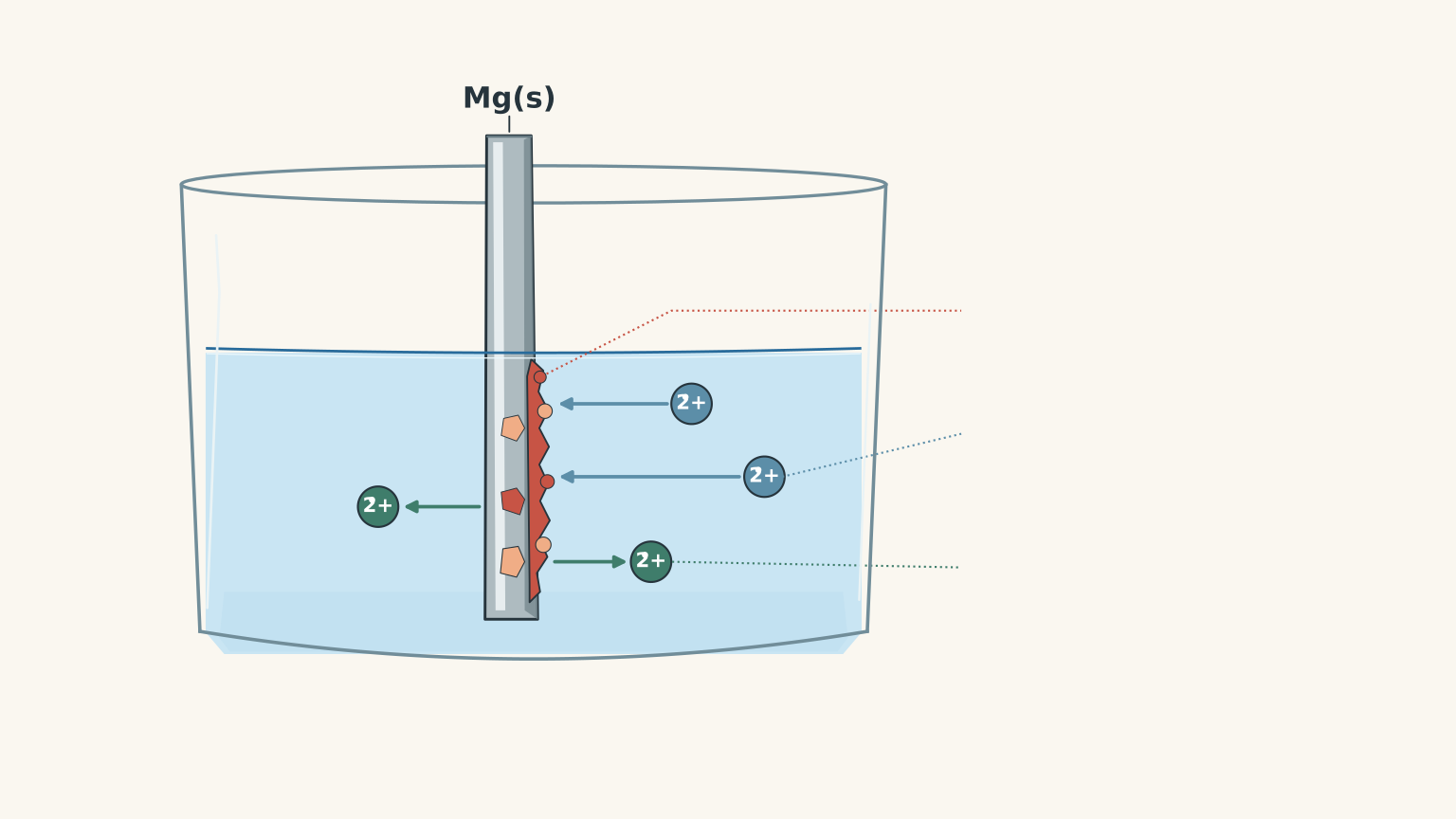
Before calculating anything, predict this: if a reaction transfers electrons from one substance to another, which substance should be the electron donor?
The answer is the substance that is more easily oxidised. It loses electrons and becomes a positive ion. The other substance gains those electrons and is reduced.
This idea is the foundation of using cell potentials.
01From electron transfer to a voltage
A redox reaction can be split into two half-equations.
For magnesium reacting with copper ions:
\[ \ce{Mg(s) -> Mg^2+(aq) + 2e^-} \]
Magnesium loses electrons, so it is oxidised.
\[ \ce{Cu^2+(aq) + 2e^- -> Cu(s)} \]
Copper ions gain electrons, so they are reduced.
These two half-reactions are happening at different places in an electrochemical cell. Because electrons have a tendency to move from one substance to another, we can measure a potential difference, or voltage, between them.
Think of it like two people deciding whether to swap something valuable. A person who strongly wants to give away their item and a person who strongly wants to receive it create a bigger push for the exchange.
The analogy is useful because it shows the idea of a “push” for electron transfer. However, electrons are not making decisions or forming relationships. The actual cause is the difference in chemical energy between reactants and products.
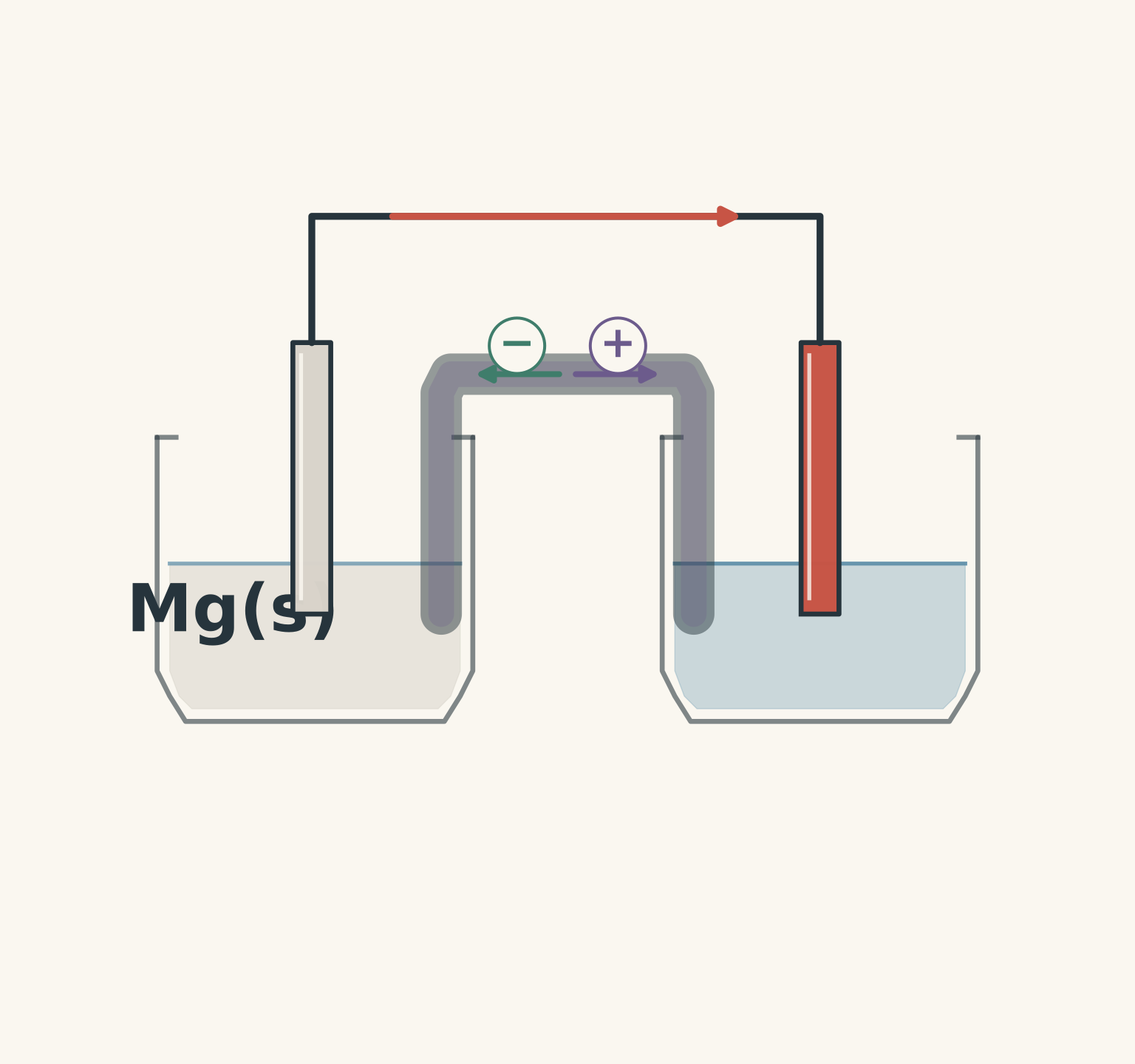
The voltage produced by a cell depends on the difference between the two half-cells.
Chemists measure each half-cell using a reference called the standard hydrogen electrode and record the value as a standard reduction potential, written as \(E^\circ\).
The key word is reduction.
Every listed value represents a reduction reaction:
\[ \ce{Cu^2+(aq) + 2e^- -> Cu(s)} \]
with a standard reduction potential:
\[ E^\circ = +0.34\text{ V} \]
A more positive reduction potential means a substance has a stronger tendency to gain electrons.
02Reading a reduction potential table
A standard reduction potential table is really a ranking of electron attraction.
| Half-equation | Standard reduction potential |
|---|---|
| \(\ce{Au^3+ + 3e^- -> Au}\) | +1.50 V |
| \(\ce{Cu^2+ + 2e^- -> Cu}\) | +0.34 V |
| \(\ce{2H+ + 2e^- -> H2}\) | 0.00 V |
| \(\ce{Zn^2+ + 2e^- -> Zn}\) | -0.76 V |
| \(\ce{Mg^2+ + 2e^- -> Mg}\) | -2.37 V |
A common mistake is thinking a negative value means the reaction cannot happen.
That is not true.
The value only describes the reaction as written: reduction.
For example:
\[ \ce{Mg^2+ + 2e^- -> Mg} \]
has a very negative value. Magnesium ions do not strongly want to gain electrons.
The reverse reaction is much more favourable:
\[ \ce{Mg -> Mg^2+ + 2e^-} \]
Magnesium metal is easily oxidised.
This is why reactive metals are good reducing agents.
03Calculating cell potential
The cell potential is calculated using:
\[ E^\circ_{\text{cell}} = E^\circ_{\text{cathode}} - E^\circ_{\text{anode}} \]
where:
- \(E^\circ_{\text{cell}}\) is the overall cell potential in volts (V)
- \(E^\circ_{\text{cathode}}\) is the reduction potential of the cathode, where reduction occurs
- \(E^\circ_{\text{anode}}\) is the reduction potential of the anode, where oxidation occurs
The cathode is always where reduction happens.
The anode is always where oxidation happens.
A quick decision rule:
- Find the two reduction potentials.
- The more positive value stays as the reduction reaction.
- The more negative value is reversed to become oxidation.
- Calculate \(E^\circ_{\text{cell}}\).
If the final value is:
- \(E^\circ_{\text{cell}} > 0\): spontaneous reaction
- \(E^\circ_{\text{cell}} < 0\): non-spontaneous reaction as written
- \(E^\circ_{\text{cell}} = 0\): equilibrium under standard conditions
04Why balancing electrons does not change the cell potential
Students often make a mistake here.
Suppose aluminium reacts with copper ions:
\[ \ce{Al -> Al^3+ + 3e^-} \]
and:
\[ \ce{Cu^2+ + 2e^- -> Cu} \]
To combine them, you need six electrons:
\[ \ce{2Al -> 2Al^3+ + 6e^-} \]
\[ \ce{3Cu^2+ + 6e^- -> 3Cu} \]
The balanced reaction is:
\[ \ce{2Al + 3Cu^2+ -> 2Al^3+ + 3Cu} \]
But the cell potential is not multiplied by 2 or 3.
Why?
Because voltage measures energy per unit charge. Changing the number of electrons changes the total amount of energy available, but not the energy per electron transferred.
05Worked example: Predicting whether magnesium reacts with copper ions
Question
Use standard reduction potentials to determine whether the reaction below is spontaneous.
\[ \ce{Mg(s) + Cu^2+(aq) -> Mg^2+(aq) + Cu(s)} \]
Given:
\[ E^\circ(\ce{Cu^2+/Cu}) = +0.34\text{ V} \]
\[ E^\circ(\ce{Mg^2+/Mg}) = -2.37\text{ V} \]
Step 1
Copper ions gain electrons:
\[ \ce{Cu^2+ + 2e^- -> Cu} \]
so copper is the cathode.
Magnesium loses electrons:
\[ \ce{Mg -> Mg^2+ + 2e^-} \]
so magnesium is the anode.
Step 2
\[ E^\circ_{\text{cell}} = E^\circ_{\text{cathode}} - E^\circ_{\text{anode}} \]
\[ E^\circ_{\text{cell}} = (+0.34) - (-2.37) \]
Step 3
\[ E^\circ_{\text{cell}} = +2.71\text{ V} \]
Step 4
The cell potential is positive, so the reaction is spontaneous under standard conditions.
Magnesium transfers electrons to copper ions because magnesium has a much stronger tendency to be oxidised.
06Worked example: Comparing two possible oxidising agents
Question
A student wants to use either zinc ions or silver ions to oxidise iron metal. Which reaction is spontaneous?
Data:
\[ E^\circ(\ce{Ag+ / Ag}) = +0.80\text{ V} \]
\[ E^\circ(\ce{Zn^2+/Zn}) = -0.76\text{ V} \]
\[ E^\circ(\ce{Fe^2+/Fe}) = -0.44\text{ V} \]
Consider:
Reaction A:
\[ \ce{Fe(s) + 2Ag+(aq) -> Fe^2+(aq) + 2Ag(s)} \]
Reaction B:
\[ \ce{Fe(s) + Zn^2+(aq) -> Fe^2+(aq) + Zn(s)} \]
Step 1
Silver ions are reduced:
\[ E^\circ_{\text{cathode}}=+0.80\text{ V} \]
Iron is oxidised:
\[ E^\circ_{\text{anode}}=-0.44\text{ V} \]
\[ E^\circ_{\text{cell}}=0.80-(-0.44) \]
\[ E^\circ_{\text{cell}}=+1.24\text{ V} \]
Step 2
Zinc ions are reduced:
\[ E^\circ_{\text{cathode}}=-0.76\text{ V} \]
Iron is oxidised:
\[ E^\circ_{\text{anode}}=-0.44\text{ V} \]
\[ E^\circ_{\text{cell}}=-0.76-(-0.44) \]
\[ E^\circ_{\text{cell}}=-0.32\text{ V} \]
Step 3
Reaction A is spontaneous because it has a positive cell potential.
Reaction B is not spontaneous in the direction written.
The trap is assuming zinc metal and iron metal are both reactive, so zinc ions should automatically react with iron. The table shows the opposite: zinc ions have a stronger resistance to being reduced than iron ions do.
07Connecting cell potentials to redox reactions
Cell potentials are a more precise version of ideas you have already used.
A metal displacement reaction asks:
“Will this metal remove another metal from solution?”
A cell potential calculation asks:
“How strong is the driving force for this electron transfer?”
You can review the connection between these ideas in Metal Displacement Reactions: Predicting HSC Chemistry Changes and the electron-transfer ideas behind oxidation and reduction in Oxidation and Reduction by Electron Transfer: HSC Chemistry.
08Common misconceptions
“A negative reduction potential means the reaction cannot occur”
A negative reduction potential means the species is unlikely to be reduced.
For example, magnesium ions have little tendency to gain electrons. Magnesium metal, however, strongly tends to lose electrons.
Always ask: “Is this reaction written as oxidation or reduction?”
“The larger the number of electrons, the larger the voltage”
Voltage does not depend on the number of electrons transferred.
Doubling the balanced equation doubles the total chemical energy, but the potential difference stays the same.
“The cathode is always positive”
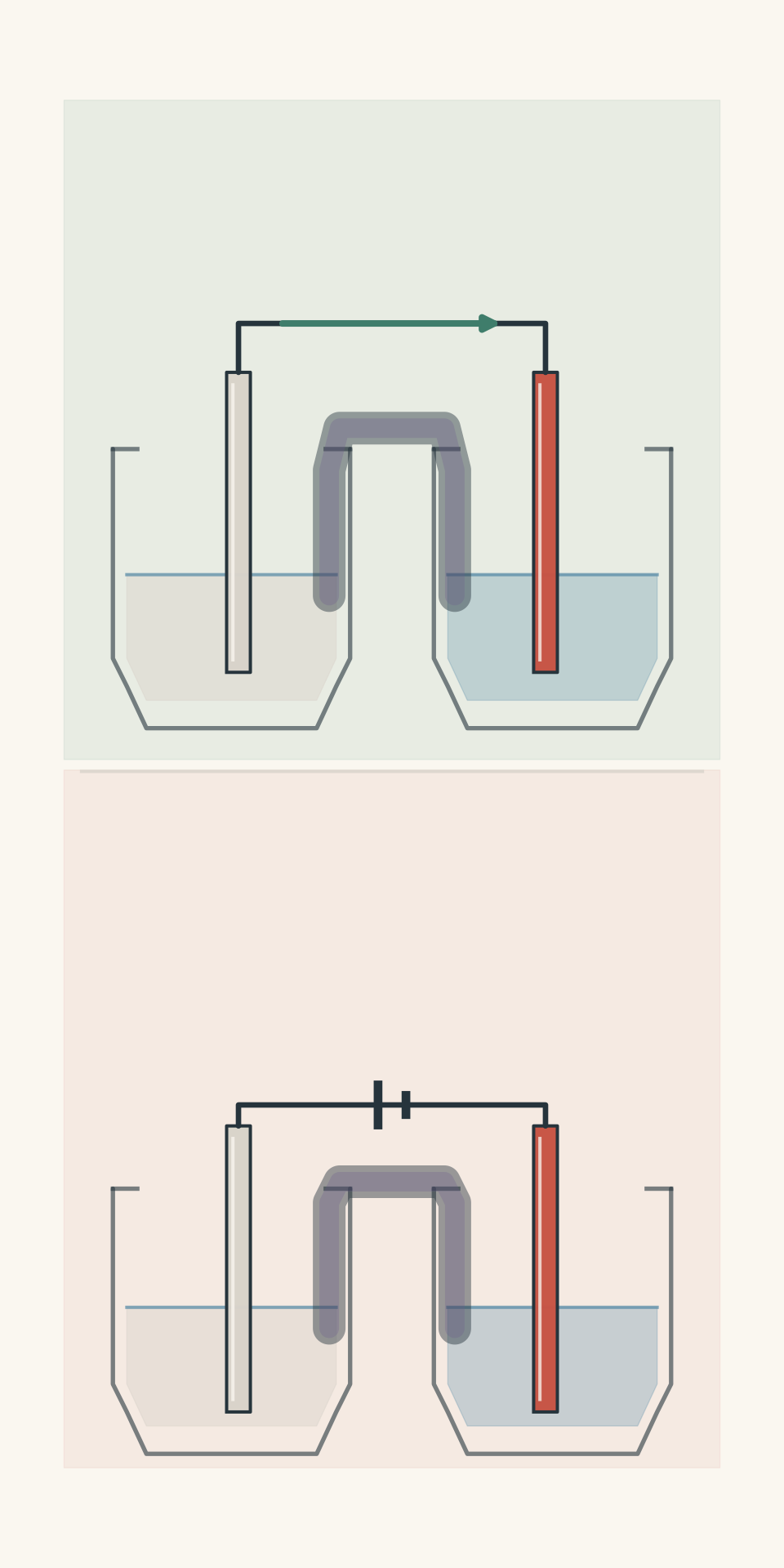
In a spontaneous galvanic cell, the cathode is positive because electrons flow away from the negative anode.
However, the safest definition is:
- cathode = reduction
- anode = oxidation
The signs depend on the type of electrochemical cell.
09Questions and solutions
Question 1
Using the data below, determine whether this reaction is spontaneous.
\[ \ce{Zn(s) + Cu^2+(aq) -> Zn^2+(aq) + Cu(s)} \]
\[ E^\circ(\ce{Cu^2+/Cu})=+0.34\text{ V} \]
\[ E^\circ(\ce{Zn^2+/Zn})=-0.76\text{ V} \]
Solution 1
The reaction is spontaneous because \(E^\circ_{\text{cell}}=+1.10\text{ V}\).
Copper ions are reduced, so:
\[ E^\circ_{\text{cathode}}=+0.34\text{ V} \]
Zinc is oxidised, so its reduction potential is used as the anode value:
\[ E^\circ_{\text{anode}}=-0.76\text{ V} \]
\[ E^\circ_{\text{cell}}=0.34-(-0.76) \]
\[ E^\circ_{\text{cell}}=+1.10\text{ V} \]
The positive value means electrons naturally move from zinc to copper ions under standard conditions.
Question 2
A student writes:
\[ \ce{Cu(s) + Mg^2+(aq) -> Cu^2+(aq) + Mg(s)} \]
Using:
\[ E^\circ(\ce{Cu^2+/Cu})=+0.34\text{ V} \]
\[ E^\circ(\ce{Mg^2+/Mg})=-2.37\text{ V} \]
Explain whether the student’s prediction is correct.
Solution 2
The student’s prediction is incorrect because the reaction has \(E^\circ_{\text{cell}}=-2.71\text{ V}\) and is not spontaneous.
In this proposed reaction, copper would need to be oxidised and magnesium ions would need to be reduced.
The calculation is:
\[ E^\circ_{\text{cell}}=(-2.37)-(+0.34) \]
\[ E^\circ_{\text{cell}}=-2.71\text{ V} \]
The tempting mistake is thinking the more reactive metal should be produced. In reality, magnesium metal is the substance that wants to lose electrons. Copper ions are much better at gaining electrons.
Question 3
A cell is made using aluminium and silver half-cells.
Given:
\[ E^\circ(\ce{Ag+/Ag})=+0.80\text{ V} \]
\[ E^\circ(\ce{Al^3+/Al})=-1.66\text{ V} \]
Determine the cell potential and explain why balancing the electrons does not affect your answer.
Solution 3
The cell potential is \(+2.46\text{ V}\), and balancing electrons does not change this value.
Silver ions are reduced:
\[ E^\circ_{\text{cathode}}=+0.80\text{ V} \]
Aluminium is oxidised:
\[ E^\circ_{\text{anode}}=-1.66\text{ V} \]
\[ E^\circ_{\text{cell}}=0.80-(-1.66) \]
\[ E^\circ_{\text{cell}}=+2.46\text{ V} \]
The balanced reaction would involve two aluminium atoms and six silver ions:
\[ \ce{Al -> Al^3++3e^-} \]
\[ \ce{Ag+ + e^- -> Ag} \]
The number of electrons changes the amount of charge transferred, but the cell potential describes the energy difference per unit charge.
Question 4
A student builds a cell using iron and copper.
They predict that because iron is more reactive than copper, increasing the concentration of copper ions will make the reaction much more spontaneous.
Using standard potentials:
\[ E^\circ(\ce{Cu^2+/Cu})=+0.34\text{ V} \]
\[ E^\circ(\ce{Fe^2+/Fe})=-0.44\text{ V} \]
Explain whether the student’s reasoning is completely correct.
Solution 4
The student’s reasoning is partly correct about the reaction direction, but the conclusion about the standard cell potential is incomplete.
The standard cell potential is fixed at:
\[ E^\circ_{\text{cell}}=0.34-(-0.44) \]
\[ E^\circ_{\text{cell}}=+0.78\text{ V} \]
This means the reaction is spontaneous under standard conditions.
However, changing concentrations affects the actual cell potential, not the standard value. Increasing copper ion concentration makes copper ions more likely to gain electrons, so it can increase the driving force for the forward reaction.
The trap is confusing \(E^\circ_{\text{cell}}\), which is measured under standard conditions, with the real cell potential, which depends on the conditions of the cell.
Question 5
A chemist has a mixture containing \(\mathrm{Cu}^{2+}\) and \(\mathrm{Ag}^{+}\) ions and adds zinc metal.
The student predicts:
“Zinc will react with copper ions first because copper is lower than silver in the reactivity series.”
Given:
\[ E^\circ(\ce{Ag+/Ag})=+0.80\text{ V} \]
\[ E^\circ(\ce{Cu^2+/Cu})=+0.34\text{ V} \]
\[ E^\circ(\ce{Zn^2+/Zn})=-0.76\text{ V} \]
Explain which ion is reduced more strongly and why the student’s prediction is flawed.
Solution 5
Silver ions are reduced more strongly than copper ions, so the student’s prediction is flawed.
Calculate both possible cell potentials.
For silver:
\[ E^\circ_{\text{cell}}=0.80-(-0.76) \]
\[ E^\circ_{\text{cell}}=+1.56\text{ V} \]
For copper:
\[ E^\circ_{\text{cell}}=0.34-(-0.76) \]
\[ E^\circ_{\text{cell}}=+1.10\text{ V} \]
Both reactions are spontaneous, but silver ions have the larger driving force for reduction.
The tempting route is to treat a reactivity series as a simple “which metal reacts first” list. The deeper idea is that cell potentials compare the full electron-transfer process. Silver ions have a much stronger tendency to gain electrons than copper ions, so zinc transfers electrons to silver ions more strongly.
This idea leads naturally into the next step in electrochemistry: using cell potentials to understand how batteries produce electrical energy and how electrolysis can force non-sp