
Plant-Dye Extraction and Basket Filtration: The Chemistry
Explore how Aboriginal plant-dye practices and woven-basket filtration demonstrate solubility, particle size, and separation of mixtures. Learn why baskets retain solid particles but allow dissolved colourants to pass through.
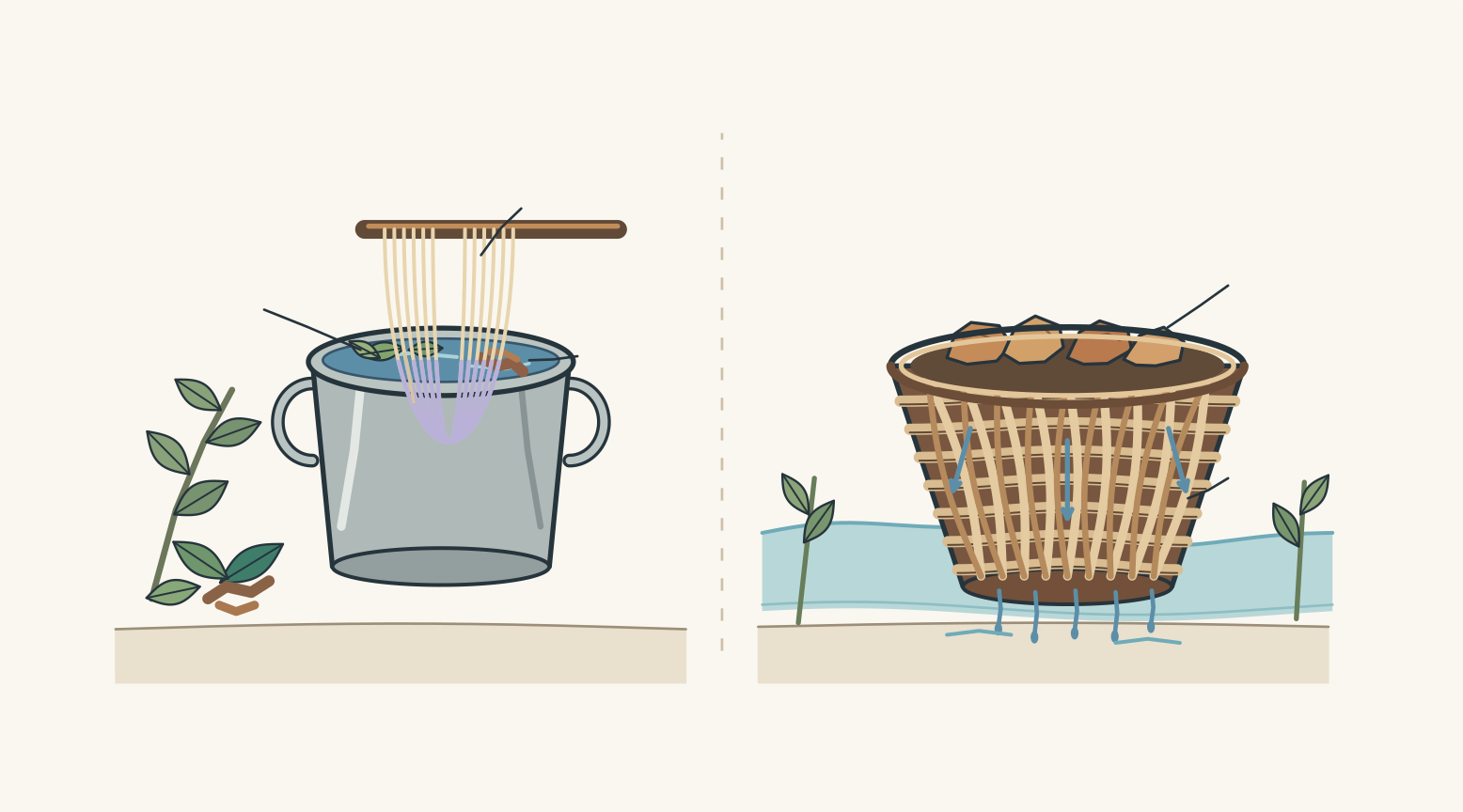
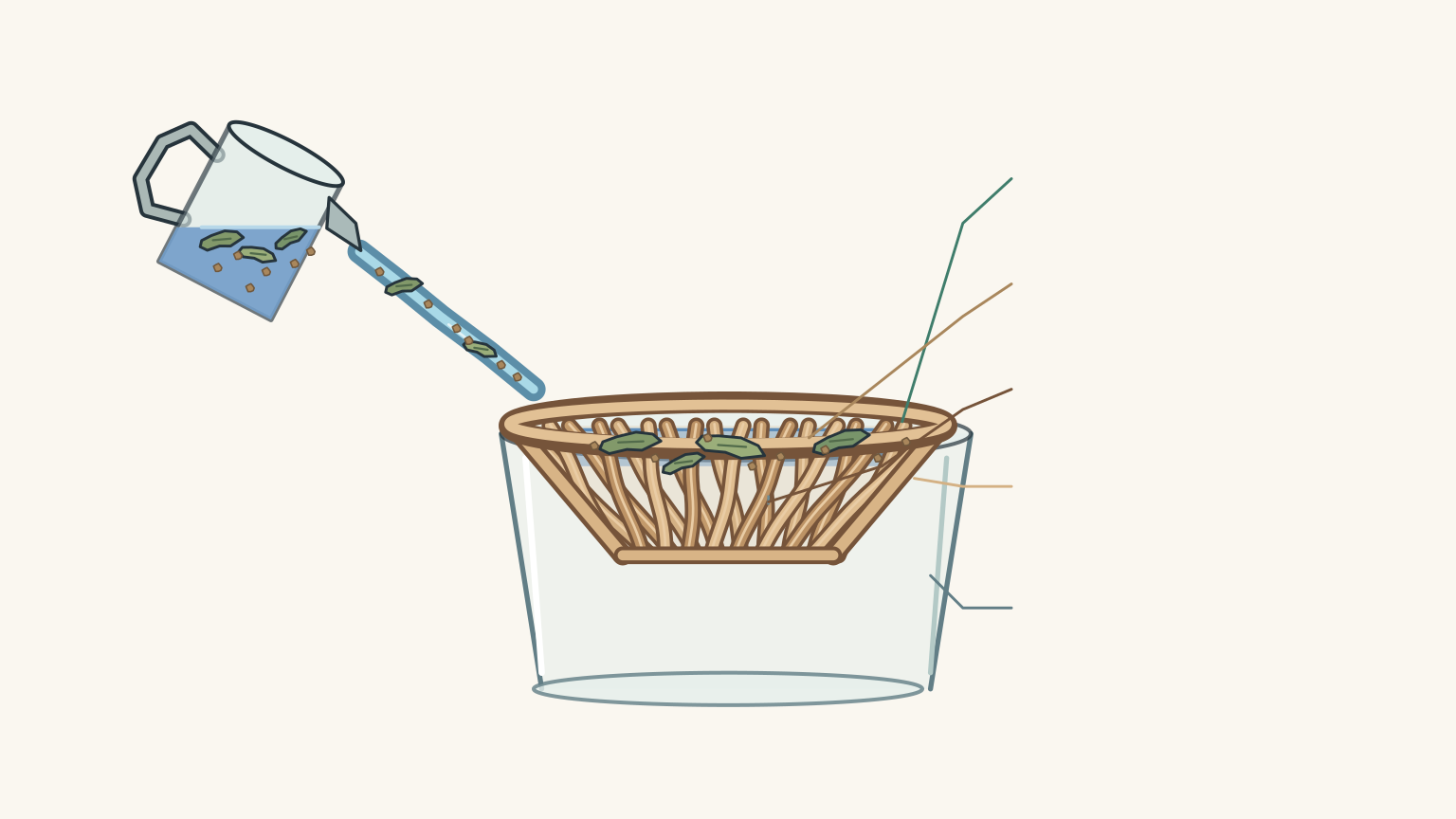
Imagine a pot of crushed plant material and water. The liquid has turned a deep blue, but pieces of root, leaf, and fibre are still floating in it. You pour the mixture through a woven basket. The plant fragments stay behind, but the liquid that passes through is still blue.
Has the basket failed to separate the mixture?
No. It has separated the larger solid particles from the liquid. The colour, however, is dissolved in the water. Those two things behave very differently during filtration.
This is the key to understanding plant-dye extraction and woven-basket filtration: separating a dissolved substance is not the same as separating an undissolved solid.
01Documented practices: different communities, different knowledge
Aboriginal and Torres Strait Islander peoples have developed sophisticated ways of working with plants, fibres, water, and other natural materials. These practices reflect detailed knowledge of local environments, seasonal conditions, and the properties of different resources.
It is important not to treat these practices as one universal technique. Different communities have different plants, materials, purposes, and cultural knowledge.
Here are several publicly documented examples.
Plant dyes and woven fibres
A 2005 documentary preserved by the National Film and Sound Archive of Australia (NFSA) records women from the Nauiyu community, near the Daly River in the Northern Territory, preparing natural dyes for fibre work.
In one documentary segment, roots are washed, scraped, and pounded with a rock before being boiled in a billycan. Fibres are then placed into the dye bath and boiled to develop their colour.
A companion segment documents Merrepen seeds being collected, crushed, and boiled to produce dye.
You can explore the two archival records:
The important chemistry is that coloured substances are extracted from plant material and transferred into fibres. The exact chemical composition of the dyes is not established by these documentary descriptions, so we should not assume that every plant produces colour in precisely the same way.
This knowledge also continues in contemporary practice. AIATSIS describes Numbulwar Numburindi Arts, a community-owned and controlled art centre, where artists use naturally dyed, locally harvested pandanus to create Wulbung baskets and Yir dilly bags.
Read about Numbulwar Numburindi Arts.
There is also a documented Wiradjuri example closer to home in NSW. Parkes Shire Council’s Wiradjuri cultural resource records Nidbul, the spreading flax lily, as a plant whose berries provide blue dye. Its fibres were also used to make baskets and nets.
Explore the Wiradjuri resource.
Woven baskets as sieves and strainers
A different example comes from Maningrida in Eastern Arnhem Land.
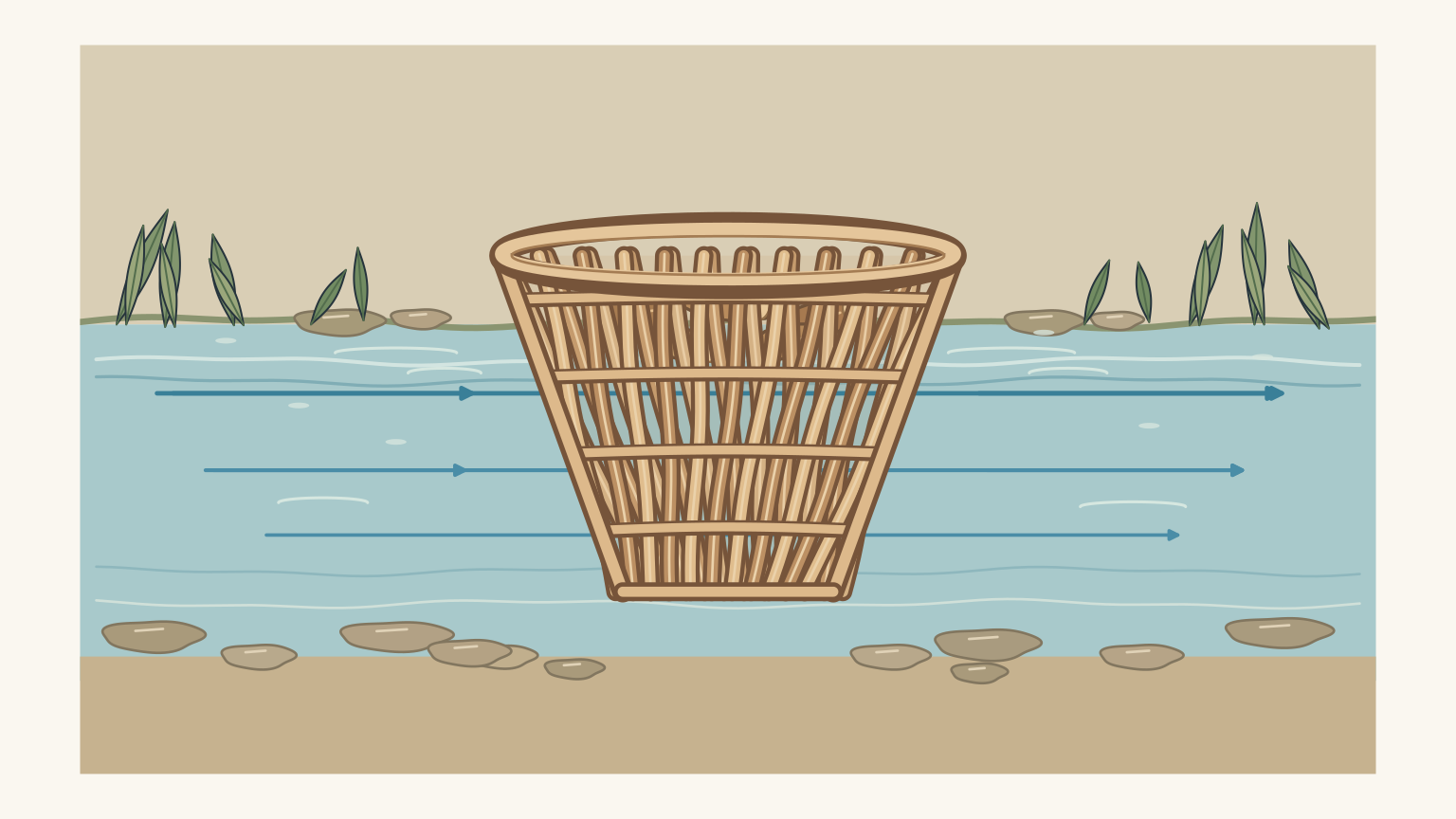
Museums Victoria records a type of woven sedge basket known as a miwanna. The baskets have an open weave, allowing water, sand, dirt, and other material to drain through.
The museum’s collection record explains that smaller versions were used as sieves for straining food in running water during the leaching of poisons from some bush foods.
The particular basket in the collection dates from 1988, and its maker is recorded as unrecorded.
See the Museums Victoria miwanna basket record.
This example gives us an important distinction. The basket can retain solid food material while water flows through it. Soluble substances can move out of the food and into the flowing water.
That does not mean the basket is filtering dissolved substances out of the water. In fact, the dissolved substances are being carried away by the water.
We will use these documented practices to understand the chemistry, but we will also use simplified classroom models. A model of pouring dye liquor through a basket, for example, is a way to investigate particle size. It is not a claim that the documented Maningrida baskets were used to filter dye baths.
The examples here explain scientific principles, not plant-identification or preparation instructions. Do not collect, taste, crush, or boil wild plants based on this article. Plant toxicity, preparation knowledge, cultural permissions, and environmental responsibilities all matter.
01Plant-dye extraction: getting colour into water
Start with a simple question.
If a plant contains a coloured substance, how could that colour move from the plant into a liquid?
Think about making tea. The tea leaves remain in the water, but coloured and flavoured substances move out of the leaves and spread through the water.
A similar general principle helps explain aqueous plant-dye extraction.
Solubility: why the water becomes coloured
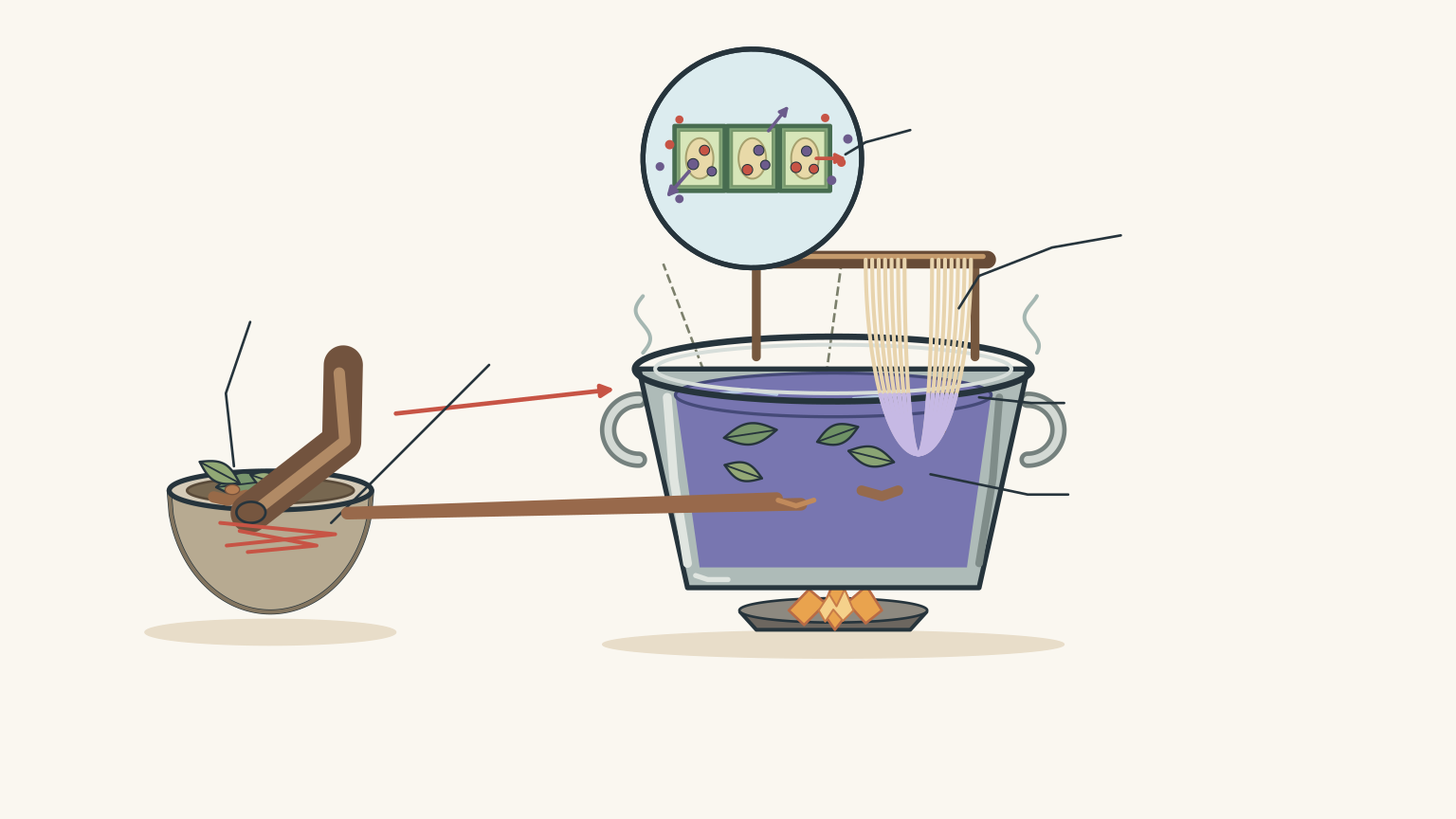
Plants contain many different chemical substances. Some of their coloured compounds can dissolve in water.
Solubility describes how much of a substance can dissolve in a particular solvent under specified conditions.
In a simple plant-dye extraction model:
- The water is the solvent.
- The coloured substances that dissolve are the solutes.
- The resulting coloured liquid is a solution.
When a soluble colourant enters water, its particles spread throughout the liquid. They do not remain as separate chunks that can easily be picked out.
This is why the water changes colour.
Two features of extraction are particularly useful to understand:
1. Breaking up the plant material
Crushing or pounding plant material exposes more of its internal structure to the solvent.
This increases the surface area available for extraction and can make it easier for soluble substances to move into the water.
2. Heating the mixture
Heating often speeds up extraction because particles move more rapidly and soluble substances can move out of the plant material more quickly.
For many substances, increased temperature also increases solubility, although the exact effect depends on the particular compound.
These ideas help explain why grinding and boiling appear in documented plant-dye preparation.
A dye bath is not necessarily a pure solution
Here is where our first model needs more precision.
When plant material is placed in water, not everything dissolves.
The mixture may contain:
- Dissolved coloured compounds.
- Undissolved pieces of plant tissue.
- Fine suspended particles.
- Other dissolved substances that are not coloured.
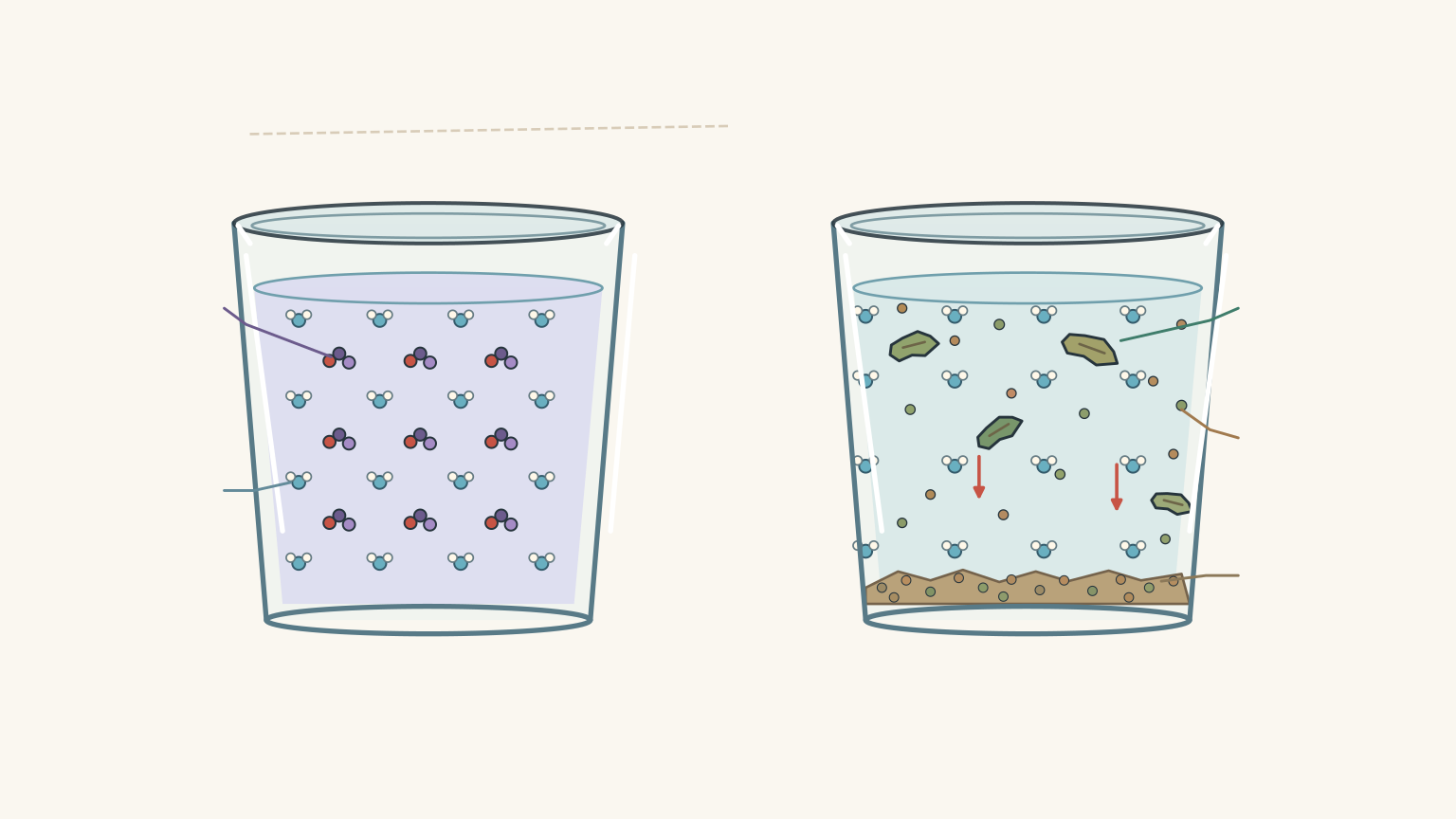
A mixture containing undissolved solid particles dispersed through a liquid is called a suspension.
Some particles are large enough to settle under gravity. Others are so fine that they remain suspended for longer.
The dye bath can therefore contain both a solution and a suspension at the same time.
This distinction is essential.
A coloured liquid does not automatically mean that all its coloured material is dissolved. Some natural colourants can behave as insoluble pigment particles rather than dissolved dyes.
For this lesson, we will focus on the simplified case of a water-soluble dye. We will consider insoluble pigments separately when comparing filtration methods.
02Basket filtration: separating by particle size
Now return to the woven basket.
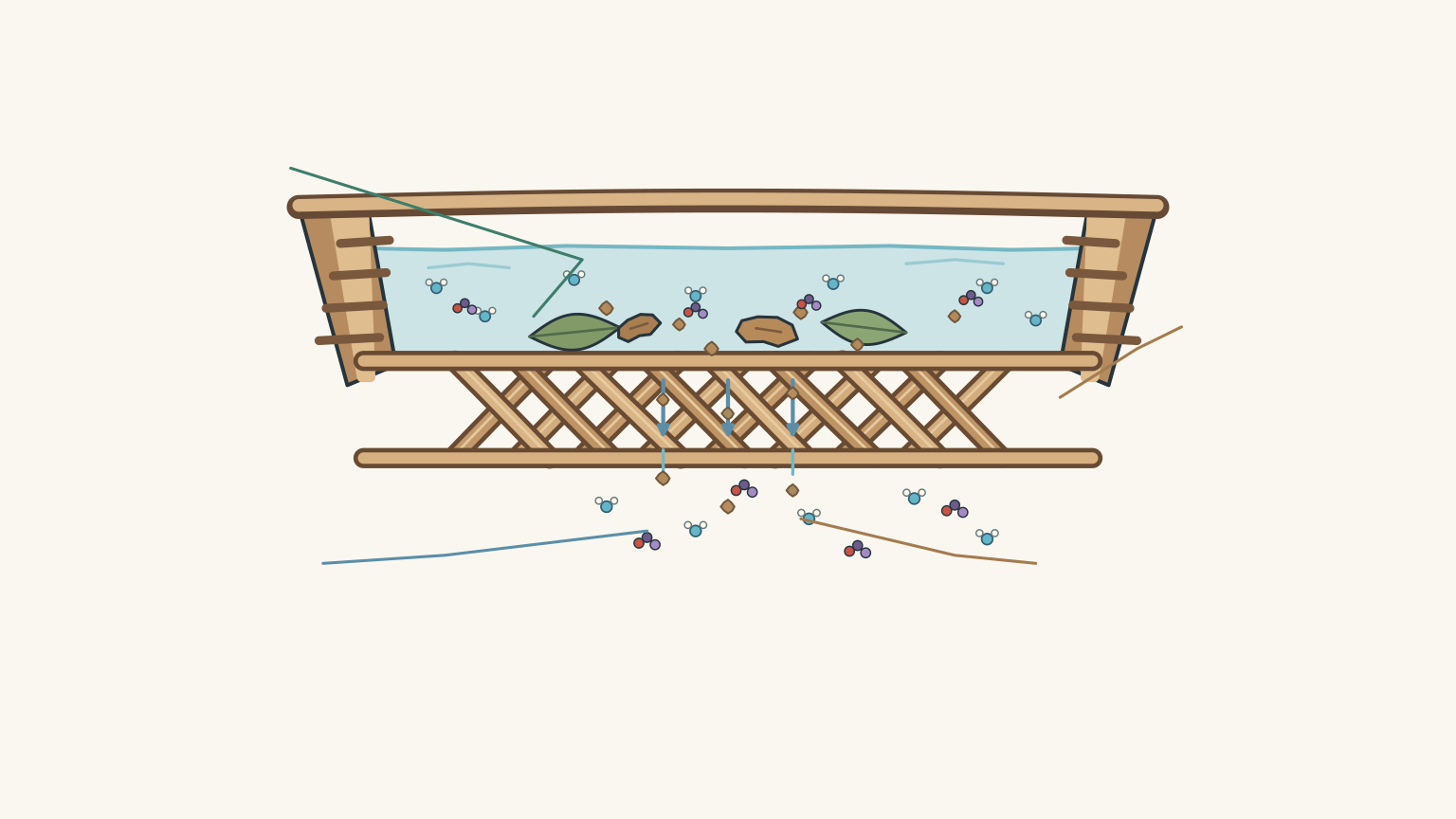
Imagine pouring a mixture of water, dissolved blue dye, and pieces of plant material through an open-weave basket.
The basket contains spaces between its woven fibres. These spaces allow liquid to pass through.
But what happens to each component?
The answer depends mainly on the size of the particles compared with the openings in the weave.
The three components behave differently
| Component | Physical state | What happens at the basket? |
|---|---|---|
| Large plant fragments | Undissolved solid particles | Retained if larger than the openings |
| Fine suspended particles | Undissolved solid particles | May pass through if smaller than the openings |
| Dissolved dye | Solute in a solution | Passes through with the water |
A woven basket is therefore a coarse strainer or sieve.
It separates solid particles according to their size relative to the openings.
It does not normally separate dissolved dye from water.
Why dissolved dye passes through
The spaces between woven fibres are enormous compared with individual dissolved dye molecules.
A dissolved dye molecule does not behave like a tiny piece of leaf. It is dispersed throughout the water at the molecular level.
When the water flows through the basket, the dissolved dye travels with it.
This is similar to using a tea strainer.
The strainer catches the tea leaves, but it does not catch the dissolved substances responsible for the colour of the tea. Those substances pass through with the liquid.
The analogy is useful, but it has a limit. A woven basket has relatively large, irregular openings, so it is generally much less effective at retaining fine suspended particles than a properly selected filter paper.
What if the basket is used twice?
Suppose you pour the coloured liquid through the same basket a second time.
Would the second filtration remove the dissolved dye?
No.
If the dye remains dissolved, it will pass through again. Repeating the same filtration does not change the physical state of the dye.
You might remove more solid particles if some were trapped during the first attempt or if the weave becomes clogged. But you cannot normally remove a dissolved substance simply by repeating the process.
The distinction is not about how many times you filter. It is about what you are trying to separate.
03Leaching is different from filtering
The Maningrida miwanna example introduces another important process: leaching.
Leaching occurs when a solvent dissolves a soluble substance from a solid material and carries it away.
Consider the arrangement described in the museum record.
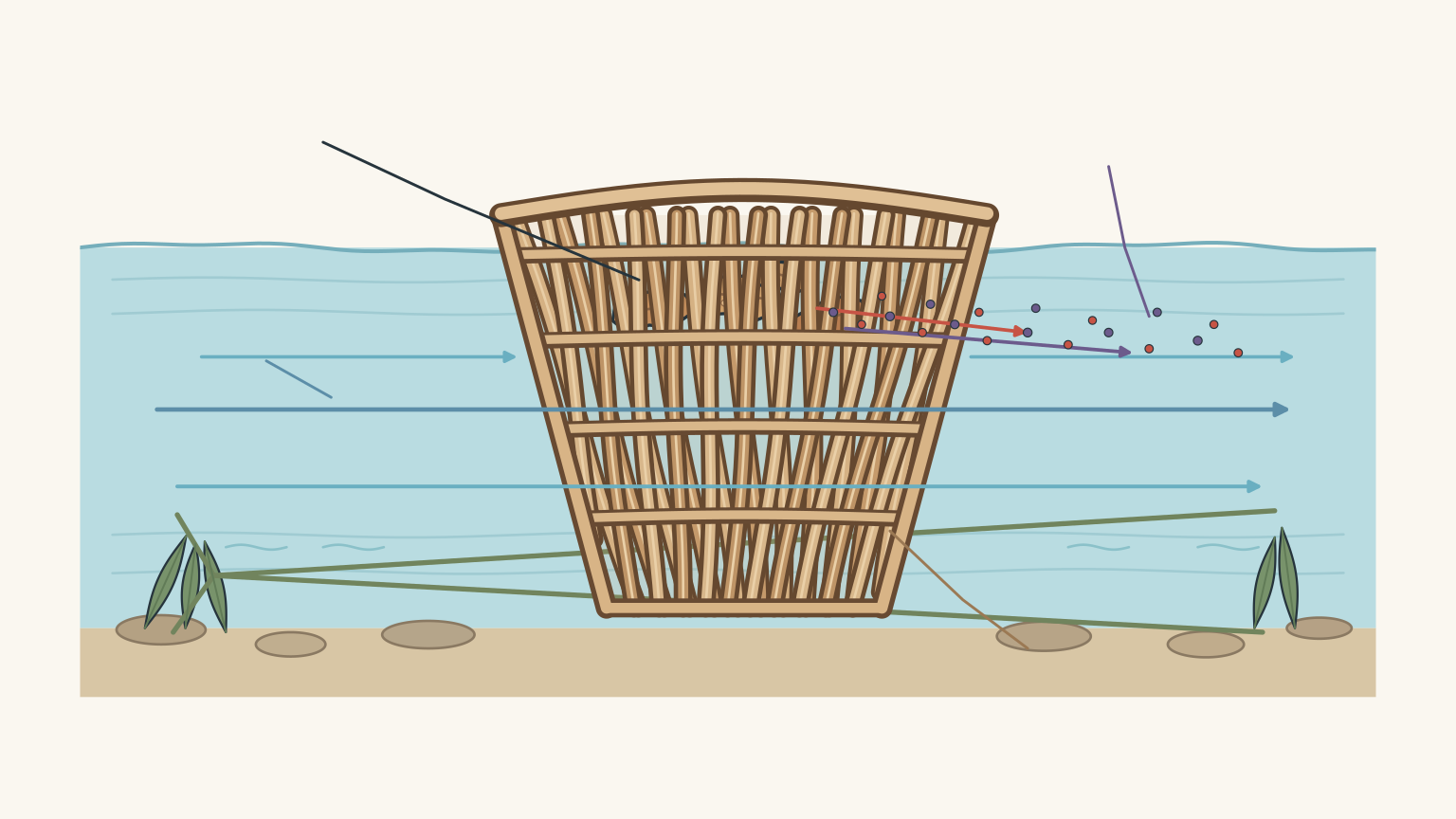
There are two processes occurring together:
Straining: The basket holds larger pieces of solid food while allowing liquid to pass.
Leaching: Water dissolves soluble compounds from the food and carries them away.
The basket is not trapping the dissolved compounds. The flowing water is transporting them out of the solid material.
This is an important distinction because students sometimes interpret the word filtering too broadly.
A filter does not automatically remove every unwanted substance from a mixture.
In this example, the basket helps keep the solid food material in place while water moves through it. The leaching process is responsible for removing the soluble substances from that material.
It would be incorrect to conclude that the basket itself makes water safe to drink. The documented practice concerns food preparation, not a general-purpose drinking-water purification method.
04Choosing the right separation method
The most useful question to ask before selecting a separation technique is:
Is the substance I want to remove dissolved, or is it present as a separate solid particle?
Your answer determines which methods are likely to work.
| Separation problem | Suitable method | Why it works |
|---|---|---|
| Large plant fragments mixed with dye liquor | Sieving or straining | Larger solids are retained |
| Fine suspended plant material | Filter paper | Smaller solid particles can be trapped |
| Water mixed with a dissolved dye | Evaporation or crystallisation, where suitable | The solvent can be removed to recover a non-volatile solute |
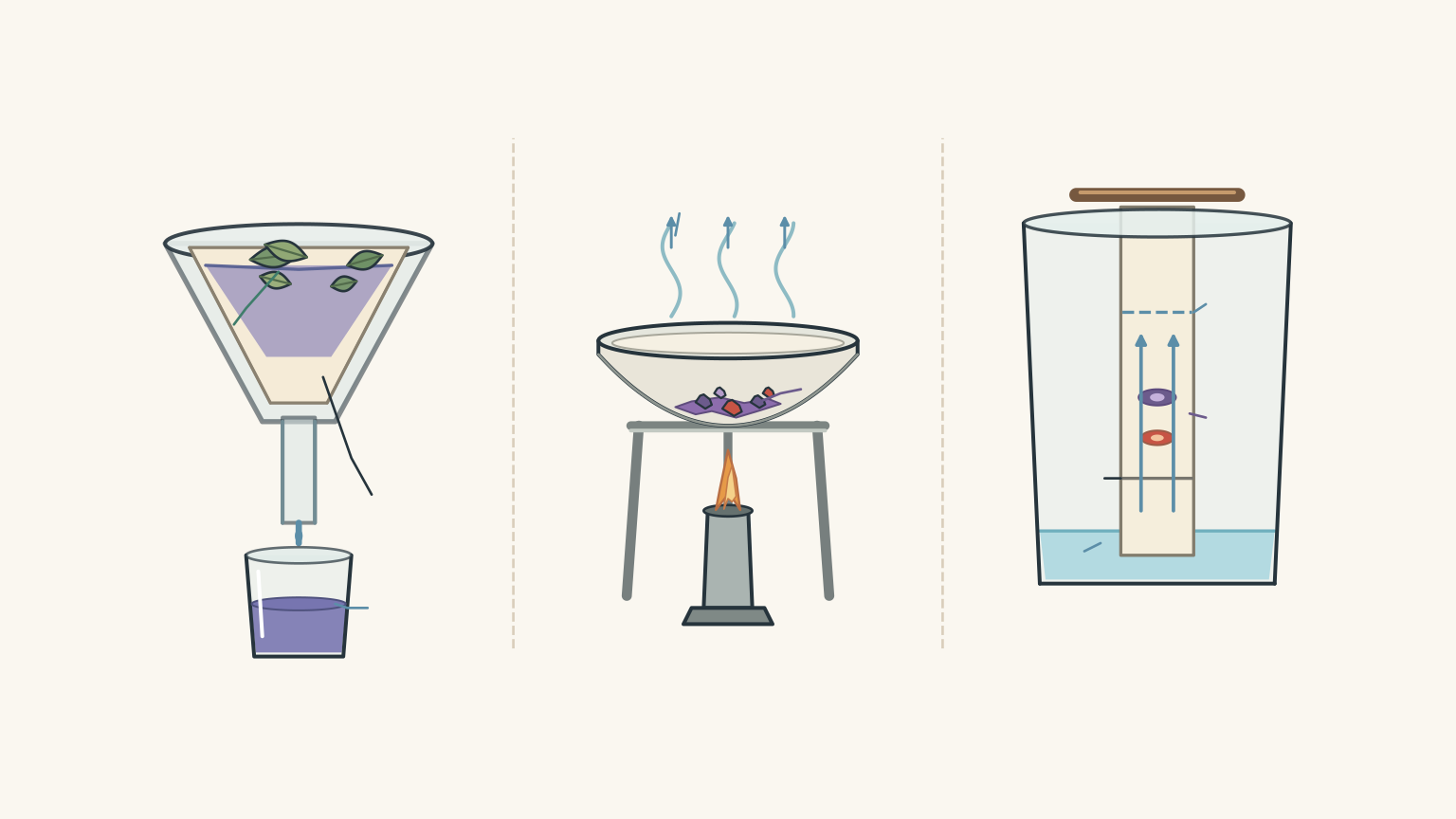
| Two different dissolved colourants | Paper chromatography | Components move differently through the paper and solvent |
| A soluble substance that needs to be removed from solid food | Leaching | A solvent dissolves and carries away the soluble substance |
Notice that filtration and chromatography solve different problems.
Filtration separates suspended solid particles from a liquid.
Chromatography can separate different substances that are already dissolved in a mixture.
What about mordants?
Some plant-dyeing processes use substances called mordants.
A mordant helps a dye attach to fibres, often by changing the interactions between the dye and the fibre.
This is a different chemical problem from filtering plant fragments out of a dye bath.
The dissolved dye can move through a basket and later interact with the fibre. Filtration and dye attachment are separate processes.
We will return to this distinction when considering adsorption and the interactions between substances.
06Worked examples
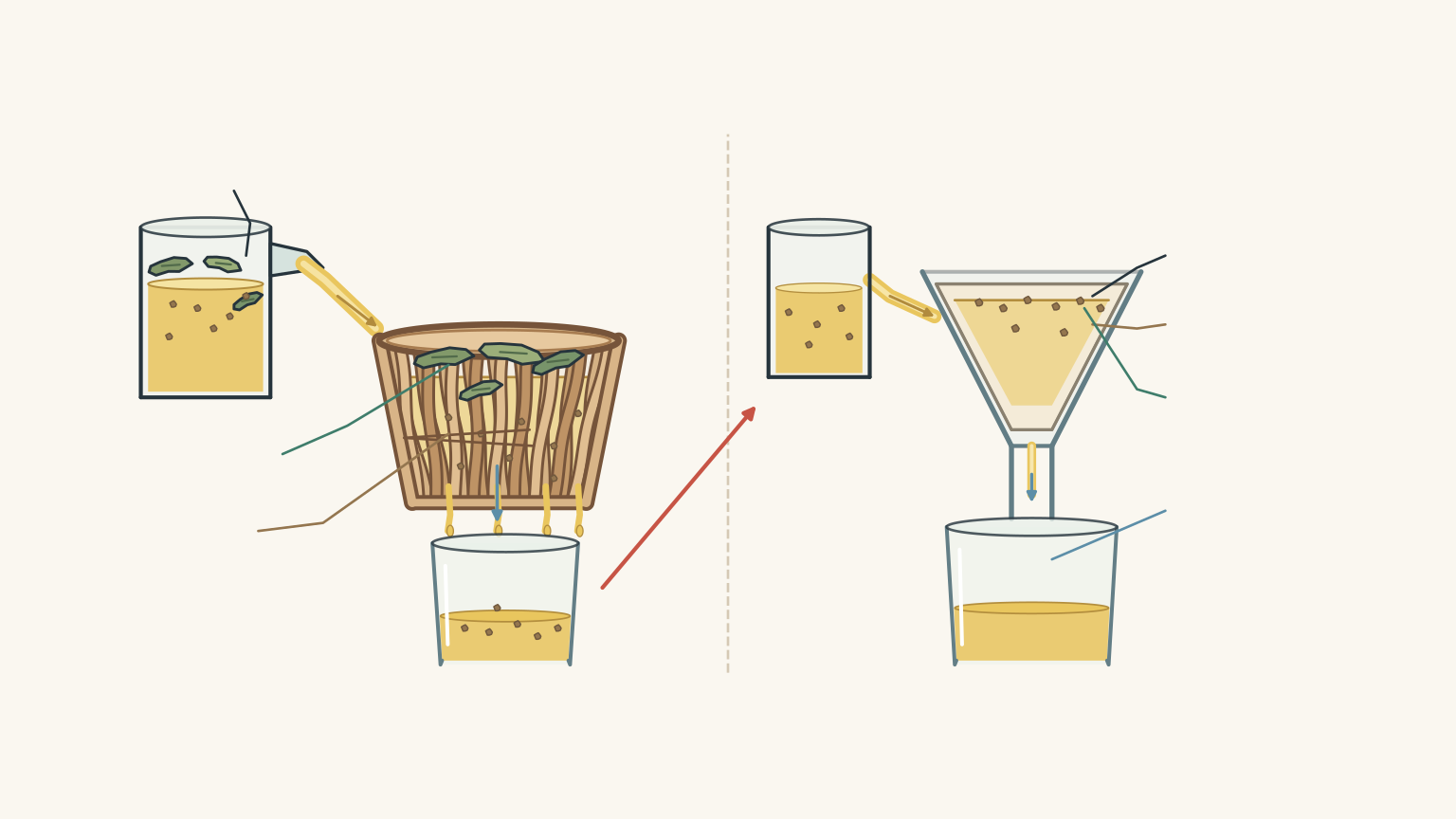
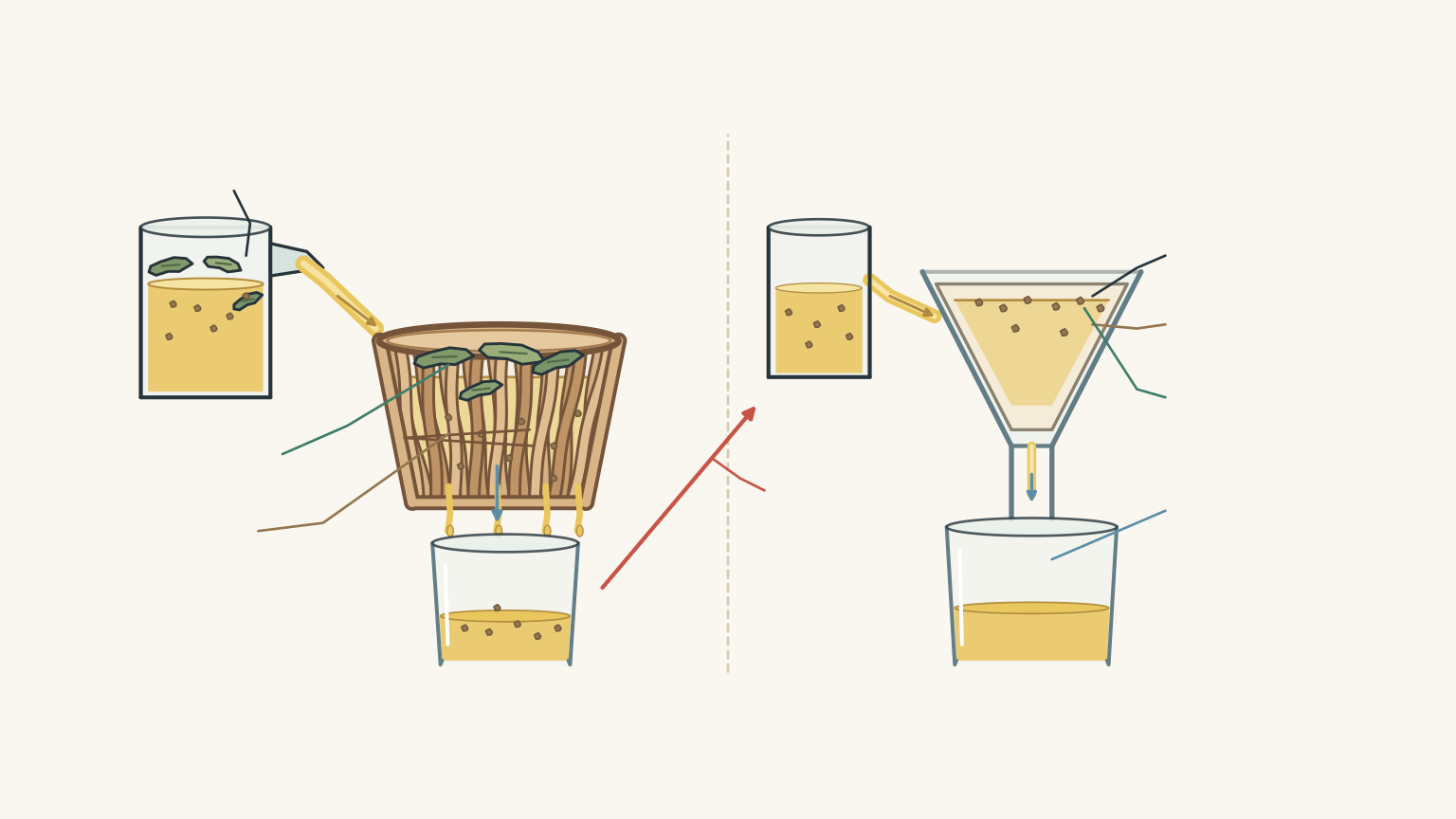
Worked example: Removing plant fragments from a dye bath
A model dye bath contains:
- Large fibre fragments measuring approximately 3 mm.
- Fine plant pulp measuring approximately 0.1 mm.
- A dissolved yellow colourant.
- Water.
The mixture is first passed through a woven basket with openings of approximately 1 mm. The liquid is then passed through filter paper that retains particles larger than 0.01 mm.
Assume neither filtering material adsorbs the dissolved colourant.
Predict what each stage removes and describe the final liquid.
Step 1
The fibre fragments and fine pulp are undissolved solids.
The yellow colourant is dissolved in the water.
Step 2
The fibre fragments are 3 mm across, which is larger than the 1 mm openings.
They are therefore retained by the basket.
The 0.1 mm pulp particles are smaller than the basket openings, so they can pass through.
The dissolved colourant also passes through with the water.
Step 3
The fine pulp particles are larger than the filter paper’s stated retention size of 0.01 mm.
They are therefore retained.
The dissolved colourant passes through because it remains dissolved in the water.
Step 4
The final liquid contains water and dissolved yellow colourant, with the specified suspended solids removed.
The basket and filter paper have separated solids of different sizes. Neither has separated the dissolved dye from the water.
This is why using two different filtration methods can improve the clarity of an extract without removing its dissolved colour.
Worked example: Should you use filtration or chromatography?
A student obtains a clear purple extract after filtering a plant mixture.
They want to determine whether the purple colour comes from one dissolved colourant or several different colourants.
Should they filter the extract again or use paper chromatography?
Step 1
The extract is clear, so the original suspended plant fragments have been removed.
However, the dissolved colourant may still be a mixture of different substances.
Step 2
Another filtration would not normally separate dissolved colourants.
If both colourants are dissolved, they will travel through the filter with the solvent.
Step 3
Paper chromatography separates substances because different components interact differently with the paper and the moving solvent.
The solvent is called the mobile phase because it moves through the paper.
The paper is the stationary phase because it remains in place.
A component that is more strongly attracted to the mobile phase relative to the paper may travel further. Another component may travel a shorter distance.
Step 4
If the purple extract separates into two distinct spots, this is evidence that it contains at least two distinguishable coloured components under those conditions.
The original purple colour may have been produced by a mixture rather than one pure colourant.
The key point is that chromatography separates dissolved substances according to their different interactions with the two phases. A basket separates solid particles according to size.
07Questions and solutions
Question 1
A mixture contains water, dissolved blue colourant, plant fragments measuring 1.6 mm, and sand grains measuring 0.2 mm.
The mixture is passed through a woven strainer with openings of approximately 1 mm.
Assume the colourant does not adsorb onto the basket.
Identify:
a) Which components are retained.
b) Which components pass through.
c) Why the collected liquid may still appear both blue and cloudy.
Solution 1
The basket retains the plant fragments, while the sand, water, and dissolved blue colourant pass through.
a) Retained components
The plant fragments measure 1.6 mm, which is larger than the 1 mm openings.
They cannot pass through the basket and are retained.
b) Components that pass through
The sand grains measure 0.2 mm, which is smaller than the basket openings.
They can pass through with the water.
The dissolved blue colourant also passes through because it is present as a solute rather than as separate solid particles.
c) Why the liquid remains blue and cloudy
The blue colour comes from the dissolved colourant, which passes through the basket.
The cloudiness comes from the suspended sand particles, which are also small enough to pass through.
This demonstrates that a basket can remove some solid particles without necessarily producing a clear or colourless liquid.
Question 2
A museum record describes smaller miwanna baskets from Maningrida as being used to strain food in running water during the leaching of poisons from bush foods.
A student argues:
“The basket filters the dissolved poisons out of the water, leaving the food clean.”
Evaluate this explanation.
Your response must distinguish between:
- The solid food material.
- The dissolved substances.
- The role of the flowing water.
- The role of the woven basket.
Solution 2
The student’s explanation is incorrect because the basket does not filter dissolved poisons out of the water. The flowing water carries soluble substances away from the solid food.
The process involves both straining and leaching.
The solid food material: Larger food pieces remain inside the basket because they cannot pass through the weave.
The dissolved substances: Some soluble compounds move from the food into the water. Once dissolved, they travel with the water.
The flowing water: It acts as the solvent. Its movement carries the dissolved compounds away from the food material.
The woven basket: It keeps the larger solid material together while allowing water and dissolved substances to pass.
The student has confused two different processes.
Filtration removes suspended solid particles from a liquid. Leaching removes soluble substances from a solid material by dissolving them in a solvent.
In this documented example, the basket helps with straining, while flowing water enables leaching.
We also cannot conclude that the water leaving the basket is safe to drink. The described practice is a specific food-preparation process, not evidence of complete water purification.
Question 3
A plant extract contains 0.48 g of dissolved colourant in 240 mL of liquid.
The extract also contains insoluble plant pulp.
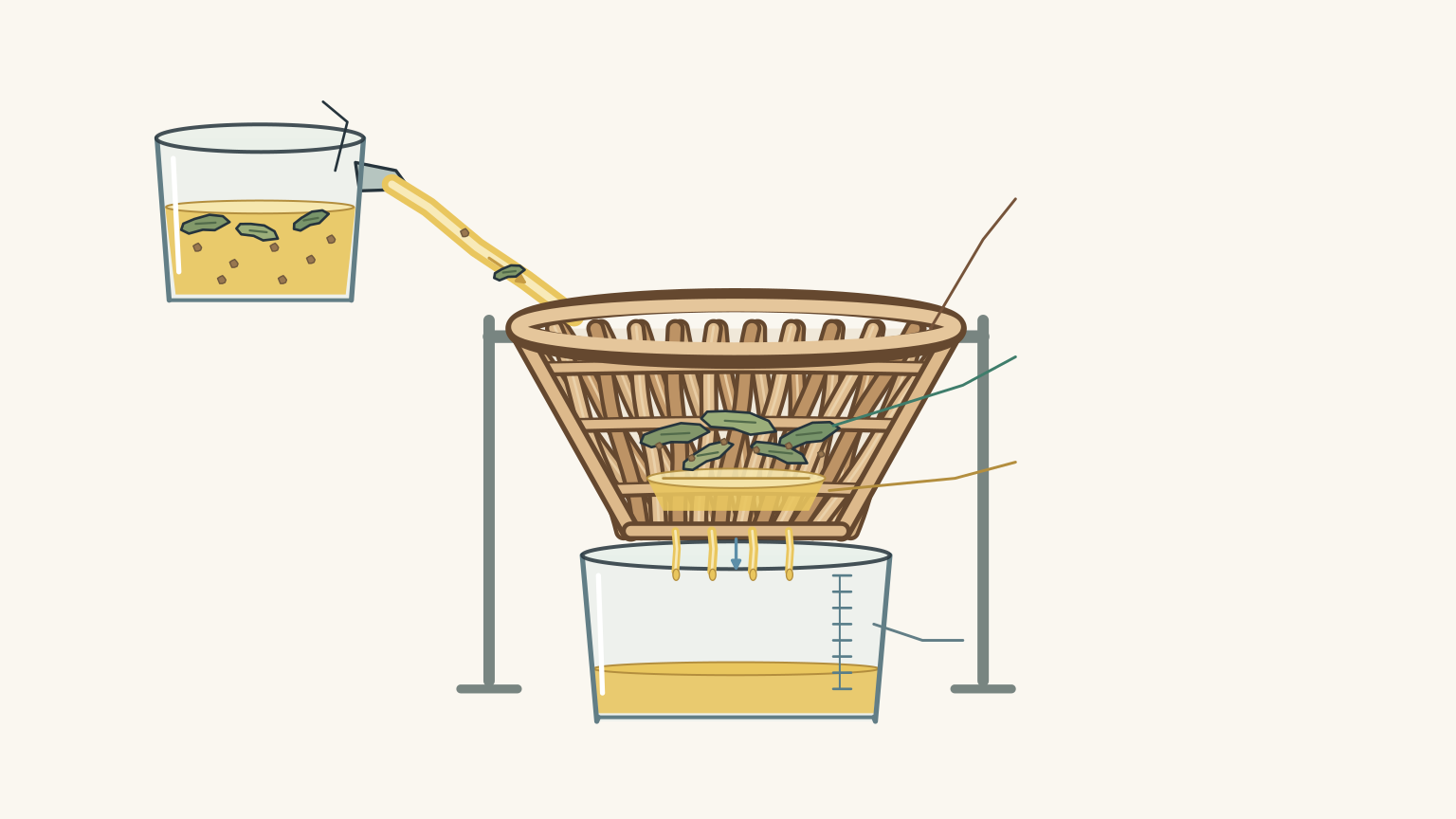
It is passed through a woven basket. The wet pulp remaining in the basket holds 20 mL of liquid.
Assume:
- The colourant is uniformly dissolved throughout the liquid.
- The colourant does not adsorb onto the basket or pulp.
- All liquid not retained by the wet pulp drains through.
- The dissolved colourant does not undergo any chemical reaction.
Calculate:
a) The initial mass concentration of the colourant in g/L.
b) The mass of colourant that passes through the basket.
c) The concentration of colourant in the collected filtrate.
Solution 3
The initial and final concentrations are both 2.0 g/L, and 0.44 g of colourant passes through the basket.
The basket retains some coloured liquid with the wet pulp, but it does not selectively remove dissolved colourant.
a) Calculate the initial mass concentration.
Mass concentration is calculated using:
\[ c=\frac{m}{V} \]
Where:
- \(c\) is mass concentration in g/L.
- \(m\) is the mass of dissolved colourant in grams.
- \(V\) is the volume of solution in litres.
Convert the volume:
\[ 240\text{ mL}=0.240\text{ L} \]
Substitute:
\[ c=\frac{0.48}{0.240} \]
\[ \boxed{c=2.0\text{ g/L}} \]
b) Calculate the mass of colourant passing through.
First, calculate the volume of liquid collected.
\[ V_{\text{filtrate}}=240-20 \]
\[ V_{\text{filtrate}}=220\text{ mL} \]
Because the colourant is uniformly dissolved, the liquid retained by the pulp has the same concentration as the original solution.
The volume retained is:
\[ 20\text{ mL}=0.020\text{ L} \]
The mass of colourant remaining in the wet pulp is:
\[ m=cV \]
\[ m=2.0\times0.020 \]
\[ m=0.040\text{ g} \]
Using conservation of mass:
\[ m_{\text{filtrate}}=0.48-0.040 \]
\[ \boxed{m_{\text{filtrate}}=0.44\text{ g}} \]
c) Calculate the concentration of the filtrate.
The collected volume is 0.220 L.
\[ c=\frac{m}{V} \]
\[ c=\frac{0.44}{0.220} \]
\[ \boxed{c=2.0\text{ g/L}} \]
The concentration has not changed.
The collected filtrate contains less total colourant only because some coloured liquid remains trapped in the wet pulp.
This is an important distinction: losing some solution during filtration is not the same as selectively removing dissolved solute.
Question 4
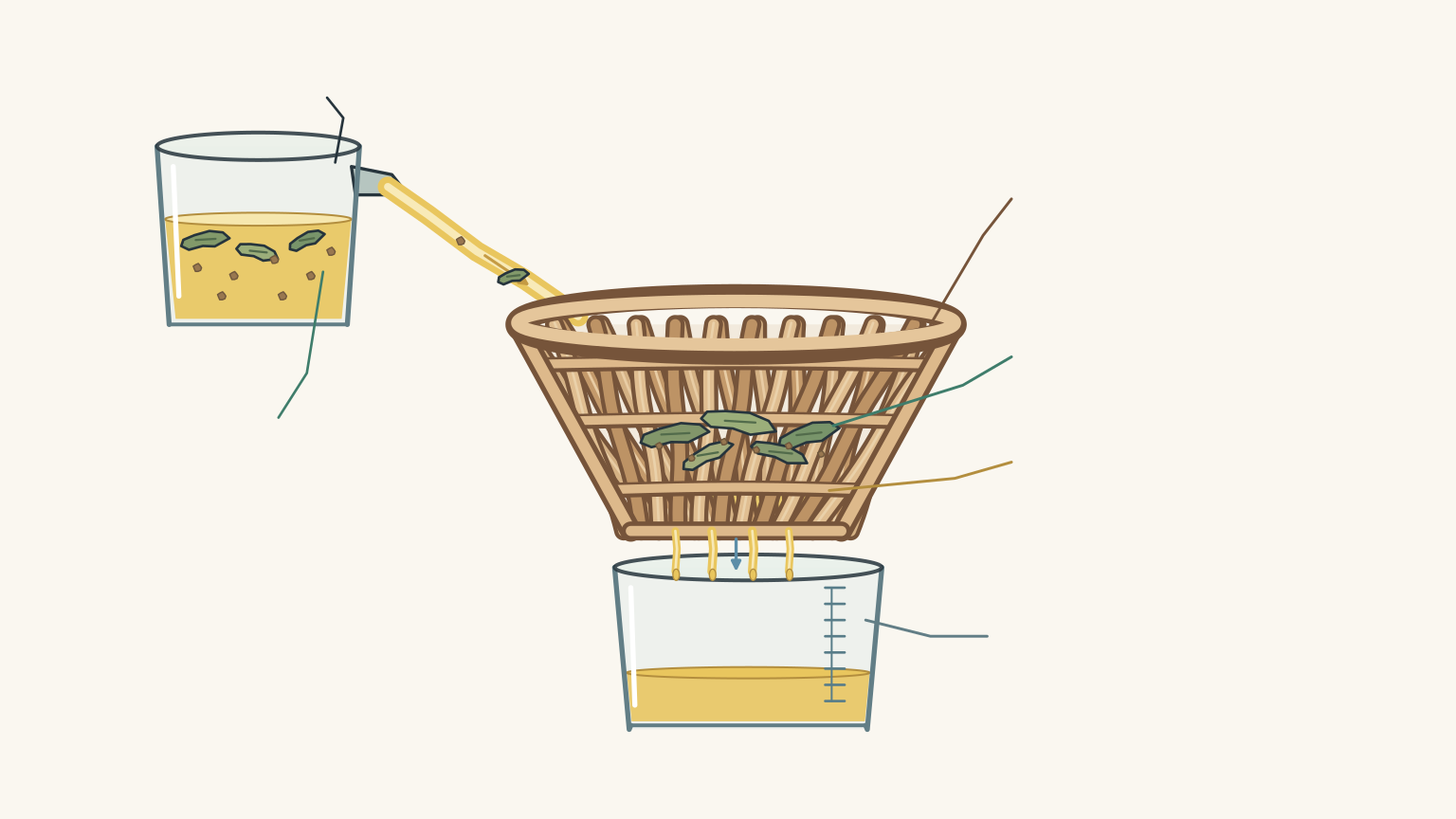
A student filters a purple plant extract until it appears clear.
They then perform paper chromatography on three samples using the same paper and solvent:
- Sample A: the original purple extract.
- Sample B: a known yellow reference colourant.
- Sample C: a known blue reference colourant.
The chromatogram shows that Sample A produces two spots. One matches the position of the yellow reference, and the other matches the position of the blue reference.
Assume the reference results are reliable.
Explain:
a) What the chromatogram suggests about the composition of the purple extract.
b) Why filtration did not separate the two colourants.
c) Why matching chromatographic positions does not necessarily establish the exact chemical identity of the substances.
Solution 4
The purple extract contains at least two distinguishable coloured components, with chromatographic behaviour matching the yellow and blue reference substances.
a) Interpret the chromatogram.
Sample A separates into two spots.
One spot travels the same distance as the yellow reference, while the other travels the same distance as the blue reference.
This suggests that the original purple extract contains at least two different colour components.
The purple appearance of the original liquid was therefore produced by a mixture rather than necessarily by one pure purple substance.
b) Explain why filtration did not separate them.
Both colourants were dissolved in the original extract.
Their dissolved particles are much smaller than the openings in a woven basket or ordinary filter paper.
Consequently, both travel through the filter with the water.
Filtration separates according to particle size, not according to whether a substance is yellow, blue, or purple.
c) Explain the limitation of matching spots.
Chromatographic position depends on how a substance interacts with the mobile and stationary phases.
Two different substances can sometimes travel similar distances under the same conditions.
Therefore, matching positions provide evidence of similar chromatographic behaviour, but do not conclusively establish chemical identity.
The chromatogram supports the conclusion that the extract contains at least two distinguishable components. Further analysis would be needed to establish their exact chemical identities.
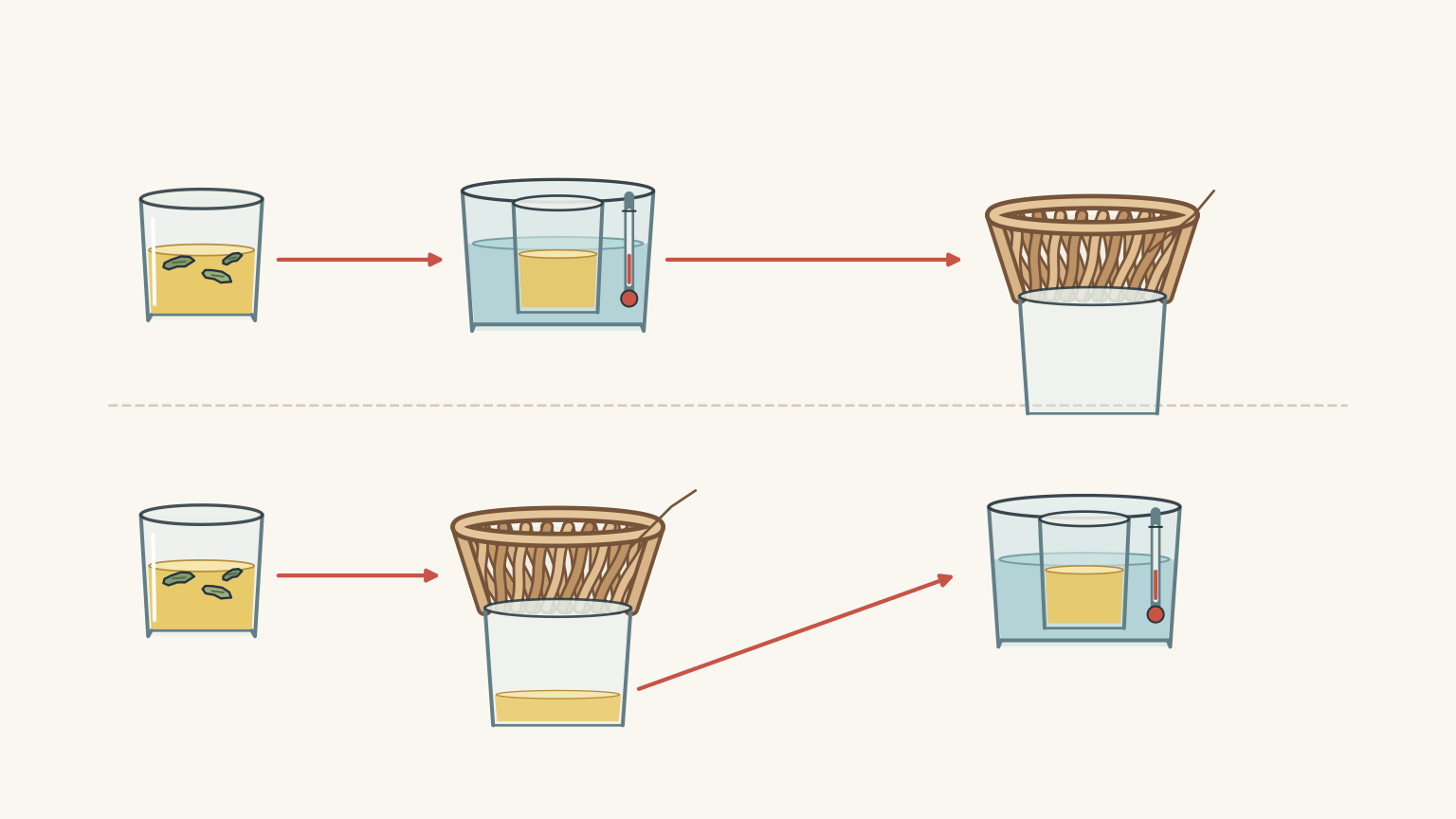
Question 5
A student investigates whether a woven basket can separate a dissolved colourant from water.
They use a simplified classroom model containing:
- 0.80 g of a water-soluble colourant dissolved in 100 mL of hot water.
- 0.20 g of a dissolved, colourless salt.
- Coarse, undissolved plant fragments.
The model colourant has a solubility of 0.50 g per 100 mL of water at 20°C.
The salt remains completely soluble at this temperature.
When the solution cools to 20°C, excess colourant crystallises. The resulting crystals have a diameter of 0.5 mm.
A woven basket has openings of 0.2 mm. It retains all the coarse plant fragments and all the colourant crystals, but allows dissolved substances and water to pass through.
Two procedures are compared.
Procedure A: The entire mixture is cooled to 20°C before being passed through the basket.
Procedure B: The hot mixture is passed through the basket first. The collected filtrate is then cooled to 20°C, but it is not filtered again.
Assume:
- All the colourant is initially dissolved in the hot water.
- The solution volume remains 100 mL.
- All crystals formed are larger than the basket openings.
- No colourant or salt adsorbs onto the basket or plant fragments.
- No liquid is retained by the basket.
For each procedure, determine:
a) The mass of colourant retained by the basket.
b) The mass of colourant remaining in the collected filtrate or its cooled contents.
c) Where the dissolved salt ends up.
Finally, explain why the statement “a basket cannot remove dissolved dye” is not a complete description of what happens in this experiment.
Solution 5
Procedure A retains 0.30 g of colourant in the basket, while Procedure B retains none. The difference is the order in which cooling and filtration occur.
The key is to consider the physical state of the colourant at the moment it passes through the basket.
Step 1: Determine how much colourant remains dissolved after cooling.
At 20°C, the solubility is:
\[ 0.50\text{ g per }100\text{ mL} \]
The solution initially contains:
\[ 0.80\text{ g colourant} \]
Therefore, the maximum mass that can remain dissolved is:
\[ m_{\text{dissolved}}=0.50\text{ g} \]
The remaining colourant must crystallise:
\[ m_{\text{crystals}}=0.80-0.50 \]
\[ \boxed{m_{\text{crystals}}=0.30\text{ g}} \]
The crystals are 0.5 mm across, which is larger than the basket’s 0.2 mm openings.
The basket can therefore retain them.
Step 2: Analyse Procedure A.
The mixture is cooled before filtration.
At 20°C:
- 0.50 g of colourant remains dissolved.
- 0.30 g of colourant forms solid crystals.
- 0.20 g of salt remains dissolved.
When the mixture passes through the basket, the solid crystals are retained.
The dissolved colourant and salt pass through with the water.
Therefore:
\[ \boxed{m_{\text{colourant in basket}}=0.30\text{ g}} \]
\[ \boxed{m_{\text{colourant in filtrate}}=0.50\text{ g}} \]
The entire 0.20 g of dissolved salt also passes through.
Step 3: Analyse Procedure B.
This time, the mixture is filtered while hot.
The problem states that all 0.80 g of colourant is dissolved at the initial temperature.
There are therefore no colourant crystals for the basket to retain.
The basket only retains the undissolved plant fragments.
All 0.80 g of colourant passes through, along with the 0.20 g of dissolved salt.
Now the collected filtrate is cooled.
At 20°C, 0.30 g of colourant crystallises inside the receiving vessel.
The remaining 0.50 g stays dissolved.
Therefore:
\[ \boxed{m_{\text{colourant in basket}}=0\text{ g}} \]
The cooled contents of the receiving vessel contain:
- 0.30 g of solid colourant crystals.
- 0.50 g of dissolved colourant.
- 0.20 g of dissolved salt.
The total colourant mass in the collected mixture remains 0.80 g.
Step 4: Compare the procedures.
| Result | Procedure A | Procedure B |
|---|---|---|
| Colourant in basket | 0.30 g | 0 g |
| Colourant still dissolved | 0.50 g | 0.50 g |
| Colourant crystals in collected vessel | 0 g | 0.30 g |
| Dissolved salt in collected liquid | 0.20 g | 0.20 g |
There is one final detail worth noticing.
If Procedure B included another filtration after cooling, the basket would now retain the 0.30 g of crystals.
The two procedures would then produce the same separation.
Step 5: Explain the underlying principle.
The student’s original statement is correct only while the colourant remains dissolved.
A basket cannot normally trap dissolved dye molecules because they pass through the openings with the water.
However, cooling causes some of the dissolved colourant to crystallise. These crystals are now solid particles, not dissolved solute.
The basket can retain them because their size exceeds the openings.
The basket has not developed the ability to filter dissolved molecules. The physical state of the colourant has changed before filtration.
This is the crucial distinction:
Filtration separates components according to their physical state and particle size at the time of filtration.
Changing the conditions of a mixture can change which separation methods become useful.
08Where this chemistry leads next
Plant-dye extraction and basket filtration show why identifying the components of a mixture must come before choosing a separation technique.
A useful sequence of questions is:
- Is the desired substance dissolved or suspended?
- If it is suspended, are its particles larger than the filter openings?
- If it is dissolved, can evaporation, crystallisation, or chromatography separate it?
- Could changing the temperature or chemical conditions cause a dissolved substance to form a solid?
- If the aim is to colour a fibre, what interactions allow the dye to attach to that material?
That final question leads into another important area of chemistry: adsorption, intermolecular attractions, and the role of mordants in dyeing.
Understanding how a colourant enters water is only half the problem. Understanding how it attaches to a fibre explains how the colour becomes part of the finished material.