
Polypropylene: Addition Polymerisation, Structure and Properties
Learn how propene forms polypropylene, how methyl-group arrangement affects crystallinity and physical properties, and how polypropylene compares with polyethylene, PVC, and PTFE.
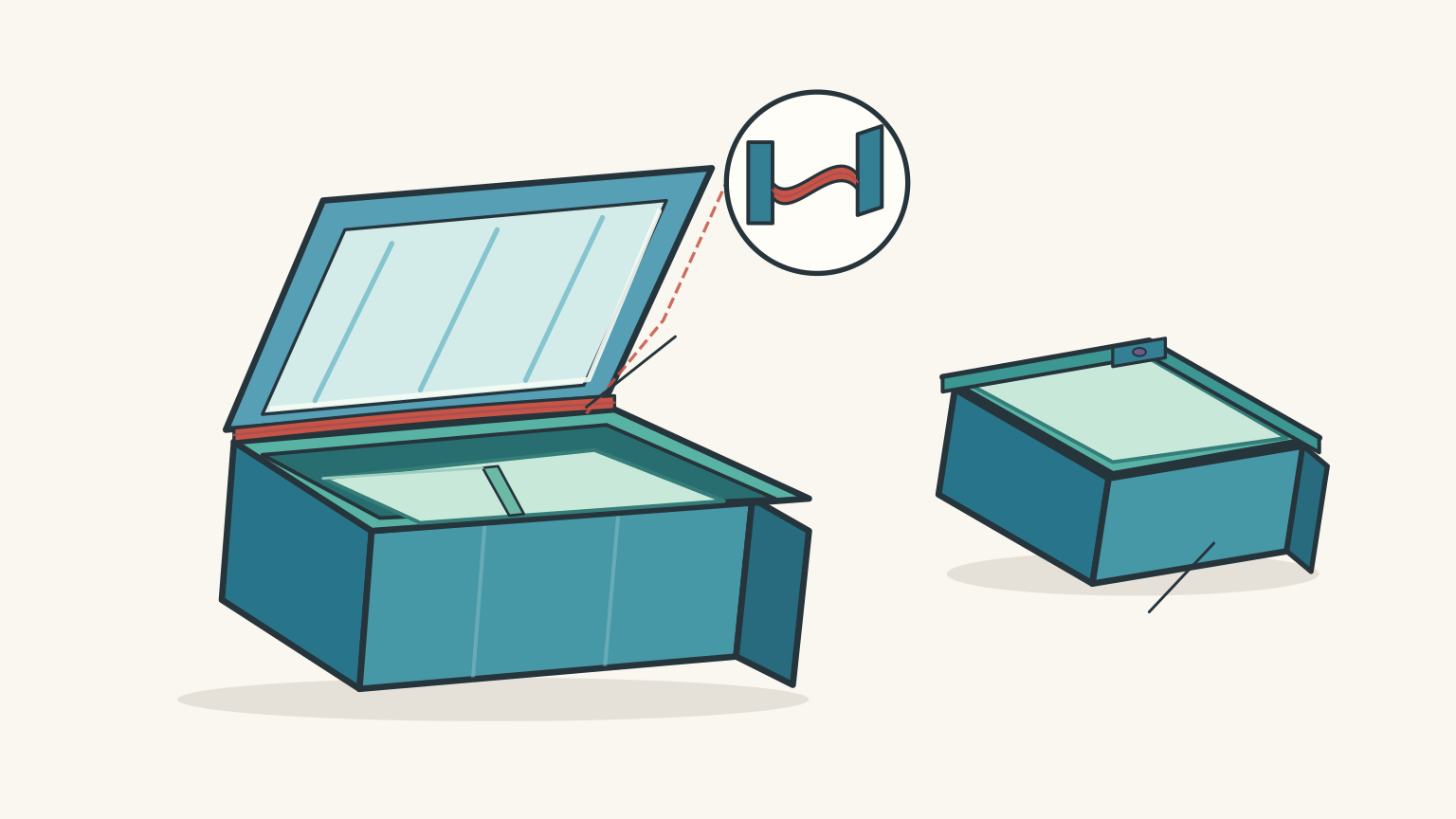
Flex the thin hinge on a polypropylene lunchbox lid. A well-designed polypropylene hinge can withstand repeated bending, while the same plastic can also be moulded into a fairly rigid food container. How can one polymer have both properties?
The answer starts with a small structural detail. Polypropylene is made by joining propene molecules together, but the methyl group in each propene molecule does not disappear. It remains attached to the growing polymer chain. How these methyl groups are arranged has a major influence on the final material.
01How propene forms polypropylene
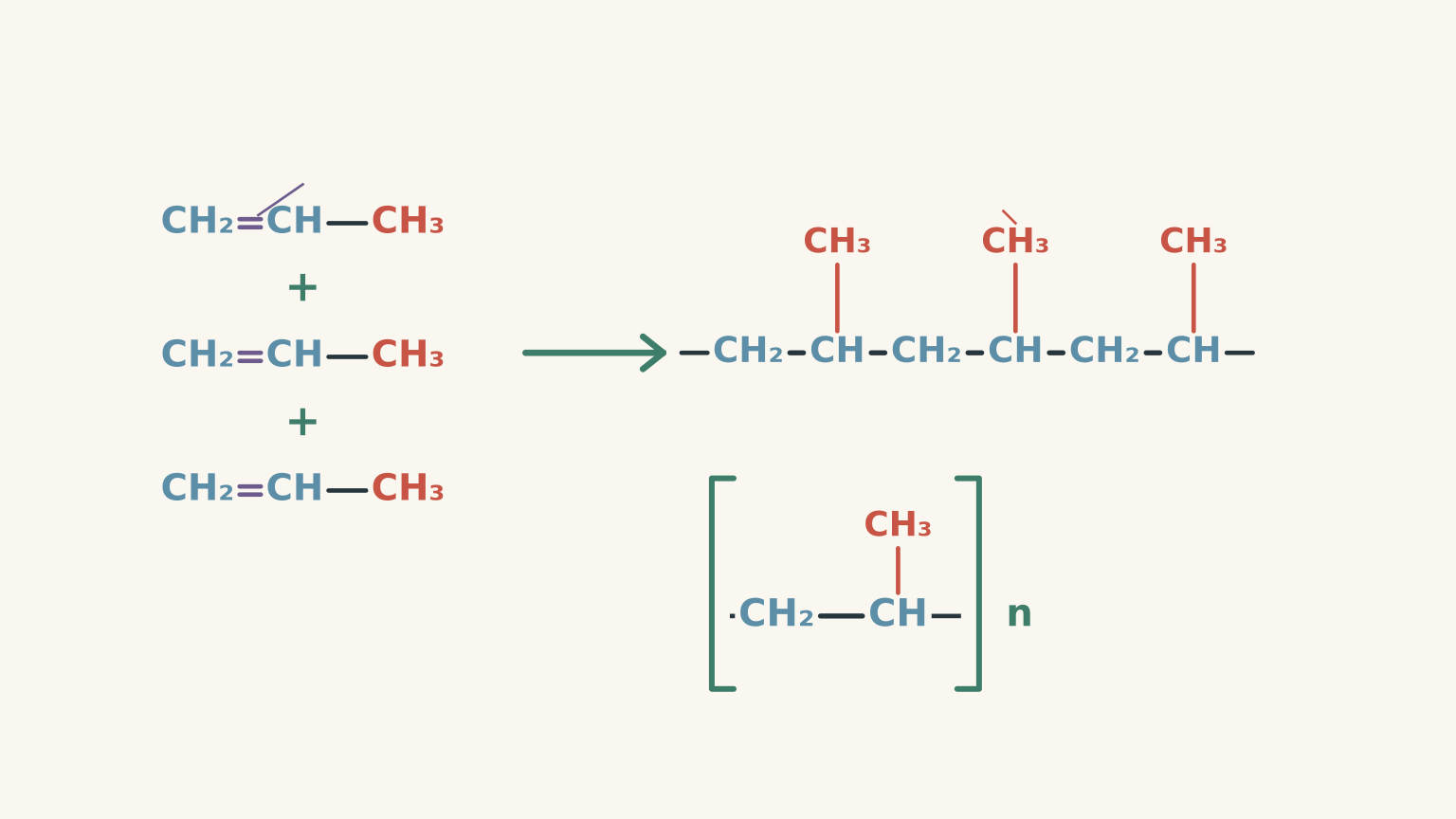
Propene is an alkene with the structural formula:
\[ \ce{CH2=CH-CH3} \]
It contains a carbon-carbon double bond. This double bond allows propene molecules to join through addition polymerisation.
Before looking at the reaction, predict what happens to the double bond when hundreds or thousands of propene molecules join together. Does the double bond remain in the polymer backbone?
No. The double bond opens, allowing new carbon-carbon single bonds to form between neighbouring monomers.
The overall reaction is:
\[ \ce{n CH2=CH-CH3 -> [-CH2-CH(CH3)-]_{n}} \]
The product is polypropylene, often abbreviated to PP.
Notice what has happened to the atoms:
- The two carbon atoms originally involved in the double bond become part of the polymer backbone.
- The carbon-carbon double bond becomes a single bond.
- The \(\ce{-CH3}\) group remains attached to one of the backbone carbon atoms.
- No atoms are removed during the addition polymerisation reaction.
This last point is important. Unlike condensation polymerisation, addition polymerisation does not produce a small molecule such as water as a by-product.
What is actually repeating?
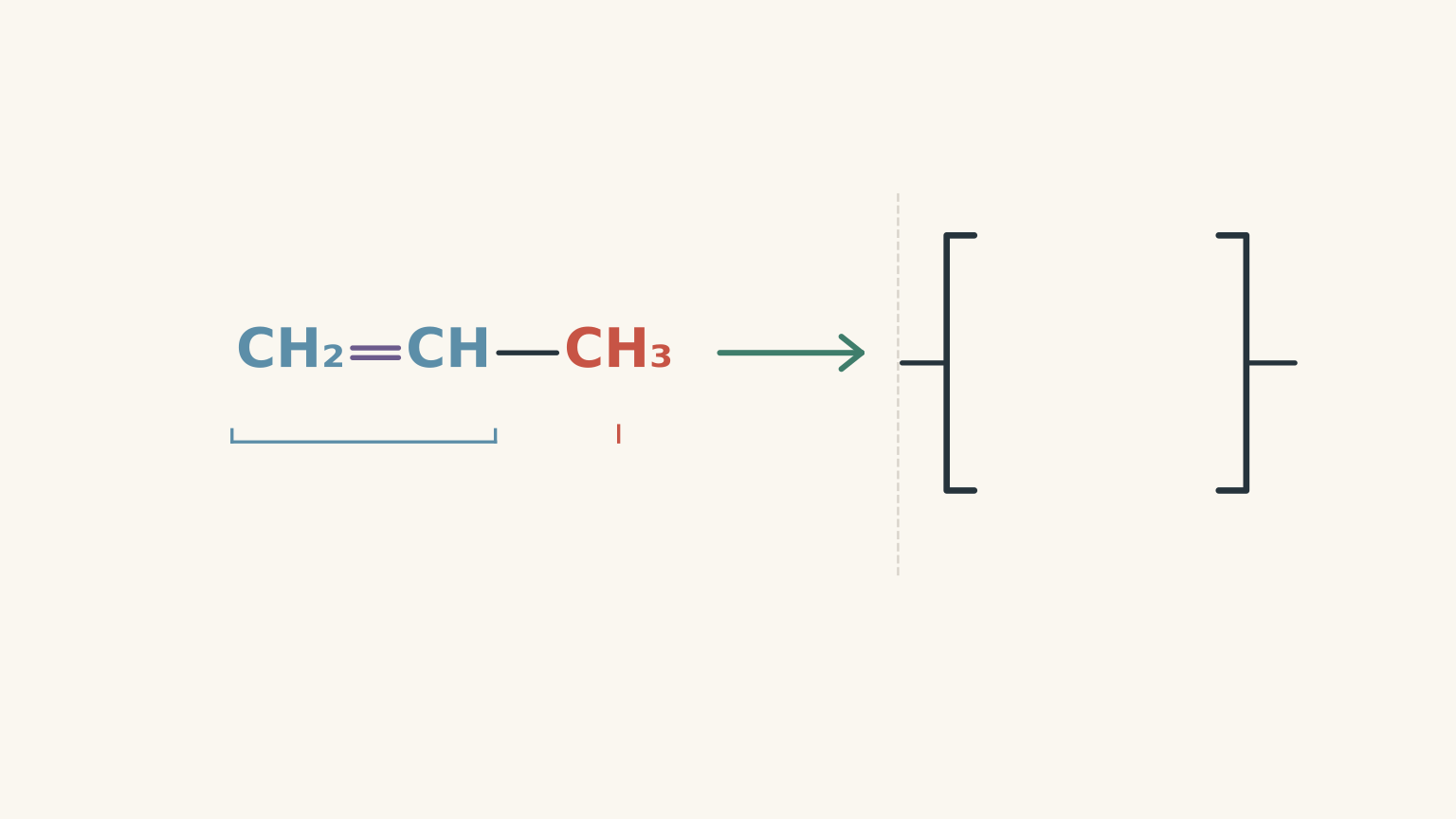
The smallest section that repeats along the polypropylene chain is:
\[ \boxed{\ce{-CH2-CH(CH3)-}} \]
This is the repeat unit of polypropylene.
Its molecular formula is:
\[ \ce{C3H6} \]
There are three carbon atoms in each repeat unit, but only two form the main polymer backbone.
The third carbon belongs to the methyl side group.
That distinction is easy to miss in an exam question. The backbone is the continuous chain of atoms connecting one end of the polymer to the other. Atoms attached to the backbone but not forming part of this continuous chain are called side groups.
In polypropylene:
- Backbone: the repeating \(\ce{-CH2-CH-}\) section.
- Side group: the \(\ce{-CH3}\) methyl group.
- Repeat unit: the complete \(\ce{-CH2-CH(CH3)-}\) section.
The brackets in the structural formula indicate that the section repeats. The subscript \(n\) represents the number of repeat units in the polymer chain.
A common mistake is to draw three carbon atoms in a straight backbone for every propene molecule. That is incorrect. The methyl carbon branches away from the backbone.
02Worked examples: drawing and interpreting polypropylene
Worked example: Draw the repeat unit of polypropylene
Propene undergoes addition polymerisation. Draw the repeat unit of the resulting polymer and identify its backbone and side group.
Step 1
The two carbon atoms in the \(\ce{C=C}\) double bond will form the continuous polymer backbone.
Step 2
Each carbon atom now has an available bonding position for joining to neighbouring monomers.
Step 3
The \(\ce{-CH3}\) group does not disappear. It remains attached to the second carbon in the backbone section.
Step 4
The final structure is:
\[ \boxed{\ce{[-CH2-CH(CH3)-]_{n}}} \]
The backbone contains two carbon atoms per repeat unit, and the methyl group is a side group.
This is addition polymerisation because all atoms from the propene monomer are retained in the polymer.
Worked example: Calculate the average number of repeat units
A polypropylene sample has a number-average molar mass of \(84\,000\ \mathrm{g\,mol^{-1}}\).
Estimate the average number of repeat units per polymer chain. Use \(C=12.0\) and \(H=1.0\).
Step 1
The repeat unit is \(\ce{C3H6}\).
Step 2
\[ \begin{aligned} M(\ce{C3H6}) &=(3\times12.0)+(6\times1.0)\\ &=42.0\ \mathrm{g\,mol^{-1}} \end{aligned} \]
Step 3
\[ \begin{aligned} n&=\frac{\text{Average polymer molar mass}} {\text{Repeat-unit molar mass}}\\[4pt] &=\frac{84\,000}{42.0}\\ &=2000 \end{aligned} \]
Answer: The average polypropylene chain contains approximately 2000 repeat units.
This is called the degree of polymerisation.
The calculation assumes that the contribution from the chain ends is negligible. It also uses the average molar mass, because real polymer samples contain chains of different lengths.
03Why the methyl side group matters
Polyethylene and polypropylene have similar-looking backbones, but their side groups are different.
Compare their repeat units:
Polyethylene (PE):
\[ \ce{[-CH2-CH2-]_{n}} \]
Polypropylene (PP):
\[ \ce{[-CH2-CH(CH3)-]_{n}} \]
Polyethylene has hydrogen atoms attached to its backbone carbons. Polypropylene has a methyl group attached to every second backbone carbon.
That extra group changes how the polymer chains behave.
The effect on chain movement and packing
Imagine two long strips with small pegs sticking out of them.
If the pegs are regularly arranged, the strips may line up in an orderly way. If the pegs point in random directions, close packing becomes more difficult.
The methyl groups in polypropylene act a little like those pegs. They take up space around the backbone and influence how neighbouring chains can approach one another.
This is called a steric effect.
The analogy has a limit: real polymer chains are three-dimensional molecules with rotating bonds, not flat strips. Their final arrangement depends on both molecular structure and processing conditions.
The methyl group can:
- Restrict some rotational movements around the polymer backbone.
- Affect how closely neighbouring chains can pack.
- Influence the formation of ordered crystalline regions.
- Change the flexibility, stiffness, and thermal behaviour of the finished material.
However, there is an important qualification.
A methyl group does not automatically make every polypropylene sample stronger, stiffer, or higher-melting than every polyethylene sample.
The arrangement of the methyl groups is just as important as their presence.
Tacticity: the arrangement of methyl groups
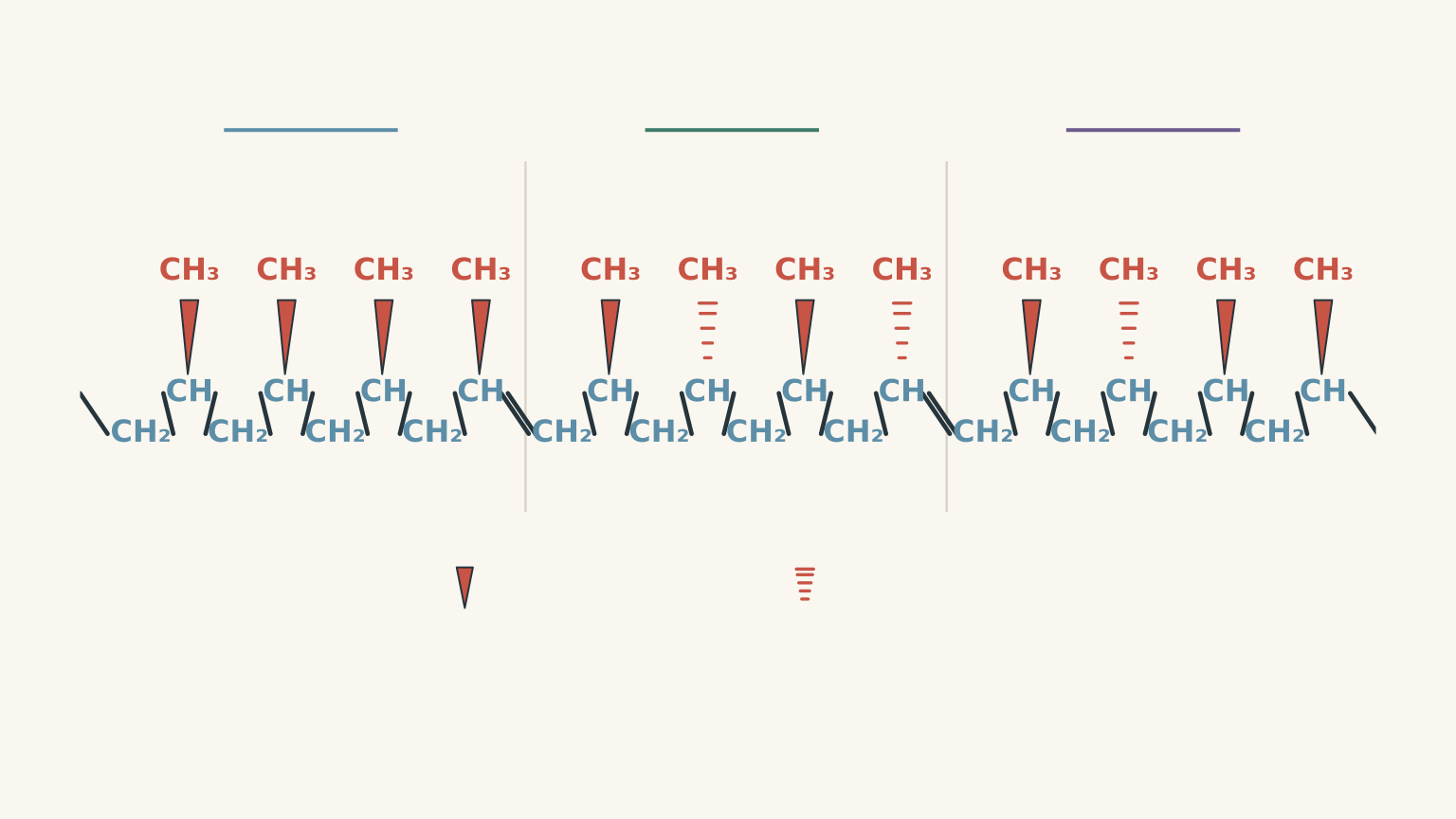
The regularity of side-group placement along a polymer chain is called tacticity.
Polypropylene can have three important forms of tacticity.
1. Isotactic polypropylene
The methyl groups have the same relative stereochemical arrangement along the chain. In a standard chain representation, they appear on the same side.
This regular arrangement allows neighbouring chains to pack into ordered regions.
Isotactic polypropylene is widely used in commercial applications because it can form a substantial crystalline structure.
2. Syndiotactic polypropylene
The methyl groups alternate sides along the chain.
This arrangement is also regular. Syndiotactic polypropylene can form crystalline regions, although its crystal structure and properties differ from those of isotactic polypropylene.
3. Atactic polypropylene
The methyl groups are arranged randomly along the chain.
This irregular arrangement makes consistent packing difficult. Atactic polypropylene is generally amorphous and typically much softer than isotactic polypropylene.
Why does this matter?
Imagine trying to stack identical books neatly. If every book has the same dimensions and orientation, they can form an organised stack. If their shapes and orientations vary randomly, the stack becomes less orderly.
Polymer chains behave in a related way. Regular side-group arrangements can make organised packing possible, while random arrangements make it more difficult.
Crystalline and amorphous regions
A polymer does not need to be either completely ordered or completely disordered.
Many polymers, including common isotactic polypropylene grades, are semicrystalline.
This means they contain two types of regions:
- Crystalline regions: sections where polymer chains are arranged in an ordered structure.
- Amorphous regions: sections where chains are arranged more randomly.
These regions exist within the same polymer material.
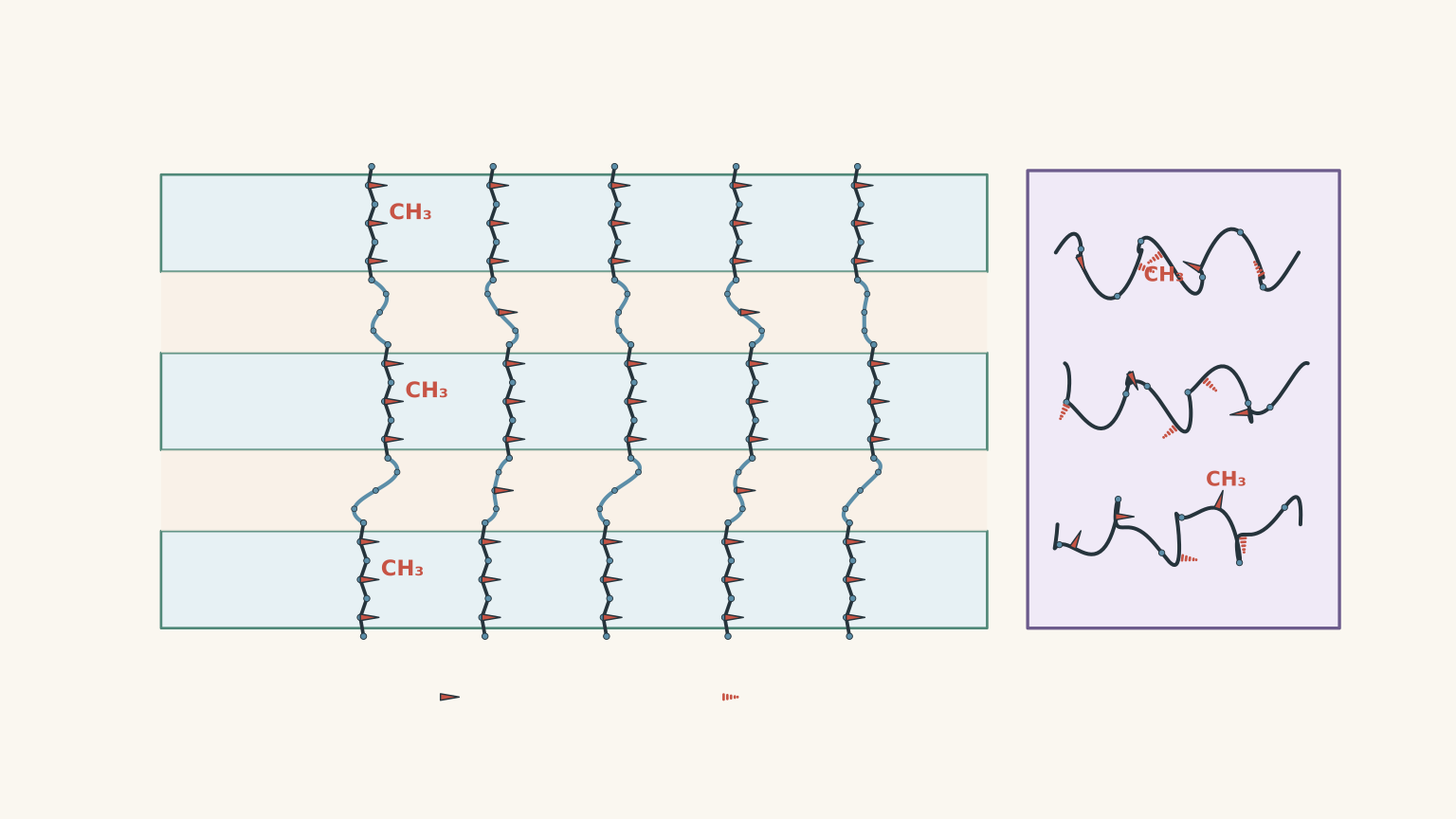
Crystalline regions restrict the movement of polymer chains. They act as physical anchors that make it harder for the material to deform.
As a general trend, increasing crystallinity can produce:
- Greater stiffness.
- Greater dimensional stability.
- Improved resistance to deformation at elevated temperatures.
- Reduced transparency, particularly when larger crystalline structures scatter visible light.
Amorphous regions allow greater chain movement and contribute to flexibility.
The balance between these regions helps determine the properties of the final material.
What happens when polypropylene is heated?
Polypropylene is a thermoplastic.
When heated sufficiently, its crystalline regions melt, allowing the polymer chains to move more freely. The material can then be moulded into a new shape.
When cooled, suitable regular chain sections can form crystalline regions again.
This is why polypropylene can be used in injection-moulded products, containers, and other manufactured shapes.
A typical isotactic polypropylene homopolymer has a melting region around \(160\text{-}170^\circ\mathrm{C}\). This is a useful approximate range, not a universal value for every polypropylene product.
The observed thermal behaviour depends on factors such as:
- Tacticity.
- Degree of crystallinity.
- Molecular mass.
- Copolymer composition.
- Additives and processing history.
Atactic polypropylene, by contrast, does not exhibit the same sharp crystalline melting transition because it lacks substantial crystalline regions.
04Polypropylene compared with other addition polymers
Polypropylene becomes easier to understand when you compare its structure directly with polyethylene, PVC, and PTFE.
All four are addition polymers, but their side groups produce quite different properties.
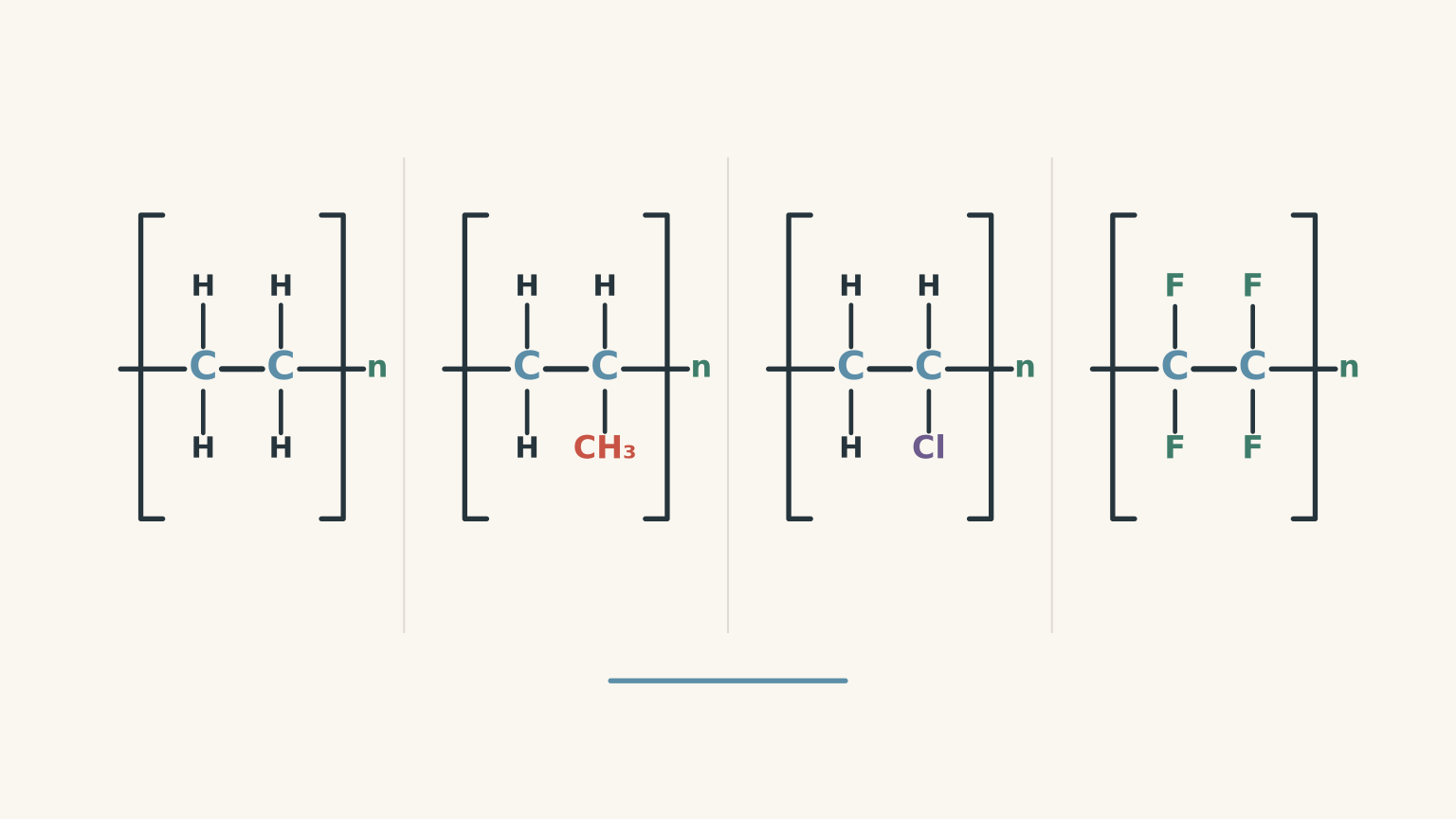
| Polymer | Repeat unit | Important structural feature | Typical properties and uses |
|---|---|---|---|
| Polyethylene (PE) | \(\ce{[-CH2-CH2-]_{n}}\) | No carbon-containing side group. Branching varies between grades. | Flexible films, bottles, and pipes. |
| Polypropylene (PP) | \(\ce{[-CH2-CH(CH3)-]_{n}}\) | Methyl groups affect chain movement and packing. Tacticity is important. | Moulded containers, fibres, and living hinges. |
| Polyvinyl chloride (PVC) | \(\ce{[-CH2-CHCl-]_{n}}\) | Chlorine side groups introduce polar C-Cl bonds. | Rigid pipes, cable insulation, and flexible products when plasticised. |
| Polytetrafluoroethylene (PTFE) | \(\ce{[-CF2-CF2-]_{n}}\) | Fluorine atoms surround the carbon backbone. | Non-stick coatings, chemical-resistant components, and seals. |
Let’s examine the important differences.
Polypropylene vs polyethylene
Both polymers have carbon backbones and are largely non-polar.
Their main structural difference is the methyl side group in polypropylene.
Polyethylene has relatively little steric interference from its hydrogen substituents. However, its properties depend strongly on branching.
For example:
- Low-density polyethylene (LDPE) has substantial branching, which interferes with close chain packing.
- High-density polyethylene (HDPE) is more linear and can generally pack more closely.
This affects their crystallinity, density, flexibility, and thermal behaviour.
Isotactic polypropylene can form an ordered crystalline structure despite its methyl side groups.
Typical isotactic polypropylene homopolymers have higher melting temperatures than many common polyethylene grades. However, the comparison depends on which polyethylene grade is being considered.
It would be incorrect to conclude that polypropylene must always be stronger or more rigid than polyethylene. Molecular mass, crystallinity, additives, and processing all influence mechanical properties.
Polypropylene vs PVC
PVC has chlorine atoms attached to alternating backbone carbon atoms.
The C-Cl bonds are polar, so PVC has significant dipole-dipole attractions between neighbouring chains, in addition to London dispersion forces.
This helps explain why unplasticised PVC is generally rigid.
However, manufacturers can add plasticisers to increase chain mobility and produce more flexible PVC products.
This is why PVC can be used for both rigid plumbing pipes and flexible cable insulation.
Polypropylene is largely non-polar, with London dispersion forces as its main intermolecular attractions. Its properties are strongly influenced by its crystalline structure and the arrangement of its methyl groups.
Polypropylene vs PTFE
PTFE has the repeat unit:
\[ \ce{[-CF2-CF2-]_{n}} \]
Instead of hydrogen or methyl groups, fluorine atoms surround the carbon backbone.
The carbon-fluorine bonds are particularly strong, and the fluorine-rich surface shields the carbon backbone.
This gives PTFE several useful properties:
- Excellent chemical resistance.
- High thermal stability.
- Very low surface energy.
- Low friction.
These properties make PTFE useful in non-stick coatings, seals, and chemical-processing equipment.
Polypropylene is generally easier to process using conventional thermoplastic manufacturing techniques, while PTFE requires specialised processing.
The key lesson is that changing the atoms attached to a polymer backbone can significantly change its behaviour.
05How polypropylene’s structure determines its uses
The structure of polypropylene makes it useful in several everyday products.
However, it is important to connect each use to the actual properties involved rather than simply memorising a list.

Food containers and packaging
Polypropylene is widely used in food containers, bottle caps, and packaging.
Several properties make it suitable:
- It has good chemical resistance to many common substances.
- It has relatively low moisture absorption.
- It can be moulded into complex shapes.
- Many grades have useful heat resistance compared with common polyethylene packaging grades.
Some polypropylene containers are designed for microwave use.
However, this depends on the particular product and its intended temperature range. Not every polypropylene container is automatically suitable for microwave heating.
Living hinges
A living hinge is a thin, flexible section of plastic connecting two more rigid sections.
Polypropylene is commonly used for these designs because suitable grades have good fatigue resistance. This means they can withstand repeated bending without failing immediately.
The material’s ability to be moulded into a continuous structure also makes it useful for this application.
Notice that this is not simply a consequence of the methyl group. The polymer grade, molecular structure, moulding process, and hinge geometry all contribute.
Fibres and woven materials
Polypropylene can be manufactured into fibres for ropes, woven bags, carpets, and other textile applications.
During fibre production, the polymer is drawn out, stretching and aligning the chains.
This alignment can improve tensile performance along the fibre direction.
The result is a useful material for applications where relatively strong, lightweight fibres are required.
Automotive and household components
Polypropylene is also used in automotive interior components, appliance housings, and other moulded products.
It can be manufactured into complex shapes and has useful chemical resistance.
Different grades can be modified with additives or blended with other polymers to improve properties such as impact resistance.
This is another reason not to assume that every polypropylene product has identical mechanical properties.
06Questions and solutions
Question 1
Propene undergoes addition polymerisation to produce polypropylene.
Draw the structural formula of the repeat unit. Identify the polymer backbone and the side group.
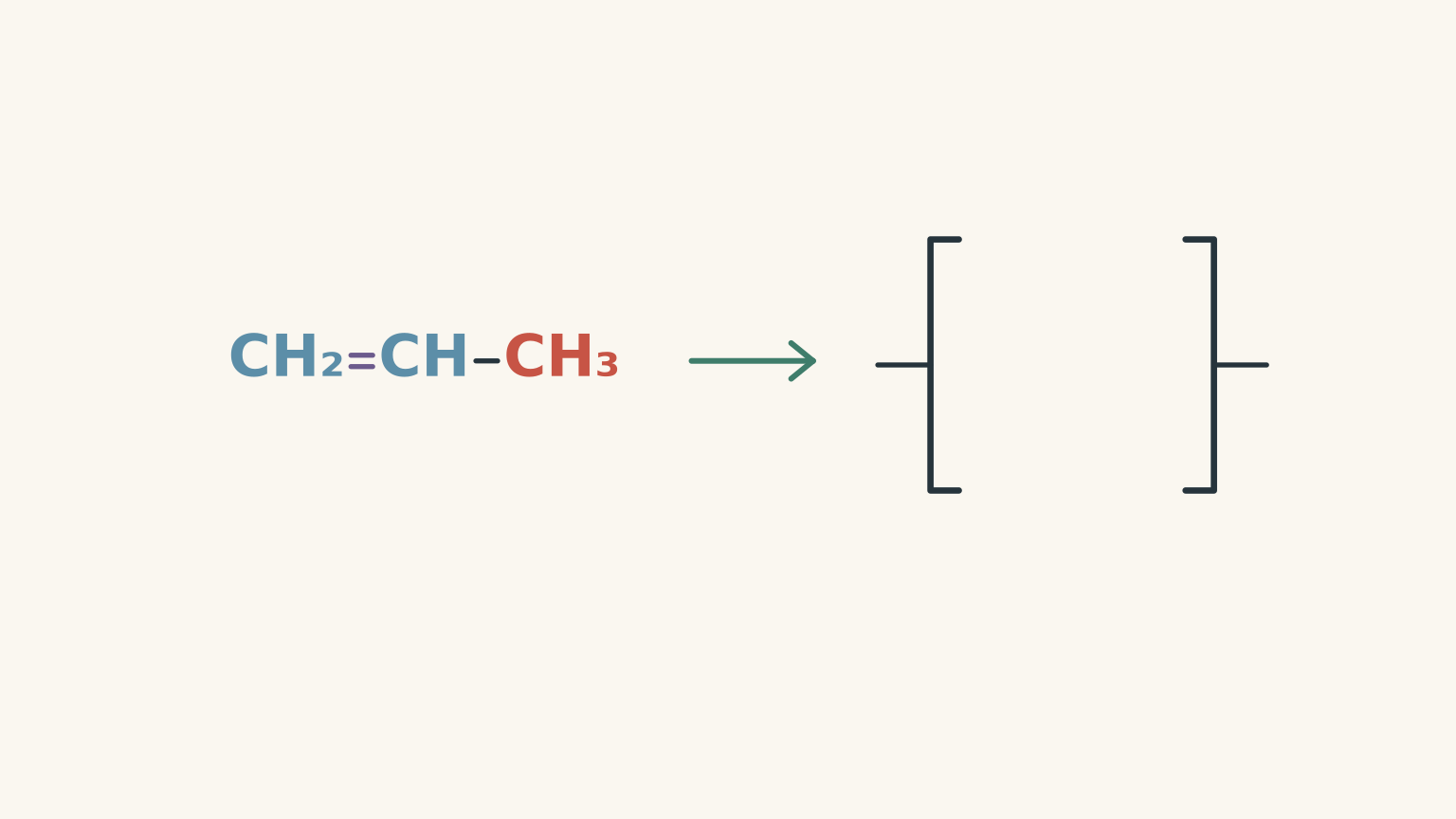
Solution 1
The repeat unit is:
\[ \boxed{\ce{[-CH2-CH(CH3)-]_{n}}} \]
The two carbon atoms originally involved in the double bond form the continuous polymer backbone.
The methyl group, \(\ce{-CH3}\), remains attached to the second backbone carbon.
The double bond opens during addition polymerisation, allowing new carbon-carbon single bonds to form between neighbouring monomers.
No atoms are removed from the propene molecules, so the repeat unit retains the formula \(\ce{C3H6}\).
Question 2
A polypropylene sample has a number-average molar mass of \(126\,000\ \mathrm{g\,mol^{-1}}\).
Calculate:
(a) The average degree of polymerisation.
(b) The number of polymer chains present in a \(2.10\ \mathrm{g}\) sample.
Use \(C=12.0\), \(H=1.0\), and \(N_A=6.02\times10^{23}\ \mathrm{mol^{-1}}\).
Assume the contribution from the polymer chain ends is negligible.
Solution 2
(a) The average degree of polymerisation is 3000 repeat units.
The repeat unit of polypropylene is \(\ce{C3H6}\).
Its molar mass is:
\[ \begin{aligned} M_r&=(3\times12.0)+(6\times1.0)\\ &=42.0 \end{aligned} \]
Therefore:
\[ \begin{aligned} n&=\frac{126\,000}{42.0}\\ &=3000 \end{aligned} \]
Each polymer chain contains approximately 3000 repeat units.
(b) The sample contains approximately \(1.00\times10^{19}\) polymer chains.
First calculate the amount of polymer chains:
\[ \begin{aligned} n_{\text{chains}} &=\frac{m}{M_n}\\ &=\frac{2.10}{126\,000}\\ &=1.67\times10^{-5}\ \mathrm{mol} \end{aligned} \]
Now use Avogadro’s constant:
\[ \begin{aligned} N&=n_{\text{chains}}N_A\\ &=(1.67\times10^{-5}) (6.02\times10^{23})\\ &=1.00\times10^{19} \end{aligned} \]
The sample therefore contains approximately \(1.00\times10^{19}\) polymer chains.
Be careful with the distinction between repeat units and polymer chains. A single polymer chain contains many repeat units, so the number of repeat units is much larger than the number of chains.
Question 3
A student makes the following claim:
“Polypropylene must always be denser and stronger than polyethylene because its repeat unit contains an extra carbon atom.”
Evaluate this statement.
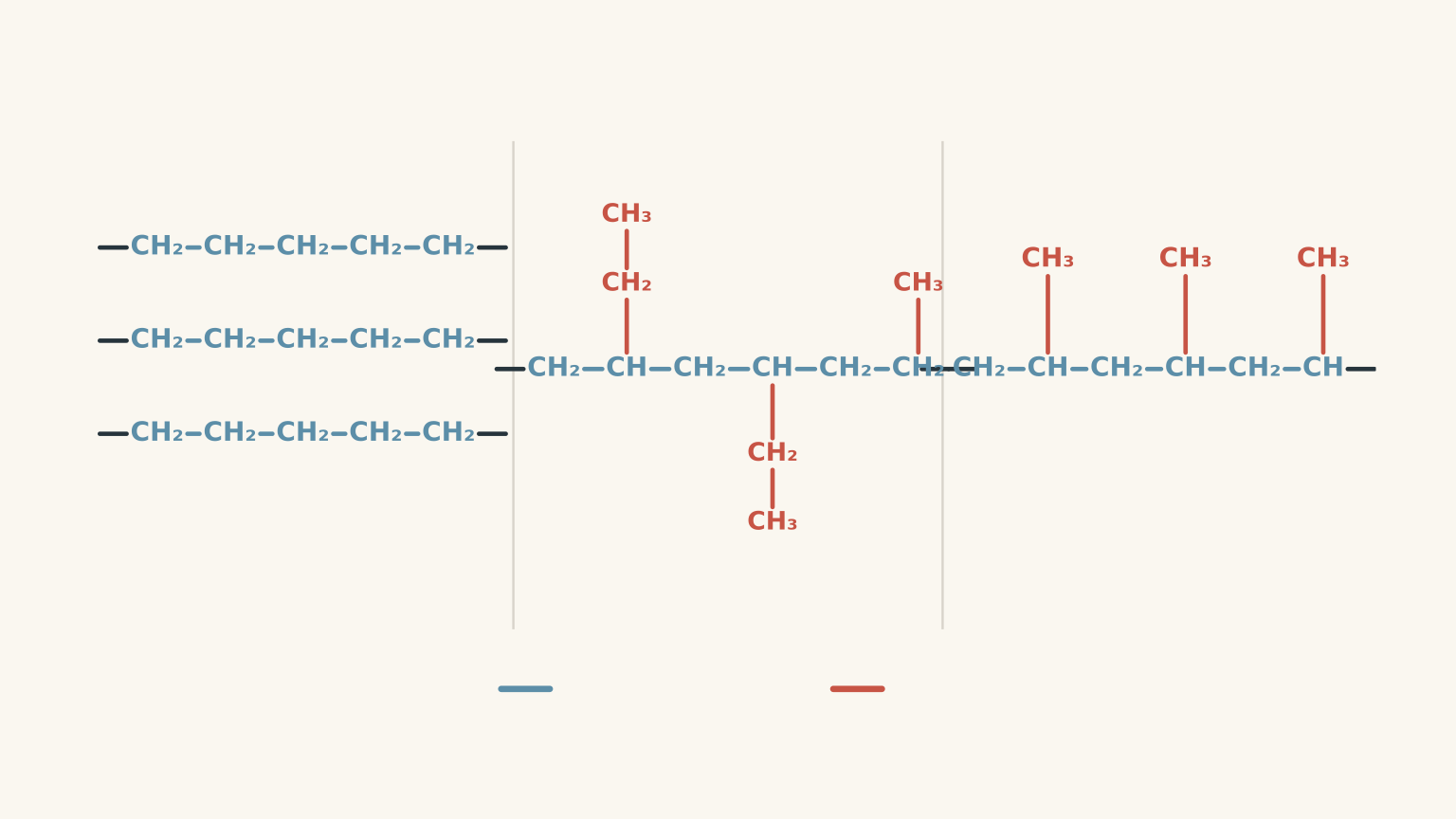
In your response, compare the structures of polypropylene, LDPE, and HDPE, and explain why the final properties cannot be predicted from the repeat-unit formula alone.
Solution 3
The student’s claim is incorrect. An extra carbon atom in the repeat unit does not automatically make polypropylene denser or stronger than every polyethylene grade.
The key is to consider how the complete polymer chains are arranged.
Polypropylene has the repeat unit:
\[ \ce{[-CH2-CH(CH3)-]_{n}} \]
The methyl groups occupy space around the backbone and influence chain packing.
However, the arrangement of these groups is important. Isotactic polypropylene can form ordered crystalline regions, while atactic polypropylene has much less ability to pack regularly.
Polyethylene has the repeat unit:
\[ \ce{[-CH2-CH2-]_{n}} \]
Its properties are strongly influenced by branching.
LDPE contains many branches. These prevent neighbouring chains from packing as closely, generally reducing crystallinity and producing a more flexible material.
HDPE has fewer branches and more linear chains. This allows closer packing and generally produces a higher crystalline fraction than LDPE.
Therefore, polyethylene itself can have quite different properties depending on its grade.
The student’s mistake is assuming that a larger repeat unit necessarily produces a greater density or strength.
Density depends on both mass and the volume occupied by the polymer structure. Strength depends on several factors, including molecular mass, crystallinity, chain orientation, and intermolecular interactions.
The correct conclusion is that polymer properties depend on the complete molecular structure and how the chains are arranged, not simply the number of carbon atoms in the repeat unit.
Question 4
Two polypropylene samples have similar average molecular masses.
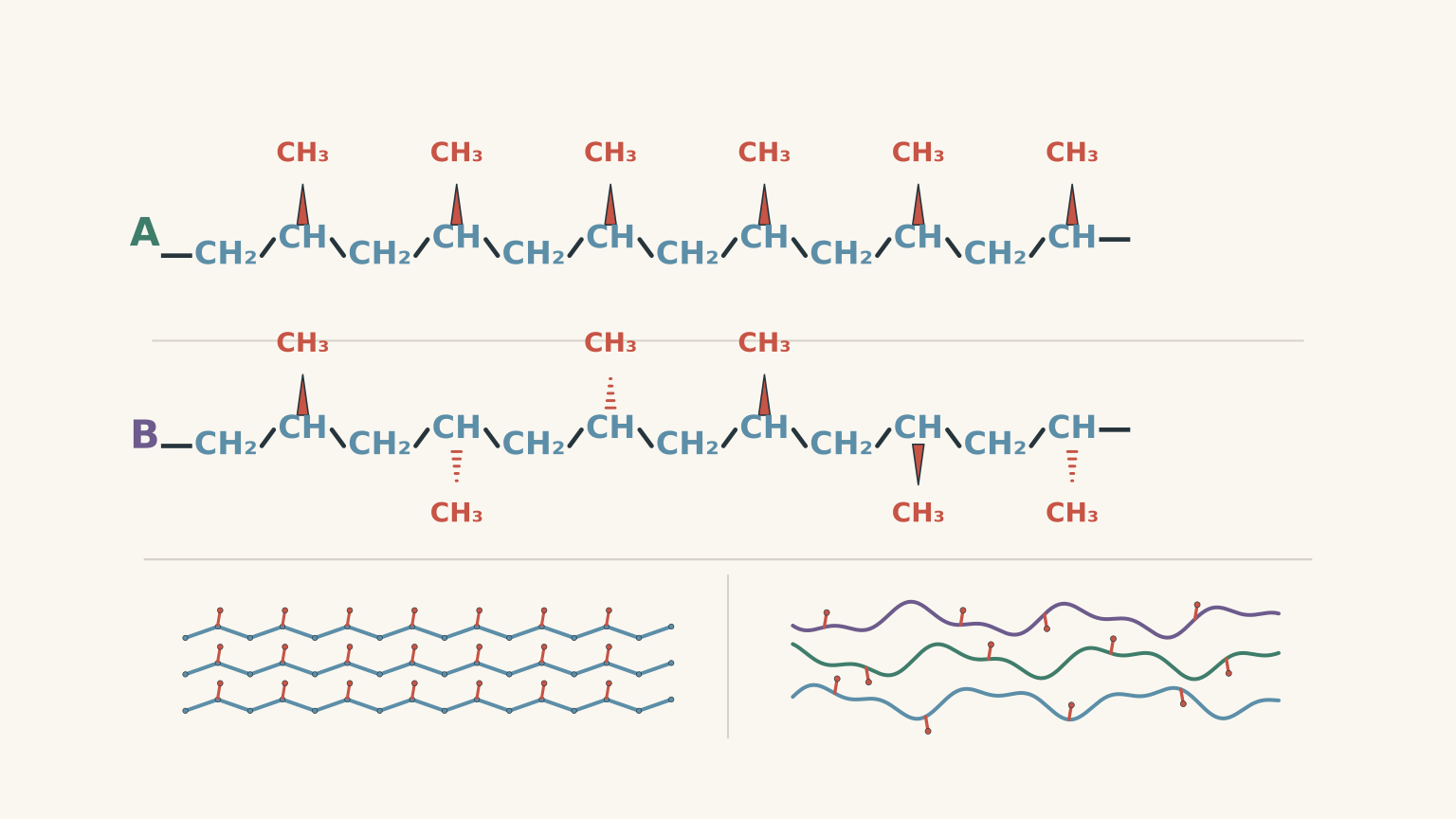
Sample A has methyl groups arranged regularly on the same relative side of the polymer backbone. It forms a rigid moulded material with a clear crystalline melting transition.
Sample B has randomly arranged methyl groups. It forms a much softer material and does not show the same sharp crystalline melting transition.
(a) Identify the type of tacticity present in each sample.
(b) Explain why the samples have different physical properties despite having the same repeat-unit formula.
(c) Which sample would generally be more suitable for manufacturing a rigid reusable food container? Justify your choice.
Solution 4
Sample A is isotactic polypropylene, while Sample B is atactic polypropylene. Sample A is generally more suitable for a rigid reusable food container.
(a) Identify the tacticity.
Sample A is isotactic because its methyl groups have the same relative stereochemical arrangement along the chain.
Sample B is atactic because its methyl groups are arranged randomly.
(b) Explain the difference in physical properties.
Both samples have the same repeat-unit formula:
\[ \ce{C3H6} \]
Their covalent bonding and chemical composition are therefore essentially the same.
However, their three-dimensional arrangements are different.
The regular arrangement in isotactic polypropylene allows neighbouring chains to pack into ordered crystalline regions.
These regions restrict chain movement and help the material retain its shape.
Atactic polypropylene has randomly arranged methyl groups. This makes regular packing difficult, so it is generally predominantly amorphous.
Its chains have greater freedom to move relative to one another, producing a softer material.
The difference in properties therefore comes from molecular arrangement and crystallinity, not a different repeat-unit formula.
(c) Select the more suitable sample.
Sample A is generally more suitable for a rigid reusable food container.
Its crystalline regions provide greater stiffness and dimensional stability.
Sample B would be less suitable when the product needs to maintain a rigid shape under normal use.
This example shows why identifying the polymer is not always enough. You may also need to know its tacticity and crystalline structure.
Question 5
A manufacturer produces two polypropylene films from the same batch of isotactic polypropylene.
Both films have the same thickness, additives, and molecular mass distribution.
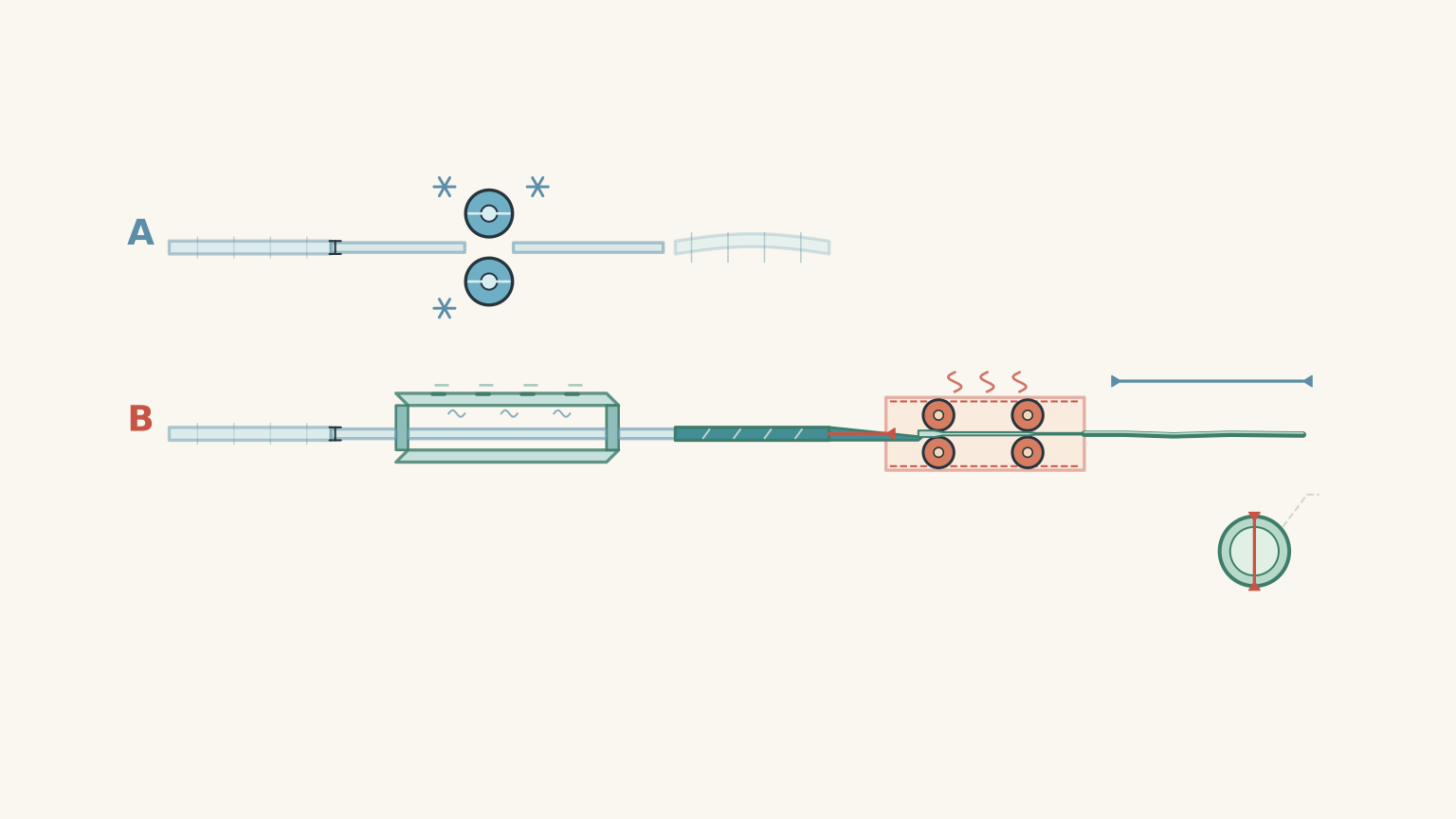
- Film A is cooled rapidly after moulding. It is relatively transparent and flexible.
- Film B is cooled slowly. It is more opaque and stiffer.
Thermal analysis shows that Film B has a higher crystalline fraction. Microscopy also shows that it contains larger crystalline structures.
Part of Film B is then heated and drawn into a long polypropylene fibre. The resulting fibre withstands much greater tensile stress along its length than across its width.
A student argues:
“All these differences must be caused by the methyl side groups. Polypropylene has methyl groups, so that is what determines its stiffness, transparency, and strength.”
Evaluate this explanation.
Your answer should explain:
(a) Why Films A and B have different stiffness despite having the same polymer structure.
(b) Why Film B is more opaque.
(c) Why the drawn fibre has different tensile properties along and across its length.
(d) What this example demonstrates about predicting polymer properties from a repeat-unit formula.
Solution 5
The student’s explanation is incomplete. The differences arise from the interaction between molecular structure, crystallinity, and processing, not simply from the presence of methyl groups.
Both films contain the same polypropylene repeat unit:
\[ \ce{[-CH2-CH(CH3)-]_{n}} \]
They also have the same tacticity and similar molecular mass distributions.
Therefore, their different properties cannot be explained by different repeat-unit structures.
(a) Explain the difference in stiffness.
Film B has a higher crystalline fraction than Film A.
Slow cooling gives polymer chains more opportunity to arrange into ordered crystalline regions.
These regions restrict the movement of neighbouring chains and make it more difficult for the material to deform.
As a result, Film B is stiffer.
Rapid cooling in Film A limits the time available for chain rearrangement and crystallisation.
A greater proportion of its structure remains disordered, allowing more chain movement and producing a more flexible material.
(b) Explain the difference in transparency.
Film B contains larger crystalline structures.
These structures can scatter visible light as it passes through the material, making the film appear more opaque.
Film A has smaller crystalline structures and a lower crystalline fraction. It therefore scatters less visible light under the conditions described.
The important distinction is that transparency depends partly on the size and distribution of structures within the material, not simply its chemical composition.
(c) Explain the fibre’s directional tensile properties.
Drawing the polypropylene stretches the polymer chains and encourages them to align along the fibre’s length.
The resulting structure has a preferred direction of molecular orientation.
When the fibre is pulled along its length, the aligned chains can carry much of the applied load through their strong covalent backbones.
Interactions between neighbouring chains also help transfer the load through the material.
When the fibre is pulled across its width, the force is not acting along the same aligned chain direction. The material relies more heavily on intermolecular interactions and resistance to chain movement.
Consequently, its tensile behaviour differs depending on the direction of the applied force.
This property is called anisotropy: the material has different properties in different directions.
(d) Explain what this demonstrates about polymer properties.
The example demonstrates that a repeat-unit formula does not provide enough information to predict every property of a finished polymer product.
The methyl side groups influence how polypropylene chains can pack. However, the final properties also depend on:
- Tacticity and stereochemical arrangement.
- Degree of crystallinity.
- Size and distribution of crystalline regions.
- Cooling rate and thermal history.
- Chain orientation produced during processing.
Films A and B have the same chemical composition, yet their processing histories produce different physical properties.
Drawing the polymer into a fibre introduces another structural change by aligning the chains and creating directional properties.
The important conclusion is that polymer properties are determined by both molecular structure and the organisation of the polymer chains.
07Where to go next
You can now move from identifying a polymer’s repeat unit to predicting how its structure affects its properties.
The next useful step is to compare addition polymers with condensation polymers. In particular, look at how their formation reactions differ, whether small molecules are eliminated, and how these differences affect the structures of polymers such as polyesters and polyamides.
That comparison will help you move beyond memorising individual polymers and start predicting their behaviour from their chemistry.