
Open and Closed Systems in Aboriginal Cooking Methods
Compare cooking over hot coals with enclosed Aboriginal earth ovens to understand system boundaries, matter and energy transfers, and conservation of mass. Includes worked examples and five HSC-style questions with detailed solutions.
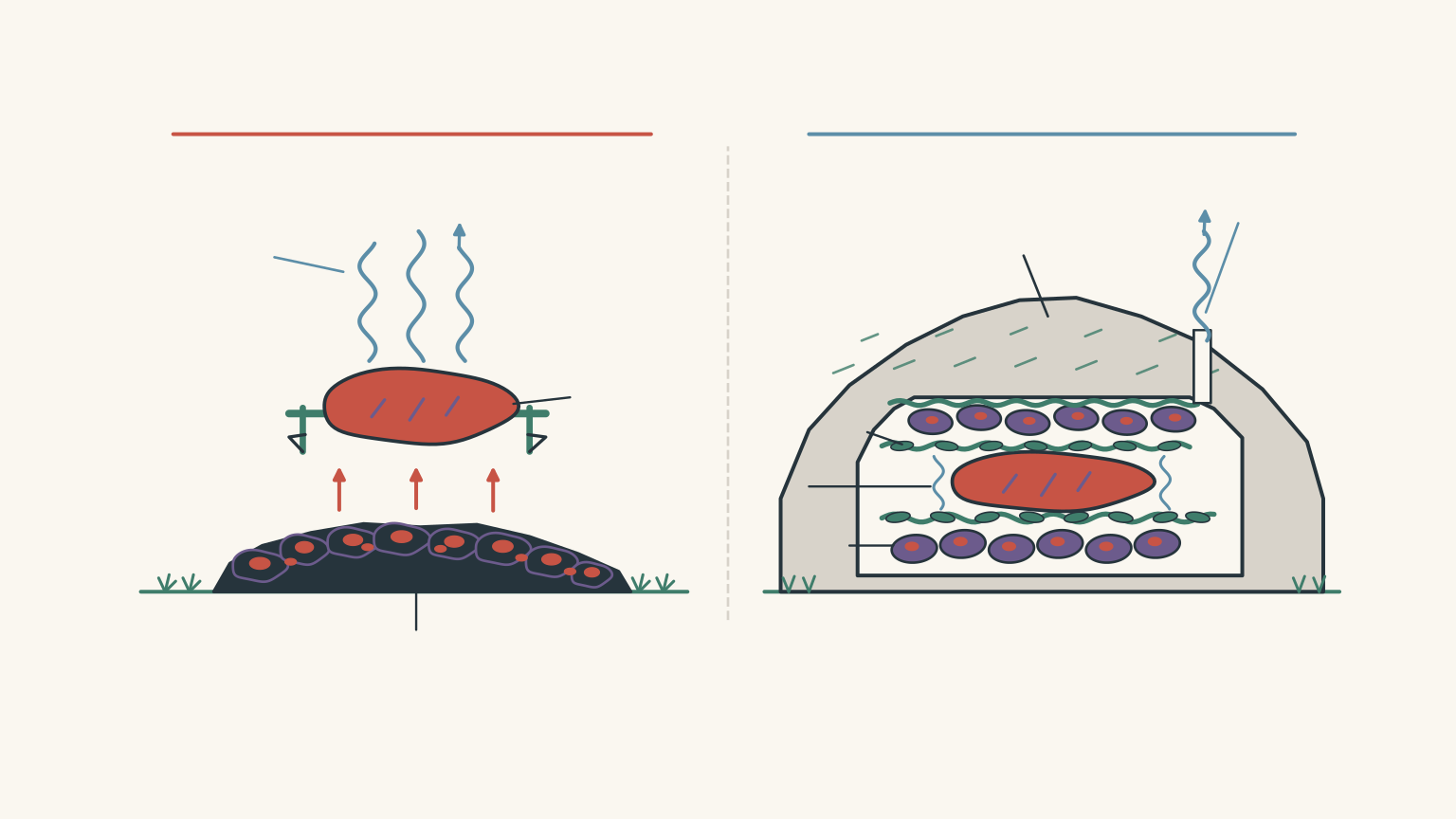
An initial 1.00 kg portion of food is placed over hot coals. After cooking, the food weighs just 0.82 kg. Where did the missing 180 g go?
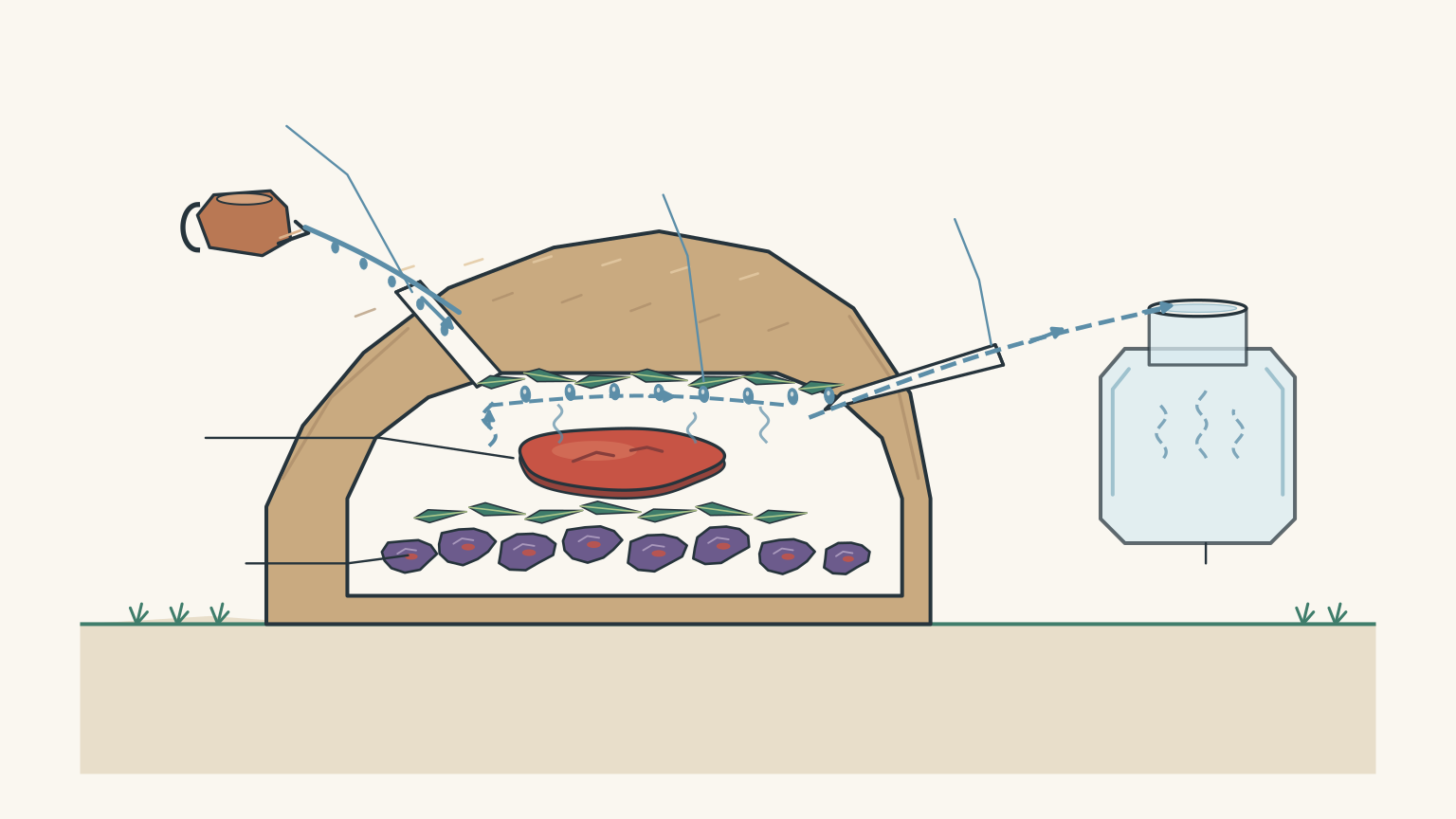
Now imagine cooking a similar portion in an earth oven, covered with hot stones, grass, and soil. Water vapour is trapped inside, but some steam may still escape through gaps. The stones also cool as they transfer energy to the food and surrounding ground.
Predict: does covering the oven guarantee that its total mass stays constant?
No. A cover can restrict the movement of matter without stopping it completely. To understand why, we need to look at two things: what we include in the system, and what crosses its boundary.
Aboriginal and Torres Strait Islander Peoples have developed diverse cooking practices across different Countries and communities. There is no single method that represents everyone.
For example, the Australian Curriculum describes how the Barindji Peoples of south-central New South Wales used hot stones beneath and above large animals, with grass and an earth covering enclosing the food. Water could also be introduced through a hole during cooking to produce steam. The same resource describes earth ovens used by the Bindal and Wulgurukaba Peoples of far North Queensland.
These examples provide a useful context for understanding how matter and energy move during cooking. They are specific cultural practices, not a universal recipe. The research paper by Morrison and colleagues (2022), Earth oven cookery and cuisines in Aboriginal Australia, also documents the considerable variation in earth oven construction, ingredients, and cooking techniques.
01First, choose your system boundary
Imagine you are investigating a piece of food being cooked. You cannot study every atom in the surrounding environment, so you choose a particular part of the situation to examine.
This is called the system.
The system is the part of the universe you are studying. Everything outside it is called the surroundings. An imaginary or physical line separating the two is the system boundary.
Think of drawing a fence around the objects you want to investigate. Anything that crosses the fence moves between the system and its surroundings.
The important detail is that you choose where the fence goes.
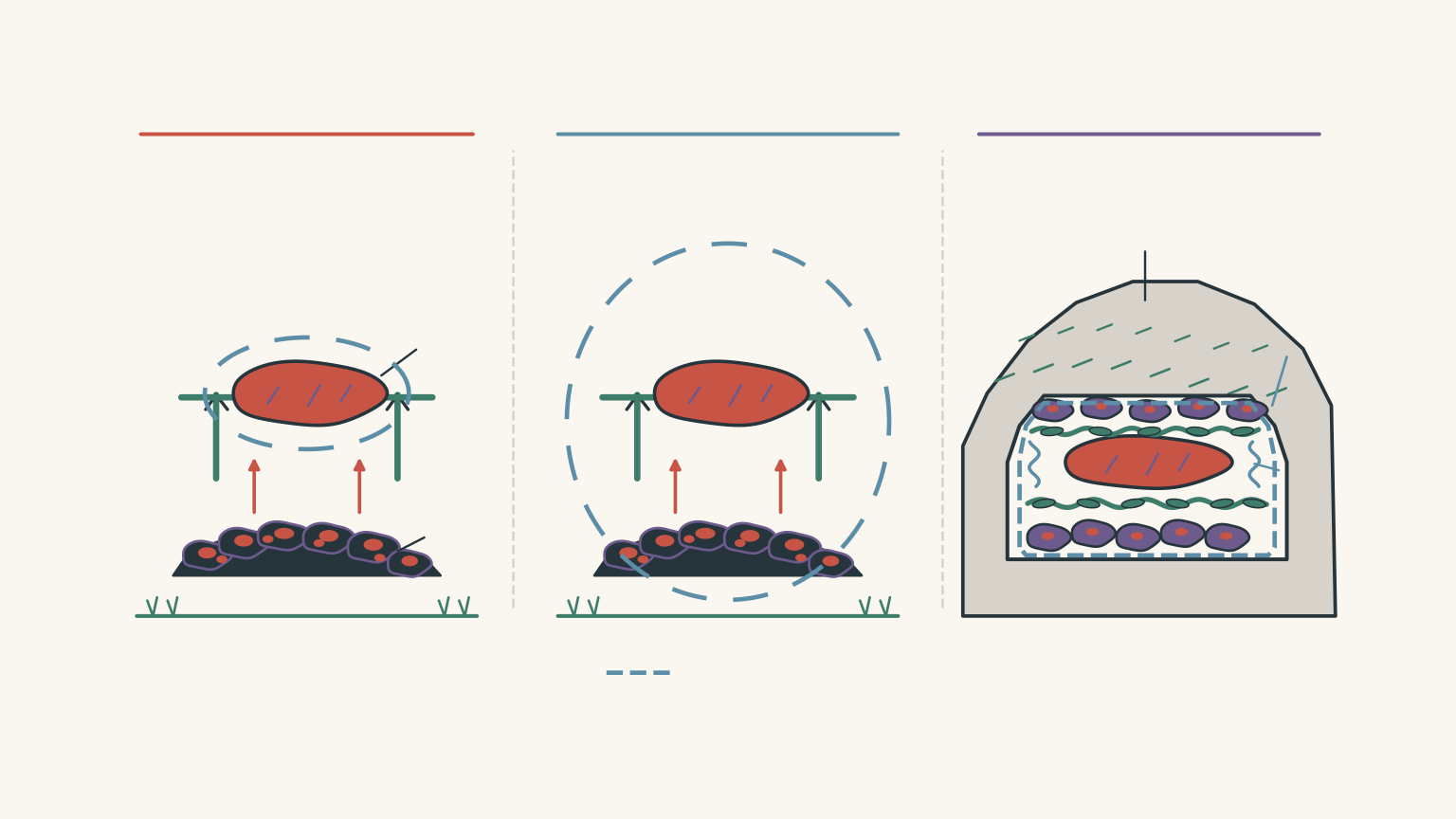
For example, you could draw a boundary around:
- Just the food being cooked.
- The food and the hot coals.
- The entire interior of an earth oven, including the food, stones, plant material, and trapped gases.
Each choice gives you a different system to analyse.
Open, closed, and isolated systems
Once you have chosen your boundary, look at what can cross it.
There are three main types of thermodynamic systems.
| System | Matter exchange | Energy exchange |
|---|---|---|
| Open | Matter can enter or leave | Energy can enter or leave |
| Closed | No matter enters or leaves | Energy can enter or leave |
| Isolated | No matter enters or leaves | No energy enters or leaves |
These definitions follow the standard chemistry treatment of systems and surroundings, as explained in the University of British Columbia’s Chemistry Instructional Resources.
The distinction between matter and energy is important.
Matter includes substances such as water, oxygen, carbon dioxide, smoke, and food particles.
Energy can cross a boundary through heating. During cooking, energy transfers from hot coals or stones to cooler food.
Heat is energy being transferred because of a temperature difference. It is not a substance that flows into the food.
A useful rule is:
- If matter crosses the boundary, the system is open.
- If matter cannot cross but energy can, the system is closed.
- If neither matter nor energy can cross, the system is isolated.
An isolated system is an idealisation. Even a well-insulated container eventually exchanges some energy with its surroundings.
02Cooking over hot coals: an open system
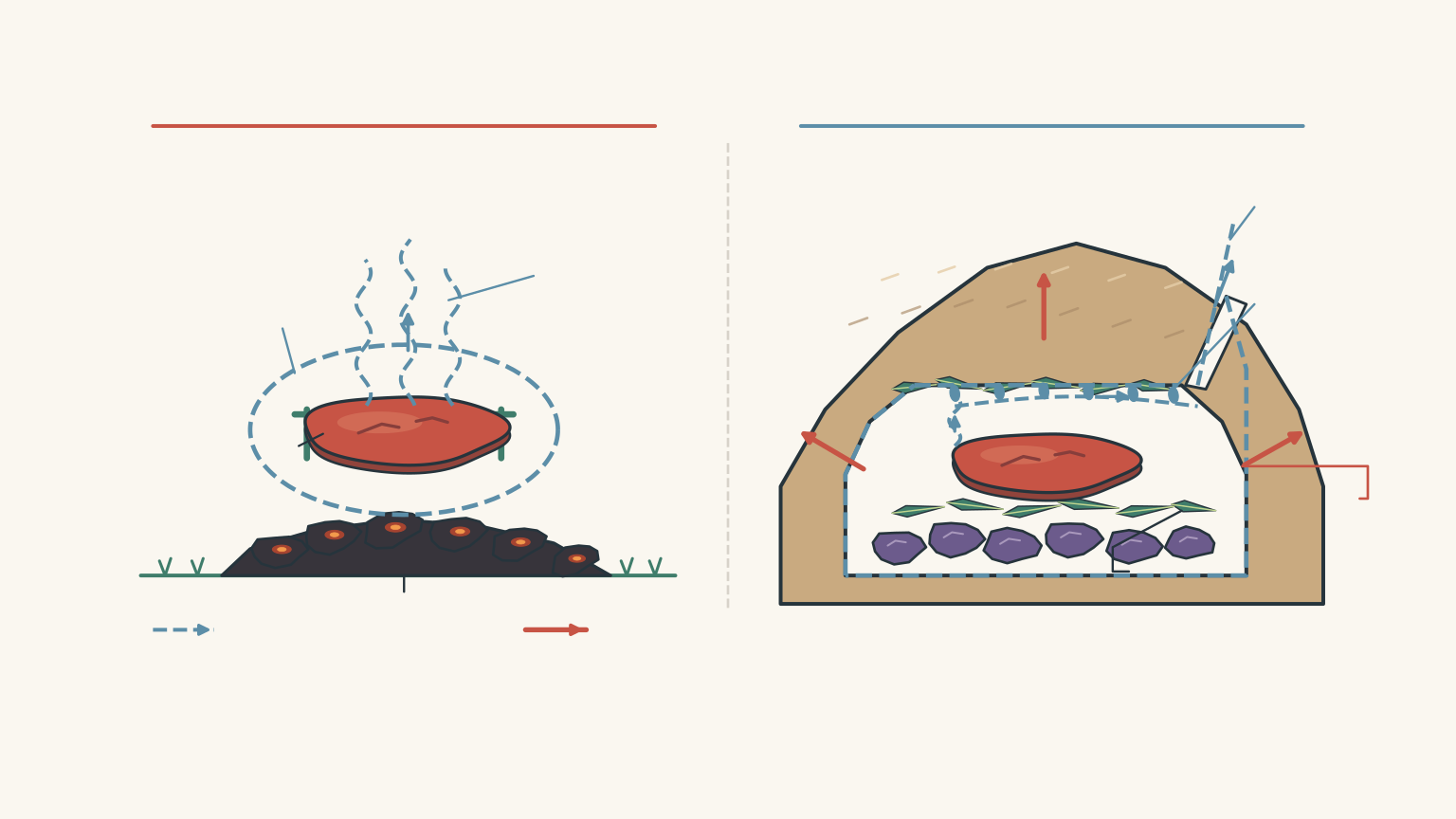
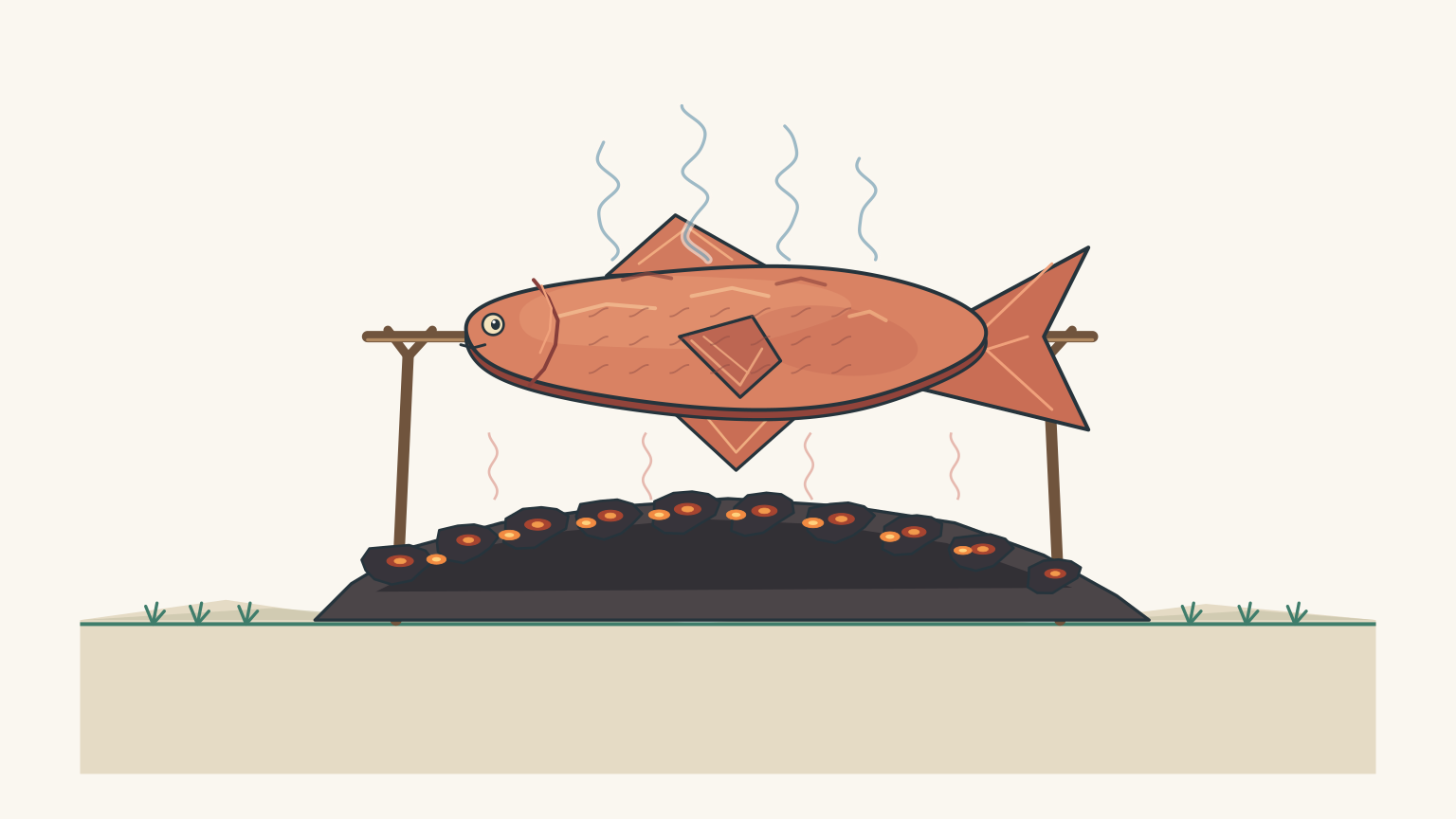
Roasting food directly over hot coals provides a straightforward example of an open cooking arrangement.
A 2000 education handout from the Australian National Botanic Gardens, written by Warwick Wright, describes roasting meat and fish on hot coals, as well as slower cooking beneath coals and ash.
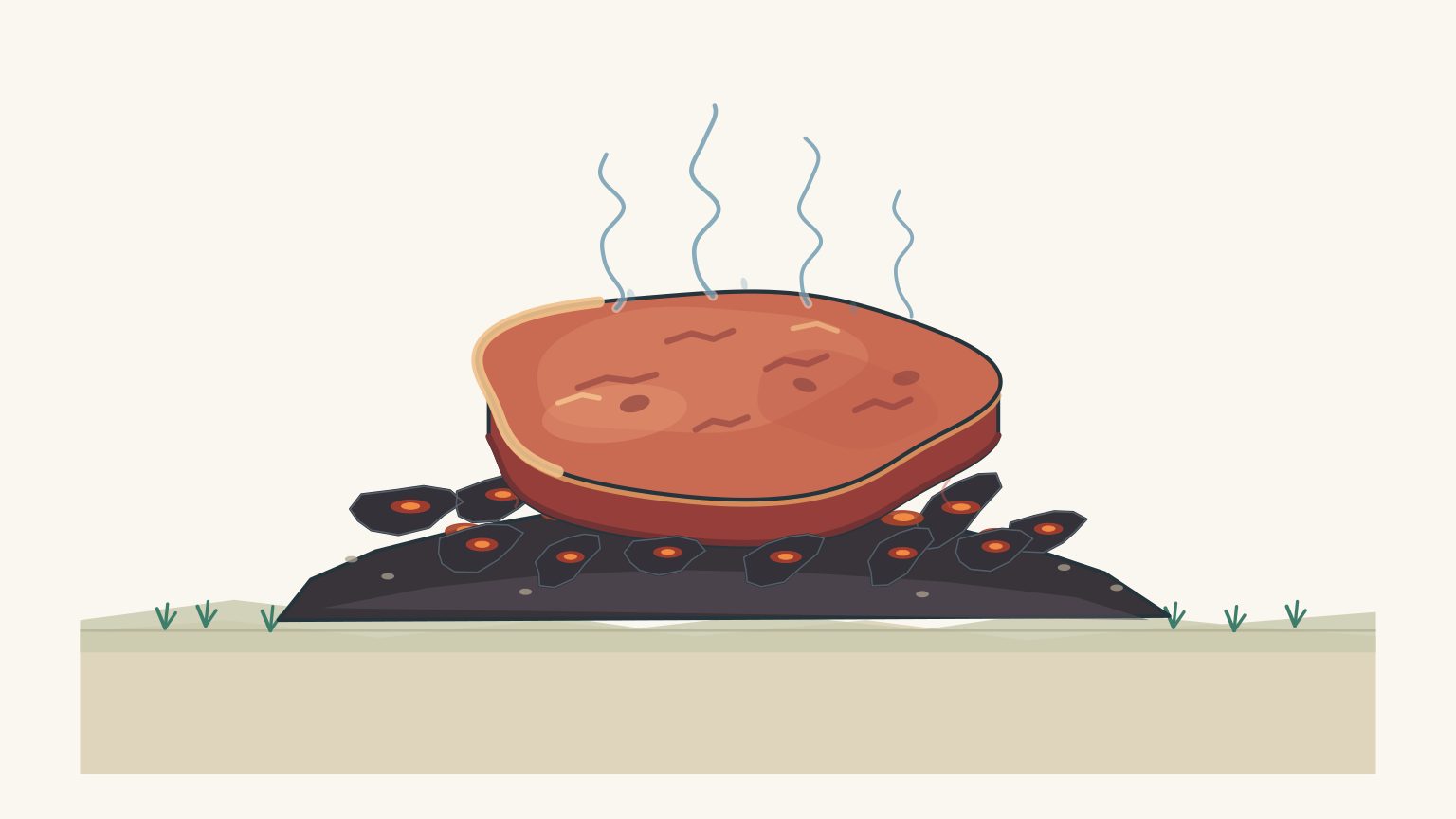
Let’s draw our system boundary around the food alone.
Several things happen during cooking.
Energy enters the food.
The hot coals transfer energy through several mechanisms:
- Radiation transfers energy from the hot coals to the food.
- Conduction transfers energy through direct contact between hot surfaces and the food.
- Convection transfers energy through the movement of hot air around the food.
Matter leaves the food.
As the food heats up, some of its liquid water evaporates.
Water molecules gain enough energy to escape from the food’s surface and enter the surrounding air as water vapour.
Some fat and liquid juices may also drip away. Volatile substances released during cooking can enter the air.
The food’s mass decreases because some of its original matter has crossed the system boundary.
There may also be matter entering the food. For example, oxygen can react with substances at its surface, and small amounts of ash or smoke may settle on it.
Therefore, the food-only system exchanges both matter and energy with its surroundings.
Classification: Open system
What if we include the fire?
Now change the boundary.
Instead of surrounding only the food, draw it around the food, coals, and burning fuel.
The system can now exchange:
- Oxygen entering from the surrounding air.
- Carbon dioxide, water vapour, and other combustion products leaving.
- Thermal energy transferring to the surroundings.
A simplified model of carbon combustion is:
\[
\ce{C(s) + O2(g) -> CO2(g)}
\]
Carbon from the fuel reacts with oxygen from the air to produce carbon dioxide.
Notice that oxygen enters the system, while carbon dioxide leaves it. The mass of the remaining charcoal can decrease, but this does not mean matter has disappeared.
The system is still open because both matter and energy cross its boundary.
03Cooking in an enclosed earth oven
Now consider an earth oven.
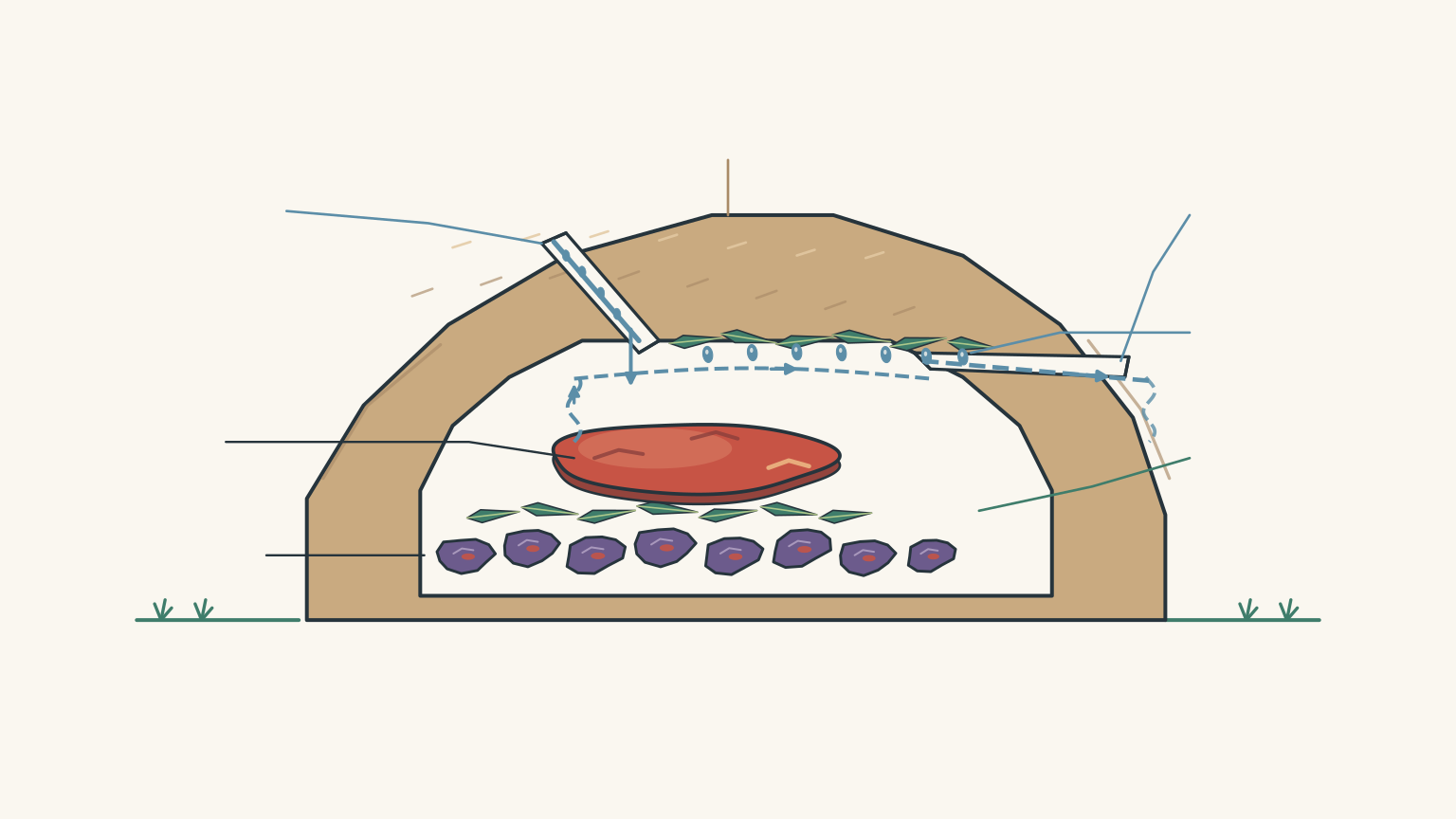
The Australian Curriculum describes a method used by the Barindji Peoples in which hot stones are placed inside a ground oven. Food is positioned on plant material over the stones, with more hot stones and grass placed above it. The entire arrangement is then covered with earth.
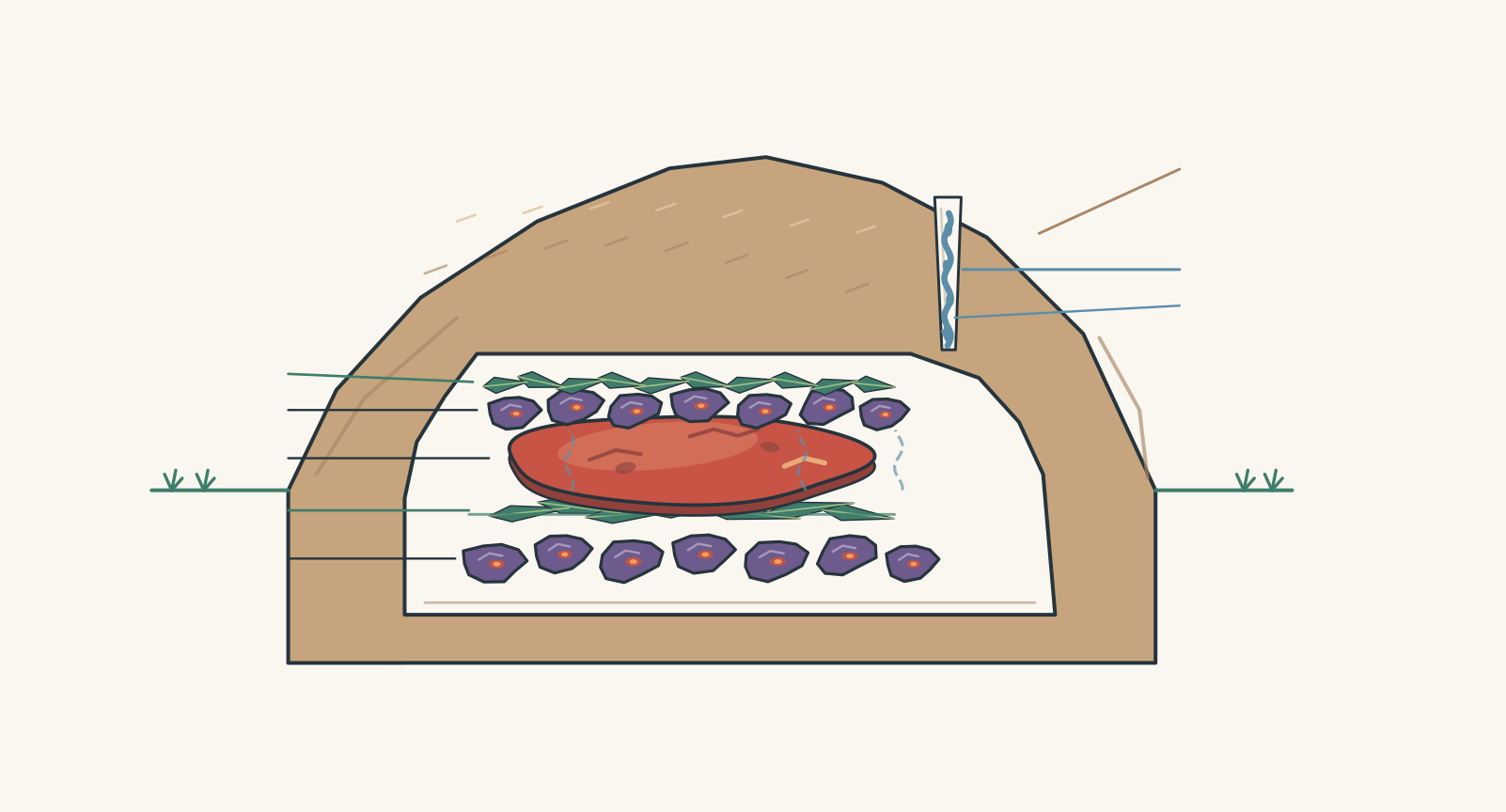
The arrangement creates a very different cooking environment.
The earth covering restricts the movement of air and water vapour. It also helps retain heat inside the oven.
Hot stones transfer energy to the food through conduction. Hot gases and steam move within the oven, transferring energy through convection.
The Australian Curriculum’s ground oven teaching resource explains how conduction and convection contribute to the effectiveness of these cooking methods.
Why does trapping steam matter?
Food contains water. When it heats up, some of that water evaporates.
In an exposed cooking arrangement, much of this water vapour escapes directly into the atmosphere.
Inside a covered oven, however, the vapour is more likely to remain within the enclosed space. It can circulate and condense on cooler internal surfaces.
This helps maintain a moist cooking environment.
The earth covering therefore restricts the movement of matter between the oven and its surroundings.
But does that make the oven a perfectly closed system?
Not necessarily.
Consider what happens during the cooking process.
1. Water may be added.
In the Barindji example documented by the Australian Curriculum, a hole was made in the oven at various cooking intervals so water could be poured inside.
That water crosses the system boundary.
2. Steam may escape.
Small gaps, cracks, or openings can allow water vapour to leave the oven.
3. Energy still transfers outwards.
Even when the earth cover prevents matter from escaping, thermal energy can move through the earth into the surrounding soil and air.
The hot stones gradually cool as they transfer energy to the food and their surroundings.
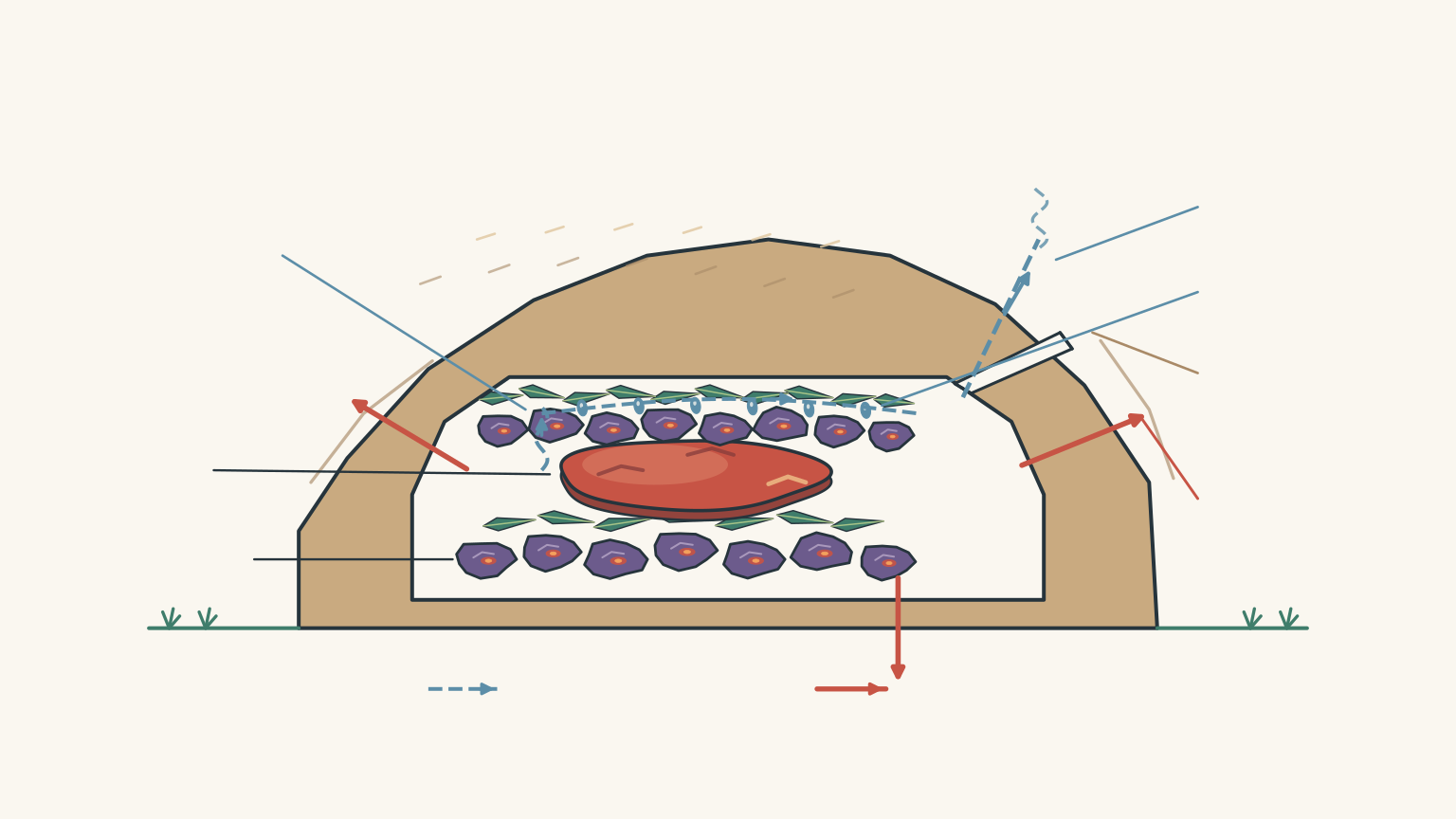
This gives us an important distinction:
An enclosed oven can behave approximately like a closed system during a period when no matter crosses its boundary. However, it is not necessarily closed throughout the entire cooking process.
It is certainly not isolated while its hot contents transfer energy to the cooler surroundings.
An important variation: wrapped food on coals
The distinction between open and enclosed cooking is not always a simple choice between two completely different arrangements.
The Australian Curriculum also describes food wrapped in leaves or moistened paperbark and cooked on hot coals or ash.
These wrappings help retain moisture and steam around the food.
The food is still receiving energy from its surroundings, but its immediate environment is more enclosed than food exposed directly to the air.
This is a useful reminder that the system boundary matters more than the name of the cooking method.
04Where does the missing mass go?
Return to our original example.
A food portion weighs 1.00 kg before cooking and 0.82 kg afterwards.
It has lost 0.18 kg.
It is tempting to think that cooking has destroyed some of the matter. But that is not what has happened.
The missing mass has moved into the surroundings, most likely as water vapour or other substances released during cooking.
This connects directly to the law of conservation of mass.
The law states that mass is conserved during ordinary physical and chemical changes. During a chemical reaction, atoms are rearranged to form new substances, but they are not created or destroyed.
The principle dates back to Antoine Lavoisier’s work in the eighteenth century. For an accessible explanation, see Sterner, Small, and Hood’s Nature Education article on the conservation of mass.
The crucial point is that conservation of mass does not mean every individual object must maintain the same mass.
It means we must account for all the matter involved.
The mass balance equation
For a system that can exchange matter with its surroundings, we can write:
\[
m_{\text{initial}}+m_{\text{in}}
=
m_{\text{final}}+m_{\text{out}}
\]
Where:
- \(m_{\text{initial}}\) is the mass inside the system before cooking.
- \(m_{\text{in}}\) is the total mass entering the system.
- \(m_{\text{final}}\) is the mass inside the system after cooking.
- \(m_{\text{out}}\) is the total mass leaving the system.
For a closed system, no matter enters or leaves. Therefore:
\[
m_{\text{in}}=m_{\text{out}}=0
\]
And the equation simplifies to:
\[
m_{\text{initial}}=m_{\text{final}}
\]
For an open system, however, the measured mass can increase or decrease depending on the amount of matter entering and leaving.
This is why you must identify your system boundary before interpreting a balance reading.
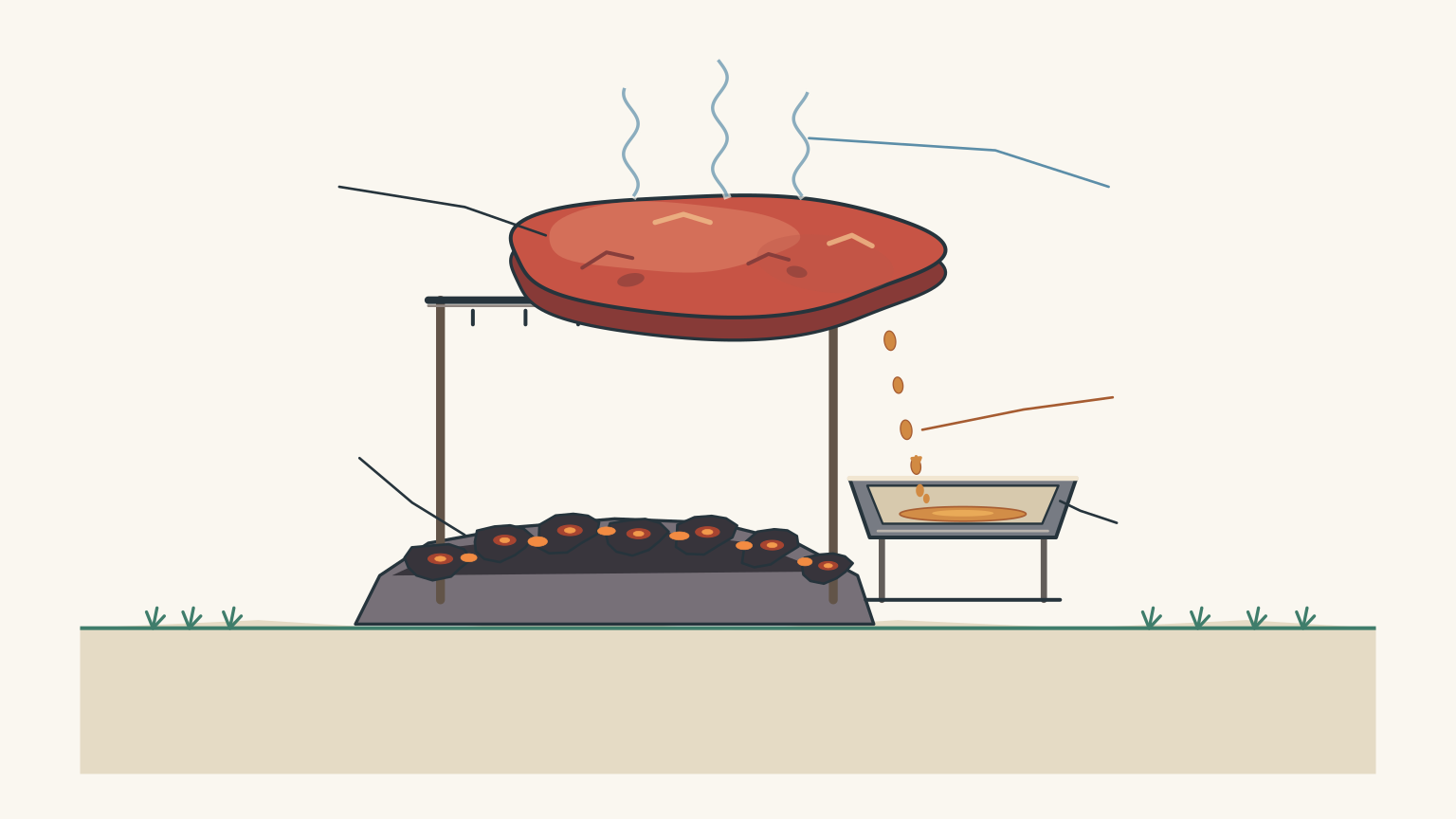
Worked example: Finding the water lost during coal cooking
A food portion has an initial mass of 1.20 kg. After cooking over hot coals, the food weighs 0.91 kg. A further 0.04 kg of fat and juices has dripped into a collection tray.
Assuming no material enters the food and the remaining mass loss is due to evaporated water, calculate the mass of water vapour released.
Step 1
\[
m_{\text{lost}}=1.20-0.91
\]
\[
m_{\text{lost}}=0.29\text{ kg}
\]
Step 2
The remaining mass loss must be water vapour.
\[
m_{\text{vapour}}=0.29-0.04
\]
\[
\boxed{m_{\text{vapour}}=0.25\text{ kg}}
\]
Step 3
\[
1.20=0.91+0.04+0.25
\]
The initial mass equals the final food mass plus the matter that left the food.
The food has lost 0.29 kg, but only 0.25 kg has escaped into the atmosphere. The other 0.04 kg remains in the collection tray.
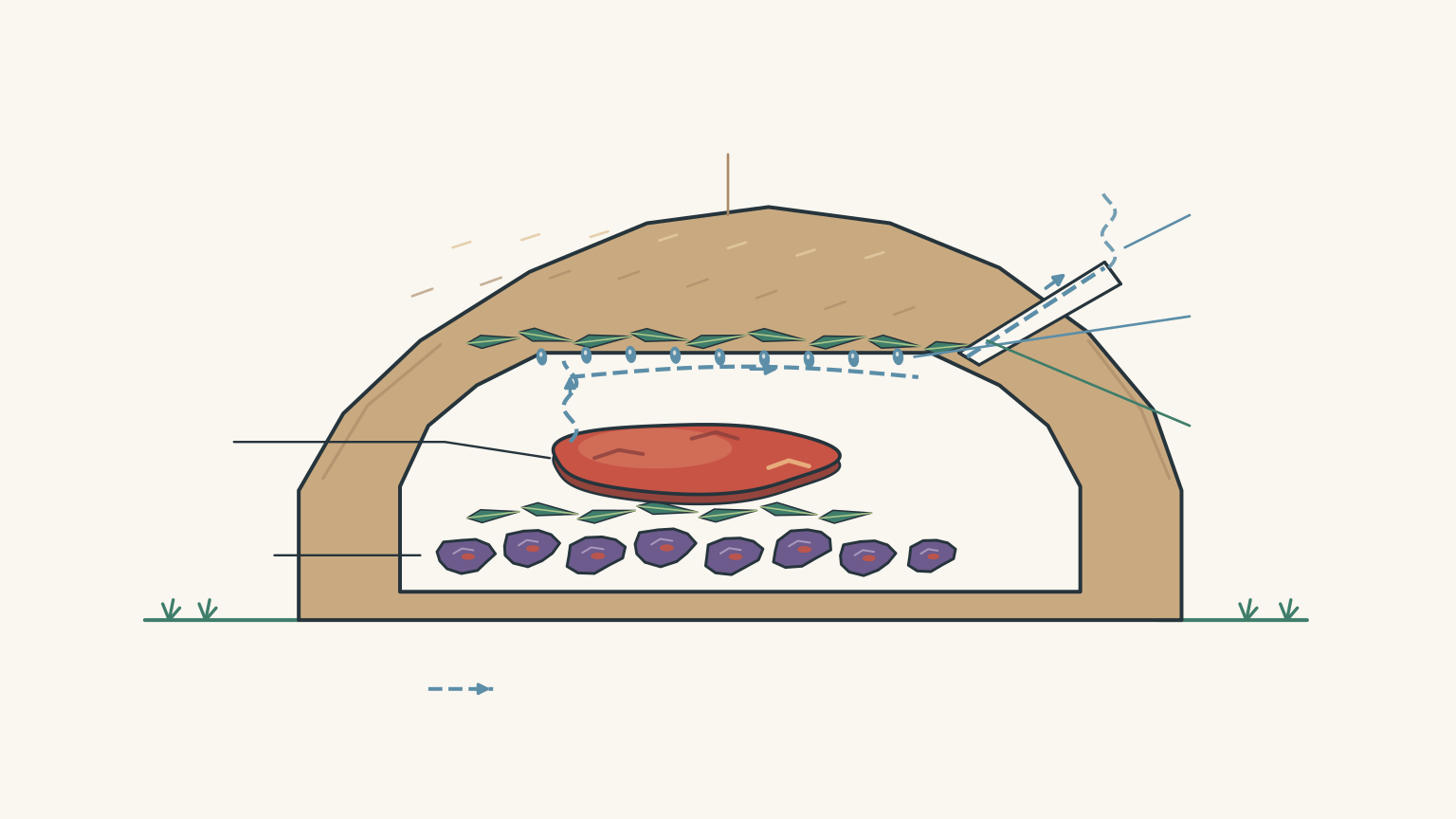
Worked example: Tracking mass inside a pit oven
A 1.00 kg food portion is cooked in an earth oven. After cooking:
- The food weighs 0.86 kg.
- A further 0.10 kg of water has condensed on the internal leaf covering.
- 0.04 kg of water vapour has escaped through a small gap.
Assume no water was added during this cooking period and no other matter crossed the system boundary.
Calculate the mass of food-derived matter retained inside the oven and the percentage of the food’s mass loss that remained inside.
Step 1
\[
m_{\text{lost}}=1.00-0.86
\]
\[
m_{\text{lost}}=0.14\text{ kg}
\]
Step 2
The food-derived matter remaining inside includes both the cooked food and the condensed water.
\[
m_{\text{retained}}=0.86+0.10
\]
\[
\boxed{m_{\text{retained}}=0.96\text{ kg}}
\]
Step 3
\[
1.00=0.86+0.10+0.04
\]
The original 1.00 kg is completely accounted for.
Only 0.04 kg has actually crossed the boundary of the whole oven.
Step 4
\[
\text{Percentage retained}
=
\frac{0.10}{0.14}\times100
\]
\[
\boxed{71.4\%}
\]
This is the interesting result.
The food lost 0.14 kg, but the oven only lost 0.04 kg of the original food-derived matter. The remaining 0.10 kg moved from the food to the internal lining.
The food’s mass and the oven’s mass do not have to change by the same amount.
05How to classify these systems in an exam
When a question asks whether an Aboriginal cooking method is open or closed, avoid answering based only on whether you can see a cover.
Use this reasoning:
- State exactly what your system includes.
- Identify what matter enters or leaves.
- Identify whether energy enters or leaves.
- Classify the system based on those exchanges.
For example:
If the boundary surrounds the entire interior of a covered pit oven, the system may approximate a closed system during a period when no matter crosses the boundary. However, if water is added or steam escapes, it becomes an open system over that interval. Energy can still transfer through the earth covering, so the oven is not isolated.
That is much stronger than simply writing that a pit oven is closed because it has a lid.
06Questions and solutions
Question 1
A 650 g fish is cooked directly over hot coals. After cooking, the fish has a mass of 520 g.
Assume that the only matter leaving the fish is water vapour and that no matter enters it.
(a) Calculate the mass of water vapour released.
(b) Classify the system if the boundary surrounds the fish alone. Explain your answer.
Solution 1
(a) The fish releases 130 g of water vapour.
Use the difference between its initial and final masses.
\[
m_{\text{vapour}}=650-520
\]
\[
\boxed{m_{\text{vapour}}=130\text{ g}}
\]
The lost mass has not been destroyed. It has crossed the boundary as water vapour.
(b) The fish is an open system.
Energy enters the fish from the hot coals, while water vapour leaves its surface.
Both matter and energy cross the chosen boundary, which is the defining feature of an open system.
Question 2
An earth oven contains a food portion with an initial mass of 1.80 kg.
During cooking:
- 0.12 kg of water is added through an opening.
- The cooked food has a mass of 1.55 kg.
- 0.20 kg of water is recovered from condensation on the internal lining.
- 0.17 kg of steam is collected outside the oven.
Assume that no other matter enters or leaves, and that the masses of the stones and plant lining remain unchanged.
(a) Calculate the final mass of the tracked matter remaining inside the oven.
(b) Verify the conservation of mass.
(c) Calculate the net change in the mass of the oven’s contents compared with the initial food mass.
Solution 2
(a) The final mass of tracked matter inside the oven is 1.75 kg.
The matter remaining inside consists of the cooked food and the condensed water.
\[
m_{\text{final}}=1.55+0.20
\]
\[
\boxed{m_{\text{final}}=1.75\text{ kg}}
\]
(b) The conservation of mass equation is satisfied.
The total mass entering the system is:
\[
m_{\text{initial}}+m_{\text{in}}
=1.80+0.12
\]
\[
=1.92\text{ kg}
\]
The total mass remaining inside and leaving the oven is:
\[
1.55+0.20+0.17
=1.92\text{ kg}
\]
Therefore:
\[
\boxed{1.92=1.92\text{ kg}}
\]
All matter has been accounted for.
(c) The oven’s contents have decreased in mass by 0.05 kg.
\[
\Delta m=1.75-1.80
\]
\[
\boxed{\Delta m=-0.05\text{ kg}}
\]
Although 0.12 kg of water entered, 0.17 kg of steam escaped.
The system therefore lost 0.05 kg overall.
This illustrates why measuring only the food would give an incomplete picture of the mass changes inside the oven.
Question 3
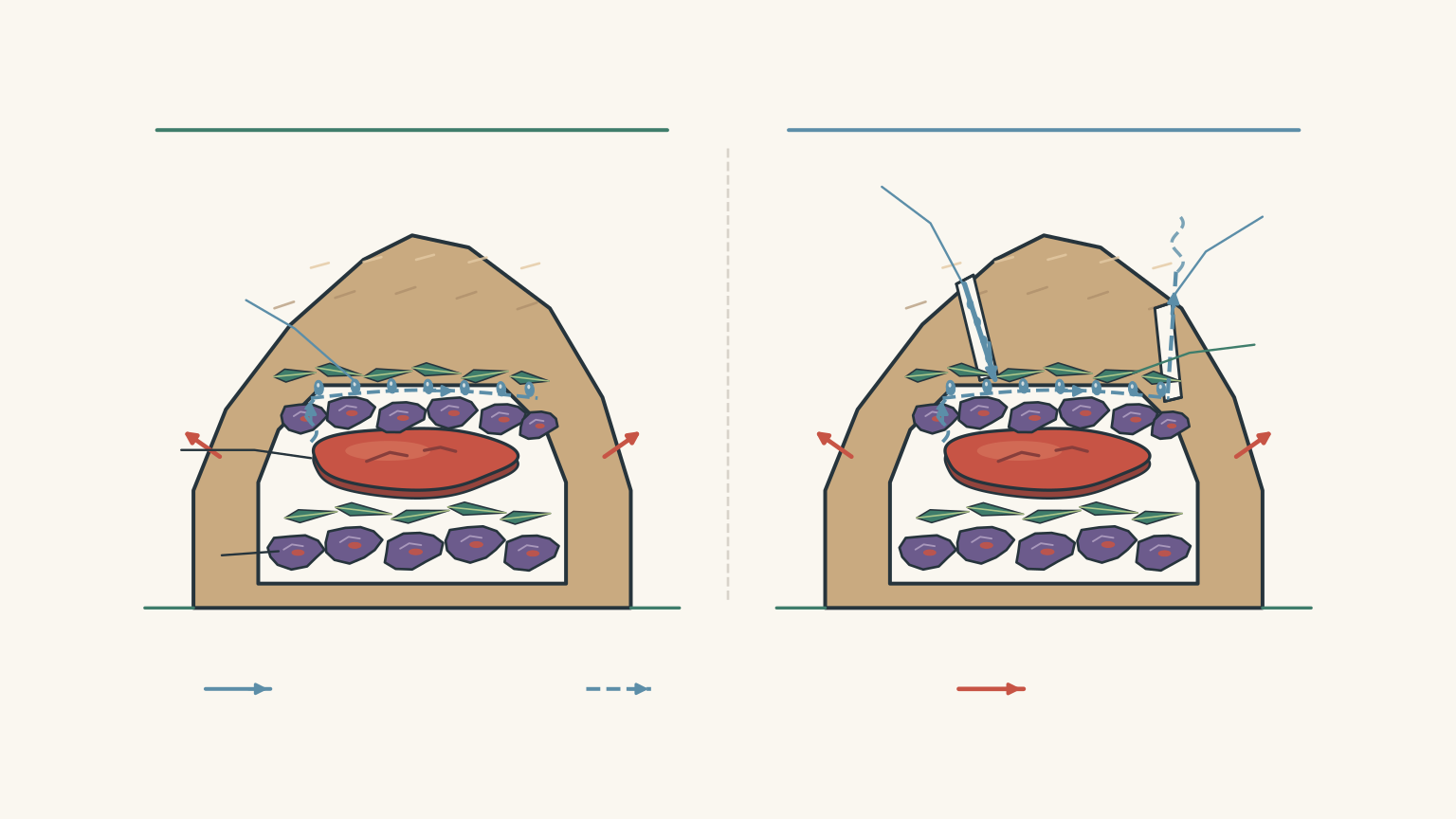
A student argues that an earth oven must always be a closed system because it is covered with soil.
Another student argues that it must be open because water is sometimes poured into it and steam can escape through cracks.
Consider a system boundary around the entire contents of the oven, excluding the surrounding soil.
During one 20-minute interval, assume the oven is completely covered and no matter enters or leaves. Thermal energy can still transfer through the earth.
(a) Classify the oven during this 20-minute interval.
(b) Classify the oven over the complete cooking process, including the addition of water and the escape of steam.
(c) Explain why neither situation represents an isolated system.
Solution 3
(a) The oven is a closed system during the specified 20-minute interval.
The question explicitly states that no matter crosses the boundary during this period.
However, thermal energy still transfers through the earth covering into the surroundings.
A closed system can exchange energy, but it cannot exchange matter.
(b) The oven is an open system over the complete cooking process.
During the full process, water enters through an opening and steam leaves through gaps in the covering.
Therefore, matter crosses the boundary.
Energy also transfers between the oven and its surroundings, making it an open system.
The important distinction is the time interval being investigated. A system’s classification can change when the period of analysis changes.
(c) Neither situation is isolated because energy still crosses the boundary.
Even during the completely covered 20-minute interval, the hot stones transfer energy to the food and surrounding soil.
The oven also loses thermal energy through its earth covering.
An isolated system cannot exchange either matter or energy. Neither situation satisfies that requirement.
Question 4
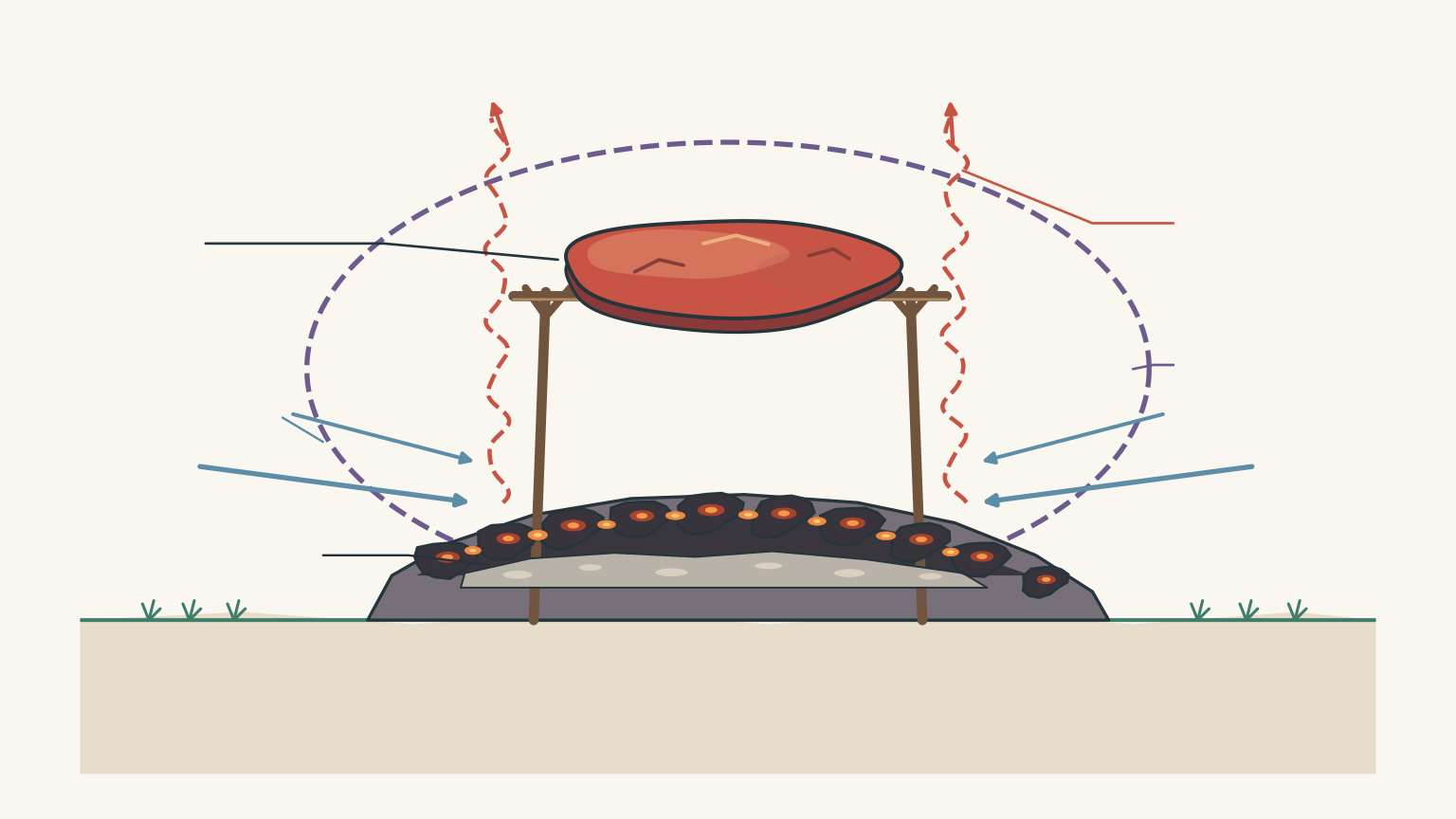
A student investigates the combustion of charcoal during an outdoor cooking process.
The system boundary surrounds the charcoal, food, and remaining solid material, but excludes the surrounding air.
The following measurements are recorded:
- Initial combined mass of charcoal and food: 800 g.
- Oxygen entering the system from the atmosphere: 240 g.
- Final combined mass of cooked food and ash remaining inside: 490 g.
Assume that all other matter leaves the system as gaseous products.
(a) Calculate the total mass of gaseous products leaving the system.
(b) Explain why the mass of the remaining solids has decreased even though oxygen entered the system.
(c) Explain how this result is consistent with the law of conservation of mass.
Solution 4
(a) The total mass of gaseous products leaving the system is 550 g.
Apply the mass balance equation:
\[
m_{\text{initial}}+m_{\text{in}}
=
m_{\text{final}}+m_{\text{out}}
\]
Substitute the supplied values:
\[
800+240=490+m_{\text{out}}
\]
Rearrange:
\[
m_{\text{out}}=1040-490
\]
\[
\boxed{m_{\text{out}}=550\text{ g}}
\]
(b) The remaining solid mass decreases because a large amount of matter leaves as gas.
The charcoal reacts with oxygen from the atmosphere.
In the simplified combustion reaction:
\[
\ce{C(s) + O2(g) -> CO2(g)}
\]
Carbon from the charcoal combines with oxygen to form carbon dioxide.
The carbon dioxide is gaseous, so it can leave the system. Other gaseous products can also be released during cooking.
The fact that oxygen entered does not mean the final solid mass must increase. The direction of the overall mass change depends on the balance between matter entering and leaving.
(c) The result obeys the law of conservation of mass.
The initial mass plus oxygen entering is:
\[
800+240=1040\text{ g}
\]
The remaining solids plus gaseous products are:
\[
490+550=1040\text{ g}
\]
Both totals are equal.
The apparent loss of 310 g from the solid contents is explained by the difference between 550 g leaving and 240 g entering.
No mass has been destroyed.
Question 5
A chemistry student investigates an earth oven to determine whether the enclosed environment retains matter during cooking.
The system boundary surrounds the food, hot stones, leaf lining, and trapped gases, but excludes the surrounding soil.
At the beginning, the entire system has a mass of \(M\). The food component has an initial mass of 1.00 kg.
During cooking:
- 0.12 kg of water is poured into the oven.
- The cooked food has a final mass of 0.88 kg.
- 0.15 kg of liquid water is recovered from the internal leaf lining.
- An external collector captures 0.09 kg of steam that escapes through the earth covering.
Assume the following:
- The food’s 0.12 kg mass decrease is entirely due to water leaving the food.
- No added water is absorbed by the food.
- The stones and leaf lining have no net mass change apart from the water collected.
- No other matter enters or leaves the system.
- The condensate and escaping steam may contain water originating from either the food or the water poured into the oven.
(a) Calculate the final total mass of the oven contents in terms of \(M\).
(b) Explain how the food can lose mass while the entire oven gains mass.
(c) Classify the oven as open, closed, or isolated during the complete cooking process.
(d) The student claims that all 0.15 kg of condensed water must have come from the food. Is this conclusion possible?
Determine the minimum and maximum possible mass of food-derived water in the condensate. Explain why the supplied measurements cannot establish its exact value.
Solution 5
(a) The final mass of the oven contents is \(M+0.03\text{ kg}\).
The initial system contains 1.00 kg of food, together with the other oven contents.
After cooking, the food has a mass of 0.88 kg, and 0.15 kg of water remains on the internal lining.
The final mass is therefore:
\[
m_{\text{final}}
=
M-1.00+0.88+0.15
\]
Simplifying:
\[
\boxed{m_{\text{final}}=M+0.03\text{ kg}}
\]
The entire oven has gained 0.03 kg.
We can verify this independently using the mass balance equation:
\[
M+0.12=(M+0.03)+0.09
\]
Both sides equal \(M+0.12\).
The calculation is consistent.
(b) The food loses 0.12 kg, while the entire oven gains 0.03 kg because the oven receives more water than it loses as steam.
The food-only system experiences a decrease in mass:
\[
1.00-0.88=0.12\text{ kg}
\]
However, the whole oven has a different boundary.
It receives 0.12 kg of water from outside, while only 0.09 kg of steam escapes.
Its net mass change is:
\[
\Delta m=0.12-0.09
\]
\[
\boxed{\Delta m=+0.03\text{ kg}}
\]
There is no contradiction.
The food and the entire oven are different systems. Matter can leave one system and remain inside the other.
(c) The entire oven is an open system during the complete cooking process.
Water enters through an opening, and steam escapes through the earth covering.
Both are matter exchanges.
Thermal energy also crosses the boundary as the hot oven transfers energy to the cooler surroundings.
The oven is therefore open, not closed or isolated.
(d) The student’s conclusion is not necessarily correct. The food-derived contribution to the condensate can be anywhere between 0.03 kg and 0.12 kg.
This is the most subtle part of the problem.
There are two possible sources of water:
- Water originally contained in the food.
- Water poured into the oven during cooking.
The food loses 0.12 kg of water, and another 0.12 kg enters from outside.
Therefore, the total amount of water available from these two sources is:
\[
0.12+0.12=0.24\text{ kg}
\]
At the end of cooking, this water is distributed between:
\[
m_{\text{condensate}}=0.15\text{ kg}
\]
and
\[
m_{\text{escaped}}=0.09\text{ kg}
\]
Check:
\[
0.15+0.09=0.24\text{ kg}
\]
Now let \(x\) represent the mass of food-derived water in the condensate.
The food originally supplied only 0.12 kg of water, so:
\[
x\leq0.12
\]
This gives the maximum possible food-derived contribution.
Next, consider the water that escaped.
If \(x\) kg of food-derived water remained inside as condensate, then the amount of food-derived water that escaped was:
\[
0.12-x
\]
The total escaping steam was 0.09 kg. Therefore, the mass of added water that escaped was:
\[
0.09-(0.12-x)
\]
This simplifies to:
\[
x-0.03
\]
A mass cannot be negative, so:
\[
x-0.03\geq0
\]
Therefore:
\[
x\geq0.03
\]
Combining both restrictions:
\[
\boxed{0.03\leq x\leq0.12\text{ kg}}
\]
The food-derived contribution to the condensate must be between 0.03 kg and 0.12 kg.
The student’s claim that all 0.15 kg came from the food is impossible because the food only lost 0.12 kg.
Likewise, all 0.15 kg cannot have come from the added water, because only 0.12 kg was introduced.
At least 0.03 kg must have come from each source.
However, the exact split cannot be determined from these measurements alone. The water from the two sources has mixed, and ordinary mass measurements cannot identify which source each water molecule originally came from.
An additional method of distinguishing the two water sources, such as using a suitable tracer, would be needed.
This question brings together three important ideas:
- The system boundary determines which mass changes you measure.
- Conservation of mass requires every input and output to be accounted for.
- Knowing the total mass of a substance does not necessarily tell you where each part of it originated.
07Where this takes you next
The key decision in any open-versus-closed system question is to draw the system boundary before discussing mass.
Cooking over exposed coals usually involves substantial exchanges of matter and energy with the surroundings. An enclosed earth oven restricts those exchanges, but openings, added water, escaping steam, and heat transfer through the soil prevent us from automatically calling it a perfectly closed or isolated system.
Once you can track matter correctly, you can investigate the next question: how efficiently does each cooking arrangement use its available thermal energy?
That means comparing the energy stored in hot stones with the energy transferred to food and the energy lost to the surrounding soil and air. The same system-boundary reasoning makes that analysis possible.