
How to Write Alcohol and Hydrogen Halide Reaction Equations
Learn how to write and balance alcohol substitution equations with HCl, HBr, and HI. Use alcohol classification, reaction conditions, worked examples, and HSC-style questions to distinguish substitution from oxidation and elimination.
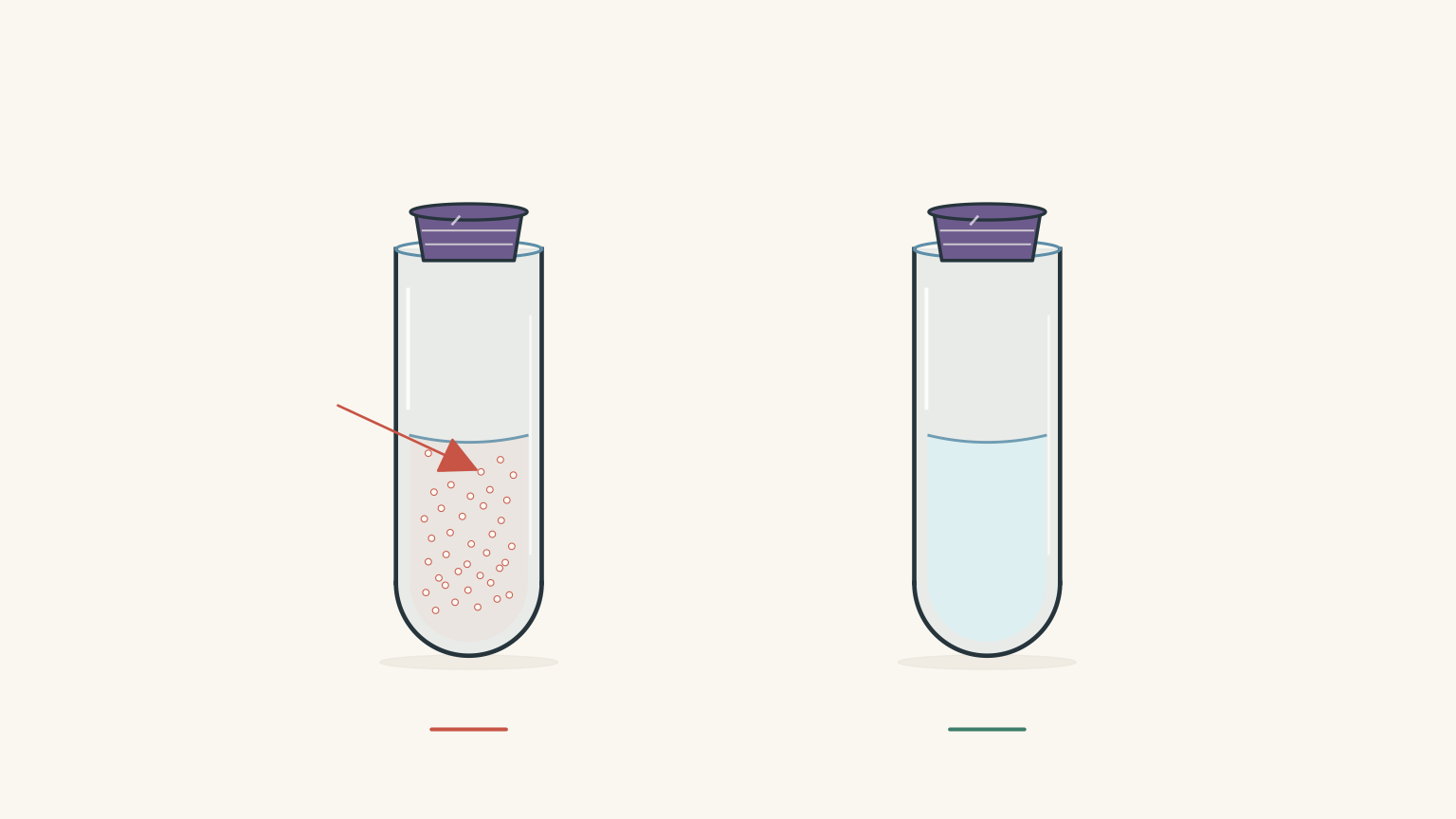
Two alcohols have the same molecular formula, \(\ce{C4H10O}\). You add concentrated hydrochloric acid and zinc chloride to each. One mixture turns cloudy almost immediately, while the other shows little change. Does that mean you need two different types of reaction equation?
Not necessarily. Both alcohols can undergo substitution, but their structures affect how readily it happens. Before writing anything, predict where the oxygen atom from the alcohol ends up. Does it stay in the organic product, or leave in another molecule?
It leaves in water. The halogen replaces the alcohol’s hydroxyl group, \(\ce{-OH}\), and the hydrogen from the hydrogen halide helps turn that group into \(\ce{H2O}\).
Due to technical limitations, this figure may display incorrectly or contain inaccuracies. Please check key details against your course materials.
01How to write the balanced equation
When an alcohol reacts with a hydrogen halide, the expected substitution equation is:
\[ \ce{ROH + HX -> RX + H2O} \]
Here:
- \(\ce{R}\) represents the carbon-containing part of the alcohol.
- \(\ce{OH}\) is the hydroxyl group.
- \(\ce{HX}\) is a hydrogen halide, usually \(\ce{HCl}\), \(\ce{HBr}\), or \(\ce{HI}\).
- \(\ce{X}\) is the halogen, chlorine, bromine, or iodine.
- \(\ce{RX}\) is the haloalkane produced.
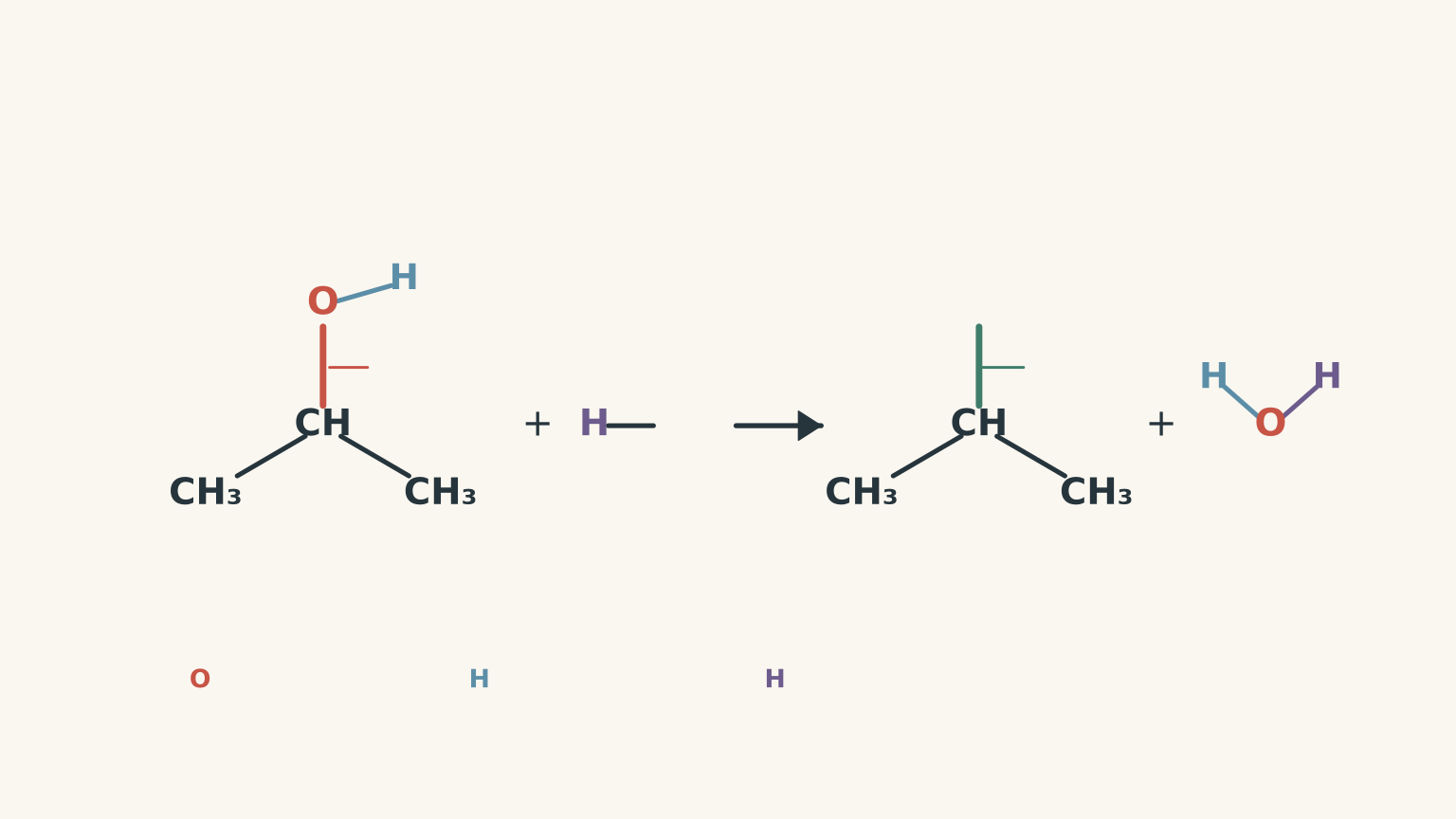
For example, propan-2-ol reacting with hydrogen bromide forms 2-bromopropane and water:
\[ \ce{CH3CH(OH)CH3 + HBr -> CH3CH(Br)CH3 + H2O} \]
This equation is already balanced. Each side contains three carbon atoms, nine hydrogen atoms, one oxygen atom, and one bromine atom.
The important change is at carbon 2: its bond to oxygen is replaced by a bond to bromine.
Due to technical limitations, this figure may display incorrectly or contain inaccuracies. Please check key details against your course materials.
Which hydrogen halide gives which product?
| Reagent | Group replacing OH | Organic product |
|---|---|---|
| \(\ce{HCl}\), hydrogen chloride | \(\ce{-Cl}\) | Chloroalkane |
| \(\ce{HBr}\), hydrogen bromide | \(\ce{-Br}\) | Bromoalkane |
| \(\ce{HI}\), hydrogen iodide | \(\ce{-I}\) | Iodoalkane |
The equation-writing method is the same for all three, but the practical reaction conditions can differ.
Hydrogen bromide and hydrogen iodide can convert many alcohols into haloalkanes under suitably concentrated acidic conditions, sometimes with heating. Hydrogen chloride reacts less readily with many primary and secondary alcohols, so zinc chloride, \(\ce{ZnCl2}\), may be used to assist the substitution.
Zinc chloride is not consumed in the overall equation. If it is specified, write it as a catalyst or reaction condition rather than adding it to the products.
For a fuller explanation of why the hydroxyl group needs activating, see Alcohol Substitution with Hydrogen Halides: HSC Chemistry.
02Why does the alcohol produce water?
The hydroxyl group is attached to carbon through a carbon-oxygen bond.
It might seem that a bromide ion could simply replace the hydroxyl group:
\[ \ce{ROH + Br^- -> RBr + OH^-} \]
This equation balances atoms and charge. But balancing an equation does not guarantee that the reaction happens readily.
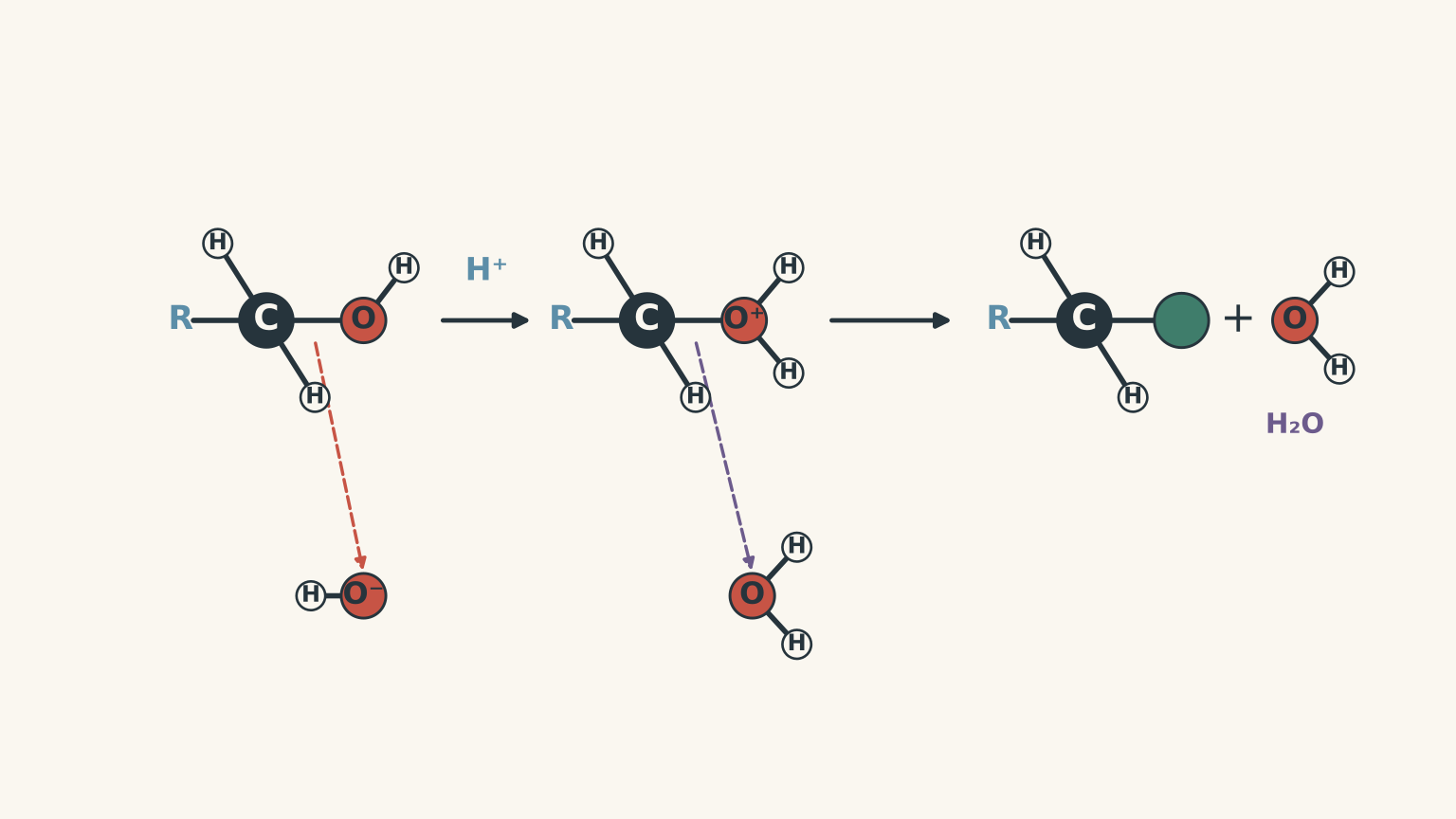
The problem is that \(\mathrm{OH}^{-}\) is a poor leaving group. A leaving group is an atom or group that departs from a molecule as a bond breaks.
Hydrogen halides provide acidic conditions that can protonate the hydroxyl group:
\[ \ce{ROH + H+ -> ROH2+} \]
The oxygen now has two hydrogen atoms attached. Instead of departing as hydroxide, it can depart as the much more stable neutral molecule, water.
The halide ion then forms a bond to the carbon that originally carried the hydroxyl group.
This is the key physical idea behind the equation: the acid helps remove oxygen as water, making room for the halogen.
Due to technical limitations, this figure may display incorrectly or contain inaccuracies. Please check key details against your course materials.
That explanation describes the essential chemistry, not one universal step-by-step mechanism. In some alcohols, carbon-oxygen bond breaking and halide attack occur together. In others, water departs before the halide bonds to carbon.
For straightforward HSC product-prediction questions, replacing \(\ce{-OH}\) with \(\ce{-X}\) is the useful starting model. More complex molecules can sometimes rearrange or undergo competing reactions, so the model should not be treated as a guarantee under every condition.
03Classify the alcohol before predicting its behaviour
Why might two alcohols with the same molecular formula react at different speeds?
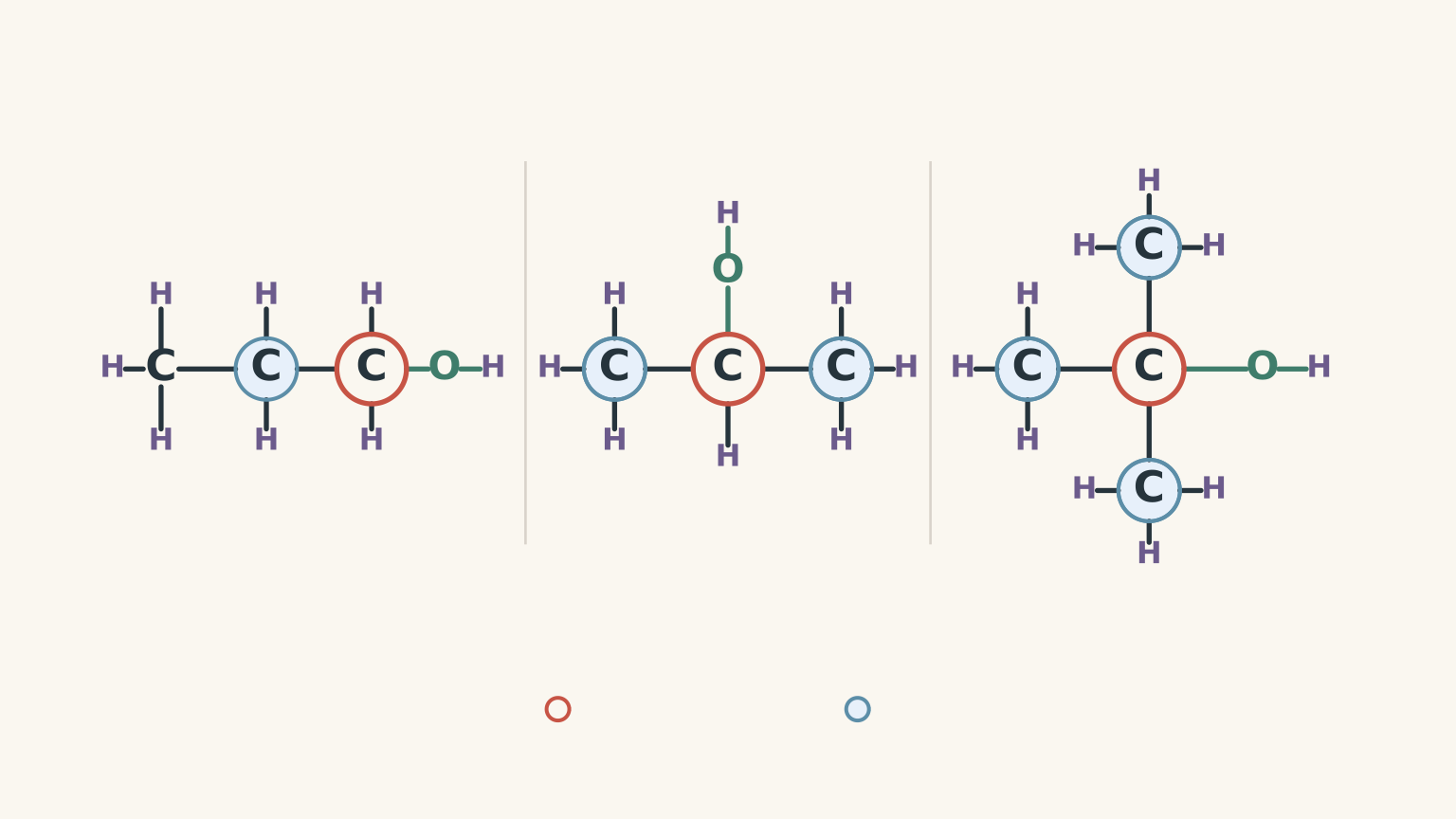
Look at the carbon directly bonded to \(\ce{-OH}\). Count how many other carbon atoms are attached to that carbon.
| Alcohol classification | Carbon neighbours of the OH-bearing carbon | Example | Oxidation with acidified dichromate |
|---|---|---|---|
| Primary (1°) | One | Propan-1-ol | Aldehyde, potentially further oxidised to a carboxylic acid |
| Secondary (2°) | Two | Propan-2-ol | Ketone |
| Tertiary (3°) | Three | 2-Methylpropan-2-ol | No reaction under ordinary oxidation conditions |
This counting rule applies directly to the usual alcohols containing at least two carbon atoms. Methanol is a special case with no carbon neighbours and is generally treated alongside primary alcohols for oxidation.
Due to technical limitations, this figure may display incorrectly or contain inaccuracies. Please check key details against your course materials.
Classification matters because the same alcohol can participate in several different reaction types. The reagent and conditions determine which transformation you should write.
Substitution: replace OH with a halogen
With hydrogen bromide under suitable substitution conditions, propan-2-ol forms 2-bromopropane:
\[ \ce{CH3CH(OH)CH3 + HBr -> CH3CH(Br)CH3 + H2O} \]
The carbon skeleton remains unchanged in this straightforward example.
Oxidation: form a carbonyl group
Under oxidation conditions, such as heating with acidified potassium dichromate, propan-2-ol forms propanone:
\[ \ce{CH3CH(OH)CH3 + [O] -> CH3COCH3 + H2O} \]
The notation \(\ce{[O]}\) represents oxygen supplied by the oxidising agent. It is a convenient shorthand for the overall oxidation, not a separate bottle of atomic oxygen.
A secondary alcohol can be oxidised to a ketone because the carbon carrying \(\ce{-OH}\) also carries a hydrogen atom.
A tertiary alcohol lacks that hydrogen and does not undergo this ordinary oxidation.
Elimination: remove water and form a double bond
When propan-2-ol is heated with concentrated phosphoric or sulfuric acid under dehydration conditions, it can form propene:
\[ \ce{CH3CH(OH)CH3 -> CH3CH=CH2 + H2O} \]
This is an elimination reaction. The alcohol loses its hydroxyl group and a hydrogen from a neighbouring carbon. A carbon-carbon double bond forms.
Notice something interesting: both substitution and elimination can produce water.
Water appearing in the products is therefore not enough to identify the reaction. You need to examine the organic product and the reagents.
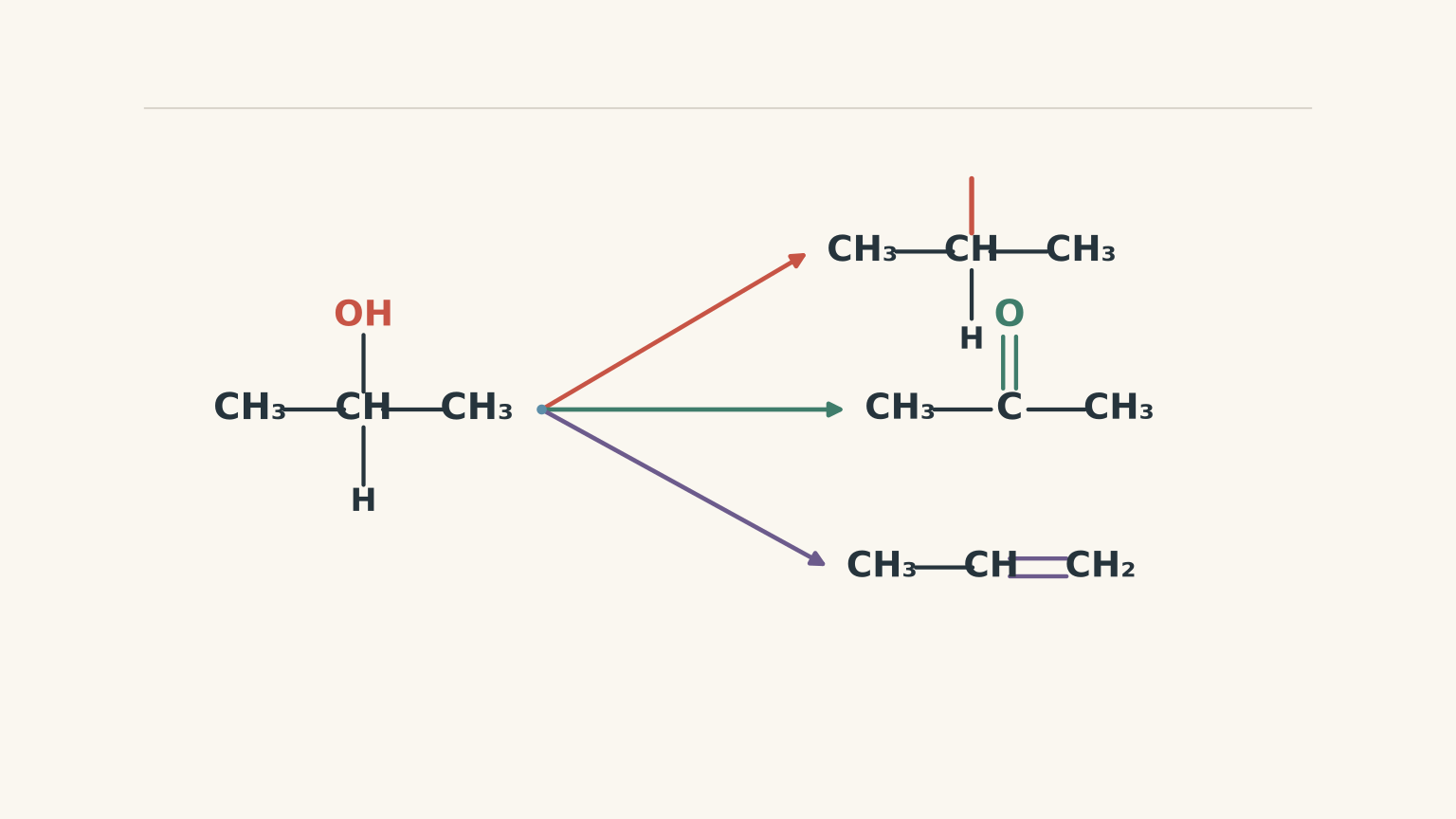
Due to technical limitations, this figure may display incorrectly or contain inaccuracies. Please check key details against your course materials.
A practical decision rule is to read the conditions before choosing the equation.
| Conditions supplied | Expected reaction | Structural change |
|---|---|---|
| Suitable conditions with \(\ce{HCl}\), \(\ce{HBr}\), or \(\ce{HI}\) | Substitution | Replace \(\ce{-OH}\) with a halogen |
| Acidified oxidising agent, such as \(\ce{K2Cr2O7}\) | Oxidation | Primary alcohol to aldehyde/acid, or secondary alcohol to ketone |
| Concentrated \(\ce{H2SO4}\) or \(\ce{H3PO4}\), with sufficient heat | Dehydration (elimination) | Remove water and form a \(\ce{C=C}\) bond |
For primary alcohol oxidation, distillation can help collect the aldehyde before further oxidation, while refluxing with excess oxidising agent favours the carboxylic acid.
For dehydration, the expected alkene also depends on the structure. If more than one neighbouring carbon can lose a hydrogen, more than one alkene may form.
04What an experiment can tell us about substitution
An equation predicts the products of a specified reaction. It does not automatically tell us how quickly those products form.
A useful experiment for investigating this difference is the Lucas test, which uses concentrated hydrochloric acid containing dissolved zinc chloride.
The first problem: a clear solution does not prove that nothing is happening
Imagine comparing three alcohols using concentrated hydrochloric acid alone at room temperature.
You could add each alcohol to a separate test tube and watch for visible changes.
What should happen if a chloroalkane forms?
If the chloroalkane is poorly soluble in the acidic reaction mixture, it may separate into tiny droplets, making the liquid look cloudy. It may eventually form a distinct organic layer.
But there is a problem with this design. Some alcohols react so slowly with hydrochloric acid that no visible change occurs during a short observation.
A clear mixture could mean little substitution has occurred, rather than that the alcohol is incapable of substitution.
The revised comparison: Lucas reagent
Adding zinc chloride to concentrated hydrochloric acid makes the reagent more effective for testing suitable alcohols.
Zinc chloride is a Lewis acid: it accepts electron pairs and helps activate the oxygen-containing group for substitution.
A conceptual Lucas-test comparison uses three separate test tubes in a fume cupboard. Each contains the same reagent at the same temperature. A small sample of a different alcohol is mixed into each tube, and the time until new cloudiness appears is observed.
No gas is being collected, and no colour indicator is added. The observation is the appearance of a separate, poorly soluble organic product.
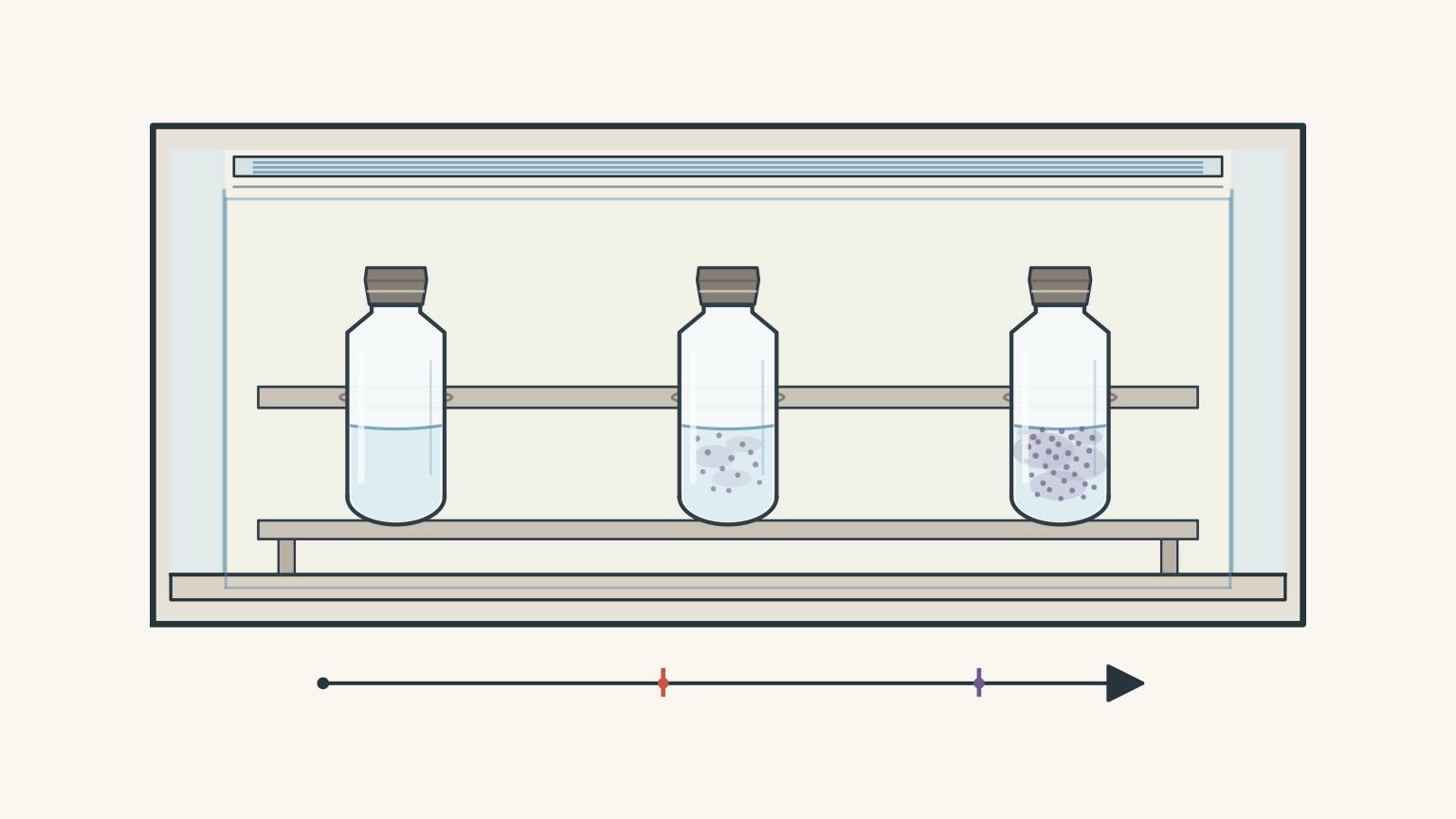
Due to technical limitations, this figure may display incorrectly or contain inaccuracies. Please check key details against your course materials.
What should the tubes show?
For simple, suitably soluble alcohols, these are the typical qualitative observations under Lucas-test conditions.
| Alcohol | Classification | Expected observation |
|---|---|---|
| Ethanol | Primary | Usually no rapid turbidity at room temperature |
| Propan-2-ol | Secondary | Turbidity develops more slowly |
| 2-Methylpropan-2-ol | Tertiary | Turbidity can develop very rapidly |
These are expected trends, not measurements from a particular experiment. Actual results depend on concentration, temperature, solubility, and the alcohol’s structure.
For example, the equation for the tertiary alcohol is:
\[ \ce{(CH3)3COH + HCl -> (CH3)3CCl + H2O} \]
The product is 2-chloro-2-methylpropane. It is much less soluble in the reaction mixture than the starting alcohol, so its formation can cause cloudiness.
The tertiary alcohol reacts readily under these conditions because its structure can support a relatively stable tertiary carbocation during substitution.
Primary alcohols generally do not form stable ordinary primary carbocations. Their substitution often follows a different pathway and can be much slower under these test conditions.
The limitation: cloudiness is not proof by itself
Suppose a larger alcohol forms droplets immediately when added to Lucas reagent.
A student might conclude that it must be tertiary because the mixture became cloudy quickly.
That is not necessarily correct. The starting alcohol itself might be poorly soluble in the reagent and form droplets before appreciable substitution occurs.
A better experimental comparison must establish that the starting mixture is initially homogeneous, use appropriate soluble alcohols, and distinguish new turbidity from pre-existing phase separation.
Where necessary, identification of the chloroalkane product provides stronger evidence than cloudiness alone.
The Lucas test is therefore useful evidence about alcohol reactivity, but it is not a universal identification method. In particular, a negative result at room temperature does not prove that an alcohol cannot undergo substitution.
This is also why oxidation evidence can be useful alongside substitution observations. If you want to practise that complementary method, see How to Identify an Unknown Alcohol from Its Oxidation Product.
05Worked example: From butan-1-ol to 1-bromobutane
A 3.70 g sample of butan-1-ol is heated with excess concentrated hydrogen bromide under suitable substitution conditions.
Write the balanced equation, name the organic product, and calculate the maximum mass of organic product obtainable. Assume complete substitution, no side reactions, and perfect recovery.
Step 1
Butan-1-ol has four carbon atoms, with the hydroxyl group on carbon 1:
\[ \ce{CH3CH2CH2CH2OH} \]
It is a primary alcohol because the carbon bonded to \(\ce{-OH}\) is attached to only one other carbon.
Step 2
Hydrogen bromide supplies bromine. Substitution forms 1-bromobutane and water:
\[ \ce{CH3CH2CH2CH2OH + HBr -> CH3CH2CH2CH2Br + H2O} \]
The equation has a 1:1 mole ratio between butan-1-ol and 1-bromobutane.
Step 3
Using atomic masses \(\ce{C}=12.01\), \(\ce{H}=1.008\), and \(\ce{O}=16.00\), the molar mass of butan-1-ol, \(\ce{C4H10O}\), is \(74.12\ \text{g mol}^{-1}\).
The amount \(n\) is calculated from mass \(m\) divided by molar mass \(M\):
\[ \begin{aligned} n &= \frac{m}{M}\\ &= \frac{3.70\ \text{g}} {74.12\ \text{g mol}^{-1}}\\ &= 0.0499\ \text{mol} \end{aligned} \]
Step 4
The organic product, \(\ce{C4H9Br}\), has a molar mass of approximately \(137.0\ \text{g mol}^{-1}\).
The 1:1 ratio gives \(0.0499\ \text{mol}\) of product, before rounding.
\[ \begin{aligned} m &= nM\\ &= 0.0499\times137.0\\ &= 6.84\ \text{g} \end{aligned} \]
The maximum theoretical mass of 1-bromobutane is 6.84 g.
This is greater than the starting alcohol’s mass because bromine from the hydrogen bromide reagent is incorporated into the organic molecule.
The calculation tells us the theoretical amount, not the reaction speed or actual isolated yield. The assumption of complete substitution is important, especially for a primary alcohol.
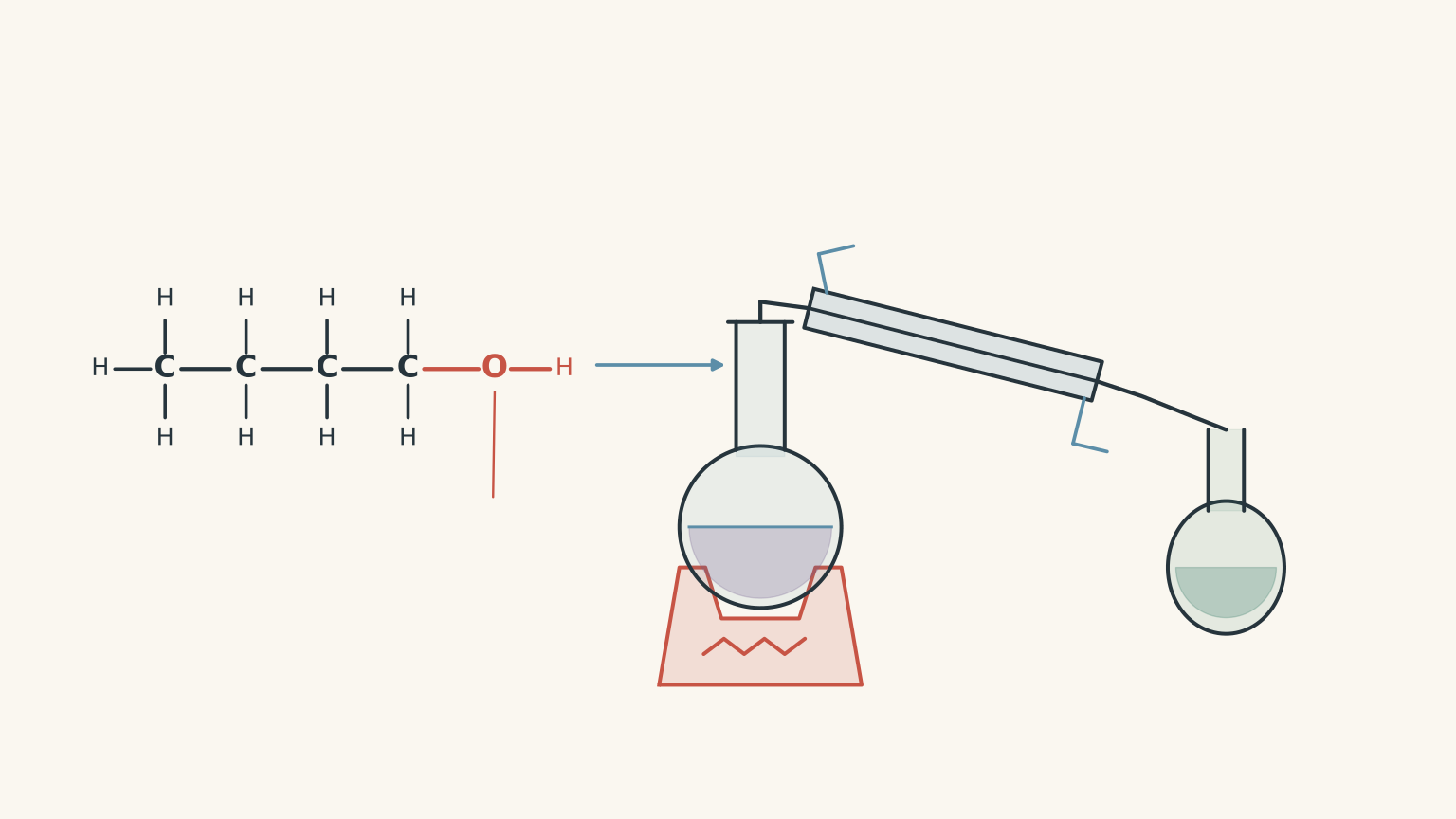
Due to technical limitations, this figure may display incorrectly or contain inaccuracies. Please check key details against your course materials.
06Worked example: One alcohol, three possible reactions
Three separate samples of butan-2-ol are treated under different conditions.
Sample A is heated with concentrated hydrogen bromide. Sample B is heated under reflux with acidified potassium dichromate. Sample C is heated with concentrated phosphoric acid under dehydration conditions.
Write the expected organic reaction equation for each sample. Explain how alcohol classification and reaction conditions determine the product.
Step 1
Butan-2-ol is:
\[ \ce{CH3CH(OH)CH2CH3} \]
The hydroxyl-bearing carbon is bonded to two other carbon atoms.
It is therefore a secondary alcohol.
Step 2
Hydrogen bromide replaces \(\ce{-OH}\) with \(\ce{-Br}\):
\[ \ce{CH3CH(OH)CH2CH3 + HBr -> CH3CH(Br)CH2CH3 + H2O} \]
The organic product is 2-bromobutane.
Step 3
Acidified potassium dichromate oxidises the secondary alcohol into a ketone:
\[ \ce{CH3CH(OH)CH2CH3 + [O] -> CH3COCH2CH3 + H2O} \]
The product is butan-2-one.
The hydroxyl-bearing carbon originally had one hydrogen atom attached. Oxidation removes hydrogen equivalents and creates a carbonyl group, \(\ce{C=O}\).
Under ordinary conditions, the ketone is not further oxidised in the same way as an aldehyde.
Step 4
Heating with concentrated phosphoric acid can remove water and form an alkene.
One possible equation is:
\[ \ce{CH3CH(OH)CH2CH3 -> CH3CH=CHCH3 + H2O} \]
This produces but-2-ene.
But-1-ene can also form because hydrogen may be removed from the other carbon adjacent to the hydroxyl-bearing carbon. But-2-ene can itself exist as two geometric isomers.
The dehydration equation shown represents one possible product, not necessarily the entire product mixture.
Step 5
Sample A undergoes substitution, producing a haloalkane.
Sample B undergoes oxidation, producing a ketone.
Sample C undergoes elimination, producing an alkene.
All three simplified equations contain water as a product. The distinguishing evidence is the change in the carbon-containing molecule and the conditions that caused it.
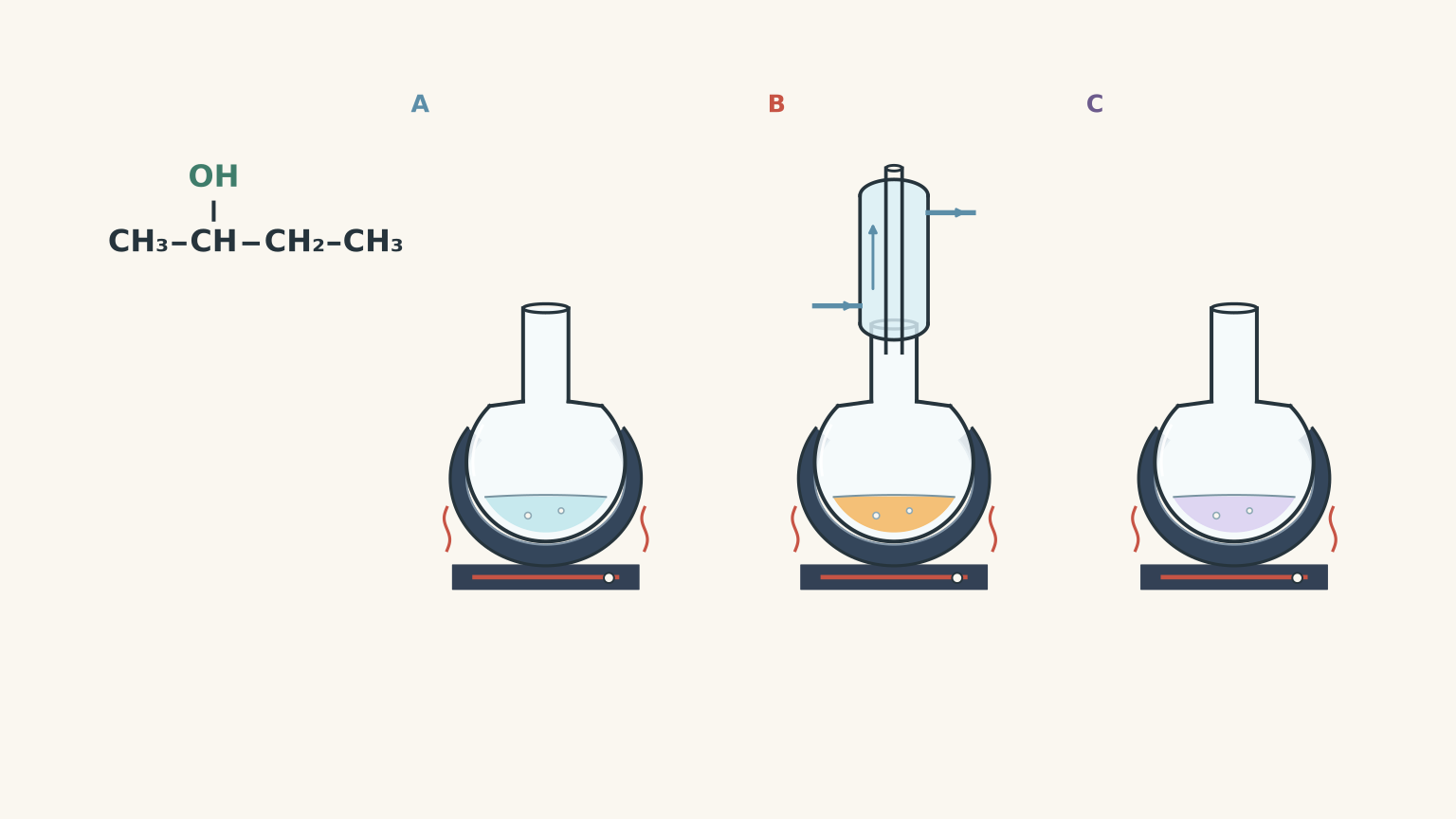
Due to technical limitations, this figure may display incorrectly or contain inaccuracies. Please check key details against your course materials.
07Questions and solutions
Question 1
Ethanol is warmed with excess concentrated hydrogen bromide under suitable substitution conditions.
Write a balanced chemical equation and name the organic product.
Solution 1
Ethanol forms bromoethane and water through a substitution reaction.
Ethanol has the structure \(\ce{CH3CH2OH}\). Hydrogen bromide supplies bromine, which replaces the hydroxyl group.
The balanced equation is:
\[ \ce{CH3CH2OH + HBr -> CH3CH2Br + H2O} \]
The organic product is bromoethane.
Every atom is conserved. In particular, the oxygen originally present in ethanol appears in water.
A tempting mistake is to write bromoethane as the only product. That leaves the oxygen and some hydrogen atoms unaccounted for. Water must be included in the complete equation.
Question 2
A student divides a sample of propan-1-ol into three equal portions.
- Portion A is heated with excess concentrated \(\ce{HBr}\) under substitution conditions.
- Portion B is heated under reflux with excess acidified \(\ce{K2Cr2O7}\).
- Portion C is heated with concentrated \(\ce{H3PO4}\) under dehydration conditions.
For each portion, write the appropriate organic reaction equation and name the main organic product.
Another student argues that portions A and C must produce the same organic compound because both reactions produce water. Explain why this reasoning fails.
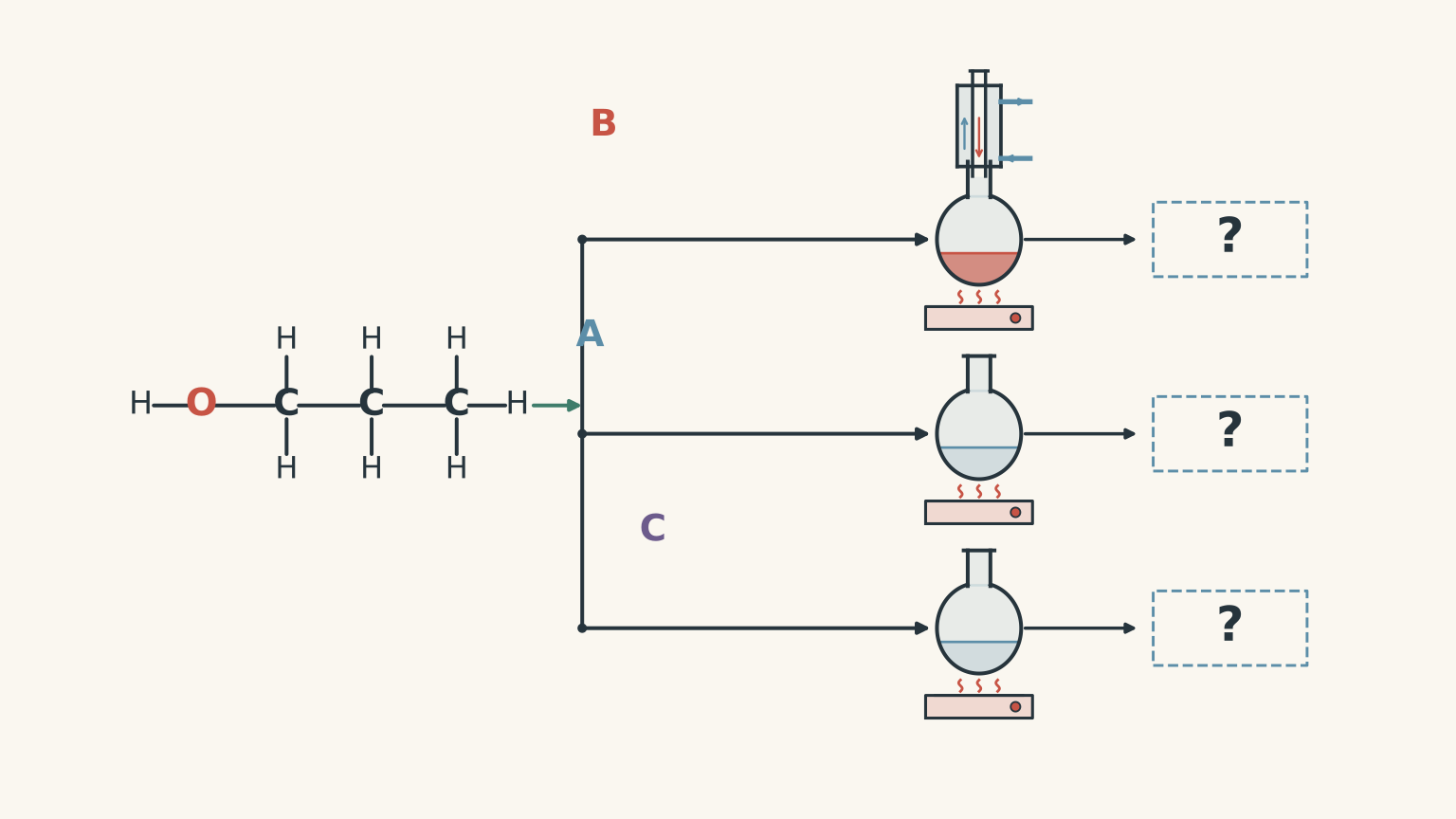
Due to technical limitations, this figure may display incorrectly or contain inaccuracies. Please check key details against your course materials.
Solution 2
Portion A produces 1-bromopropane, portion B produces propanoic acid, and portion C produces propene. The three reactions form different organic products because their reagents cause different bond changes.
For portion A, hydrogen bromide substitutes bromine for the hydroxyl group:
\[ \ce{CH3CH2CH2OH + HBr -> CH3CH2CH2Br + H2O} \]
For portion B, propan-1-ol is a primary alcohol. Reflux with excess acidified dichromate favours oxidation through the aldehyde to the carboxylic acid:
\[ \ce{CH3CH2CH2OH + 2[O] -> CH3CH2COOH + H2O} \]
The main organic product is propanoic acid.
If the reaction conditions instead allowed the initial aldehyde to be collected by distillation, propanal could be isolated before substantial further oxidation.
For portion C, dehydration removes water from neighbouring atoms and creates a carbon-carbon double bond:
\[ \ce{CH3CH2CH2OH -> CH3CH=CH2 + H2O} \]
The organic product is propene.
The second student’s reasoning fails because water is not unique to substitution. Both substitution and dehydration can produce water, while the organic structures are different.
In portion A, the carbon originally bonded to oxygen becomes bonded to bromine. In portion C, a new double bond forms between adjacent carbon atoms. The reagent and conditions, not simply the presence of water, distinguish the reactions.
Question 3
A student performs two qualitative Lucas tests under identical temperature conditions.
Tube A contains 2-methylpropan-2-ol, which mixes to form an initially clear solution with Lucas reagent. The solution then becomes cloudy very quickly.
Tube B contains pentan-1-ol. Two liquid phases are visible immediately after mixing it with Lucas reagent.
The student concludes that both alcohols undergo rapid substitution and must therefore be tertiary.
Evaluate this conclusion. Write the expected substitution equation for Tube A and explain how the investigation could be improved to distinguish a genuine reaction from a solubility effect.
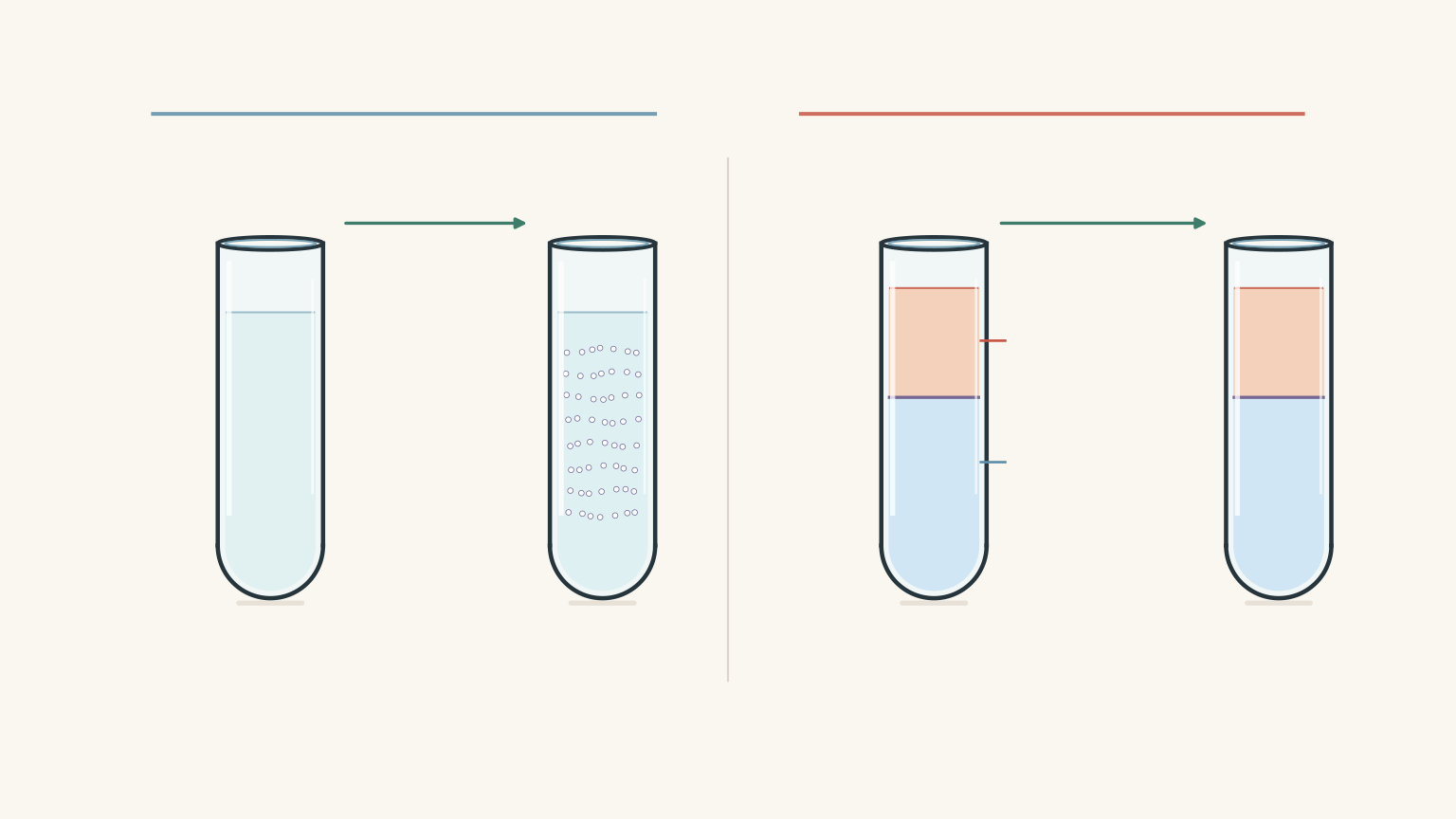
Due to technical limitations, this figure may display incorrectly or contain inaccuracies. Please check key details against your course materials.
Solution 3
Tube A supports rapid substitution by a tertiary alcohol, but Tube B does not provide reliable evidence of rapid substitution. The student’s conclusion about both samples is incorrect.
2-Methylpropan-2-ol is tertiary because its hydroxyl-bearing carbon is bonded to three carbon atoms. Under Lucas-test conditions, it can react rapidly with hydrochloric acid:
\[ \ce{(CH3)3COH + HCl -> (CH3)3CCl + H2O} \]
Zinc chloride helps the substitution occur. The resulting 2-chloro-2-methylpropane is poorly soluble in the aqueous acidic mixture, so it may form droplets and cause turbidity.
Tube B presents a different problem. Pentan-1-ol is a primary alcohol, not a tertiary one. Its relatively low solubility in the reaction mixture can cause an immediate separate liquid phase even without significant substitution.
The important distinction is between cloudiness that develops as a product forms and phase separation that occurs because the starting material is insoluble.
A stronger investigation would compare alcohols that are initially soluble under the selected test conditions, establish the appearance of each starting mixture before attributing cloudiness to reaction, and use an appropriate control. If needed, the formation of a chloroalkane should be confirmed independently.
The tempting assumption is that visible cloudiness always means rapid substitution. The experimental constraint is that both the starting alcohol and the organic product can affect the appearance of the mixture.
A valid observation is not automatically a unique explanation.
Question 4
A reaction vessel initially contains \(0.0400\ \text{mol}\) of butan-2-ol and \(0.0250\ \text{mol}\) of hydrogen bromide.
Assume the intended reaction is substitution, with no rearrangement or competing reactions in the theoretical calculation.
After the reaction and product separation, the student isolates 2.10 g of 2-bromobutane.
The molar mass of 2-bromobutane is \(137.0\ \text{g mol}^{-1}\).
Calculate the maximum theoretical mass of 2-bromobutane and the percentage yield. Explain whether the percentage yield is enough to determine what fraction of the original alcohol actually underwent substitution.
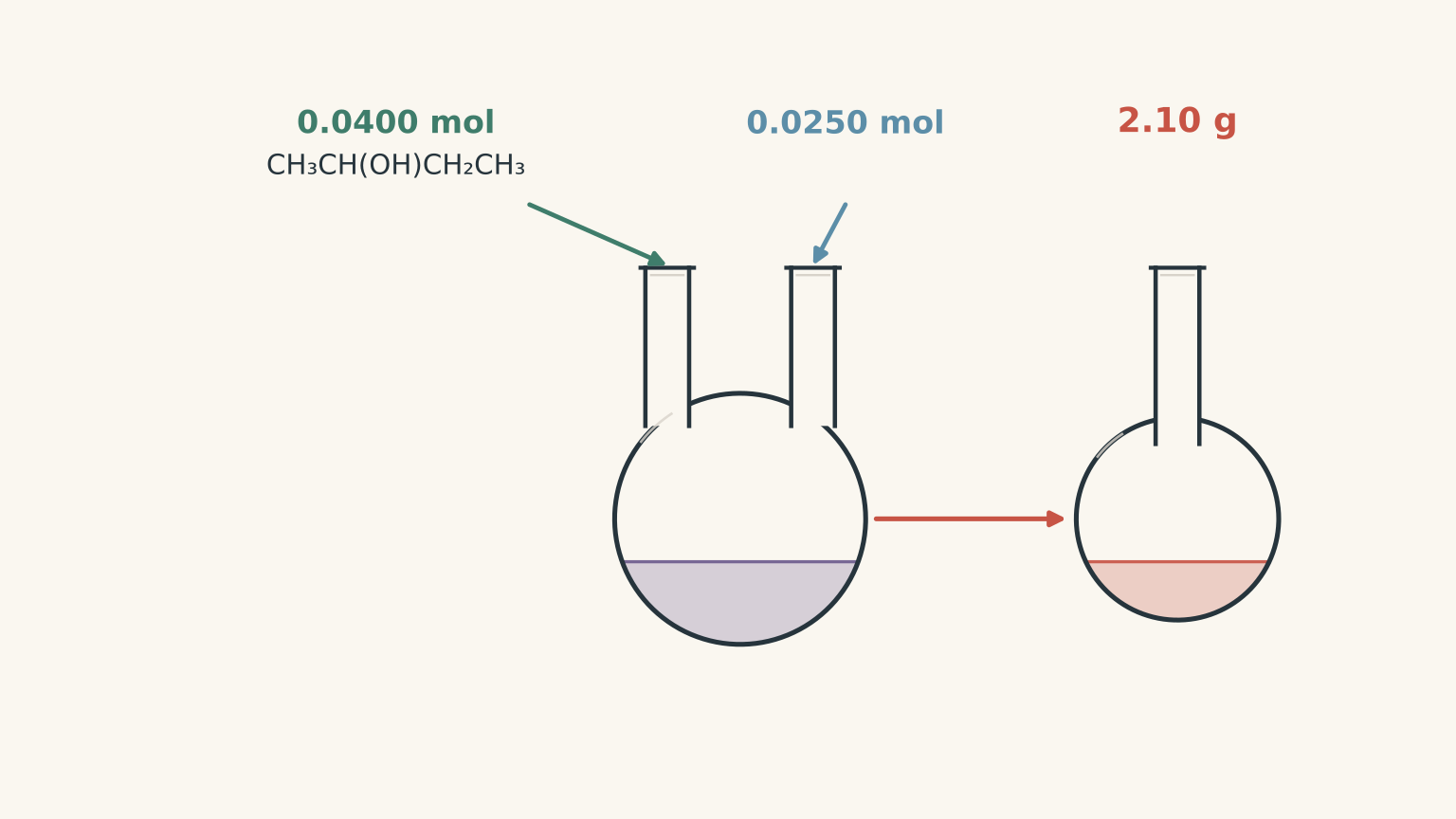
Due to technical limitations, this figure may display incorrectly or contain inaccuracies. Please check key details against your course materials.
Solution 4
Hydrogen bromide is the limiting reagent. The maximum theoretical mass of 2-bromobutane is 3.43 g, giving a percentage yield of approximately 61.3%. That yield does not, by itself, establish the actual fraction of alcohol converted.
First, write the balanced equation:
\[ \ce{CH3CH(OH)CH2CH3 + HBr -> CH3CH(Br)CH2CH3 + H2O} \]
The mole ratio of alcohol to hydrogen bromide to bromoalkane is \(1:1:1\).
There are \(0.0400\ \text{mol}\) of alcohol but only \(0.0250\ \text{mol}\) of hydrogen bromide. Even if all the hydrogen bromide reacts through the stated substitution pathway, it cannot convert more than \(0.0250\ \text{mol}\) of alcohol.
The maximum amount of 2-bromobutane is therefore:
\[ n_{\max}=0.0250\ \text{mol} \]
Using \(m=nM\):
\[ \begin{aligned} m_{\max} &=0.0250\times137.0\\ &=3.425\ \text{g}\\ &\approx3.43\ \text{g} \end{aligned} \]
Now calculate percentage yield:
\[ \begin{aligned} \%\text{ yield} &=\frac{m_{\text{actual}}} {m_{\text{theoretical}}}\times100\\ &=\frac{2.10}{3.425}\times100\\ &=61.3\% \end{aligned} \]
The isolated yield is 61.3% of the theoretical maximum based on the available hydrogen bromide.
However, this is not automatically the percentage conversion of the original alcohol.
The isolated amount could be lower because some alcohol remained unreacted, some product was lost during separation, or other processes reduced the amount recovered. The question does not provide enough evidence to distinguish those possibilities.
Even with perfect conversion of the available hydrogen bromide, at least \(0.0150\ \text{mol}\) of butan-2-ol would remain unconverted through this substitution because the hydrogen bromide supply is insufficient.
The tempting route is to interpret percentage yield as the fraction of alcohol molecules that reacted. The constraint that changes the result is the distinction between reaction conversion and recovery of an isolated product, together with the fact that hydrogen bromide was limiting.
Question 5
A chemist has an illustrative mixture containing exactly \(0.1000\ \text{mol}\) of two alcohols:
- 2-Methylpropan-1-ol, a primary alcohol.
- 2-Methylpropan-2-ol, a tertiary alcohol.
Both alcohols have molecular formula \(\ce{C4H10O}\), but their hydroxyl groups occupy different carbon environments.
The mixture is investigated by two different reaction pathways.
In Route A, the mixture reacts with hydrogen bromide under conditions that allow partial substitution. The recovered substances are:
| Recovered substance | Amount |
|---|---|
| 1-Bromo-2-methylpropane | \(0.0200\ \text{mol}\) |
| 2-Bromo-2-methylpropane | \(0.0600\ \text{mol}\) |
| Unreacted 2-methylpropan-1-ol | \(0.0200\ \text{mol}\) |
| Unreacted 2-methylpropan-2-ol | \(0\ \text{mol}\) |
In Route B, a separate sample with the same initial composition is dehydrated to an alkene, then treated with hydrogen bromide under ordinary ionic addition conditions without peroxides.
For this question, assume complete recovery in Route A, no carbon-skeleton rearrangements or competing reactions, and that both alcohols give 2-methylpropene on dehydration. Assume that hydrogen bromide adds to this alkene with the usual Markovnikov preference.
Determine the original amounts of both alcohols, and explain why the ratio of the two bromoalkanes from Route A is not the original alcohol ratio.
Then write the equations for Route B and determine whether its major bromoalkane product can reveal the original alcohol composition.
Finally, a student argues that because both alcohols have formula \(\ce{C4H10O}\), their direct substitution products must be the same compound. Evaluate this argument.
All quantities in this question are hypothetical, not experimental measurements.
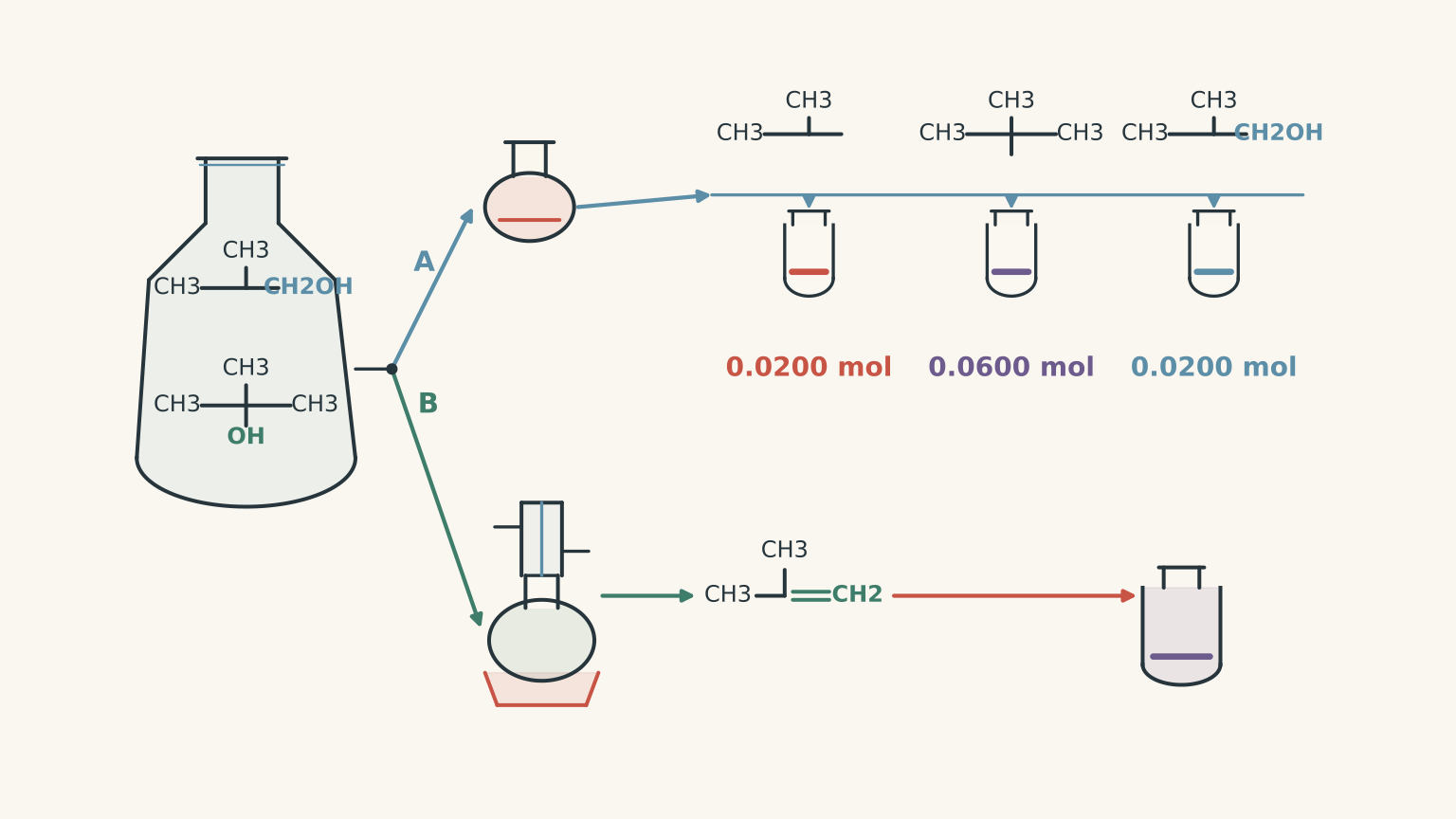
Due to technical limitations, this figure may display incorrectly or contain inaccuracies. Please check key details against your course materials.
Solution 5
The original mixture contained \(0.0400\ \text{mol}\) of 2-methylpropan-1-ol and \(0.0600\ \text{mol}\) of 2-methylpropan-2-ol. Their original mole ratio was \(2:3\), whereas the primary-to-tertiary bromoalkane product ratio was \(1:3\).
The difference arises because Route A was stopped before all the primary alcohol had reacted.
For the primary alcohol, direct substitution gives:
\[ \ce{(CH3)2CHCH2OH + HBr -> (CH3)2CHCH2Br + H2O} \]
Its product is 1-bromo-2-methylpropane.
The recovered \(0.0200\ \text{mol}\) of this bromoalkane represents \(0.0200\ \text{mol}\) of primary alcohol that reacted.
Another \(0.0200\ \text{mol}\) of primary alcohol remained unreacted.
Therefore:
\[ \begin{aligned} n_{\text{primary}} &=0.0200+0.0200\\ &=0.0400\ \text{mol} \end{aligned} \]
For the tertiary alcohol, direct substitution gives:
\[ \ce{(CH3)3COH + HBr -> (CH3)3CBr + H2O} \]
Its product is 2-bromo-2-methylpropane.
All recovered tertiary-derived material is in the product, and the question states that no tertiary alcohol remains.
Therefore:
\[ n_{\text{tertiary}}=0.0600\ \text{mol} \]
Checking conservation:
\[ 0.0400+0.0600=0.1000\ \text{mol} \]
So the original primary-to-tertiary alcohol ratio was:
\[ 0.0400:0.0600=2:3 \]
The bromoalkane ratio was:
\[ 0.0200:0.0600=1:3 \]
It would be tempting to use the bromoalkane amounts directly as a measure of the starting composition. That would be wrong because the two alcohols were not converted to the same extent.
Now consider Route B.
Dehydration of 2-methylpropan-1-ol can be represented as:
\[ \ce{(CH3)2CHCH2OH -> CH2=C(CH3)2 + H2O} \]
Dehydration of 2-methylpropan-2-ol gives:
\[ \ce{(CH3)3COH -> CH2=C(CH3)2 + H2O} \]
Both reactions produce the same alkene, 2-methylpropene.
This is the conceptual hinge: two alcohols with different classifications and different hydroxyl positions can lose water and produce an identical carbon-carbon double-bond structure.
When hydrogen bromide adds to 2-methylpropene under ordinary ionic conditions, the major product follows Markovnikov’s rule. Hydrogen adds in the way that leads to bromine bonding to the more substituted carbon:
\[ \ce{CH2=C(CH3)2 + HBr -> (CH3)3CBr} \]
The major product is 2-bromo-2-methylpropane.
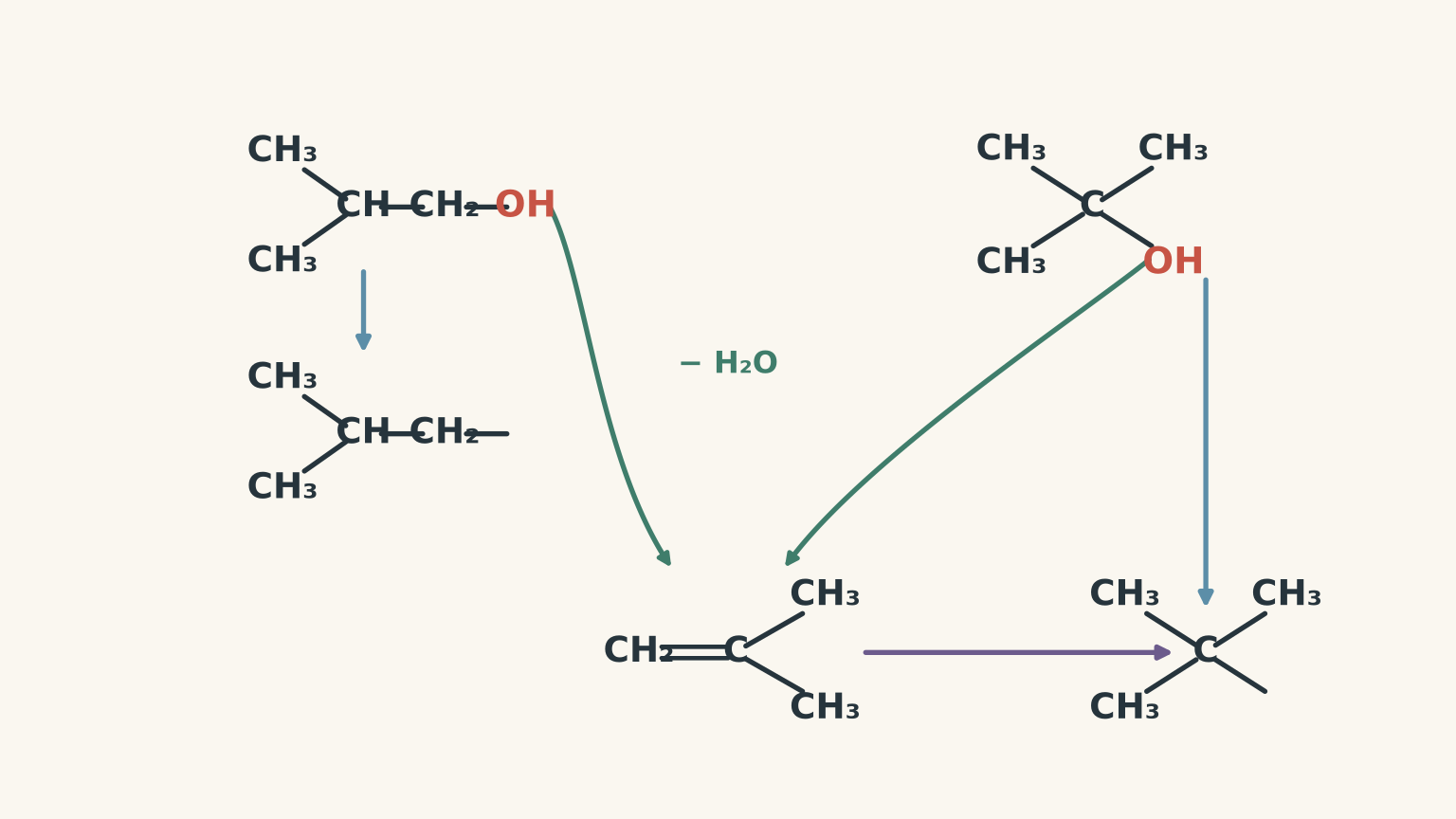
Due to technical limitations, this figure may display incorrectly or contain inaccuracies. Please check key details against your course materials.
Route B therefore cannot reveal the original mixture ratio using the identity of its major bromoalkane product.
The reason is not that the two starting alcohols were identical. Their structures were different, but dehydration removed the structural information about the original hydroxyl position.
After that, adding HBr to their common alkene favoured the same haloalkane.
Finally, the student’s argument about molecular formulas is incorrect.
The direct substitution products are:
\[ \ce{(CH3)2CHCH2Br} \]
and
\[ \ce{(CH3)3CBr} \]
Both have the molecular formula \(\ce{C4H9Br}\), but they have different connectivity. They are structural isomers, not the same compound.
The first is 1-bromo-2-methylpropane. The second is 2-bromo-2-methylpropane.
This explains why molecular formulas alone cannot reliably identify organic reaction products. To write the correct equation, you need the actual structure, the reaction conditions, and the bond changes taking place.
The hardest part of this question is recognising that two different reaction pathways can destroy different amounts of information about a starting compound. Direct substitution can preserve the position of the original hydroxyl-bearing carbon in the product, while dehydration followed by addition can lead different alcohols to the same final product.
08Where this method leads next
When you are asked to write an equation for an alcohol reacting with a hydrogen halide, start with the carbon bonded to \(\ce{-OH}\). Under the stated substitution conditions, replace that group with the halogen and include water. Then balance the equation and check the organic product’s name.
But keep the equation separate from the experimental claim. A balanced equation does not prove that a reaction is fast, complete, or the only reaction possible.
That becomes especially important in multi-step organic synthesis. Once an alcohol has become a haloalkane, aqueous hydroxide may substitute the halogen to regenerate an alcohol, while heated ethanolic hydroxide may promote elimination to form an alkene.
The next useful skill is following those pathways in both directions: identifying not just the functional groups present, but which structural information survives each reaction and which information is lost.