
How to Predict the Alkene Formed by Alcohol Dehydration
Learn how to predict alkene products from alcohol dehydration by identifying alpha and beta carbons, locating available hydrogens, and applying reaction conditions. Includes worked examples, oxidation and substitution comparisons, and HSC-style practice questions with detailed solutions.
Two alcohols can have the same molecular formula but behave quite differently when you change the reaction conditions. Consider 2-methylpropan-1-ol and 2-methylpropan-2-ol. Both have the molecular formula \(\ce{C4H10O}\). Predict what happens when each is heated with concentrated sulfuric acid. Will they produce the same alkene? And will they oxidise in the same way?
Interestingly, both can produce 2-methylpropene through dehydration, but only the primary alcohol is readily oxidised under standard acidified dichromate conditions.
The key to predicting an alkene is to identify the carbon bonded to the \(\ce{-OH}\) group, then check which neighbouring carbon atoms have a hydrogen available for elimination. Alcohol classification helps you understand why different reactions produce different products.
01How to predict the alkene formed by alcohol dehydration
When an alcohol is heated strongly with concentrated sulfuric acid, it can undergo dehydration. This means it loses the elements of water, forming an alkene.
The overall reaction is:
\[ \ce{Alcohol ->[conc. H2SO4,\ heat] Alkene + H2O} \]
To predict the alkene, you need to understand which atoms are removed and where the new carbon-carbon double bond forms.
Find the two carbon atoms involved
Consider the structure of 2-methylpropan-2-ol:
\[ \ce{(CH3)3COH} \]
The carbon bonded directly to the hydroxyl group is called the alpha carbon. Any carbon directly attached to it is called a beta carbon.
During dehydration:
- The hydroxyl group is removed from the alpha carbon.
- A hydrogen is removed from an adjacent beta carbon.
- A double bond forms between the alpha and beta carbons.
- The removed hydrogen and hydroxyl group form water.
The important detail is that the hydrogen comes from a neighbouring carbon, not necessarily from the carbon carrying the hydroxyl group.
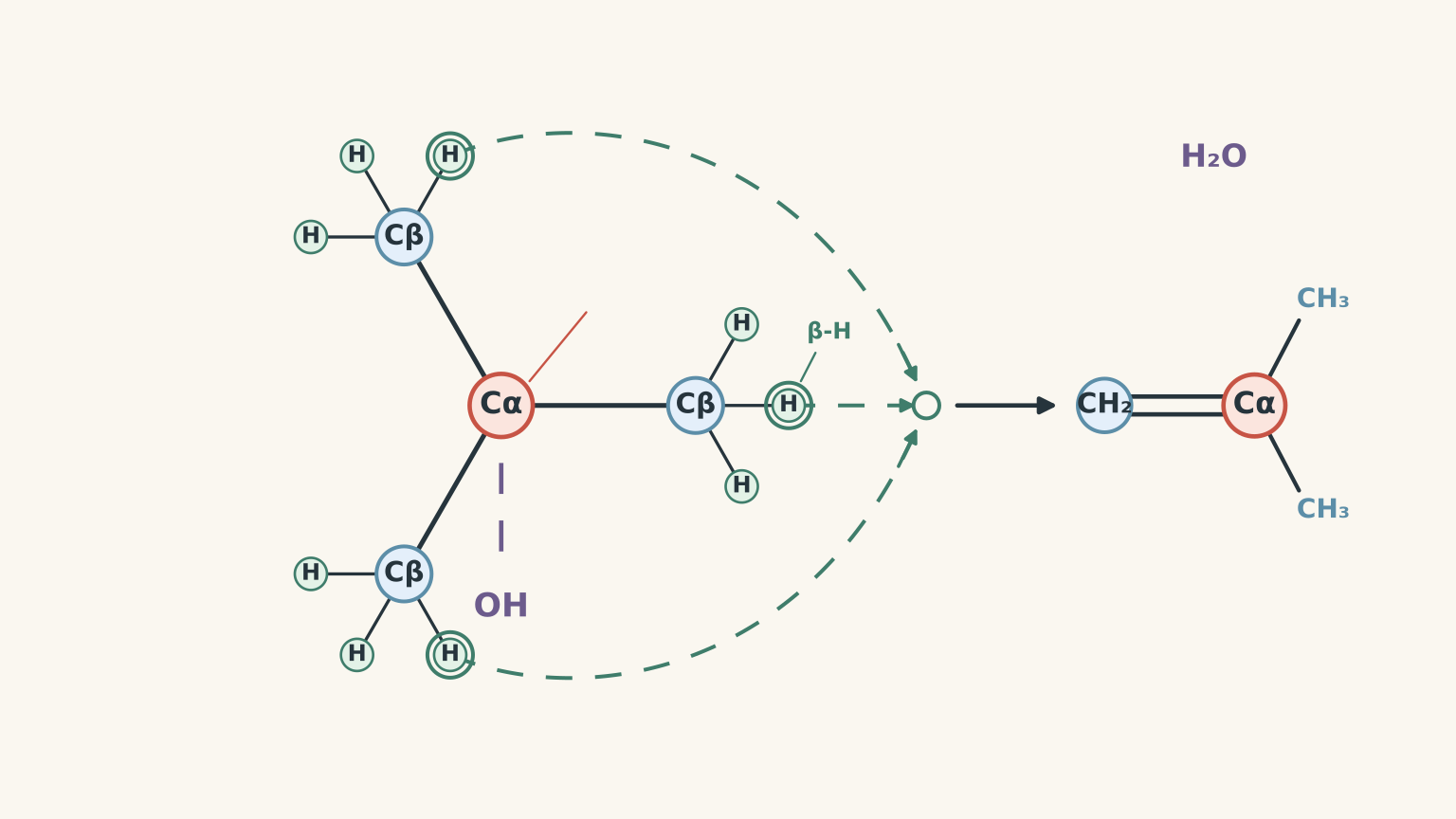
Due to technical limitations, this figure may display incorrectly or contain inaccuracies. Please check key details against your course materials.
For 2-methylpropan-2-ol, all three beta carbons are methyl groups. Each contains hydrogen atoms, so elimination can occur towards any of them.
However, all three methyl groups are equivalent. Removing a hydrogen from any one of them produces the same alkene.
The equation is:
\[ \ce{(CH3)3COH ->[conc. H2SO4,\ heat] CH2=C(CH3)2 + H2O} \]
The product is 2-methylpropene.
Notice something important: the alpha carbon in this alcohol has no hydrogen atoms. That does not prevent dehydration because the reaction removes a hydrogen from a beta carbon instead.
A reliable method for predicting the product
Use this sequence when answering an HSC product-prediction question.
Check the conditions. Confirm that the alcohol is undergoing dehydration, usually with concentrated \(\ce{H2SO4}\) and strong heating.
Locate the alpha carbon. Find the carbon directly bonded to the \(\ce{-OH}\) group.
Identify the beta carbons. These are all the carbon atoms directly attached to the alpha carbon.
Check for beta hydrogens. A neighbouring carbon must have at least one hydrogen available for elimination.
Form the possible double bonds. Draw a \(\ce{C=C}\) bond between the alpha carbon and each eligible beta carbon.
Remove duplicate products. If two elimination pathways produce the same structure because of molecular symmetry, count that as one constitutional product.
Identify the likely major product. If multiple different alkenes are possible, the more substituted alkene is generally favoured under common acid-catalysed dehydration conditions.
The final step is a prediction about which product is favoured, not a way to decide which products are possible. A more substituted alkene cannot form if the required beta hydrogen does not exist.
For a more extensive treatment of positional alkene products, see Dehydration of Alcohols: HSC Chemistry Product Prediction.
02Why alcohol classification matters
Before predicting the products of oxidation, substitution, or elimination, identify whether the alcohol is primary, secondary, or tertiary.
Classification depends on the number of carbon atoms directly bonded to the carbon carrying the \(\ce{-OH}\) group.
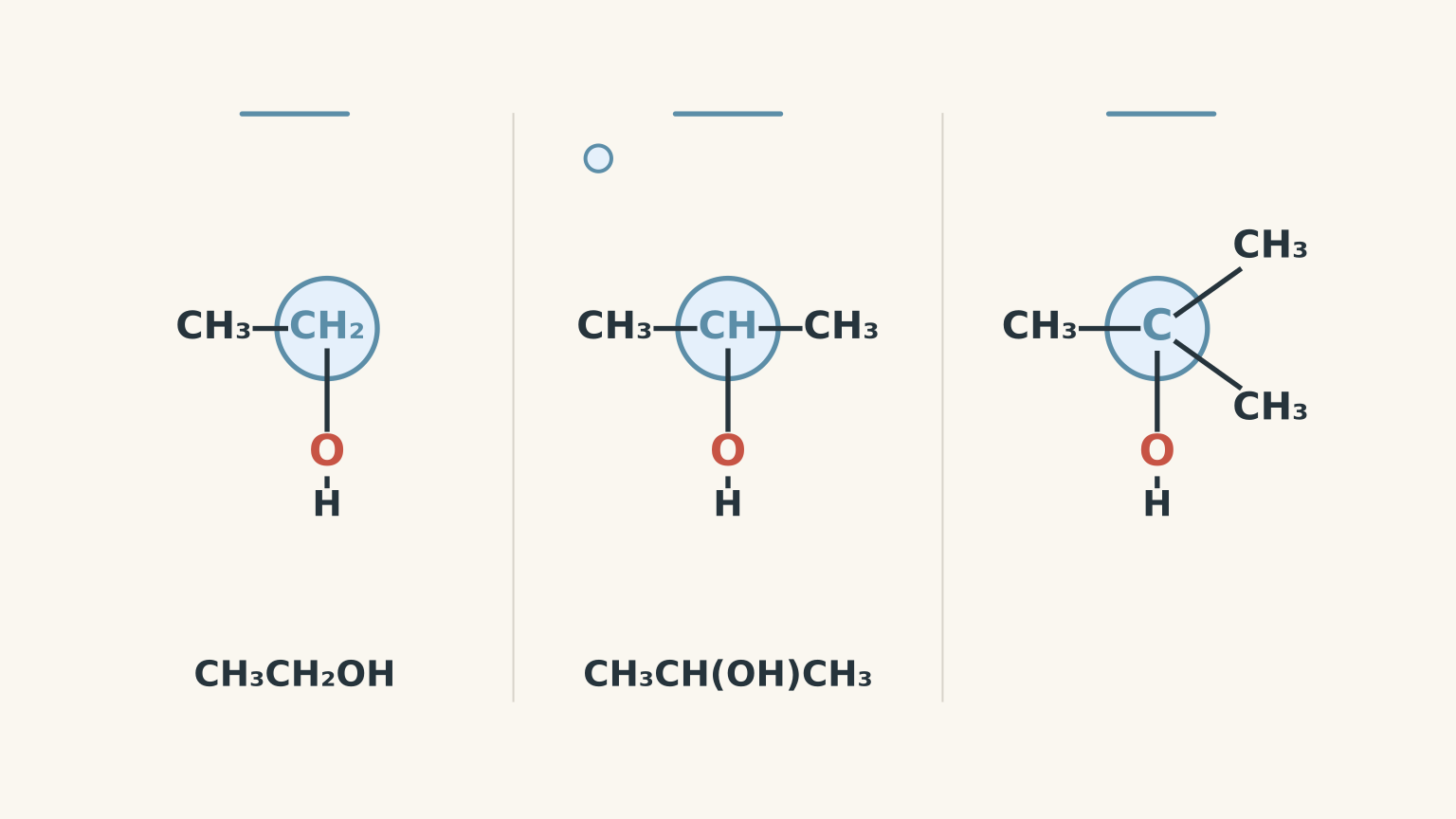
Due to technical limitations, this figure may display incorrectly or contain inaccuracies. Please check key details against your course materials.
| Alcohol type | Carbon atoms attached to the OH-bearing carbon | General structure |
|---|---|---|
| Primary | 1 | \(\ce{RCH2OH}\) |
| Secondary | 2 | \(\ce{R2CHOH}\) |
| Tertiary | 3 | \(\ce{R3COH}\) |
This classification becomes particularly useful when comparing three important alcohol reactions.
1. Oxidation
Alcohols can undergo oxidation when treated with an oxidising agent such as acidified potassium dichromate(VI), \(\ce{K2Cr2O7}\).
The outcome depends strongly on the alcohol classification.
| Alcohol type | Expected oxidation product | Conditions |
|---|---|---|
| Primary | Aldehyde | Controlled oxidation, followed by distillation |
| Primary | Carboxylic acid | Excess oxidising agent and reflux |
| Secondary | Ketone | Acidified dichromate(VI) |
| Tertiary | No reaction under standard conditions | Acidified dichromate(VI) |
Why does this happen?
Primary and secondary alcohols have at least one hydrogen attached to the carbon carrying the hydroxyl group. This allows the usual oxidation process to occur without breaking the carbon skeleton.
A tertiary alcohol has no hydrogen attached to that carbon. Oxidation using standard acidified dichromate conditions would require breaking carbon-carbon bonds, so tertiary alcohols are generally resistant to this reaction.
You may also observe a colour change when acidified potassium dichromate is used:
- Orange: dichromate(VI) ions.
- Green: chromium(III) ions formed during reduction.
This colour change is evidence of a redox reaction, not a test that independently identifies the organic product.
2. Substitution
Alcohols can also undergo substitution reactions with hydrogen halides.
For example, when an alcohol reacts with concentrated hydrobromic acid, the hydroxyl group is replaced by a bromine atom.
The general equation is:
\[ \ce{R-OH + HBr -> R-Br + H2O} \]
The product is a bromoalkane.
Compare the possible products for the three alcohol classes:
| Starting alcohol | Product after substitution with HBr |
|---|---|
| Primary | Primary bromoalkane |
| Secondary | Secondary bromoalkane |
| Tertiary | Tertiary bromoalkane |
The carbon skeleton is retained. The key change is that bromine takes the place of the hydroxyl group.
For example:
\[ \ce{(CH3)2CHCH2OH + HBr -> (CH3)2CHCH2Br + H2O} \]
The primary alcohol 2-methylpropan-1-ol produces 1-bromo-2-methylpropane.
This is different from dehydration. Substitution replaces one functional group with another, whereas dehydration removes water and forms a carbon-carbon double bond.
3. Elimination
Elimination occurs when an alcohol loses the elements of water to form an alkene.
The usual HSC reaction conditions are concentrated sulfuric acid and strong heating.
Unlike oxidation, elimination does not require a hydrogen on the carbon carrying the hydroxyl group. It requires a hydrogen on an adjacent beta carbon.
This explains why primary, secondary, and tertiary alcohols can all undergo dehydration when their structures allow it.
Consider cyclohexanol, a secondary alcohol.
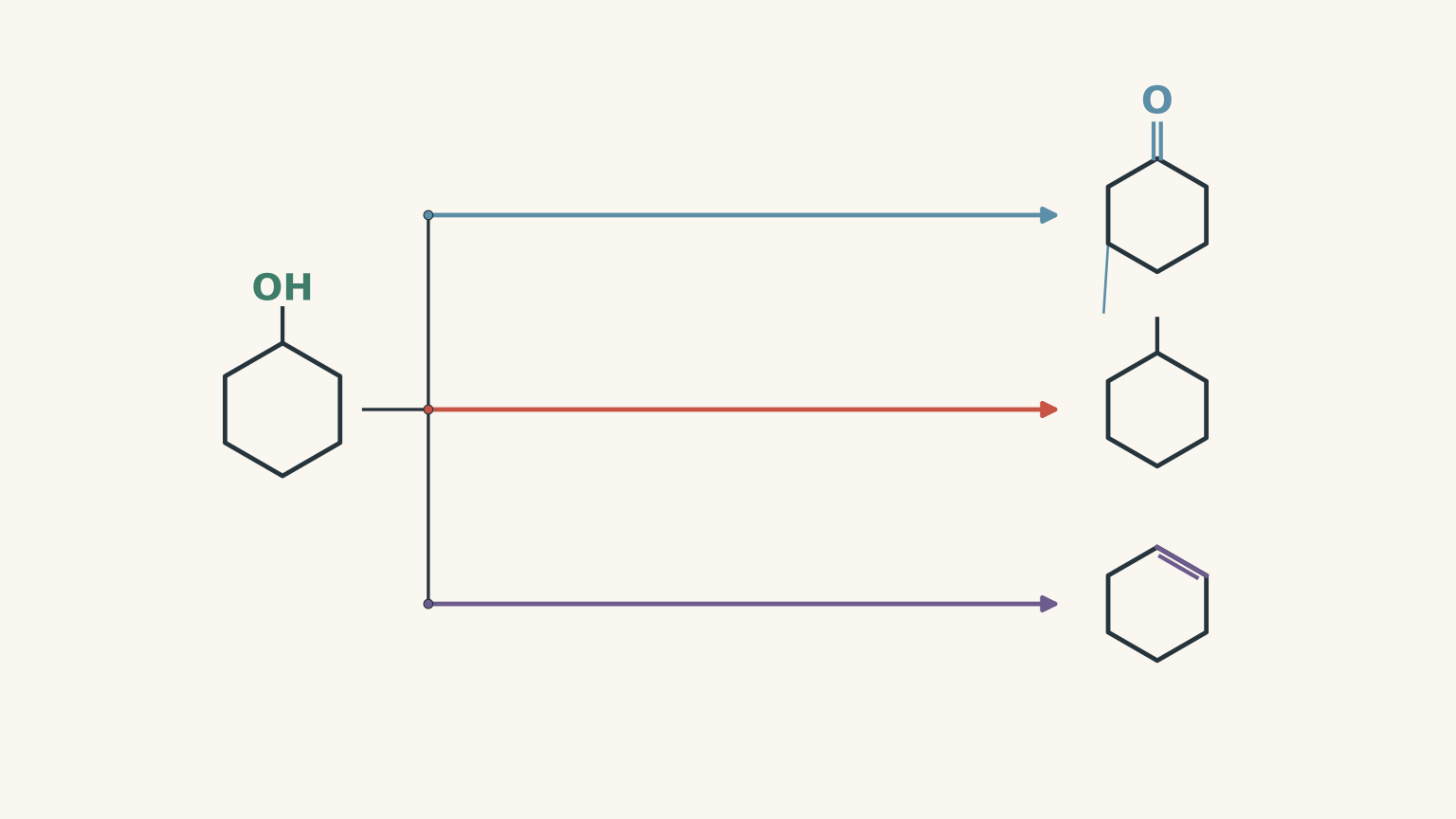
Due to technical limitations, this figure may display incorrectly or contain inaccuracies. Please check key details against your course materials.
The three possible reaction pathways can be summarised as follows:
| Reaction | Conditions | Organic product |
|---|---|---|
| Oxidation | Acidified \(\ce{K2Cr2O7}\), reflux | Cyclohexanone |
| Substitution | Concentrated HBr, warming | Bromocyclohexane |
| Elimination | Concentrated \(\ce{H2SO4}\), strong heating | Cyclohexene |
The same starting alcohol can therefore produce three different organic products.
The reagent and reaction conditions determine which pathway occurs. Simply recognising that a molecule is an alcohol is not enough to predict its product.
Temperature can change the dehydration product
There is another condition worth remembering, particularly for ethanol.
When ethanol reacts with concentrated sulfuric acid, temperature influences whether elimination or intermolecular dehydration occurs.
Under conventional textbook conditions:
- Around \(140^\circ\mathrm{C}\), ether formation is favoured.
- Around \(170^\circ\mathrm{C}\), alkene formation is favoured.
At the lower temperature, two ethanol molecules combine to form ethoxyethane:
\[ \ce{2CH3CH2OH -> CH3CH2OCH2CH3 + H2O} \]
At the higher temperature, ethanol forms ethene:
\[ \ce{CH3CH2OH -> CH2=CH2 + H2O} \]
These are approximate teaching conditions for the ethanol example, not universal temperature cut-offs for every alcohol.
The lesson is simple: read the temperature as carefully as the reagent. If a question specifies conditions, include them in your reasoning and reaction equation.
03Experimental check: how do we know an alkene has formed?
Predicting cyclohexene from cyclohexanol is one thing. How could an experiment provide evidence that the collected product contains a carbon-carbon double bond?
A suitable investigation combines dehydration with a test for unsaturation.
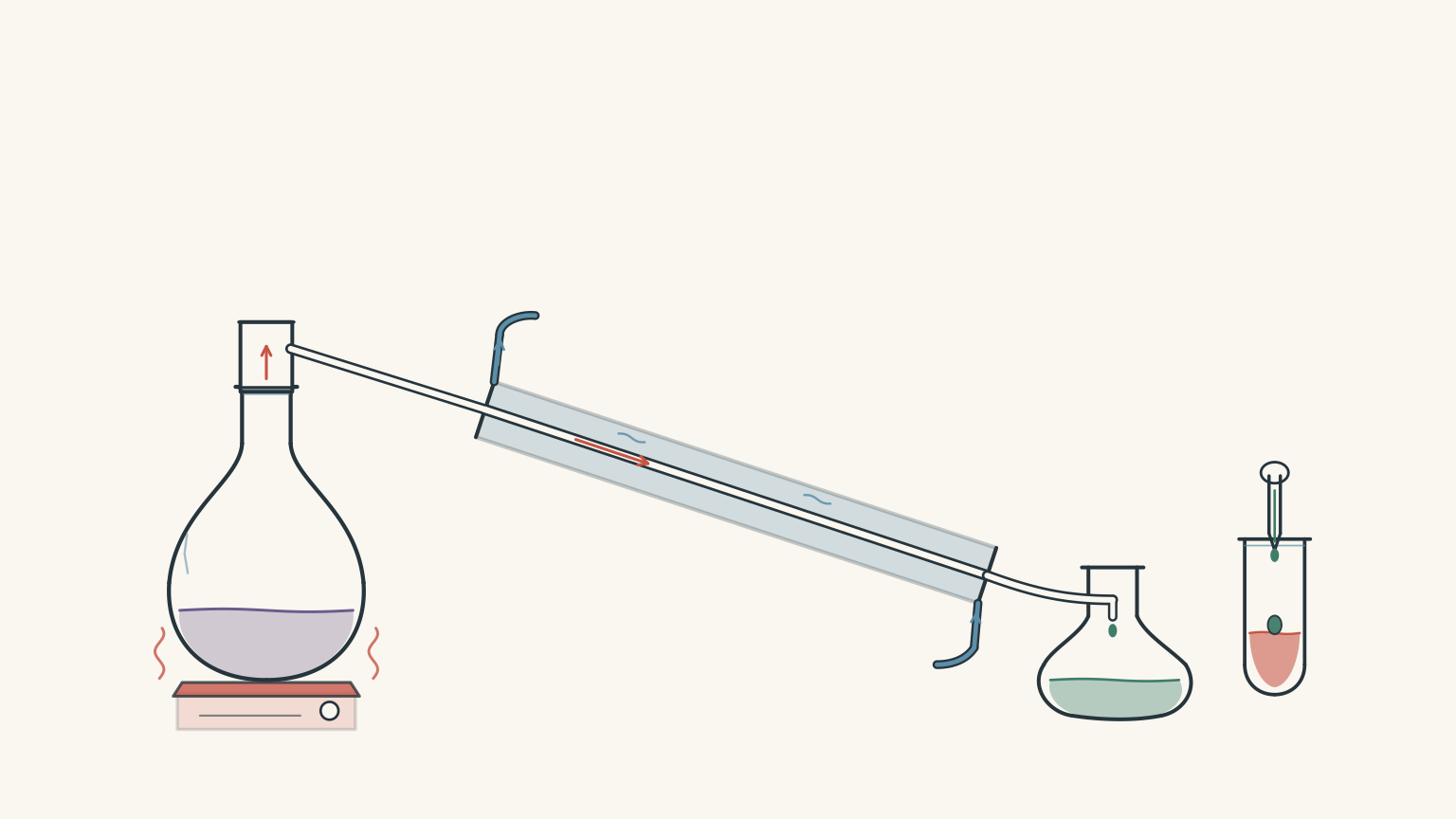
The apparatus and the prediction
A common practical approach uses cyclohexanol and concentrated phosphoric acid.
The reaction mixture is placed in a heated round-bottom flask. Vapour travels from the flask through a distillation head and into a water-cooled condenser.
Cooling water enters the condenser through its lower connection and exits through the upper connection. This keeps the condenser jacket filled with cooling water.
The condensed liquid then flows into a separate receiving flask, which can be cooled to help collect the volatile product.
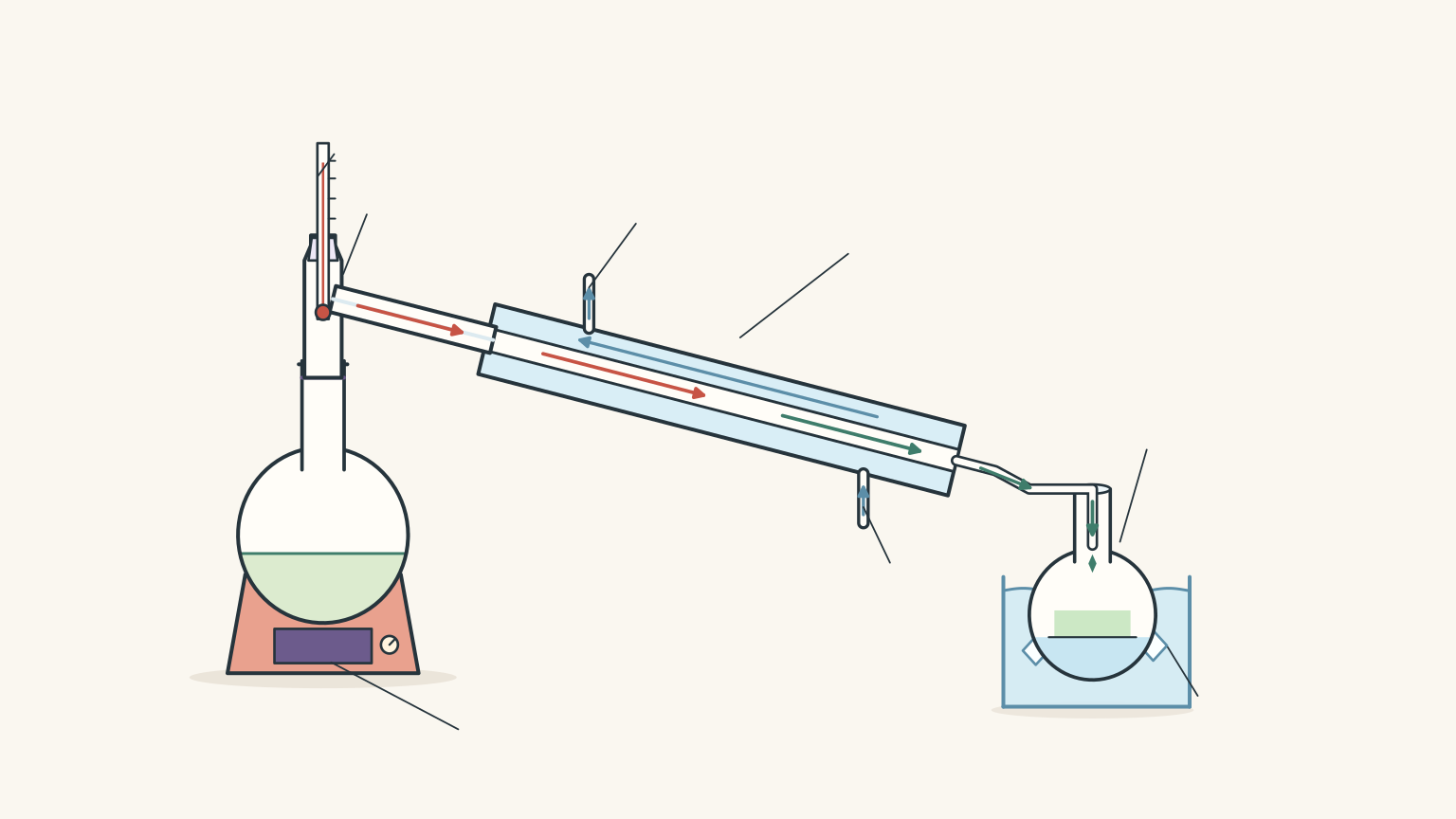
Due to technical limitations, this figure may display incorrectly or contain inaccuracies. Please check key details against your course materials.
The expected reaction is:
\[ \ce{C6H11OH -> C6H10 + H2O} \]
The organic product is cyclohexene.
The distillation arrangement helps separate the more volatile cyclohexene from the original alcohol and the acidic reaction mixture.
For the HSC product-prediction model, concentrated sulfuric acid and heat are commonly specified. Concentrated phosphoric acid is another acid catalyst that can be used in a dehydration investigation.
Testing the collected product
A small sample of the collected product can be tested with bromine water.
Bromine water is orange-brown. Alkenes react with bromine through addition across the carbon-carbon double bond.
If the sample contains an alkene, the bromine water loses its orange-brown colour.
The prediction is therefore:
- If the collected sample contains an alkene, bromine water should decolourise.
- If it contains only an unreactive saturated compound, the orange-brown colour should remain under the usual test conditions.
The observation supports the presence of unsaturation.
However, there is an important limitation: bromine water does not prove that the product is specifically cyclohexene. Other alkenes can also decolourise bromine water. It does not identify the position of a double bond or establish that the sample is pure.
This is why separating the product before testing is useful. Sending all the reaction vapour directly into bromine water would provide weaker evidence because the test would not distinguish the desired product from other substances carried through the apparatus.
A second independent identification method, such as an infrared spectrum or comparison of a measured boiling point with a reference value, would provide stronger evidence for the exact identity.
A small calculation: estimating the theoretical product mass
Suppose an investigation begins with \(0.0200\ \mathrm{mol}\) of cyclohexanol.
The balanced dehydration equation shows a 1:1 mole ratio:
\[ 1\ \mathrm{mol\ cyclohexanol} : 1\ \mathrm{mol\ cyclohexene} \]
Therefore, complete conversion produces:
\[ n(\ce{C6H10})=0.0200\ \mathrm{mol} \]
The molar mass of cyclohexene is \(82.15\ \mathrm{g\,mol^{-1}}\).
Using \(m=nM\):
\[ \begin{aligned} m &= nM\\ &=0.0200\times82.15\\ &=1.64\ \mathrm{g} \end{aligned} \]
The theoretical yield is \(1.64\ \mathrm{g}\) of cyclohexene.
This estimate assumes complete conversion, a 1:1 reaction pathway, and no competing reactions. An actual isolated mass may be lower because of incomplete conversion, side reactions, or product lost during collection.
The important distinction is that experimental yield tells you how much product was recovered. It does not change the structural rules used to predict which alkene can form.
04Worked examples
Worked example: Predicting the alkene from a primary alcohol
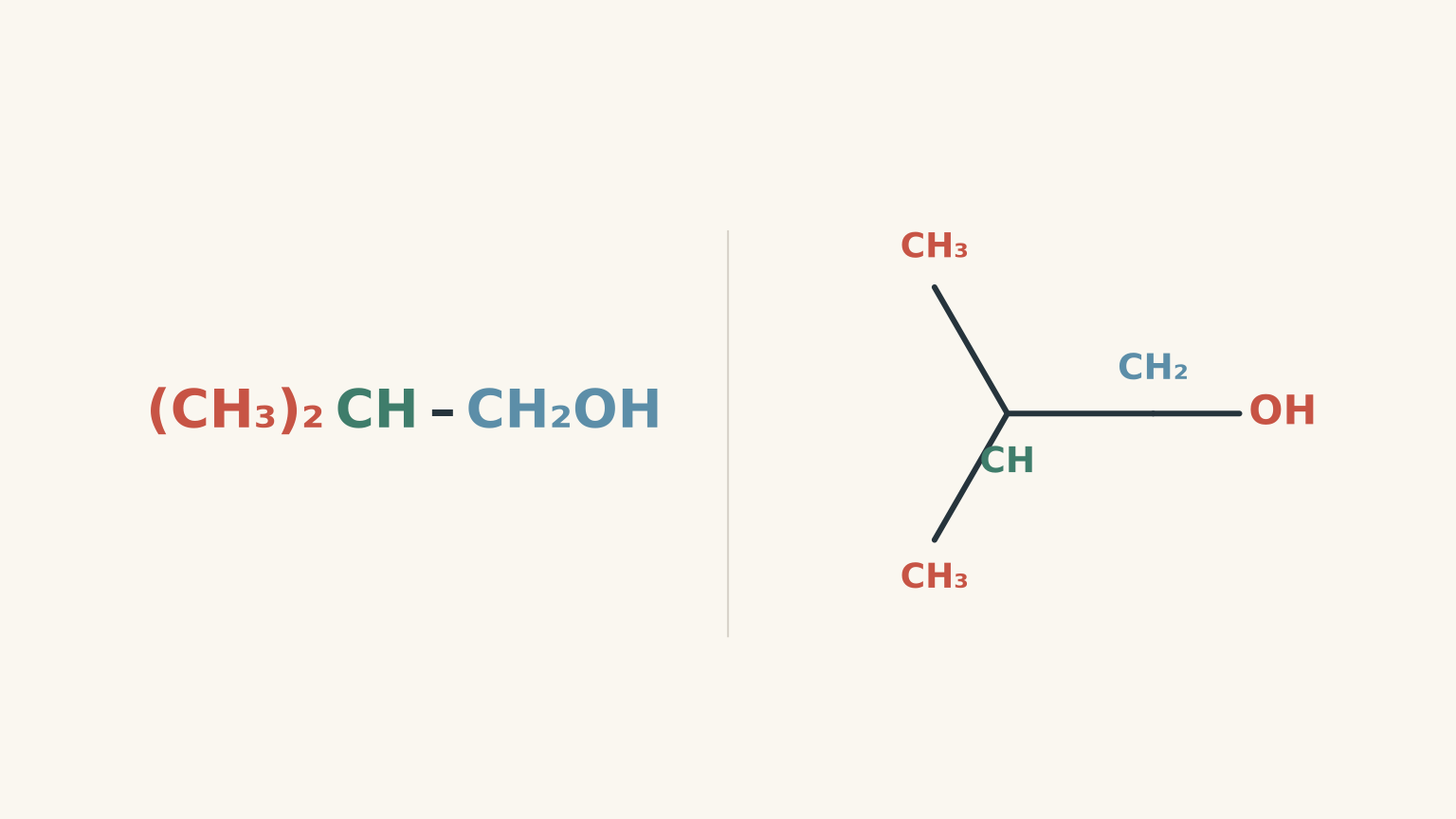
A student heats 2-methylpropan-1-ol with concentrated sulfuric acid and strong heat. Identify the alcohol classification, predict the organic product, and write a balanced structural equation. Also explain how the products would differ under oxidation and substitution conditions.
Step 1
The structure is:
\[ \ce{(CH3)2CHCH2OH} \]
The carbon carrying the hydroxyl group is attached to only one other carbon.
Therefore, 2-methylpropan-1-ol is a primary alcohol.
Step 2
The terminal \(\ce{CH2OH}\) carbon is the alpha carbon.
The central \(\ce{CH}\) carbon is the only beta carbon. It has one hydrogen available for elimination.
Step 3
The hydroxyl group is removed from the alpha carbon, and the hydrogen is removed from the beta carbon.
A double bond forms between these two carbon atoms.
The product is:
\[ \ce{CH2=C(CH3)2} \]
Step 4
The product is 2-methylpropene.
\[ \ce{(CH3)2CHCH2OH ->[conc. H2SO4,\ heat] CH2=C(CH3)2 + H2O} \]
The carbon skeleton is retained, and water is produced.
Step 5
If the alcohol were oxidised using acidified dichromate(VI), the product would depend on the conditions.
Controlled oxidation followed by distillation produces 2-methylpropanal:
\[ \ce{(CH3)2CHCH2OH + [O] -> (CH3)2CHCHO + H2O} \]
Further oxidation under reflux with excess oxidising agent produces 2-methylpropanoic acid:
\[ \ce{(CH3)2CHCH2OH + 2[O] -> (CH3)2CHCOOH + H2O} \]
Here, \([O]\) represents an oxidising equivalent rather than free oxygen atoms.
If concentrated HBr were used instead, substitution would produce 1-bromo-2-methylpropane.
The starting alcohol has not changed. The reaction conditions have.
Due to technical limitations, this figure may display incorrectly or contain inaccuracies. Please check key details against your course materials.
Worked example: Predicting multiple products from a tertiary cyclic alcohol
A sample of 1-methylcyclohexan-1-ol is heated with concentrated sulfuric acid. Predict all distinct constitutional alkene products and identify the expected major product.
Step 1
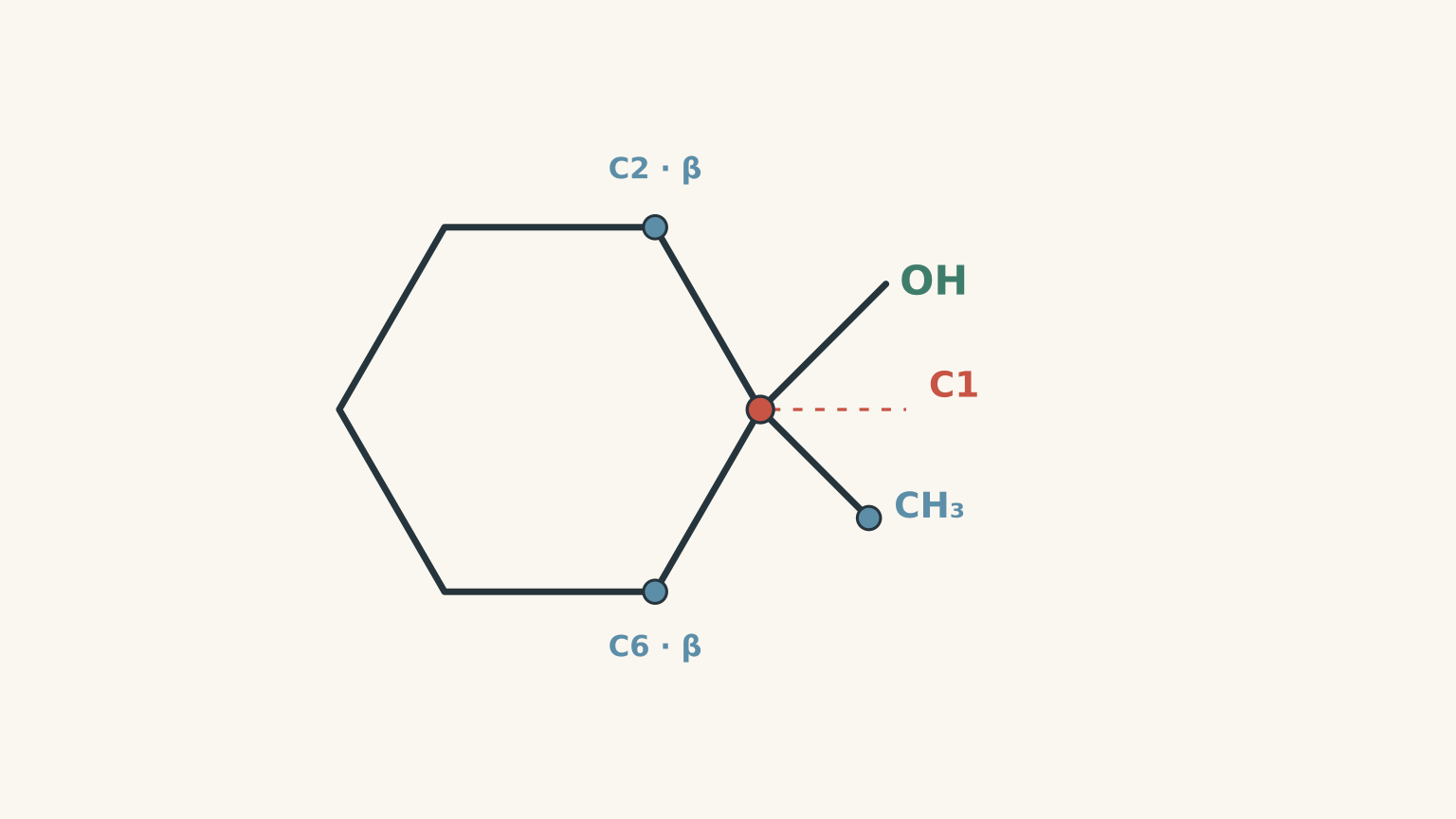
The carbon carrying the hydroxyl group is carbon 1.
It is attached to three other carbon atoms:
- Carbon 2 of the ring.
- Carbon 6 of the ring.
- The methyl substituent.
Therefore, 1-methylcyclohexan-1-ol is a tertiary alcohol.
Step 2
There are three beta carbons:
- Carbon 2.
- Carbon 6.
- The carbon in the methyl substituent.
All three contain hydrogen atoms.
This means elimination is possible in all three directions.
Step 3
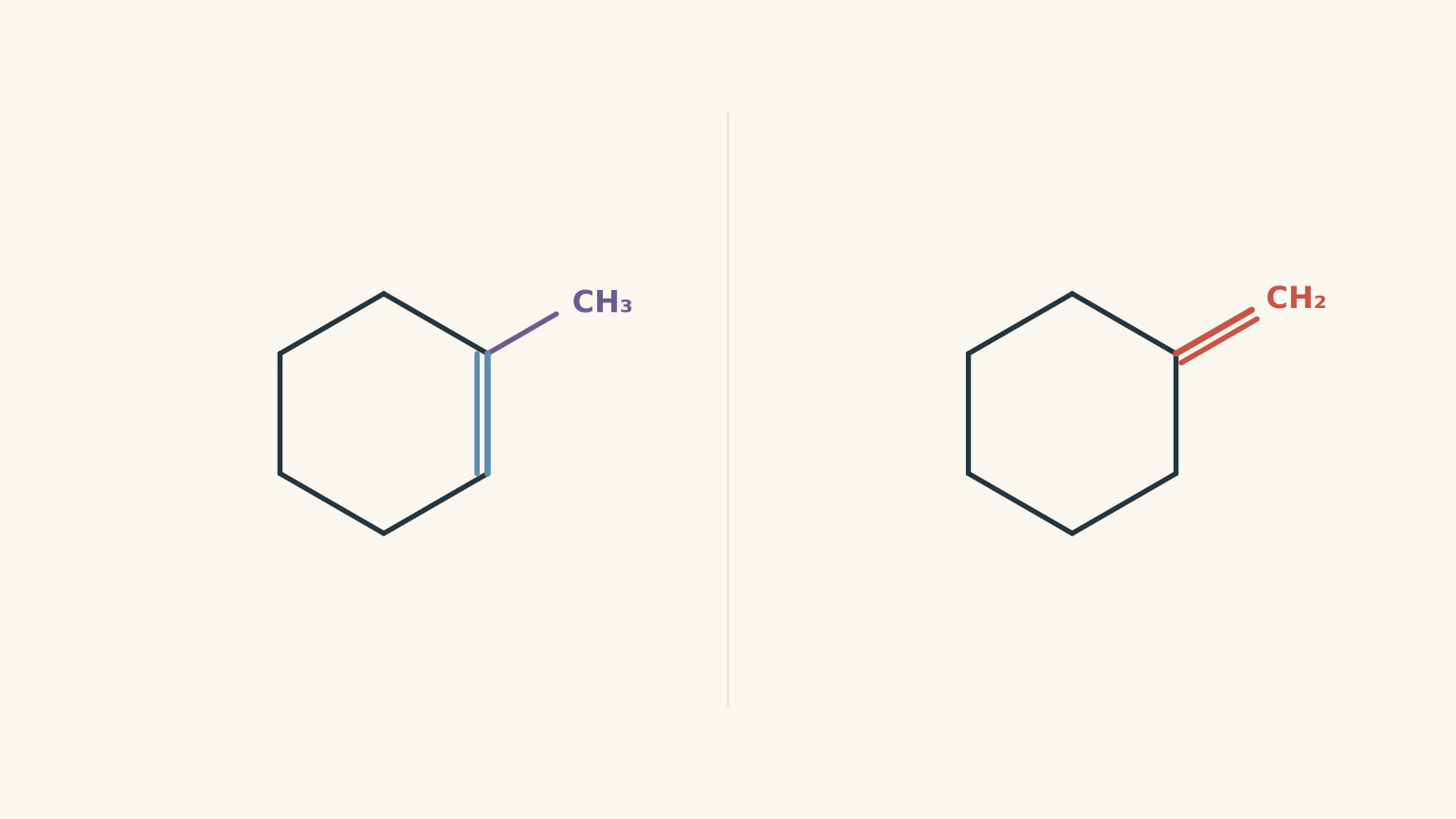
Elimination towards carbon 2 produces a double bond between carbons 1 and 2.
Elimination towards carbon 6 produces a double bond between carbons 1 and 6.
However, carbons 2 and 6 are equivalent because of the symmetry of the starting molecule. Both pathways produce the same constitutional alkene.
This product is 1-methylcyclohex-1-ene.
Elimination towards the methyl substituent produces an exocyclic double bond between carbon 1 and the former methyl carbon.
This product is methylenecyclohexane.
Step 4
1-Methylcyclohex-1-ene has a more substituted carbon-carbon double bond than methylenecyclohexane.
The internal alkene has three carbon substituents attached to its double-bonded carbons, whereas the exocyclic alkene has two.
The more substituted alkene is generally favoured under the usual acid-catalysed dehydration model.
Therefore:
- 1-Methylcyclohex-1-ene is the expected major product.
- Methylenecyclohexane is a possible minor product.
Step 5
The starting alcohol is tertiary, so its alpha carbon has no hydrogen atoms.
However, all three beta positions have hydrogens available. Dehydration can therefore occur.
This is exactly why you must not apply the oxidation rule to elimination. The absence of an alpha hydrogen prevents ordinary oxidation with acidified dichromate, but it does not prevent dehydration.
Due to technical limitations, this figure may display incorrectly or contain inaccuracies. Please check key details against your course materials.
Due to technical limitations, this figure may display incorrectly or contain inaccuracies. Please check key details against your course materials.
05Questions and solutions
Question 1
Propan-2-ol is heated with concentrated sulfuric acid.
a. Classify the alcohol as primary, secondary, or tertiary.
b. Predict the organic product.
c. Write a balanced structural equation and identify the reaction type.
Solution 1
The product is propene, and the reaction is elimination.
Propan-2-ol has the structure:
\[ \ce{CH3CH(OH)CH3} \]
The carbon carrying the hydroxyl group is attached to two other carbon atoms, making it a secondary alcohol.
The two neighbouring methyl groups both contain hydrogen atoms. Removing a hydrogen from either side produces the same constitutional alkene because the two sides are equivalent.
The product is propene:
\[ \ce{CH3CH(OH)CH3 ->[conc. H2SO4,\ heat] CH3CH=CH2 + H2O} \]
The reaction is balanced, with three carbon atoms, eight hydrogen atoms, and one oxygen atom on each side.
The important point is that two possible elimination directions do not necessarily mean two different products. Molecular symmetry can make them equivalent.
Question 2
Ethanol is treated with concentrated sulfuric acid under two different temperature conditions.
- Experiment A: approximately \(140^\circ\mathrm{C}\).
- Experiment B: approximately \(170^\circ\mathrm{C}\).
Using conventional textbook conditions:
a. Predict the major organic product in each experiment.
b. Write a balanced structural equation for each reaction.
c. Explain why the reagent alone is insufficient to predict the product.
Solution 2
Experiment A produces ethoxyethane, while Experiment B produces ethene.
The difference is the reaction pathway favoured at each temperature.
Experiment A: approximately \(140^\circ\mathrm{C}\)
At the lower temperature, intermolecular dehydration is favoured.
Two ethanol molecules combine, producing an ether and water:
\[ \ce{2CH3CH2OH -> CH3CH2OCH2CH3 + H2O} \]
The organic product is ethoxyethane.
Experiment B: approximately \(170^\circ\mathrm{C}\)
At the higher temperature, elimination within an ethanol molecule is favoured.
The hydroxyl group and a hydrogen from the neighbouring carbon are removed, producing ethene:
\[ \ce{CH3CH2OH -> CH2=CH2 + H2O} \]
The organic product is ethene.
The tempting mistake is to see concentrated sulfuric acid and immediately write an alkene. However, temperature influences which dehydration pathway is favoured.
These temperatures are conventional textbook conditions for ethanol. They should not be treated as exact universal boundaries for every alcohol.
Question 3
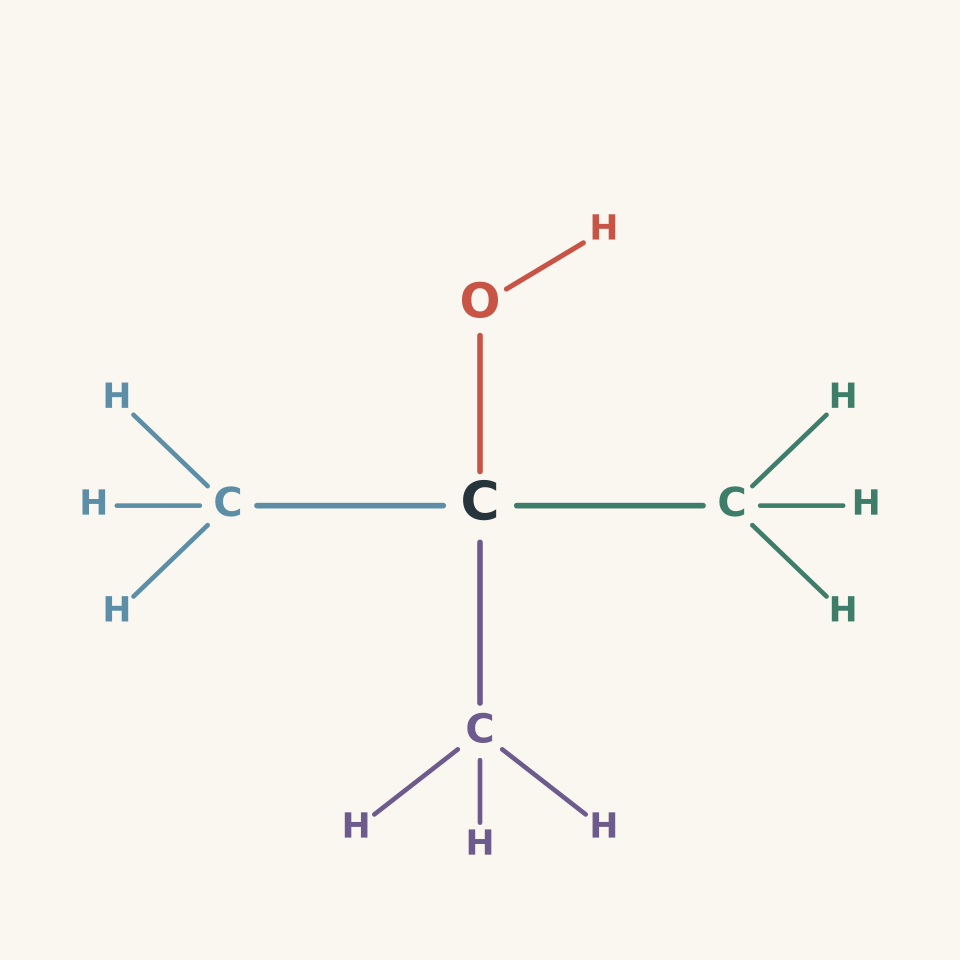
2-Methylpropan-2-ol is treated separately under three sets of conditions:
- Acidified potassium dichromate(VI) under standard oxidation conditions.
- Concentrated hydrobromic acid.
- Concentrated sulfuric acid with strong heating.
a. Classify the starting alcohol.
b. Predict the product of each reaction, including whether oxidation occurs.
c. Explain why the absence of a hydrogen on the carbon carrying the hydroxyl group does not prevent dehydration.
Due to technical limitations, this figure may display incorrectly or contain inaccuracies. Please check key details against your course materials.
Solution 3
2-Methylpropan-2-ol is a tertiary alcohol. It does not undergo ordinary oxidation with acidified dichromate(VI), but it can undergo both substitution and elimination.
Its structure is:
\[ \ce{(CH3)3COH} \]
The carbon carrying the hydroxyl group is attached to three other carbon atoms.
a. Oxidation
There is no ordinary oxidation reaction under the specified acidified dichromate(VI) conditions.
The alpha carbon has no hydrogen attached to it. Oxidation would require carbon-carbon bond cleavage, which does not occur in the usual HSC oxidation model.
b. Substitution
With concentrated HBr, the hydroxyl group is replaced by bromine.
\[ \ce{(CH3)3COH + HBr -> (CH3)3CBr + H2O} \]
The product is 2-bromo-2-methylpropane.
c. Elimination
With concentrated sulfuric acid and strong heating, dehydration occurs.
The alpha carbon has three neighbouring methyl groups. Each contains beta hydrogens.
Removing a beta hydrogen and the hydroxyl group produces:
\[ \ce{(CH3)3COH ->[conc. H2SO4,\ heat] CH2=C(CH3)2 + H2O} \]
The product is 2-methylpropene.
The student’s likely misconception is that every elimination reaction requires a hydrogen to be removed from the carbon carrying the hydroxyl group.
That is incorrect. The hydrogen required for dehydration comes from an adjacent beta carbon.
The oxidation and dehydration reactions therefore have different hydrogen requirements, even though they involve the same starting alcohol.
Question 4
A student investigates the dehydration of cyclohexanol using concentrated phosphoric acid and heat.
The collected liquid product decolourises bromine water.
The student begins with \(5.00\ \mathrm{g}\) of cyclohexanol and collects \(3.10\ \mathrm{g}\) of dry organic product.
The following molar masses are provided:
- Cyclohexanol: \(100.16\ \mathrm{g\,mol^{-1}}\).
- Cyclohexene: \(82.15\ \mathrm{g\,mol^{-1}}\).
Assume that the collected product is pure and that the only organic product formed is cyclohexene.
a. Write the balanced reaction equation.
b. Calculate the theoretical mass of cyclohexene.
c. Calculate the percentage yield.
d. Explain what the bromine water test establishes and why it does not independently prove that the product is cyclohexene.
e. Explain why collecting a separate product fraction before performing the test provides stronger evidence than bubbling the entire reaction mixture directly into bromine water.
Due to technical limitations, this figure may display incorrectly or contain inaccuracies. Please check key details against your course materials.
Solution 4
The predicted product is cyclohexene, the theoretical yield is \(4.10\ \mathrm{g}\), and the percentage yield is \(75.6\%\).
a. Reaction equation
Cyclohexanol undergoes dehydration to form cyclohexene and water.
\[ \ce{C6H11OH -> C6H10 + H2O} \]
The reaction has a 1:1 mole ratio between cyclohexanol and cyclohexene.
b. Theoretical mass
First, calculate the amount of cyclohexanol used.
\[ \begin{aligned} n &= \frac{m}{M}\\ &= \frac{5.00}{100.16}\\ &=0.0499\ \mathrm{mol} \end{aligned} \]
Using the 1:1 mole ratio:
\[ n(\ce{C6H10})=0.0499\ \mathrm{mol} \]
Now calculate the theoretical mass of cyclohexene.
\[ \begin{aligned} m &= nM\\ &=0.0499\times82.15\\ &=4.10\ \mathrm{g} \end{aligned} \]
The theoretical yield is \(4.10\ \mathrm{g}\).
c. Percentage yield
Percentage yield is calculated using:
\[ \text{Yield}= \frac{\text{Actual yield}}{\text{Theoretical yield}} \times100 \]
Substituting:
\[ \begin{aligned} \text{Yield} &=\frac{3.10}{4.10}\times100\\ &=75.6\% \end{aligned} \]
The percentage yield is \(75.6\%\).
The difference between the theoretical and actual masses may result from incomplete conversion, side reactions, or losses during collection.
d. Interpretation of the bromine water test
The bromine water decolourisation supports the presence of a carbon-carbon double bond.
Cyclohexene is an alkene, so it reacts with bromine through an addition reaction.
However, other alkenes also decolourise bromine water. The observation does not independently establish the exact molecular structure or prove that the sample contains only cyclohexene.
e. Why separate the product first?
Collecting a separate fraction helps isolate the organic product from the original alcohol, water, and acidic reaction mixture.
If the entire reaction mixture were tested directly, the result would be harder to interpret because other substances could affect the observation.
Distillation improves the quality of the sample being tested, although an additional identification method would still be needed to establish the exact product structure confidently.
Question 5
Two unknown compounds, A and B, are structural isomers with the molecular formula \(\ce{C4H10O}\).
Both are open-chain, saturated, monohydric alcohols.
The following experimental observations are recorded:
- Both A and B produce 2-methylpropene as their only detected constitutional alkene when heated with concentrated sulfuric acid.
- A produces a carboxylic acid when refluxed with excess acidified potassium dichromate(VI).
- B shows no reaction with acidified potassium dichromate(VI) under standard conditions.
- Both A and B undergo substitution when treated with concentrated HBr, producing different bromoalkanes.
Assume the carbon skeleton does not rearrange during dehydration and that the observations represent the expected products under the stated conditions.
a. Identify the structures and classifications of A and B.
b. Explain how two different alcohol structures can produce the same alkene.
c. Write the balanced structural equation for the dehydration of each alcohol.
d. Write the oxidation equation for A and explain why B does not undergo the corresponding reaction.
e. Write the substitution equation for each alcohol and name the resulting bromoalkanes.
f. Explain why identifying the alkene alone would not be sufficient to determine which starting alcohol was used.
Solution 5
A is 2-methylpropan-1-ol, a primary alcohol. B is 2-methylpropan-2-ol, a tertiary alcohol. Both can form 2-methylpropene because their different hydroxyl positions allow elimination to produce the same carbon-carbon double bond.
The key is to work backwards from the reaction evidence rather than assuming that one product must come from only one starting structure.
a. Identify the alcohols
A produces a carboxylic acid when oxidised under reflux with excess acidified dichromate(VI).
This is characteristic of a primary alcohol.
B does not undergo ordinary oxidation under the same conditions. This indicates that it is a tertiary alcohol.
The two structures are:
\[ \text{A: }\ce{(CH3)2CHCH2OH} \]
\[ \text{B: }\ce{(CH3)3COH} \]
A is 2-methylpropan-1-ol.
B is 2-methylpropan-2-ol.
Both have the molecular formula \(\ce{C4H10O}\), but their hydroxyl groups occupy different positions.
b. Explain why they produce the same alkene
Consider A first.
In 2-methylpropan-1-ol, the alpha carbon is the terminal \(\ce{CH2OH}\) carbon.
The adjacent central carbon is the beta carbon. It has one hydrogen available for elimination.
Removing that hydrogen and the hydroxyl group forms a double bond between the terminal and central carbon atoms.
Now consider B.
In 2-methylpropan-2-ol, the alpha carbon is the central carbon.
The three neighbouring methyl groups are equivalent beta carbons. Removing a hydrogen from any one of them produces the same double-bond arrangement.
Both pathways therefore produce:
\[ \ce{CH2=C(CH3)2} \]
The product is 2-methylpropene.
The important insight is that the starting alcohols have the same carbon skeleton but different positions for the hydroxyl group. Dehydration removes that difference by forming the same final alkene structure.
c. Dehydration equations
For A:
\[ \ce{(CH3)2CHCH2OH ->[conc. H2SO4,\ heat] CH2=C(CH3)2 + H2O} \]
For B:
\[ \ce{(CH3)3COH ->[conc. H2SO4,\ heat] CH2=C(CH3)2 + H2O} \]
Both equations are balanced.
d. Oxidation of A and B
A is a primary alcohol, so refluxing it with excess acidified dichromate(VI) produces a carboxylic acid.
The equation is:
\[ \ce{(CH3)2CHCH2OH + 2[O] -> (CH3)2CHCOOH + H2O} \]
The product is 2-methylpropanoic acid.
B is a tertiary alcohol. Its hydroxyl-bearing carbon has no hydrogen attached, so it does not undergo ordinary oxidation with acidified dichromate(VI).
This explains why the oxidation experiment distinguishes the two starting alcohols even though their dehydration products are identical.
e. Substitution reactions
Both alcohols can undergo substitution with concentrated HBr.
For A:
\[ \ce{(CH3)2CHCH2OH + HBr -> (CH3)2CHCH2Br + H2O} \]
The product is 1-bromo-2-methylpropane.
For B:
\[ \ce{(CH3)3COH + HBr -> (CH3)3CBr + H2O} \]
The product is 2-bromo-2-methylpropane.
The bromine atom replaces the hydroxyl group, while the carbon skeleton is retained.
f. Why the alkene alone cannot identify the starting alcohol
The tempting assumption is that a particular alkene must correspond to one particular alcohol.
But the reactions show otherwise.
In A, the hydroxyl group begins on a terminal carbon, and the central beta carbon supplies the hydrogen.
In B, the hydroxyl group begins on the central carbon, and a terminal methyl group supplies the hydrogen.
Both pathways form the same double bond between the central carbon and a terminal carbon.
Therefore, identifying 2-methylpropene does not uniquely identify the original alcohol.
The oxidation and substitution evidence provides the additional structural information needed to distinguish A from B.
This is a useful principle for organic chemistry: reaction products do not always reveal a unique starting structure. You often need evidence from more than one reaction to identify an unknown compound.
06What to predict next
Once you can predict the alkene formed by dehydration, the next step is to examine the structure of that alkene.
Check whether its double bond allows geometric isomerism, whether the alkene is terminal or internal, and how its structure affects subsequent addition reactions.
For a refresher on identifying and naming alkenes, including their molecular and structural formulae, see HSC Chemistry: Alkane, Alkene and Alkyne Formulae.
The main decision to carry into your next organic chemistry question is this: classify the alcohol, read the reaction conditions, and then identify which bonds can actually change.