
How to Identify the Reagent Added in Excess in Back Titration
Learn how to identify which reagent is deliberately added in excess, distinguish added, leftover, and consumed amounts, and use back-titration results correctly. Includes step-by-step worked examples, common misconceptions, and five practice questions with detailed solutions.
A powdered acid sample receives 25.00 mL of sodium hydroxide. Later, a burette delivers 40.00 mL of hydrochloric acid before the titration reaches its endpoint. Which reagent was deliberately added in excess?
You might choose hydrochloric acid because 40.00 mL is the larger volume. But if the procedure was designed to neutralise the sample with more sodium hydroxide than it needed, the deliberately added excess reagent is sodium hydroxide. The hydrochloric acid is used afterwards to measure how much sodium hydroxide remains.
The key is to follow what each reagent does, not how much liquid is added.
In a back titration, the reagent deliberately added in excess is the one supplied to the original sample in a known amount, with the intention that some will remain after the sample has reacted completely. The leftover amount is then measured using another reagent, called the titrant.
You identify the intended excess reagent from the experimental procedure. You confirm that it was actually in excess by establishing that some remained after the sample reacted.
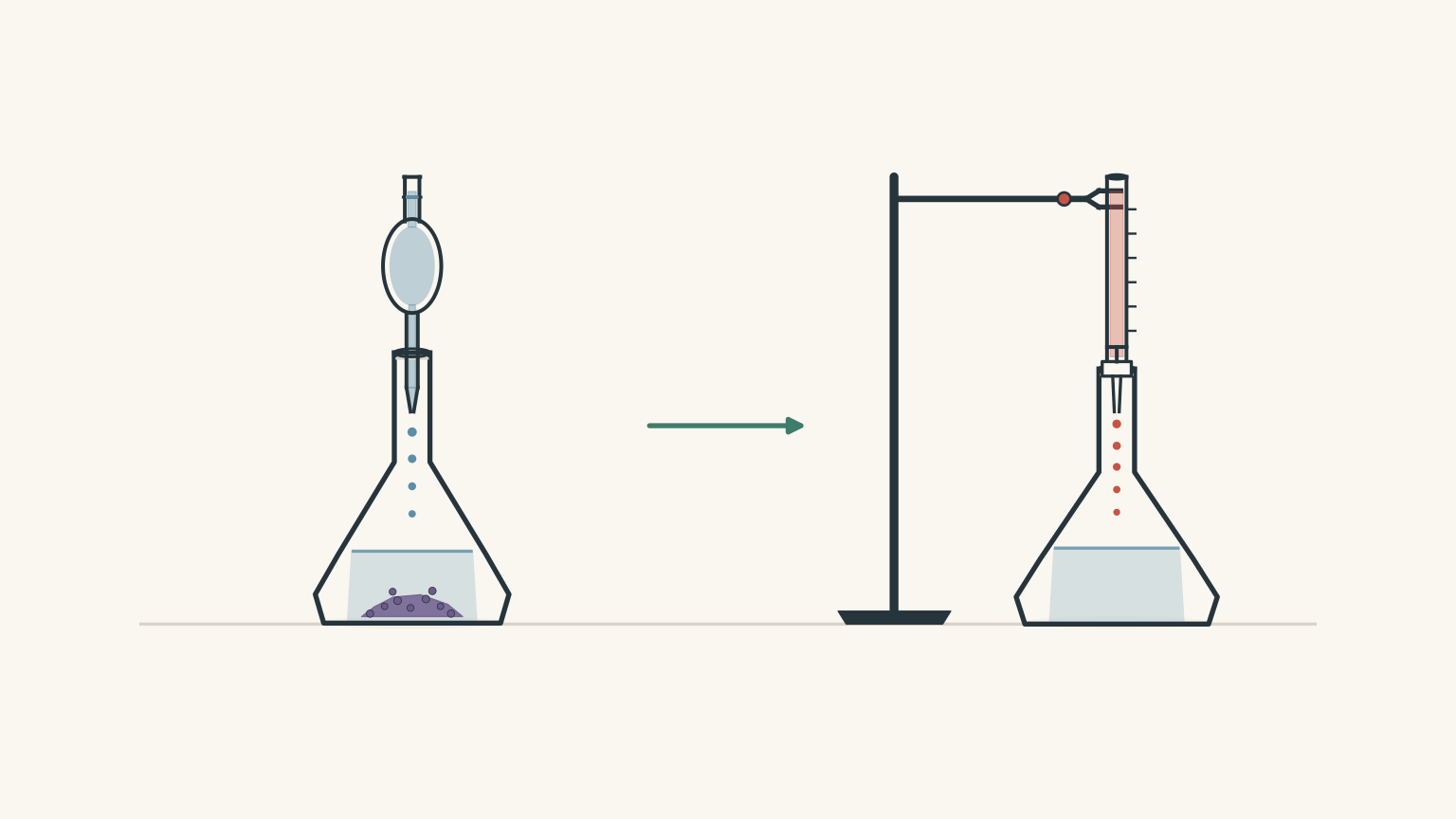
Due to technical limitations, this figure may display incorrectly or contain inaccuracies. Please check key details against your course materials.
01Why deliberately add more reagent than the sample needs?
Suppose you’re analysing a powdered lime mixture containing calcium hydroxide, \(\ce{Ca(OH)2}\), and insoluble sand.
You want to find how much calcium hydroxide the powder contains.
One possible method is to add hydrochloric acid gradually while monitoring the pH. You might expect the endpoint to appear when the calcium hydroxide has finished reacting.
But predict what happens if a particle of calcium hydroxide takes another 20 seconds to react after you’ve added a drop of acid.
The pH can change again as that particle consumes more acid. What looked like an endpoint may not have been stable.
The problem isn’t the balanced equation. It’s that a reaction involving solid particles can take time, and the liquid around the particles may not immediately represent the whole sample.
The reaction is:
\[ \ce{Ca(OH)2 + 2HCl -> CaCl2 + 2H2O} \]
One mole of calcium hydroxide consumes two moles of hydrochloric acid.
A revised experimental design: measure what is left
Instead of trying to stop the first reaction at exactly the right moment, you can add a known quantity of hydrochloric acid that is greater than the amount the sample is expected to require.
The experimental sequence is:
- Place the weighed lime mixture in a conical flask.
- Add an accurately measured volume of hydrochloric acid of known concentration.
- Mix thoroughly and allow sufficient time for the calcium hydroxide to react.
- If necessary, remove inert solids while retaining all the acidic liquid and washings.
- Titrate the remaining hydrochloric acid with standardised sodium hydroxide.
The last reaction is:
\[ \ce{HCl + NaOH -> NaCl + H2O} \]
This reaction has a 1:1 mole ratio.
Every mole of NaOH used in the final titration therefore corresponds to one mole of HCl remaining, provided the titration measures only that residual acid.
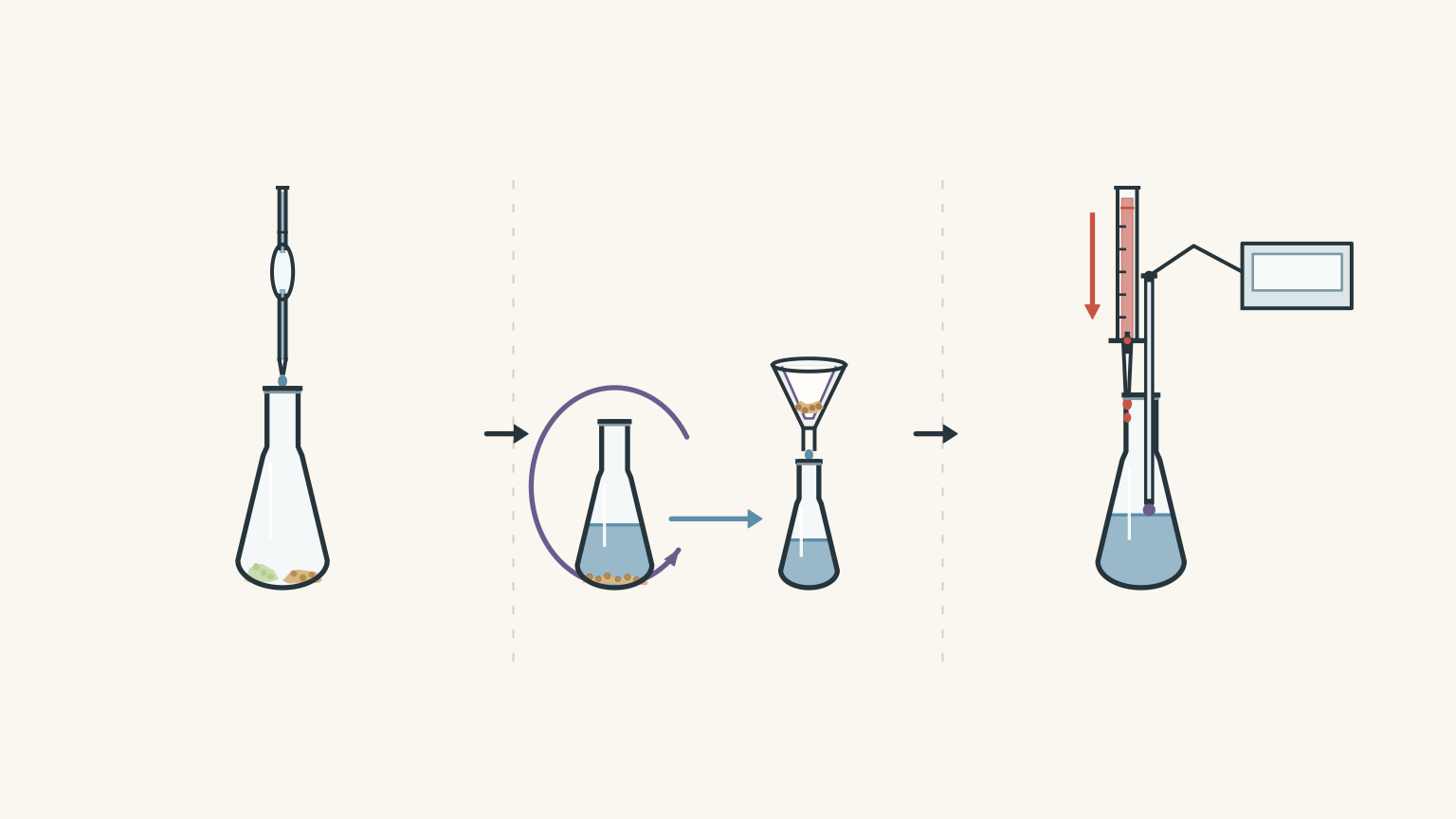
Due to technical limitations, this figure may display incorrectly or contain inaccuracies. Please check key details against your course materials.
This is a back titration: you measure the unused portion of the first reagent rather than trying to measure directly how much of it reacted with the sample.
If NaOH is needed to neutralise the remaining acid, that is evidence that HCl remains in the tested solution.
It does not automatically prove that every particle of calcium hydroxide reacted. An inaccessible clump might still contain unreacted material. Complete reaction remains an experimental assumption that must be justified.
02Separate added, leftover, and consumed reagent
This is the distinction that makes excess-reagent questions manageable.
Imagine starting with a measured amount of HCl. Part of it reacts with the sample, and the rest remains in solution.
All three quantities refer to the same chemical, but to different stages of the experiment.
| Quantity | Meaning | How it is found |
|---|---|---|
| Reagent added | Total amount originally supplied to the sample | Initial concentration and volume |
| Reagent leftover | Amount remaining after the sample reacts | Subsequent titration |
| Reagent consumed | Amount that reacted with the sample | Added minus leftover |
The chemical balance is:
\[ n_{\mathrm{consumed}} = n_{\mathrm{added}}-n_{\mathrm{left}} \]
Here, \(n\) represents the amount of the same reagent, measured in moles (mol).
All three quantities must refer to the entire original reaction mixture. If only a portion of the leftover solution is titrated, its measured amount must first be scaled to the whole mixture.
For solutions, use:
\[ n=cV \]
where:
- \(n\) is the amount of substance in mol.
- \(c\) is concentration in \(\mathrm{mol\,L^{-1}}\).
- \(V\) is solution volume in litres (L).
Remember that 1000 mL = 1 L.
The subtraction is valid when the added reagent is either consumed by the sample or remains available to be measured. If it is lost, reacts with another substance, or is measured incorrectly, the calculation needs correction.
A quick way to identify the reagent
Before calculating anything, ask these three questions:
- Which reagent was added to the original sample? Look for a measured quantity deliberately supplied to complete the sample reaction.
- Which reagent remains after that reaction? The method should identify it through a later measurement.
- Which reagent is delivered during the final titration? This is the titrant. Its job is to measure the leftover reagent, not necessarily to react with the original sample.
For the two common acid-base arrangements:
| Original sample | Reagent deliberately added in excess | Reagent used to measure what remains |
|---|---|---|
| Basic solid | HCl | NaOH |
| Acidic sample | NaOH | HCl |
These are possible experimental designs, not universal rules about all acids or bases.
The direction can be reversed. What matters is the procedure, the chemical reactions, and evidence that the intended excess actually remained.
03Worked example: Which reagent was added in excess to a lime sample?
A 0.6500 g powdered lime sample contains calcium hydroxide and inert sand.
A student adds 50.00 mL of 0.2000 \(\mathrm{mol\,L^{-1}}\) HCl and allows the calcium hydroxide to react completely.
The remaining acid is titrated using 12.00 mL of 0.1000 \(\mathrm{mol\,L^{-1}}\) NaOH.
Identify the deliberately added excess reagent, calculate the amounts added, leftover, and consumed, and determine the percentage by mass of calcium hydroxide in the original sample.
Use \(M(\ce{Ca(OH)2})=74.09\ \mathrm{g\,mol^{-1}}\). Assume only calcium hydroxide consumes HCl, no acid is lost, and the entire residual acidic solution is titrated.
Step 1
HCl was added directly to the lime sample in a known amount.
NaOH was introduced later to measure the HCl remaining.
Therefore, HCl is the deliberately added excess reagent, and NaOH is the back-titration reagent.
Step 2
Convert 50.00 mL to 0.05000 L.
\[ \begin{aligned} n_{\mathrm{added}} &=cV\\ &=0.2000\times0.05000\\ &=0.01000\ \mathrm{mol} \end{aligned} \]
The student initially supplied 0.01000 mol of HCl.
Step 3
From the titration reaction:
\[ \ce{HCl + NaOH -> NaCl + H2O} \]
One mole of NaOH reacts with one mole of HCl.
\[ \begin{aligned} n(\ce{NaOH}) &=0.1000\times0.01200\\ &=0.001200\ \mathrm{mol} \end{aligned} \]
Therefore:
\[ n_{\mathrm{left}}=0.001200\ \mathrm{mol} \]
That positive amount confirms that HCl remained after the sample reaction, under the stated assumptions.
Step 4
\[ \begin{aligned} n_{\mathrm{consumed}} &=0.01000-0.001200\\ &=0.008800\ \mathrm{mol} \end{aligned} \]
The sample consumed 0.008800 mol of HCl.
Notice that the 0.001200 mol measured through the NaOH titration is not the amount consumed by the lime. It is the amount the lime didn’t consume.
Step 5
\[ \ce{Ca(OH)2 + 2HCl -> CaCl2 + 2H2O} \]
The ratio is 1 mol of \(\ce{Ca(OH)2}\) to 2 mol of HCl.
\[ \begin{aligned} n(\ce{Ca(OH)2}) &=\frac{0.008800}{2}\\ &=0.004400\ \mathrm{mol} \end{aligned} \]
Now convert to mass using \(m=nM\), where \(m\) is mass in grams and \(M\) is molar mass in grams per mole.
\[ \begin{aligned} m(\ce{Ca(OH)2}) &=0.004400\times74.09\\ &=0.3260\ \mathrm{g} \end{aligned} \]
The percentage by mass is:
\[ \begin{aligned} \%\ \ce{Ca(OH)2} &=\frac{0.3260}{0.6500}\times100\\ &=50.2\% \end{aligned} \]
The sample is approximately 50.2% calcium hydroxide by mass.
The experimental result has two different meanings: HCl is the reagent deliberately added in excess, while calcium hydroxide is the sample component whose mass we are determining.
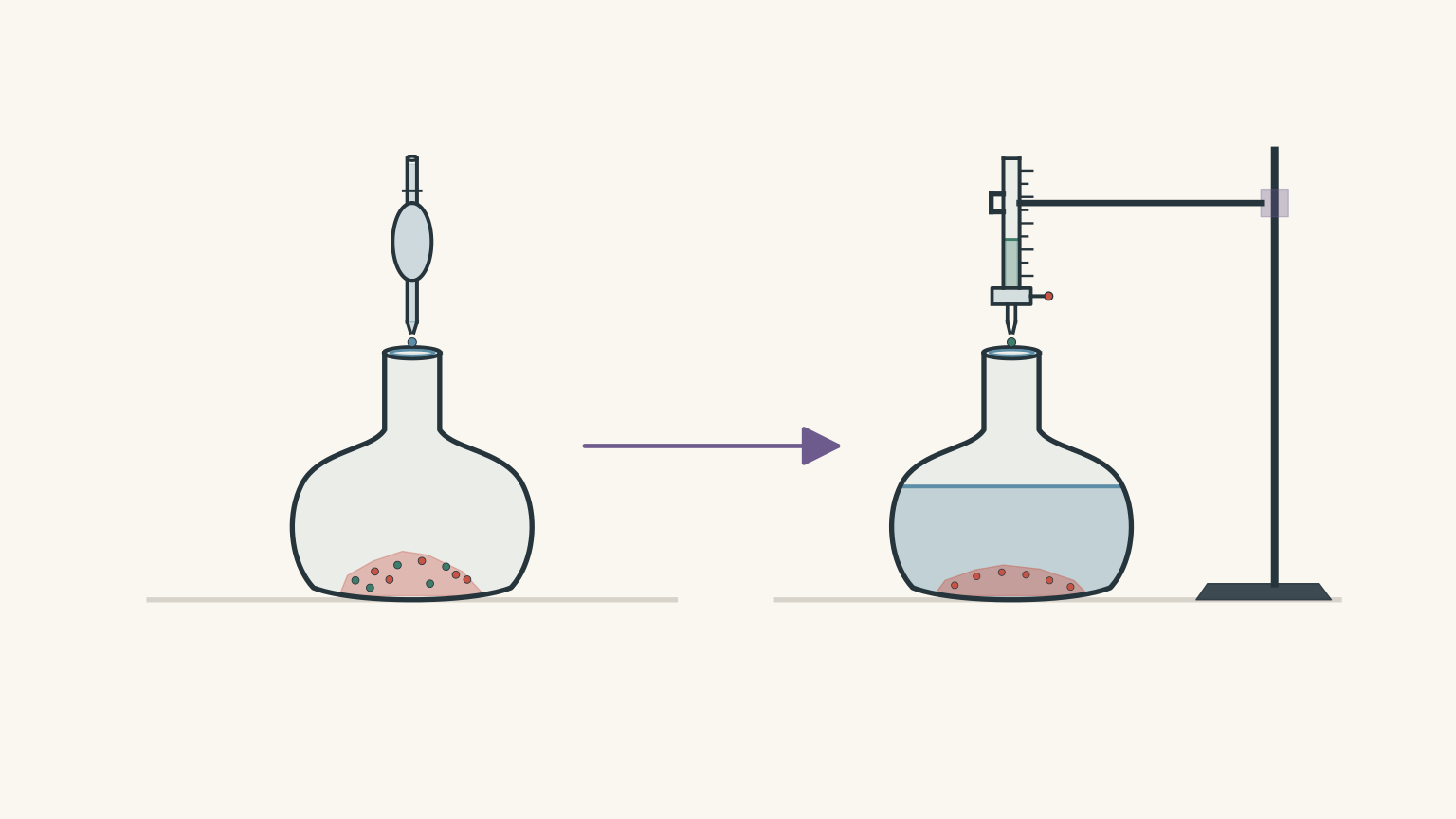
Due to technical limitations, this figure may display incorrectly or contain inaccuracies. Please check key details against your course materials.
04Contrasting case: The excess reagent is a base
Now reverse the chemistry.
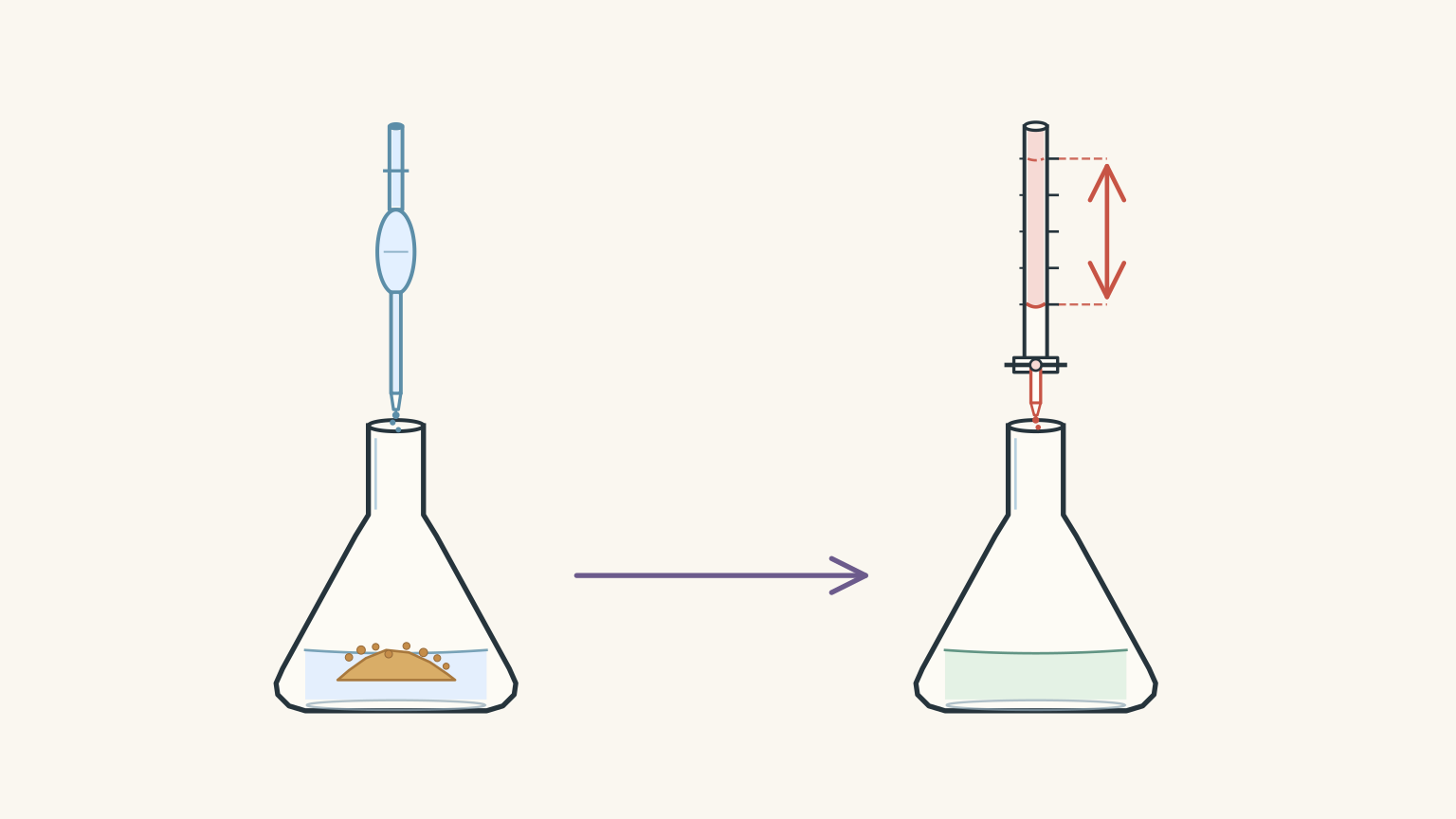
Suppose an acidic powder is analysed by adding a known surplus of NaOH. Afterwards, HCl is used to measure the unreacted NaOH.
Would the HCl become the excess reagent just because it was delivered from the burette?
No. The HCl is measuring the surplus base already present. It is not the reagent originally supplied in excess to the sample.
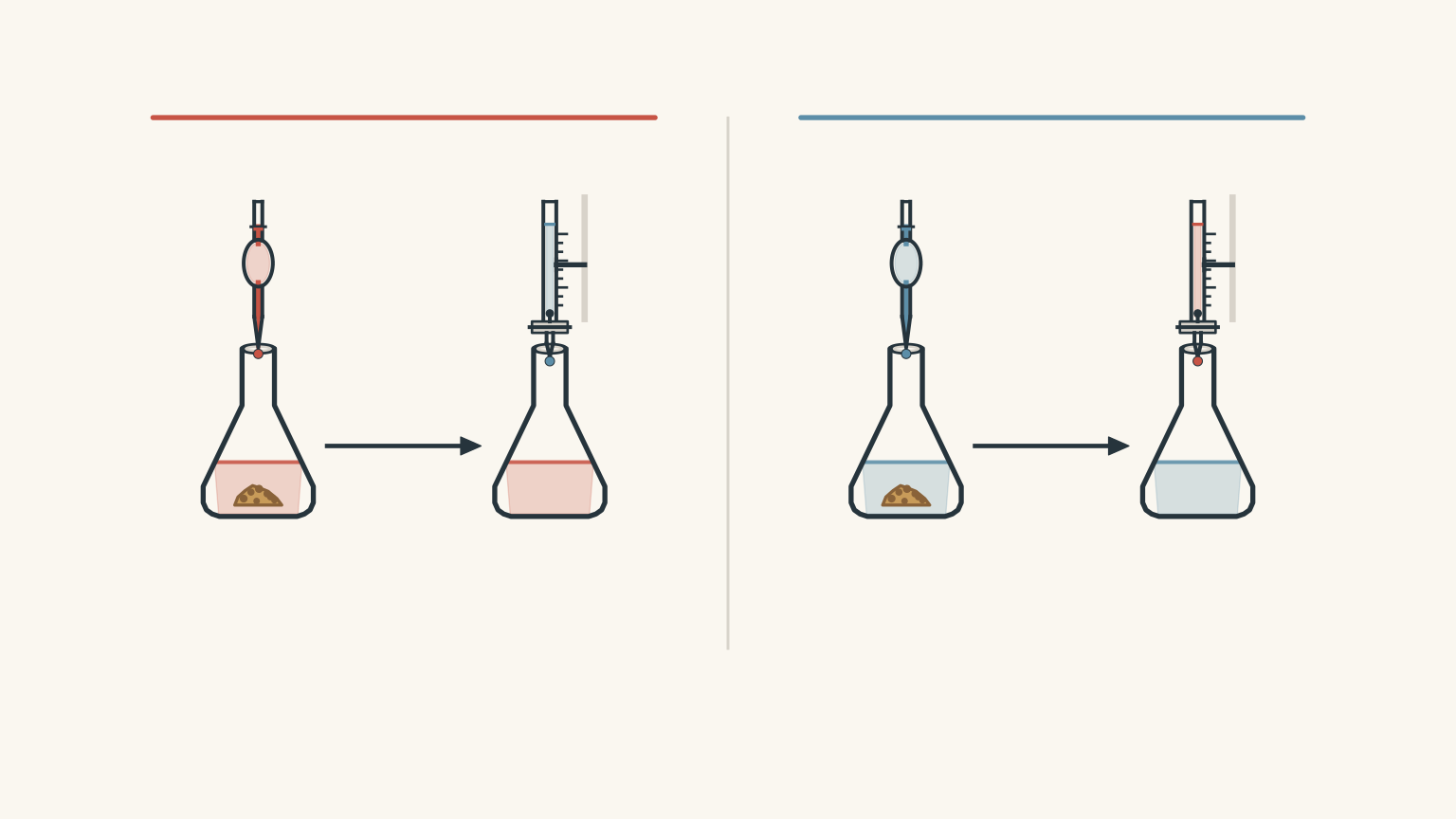
Due to technical limitations, this figure may display incorrectly or contain inaccuracies. Please check key details against your course materials.
Worked example: Is the larger-volume acid the excess reagent?
A 0.6000 g powdered mixture contains tartaric acid, \(\ce{C4H6O6}\), and inert material.
A chemist adds 25.00 mL of 0.4000 \(\mathrm{mol\,L^{-1}}\) NaOH to neutralise the acid completely.
The excess NaOH is then titrated using 40.00 mL of 0.1000 \(\mathrm{mol\,L^{-1}}\) HCl.
Identify the deliberately added excess reagent and calculate the mass percentage of tartaric acid.
Assume the entire reaction mixture is titrated, all tartaric acid reacts, and no other sample component consumes NaOH. Use \(M(\ce{C4H6O6})=150.09\ \mathrm{g\,mol^{-1}}\).
Step 1
NaOH was deliberately added to the powdered acid before the back titration.
HCl was used afterwards to determine how much NaOH remained.
Therefore, NaOH is the excess reagent and HCl is the titrant.
Step 2
\[ \begin{aligned} n_{\mathrm{added}} &=0.4000\times0.02500\\ &=0.01000\ \mathrm{mol} \end{aligned} \]
Step 3
\[ \ce{HCl + NaOH -> NaCl + H2O} \]
The mole ratio is 1:1.
\[ \begin{aligned} n(\ce{HCl}) &=0.1000\times0.04000\\ &=0.004000\ \mathrm{mol} \end{aligned} \]
Therefore:
\[ n_{\mathrm{left}}(\ce{NaOH}) =0.004000\ \mathrm{mol} \]
Step 4
\[ \begin{aligned} n_{\mathrm{consumed}} &=0.01000-0.004000\\ &=0.006000\ \mathrm{mol} \end{aligned} \]
Tartaric acid is diprotic, meaning each molecule can donate two acidic protons in this neutralisation.
\[ \ce{C4H6O6 + 2NaOH -> Na2C4H4O6 + 2H2O} \]
Two moles of NaOH neutralise one mole of tartaric acid.
\[ \begin{aligned} n(\ce{C4H6O6}) &=\frac{0.006000}{2}\\ &=0.003000\ \mathrm{mol} \end{aligned} \]
Step 5
\[ \begin{aligned} m(\ce{C4H6O6}) &=0.003000\times150.09\\ &=0.4503\ \mathrm{g} \end{aligned} \]
\[ \begin{aligned} \%\ \text{tartaric acid} &=\frac{0.4503}{0.6000}\times100\\ &=75.0\% \end{aligned} \]
The powder contains approximately 75.0% tartaric acid by mass.
The interesting result is that 40.00 mL of HCl was used during the titration, even though only 25.00 mL of NaOH was initially added.
That does not mean HCl was in excess during the original sample reaction. The two solutions had different concentrations, and they were used at different stages.
Due to technical limitations, this figure may display incorrectly or contain inaccuracies. Please check key details against your course materials.
05When the word ‘excess’ is misleading
An experimental instruction might say ‘add excess HCl’, but that describes the intended procedure. It isn’t proof that HCl actually remained.
There are three different situations worth separating.
| Experimental evidence | What you can conclude |
|---|---|
| HCl is deliberately added in a known surplus, and residual HCl is measured | HCl was intended to be, and actually remained, in excess |
| HCl is intended to be in excess, but no residual HCl is detected | Excess has not been demonstrated; the acid may have been exhausted |
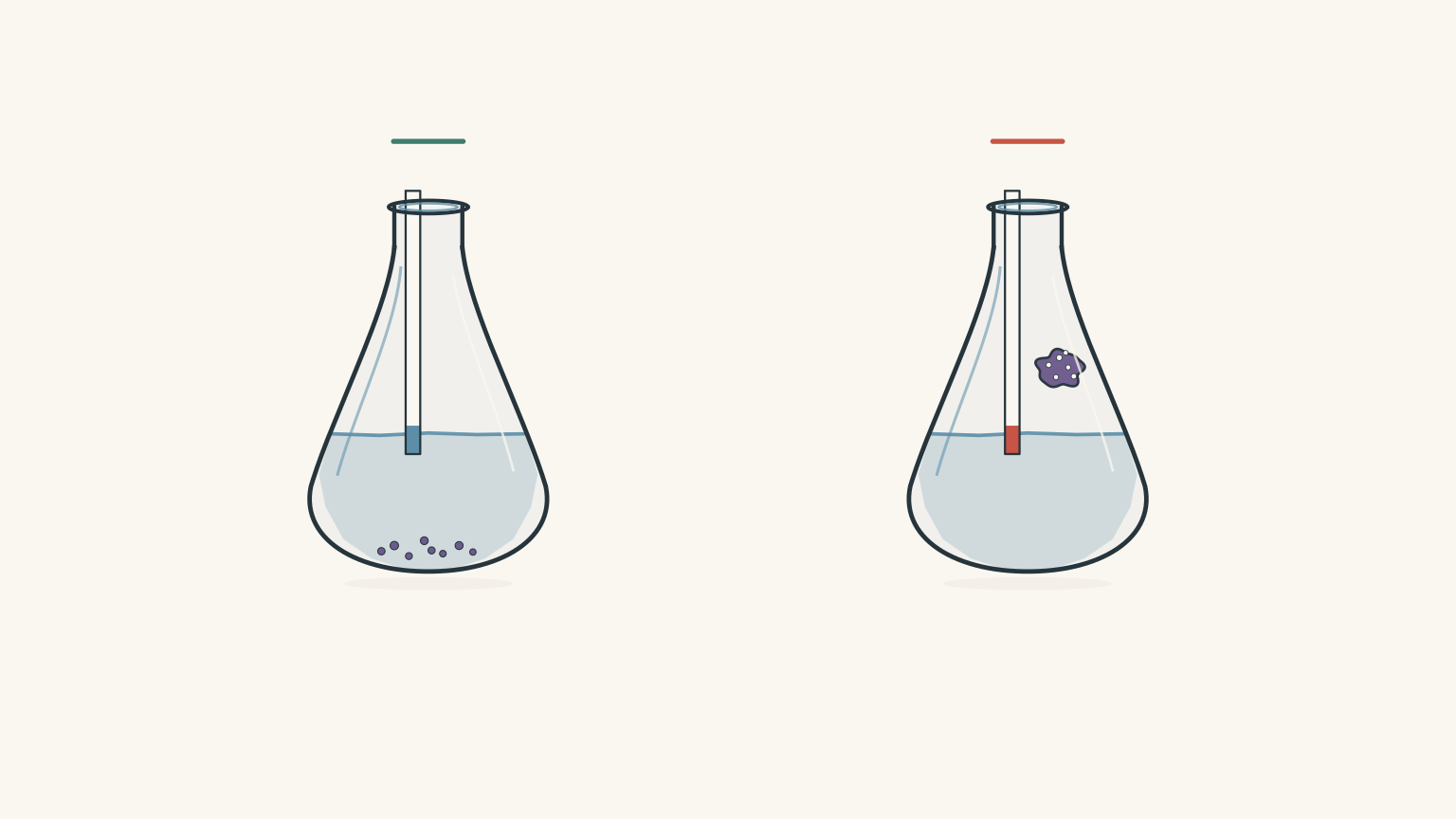
| HCl remains in solution, but reactive solid is still present | Acid remains in the liquid, but complete reaction has not been established |
The second situation is especially important. If the sample consumed all the HCl, the experiment may not provide enough information to determine the sample’s total capacity to react.
The third situation is more subtle. Two reactants can still be present without reacting completely if they cannot contact one another effectively or the reaction has not had enough time.
Due to technical limitations, this figure may display incorrectly or contain inaccuracies. Please check key details against your course materials.
This is where the ordinary limiting-reagent model needs an experimental qualification. Stoichiometry predicts what can react, assuming the reaction proceeds to completion. It does not guarantee that every reacting particle is accessible.
For the broader mole-ratio method, see Limiting Reagent Reactions: HSC Chemistry Explained.
There is one further limitation: the back-titration reagent must measure the species you think it measures. If another substance in the reaction mixture also consumes the titrant, a positive titre may not represent the amount of the original reagent remaining.
The practice questions now test these distinctions.
06Questions and solutions
The data in the following questions are illustrative. Unless stated otherwise, assume accurate measurements, complete mixing, and no reagent losses or side reactions.
Question 1
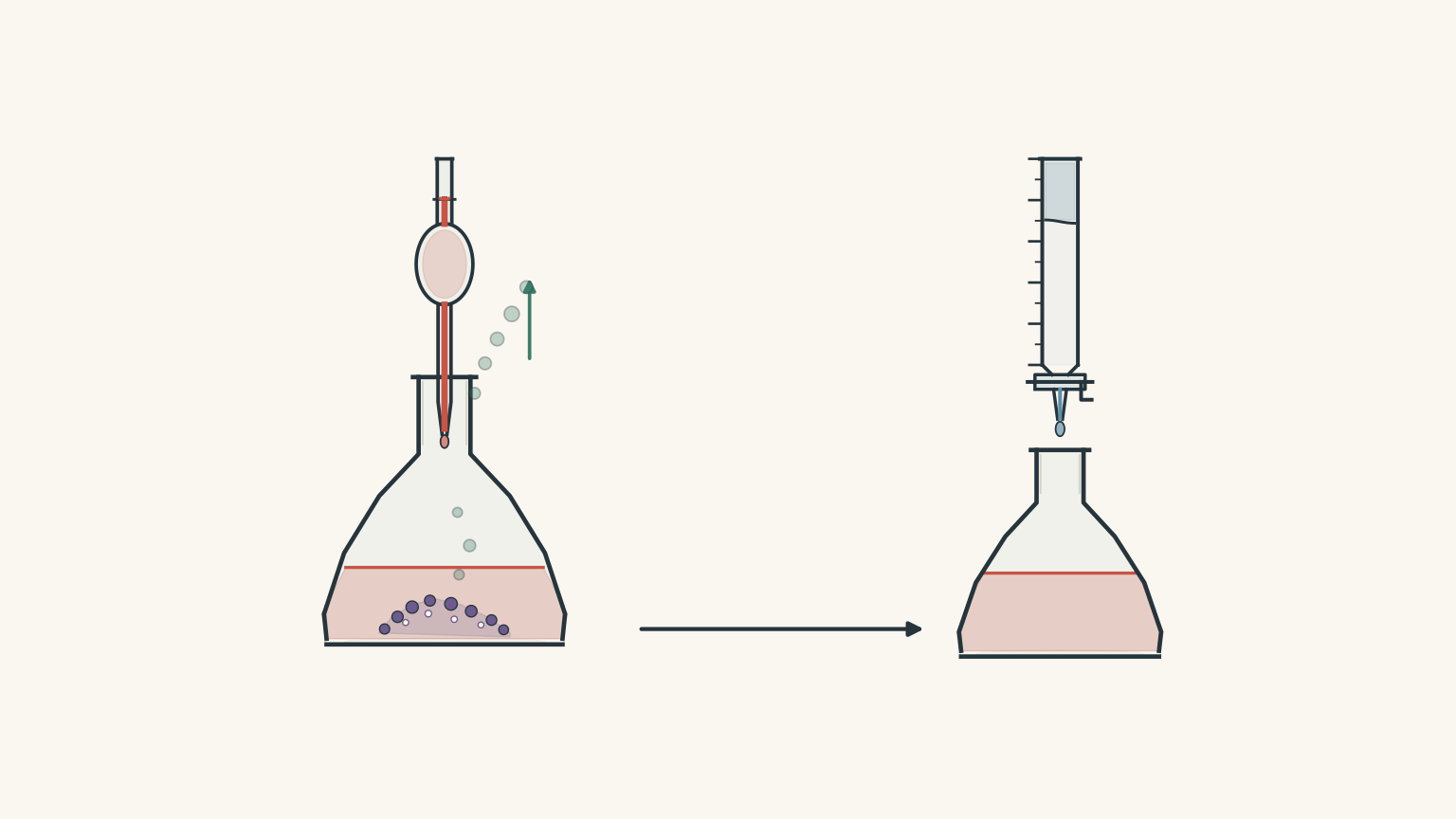
A powdered sample of sodium carbonate, \(\ce{Na2CO3}\), reacts with 50.00 mL of 0.1200 \(\mathrm{mol\,L^{-1}}\) HCl.
After the reaction is complete and all carbon dioxide has been removed, the remaining acid requires 20.00 mL of 0.1000 \(\mathrm{mol\,L^{-1}}\) NaOH for neutralisation.
The reaction is:
\[ \ce{Na2CO3 + 2HCl -> 2NaCl + CO2 + H2O} \]
Identify the reagent deliberately added in excess. Calculate the moles of HCl added, leftover, and consumed, and determine the amount of sodium carbonate in the sample.
Due to technical limitations, this figure may display incorrectly or contain inaccuracies. Please check key details against your course materials.
Solution 1
HCl was deliberately added in excess. Of the 0.006000 mol initially added, 0.002000 mol remained and 0.004000 mol was consumed, corresponding to 0.002000 mol of sodium carbonate.
First calculate the acid added:
\[ \begin{aligned} n_{\mathrm{added}} &=0.1200\times0.05000\\ &=0.006000\ \mathrm{mol} \end{aligned} \]
The final NaOH titre measures the HCl remaining. Because HCl and NaOH react 1:1:
\[ \begin{aligned} n_{\mathrm{left}} &=0.1000\times0.02000\\ &=0.002000\ \mathrm{mol} \end{aligned} \]
Subtract to find the acid consumed:
\[ \begin{aligned} n_{\mathrm{consumed}} &=0.006000-0.002000\\ &=0.004000\ \mathrm{mol} \end{aligned} \]
The carbonate reaction requires 2 mol of HCl per mole of sodium carbonate.
\[ \begin{aligned} n(\ce{Na2CO3}) &=\frac{0.004000}{2}\\ &=0.002000\ \mathrm{mol} \end{aligned} \]
The tempting mistake is to treat the 0.002000 mol measured by the NaOH titre as the acid consumed by the sample. It is actually the unused acid. Removing the carbon dioxide also matters because dissolved carbon dioxide can interfere with a subsequent NaOH titration.
Question 2
A freshly prepared 0.5000 g alkaline powder contains only sodium hydroxide and calcium hydroxide.
The entire sample reacts completely with 25.00 mL of 0.6000 \(\mathrm{mol\,L^{-1}}\) HCl.
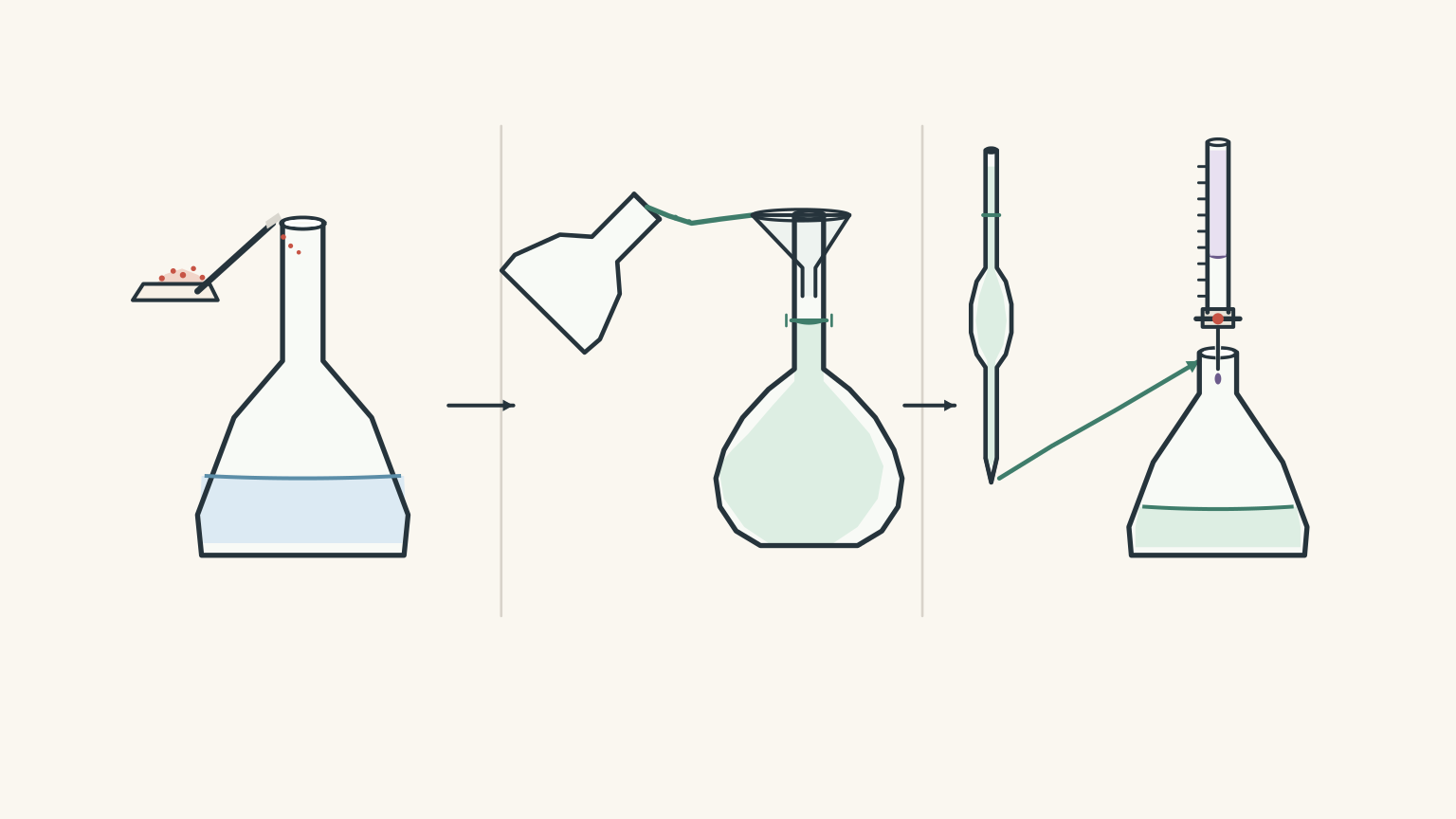
The reaction solution is diluted to exactly 100.0 mL. A 25.00 mL aliquot is taken and titrated with 5.00 mL of 0.1000 \(\mathrm{mol\,L^{-1}}\) NaOH.
Assume both original hydroxides react fully with the HCl, neither is lost, and the sample has not absorbed atmospheric carbon dioxide.
Use:
- \(M(\ce{NaOH})=40.00\ \mathrm{g\,mol^{-1}}\)
- \(M(\ce{Ca(OH)2})=74.09\ \mathrm{g\,mol^{-1}}\)
Identify the deliberately added excess reagent and calculate the mass of each hydroxide in the original powder. Explain why the HCl consumed cannot simply be attributed to one component.
Due to technical limitations, this figure may display incorrectly or contain inaccuracies. Please check key details against your course materials.
Solution 2
HCl was deliberately added in excess, while NaOH was the back-titrant. The original sample contained approximately 0.251 g calcium hydroxide and 0.249 g sodium hydroxide.
Both hydroxides consume HCl, so we must use both reaction ratios and the total sample mass.
First, calculate the HCl added:
\[ \begin{aligned} n_{\mathrm{added}} &=0.6000\times0.02500\\ &=0.01500\ \mathrm{mol} \end{aligned} \]
The 25.00 mL aliquot contains leftover HCl equivalent to:
\[ \begin{aligned} n_{\mathrm{aliquot}} &=0.1000\times0.00500\\ &=0.000500\ \mathrm{mol} \end{aligned} \]
The aliquot is one-quarter of the 100.0 mL solution. Therefore, the amount of HCl remaining in the complete mixture is:
\[ \begin{aligned} n_{\mathrm{left}} &=0.000500\times4\\ &=0.00200\ \mathrm{mol} \end{aligned} \]
The HCl consumed by the powder is:
\[ \begin{aligned} n_{\mathrm{consumed}} &=0.01500-0.00200\\ &=0.01300\ \mathrm{mol} \end{aligned} \]
Now consider the two reactions:
\[ \ce{NaOH + HCl -> NaCl + H2O} \]
\[ \ce{Ca(OH)2 + 2HCl -> CaCl2 + 2H2O} \]
NaOH consumes HCl in a 1:1 mole ratio. Calcium hydroxide consumes HCl in a 1:2 ratio.
Let \(x\) be the mass of calcium hydroxide in grams.
The mass of NaOH is then \(0.5000-x\) grams.
Their amounts, in moles, are:
\[ \begin{aligned} n(\ce{Ca(OH)2})&=\frac{x}{74.09}\\ n(\ce{NaOH})&=\frac{0.5000-x}{40.00} \end{aligned} \]
The sum of their HCl consumption must equal 0.01300 mol:
\[ \begin{aligned} 0.01300 &=\frac{2x}{74.09}\\ &\quad+\frac{0.5000-x}{40.00} \end{aligned} \]
Solving:
\[ x=0.2507\ \mathrm{g} \]
Therefore:
\[ \begin{aligned} m(\ce{Ca(OH)2})&=0.2507\ \mathrm{g}\\ m(\ce{NaOH})&=0.2493\ \mathrm{g} \end{aligned} \]
These correspond to approximately 50.1% calcium hydroxide and 49.9% sodium hydroxide by mass.
The tempting shortcut is to divide all the consumed HCl by the coefficient of one hydroxide. That would pretend the other hydroxide consumed none.
The mass constraint is what makes the composition determinable. We know both substances consume acid, their mole ratios differ, and their masses add to exactly 0.5000 g. Without that additional information, a single titre would not uniquely identify the two amounts.
Question 3
A 0.6000 g powdered rock sample contains calcium carbonate and inert mineral material.
A student adds 0.01000 mol of HCl, intending it to be in excess.
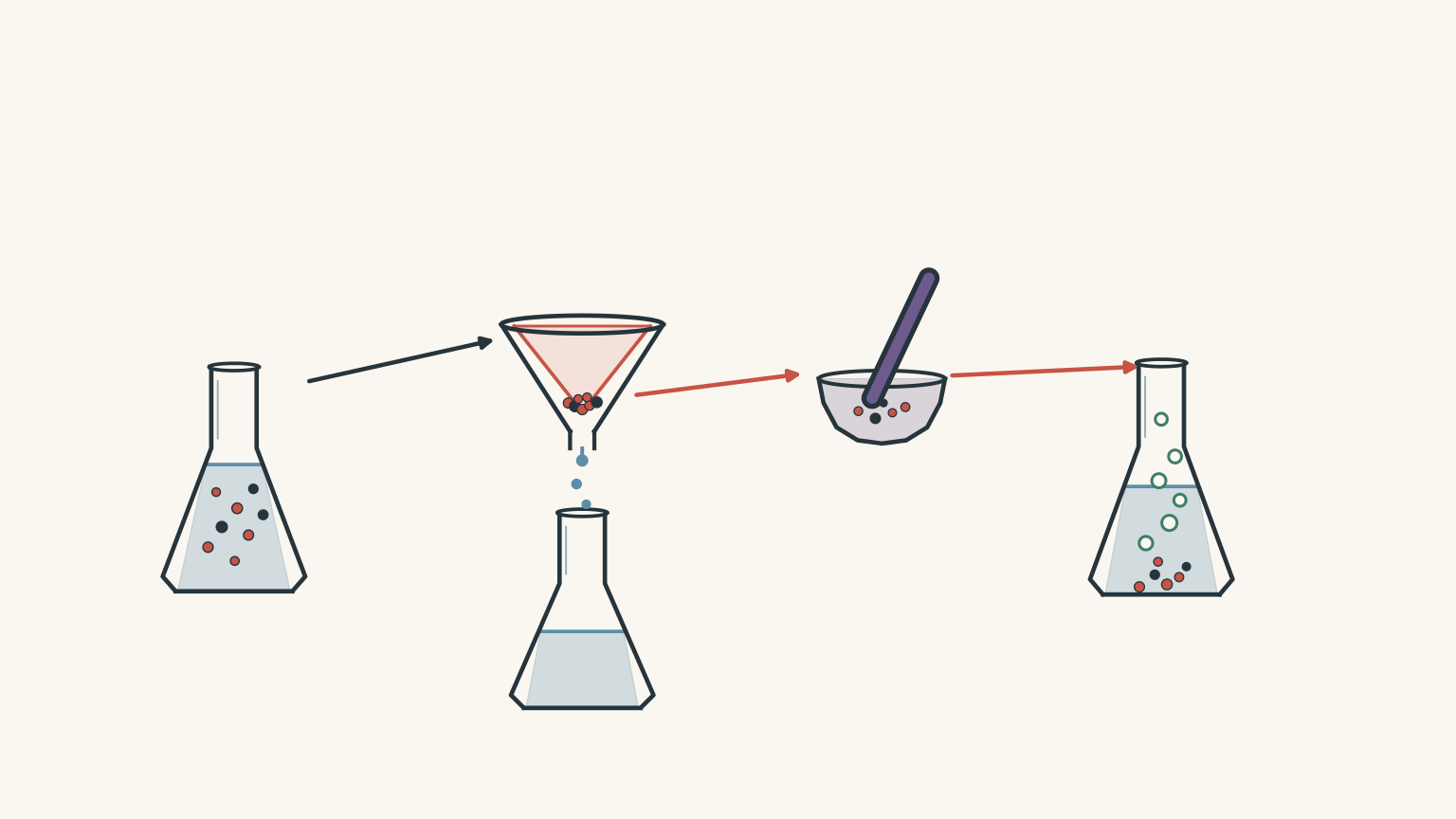
After a short reaction time, the mixture is filtered. The filtrate is treated to remove dissolved carbon dioxide, and a back titration determines that 0.00400 mol of HCl remains.
The student concludes that the carbonate has reacted completely because acid is still present.
However, the collected solid residue is subsequently crushed and treated with fresh excess acid. It releases a further 0.00100 mol of carbon dioxide.
Assume all carbon dioxide measured in the second treatment comes from previously unreacted calcium carbonate, all reactive carbonate is consumed during that second treatment, and only calcium carbonate reacts with the original HCl.
Use:
\[ \ce{CaCO3 + 2HCl -> CaCl2 + CO2 + H2O} \]
and \(M(\ce{CaCO3})=100.09\ \mathrm{g\,mol^{-1}}\).
Calculate the true percentage of calcium carbonate in the original sample. Was the original HCl stoichiometrically in excess of the total carbonate? Explain how acid and unreacted carbonate could both have been present after the first treatment.
Due to technical limitations, this figure may display incorrectly or contain inaccuracies. Please check key details against your course materials.
Solution 3
The original sample contained approximately 66.7% calcium carbonate by mass. HCl was genuinely in stoichiometric excess, but the first reaction was incomplete because not all the carbonate had reacted before filtration.
Start with the acid consumed in the first treatment:
\[ \begin{aligned} n(\ce{HCl\ consumed}) &=0.01000-0.00400\\ &=0.00600\ \mathrm{mol} \end{aligned} \]
From the 2:1 acid-to-carbonate ratio:
\[ \begin{aligned} n(\ce{CaCO3\ reacted}) &=\frac{0.00600}{2}\\ &=0.00300\ \mathrm{mol} \end{aligned} \]
The additional carbon dioxide released from the residue identifies another 0.00100 mol of carbonate, because each mole of calcium carbonate produces one mole of carbon dioxide.
Therefore:
\[ \begin{aligned} n(\ce{CaCO3\ total}) &=0.00300+0.00100\\ &=0.00400\ \mathrm{mol} \end{aligned} \]
Convert this to mass:
\[ \begin{aligned} m(\ce{CaCO3}) &=0.00400\times100.09\\ &=0.4004\ \mathrm{g} \end{aligned} \]
The percentage by mass is:
\[ \begin{aligned} \%\ \ce{CaCO3} &=\frac{0.4004}{0.6000}\times100\\ &=66.7\% \end{aligned} \]
Now test whether the original HCl was actually in excess.
Complete reaction of all 0.00400 mol of carbonate would require:
\[ \begin{aligned} n(\ce{HCl\ required}) &=2\times0.00400\\ &=0.00800\ \mathrm{mol} \end{aligned} \]
The student originally added 0.01000 mol of HCl. Therefore, the initial HCl quantity was greater than the total stoichiometric requirement.
There was enough acid to react with all the carbonate.
So why did some carbonate remain?
The first reaction was stopped before every reactive particle had finished reacting. Coarse particles, incomplete mixing, or material trapped inside compact grains could prevent acid from reaching some carbonate in the available time.
The tempting conclusion was that residual HCl guaranteed completion. It did not.
The experimental evidence establishes that acid remained in the filtrate, while the second treatment establishes that reactive carbonate remained in the separated solid.
Stoichiometric excess answers whether enough acid was supplied. It cannot, by itself, establish that the reaction reached completion.
Question 4
A technician intends to use excess hydrochloric acid to analyse magnesium hydroxide in a powder.
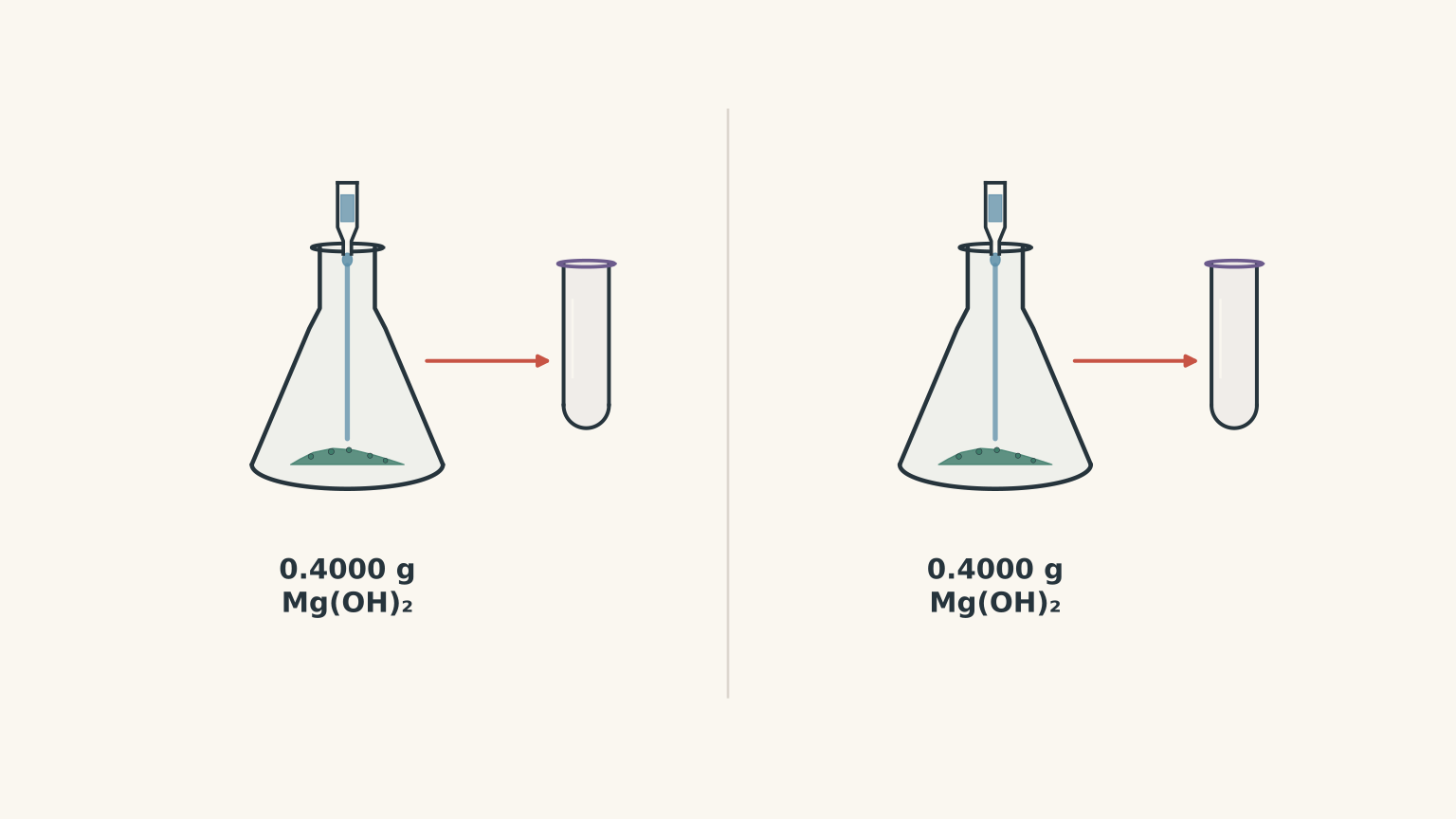
Two 0.4000 g portions are taken from a uniformly mixed sample containing only \(\ce{Mg(OH)2}\) and inert material.
The technician performs the following trials:
| Trial | HCl initially added | HCl remaining after reaction |
|---|---|---|
| A | 0.00600 mol | None detected |
| B | 0.01200 mol | 0.00300 mol |
In both trials, the powder is thoroughly mixed, and the reaction proceeds as far as the supplied acid allows. Assume identical composition in both portions, no side reactions, and ideal measurements.
The reaction is:
\[ \ce{Mg(OH)2 + 2HCl -> MgCl2 + 2H2O} \]
Use \(M(\ce{Mg(OH)2})=58.32\ \mathrm{g\,mol^{-1}}\).
Determine which trial actually contained HCl in excess. Calculate the mass of magnesium hydroxide in each original portion and the mass of magnesium hydroxide left unreacted in Trial A.
Explain why the laboratory instruction ‘add excess HCl’ does not establish that both trials were valid back titrations.
Due to technical limitations, this figure may display incorrectly or contain inaccuracies. Please check key details against your course materials.
Solution 4
Only Trial B actually had HCl in excess. Each original portion contained 0.262 g of magnesium hydroxide, and Trial A left approximately 0.0875 g of magnesium hydroxide unreacted.
Use Trial B first because its positive residual-acid measurement and the stated completion assumptions establish how much magnesium hydroxide the sample contains.
The HCl consumed in Trial B was:
\[ \begin{aligned} n(\ce{HCl\ consumed}) &=0.01200-0.00300\\ &=0.00900\ \mathrm{mol} \end{aligned} \]
The reaction requires 2 mol HCl per mole of magnesium hydroxide.
\[ \begin{aligned} n(\ce{Mg(OH)2}) &=\frac{0.00900}{2}\\ &=0.00450\ \mathrm{mol} \end{aligned} \]
The mass is:
\[ \begin{aligned} m(\ce{Mg(OH)2}) &=0.00450\times58.32\\ &=0.2624\ \mathrm{g} \end{aligned} \]
Because the portions have the same mass and composition, Trial A also originally contained 0.00450 mol of magnesium hydroxide.
That amount would require:
\[ \begin{aligned} n(\ce{HCl\ required}) &=2\times0.00450\\ &=0.00900\ \mathrm{mol} \end{aligned} \]
But Trial A received only 0.00600 mol.
Therefore, HCl was limiting in Trial A.
With complete consumption of its available acid, the amount of magnesium hydroxide that reacted was:
\[ \begin{aligned} n(\ce{Mg(OH)2\ reacted}) &=\frac{0.00600}{2}\\ &=0.00300\ \mathrm{mol} \end{aligned} \]
The unreacted magnesium hydroxide was:
\[ \begin{aligned} n_{\mathrm{unreacted}} &=0.00450-0.00300\\ &=0.00150\ \mathrm{mol} \end{aligned} \]
Convert to mass:
\[ \begin{aligned} m_{\mathrm{unreacted}} &=0.00150\times58.32\\ &=0.08748\ \mathrm{g} \end{aligned} \]
So approximately 0.0875 g of magnesium hydroxide remained unreacted in Trial A.
The tempting route is to assume that because the technician intended both acid additions to be excessive, the sample must have reacted completely in both trials.
Trial B disproves that assumption.
It reveals a total acid requirement of 0.00900 mol per portion, greater than the 0.00600 mol supplied in Trial A.
A zero residual-acid measurement cannot distinguish an exactly stoichiometric reaction from one in which acid ran out before the sample finished reacting. The comparison with Trial B resolves the ambiguity.
This also explains why a result calculated from Trial A alone would underestimate the magnesium hydroxide content.
Question 5
Extension challenge – when the back titration hides the original reaction
A student analyses an unknown mass of pure sodium hydrogencarbonate, \(\ce{NaHCO3}\), using excess HCl.
The reaction is:
\[ \ce{NaHCO3 + HCl -> NaCl + CO2 + H2O} \]
The student initially adds 40.00 mL of 0.2000 \(\mathrm{mol\,L^{-1}}\) HCl.
Two identical samples are prepared for separate back titrations using 0.2000 \(\mathrm{mol\,L^{-1}}\) NaOH.
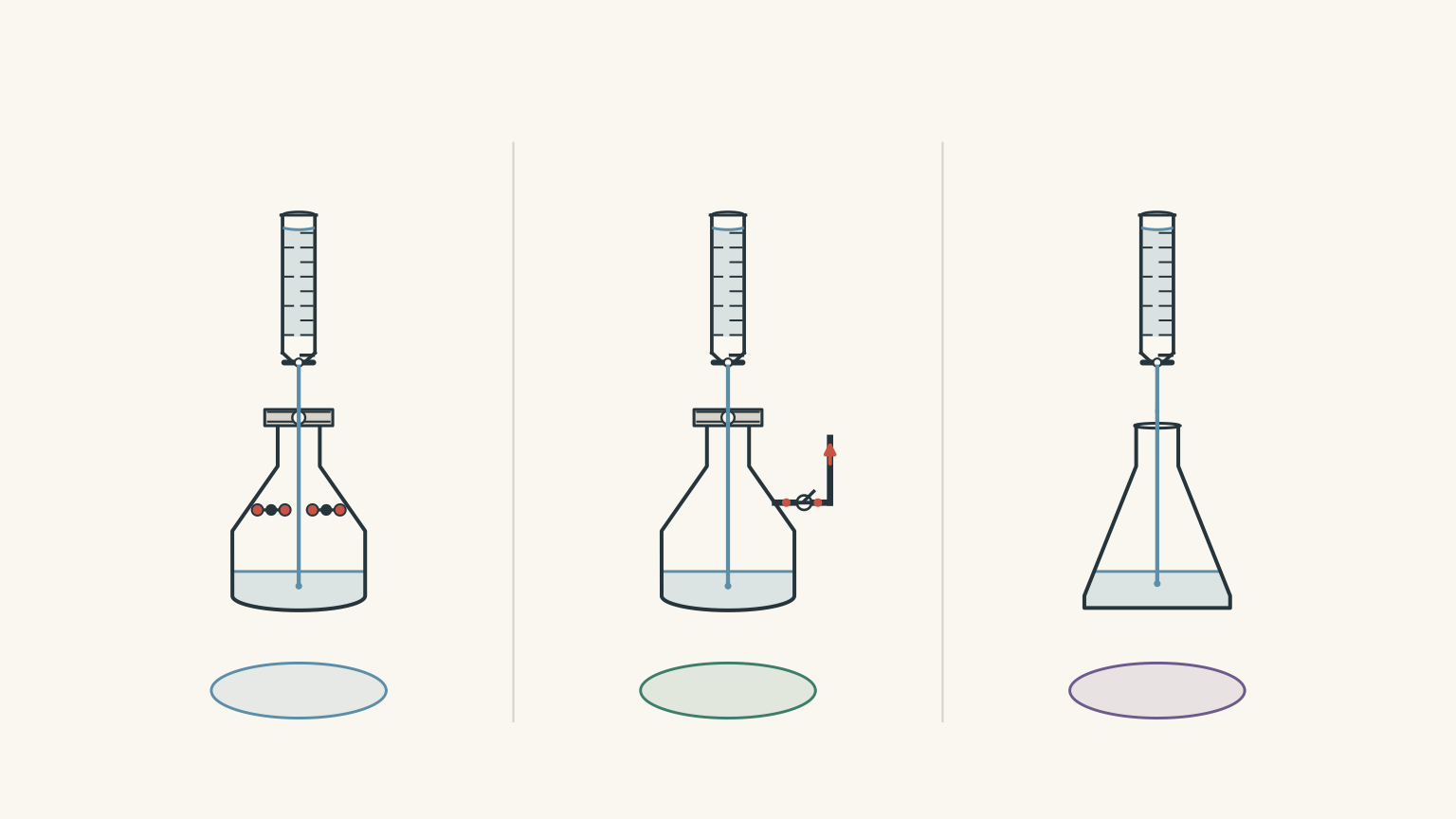
Run W: Carbon dioxide retained
The reaction and titration take place under idealised gas-tight conditions. No carbon dioxide escapes.
At the chosen endpoint, assume that each mole of carbon dioxide produced has consumed exactly one mole of NaOH according to:
\[ \ce{CO2 + NaOH -> NaHCO3} \]
NaOH can therefore react with both leftover HCl and carbon dioxide.
The observed NaOH titre is 40.00 mL.
Run D: Carbon dioxide removed
An identical sample receives the same original amount of HCl, but all carbon dioxide is removed before the back titration. Assume this removes no HCl.
Only leftover HCl consumes NaOH.
The observed NaOH titre is 36.00 mL.
A blank containing the same initial HCl but no sodium hydrogencarbonate requires 40.00 mL of NaOH.
Due to technical limitations, this figure may display incorrectly or contain inaccuracies. Please check key details against your course materials.
Answer the following.
(a) Explain why Run W gives exactly the same NaOH titre as the blank, even though sodium hydrogencarbonate consumed some of the HCl.
(b) Calculate the original mass of sodium hydrogencarbonate. Use \(M(\ce{NaHCO3})=84.01\ \mathrm{g\,mol^{-1}}\).
(c) Determine whether HCl was actually in excess. Explain why the titre in Run W alone cannot establish this.
(d) Predict what would happen to each NaOH titre if the sodium hydrogencarbonate mass were doubled, provided the sample still reacted completely and all the stated assumptions held.
Solution 5
The sample contained 0.0672 g of sodium hydrogencarbonate, and 0.00720 mol of HCl remained after the reaction. HCl was genuinely in excess.
The surprising result is that the titre in Run W does not depend on the amount of sodium hydrogencarbonate, within the stated model. The carbon dioxide produced consumes NaOH in a way that exactly compensates for the HCl consumed by the sample.
Part (a): Explain the matching blank titre.
First calculate the initial HCl:
\[ \begin{aligned} n_{\mathrm{added}} &=0.2000\times0.04000\\ &=0.008000\ \mathrm{mol} \end{aligned} \]
Let \(x\) represent the moles of sodium hydrogencarbonate that reacted.
The reaction has a 1:1 ratio between \(\ce{NaHCO3}\), HCl, and carbon dioxide.
Therefore:
\[ \begin{aligned} n(\ce{HCl\ left})&=0.008000-x\\ n(\ce{CO2})&=x \end{aligned} \]
Now consider Run W.
NaOH neutralises the leftover HCl:
\[ \ce{HCl + NaOH -> NaCl + H2O} \]
But NaOH also reacts with the retained carbon dioxide:
\[ \ce{CO2 + NaOH -> NaHCO3} \]
Under the specified endpoint assumptions, the total NaOH requirement is:
\[ \begin{aligned} n(\ce{NaOH}) &=(0.008000-x)+x\\ &=0.008000\ \mathrm{mol} \end{aligned} \]
The \(x\) terms cancel.
That is the crucial interaction.
Every mole of hydrogencarbonate that reacts consumes one mole of HCl, reducing the amount of HCl left for the back titration by one mole.
But it also produces one mole of carbon dioxide, which consumes one mole of NaOH during the back titration.
So the total NaOH requirement stays unchanged.
The predicted titre is:
\[ \begin{aligned} V(\ce{NaOH}) &=\frac{0.008000}{0.2000}\\ &=0.04000\ \mathrm{L}\\ &=40.00\ \mathrm{mL} \end{aligned} \]
That is identical to the blank.
The blank contains no carbonate reaction products, so all its NaOH neutralises HCl. Run W contains less HCl, but its retained carbon dioxide makes up the difference.
Part (b): Calculate the original sample mass.
Run D removes the carbon dioxide before titration.
Therefore, NaOH now measures only leftover HCl.
\[ \begin{aligned} n(\ce{HCl\ left}) &=0.2000\times0.03600\\ &=0.007200\ \mathrm{mol} \end{aligned} \]
The HCl consumed by the sample is:
\[ \begin{aligned} n(\ce{HCl\ consumed}) &=0.008000-0.007200\\ &=0.000800\ \mathrm{mol} \end{aligned} \]
One mole of sodium hydrogencarbonate consumes one mole of HCl.
Therefore:
\[ n(\ce{NaHCO3})=0.000800\ \mathrm{mol} \]
Convert to mass:
\[ \begin{aligned} m(\ce{NaHCO3}) &=0.000800\times84.01\\ &=0.0672\ \mathrm{g} \end{aligned} \]
The original sample contained approximately 0.0672 g of sodium hydrogencarbonate.
Part (c): Determine whether HCl was in excess.
Yes. Run D establishes that 0.007200 mol of HCl remained after the sample reaction.
That is a positive leftover amount, so HCl was genuinely in excess under the stated assumptions.
However, Run W alone could not establish this.
Its titre is affected by both residual HCl and carbon dioxide. Since their contributions cancel the change caused by the sample reaction, the same NaOH titre could arise from different amounts of sodium hydrogencarbonate.
The tempting conclusion is that a 40.00 mL NaOH titre must represent 0.008000 mol of leftover HCl.
That would be true for the blank, but not for Run W.
The exact failure is assuming the titrant reacts with only one substance when it actually reacts with two.
Part (d): Double the sample mass.
Doubling the mass doubles the amount of sodium hydrogencarbonate:
\[ \begin{aligned} n(\ce{NaHCO3}) &=2\times0.000800\\ &=0.001600\ \mathrm{mol} \end{aligned} \]
This consumes 0.001600 mol of HCl and produces 0.001600 mol of carbon dioxide.
In Run W, the NaOH requirement becomes:
\[ \begin{aligned} n(\ce{NaOH}) &=(0.008000-0.001600)\\ &\quad+0.001600\\ &=0.008000\ \mathrm{mol} \end{aligned} \]
The predicted titre is still 40.00 mL.
In Run D, the carbon dioxide has been removed, so the residual HCl is:
\[ \begin{aligned} n(\ce{HCl\ left}) &=0.008000-0.001600\\ &=0.006400\ \mathrm{mol} \end{aligned} \]
The new titre is:
\[ \begin{aligned} V(\ce{NaOH}) &=\frac{0.006400}{0.2000}\\ &=0.03200\ \mathrm{L}\\ &=32.00\ \mathrm{mL} \end{aligned} \]
Doubling the sample mass produces:
| Measurement | Original sample | Doubled sample |
|---|---|---|
| Run W, CO2 retained | 40.00 mL | 40.00 mL |
| Run D, CO2 removed | 36.00 mL | 32.00 mL |
The two methods respond differently even though the original chemical reaction is the same.
This is an idealised extension designed to expose the measurement problem. Ordinary open-flask titrations do not necessarily retain a fixed amount of carbon dioxide, so real carbonate back titrations require appropriate control of dissolved carbon dioxide and the endpoint.
The deeper lesson is that identifying a reagent as deliberately added in excess is only the first part of a valid calculation. You also need to establish that the final titration actually isolates the leftover amount of that reagent.
07What to check before using an excess-reagent result
When you’re reading an experimental method, identify the reagent deliberately supplied to the sample, find how much of that same reagent remains, and subtract to determine what was consumed.
But before converting that consumption into a sample mass, ask whether the result is chemically possible.
A calculated sample component cannot have a mass greater than the entire sample under a simple composition model. A negative leftover amount is not physical evidence of negative reagent. And a positive titre is not necessarily a selective measurement of the species you intended to measure.
These checks help you distinguish a valid back titration from an experiment that needs a revised method.
The next useful skill is applying independent mass and reaction constraints to test the result, rather than accepting the subtraction simply because the arithmetic works. See How to Check a Back-Titration Answer Against Sample Mass.