
How to Calculate a Serial-Dilution Factor in HSC Chemistry
Learn how to calculate individual and overall serial-dilution factors using worked examples. Understand when to multiply dilution factors, how to handle mixed solutions, and why chemical reactions require a different approach.
Take 10.0 mL of a stock solution and dilute it to 100.0 mL. Then take 5.00 mL of that diluted solution and dilute it to 25.0 mL. Is the final solution 15 times or 50 times less concentrated than the original?
It is 50 times less concentrated. The first dilution has a factor of 10, and the second has a factor of 5. Multiply them to find the overall dilution factor:
\[ DF_{\mathrm{overall}}=10\times5=50 \]
The rule is simple: multiply the individual dilution factors to calculate the overall factor in a serial dilution.
However, this rule has an important condition. Each step must be a genuine dilution of a single, well-mixed solution, with no chemical reaction or loss of the solute being tracked. Mixing two solutions containing solute requires a different calculation.
01Calculate the dilution factor for one step
A dilution factor tells you how many times the concentration has decreased.
For a single dilution:
\[ \boxed{DF=\frac{V_{\mathrm{final}}}{V_{\mathrm{aliquot}}}} \]
Where:
- \(DF\) is the dilution factor (no units).
- \(V_{\mathrm{final}}\) is the total volume of the diluted solution.
- \(V_{\mathrm{aliquot}}\) is the volume of the original solution transferred.
An aliquot is a measured portion of a solution taken for further use.
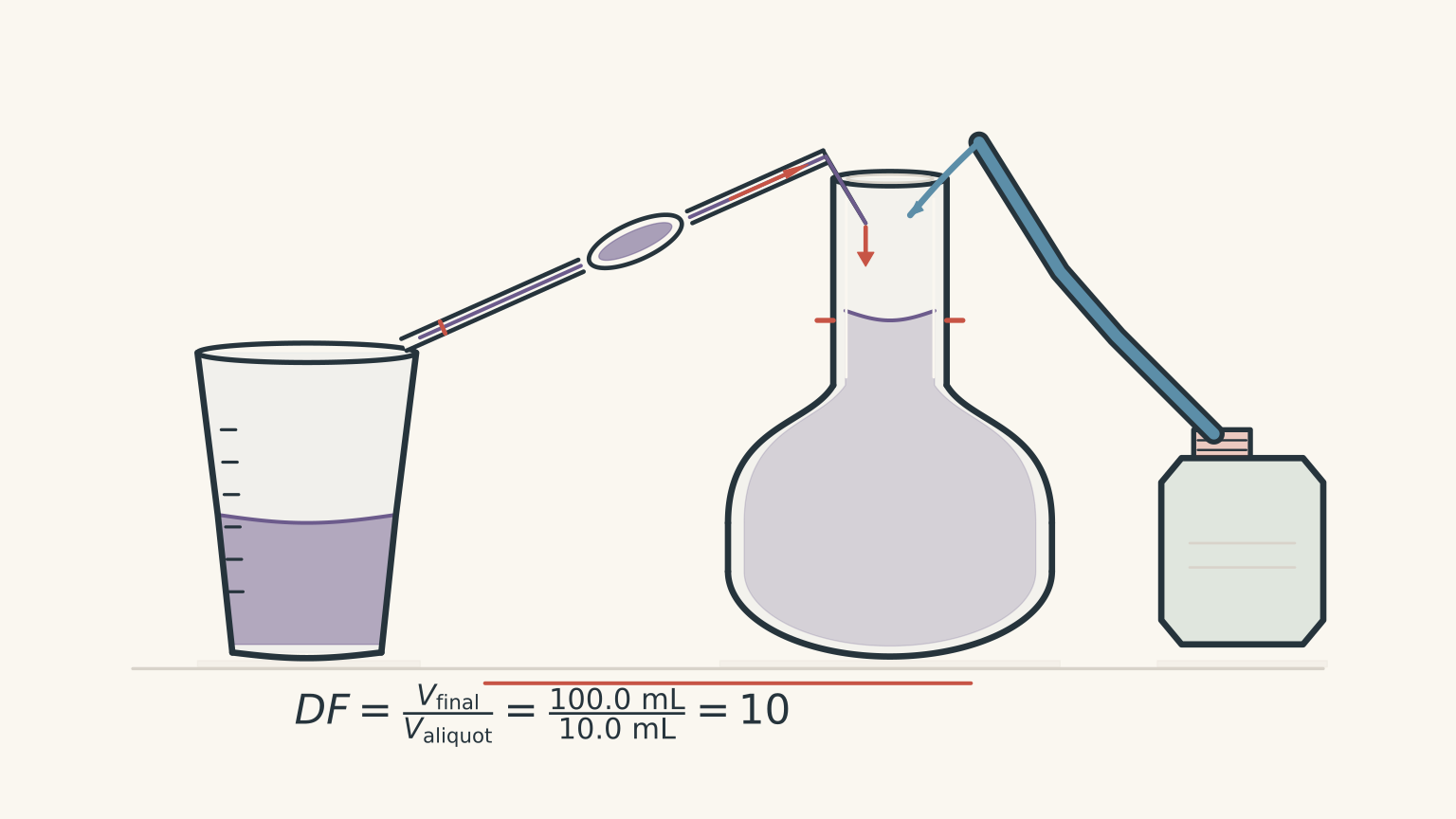
For example, suppose you transfer 10.0 mL of a stock solution into a volumetric flask and add water until the total volume reaches 100.0 mL.
The dilution factor is:
\[ DF=\frac{100.0}{10.0}=10 \]
This is a ten-fold dilution. The final concentration is one-tenth of the original concentration.
Due to technical limitations, this figure may display incorrectly or contain inaccuracies. Please check key details against your course materials.
A few details matter:
- Use the final solution volume, not the volume of water added.
- The aliquot is the volume actually transferred, not the total volume in the original stock bottle.
- Both volumes must use the same units. Millilitres can be used for both, because the units cancel.
- A dilution factor is greater than 1 for an ordinary dilution.
What does a 1:10 dilution mean?
You may also see dilution instructions written as ratios.
A 1:10 dilution means one part of the original solution made up to ten parts of total solution.
For example:
- 1.0 mL of stock solution.
- Water added until the total volume is 10.0 mL.
- Dilution factor = 10.
Be careful with the wording. One part stock solution mixed with ten parts water gives eleven parts in total, so that would be an eleven-fold dilution.
02Calculate the overall serial-dilution factor
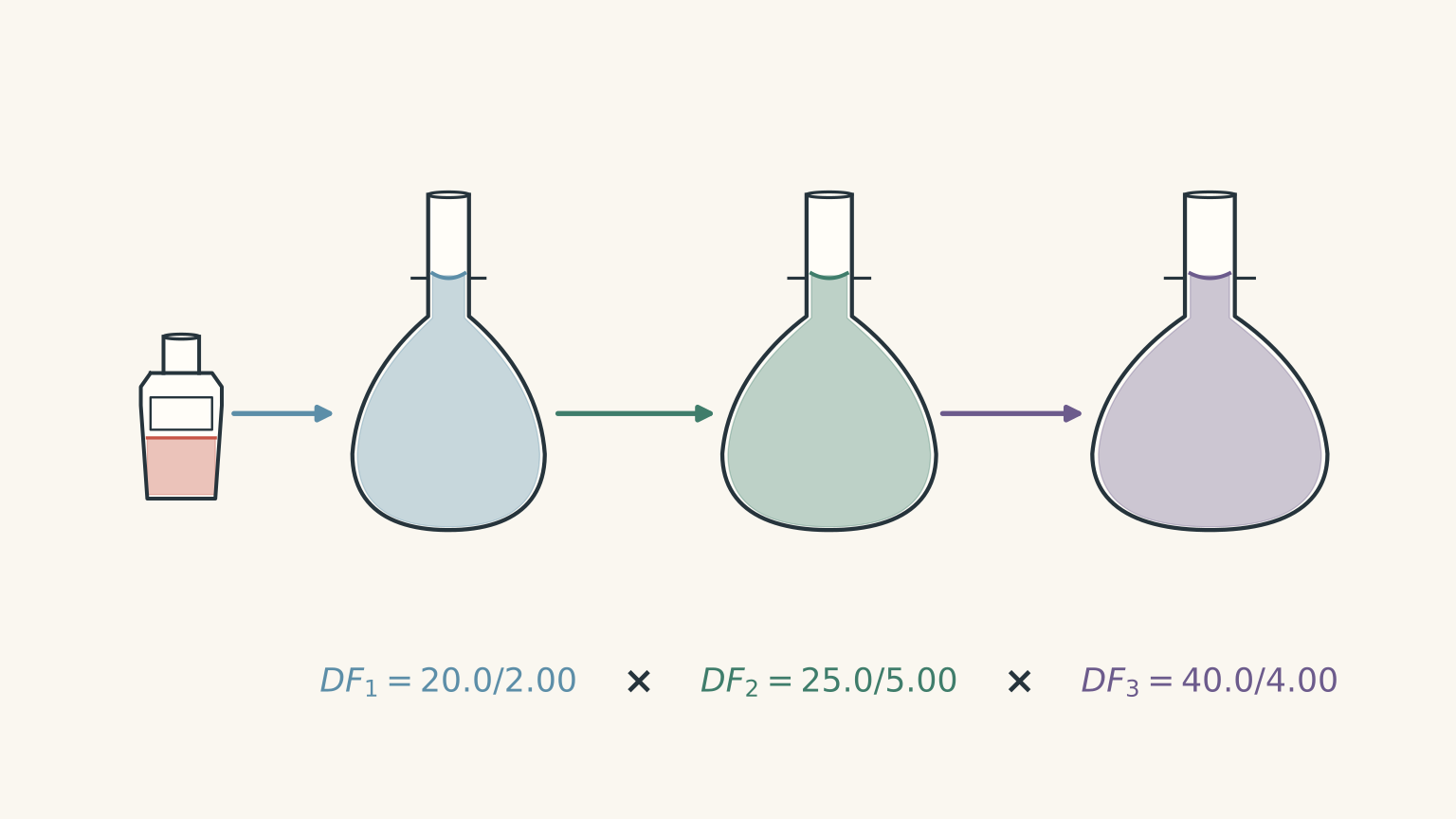
A serial dilution involves performing multiple dilutions in sequence.
The important detail is that each new dilution starts with the solution produced by the previous step, rather than returning to the original stock solution.
For each step, calculate its individual dilution factor:
\[ DF_1=\frac{V_{\mathrm{final},1}}{V_{\mathrm{aliquot},1}} \]
\[ DF_2=\frac{V_{\mathrm{final},2}}{V_{\mathrm{aliquot},2}} \]
Continue this process for every subsequent dilution.
The overall factor is:
\[ \boxed{DF_{\mathrm{overall}}=DF_1\times DF_2\times\cdots\times DF_n} \]
Why do we multiply rather than add?
Imagine reducing a concentration to one-tenth of its original value. You then reduce that new concentration to one-fifth of its value.
The final concentration is:
\[ c_{\mathrm{final}} =c_{\mathrm{initial}}\times\frac{1}{10} \times\frac{1}{5} \]
Therefore:
\[ c_{\mathrm{final}}=\frac{c_{\mathrm{initial}}}{50} \]
Each dilution acts on the concentration produced by the previous dilution. This is why the factors multiply.
Due to technical limitations, this figure may display incorrectly or contain inaccuracies. Please check key details against your course materials.
Worked example: Calculate the overall factor for three dilutions
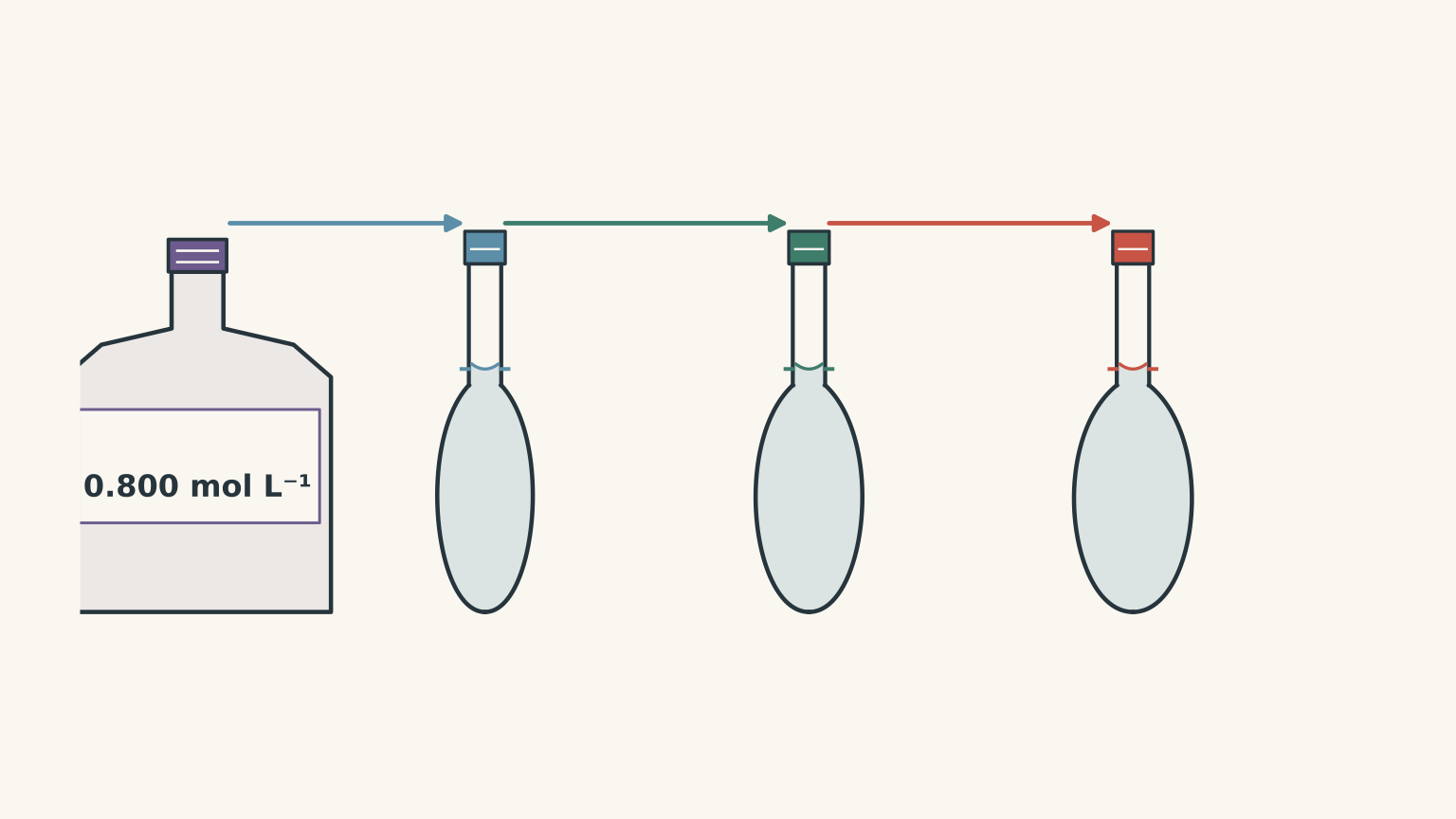
A student starts with a \(0.800\ \mathrm{mol\,L^{-1}}\) potassium nitrate solution, \(\ce{KNO3}\).
They perform three successive dilutions:
- First, 2.00 mL of the original solution is diluted to 20.0 mL.
- Next, 5.00 mL of the first diluted solution is diluted to 25.0 mL.
- Finally, 4.00 mL of the second diluted solution is diluted to 40.0 mL.
Calculate the individual dilution factors, the overall dilution factor, and the final concentration.
Step 1
The first aliquot is 2.00 mL, and the final volume is 20.0 mL.
\[ DF_1=\frac{20.0}{2.00}=10.0 \]
The first dilution is ten-fold.
Step 2
The second aliquot is 5.00 mL, taken from the first diluted solution.
\[ DF_2=\frac{25.0}{5.00}=5.00 \]
The second dilution is five-fold.
Notice that we use the concentration of the first diluted solution as the starting concentration for this step, not the original stock concentration.
Step 3
The third aliquot is 4.00 mL, and the final volume is 40.0 mL.
\[ DF_3=\frac{40.0}{4.00}=10.0 \]
The third dilution is ten-fold.
Step 4
\[ \begin{aligned} DF_{\mathrm{overall}} &=DF_1\times DF_2\times DF_3\\ &=10.0\times5.00\times10.0\\ &=\boxed{500} \end{aligned} \]
The final solution has undergone a 500-fold dilution.
Step 5
Divide the original concentration by the overall dilution factor.
\[ \begin{aligned} c_{\mathrm{final}} &=\frac{c_{\mathrm{initial}}}{DF_{\mathrm{overall}}}\\ &=\frac{0.800}{500}\\ &=\boxed{0.00160\ \mathrm{mol\,L^{-1}}} \end{aligned} \]
The final potassium nitrate concentration is \(0.00160\ \mathrm{mol\,L^{-1}}\).
The concentration is now one five-hundredth of its original value.
Due to technical limitations, this figure may display incorrectly or contain inaccuracies. Please check key details against your course materials.
Why the amount of solute needs careful tracking
There is another important detail in serial dilutions: the amount of solute transferred is not necessarily the amount present in the previous flask.
During a dilution with pure water, no chemical reaction occurs, so the amount of solute in the transferred aliquot remains unchanged.
However, when you remove only part of a well-mixed solution, you leave some of its solute behind.
Return to the previous example.
The first diluted flask contains 20.0 mL of solution. Only 5.00 mL is transferred to the second flask.
Therefore, only one-quarter of the solute in the first flask moves forward:
\[ \text{Fraction transferred}=\frac{5.00}{20.0}=0.250 \]
The remaining three-quarters stays in the first flask.
This does not change the concentration of the aliquot. It simply means that the second flask receives less total solute.
The distinction is:
- Removing an aliquot reduces the total amount of solute in the source flask.
- Diluting that aliquot with pure water reduces its concentration.
- The amount of solute in the aliquot remains constant during the dilution, provided no reaction or loss occurs.
This is why you must follow the transferred sample through each stage rather than assuming that every flask contains all the solute from the original stock bottle.
03Mixing solutions is not the same as serial dilution
Here is a situation where multiplying dilution factors can give the wrong answer.
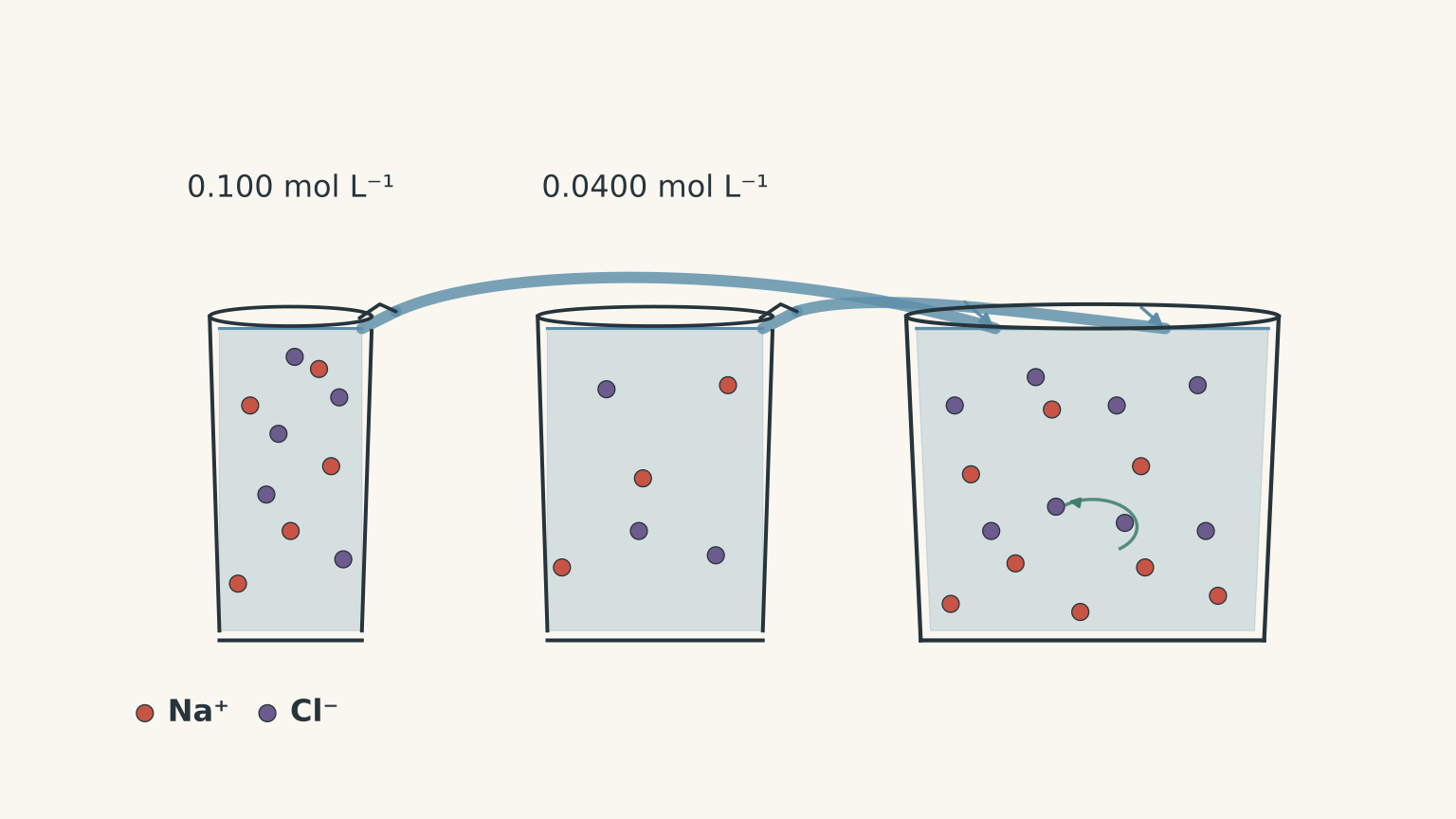
Suppose you have two sodium chloride solutions:
- Solution A: \(0.100\ \mathrm{mol\,L^{-1}}\).
- Solution B: \(0.0400\ \mathrm{mol\,L^{-1}}\).
You pour both into the same container.
Can you simply use the dilution factor of solution A to calculate the final concentration?
No. Both solutions contribute sodium chloride, so you must account for the amount of solute entering from each solution.
For a mixture containing the same solute, assuming no reaction or solute loss:
\[ n_{\mathrm{total}}=n_A+n_B \]
Using \(n=cV\):
\[ n_{\mathrm{total}}=c_AV_A+c_BV_B \]
The final concentration is:
\[ \boxed{ c_{\mathrm{final}}= \frac{c_AV_A+c_BV_B}{V_{\mathrm{final}}} } \]
This is different from a simple single-solution dilution because there are two sources of solute.
Due to technical limitations, this figure may display incorrectly or contain inaccuracies. Please check key details against your course materials.
Worked example: Mixing two solutions of the same solute
A student mixes:
- 20.0 mL of \(0.100\ \mathrm{mol\,L^{-1}}\) sodium chloride solution.
- 30.0 mL of \(0.0400\ \mathrm{mol\,L^{-1}}\) sodium chloride solution.
Assume the volumes are additive and no reaction occurs.
Calculate the final sodium chloride concentration.
Step 1
Convert the volume into litres:
\[ 20.0\ \mathrm{mL}=0.0200\ \mathrm{L} \]
Using \(n=cV\):
\[ \begin{aligned} n_A&=(0.100)(0.0200)\\ &=0.00200\ \mathrm{mol} \end{aligned} \]
Step 2
\[ 30.0\ \mathrm{mL}=0.0300\ \mathrm{L} \]
\[ \begin{aligned} n_B&=(0.0400)(0.0300)\\ &=0.00120\ \mathrm{mol} \end{aligned} \]
Step 3
Both solutions contain the same solute, and no reaction occurs.
\[ \begin{aligned} n_{\mathrm{total}} &=0.00200+0.00120\\ &=0.00320\ \mathrm{mol} \end{aligned} \]
Step 4
Assuming volumes are additive:
\[ V_{\mathrm{final}}=20.0+30.0 =50.0\ \mathrm{mL} \]
Convert to litres:
\[ V_{\mathrm{final}}=0.0500\ \mathrm{L} \]
Step 5
\[ \begin{aligned} c_{\mathrm{final}} &=\frac{n_{\mathrm{total}}}{V_{\mathrm{final}}}\\ &=\frac{0.00320}{0.0500}\\ &=\boxed{0.0640\ \mathrm{mol\,L^{-1}}} \end{aligned} \]
The final concentration is \(0.0640\ \mathrm{mol\,L^{-1}}\).
Notice that the answer lies between the two starting concentrations. That makes sense because you have mixed a more concentrated solution with a less concentrated solution.
If you had treated the second solution as pure water, you would have ignored the additional \(0.00120\) mol of sodium chloride.
What if the solutions contain different solutes?
If two solutions contain different solutes and no reaction occurs, calculate the amount of each solute separately.
For example, mixing sodium chloride and potassium nitrate does not mean their amounts can be added together and treated as one solute.
Instead:
\[ n_{\ce{NaCl}}=c_{\ce{NaCl}}V_{\ce{NaCl}} \]
\[ n_{\ce{KNO3}}=c_{\ce{KNO3}}V_{\ce{KNO3}} \]
Then divide each amount by the total final solution volume to find its individual concentration.
The key is to follow the particular substance whose concentration you are calculating.
04When a chemical reaction occurs, conservation of solute no longer applies
The dilution equations rely on the assumption that the solute being tracked does not react or disappear.
Consider mixing hydrochloric acid with sodium hydroxide.
The acid and base react according to:
\[ \ce{H3O+ + OH- -> 2H2O} \]
Hydronium ions and hydroxide ions are consumed to produce water.
Therefore, you cannot assume that the original amount of hydronium ions remains unchanged throughout the process.
You must calculate the reaction first, then determine the concentration of any remaining species after dilution.
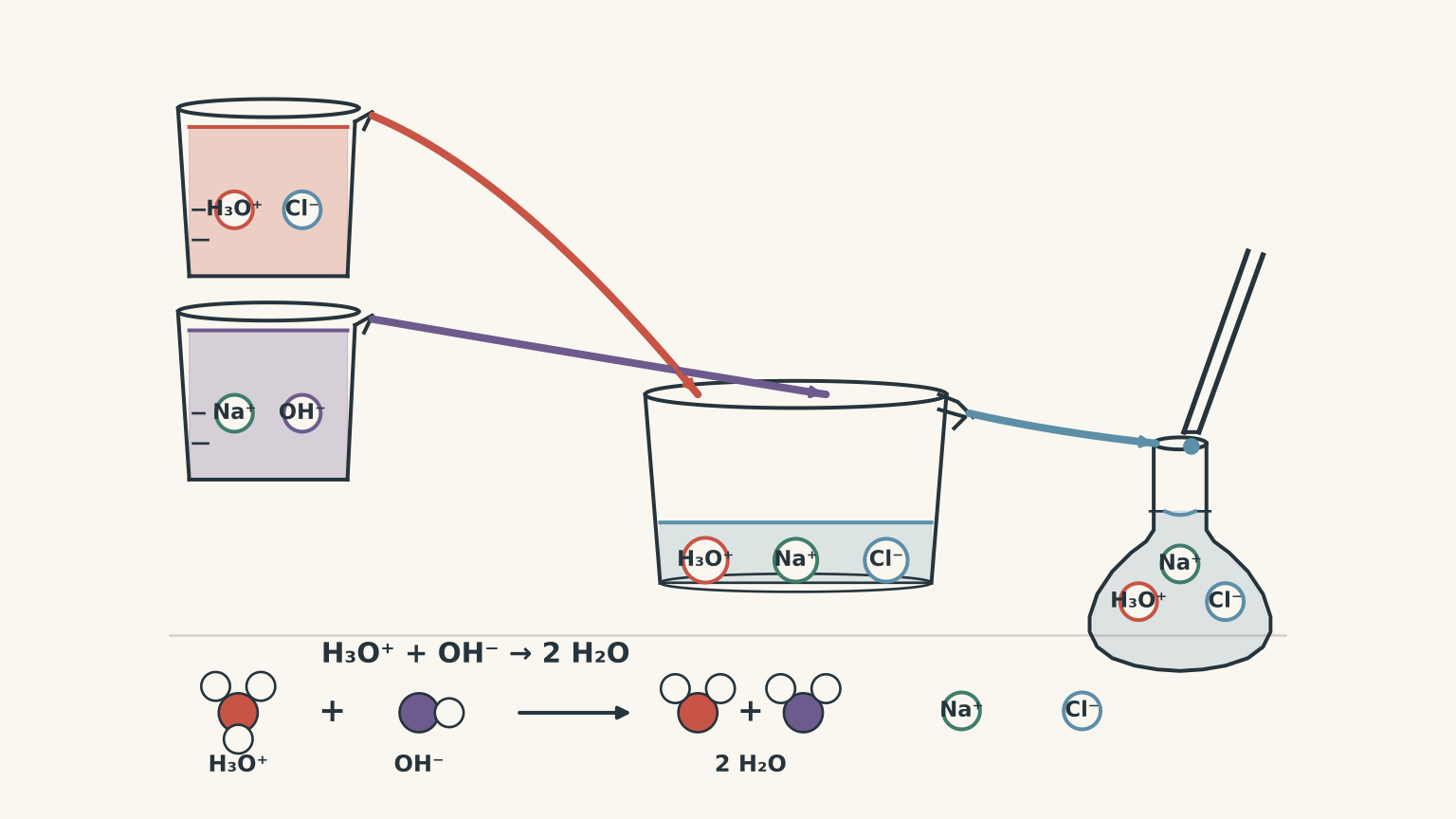
Due to technical limitations, this figure may display incorrectly or contain inaccuracies. Please check key details against your course materials.
For example, suppose 25.0 mL of \(0.100\ \mathrm{mol\,L^{-1}}\) hydrochloric acid is mixed with 15.0 mL of \(0.100\ \mathrm{mol\,L^{-1}}\) sodium hydroxide.
The resulting mixture is then diluted to a final volume of 100.0 mL.
Calculate the final hydronium ion concentration.
Step 1: Calculate the initial amounts of hydronium and hydroxide ions.
Hydrochloric acid is a strong acid, so it fully ionises in water.
\[ \begin{aligned} n(\ce{H3O+}) &=0.100\times0.0250\\ &=0.00250\ \mathrm{mol} \end{aligned} \]
For sodium hydroxide:
\[ \begin{aligned} n(\ce{OH-}) &=0.100\times0.0150\\ &=0.00150\ \mathrm{mol} \end{aligned} \]
Step 2: Determine which reactant is in excess.
The reaction ratio is 1:1.
Therefore, hydroxide ions consume \(0.00150\) mol of hydronium ions.
The remaining hydronium amount is:
\[ \begin{aligned} n_{\mathrm{remaining}}(\ce{H3O+}) &=0.00250-0.00150\\ &=0.00100\ \mathrm{mol} \end{aligned} \]
Step 3: Calculate the final concentration after dilution.
The final volume is:
\[ 100.0\ \mathrm{mL}=0.1000\ \mathrm{L} \]
Therefore:
\[ \begin{aligned} [\ce{H3O+}] &=\frac{0.00100}{0.1000}\\ &=\boxed{0.0100\ \mathrm{mol\,L^{-1}}} \end{aligned} \]
The final hydronium concentration is \(0.0100\ \mathrm{mol\,L^{-1}}\).
A student who treats the entire process as a simple four-fold dilution of the original acid would calculate:
\[ \frac{0.100}{4}=0.0250\ \mathrm{mol\,L^{-1}} \]
That answer is incorrect because it ignores the neutralisation reaction.
The acid’s hydronium amount decreased before the final dilution took place.
This is the important boundary: conservation of the amount of a particular solute applies during dilution only when that substance is not consumed, produced, or otherwise removed by a reaction or physical loss.
05A quick decision guide
Before calculating a dilution factor, identify what is actually happening.
| Situation | Correct approach |
|---|---|
| One solution diluted with pure water | Divide final volume by aliquot volume. |
| Multiple successive dilutions | Multiply the individual dilution factors. |
| Two solutions containing the same solute are mixed | Add the moles of solute from both solutions, then divide by the final volume. |
| Solutions containing different solutes are mixed without reaction | Calculate the concentration of each solute separately. |
| Solutions react when mixed | Calculate the reaction using stoichiometry before calculating final concentrations. |
| Some solution is lost during transfer | Account for the amount of solute lost before calculating the remaining concentration. |
A useful check is to ask whether your calculated final concentration makes physical sense.
For a simple dilution with pure water:
- The dilution factor should be greater than 1.
- The final concentration should be lower than the starting concentration.
- The final concentration should equal the starting concentration divided by the overall dilution factor.
If any of these conditions fail, check which volume you used and whether you have accidentally treated a mixture or reaction as a simple dilution.
06Questions and solutions
Assume solutions are homogeneous, no solute is lost, and no chemical reaction occurs unless stated otherwise. Treat volumes as additive where required, and use the stated final solution volumes.
Question 1
A student starts with a \(0.500\ \mathrm{mol\,L^{-1}}\) sodium chloride solution.
They transfer 10.0 mL into a volumetric flask and dilute it to 50.0 mL.
They then transfer 4.00 mL of this first diluted solution into another flask and dilute it to 20.0 mL.
Calculate:
a) The dilution factor for each step.
b) The overall dilution factor.
c) The final sodium chloride concentration.
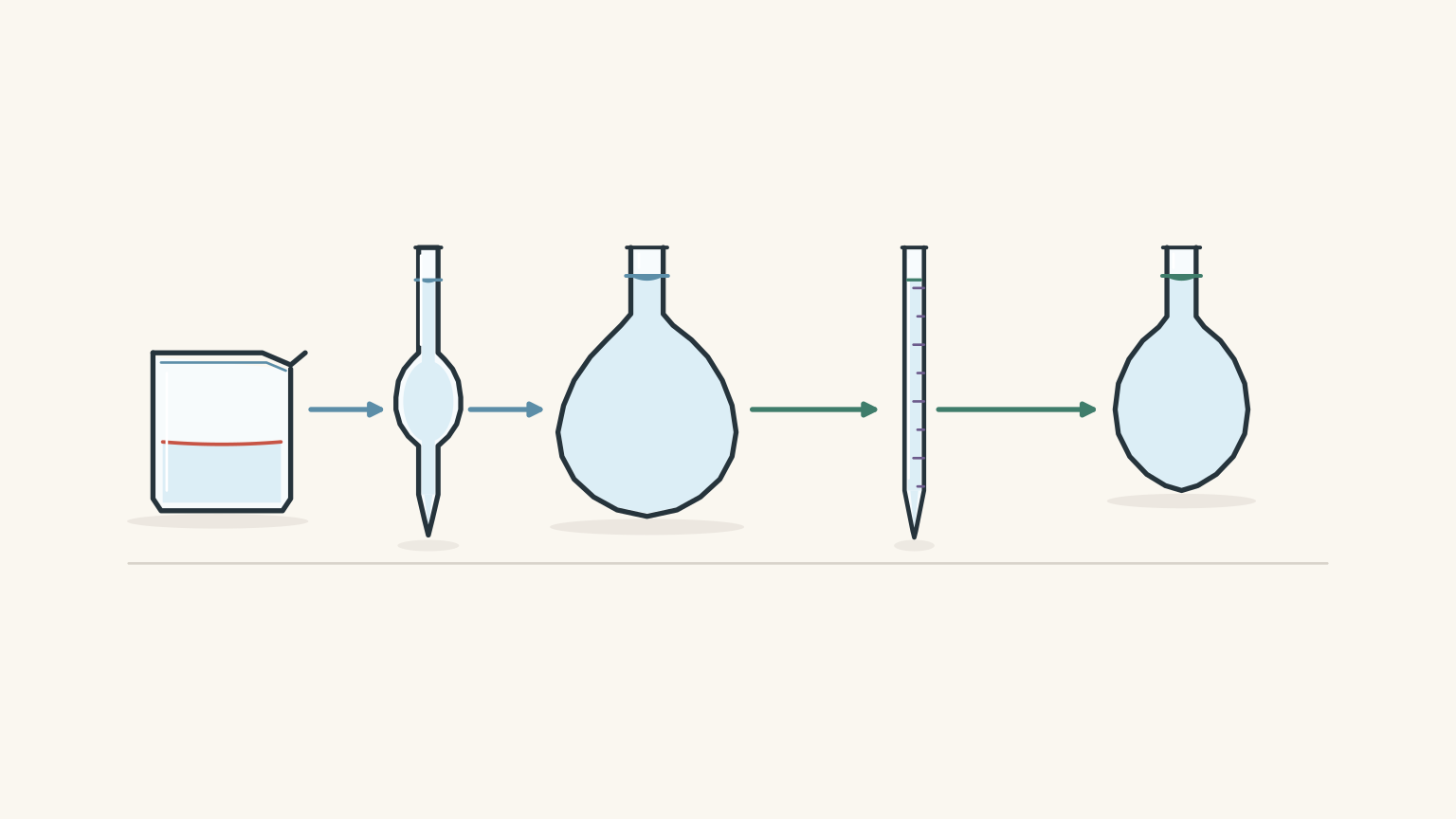
Due to technical limitations, this figure may display incorrectly or contain inaccuracies. Please check key details against your course materials.
Solution 1
The individual dilution factors are both 5, giving an overall dilution factor of 25 and a final concentration of \(0.0200\ \mathrm{mol\,L^{-1}}\).
Step 1: Calculate the first dilution factor.
\[ DF_1=\frac{50.0}{10.0}=5.00 \]
Step 2: Calculate the second dilution factor.
\[ DF_2=\frac{20.0}{4.00}=5.00 \]
Step 3: Calculate the overall factor.
\[ \begin{aligned} DF_{\mathrm{overall}} &=5.00\times5.00\\ &=\boxed{25.0} \end{aligned} \]
Step 4: Calculate the final concentration.
\[ \begin{aligned} c_{\mathrm{final}} &=\frac{0.500}{25.0}\\ &=\boxed{0.0200\ \mathrm{mol\,L^{-1}}} \end{aligned} \]
The final solution is 25 times less concentrated than the original stock solution.
The important point is that the second aliquot comes from the first diluted solution, so its concentration is already lower than the original stock concentration.
Question 2
A chemist performs three successive dilutions using a glucose solution with an initial concentration of \(0.240\ \mathrm{mol\,L^{-1}}\).
The procedure is:
- Transfer 6.00 mL of stock solution and dilute to 30.0 mL.
- Transfer 8.00 mL of the first diluted solution and dilute to 50.0 mL.
- Transfer 10.0 mL of the second diluted solution and dilute to 25.0 mL.
Calculate:
a) The individual dilution factors.
b) The overall dilution factor.
c) The final glucose concentration.
d) The percentage of the solute initially present in the 6.00 mL stock aliquot that reaches the final flask.
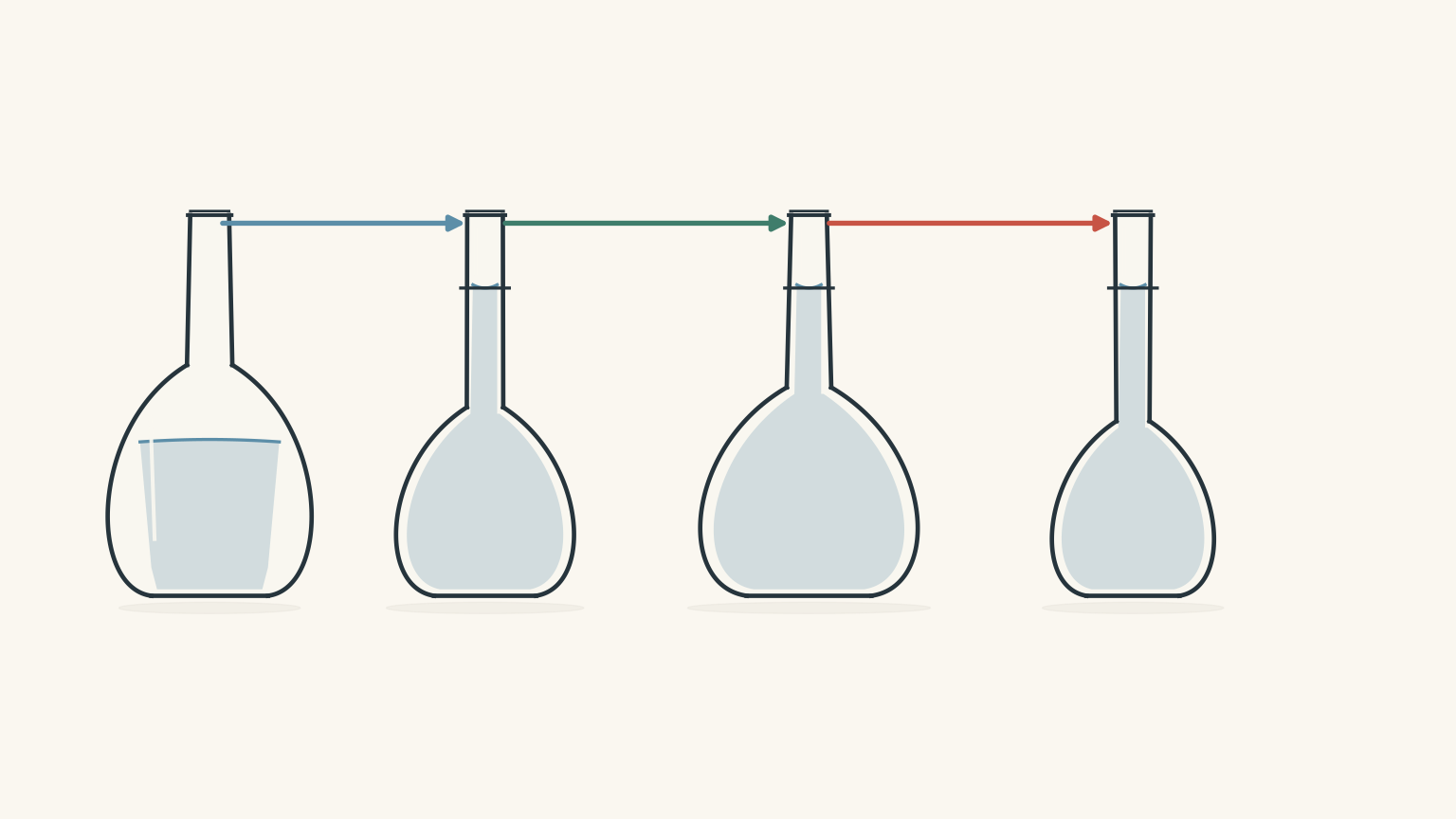
Due to technical limitations, this figure may display incorrectly or contain inaccuracies. Please check key details against your course materials.
Solution 2
The overall dilution factor is 78.125, the final concentration is \(0.00307\ \mathrm{mol\,L^{-1}}\), and 5.33% of the solute in the original aliquot reaches the final flask.
Step 1: Calculate the individual dilution factors.
First dilution:
\[ DF_1=\frac{30.0}{6.00}=5.00 \]
Second dilution:
\[ DF_2=\frac{50.0}{8.00}=6.25 \]
Third dilution:
\[ DF_3=\frac{25.0}{10.0}=2.50 \]
Step 2: Multiply the factors.
\[ \begin{aligned} DF_{\mathrm{overall}} &=5.00\times6.25\times2.50\\ &=\boxed{78.125} \end{aligned} \]
Step 3: Calculate the final concentration.
\[ \begin{aligned} c_{\mathrm{final}} &=\frac{0.240}{78.125}\\ &=\boxed{0.00307\ \mathrm{mol\,L^{-1}}} \end{aligned} \]
Step 4: Calculate the fraction of solute that reaches the final flask.
The first dilution transfers the entire 6.00 mL aliquot, so no solute is lost at this stage.
However, the second transfer takes only 8.00 mL from a total of 30.0 mL.
The fraction transferred is:
\[ \frac{8.00}{30.0}=0.2667 \]
The third transfer takes 10.0 mL from a total of 50.0 mL.
The fraction transferred is:
\[ \frac{10.0}{50.0}=0.200 \]
Multiply these fractions:
\[ \begin{aligned} \text{Fraction reaching final flask} &=0.2667\times0.200\\ &=0.05333 \end{aligned} \]
Convert to a percentage:
\[ 0.05333\times100=\boxed{5.33\%} \]
Only 5.33% of the solute in the original 6.00 mL aliquot reaches the final flask.
This is not the same as the percentage concentration remaining. The overall concentration reduction is determined by the dilution factors, whereas the percentage of solute transferred depends on how much solution is removed at each stage.
Question 3
A student prepares a mixture by combining:
- 25.0 mL of \(0.120\ \mathrm{mol\,L^{-1}}\) sodium chloride solution.
- 15.0 mL of \(0.0800\ \mathrm{mol\,L^{-1}}\) potassium nitrate solution.
The mixture is then diluted with water to a final volume of 100.0 mL.
Calculate the final concentration of each solute.
A student argues that the overall dilution factor is:
\[ DF=\frac{100.0}{25.0+15.0}=2.50 \]
Explain why this approach does not give the correct dilution factor for either solute.
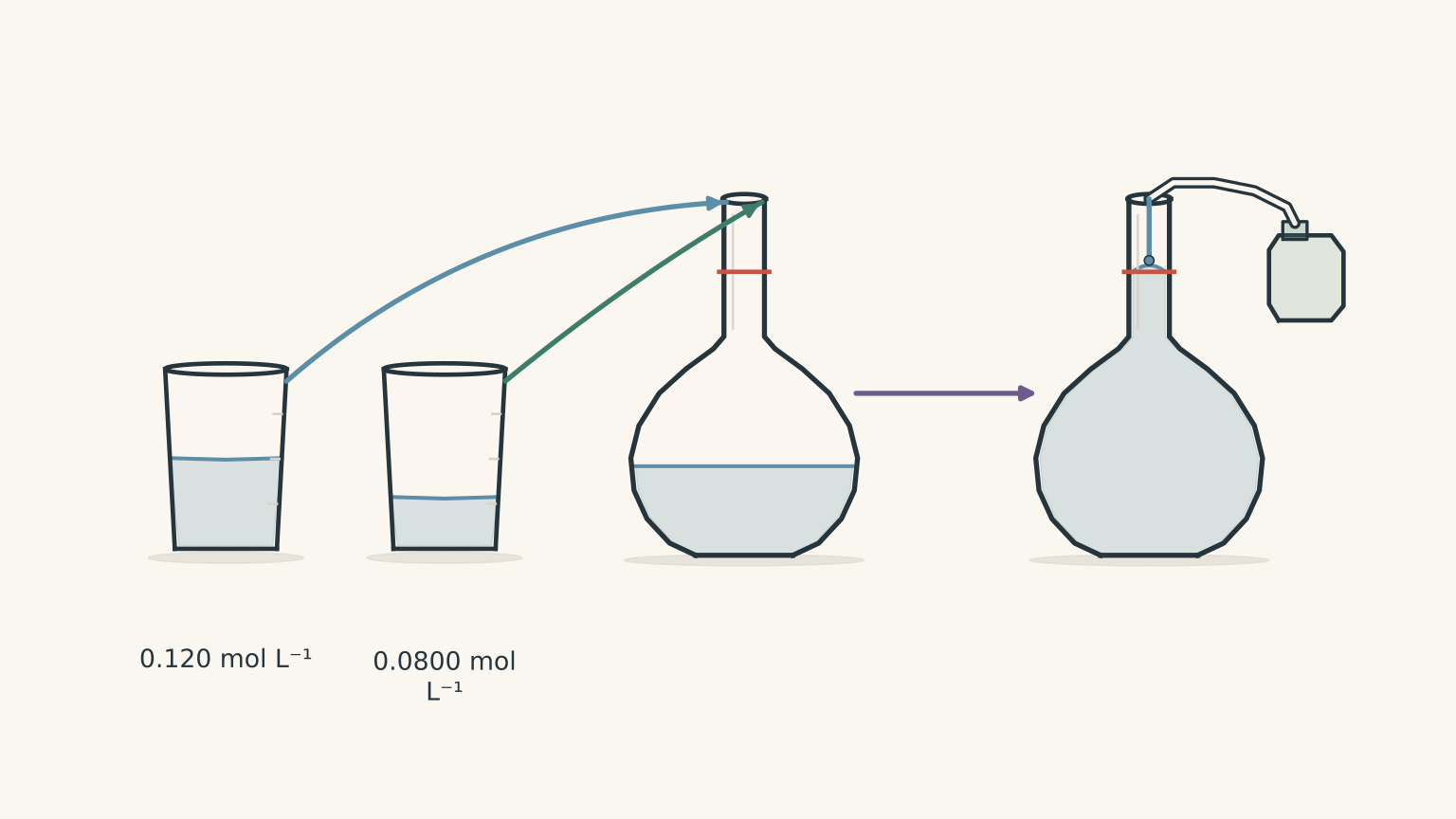
Due to technical limitations, this figure may display incorrectly or contain inaccuracies. Please check key details against your course materials.
Solution 3
The final sodium chloride concentration is \(0.0300\ \mathrm{mol\,L^{-1}}\), and the final potassium nitrate concentration is \(0.0120\ \mathrm{mol\,L^{-1}}\). The two solutes must be calculated separately because they enter the mixture in different volumes and amounts.
Step 1: Calculate the amount of sodium chloride.
\[ \begin{aligned} n_{\ce{NaCl}} &=cV\\ &=0.120\times0.0250\\ &=0.00300\ \mathrm{mol} \end{aligned} \]
Step 2: Calculate the amount of potassium nitrate.
\[ \begin{aligned} n_{\ce{KNO3}} &=cV\\ &=0.0800\times0.0150\\ &=0.00120\ \mathrm{mol} \end{aligned} \]
Step 3: Calculate the final sodium chloride concentration.
The final volume is 100.0 mL, or 0.1000 L.
\[ \begin{aligned} c_{\ce{NaCl}} &=\frac{0.00300}{0.1000}\\ &=\boxed{0.0300\ \mathrm{mol\,L^{-1}}} \end{aligned} \]
Step 4: Calculate the final potassium nitrate concentration.
\[ \begin{aligned} c_{\ce{KNO3}} &=\frac{0.00120}{0.1000}\\ &=\boxed{0.0120\ \mathrm{mol\,L^{-1}}} \end{aligned} \]
Step 5: Explain the student’s mistake.
The student has calculated the ratio between the final volume and the combined starting volume.
However, each solute starts in a different solution and therefore has a different initial aliquot volume.
The correct individual dilution factors are:
For sodium chloride:
\[ DF_{\ce{NaCl}}=\frac{100.0}{25.0}=4.00 \]
For potassium nitrate:
\[ DF_{\ce{KNO3}}=\frac{100.0}{15.0}=6.67 \]
The value 2.50 does not describe the dilution of either individual solute.
This is why mixing solutions requires you to track the amount of each solute separately.
Question 4
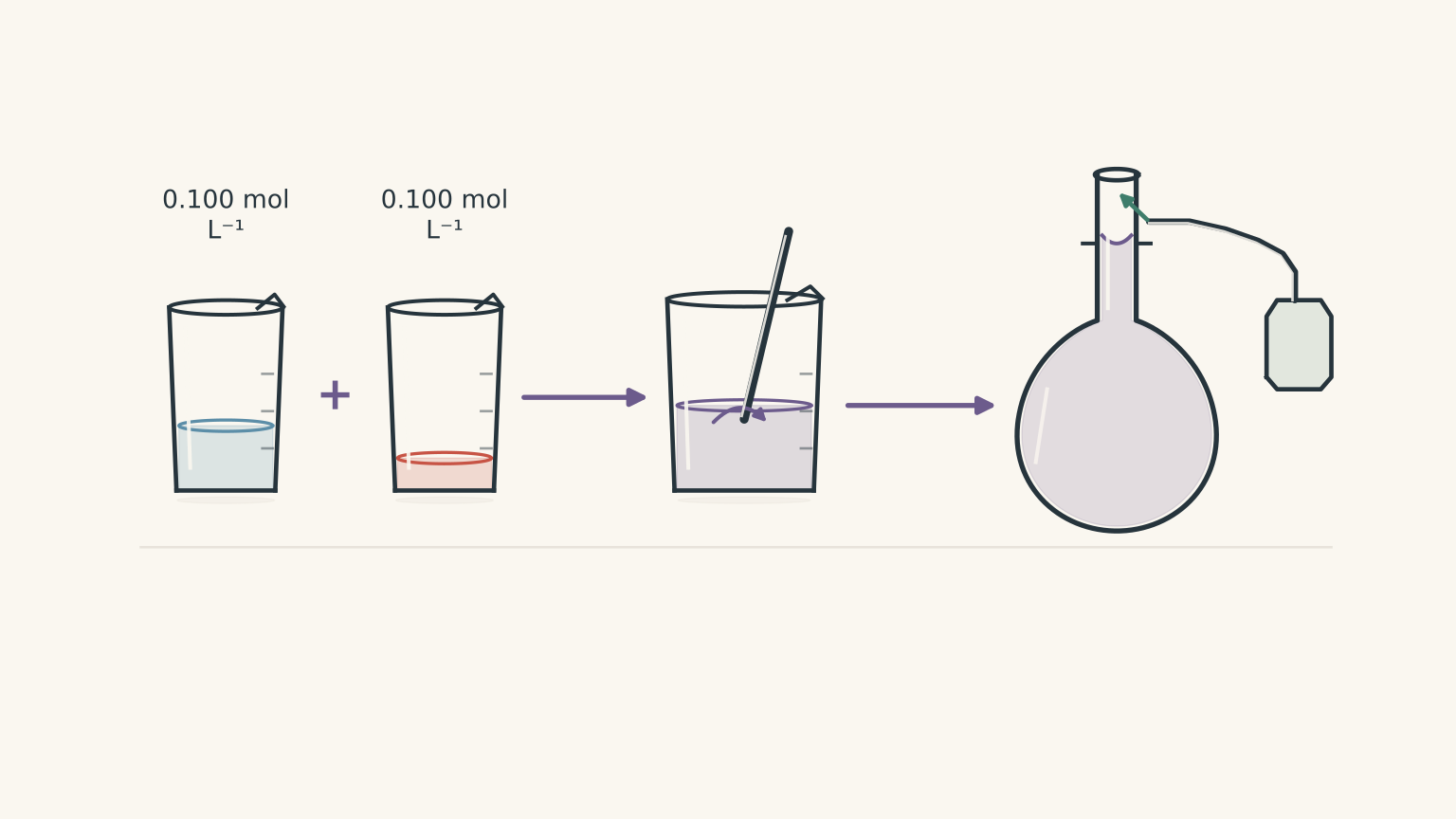
A student mixes 25.0 mL of \(0.100\ \mathrm{mol\,L^{-1}}\) hydrochloric acid with 15.0 mL of \(0.100\ \mathrm{mol\,L^{-1}}\) sodium hydroxide.
The reaction proceeds to completion, and the resulting mixture is then diluted to a final volume of 100.0 mL.
Calculate the final hydronium ion concentration.
Explain why treating the process as a simple dilution of the original hydrochloric acid gives an incorrect answer.
Due to technical limitations, this figure may display incorrectly or contain inaccuracies. Please check key details against your course materials.
Solution 4
The final hydronium ion concentration is \(0.0100\ \mathrm{mol\,L^{-1}}\). Neutralisation consumes some of the original hydronium ions before the solution is diluted, so the original acid amount cannot be treated as conserved.
Step 1: Calculate the initial amount of hydronium ions.
\[ \begin{aligned} n(\ce{H3O+}) &=0.100\times0.0250\\ &=0.00250\ \mathrm{mol} \end{aligned} \]
Step 2: Calculate the amount of hydroxide ions.
\[ \begin{aligned} n(\ce{OH-}) &=0.100\times0.0150\\ &=0.00150\ \mathrm{mol} \end{aligned} \]
Step 3: Calculate the amount of hydronium ions remaining after the reaction.
The reaction is:
\[ \ce{H3O+ + OH- -> 2H2O} \]
The mole ratio is 1:1.
Therefore:
\[ \begin{aligned} n_{\mathrm{remaining}}(\ce{H3O+}) &=0.00250-0.00150\\ &=0.00100\ \mathrm{mol} \end{aligned} \]
Step 4: Calculate the final concentration.
The final volume is 0.1000 L.
\[ \begin{aligned} [\ce{H3O+}] &=\frac{0.00100}{0.1000}\\ &=\boxed{0.0100\ \mathrm{mol\,L^{-1}}} \end{aligned} \]
Step 5: Explain why the simple dilution calculation fails.
If no reaction occurred, diluting the original 25.0 mL of acid to 100.0 mL would give:
\[ c_{\mathrm{final}}=0.100\times\frac{25.0}{100.0} \]
\[ c_{\mathrm{final}}=0.0250\ \mathrm{mol\,L^{-1}} \]
But this calculation assumes that all the original hydronium ions remain present.
The sodium hydroxide has consumed \(0.00150\) mol of hydronium ions, so only \(0.00100\) mol remains.
The reaction must therefore be considered before the dilution calculation.
Question 5
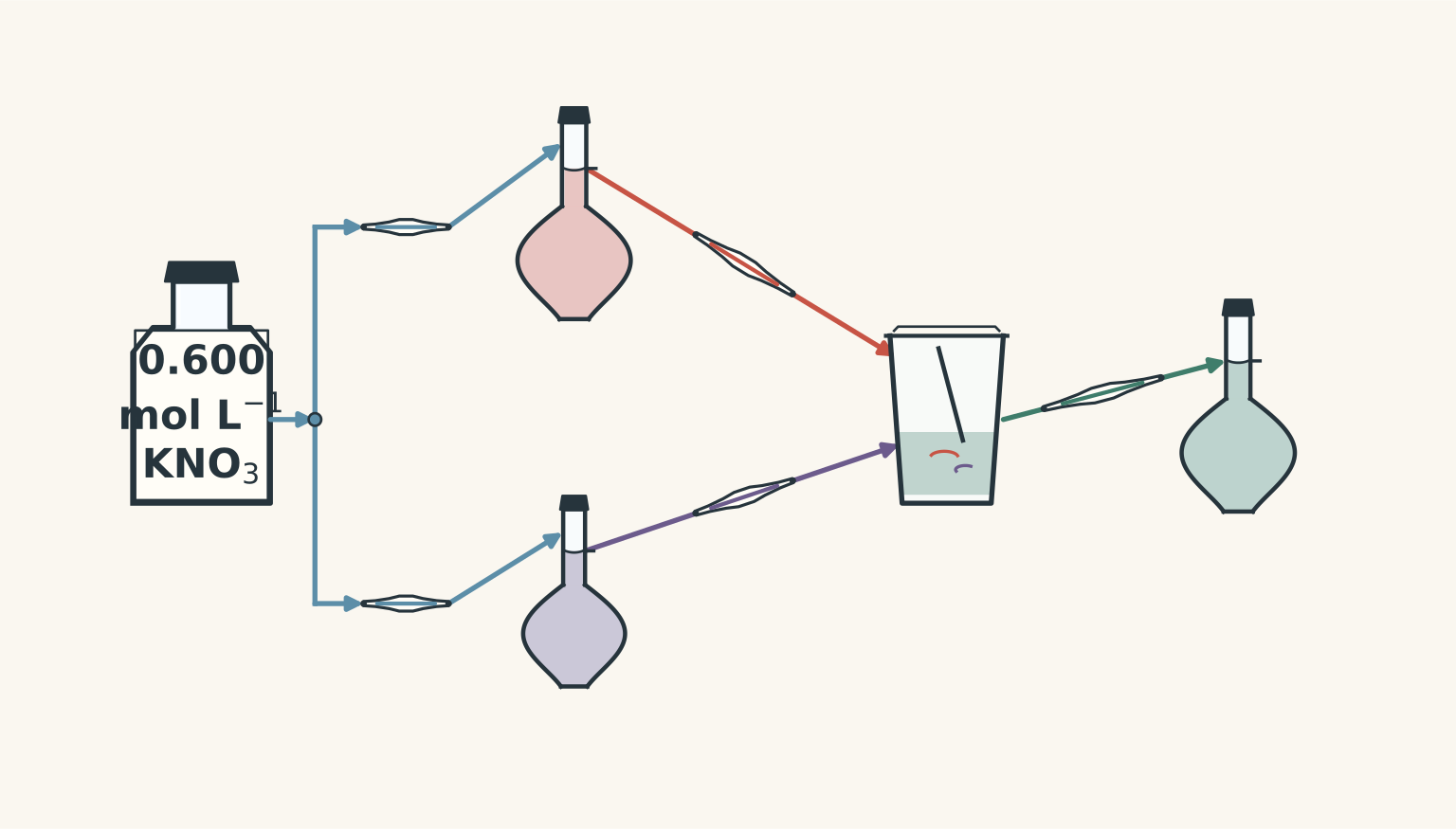
A laboratory has a stock solution of potassium nitrate with a concentration of \(0.600\ \mathrm{mol\,L^{-1}}\).
The student prepares two separate dilution branches.
Branch A:
4.00 mL of the stock solution is diluted to 40.0 mL.
Branch B:
5.00 mL of the stock solution is diluted to 25.0 mL.
The student then:
- Transfers 15.0 mL from Branch A into a mixing container.
- Transfers 5.00 mL from Branch B into the same container.
- Mixes the solutions thoroughly.
- Transfers 8.00 mL of the mixture into a final flask and dilutes it to 40.0 mL.
Calculate the final potassium nitrate concentration.
A laboratory record describes the final solution as a 40-fold dilution of the original stock solution.
Is this description correct? Explain why multiplying the dilution factors along either individual branch does not give the correct result for the final mixture.
Assume no reaction or solute loss, and that all stated volumes are exact and additive.
Due to technical limitations, this figure may display incorrectly or contain inaccuracies. Please check key details against your course materials.
Solution 5
The final concentration is \(0.0150\ \mathrm{mol\,L^{-1}}\). The laboratory’s 40-fold dilution description is correct if it refers to the ratio of the original stock concentration to the final concentration. However, 40 is not the product of the dilution factors along either individual branch.
Step 1: Calculate the concentration in Branch A.
The first branch is a ten-fold dilution.
\[ DF_A=\frac{40.0}{4.00}=10.0 \]
Therefore:
\[ c_A=\frac{0.600}{10.0} =0.0600\ \mathrm{mol\,L^{-1}} \]
Step 2: Calculate the concentration in Branch B.
The second branch is a five-fold dilution.
\[ DF_B=\frac{25.0}{5.00}=5.00 \]
Therefore:
\[ c_B=\frac{0.600}{5.00} =0.120\ \mathrm{mol\,L^{-1}} \]
At this point, the two branches contain the same solute at different concentrations.
Step 3: Calculate the amount of solute contributed by each branch.
Branch A contributes:
\[ \begin{aligned} n_A &=c_AV_A\\ &=0.0600\times0.0150\\ &=0.000900\ \mathrm{mol} \end{aligned} \]
Branch B contributes:
\[ \begin{aligned} n_B &=c_BV_B\\ &=0.120\times0.00500\\ &=0.000600\ \mathrm{mol} \end{aligned} \]
Step 4: Calculate the concentration of the mixture.
The total amount of solute is:
\[ \begin{aligned} n_{\mathrm{total}} &=0.000900+0.000600\\ &=0.00150\ \mathrm{mol} \end{aligned} \]
The total mixture volume is:
\[ V_{\mathrm{mixture}}=15.0+5.00=20.0\ \mathrm{mL} \]
Convert to litres:
\[ V_{\mathrm{mixture}}=0.0200\ \mathrm{L} \]
Therefore:
\[ \begin{aligned} c_{\mathrm{mixture}} &=\frac{0.00150}{0.0200}\\ &=0.0750\ \mathrm{mol\,L^{-1}} \end{aligned} \]
Step 5: Calculate the final concentration after the last dilution.
The student transfers 8.00 mL of the mixture and dilutes it to 40.0 mL.
The final dilution factor is:
\[ DF_3=\frac{40.0}{8.00}=5.00 \]
Therefore:
\[ \begin{aligned} c_{\mathrm{final}} &=\frac{0.0750}{5.00}\\ &=\boxed{0.0150\ \mathrm{mol\,L^{-1}} } \end{aligned} \]
Step 6: Evaluate the laboratory record.
Calculate the effective dilution factor relative to the original stock:
\[ \begin{aligned} DF_{\mathrm{effective}} &=\frac{c_{\mathrm{initial}}}{c_{\mathrm{final}}}\\ &=\frac{0.600}{0.0150}\\ &=\boxed{40.0} \end{aligned} \]
So the final solution does have a concentration 40 times lower than the original stock.
However, consider what happens if you multiply the factors along each branch.
For Branch A:
\[ 10.0\times5.00=50.0 \]
For Branch B:
\[ 5.00\times5.00=25.0 \]
Neither gives 40.
The reason is that the final solution contains solute from both branches. It does not follow one continuous dilution pathway.
The final concentration is determined by the combined amount of solute from both branches, not by multiplying the factors along just one route.
This is the subtle distinction: an effective dilution factor can be calculated from the ratio of the starting and final concentrations, even when the preparation does not consist of one continuous serial dilution.
07Where to go next
Once you can calculate serial-dilution factors, the next useful skill is knowing how to prepare a solution accurately using volumetric glassware.
For the practical method, including how to use volumetric pipettes and flasks, read How to Perform a Solution Dilution in HSC Chemistry.
For more practice with concentration, aliquots, and conservation of solute, see Solution dilution calculations for HSC Chemistry.
The key decision to carry forward is simple: before multiplying dilution factors, check that you are actually following one solution through successive dilutions, rather than combining different solutions or allowing a chemical reaction to change the amount of the substance being measured.