
How to Calculate Q Immediately After Two Solutions Are Mixed
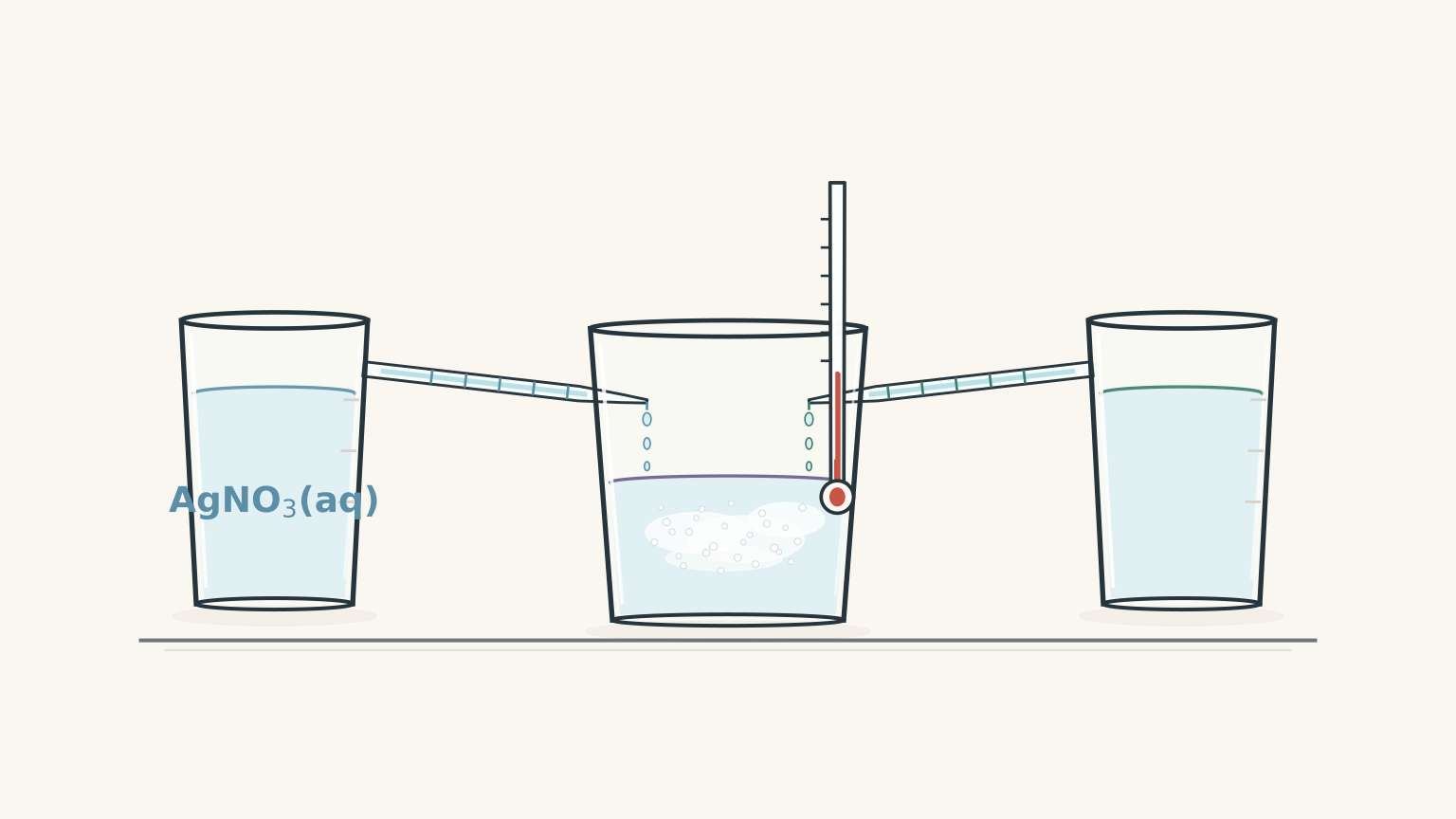
Two clear solutions go into a beaker. A few seconds later, the mixture turns cloudy as a solid begins to form.
Two clear solutions go into a beaker. A few seconds later, the mixture turns cloudy as a solid begins to form. Could you have predicted that the precipitate would form before you mixed the solutions?
Yes. The key is to calculate the reaction quotient, \(Q\), using the concentrations in the mixture immediately after combining the solutions.
There is one important catch: the concentrations in the original bottles are no longer the concentrations in the mixed solution. You must account for the total volume before calculating \(Q\).
The method is straightforward:
- Calculate the moles of each reacting species contributed by both solutions.
- Calculate the total volume after mixing.
- Divide the total moles of each species by the total volume to find its new concentration.
- Substitute these concentrations into the correct reaction quotient expression.
- Compare \(Q\) with the equilibrium constant, \(K\), at the same temperature.
For precipitation reactions, you will usually calculate the ionic reaction quotient, \(Q_{sp}\), and compare it with the solubility product, \(K_{sp}\).
Let’s work through why this method works and how to apply it without making the common concentration errors.
Due to technical limitations, this figure may display incorrectly or contain inaccuracies. Please check key details against your course materials.
01What does Q represent immediately after mixing?
Imagine preparing a mixture using silver nitrate, \(\ce{AgNO3}\), and sodium chloride, \(\ce{NaCl}\).
Both substances dissolve in water:
\[ \ce{AgNO3(aq) -> Ag+(aq) + NO3-(aq)} \]
\[ \ce{NaCl(aq) -> Na+(aq) + Cl-(aq)} \]
When the solutions are combined, silver ions and chloride ions can react to form solid silver chloride:
\[ \ce{Ag+(aq) + Cl-(aq) <=> AgCl(s)} \]
The important question is whether the mixture contains enough silver ions and chloride ions to favour precipitation.
Before calculating anything, predict which concentrations you should use:
- The concentrations written on the original solution bottles?
- The concentrations of the ions after both solutions have been combined?
The second option is correct.
The original solutions have been diluted by combining their volumes. You must calculate the concentrations in the final mixture, not reuse the stock concentrations.
Reaction quotient versus equilibrium constant
The reaction quotient, \(Q\), describes the relative concentrations of products and reactants at a particular moment.
It can be calculated at any stage of a reaction, including immediately after mixing two solutions.
The equilibrium constant, \(K\), describes the same concentration relationship when the system has reached equilibrium at a particular temperature.
For a general reversible reaction:
\[ \ce{aA + bB <=> cC + dD} \]
The concentration reaction quotient is:
\[ Q_c=\frac{[C]^c[D]^d}{[A]^a[B]^b} \]
Where:
- \(Q_c\) is the concentration reaction quotient.
- Square brackets represent molar concentrations in \(\mathrm{mol\,L^{-1}}\).
- \(a,b,c,d\) are the coefficients in the balanced chemical equation.
Notice that the coefficients become powers in the expression.
For example, consider the equilibrium:
\[ \ce{Fe^3+(aq) + SCN^-(aq) <=> FeSCN^2+(aq)} \]
Its reaction quotient is:
\[ Q_c= \frac{[\mathrm{FeSCN}^{2+}]} {[\mathrm{Fe}^{3+}][\mathrm{SCN}^{-}]} \]
You use the concentrations present immediately after mixing.
If no \(\mathrm{FeSCN}^{2+}\) is initially present, the numerator is zero, so \(Q_c=0\). If some product is already present in either solution, you must calculate and include it.
What changes for a precipitation reaction?
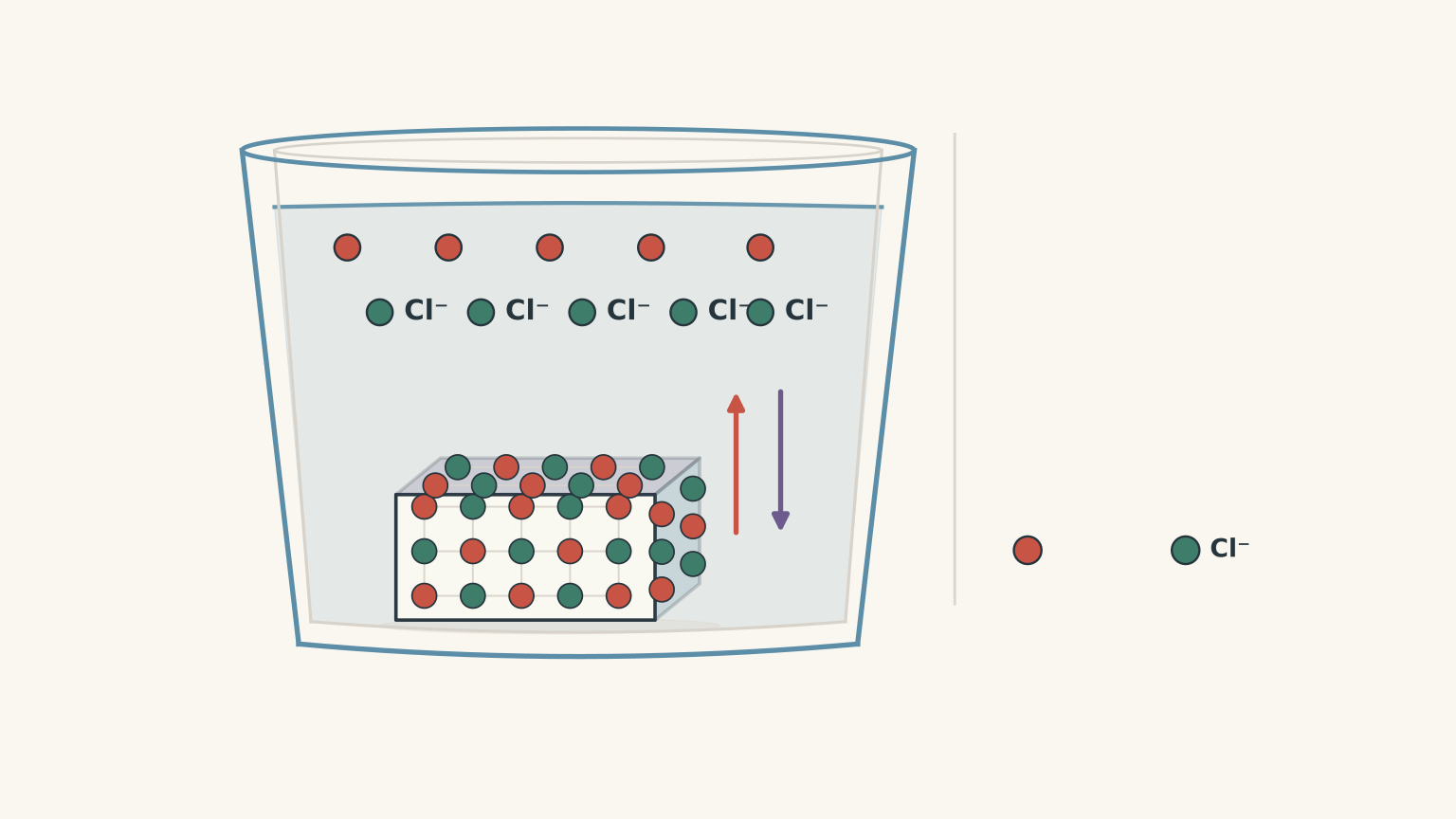
For a sparingly soluble ionic compound, we usually write the equilibrium in the dissolution direction.
For silver chloride:
\[ \ce{AgCl(s) <=> Ag+(aq) + Cl-(aq)} \]
The equilibrium constant is the solubility product:
\[ K_{sp}=[\mathrm{Ag}^{+}][\mathrm{Cl}^{-}] \]
The reaction quotient immediately after mixing is:
\[ \boxed{Q_{sp}=[\mathrm{Ag}^{+}][\mathrm{Cl}^{-}]} \]
Notice that solid silver chloride does not appear in the expression.
Pure solids are excluded from equilibrium expressions because their activity is treated as constant.
Due to technical limitations, this figure may display incorrectly or contain inaccuracies. Please check key details against your course materials.
This is the expression you will use when deciding whether silver chloride precipitates.
There is an important detail about reaction direction. If you instead write the equation as:
\[ \ce{Ag+(aq) + Cl-(aq) <=> AgCl(s)} \]
the reaction quotient is the reciprocal:
\[ Q_c=\frac{1}{[\mathrm{Ag}^{+}][\mathrm{Cl}^{-}]} \]
You cannot use this expression and compare it directly with \(K_{sp}\). The equilibrium constant must also be reversed.
The easiest approach for precipitation questions is to write the dissolution equation and use \(Q_{sp}\) and \(K_{sp}\) consistently.
02The method: calculate concentrations after mixing
The most important relationship is:
\[ n=cV \]
Where:
- \(n\) is the amount of substance in moles.
- \(c\) is the molar concentration in \(\mathrm{mol\,L^{-1}}\).
- \(V\) is the solution volume in litres.
Rearranging:
\[ c=\frac{n}{V} \]
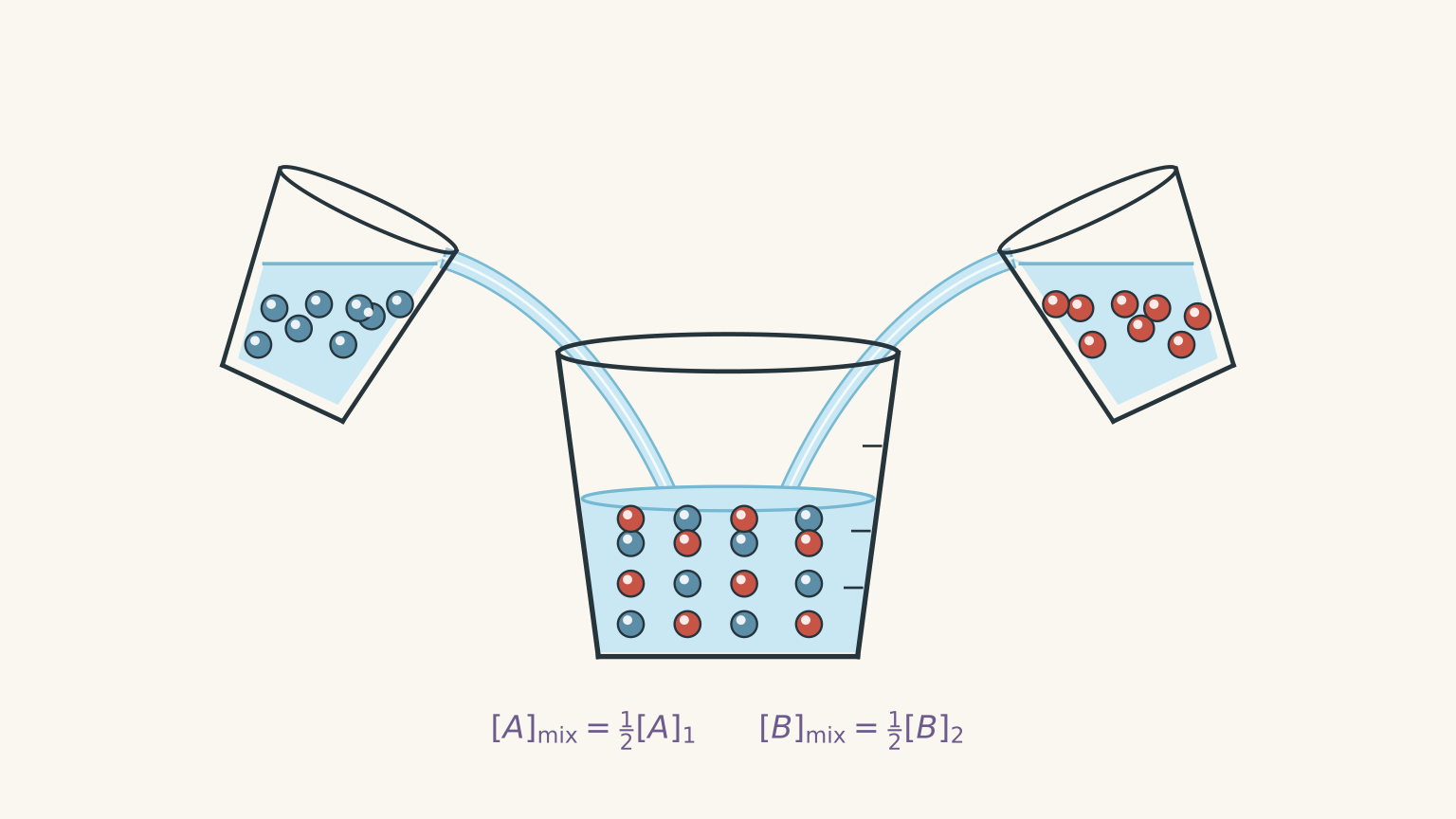
When two solutions are mixed, the moles of each dissolved substance are conserved initially, but the total volume increases.
Therefore:
\[ \boxed{ [\text{species}]_{\text{mixture}} = \frac{\text{total moles of species}}{\text{total volume}} } \]
Assume solution volumes are additive unless the question gives you a different final volume.
A reliable six-step approach
Step 1: Write the balanced equilibrium equation.
Identify the reacting species and their coefficients.
For a precipitation calculation, write the dissolution equation so that your expression matches \(K_{sp}\).
Step 2: Calculate the moles from each solution.
Use \(n=cV\) separately for each solution.
Convert millilitres to litres before calculating moles.
Step 3: Add contributions from the same species.
If both solutions contain the same reacting ion, calculate the moles contributed by each and add them.
Do not simply add their original concentrations.
Step 4: Calculate the total volume.
For two solutions:
\[ V_{\text{total}}=V_1+V_2 \]
This assumes the volumes are additive.
Step 5: Calculate the new concentrations.
Divide the total moles of each reacting species by the total volume.
Step 6: Substitute into the expression for Q.
Use the balanced equation to determine the correct powers.
Finally, compare \(Q\) with \(K\) or \(K_{sp}\), using the value for the mixture’s temperature.
Due to technical limitations, this figure may display incorrectly or contain inaccuracies. Please check key details against your course materials.
If you need to refresh the underlying dilution calculations, see Solution dilution calculations for HSC Chemistry.
03Worked example: Calculate Q immediately after mixing silver nitrate and sodium chloride
Question
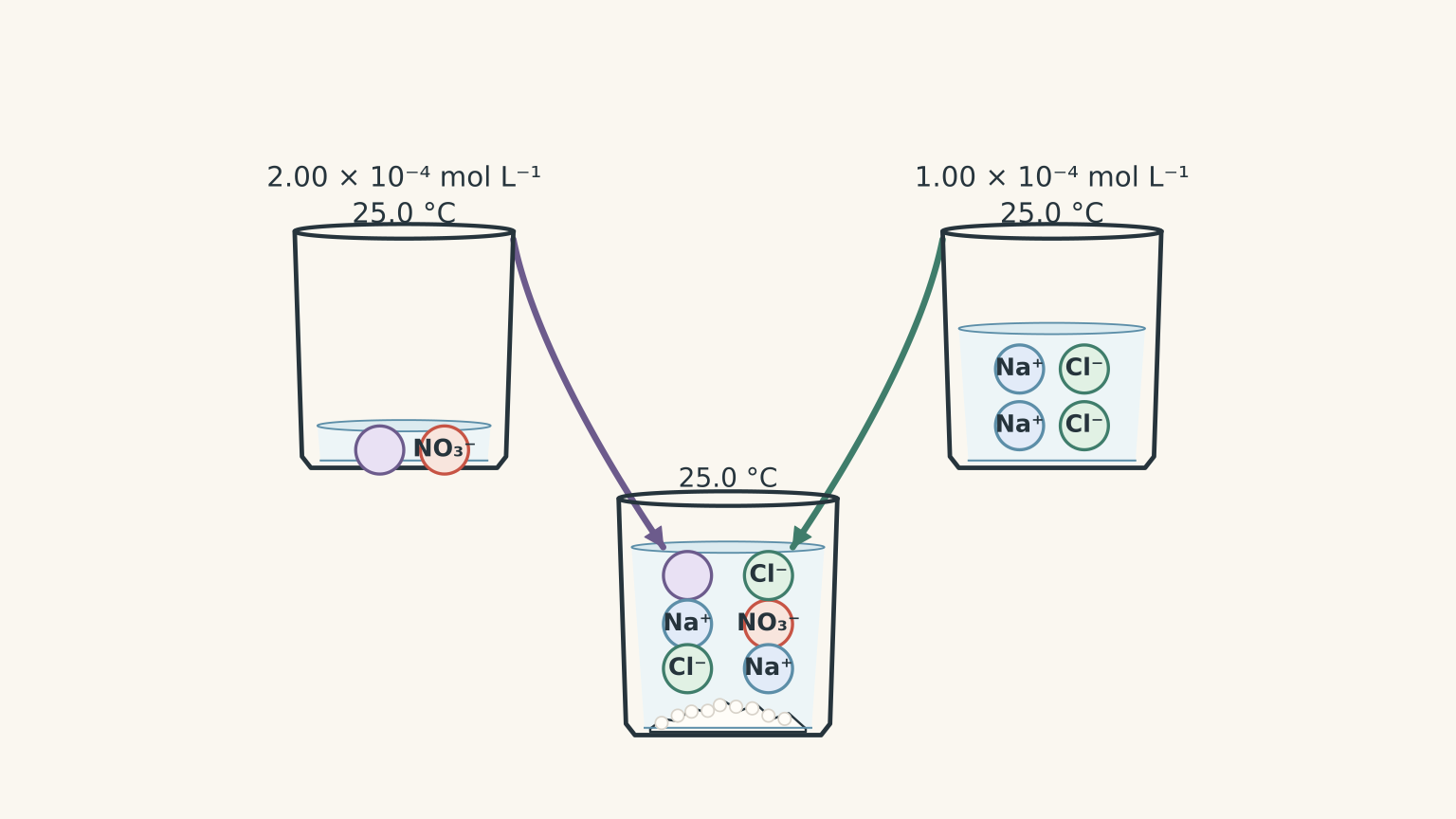
At \(25.0^\circ\mathrm{C}\), a student mixes:
- \(25.0\,\mathrm{mL}\) of \(2.00\times10^{-4}\,\mathrm{mol\,L^{-1}}\) silver nitrate solution.
- \(75.0\,\mathrm{mL}\) of \(1.00\times10^{-4}\,\mathrm{mol\,L^{-1}}\) sodium chloride solution.
Assume both salts dissociate completely, the volumes are additive, and the temperature remains constant.
The solubility product of silver chloride at \(25.0^\circ\mathrm{C}\) is:
\[ K_{sp}=1.80\times10^{-10} \]
Calculate \(Q_{sp}\) immediately after mixing and predict whether a precipitate will form.
Step 1
Silver chloride dissolves according to:
\[ \ce{AgCl(s) <=> Ag+(aq) + Cl-(aq)} \]
Therefore:
\[ Q_{sp}=[\mathrm{Ag}^{+}][\mathrm{Cl}^{-}] \]
We need the concentrations of silver ions and chloride ions after mixing.
Step 2
Convert the volume:
\[ 25.0\,\mathrm{mL}=0.0250\,\mathrm{L} \]
Using \(n=cV\):
\[ \begin{aligned} n(\mathrm{Ag}^{+}) &=2.00\times10^{-4}\times0.0250\\ &=5.00\times10^{-6}\,\mathrm{mol} \end{aligned} \]
One mole of silver nitrate produces one mole of silver ions.
Step 3
Convert the volume:
\[ 75.0\,\mathrm{mL}=0.0750\,\mathrm{L} \]
Then:
\[ \begin{aligned} n(\mathrm{Cl}^{-}) &=1.00\times10^{-4}\times0.0750\\ &=7.50\times10^{-6}\,\mathrm{mol} \end{aligned} \]
One mole of sodium chloride produces one mole of chloride ions.
Step 4
\[ \begin{aligned} V_{\text{total}} &=25.0+75.0\\ &=100.0\,\mathrm{mL}\\ &=0.1000\,\mathrm{L} \end{aligned} \]
Step 5
For silver ions:
\[ \begin{aligned} [\mathrm{Ag}^{+}] &=\frac{5.00\times10^{-6}}{0.1000}\\ &=5.00\times10^{-5}\,\mathrm{mol\,L^{-1}} \end{aligned} \]
For chloride ions:
\[ \begin{aligned} [\mathrm{Cl}^{-}] &=\frac{7.50\times10^{-6}}{0.1000}\\ &=7.50\times10^{-5}\,\mathrm{mol\,L^{-1}} \end{aligned} \]
Step 6
Substitute the new concentrations:
\[ \begin{aligned} Q_{sp} &=[\mathrm{Ag}^{+}][\mathrm{Cl}^{-}]\\ &=(5.00\times10^{-5}) (7.50\times10^{-5})\\ &=3.75\times10^{-9} \end{aligned} \]
Therefore:
\[ Q_{sp}=3.75\times10^{-9} \]
Step 7
We have:
\[ Q_{sp}=3.75\times10^{-9} \]
\[ K_{sp}=1.80\times10^{-10} \]
Therefore:
\[ Q_{sp}>K_{sp} \]
A silver chloride precipitate is thermodynamically favoured.
The mixture initially contains more dissolved silver and chloride ions than can remain in equilibrium at this temperature. Precipitation reduces their concentrations until equilibrium can be established.
Notice that \(Q_{sp}\) is approximately 20.8 times \(K_{sp}\). This does not mean that 20.8 times as much precipitate will form. It simply describes how far the initial ion product exceeds the equilibrium value.
Due to technical limitations, this figure may display incorrectly or contain inaccuracies. Please check key details against your course materials.
04Worked example: Calculate Q for a salt with a different ion ratio
The previous example involved a 1:1 ratio of ions.
What happens when the salt contains two of one ion for every one of the other?
This is where the coefficients in your balanced equation become particularly important.
Worked example: Mixing lead(II) nitrate and potassium iodide
Question
At \(25.0^\circ\mathrm{C}\), mix:
- \(40.0\,\mathrm{mL}\) of \(1.50\times10^{-3}\,\mathrm{mol\,L^{-1}}\) lead(II) nitrate, \(\ce{Pb(NO3)2}\).
- \(60.0\,\mathrm{mL}\) of \(7.00\times10^{-3}\,\mathrm{mol\,L^{-1}}\) potassium iodide, \(\ce{KI}\).
The solubility product of lead(II) iodide is given as:
\[ K_{sp}=8.00\times10^{-9} \]
Assume complete dissociation, additive volumes, and constant temperature.
Calculate \(Q_{sp}\) immediately after mixing and predict whether precipitation occurs. The numerical \(K_{sp}\) is illustrative supplied data for this example.
Step 1
Lead(II) iodide dissolves according to:
\[ \ce{PbI2(s) <=> Pb^2+(aq) + 2I^-(aq)} \]
The equilibrium expression is:
\[ K_{sp}=[\mathrm{Pb}^{2+}][\mathrm{I}^{-}]^2 \]
The reaction quotient is therefore:
\[ Q_{sp}=[\mathrm{Pb}^{2+}][\mathrm{I}^{-}]^2 \]
The iodide concentration is squared because the balanced equation contains a coefficient of 2.
Step 2
Convert the volume:
\[ 40.0\,\mathrm{mL}=0.0400\,\mathrm{L} \]
Since one mole of \(\ce{Pb(NO3)2}\) produces one mole of \(\mathrm{Pb}^{2+}\):
\[ \begin{aligned} n(\mathrm{Pb}^{2+}) &=1.50\times10^{-3}\times0.0400\\ &=6.00\times10^{-5}\,\mathrm{mol} \end{aligned} \]
Step 3
Convert the volume:
\[ 60.0\,\mathrm{mL}=0.0600\,\mathrm{L} \]
Potassium iodide produces one iodide ion per formula unit.
\[ \begin{aligned} n(\mathrm{I}^{-}) &=7.00\times10^{-3}\times0.0600\\ &=4.20\times10^{-4}\,\mathrm{mol} \end{aligned} \]
Step 4
\[ V_{\text{total}}=0.0400+0.0600 \]
\[ V_{\text{total}}=0.1000\,\mathrm{L} \]
Step 5
For lead ions:
\[ \begin{aligned} [\mathrm{Pb}^{2+}] &=\frac{6.00\times10^{-5}}{0.1000}\\ &=6.00\times10^{-4}\,\mathrm{mol\,L^{-1}} \end{aligned} \]
For iodide ions:
\[ \begin{aligned} [\mathrm{I}^{-}] &=\frac{4.20\times10^{-4}}{0.1000}\\ &=4.20\times10^{-3}\,\mathrm{mol\,L^{-1}} \end{aligned} \]
Step 6
Substitute into the expression:
\[ \begin{aligned} Q_{sp} &=[\mathrm{Pb}^{2+}][\mathrm{I}^{-}]^2\\ &=(6.00\times10^{-4}) (4.20\times10^{-3})^2\\ &=(6.00\times10^{-4}) (1.764\times10^{-5})\\ &=1.0584\times10^{-8} \end{aligned} \]
To three significant figures:
\[ Q_{sp}=1.06\times10^{-8} \]
Step 7
\[ Q_{sp}=1.06\times10^{-8} \]
\[ K_{sp}=8.00\times10^{-9} \]
Therefore:
\[ Q_{sp}>K_{sp} \]
Lead(II) iodide precipitation is thermodynamically favoured.
The important detail is the squared iodide concentration. Forgetting this exponent would give a completely different numerical result.
Also, don’t confuse the coefficient in the equilibrium equation with the number of ions produced by the starting salt. \(\ce{KI}\) produces one iodide ion per formula unit. The exponent of 2 comes from the dissolution equation for \(\ce{PbI2}\).
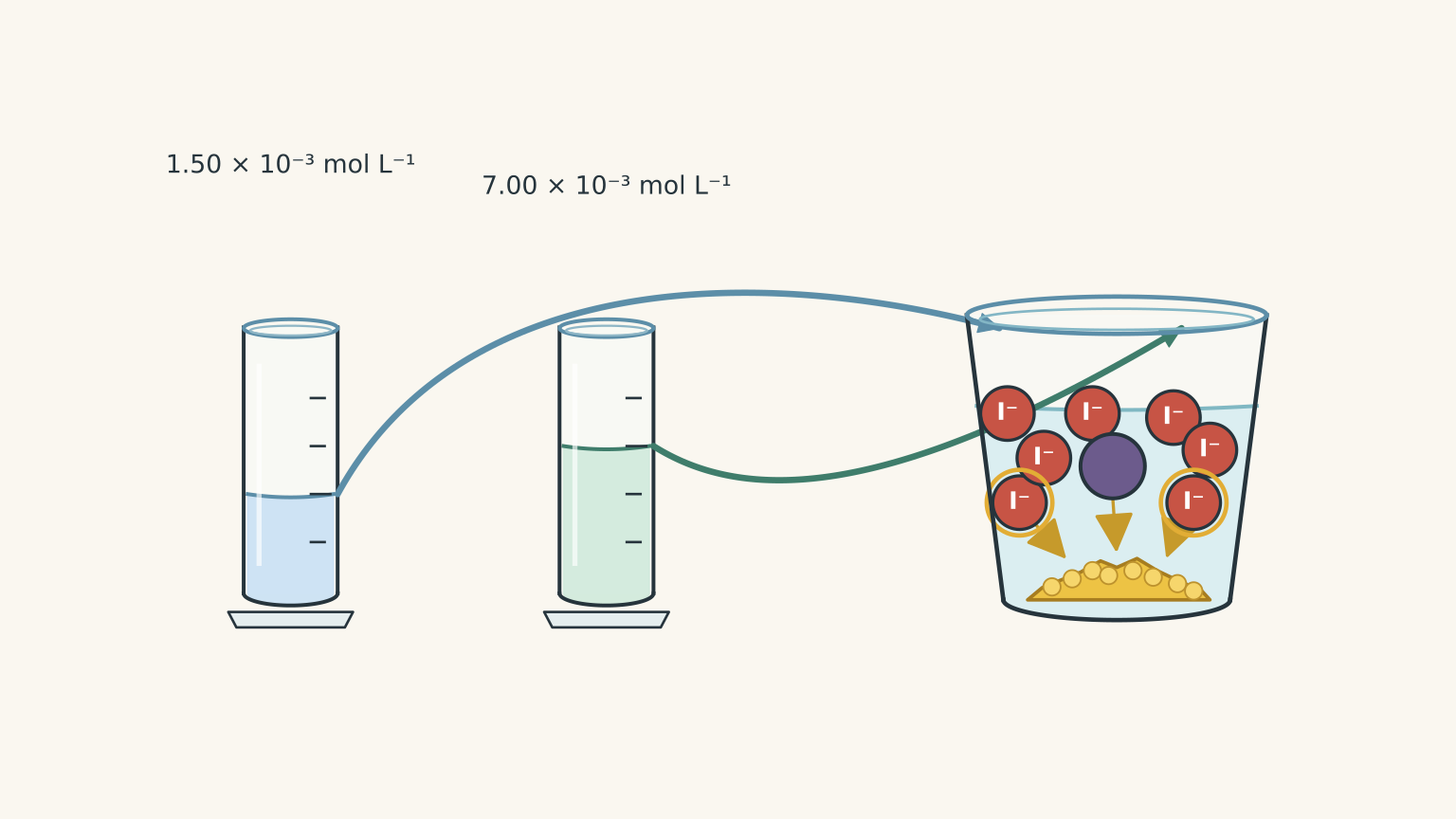
Due to technical limitations, this figure may display incorrectly or contain inaccuracies. Please check key details against your course materials.
05The common mistake: Using the original concentrations
This mistake is particularly tempting because the concentrations are already provided in the question.
Consider another silver chloride example.
Mix:
- \(10.0\,\mathrm{mL}\) of \(2.00\times10^{-5}\,\mathrm{mol\,L^{-1}}\) \(\ce{AgNO3}\).
- \(90.0\,\mathrm{mL}\) of \(2.00\times10^{-5}\,\mathrm{mol\,L^{-1}}\) \(\ce{NaCl}\).
The total volume is \(100.0\,\mathrm{mL}\), and:
\[ K_{sp}=1.80\times10^{-10} \]
A student might calculate:
\[ Q_{sp}=(2.00\times10^{-5})^2 \]
\[ Q_{sp}=4.00\times10^{-10} \]
They then conclude that precipitation occurs because \(Q_{sp}>K_{sp}\).
Unfortunately, this calculation uses the wrong concentrations.
Calculate the actual concentrations
For silver ions:
\[ \begin{aligned} n(\mathrm{Ag}^{+}) &=2.00\times10^{-5}\times0.0100\\ &=2.00\times10^{-7}\,\mathrm{mol} \end{aligned} \]
Therefore:
\[ [\mathrm{Ag}^{+}] =\frac{2.00\times10^{-7}}{0.1000} =2.00\times10^{-6}\,\mathrm{mol\,L^{-1}} \]
For chloride ions:
\[ \begin{aligned} n(\mathrm{Cl}^{-}) &=2.00\times10^{-5}\times0.0900\\ &=1.80\times10^{-6}\,\mathrm{mol} \end{aligned} \]
Therefore:
\[ [\mathrm{Cl}^{-}] =\frac{1.80\times10^{-6}}{0.1000} =1.80\times10^{-5}\,\mathrm{mol\,L^{-1}} \]
Now calculate the correct reaction quotient:
\[ \begin{aligned} Q_{sp} &=(2.00\times10^{-6}) (1.80\times10^{-5})\\ &=3.60\times10^{-11} \end{aligned} \]
Compare:
\[ 3.60\times10^{-11} < 1.80\times10^{-10} \]
Correct prediction No silver chloride precipitation is thermodynamically favoured.
Due to technical limitations, this figure may display incorrectly or contain inaccuracies. Please check key details against your course materials.
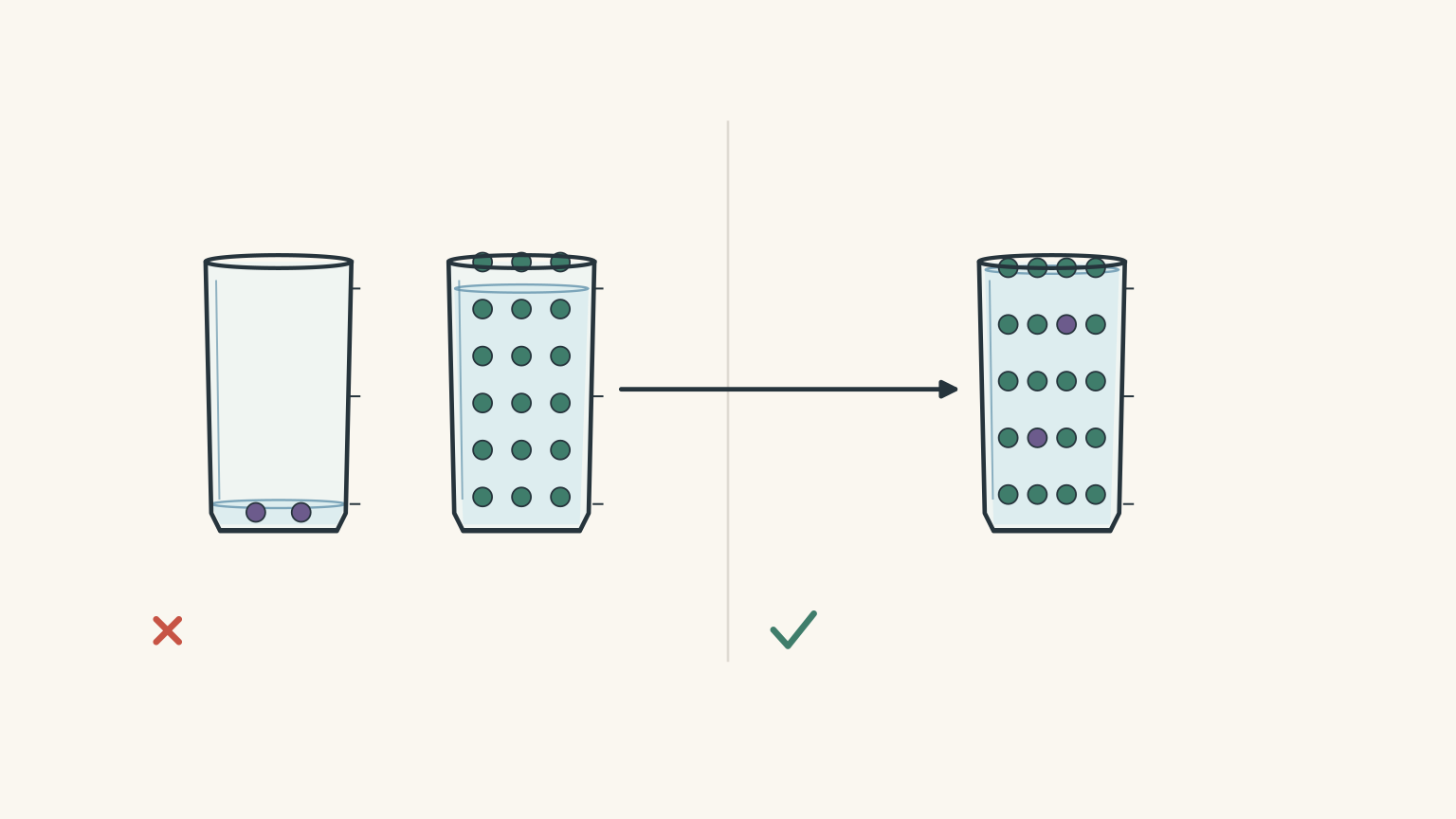
The original concentrations were identical, but the volumes transferred were very different.
That is why you cannot assume both ions experience the same dilution.
The lesson is simple: calculate the moles first, then calculate the concentrations in the combined volume.
06How to interpret Q compared with K
Once you have calculated \(Q\), you need to interpret it correctly.
For a general reversible reaction:
\[ \ce{aA + bB <=> cC + dD} \]
the comparison is:
| Comparison | Prediction |
|---|---|
| \(Q<K\) | Net reaction proceeds forwards, towards products. |
| \(Q>K\) | Net reaction proceeds backwards, towards reactants. |
| \(Q=K\) | The system is at equilibrium. |
For a sparingly soluble salt, using the dissolution equation:
\[ \ce{MX(s) <=> M^2+(aq) + X^2-(aq)} \]
the interpretation is:
| Comparison | Interpretation |
|---|---|
| \(Q_{sp}<K_{sp}\) | Solution is unsaturated. No precipitation is favoured. |
| \(Q_{sp}=K_{sp}\) | Solution is saturated and at equilibrium with the solid. |
| \(Q_{sp}>K_{sp}\) | Solution is supersaturated. Precipitation is favoured. |
There is a subtle but important difference in how you describe the direction.
For the dissolution equation, \(Q_{sp}>K_{sp}\) means the reaction shifts backwards. That backward reaction forms the solid, so precipitation occurs.
Why temperature matters
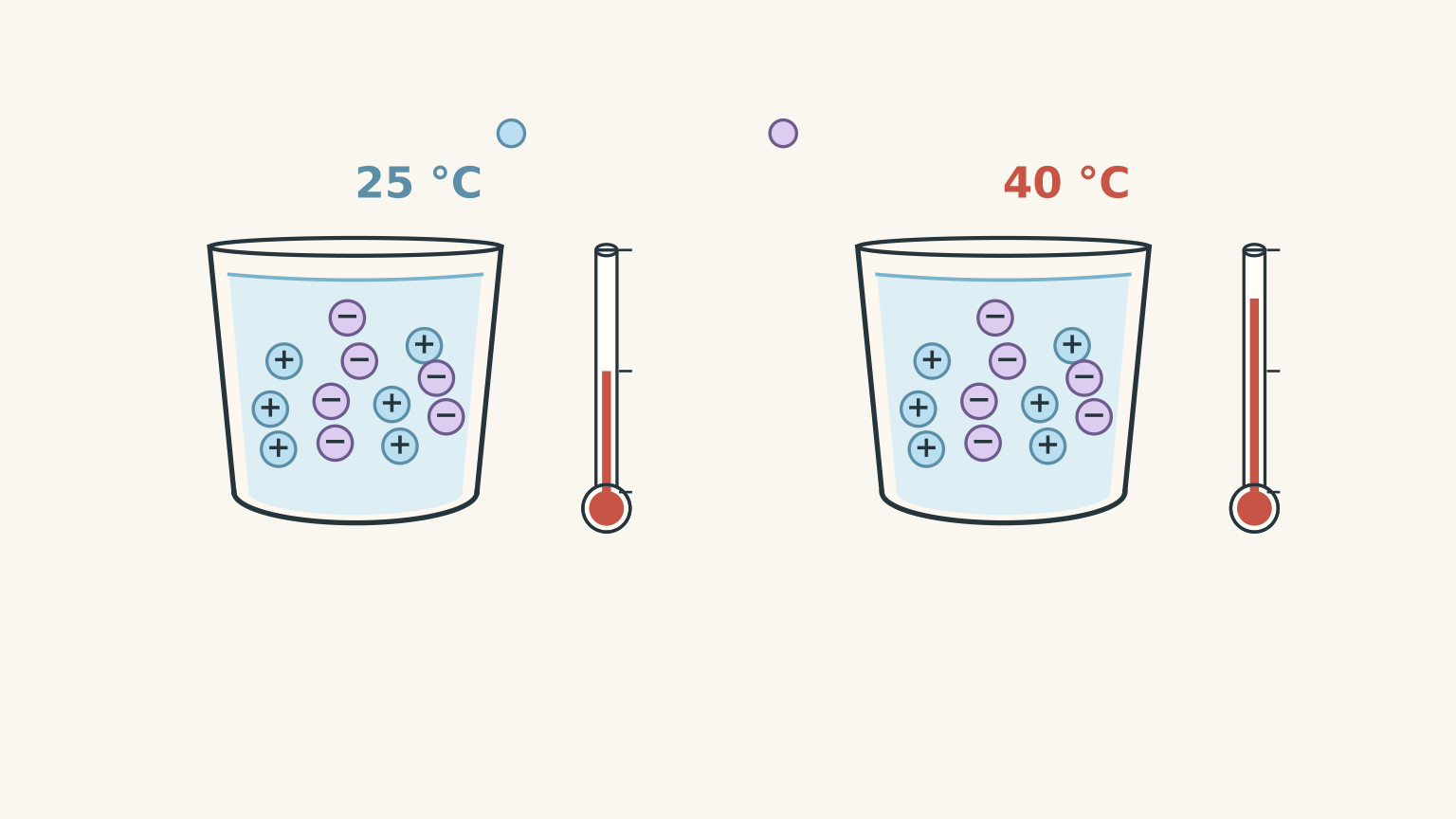
You must compare Q and K at the same temperature.
The reaction quotient depends on the concentrations at the moment you calculate it.
The equilibrium constant depends on the reaction and temperature.
Changing the temperature can change \(K\), even if the concentrations have not yet changed.
For example, suppose a particular salt has:
\[ K_{sp}(25^\circ\mathrm{C})=2.0\times10^{-8} \]
and:
\[ K_{sp}(40^\circ\mathrm{C})=8.0\times10^{-8} \]
If the initial ion product is \(6.0\times10^{-8}\), precipitation is favoured at \(25^\circ\mathrm{C}\), but not at \(40^\circ\mathrm{C}\), provided the concentrations remain unchanged.
The temperature has changed the equilibrium constant, not the initial ion product.
In an actual mixing experiment, record the final mixture temperature. If the solutions start at different temperatures, do not automatically use the temperature of either original solution.
Due to technical limitations, this figure may display incorrectly or contain inaccuracies. Please check key details against your course materials.
Does a large Q mean lots of precipitate?
Not necessarily.
The numerical size of Q has no useful interpretation on its own.
For example, a value of \(10^{-6}\) could be much larger than one equilibrium constant and much smaller than another.
You need to compare Q with the corresponding K for the same reaction and temperature.
Also, Q does not tell you how quickly a reaction will occur.
Even when \(Q_{sp}>K_{sp}\), visible precipitation can take time because the formation of stable crystal nuclei may be delayed. This is a kinetic effect, not a change in the thermodynamic prediction.
Finally, Q does not calculate the mass of precipitate formed. It tells you whether precipitation is favoured initially. Calculating the amount formed requires further stoichiometric and equilibrium calculations.
Assumptions behind the HSC calculation
The standard mixing calculations usually assume:
- The volumes of the solutions are additive.
- Soluble ionic compounds dissociate completely.
- There are no significant side reactions, such as complex-ion formation.
- The concentrations used represent the free dissolved ions.
- The temperature is constant unless the question specifies otherwise.
- The concentration approximation is suitable for the system.
In more concentrated real solutions, ion interactions can affect activities, so concentration-based quotients become approximations. For typical HSC calculations, use the concentration model and assumptions supplied in the question.
07Questions and solutions
Try each question before reading its solution. The questions progress from a straightforward precipitation calculation to more complicated situations involving existing products, reaction direction, and temperature.
Question 1
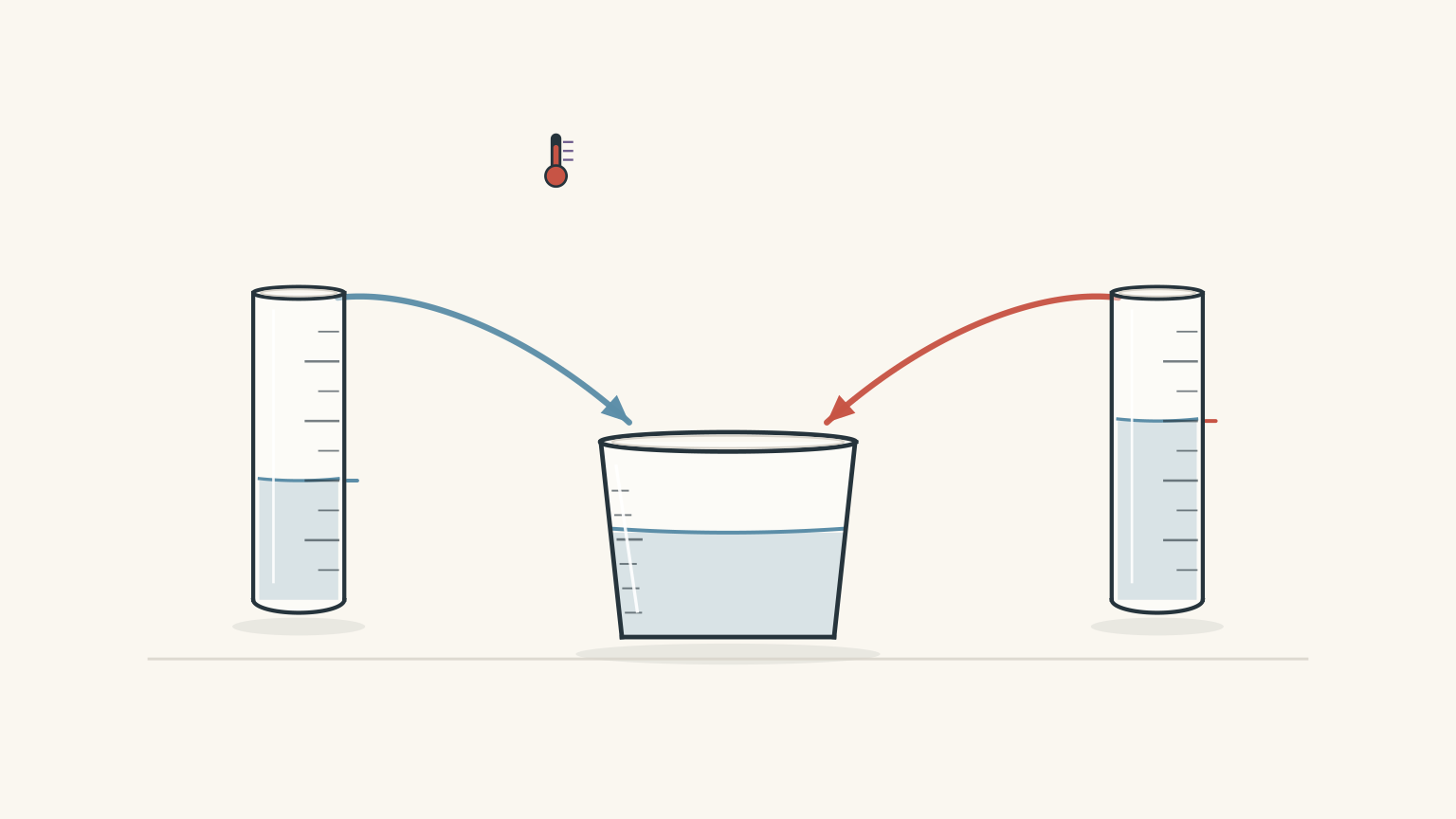
A student mixes \(20.0\,\mathrm{mL}\) of \(1.00\times10^{-4}\,\mathrm{mol\,L^{-1}}\) silver nitrate with \(30.0\,\mathrm{mL}\) of \(2.00\times10^{-4}\,\mathrm{mol\,L^{-1}}\) sodium chloride.
Both solutions are at \(25.0^\circ\mathrm{C}\).
Given:
\[ K_{sp}(\ce{AgCl})=1.80\times10^{-10} \]
Assuming complete dissociation and additive volumes:
a) Calculate the concentration of each reacting ion immediately after mixing.
b) Calculate \(Q_{sp}\).
c) Predict whether a precipitate forms and justify your answer.
Due to technical limitations, this figure may display incorrectly or contain inaccuracies. Please check key details against your course materials.
Solution 1
Silver chloride precipitation is favoured because \(Q_{sp}=4.80\times10^{-9}\), which is greater than \(K_{sp}=1.80\times10^{-10}\).
Step 1: Write the equilibrium expression.
\[ \ce{AgCl(s) <=> Ag+(aq) + Cl-(aq)} \]
\[ Q_{sp}=[\mathrm{Ag}^{+}][\mathrm{Cl}^{-}] \]
Step 2: Calculate the moles of each ion.
For silver ions:
\[ \begin{aligned} n(\mathrm{Ag}^{+}) &=1.00\times10^{-4}\times0.0200\\ &=2.00\times10^{-6}\,\mathrm{mol} \end{aligned} \]
For chloride ions:
\[ \begin{aligned} n(\mathrm{Cl}^{-}) &=2.00\times10^{-4}\times0.0300\\ &=6.00\times10^{-6}\,\mathrm{mol} \end{aligned} \]
Step 3: Calculate the total volume.
\[ V_{\text{total}}=0.0200+0.0300 \]
\[ V_{\text{total}}=0.0500\,\mathrm{L} \]
Step 4: Calculate the final concentrations.
\[ [\mathrm{Ag}^{+}] =\frac{2.00\times10^{-6}}{0.0500} \]
\[ [\mathrm{Ag}^{+}]=4.00\times10^{-5}\,\mathrm{mol\,L^{-1}} \]
Similarly:
\[ [\mathrm{Cl}^{-}] =\frac{6.00\times10^{-6}}{0.0500} \]
\[ [\mathrm{Cl}^{-}]=1.20\times10^{-4}\,\mathrm{mol\,L^{-1}} \]
Step 5: Calculate Qsp.
\[ \begin{aligned} Q_{sp} &=(4.00\times10^{-5}) (1.20\times10^{-4})\\ &=4.80\times10^{-9} \end{aligned} \]
Step 6: Compare Qsp and Ksp.
\[ 4.80\times10^{-9} > 1.80\times10^{-10} \]
Therefore, silver chloride precipitation is favoured.
The solution is supersaturated immediately after mixing, so the dissolved ions will tend to form solid silver chloride.
Question 2
Consider the equilibrium:
\[ \ce{Fe^3+(aq) + SCN^-(aq) <=> FeSCN^2+(aq)} \]
At \(25.0^\circ\mathrm{C}\), the equilibrium constant is:
\[ K_c=5.00\times10^2\,\mathrm{L\,mol^{-1}} \]
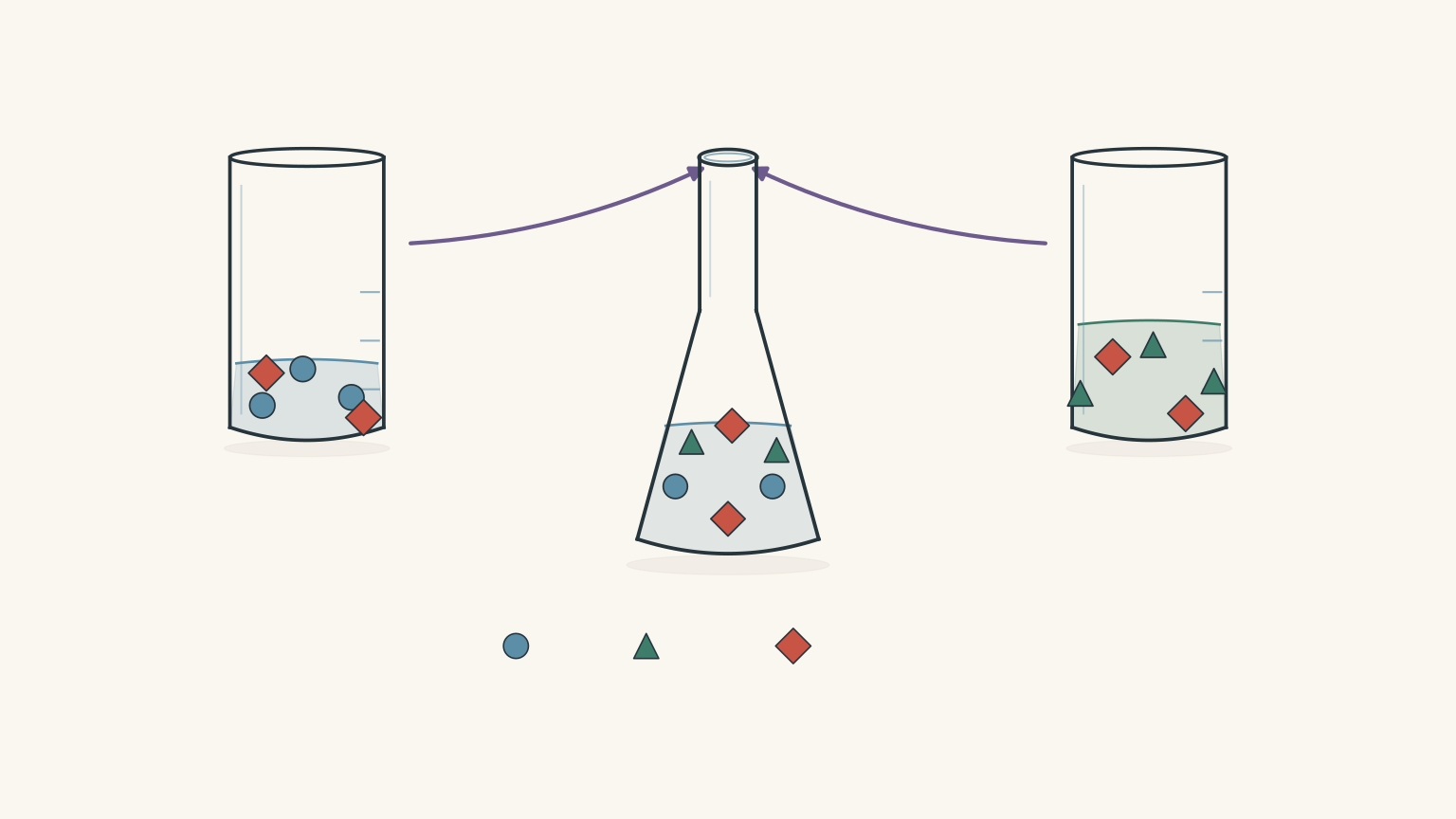
Two solutions are mixed:
Solution A:
- \(40.0\,\mathrm{mL}\)
- \([\mathrm{Fe}^{3+}]=2.00\times10^{-3}\,\mathrm{mol\,L^{-1}}\)
- \([\mathrm{FeSCN}^{2+}]=1.00\times10^{-4}\,\mathrm{mol\,L^{-1}}\)
Solution B:
- \(60.0\,\mathrm{mL}\)
- \([\mathrm{SCN}^{-}]=3.00\times10^{-3}\,\mathrm{mol\,L^{-1}}\)
- \([\mathrm{FeSCN}^{2+}]=2.00\times10^{-4}\,\mathrm{mol\,L^{-1}}\)
Assume additive volumes, no side reactions, and that all species remain dissolved.
a) Calculate the concentrations of all three reacting species immediately after mixing.
b) Calculate \(Q_c\).
c) Determine the direction in which the net reaction proceeds to reach equilibrium.
Due to technical limitations, this figure may display incorrectly or contain inaccuracies. Please check key details against your course materials.
Solution 2
The net reaction proceeds forwards, forming more \(\mathrm{FeSCN}^{2+}\), because \(Q_c=1.11\times10^2\) is smaller than \(K_c=5.00\times10^2\).
Step 1: Write the reaction quotient.
\[ Q_c= \frac{[\mathrm{FeSCN}^{2+}]} {[\mathrm{Fe}^{3+}][\mathrm{SCN}^{-}]} \]
Step 2: Calculate the moles of iron(III) ions.
Only Solution A contains iron(III) ions.
\[ \begin{aligned} n(\mathrm{Fe}^{3+}) &=2.00\times10^{-3}\times0.0400\\ &=8.00\times10^{-5}\,\mathrm{mol} \end{aligned} \]
Step 3: Calculate the moles of thiocyanate ions.
Only Solution B contains thiocyanate ions.
\[ \begin{aligned} n(\mathrm{SCN}^{-}) &=3.00\times10^{-3}\times0.0600\\ &=1.80\times10^{-4}\,\mathrm{mol} \end{aligned} \]
Step 4: Calculate the total moles of complex ions.
This is the important part.
Both solutions already contain \(\mathrm{FeSCN}^{2+}\). You must include the contribution from each.
From Solution A:
\[ n_A=1.00\times10^{-4}\times0.0400 \]
\[ n_A=4.00\times10^{-6}\,\mathrm{mol} \]
From Solution B:
\[ n_B=2.00\times10^{-4}\times0.0600 \]
\[ n_B=1.20\times10^{-5}\,\mathrm{mol} \]
Total:
\[ \begin{aligned} n(\mathrm{FeSCN}^{2+}) &=4.00\times10^{-6} +1.20\times10^{-5}\\ &=1.60\times10^{-5}\,\mathrm{mol} \end{aligned} \]
Step 5: Calculate the total volume.
\[ V_{\text{total}}=0.0400+0.0600 \]
\[ V_{\text{total}}=0.1000\,\mathrm{L} \]
Step 6: Calculate the new concentrations.
\[ [\mathrm{Fe}^{3+}] =\frac{8.00\times10^{-5}}{0.1000} =8.00\times10^{-4}\,\mathrm{mol\,L^{-1}} \]
\[ [\mathrm{SCN}^{-}] =\frac{1.80\times10^{-4}}{0.1000} =1.80\times10^{-3}\,\mathrm{mol\,L^{-1}} \]
\[ [\mathrm{FeSCN}^{2+}] =\frac{1.60\times10^{-5}}{0.1000} =1.60\times10^{-4}\,\mathrm{mol\,L^{-1}} \]
Step 7: Calculate Qc.
\[ \begin{aligned} Q_c &=\frac{1.60\times10^{-4}} {(8.00\times10^{-4})(1.80\times10^{-3})}\\ &=\frac{1.60\times10^{-4}}{1.44\times10^{-6}}\\ &=1.11\times10^2\,\mathrm{L\,mol^{-1}} \end{aligned} \]
Step 8: Compare Qc with Kc.
\[ 1.11\times10^2<5.00\times10^2 \]
Therefore:
\[ Q_c<K_c \]
The reaction proceeds forwards, consuming \(\mathrm{Fe}^{3+}\) and \(\mathrm{SCN}^{-}\) to produce more \(\mathrm{FeSCN}^{2+}\).
A tempting mistake would be to assume that the product concentration is initially zero because the product is formed by the reaction. However, the question explicitly tells you that both starting solutions already contain some complex ions.
Always include every source of a reacting species.
Question 3
A student is calculating whether silver chloride precipitates from a solution containing:
\[ [\mathrm{Ag}^{+}]=2.00\times10^{-5}\,\mathrm{mol\,L^{-1}} \]
\[ [\mathrm{Cl}^{-}]=1.00\times10^{-5}\,\mathrm{mol\,L^{-1}} \]
At \(25.0^\circ\mathrm{C}\):
\[ K_{sp}(\ce{AgCl})=1.80\times10^{-10} \]
The student writes:
\[ \ce{Ag+(aq) + Cl-(aq) <=> AgCl(s)} \]
They then calculate:
\[ Q=[\mathrm{Ag}^{+}][\mathrm{Cl}^{-}] \]
and compare this value directly with \(K_{sp}\).
Explain the error in the student’s approach. Calculate the correct reaction quotient for the equation they wrote, and demonstrate how it gives the same precipitation prediction as the conventional \(Q_{sp}\) method.
Solution 3
The student’s numerical calculation is a valid ion-product calculation, but it is not the reaction quotient for the precipitation equation they wrote.
The error is mixing the reaction direction used for \(Q\) with the equilibrium constant for the opposite direction.
Step 1: Calculate the conventional ion product.
For silver chloride dissolution:
\[ \ce{AgCl(s) <=> Ag+(aq) + Cl-(aq)} \]
The ion product is:
\[ Q_{sp}=[\mathrm{Ag}^{+}][\mathrm{Cl}^{-}] \]
Substitute:
\[ \begin{aligned} Q_{sp} &=(2.00\times10^{-5}) (1.00\times10^{-5})\\ &=2.00\times10^{-10} \end{aligned} \]
Compare:
\[ 2.00\times10^{-10} > 1.80\times10^{-10} \]
Therefore, precipitation is favoured.
Step 2: Write the correct quotient for the student’s equation.
The student wrote:
\[ \ce{Ag+ + Cl- <=> AgCl(s)} \]
The product is a pure solid, so it is excluded.
The correct quotient is:
\[ Q_c=\frac{1}{[\mathrm{Ag}^{+}][\mathrm{Cl}^{-}]} \]
Therefore:
\[ Q_c=\frac{1}{2.00\times10^{-10}} \]
\[ Q_c=5.00\times10^9 \]
Step 3: Reverse the equilibrium constant as well.
When a chemical equation is reversed, its equilibrium constant becomes its reciprocal.
Therefore:
\[ K_{\text{precipitation}}=\frac{1}{K_{sp}} \]
\[ K_{\text{precipitation}} =\frac{1}{1.80\times10^{-10}} \]
\[ K_{\text{precipitation}} =5.56\times10^9 \]
Step 4: Compare the consistent values.
\[ Q_c=5.00\times10^9 \]
\[ K_c=5.56\times10^9 \]
Therefore:
\[ Q_c<K_c \]
The precipitation reaction proceeds forwards, forming solid silver chloride.
Both approaches give the same prediction.
The important rule is that reversing a chemical equation also reverses its equilibrium constant. You cannot reverse one without reversing the other.
For most HSC precipitation calculations, using the dissolution equation and comparing \(Q_{sp}\) directly with \(K_{sp}\) is the simpler method.
Question 4
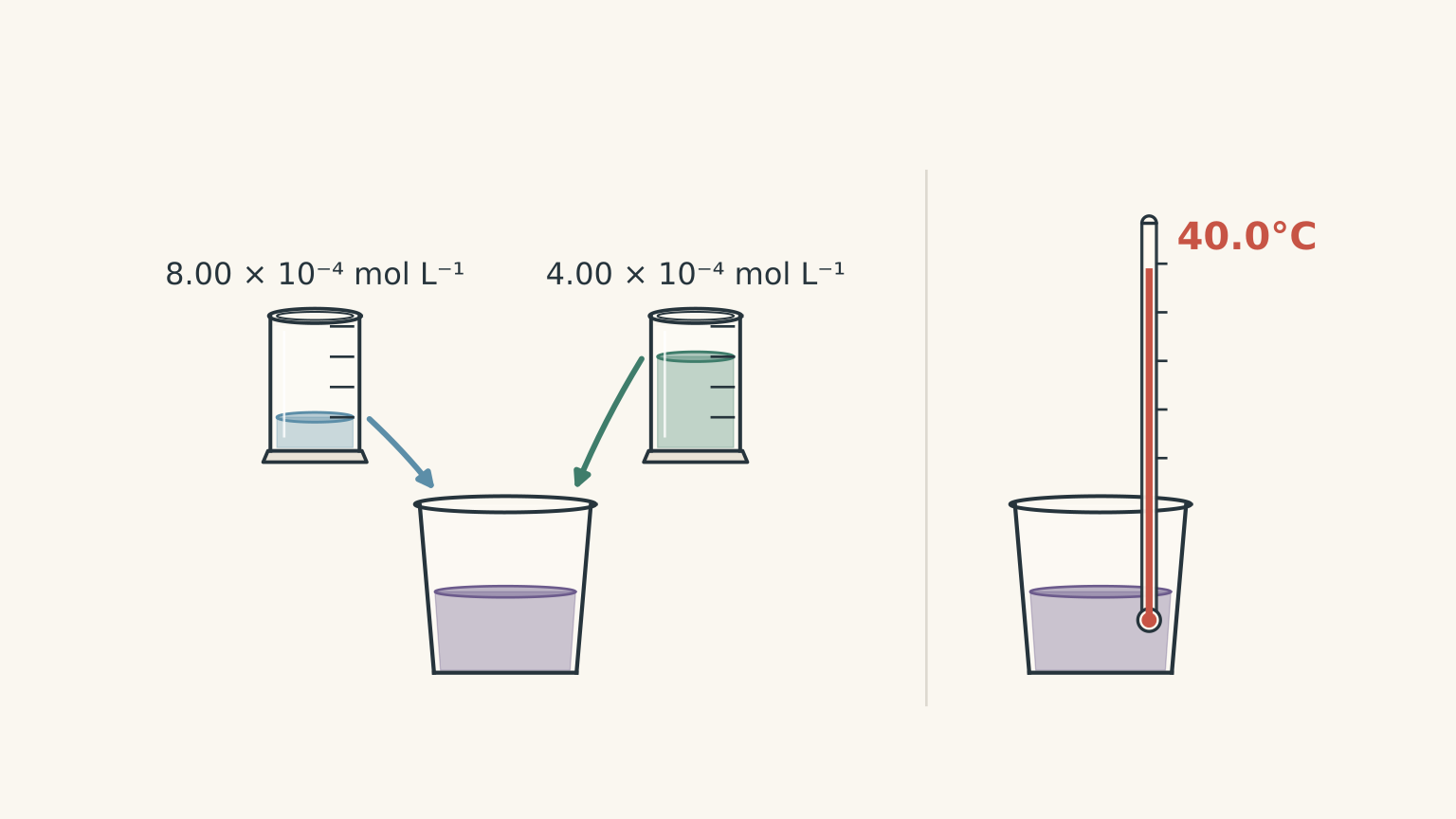
A hypothetical sparingly soluble salt, \(\ce{MX}\), dissolves according to:
\[ \ce{MX(s) <=> M^2+(aq) + X^2-(aq)} \]
Two solutions are mixed at \(25.0^\circ\mathrm{C}\):
- \(25.0\,\mathrm{mL}\) of \(8.00\times10^{-4}\,\mathrm{mol\,L^{-1}}\) \(\ce{MCl2}\).
- \(75.0\,\mathrm{mL}\) of \(4.00\times10^{-4}\,\mathrm{mol\,L^{-1}}\) \(\ce{Na2X}\).
The following equilibrium constants are supplied:
\[ K_{sp}(25^\circ\mathrm{C})=2.00\times10^{-8} \]
\[ K_{sp}(40^\circ\mathrm{C})=8.00\times10^{-8} \]
Assume the salts dissociate completely, the volumes are additive, and there are no side reactions.
a) Calculate \(Q_{sp}\) immediately after mixing.
b) Predict whether precipitation is favoured at \(25.0^\circ\mathrm{C}\).
c) A separate identical mixture is prepared and brought to \(40.0^\circ\mathrm{C}\) before any appreciable precipitation occurs. Assume the initial concentrations remain unchanged during this temperature adjustment. Predict what happens now.
Due to technical limitations, this figure may display incorrectly or contain inaccuracies. Please check key details against your course materials.
Solution 4
The initial ion product is \(6.00\times10^{-8}\). Precipitation is favoured at \(25.0^\circ\mathrm{C}\), but not at \(40.0^\circ\mathrm{C}\) when the concentrations remain unchanged.
Step 1: Write the solubility product expression.
\[ \ce{MX(s) <=> M^2+(aq) + X^2-(aq)} \]
Therefore:
\[ Q_{sp}=[\mathrm{M}^{2+}][\mathrm{X}^{2-}] \]
Step 2: Calculate the moles of each ion.
For \(\mathrm{M}^{2+}\):
\[ \begin{aligned} n(\mathrm{M}^{2+}) &=8.00\times10^{-4}\times0.0250\\ &=2.00\times10^{-5}\,\mathrm{mol} \end{aligned} \]
For \(\mathrm{X}^{2-}\):
\[ \begin{aligned} n(\mathrm{X}^{2-}) &=4.00\times10^{-4}\times0.0750\\ &=3.00\times10^{-5}\,\mathrm{mol} \end{aligned} \]
Step 3: Calculate the total volume.
\[ V_{\text{total}}=0.0250+0.0750 \]
\[ V_{\text{total}}=0.1000\,\mathrm{L} \]
Step 4: Calculate the final concentrations.
\[ [\mathrm{M}^{2+}] =\frac{2.00\times10^{-5}}{0.1000} \]
\[ [\mathrm{M}^{2+}]=2.00\times10^{-4}\,\mathrm{mol\,L^{-1}} \]
Similarly:
\[ [\mathrm{X}^{2-}] =\frac{3.00\times10^{-5}}{0.1000} \]
\[ [\mathrm{X}^{2-}]=3.00\times10^{-4}\,\mathrm{mol\,L^{-1}} \]
Step 5: Calculate Qsp.
\[ \begin{aligned} Q_{sp} &=(2.00\times10^{-4})(3.00\times10^{-4})\\ &=6.00\times10^{-8} \end{aligned} \]
Step 6: Predict what happens at \(25.0^\circ\mathrm{C}\).
\[ Q_{sp}=6.00\times10^{-8} \]
\[ K_{sp}=2.00\times10^{-8} \]
Since:
\[ Q_{sp}>K_{sp} \]
precipitation is favoured at \(25.0^\circ\mathrm{C}\).
Step 7: Reconsider the mixture at \(40.0^\circ\mathrm{C}\).
The question states that the concentrations remain unchanged during the temperature adjustment.
Therefore:
\[ Q_{sp}=6.00\times10^{-8} \]
However, the new equilibrium constant is:
\[ K_{sp}=8.00\times10^{-8} \]
Now:
\[ Q_{sp}<K_{sp} \]
The solution is unsaturated at \(40.0^\circ\mathrm{C}\), so precipitation is no longer favoured.
If solid were already present, dissolution would be favoured under these stated conditions.
This question demonstrates why you cannot treat \(K_{sp}\) as an unchanging number. The initial ion concentrations determine Q, but the temperature determines which equilibrium constant you must compare it against.
Question 5
This final question combines dilution, equilibrium, and temperature. The challenge is to avoid confidently applying the correct rule at the wrong temperature.
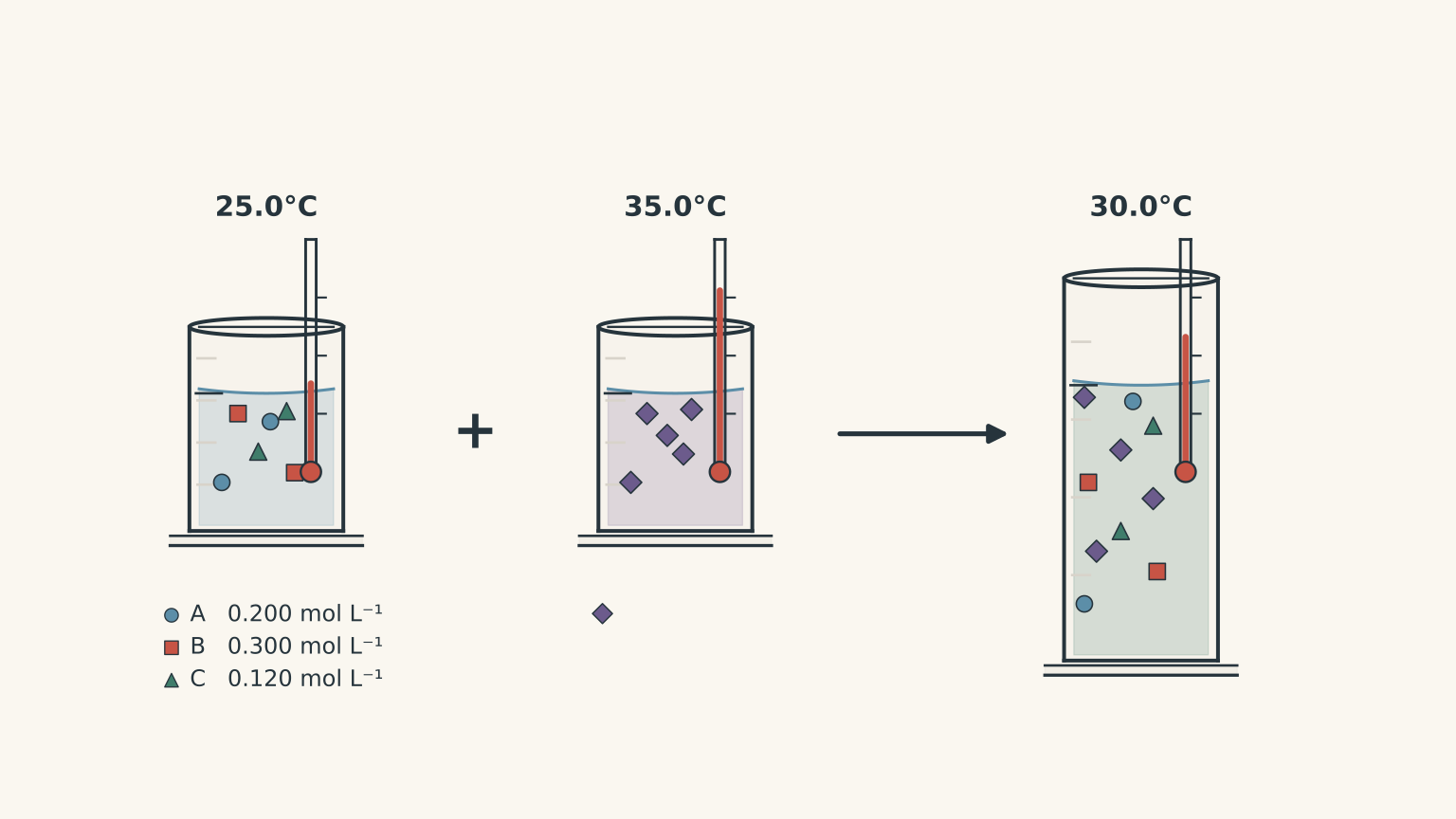
Consider the reversible reaction:
\[ \ce{A(aq) + B(aq) <=> C(aq)} \]
At \(25.0^\circ\mathrm{C}\), an equilibrium mixture has the following concentrations:
| Species | Concentration |
|---|---|
| A | \(0.200\,\mathrm{mol\,L^{-1}}\) |
| B | \(0.300\,\mathrm{mol\,L^{-1}}\) |
| C | \(0.120\,\mathrm{mol\,L^{-1}}\) |
The equilibrium constant at \(25.0^\circ\mathrm{C}\) is:
\[ K_c(25^\circ\mathrm{C})=2.00\,\mathrm{L\,mol^{-1}} \]
This \(100.0\,\mathrm{mL}\) equilibrium mixture is combined with \(100.0\,\mathrm{mL}\) of a second solution containing only an inert, non-reacting solute. The second solution is initially at \(35.0^\circ\mathrm{C}\).
Assume:
- Both solutions have equal heat capacities per unit volume.
- Their volumes are additive.
- The final mixture temperature is \(30.0^\circ\mathrm{C}\).
- No evaporation or reaction occurs before mixing is complete.
- The inert solute does not affect the reaction or the activity coefficients.
- The equilibrium constant at \(30.0^\circ\mathrm{C}\) is \(5.00\,\mathrm{L\,mol^{-1}}\).
Answer the following:
a) Verify that the original mixture is at equilibrium at \(25.0^\circ\mathrm{C}\).
b) Calculate the concentrations of A, B, and C immediately after mixing.
c) Calculate the new reaction quotient.
d) Predict the direction of the net reaction at \(30.0^\circ\mathrm{C}\).
e) Explain why using the original \(25.0^\circ\mathrm{C}\) equilibrium constant would produce the opposite prediction. Verify your final prediction using the reverse reaction.
Due to technical limitations, this figure may display incorrectly or contain inaccuracies. Please check key details against your course materials.
Solution 5
The net reaction proceeds forwards, forming more C at \(30.0^\circ\mathrm{C}\).
The crucial point is that dilution changes Q, while the temperature change also changes K. You must account for both before predicting the direction.
Step 1: Verify the original equilibrium.
The reaction is:
\[ \ce{A(aq) + B(aq) <=> C(aq)} \]
The equilibrium expression is:
\[ K_c=\frac{[C]}{[A][B]} \]
Substitute the original concentrations:
\[ \begin{aligned} Q_c &=\frac{0.120}{(0.200)(0.300)}\\ &=\frac{0.120}{0.0600}\\ &=2.00\,\mathrm{L\,mol^{-1}} \end{aligned} \]
Since:
\[ Q_c=K_c \]
the original mixture is at equilibrium at \(25.0^\circ\mathrm{C}\).
Step 2: Calculate the concentrations after mixing.
The original solution volume is \(100.0\,\mathrm{mL}\).
The final volume is:
\[ V_{\text{total}}=100.0+100.0 \]
\[ V_{\text{total}}=200.0\,\mathrm{mL} \]
The inert solution contributes none of A, B, or C.
Therefore, the amount of each reactive species stays the same, but its concentration is halved.
For A:
\[ [A]_{\text{new}}=\frac{0.200}{2} \]
\[ [A]_{\text{new}}=0.100\,\mathrm{mol\,L^{-1}} \]
For B:
\[ [B]_{\text{new}}=\frac{0.300}{2} \]
\[ [B]_{\text{new}}=0.150\,\mathrm{mol\,L^{-1}} \]
For C:
\[ [C]_{\text{new}}=\frac{0.120}{2} \]
\[ [C]_{\text{new}}=0.0600\,\mathrm{mol\,L^{-1}} \]
Step 3: Calculate the new reaction quotient.
Use the concentrations immediately after mixing:
\[ Q_c=\frac{[C]}{[A][B]} \]
Substitute:
\[ \begin{aligned} Q_c &=\frac{0.0600}{(0.100)(0.150)}\\ &=\frac{0.0600}{0.0150}\\ &=4.00\,\mathrm{L\,mol^{-1}} \end{aligned} \]
Therefore:
\[ Q_c=4.00\,\mathrm{L\,mol^{-1}} \]
Notice that Q has doubled, even though every concentration has halved.
Why?
The denominator contains two concentration terms, while the numerator contains only one. Halving both reactant concentrations reduces their product by a factor of four, whereas halving the product concentration only reduces the numerator by a factor of two.
Consequently, the quotient doubles.
Step 4: Use the equilibrium constant at the final temperature.
The final temperature is \(30.0^\circ\mathrm{C}\).
Therefore, the correct equilibrium constant is:
\[ K_c(30^\circ\mathrm{C})=5.00\,\mathrm{L\,mol^{-1}} \]
Compare:
\[ Q_c=4.00 \]
\[ K_c=5.00 \]
Since:
\[ Q_c<K_c \]
the net reaction proceeds forwards, producing more C.
Step 5: Investigate the tempting alternative.
A student might compare the new Q with the original equilibrium constant:
\[ Q_c=4.00 \]
\[ K_c(25^\circ\mathrm{C})=2.00 \]
They would conclude:
\[ Q_c>K_c \]
and predict a backwards reaction.
This would be correct if the final mixture remained at \(25.0^\circ\mathrm{C}\).
At constant temperature, the dilution has increased Q relative to K, favouring the side with more dissolved particles, A and B.
However, the mixture is now at \(30.0^\circ\mathrm{C}\), not \(25.0^\circ\mathrm{C}\).
The equilibrium constant has increased from 2.00 to 5.00. That change is large enough to reverse the prediction.
The temperature effect and the dilution effect must both be considered. You cannot simply apply the dilution prediction and ignore the new temperature.
Step 6: Verify using the reverse reaction.
Reverse the original equation:
\[ \ce{C(aq) <=> A(aq) + B(aq)} \]
The reverse reaction quotient is:
\[ Q_{\text{reverse}}=\frac{[A][B]}{[C]} \]
Substitute:
\[ \begin{aligned} Q_{\text{reverse}} &=\frac{(0.100)(0.150)}{0.0600}\\ &=0.250\,\mathrm{mol\,L^{-1}} \end{aligned} \]
The reverse equilibrium constant is the reciprocal of the forward equilibrium constant:
\[ K_{\text{reverse}}=\frac{1}{5.00} \]
\[ K_{\text{reverse}}=0.200\,\mathrm{mol\,L^{-1}} \]
Compare:
\[ Q_{\text{reverse}}>K_{\text{reverse}} \]
The reverse reaction therefore proceeds backwards, towards C.
This confirms the original prediction: the net reaction proceeds forwards, producing more C.
The key insight is that the direction of a reaction is determined by comparing Q with K at the actual temperature of the system, not the temperature at which the original equilibrium was established.
Once you can calculate Q immediately after mixing, the next step is to determine how much of the reactants will actually be consumed and how much precipitate can form.
That requires tracking the reacting mole ratios and, where relevant, calculating the equilibrium concentrations remaining after precipitation.
For that next stage, see Mixing Two Solutions: A Worked Limiting-Reagent Problem.
Keep the distinction clear: Q predicts the initial direction of change; stoichiometry and equilibrium calculations determine how far the system proceeds.