
Relativistic Effects in Heavy Elements: Gold and Mercury
Discover how Einstein’s relativity changes electron orbitals in heavy atoms, helping explain why gold is yellow and mercury is liquid at room temperature. Builds on Year 11 Chemistry atomic structure with clear explanations, worked examples, and challenging practice questions.
Under the same white light, a gold ring looks yellow, while a silver ring looks silvery-white. Yet both are metals with mobile electrons that reflect light. Right next to gold on the periodic table is mercury, a metal that remains liquid at room temperature.
Here’s a prediction worth testing: if electrons are attracted more strongly towards an atom’s nucleus, shouldn’t the atoms also bond more strongly to each other?
Not necessarily. Holding electrons tightly within an atom and using electrons to bond neighbouring atoms are different things. That distinction helps explain both gold’s colour and mercury’s unusually low melting point.
This is an extension beyond the required content of the NSW Chemistry 11-12 Syllabus (2025). It builds on the Year 11 focus area Properties and structure of matter, particularly how scientists developed our understanding of atomic structure. Relativistic quantum chemistry itself is not an HSC assessment requirement.
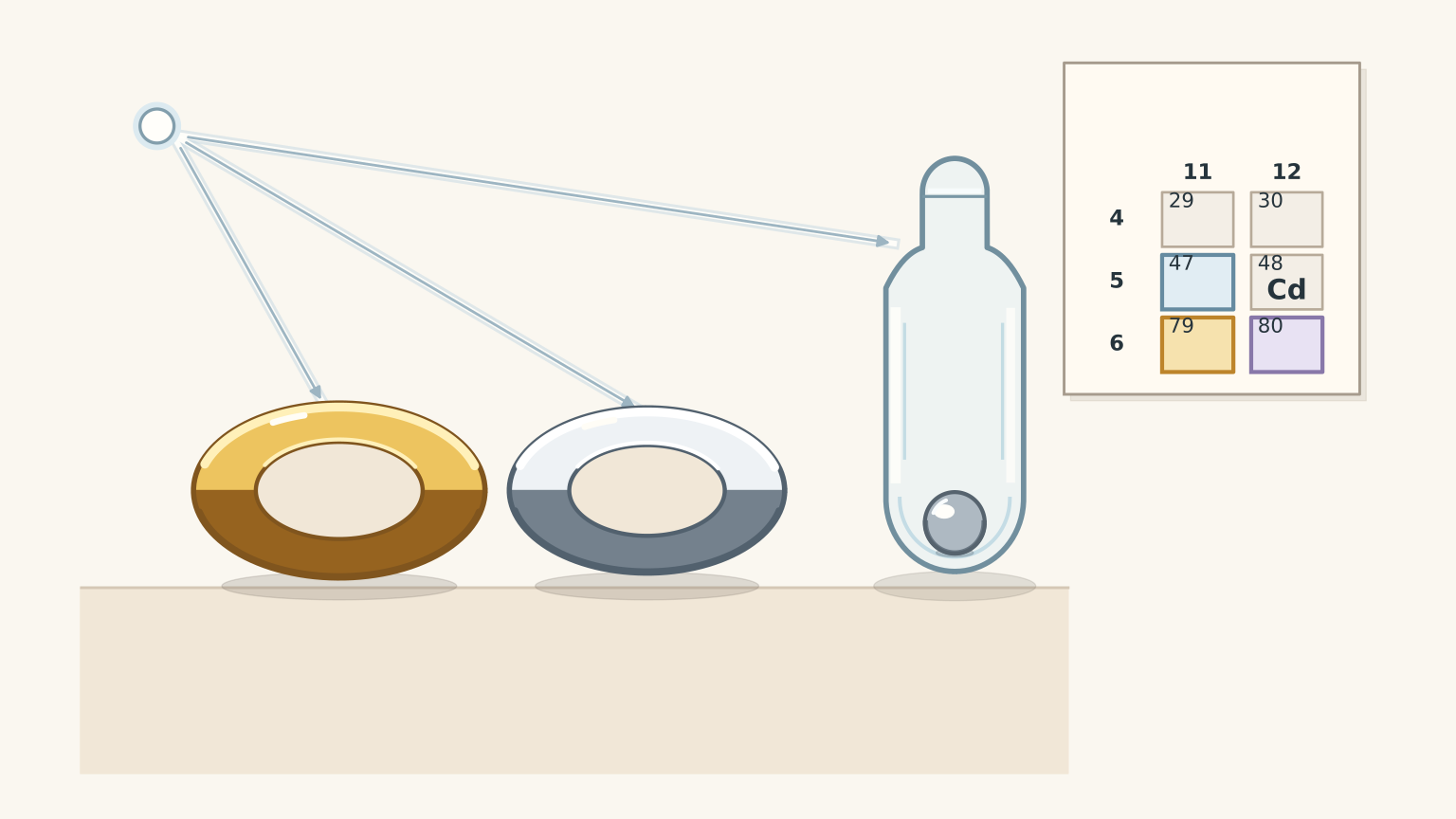
Due to technical limitations, this figure may display incorrectly or contain inaccuracies. Please check key details against your course materials.
01The atomic model we already know
To understand what happens inside heavy atoms, we need to revisit how our picture of electrons developed.
Rutherford’s scattering experiments established that atoms contain a tiny, dense, positively charged nucleus.
Bohr then proposed that electrons occupy specific energy levels. His model helped explain why hydrogen atoms absorb and emit particular wavelengths of light.
But Bohr’s picture of electrons travelling around the nucleus in fixed circular paths couldn’t adequately describe atoms containing many electrons.
In 1926, Erwin Schrödinger developed a wave-based description of electrons. Max Born supplied the probability interpretation: rather than following a definite path, an electron is described by a probability distribution showing where it may be detected.
These developments gave us atomic orbitals.
An orbital is a mathematical description associated with an electron’s energy and spatial probability distribution. The familiar orbital shapes are ways of visualising that distribution, not solid containers or actual electron trajectories.
What the electron configuration tells us
Consider three elements:
| Element | Atomic number | Relevant occupied subshells |
|---|---|---|
| Silver (Ag) | 47 | \(4d^{10}5s^1\) |
| Gold (Au) | 79 | \(5d^{10}6s^1\) |
| Mercury (Hg) | 80 | \(5d^{10}6s^2\) |
These are partial electron configurations. Inner subshells have been omitted.
The number before a letter identifies the principal energy level. The letters \(s\) and \(d\) identify different orbital types, and the superscript gives the number of electrons occupying that subshell.
For example, \(6s^2\) means that two electrons occupy the 6s subshell.
Notice that gold and mercury both have filled \(5d^{10}\) subshells. The difference shown here is that gold has one 6s electron, while mercury has two.
That small difference will become important when we examine metallic bonding.
But electron configuration alone doesn’t explain why gold’s electrons behave differently from silver’s.
For that, we need another contribution to atomic theory.
02Why heavy atoms need relativity
The effect of a strongly charged nucleus
Gold has 79 protons in its nucleus. Mercury has 80.
The number of protons is the atomic number, written as \(Z\). A larger positive nuclear charge can produce a stronger attraction on electrons, especially those that spend time close to the nucleus.
In heavy atoms, electrons experiencing this strong attraction can have sufficiently high characteristic speeds that relativistic effects become important.
Einstein’s special relativity describes how motion behaves at speeds approaching the speed of light. Paul Dirac’s relativistic quantum theory, developed in 1928, combined relativistic principles with the quantum description of electrons.
The result is a more accurate account of electron energies and orbital distributions in heavy atoms.
This doesn’t mean electrons are tiny planets racing around the nucleus. They still behave according to quantum mechanics. Relativity changes the mathematical description of their energies and probability distributions.
Why s orbitals are affected differently from d orbitals
You might expect the nucleus to pull every orbital inward by the same amount.
It doesn’t.
An s orbital has electron probability density extending into the region very close to the nucleus. Even an outer 6s electron can spend some of its time penetrating the region occupied by inner electrons.
A d orbital has a different spatial distribution, with much less probability density close to the nucleus.
This means the two orbital types respond differently when relativistic effects become important.
For many heavy atoms:
- s orbitals contract and become more stable.
- d orbitals can expand and become less stable through an indirect effect.
Here, contraction means the electron probability distribution becomes more concentrated towards the nucleus. It doesn’t mean a solid ball physically shrinks.
Stabilisation means the orbital’s energy becomes lower. An electron in a lower-energy state generally requires more energy to be removed from that state.
Why can d orbitals expand when the nucleus is so attractive?
This seems backwards.
If the nucleus is strongly positive, why would any electron distribution become less tightly held?
The missing idea is electron shielding.
Inner electrons repel outer electrons and partially shield them from the full positive charge of the nucleus.
When relativistic effects change the distribution of s electrons, they also change how the other electrons experience the nucleus.
The more concentrated s-electron density can increase shielding of d electrons. Consequently, those d electrons can experience a weaker effective attraction, become less tightly bound, and occupy a more extended distribution.
So relativity produces two related changes:
- A direct effect, especially strong for s electrons, which become more tightly bound.
- An indirect effect on other orbitals, including d orbitals, through changes in shielding and electron interactions.
The simple result is that the energies of s and d orbitals move closer together in some heavy atoms.
This is the key to gold’s unusual colour.
There is a limit to this explanation. Real relativistic quantum calculations also account for effects such as spin-orbit coupling, which connects an electron’s spin with its motion in the nuclear electric field. The contraction-and-expansion model captures an important trend, but not every detail of a heavy atom’s electronic structure.
03Why gold is yellow but silver is silvery
First, what makes a metal appear coloured?
When white light strikes a metal, some light is reflected and some may be absorbed.
White light contains a range of visible wavelengths, from violet and blue through green, yellow, orange, and red.
If a metal reflects most visible wavelengths fairly evenly, it looks silvery-white.
But if it absorbs more light from one part of the visible spectrum, the reflected light has a different mixture of colours.
Gold absorbs a substantial amount of blue and violet light. Its reflected light is therefore richer in yellow, orange, and red.
That produces its characteristic golden appearance.
The harder question is why gold absorbs those particular wavelengths.
The 5d-6s energy difference
Electrons can absorb light when a photon provides energy for an allowed transition into a higher-energy electronic state.
A photon is a packet of light energy.
For a simple two-state picture:
\[ E_{\text{photon}}=\Delta E \]
Here, \(E_{\text{photon}}\) is the photon’s energy, and \(\Delta E\) is the energy difference between the initial and final electronic states.
Larger energy differences require higher-energy photons.
In solid gold, occupied electronic states derived largely from 5d orbitals lie relatively close in energy to available states in the conduction bands, which have substantial 6s and 6p character.
Because of relativistic effects:
- Gold’s 6s orbital is stabilised.
- Its 5d orbitals are relatively destabilised.
- The separation between the relevant occupied and available electronic states decreases.
That reduced energy separation allows absorption to begin within the visible spectrum.
For gold, a major interband absorption begins at an energy of approximately 2.3 electronvolts, within the visible region.
An electronvolt, abbreviated eV, is a small unit of energy commonly used for electrons and photons.
This allows blue and violet light to be absorbed strongly.
In silver, the corresponding absorption begins at a higher energy, in the ultraviolet region. Most visible light is therefore reflected efficiently.
This difference helps explain why two metals with similar outer electron configurations can have such different colours.
The distinction between isolated atoms and solid metals is important here. In a solid, neighbouring atomic orbitals interact to produce ranges of allowed energies called bands. Gold’s yellow colour is more accurately explained using transitions between those bands, rather than a single electron jumping between two isolated atomic orbitals.
Worked example: Why does the gold reflect a different colour?
Two polished samples, one pure gold and one pure silver, are illuminated with the same white light. Both have shiny metallic surfaces.
Explain why the gold appears yellow while the silver appears silvery-white. Include the role of electron energies and one limitation of the simple orbital explanation.
Step 1
The colour depends on the wavelengths that reach our eyes after reflection.
Gold reflects relatively less blue and violet light, leaving the reflected light enriched in longer visible wavelengths.
Silver reflects visible wavelengths more evenly.
Step 2
Gold’s large nuclear charge makes relativistic effects important.
Its 6s states are stabilised, while its 5d states are relatively raised in energy. This helps reduce the energy required for relevant electronic transitions.
Silver has weaker relativistic changes, so its corresponding absorption is mainly in the ultraviolet.
Step 3
The electrons in a metal occupy bands rather than isolated atomic energy levels.
A precise colour prediction requires the allowed transitions, the distribution of electrons among those states, and the metal’s overall reflection and absorption properties.
Step 4
Gold looks yellow because relativistic effects help shift important electronic absorption into the visible blue-violet region.
The colour is primarily a consequence of selective absorption and reflection, not the metal producing yellow light.
04Why mercury is liquid at room temperature
Now consider the element immediately after gold.
Gold has the outer configuration \(5d^{10}6s^1\).
Mercury has \(5d^{10}6s^2\).
Both experience substantial relativistic effects, including stabilisation of their 6s electrons.
Yet gold melts at approximately \(1064^\circ\mathrm{C}\), while mercury melts at approximately \(-38.8^\circ\mathrm{C}\).
Why such different behaviour?
Metallic bonding depends on what electrons can do between atoms
In the simple Year 11 model of metallic bonding, atoms are held together by attraction involving positively charged metal centres and delocalised electrons.
Delocalised electrons are shared across the metal rather than belonging entirely to one atom.
This helps explain why metals conduct electricity and why many have relatively high melting points.
But not all metals share their electrons equally effectively.
Mercury’s two 6s electrons form a filled pair. Relativistic stabilisation makes these electrons more tightly bound and reduces their contribution to strong bonding between neighbouring mercury atoms.
In other words, the electrons are relatively comfortable in their low-energy states. Sharing electron density between neighbouring atoms offers less of an energetic advantage.
Gold has one 6s electron per neutral atom, and its available electronic states permit stronger metallic cohesion. Its 5d electrons also contribute to its more complex bonding.
The result is that mercury has unusually weak cohesion between atoms compared with many other metals.
Does that mean mercury has no metallic bonding?
No.
Mercury is still a metal. Liquid mercury conducts electricity, and its atoms interact electronically.
The explanation is that its bonding is unusually weak, not that bonding disappears entirely.
Also, melting doesn’t depend only on how strongly an isolated pair of atoms attracts one another.
The melting point depends on the relative stability of the solid and liquid phases. Their electronic energies, atomic arrangements, and thermal behaviour all matter.
That is why an electron configuration alone cannot give an accurate melting point.
Comparing mercury with cadmium
Cadmium sits directly above mercury in Group 12.
Cadmium has a filled \(4d^{10}5s^2\) outer configuration, analogous to mercury’s \(5d^{10}6s^2\).
Yet cadmium is solid at room temperature and melts at approximately \(321^\circ\mathrm{C}\).
So the presence of two s electrons cannot be the whole explanation.
Mercury’s much stronger relativistic effects help account for the difference.
Worked example: Would mercury still be liquid without relativity?
Researchers simulated the melting of mercury using two different quantum-mechanical models.
In a 2017 study by Steenbergen, Pahl, and Schwerdtfeger, the calculated melting temperatures were:
| Model | Predicted melting temperature |
|---|---|
| Relativistic mercury | \(241\ \mathrm{K}\) |
| Non-relativistic mercury | \(402\ \mathrm{K}\) |
The experimentally measured melting temperature is approximately \(234\ \mathrm{K}\).
Here, K means kelvin, the SI unit of temperature. A room temperature of \(25^\circ\mathrm{C}\) is approximately \(298\ \mathrm{K}\).
Determine which model predicts liquid mercury at room temperature and calculate the difference between the predicted melting temperatures.
Step 1
At a fixed pressure, a pure substance is normally solid below its melting temperature and liquid above it, provided it has not reached its boiling temperature.
For the relativistic model:
\[ 298\ \mathrm{K}>241\ \mathrm{K} \]
The model predicts liquid mercury.
For the non-relativistic model:
\[ 298\ \mathrm{K}<402\ \mathrm{K} \]
The model predicts solid mercury.
Step 2
Let \(\Delta T_m\) represent the difference between the two predicted melting temperatures.
\[ \begin{aligned} \Delta T_m &=402\ \mathrm{K}-241\ \mathrm{K}\\ &=161\ \mathrm{K} \end{aligned} \]
Including relativistic effects lowers the predicted melting temperature by approximately \(161\ \mathrm{K}\).
Step 3
The relativistic prediction of \(241\ \mathrm{K}\) is close to the measured value of \(234\ \mathrm{K}\).
The non-relativistic prediction of \(402\ \mathrm{K}\) is much higher.
This provides strong theoretical evidence that relativistic effects are important to mercury’s unusually low melting point.
Step 4
The researchers didn’t produce a physical sample of non-relativistic mercury. They compared computational descriptions of the same material.
The result supports the importance of relativity, but the accurate melting temperature still depends on modelling the interactions and structures of both the solid and liquid.
05The misconception: contracted orbitals always mean weaker bonds
At this point, it’s tempting to make a general rule:
“If relativity contracts an s orbital, that atom will form weaker metallic bonds.”
But gold and mercury show why that rule fails.
In gold, relativistic changes help alter the energies and interactions of the electronic states involved in metallic bonding. Gold remains a strongly cohesive solid at room temperature.
In mercury, the strongly stabilised, filled 6s pair is much less effective at supporting strong bonding between neighbouring atoms.
The same broad physical effect operates in both elements, but it acts on different electron occupancies and electronic structures.
| Question | Gold | Mercury |
|---|---|---|
| Relevant outer subshells | \(5d^{10}6s^1\) | \(5d^{10}6s^2\) |
| Important relativistic change | 6s stabilisation and relative 5d destabilisation | Strong stabilisation of the filled 6s pair |
| Main consequence discussed here | Visible-light absorption and yellow colour | Reduced metallic cohesion and unusually low melting point |
| What else matters? | Electronic bands and allowed optical transitions | Electron sharing, solid structure, and phase stability |
One further caution: the pattern isn’t controlled only by relativity. Electron shielding, the filled inner subshells, the number of available electronic states, and the structure of the solid also contribute.
A reliable explanation identifies which property is changing and how the orbital changes affect that property.
06Questions and solutions
Question 1
Pure gold and pure silver are illuminated with white light.
Explain why gold appears yellow while silver appears silvery-white. Refer to relativistic effects and the absorption of visible light.
Solution 1
Gold appears yellow because relativistic effects help shift an important electronic absorption into the visible blue-violet region, while silver’s corresponding absorption occurs mainly in the ultraviolet.
In gold, relativistic stabilisation of 6s states and relative destabilisation of 5d states reduce the energy separation involved in electronic transitions.
As blue and violet light are absorbed more strongly, the reflected light becomes richer in yellow, orange, and red wavelengths.
Silver has a larger separation between the corresponding electronic states. It reflects most visible wavelengths efficiently, producing its silvery-white appearance.
The tempting misconception is that gold emits yellow light. Under ordinary illumination, its colour comes mainly from the wavelengths reflected from its surface.
Question 2
A student examines polished samples of pure gold and pure silver using two narrow-band light sources.
The first lamp produces only blue light at wavelengths where bulk gold absorbs strongly.
The second lamp produces only red light that both metals reflect efficiently.
No other light reaches the samples.
The student predicts:
“Gold will look yellow under either lamp because yellow is its natural colour. Silver will always look silvery.”
Predict the appearance and relative brightness of both metals under each lamp. Explain why changing the illumination does not change the underlying relativistic orbital effects.
Solution 2
Under blue light, gold should appear relatively dark, while silver should reflect more blue light and appear brighter. Under red light, both metals should appear red and relatively bright.
The reasoning depends on which wavelengths are available to reflect.
Under the blue lamp, gold absorbs much of the incident light. Any light that reaches the observer is still blue, so gold cannot produce its usual yellow appearance from the missing red, orange, and yellow wavelengths.
Silver reflects blue light efficiently, so it appears brighter.
Under the red lamp, both metals reflect the supplied red light. They appear red rather than displaying their familiar colours under white illumination.
The different results do not mean the orbital energies have changed. The electron structure of each metal remains essentially the same; the lamps simply supply different photons.
Relativistic effects help determine which photon energies are absorbed, but the observed colour also depends on the incoming spectrum.
This is why an object’s apparent colour is not determined by its atomic structure alone.
The prediction assumes clean bulk-metal surfaces and sufficiently narrow-band light sources. Real reflection is not perfectly selective, so gold need not become completely black under blue illumination.
Question 3
Two simplified theoretical models describe how relativistic effects could change the electronic energies of a hypothetical heavy metal.
Initially, an occupied d-derived electronic state lies below an available s/p-derived state.
In Model A, including relativity lowers both states by exactly the same amount.
In Model B, including relativity raises the occupied d-derived state while lowering the available s/p-derived state.
The metal’s composition and atomic arrangement remain unchanged in both models.
A researcher claims:
“Both models must cause a visible colour change because relativity changes the orbital energies.”
Evaluate the claim.
Identify which model changes the energy required for the transition, explain the direction of the change, and determine whether either model guarantees a yellow appearance.
Solution 3
Only Model B changes the energy separation between the two states. Neither model guarantees that the metal will become yellow.
In Model A, both electronic states move downward by equal amounts.
The energy difference between them remains unchanged.
Since the photon energy required for that transition is determined by the difference between the states, the transition energy does not change.
In Model B, the occupied d-derived state moves upward while the available s/p-derived state moves downward.
These changes bring the two states closer together.
The required transition energy therefore decreases.
That could move absorption from the ultraviolet into the visible spectrum, as happens for important transitions in gold.
However, a smaller gap does not automatically produce a yellow metal.
The absorption must occur at suitable visible wavelengths, and the metal must reflect the remaining wavelengths in proportions that appear yellow.
Real solids also have bands containing many allowed states, with different transition probabilities.
The researcher’s mistake is to confuse changes in absolute energy with changes in energy differences.
For light absorption, the relevant separation between occupied and available states is crucial. Moving two states together without changing their separation need not change the colour.
Question 4
The following information is available for mercury and cadmium:
| Material or model | Melting temperature |
|---|---|
| Real mercury, measured | \(234\ \mathrm{K}\) |
| Mercury, relativistic calculation | \(241\ \mathrm{K}\) |
| Mercury, non-relativistic calculation | \(402\ \mathrm{K}\) |
| Real cadmium, measured | \(594\ \mathrm{K}\) |
A scientist compares these materials at \(350\ \mathrm{K}\), at ordinary atmospheric pressure.
The scientist makes two claims:
- “Removing relativistic effects would make mercury solid at this temperature.”
- “Non-relativistic mercury would behave exactly like cadmium because both have two outer s electrons.”
Determine the predicted physical state of each material or model at \(350\ \mathrm{K}\), then evaluate both claims.
Solution 4
The first claim is supported by the model predictions, but the second claim is incorrect. Removing relativistic effects would make the model of mercury solid at \(350\ \mathrm{K}\), without making it identical to cadmium.
At a given pressure, compare the temperature with the melting point:
- Real mercury: \(350\ \mathrm{K}>234\ \mathrm{K}\), so it is liquid.
- Relativistic mercury model: \(350\ \mathrm{K}>241\ \mathrm{K}\), so it predicts a liquid.
- Non-relativistic mercury model: \(350\ \mathrm{K}<402\ \mathrm{K}\), so it predicts a solid.
- Real cadmium: \(350\ \mathrm{K}<594\ \mathrm{K}\), so it is solid.
These comparisons assume the equilibrium phase is reached and that neither material is near its boiling point at the stated temperature.
The first claim follows from the modelled change in melting point. Turning off relativistic effects in the calculation raises mercury’s predicted melting point above the chosen temperature.
But the second claim goes too far.
Cadmium and mercury have analogous outer electron configurations, yet they have different nuclear charges, inner electron structures, orbital energies, and interactions between atoms.
Even without relativistic corrections, the predicted melting temperature of mercury is \(402\ \mathrm{K}\), not cadmium’s measured \(594\ \mathrm{K}\).
Their difference is:
\[ \begin{aligned} \Delta T_m &=594\ \mathrm{K}-402\ \mathrm{K}\\ &=192\ \mathrm{K} \end{aligned} \]
The non-relativistic mercury model still predicts a melting temperature approximately \(192\ \mathrm{K}\) below that of real cadmium.
This demonstrates that relativity is a major contributor to mercury’s unusual behaviour, but it is not the only difference between mercury and cadmium.
The tempting route is to treat cadmium as a perfect version of mercury with relativity switched off. Cadmium is a useful comparison, but it is a different element, not a controlled non-relativistic mercury experiment.
Question 5
A researcher wants to investigate why gold is a yellow solid and mercury is a silvery liquid at room temperature.
They propose the following thought experiment:
“Neutral gold atoms have the outer configuration \(5d^{10}6s^1\), while neutral mercury atoms have \(5d^{10}6s^2\).
Suppose we remove one 6s electron from every mercury atom, collecting the removed electrons on a separate plate while leaving the mercury nuclei unchanged.
The remaining mercury particles will now have \(5d^{10}6s^1\), just like gold.
Therefore, the sample should become a yellow, strongly bonded solid. This proves that the additional 6s electron is the sole reason mercury behaves differently from gold.”
Assume electron removal is possible for the thought experiment and that no unrelated chemical reactions occur.
Evaluate the argument by addressing all four issues:
(a) What charge would each remaining mercury particle have? Explain why the mercury sample is no longer a neutral metallic analogue of gold, even if the larger apparatus remains electrically neutral.
(b) If negatively charged counterions were introduced to neutralise the mercury particles and produce a bulk material, would gold-like colour and melting behaviour necessarily follow?
(c) Describe more reliable theoretical comparisons that could separately test the contribution of relativity to gold’s colour and mercury’s melting point. State what must remain unchanged in each comparison.
(d) Reconcile the fact that relativistic 6s stabilisation is important in both gold and mercury, yet gold has strong metallic cohesion while mercury has unusually weak cohesion.
Solution 5
The researcher’s conclusion is not justified. Removing an electron from mercury produces a mercury ion, not a neutral gold atom, and matching one part of an electron configuration is insufficient to predict either the colour or melting point of a bulk material.
The argument fails because it changes charge, electronic structure, and potentially the nature of bonding while treating them as though only one variable has changed.
(a) Charge conservation
A neutral mercury atom contains 80 protons and 80 electrons.
Removing one electron leaves 80 protons and 79 electrons.
The remaining particle is therefore a singly positive mercury ion:
\[ \mathrm{Hg}\rightarrow\mathrm{Hg}^{+}+e^- \]
The symbol \(e^-\) represents an electron carrying one negative elementary charge.
Although \(\mathrm{Hg}^{+}\) can have the outer configuration \(5d^{10}6s^1\), it remains mercury. Its nucleus still has 80 protons, rather than gold’s 79.
The separated mercury sample is also positively charged.
Collecting the removed electrons on another plate can preserve the total charge of the entire apparatus, but it does not make the mercury particles neutral.
This is the first serious problem with the proposed comparison.
A sample made entirely of separated positive ions cannot simply be treated as an ordinary neutral metal with unchanged bonding.
(b) Neutralising the ions does not recreate gold
Adding negative counterions would produce a different electrical and chemical environment.
The resulting material could have ionic interactions, different atomic arrangements, and electronic states very unlike those of bulk gold.
Its colour would depend on the electronic transitions available in that particular material.
Its melting point would depend on the stability of its solid and liquid phases.
The configuration \(5d^{10}6s^1\) alone cannot determine either property.
There is also a second problem: even an isolated \(\mathrm{Hg}^{+}\) ion and a neutral gold atom do not have identical orbital energies.
They have the same total number of electrons, but their nuclei have different positive charges.
Two species with equal electron counts are called isoelectronic. Isoelectronic species are not necessarily chemically or physically identical.
The tempting prediction fails because equal electron configurations do not guarantee equal electron energies or equal bonding environments.
(c) Testing relativity without changing the element
A better approach is to compare two quantum-mechanical models of the same material.
For gold, use models that retain the same nuclear charge, electron count, and specified solid structure, but differ in whether relativistic corrections are included.
Then compare the calculated electronic bands and optical absorption.
The relevant prediction is whether the onset of strong absorption moves into the visible region when relativity is included.
For mercury, similarly compare relativistic and non-relativistic descriptions of the same element, using consistent computational methods and pressure conditions.
However, the solid and liquid arrangements must be allowed to have their appropriate structures. The calculation needs to compare the stability of both phases, rather than forcing mercury to retain one arrangement.
This is the idea behind published quantum simulations showing that relativistic corrections substantially lower mercury’s predicted melting point.
These comparisons are much more informative because they change the physical theory while keeping the identity of the element unchanged.
Even then, they do not establish that one isolated-orbital rule completely determines every property. Accurate predictions require electron interactions and the collective behaviour of the material.
(d) Why the same relativistic trend produces different outcomes
Gold and mercury both experience strong relativistic stabilisation of their 6s electrons.
But gold has one 6s electron per neutral atom, while mercury has a filled 6s pair.
In bulk gold, the interaction of its electronic states supports substantial metallic cohesion. Its relativistically modified 5d and 6s electronic structure is also responsible for important visible-light absorption.
In mercury, the stabilised, filled 6s pair is less effective at contributing to strong cohesion between neighbouring atoms.
This contributes to mercury’s unusually low melting point.
The subtle point is that orbital contraction by itself doesn’t determine whether bonding becomes stronger or weaker.
The effect depends on electron occupancy, available electronic states, and how the atoms interact in the material.
Gold’s colour and mercury’s liquidity are therefore not two identical consequences of a single rule.
They are different consequences of relativistically modified electronic structures, acting through different physical mechanisms.
That is why the proposed electron-removal experiment cannot establish the researcher’s claim.
07Scientific basis
The central explanations and numerical examples are supported by established scientific literature:
- NSW Education Standards Authority, Chemistry 11-12 Syllabus (2025). The Year 11 focus area Properties and structure of matter provides the atomic-structure foundation. The new syllabus is scheduled for implementation from 2028.
- Pyykkö, P. (2012), “Relativistic Effects in Chemistry: More Common Than You Thought”, Annual Review of Physical Chemistry, 63, 45-64. A review of relativistic contributions to heavy-element chemistry.
- Romaniello, P., and de Boeij, P. L. (2005), “The role of relativity in the optical response of gold within the time-dependent current-density-functional theory”, Journal of Chemical Physics, 122, 164303. A theoretical investigation of gold’s optical absorption.
- Steenbergen, K. G., Pahl, E., and Schwerdtfeger, P. (2017), “Accurate, Large-Scale Density Functional Melting of Hg: Relativistic Effects Decrease Melting Temperature by 160 K”, Journal of Physical Chemistry Letters, 8, 1407-1412. The source of the mercury melting-temperature predictions used in the worked example.
- Royal Society of Chemistry, Periodic Table: gold, mercury, and cadmium element data, including electron configurations and measured melting points.
08Where this idea leads
The important connection is between an atom’s electronic structure and the collective properties of a material.
Relativistic quantum theory changes the energies and distributions of electrons in heavy atoms. But explaining the colour, conductivity, or melting behaviour of a metal requires one more step: understanding how those atomic orbitals interact when many atoms come together.
That’s the subject of Band Theory: How Energy Bands Explain Electrical Conductivity. It develops the electronic-band picture used to explain gold’s absorption of light.
A separate question is how elements as heavy as gold first come to exist. Nucleosynthesis in Stars: How Heavy Elements Form explores the nuclear processes involved in forming heavy elements.
The distinction is worth keeping: nuclear processes help explain how an element is formed, while its electronic structure helps explain how that element behaves.