
Effective Nuclear Charge and Slater’s Rules
Learn how electron shielding changes the nuclear attraction experienced by individual electrons. This extension article explains Slater's rules, orbital groupings, and effective nuclear charge calculations through clear worked examples involving atoms and ions.
A chloride ion contains 17 protons and 18 electrons. Its overall charge is −1, but its outer electrons are still attracted towards a positively charged nucleus. So what nuclear charge does an individual electron actually experience?
The answer is not simply the atomic number, and it is not the overall ionic charge either. Other electrons partially shield the nucleus, reducing the attractive force experienced by the electron we’re interested in.
This leads to a useful extension of atomic structure: effective nuclear charge and Slater’s rules.
This topic goes beyond the required NSW HSC Chemistry content. The Year 11 Properties and Structure of Matter module provides the prerequisite knowledge, including atomic number, electron configurations, and atomic models. Slater’s rules are an extension, not an HSC assessment requirement.
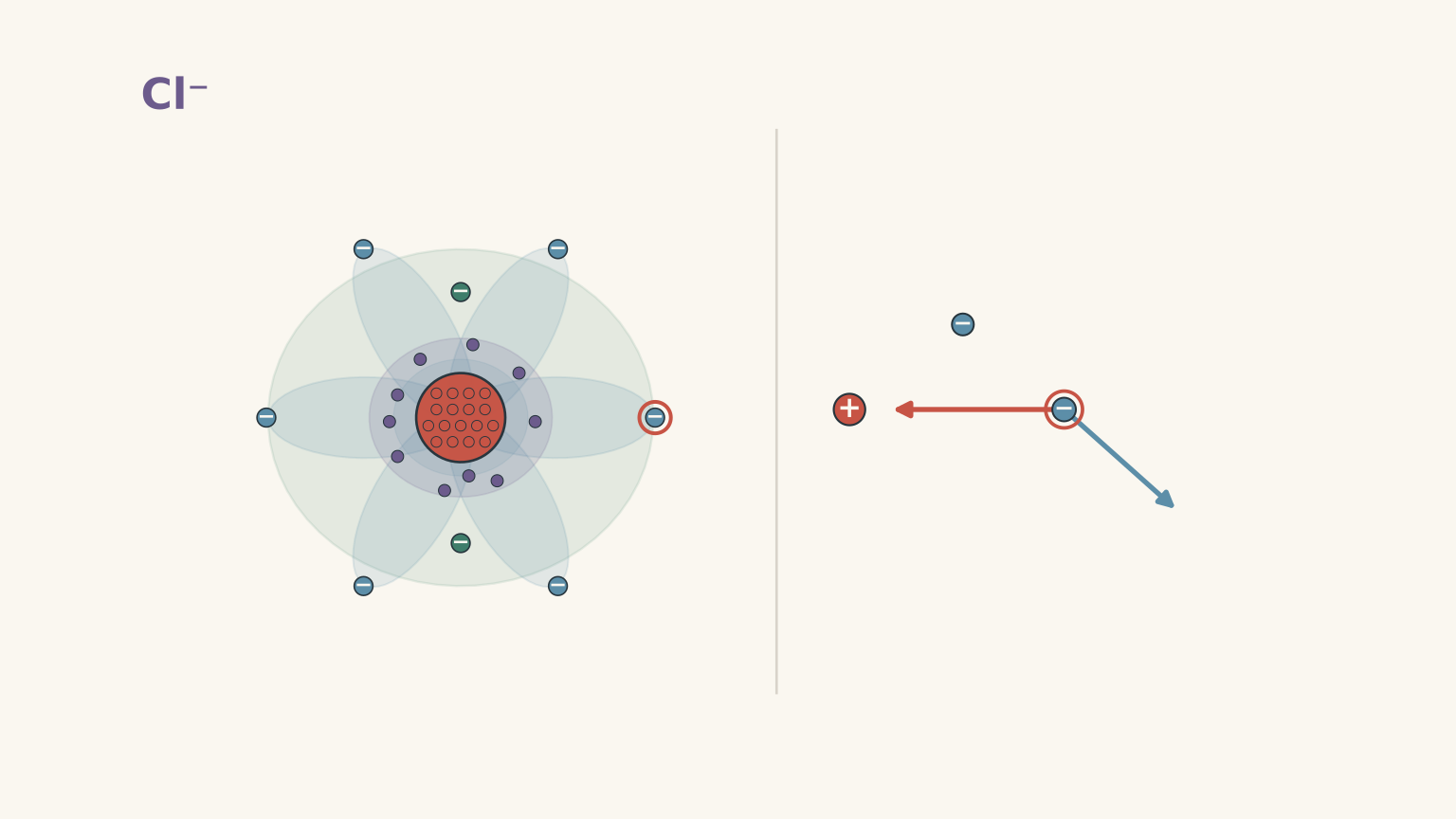
Due to technical limitations, this figure may display incorrectly or contain inaccuracies. Please check key details against your course materials.
01Why don’t electrons experience the full nuclear charge?
Start with a simpler atom: hydrogen.
Hydrogen contains one proton and one electron. There are no other electrons to repel the electron or shield it from the nucleus. The electron therefore experiences the full nuclear charge of \(+1\).
Now consider oxygen, which has eight protons and eight electrons.
Its nucleus has a charge of \(+8\), but an outer electron does not experience the same attraction as an electron in a hydrogen-like atom with a bare \(+8\) nucleus.
Why?
Because the other electrons repel it.
Understanding electron shielding
Electrons are negatively charged, so they repel one another. Electrons closer to the nucleus can partially shield outer electrons from the nucleus’s positive attraction.
This effect is called electron shielding, also known as screening.
Think of standing behind a crowd while trying to see someone on a stage. The people in front of you partially block your view, but they don’t make the stage disappear.
Similarly, inner electrons partially reduce the nuclear attraction experienced by an outer electron.
The analogy has a limitation: electrons aren’t stationary people standing in a neat line. They occupy probability distributions, and their electron clouds overlap. Shielding is a result of electrostatic interactions, not a physical wall between the nucleus and an electron.
The important point is that shielding is incomplete.
An inner electron does not cancel one entire proton’s positive charge. It only reduces the effective attraction experienced by another electron.
This means we can describe the attraction using an approximate quantity called the effective nuclear charge.
What is effective nuclear charge?
Effective nuclear charge is the net positive nuclear attraction experienced by a particular electron after accounting for shielding by the other electrons.
It is represented by:
\[ Z_{\mathrm{eff}}=Z-S \]
Where:
- \(Z_{\mathrm{eff}}\) is the effective nuclear charge experienced by the selected electron.
- \(Z\) is the atomic number, equal to the number of protons in the nucleus.
- \(S\) is the shielding constant, representing the combined shielding contribution of the other electrons.
Both \(Z\) and \(S\) are expressed in units of elementary charge, so \(Z_{\mathrm{eff}}\) is a dimensionless number representing a charge in units of \(e\).
For example, if \(Z_{\mathrm{eff}}=4.5\), the approximate effective nuclear charge is \(+4.5e\).
Notice that the equation depends on the electron we select.
An electron in the 1s orbital and an electron in the 3p orbital of the same atom will generally experience different effective nuclear charges.
There is no single effective nuclear charge that describes every electron in an atom or ion.
Effective nuclear charge is not ionic charge
This distinction is particularly important when working with ions.
The overall ionic charge is calculated by comparing the total number of protons and electrons:
\[ \frac{q_{\mathrm{ion}}}{e}=Z-N_e \]
Here, \(q_{\mathrm{ion}}\) is the total ionic charge and \(N_e\) is the total number of electrons.
Effective nuclear charge uses a different calculation:
\[ Z_{\mathrm{eff}}=Z-S \]
The difference is that \(N_e\) counts every electron equally, whereas \(S\) assigns different shielding contributions to different electrons.
Consider chloride, \(\mathrm{Cl^-}\).
- Atomic number: 17.
- Number of electrons: 18.
- Overall ionic charge: −1.
However, the effective nuclear charge experienced by one of its 3p electrons is positive, not negative.
We’ll calculate its value shortly.
02How Slater’s rules developed
The problem of electron shielding became particularly important when scientists tried to describe atoms containing several electrons.
Rutherford’s nuclear model established that an atom contains a small, positively charged nucleus. However, knowing the nuclear charge alone was not enough to explain the behaviour of every electron surrounding it.
You can revisit the development of this starting model in Rutherford’s Nuclear Atomic Model: HSC Physics Explained.
For hydrogen, the attraction between the nucleus and its electron can be described relatively simply. For atoms with multiple electrons, electron-electron repulsion makes the problem much harder.
Scientists needed a practical way to approximate how strongly individual electrons experienced the nucleus.
John Slater’s contribution
In 1930, American physicist John C. Slater published a paper titled Atomic Shielding Constants in the journal Physical Review.
His aim was to develop simple rules that could approximate atomic wavefunctions and energy levels for atoms and ions.
Rather than calculating every electron interaction in complete detail, Slater assigned different shielding contributions to electrons according to their orbital groups.
These contributions were chosen to give reasonable agreement with existing experimental measurements, including X-ray energy levels and atomic sizes.
His approach was an approximation, not an exact solution to the many-electron problem.
How could scientists test the model?
One useful source of evidence was X-ray absorption.
Consider an iron atom. Its innermost electrons occupy the 1s orbital, also called the K shell.
If an incoming X-ray photon has sufficient energy, it can eject a 1s electron from the atom.
The energy required to remove that electron can be determined from the absorption threshold.
Conceptually, the measurement follows this sequence:
- An X-ray source produces photons with a controlled energy.
- The X-rays pass through a sample containing atoms.
- A detector measures the transmitted X-ray intensity.
- As photon energy increases, a sharp change in absorption occurs when the energy becomes sufficient to eject a 1s electron.
- The threshold provides information about the binding energy of that electron.
What did Slater’s model predict?
Slater compared his calculations with measured atomic properties.
For iron, his full approximate model predicted an energy of 532.6 Rydberg units for removing a 1s electron. The observed K-shell absorption limit was 524.0 Rydberg units.
We can calculate the percentage difference:
\[ \begin{aligned} \text{Percentage difference} &=\frac{|532.6-524.0|}{524.0}\times100\\ &=\frac{8.6}{524.0}\times100\\ &\approx1.64\% \end{aligned} \]
The prediction was reasonably close to the measured value.
This supported the usefulness of Slater’s approximate model, but it did not prove that his shielding constants were exact. A successful prediction for one property does not guarantee equal accuracy for every orbital or atom.
In fact, Slater himself acknowledged that his approach was approximate and that its numerical predictions should not be trusted in every detail.
How was the model improved?
In 1963, Enrico Clementi and Daniele Raimondi published further work on atomic screening constants.
They used self-consistent-field calculations to obtain improved estimates of electron shielding. Their work demonstrated the importance of considering additional effects, including shielding contributions from electrons outside the orbital group being studied.
This highlighted a limitation of Slater’s original rules: they simplify the interactions between electrons by assigning fixed contributions to particular groups.
Modern quantum calculations describe electron distributions and interactions in considerably more detail.
The historical development gives us an important distinction:
- Observation: Atomic energy levels and X-ray absorption thresholds can be measured.
- Model: Slater’s rules estimate shielding using fixed numerical contributions.
- Modern interpretation: Effective nuclear charge is a useful approximation, not a literal reduction in the number of protons.
03How to apply Slater’s rules
Now we can calculate effective nuclear charge rather than just describe it.
The key is to identify which electrons contribute to the shielding of the electron being studied.
Slater’s rules begin by organising an electron configuration into specific groups.
Step 1: Group the electron configuration
Write the electron configuration using the following grouping:
\[ \begin{aligned} &(1s)\\ &(2s,2p)\\ &(3s,3p)\\ &(3d)\\ &(4s,4p)\\ &(4d)\\ &(4f)\\ &(5s,5p)\ldots \end{aligned} \]
Notice something unusual.
The 3d group appears before the 4s group, even though the 4s orbital is filled before the 3d orbital in the usual electron-filling sequence.
This distinction matters when calculating shielding.
The grouping determines which electrons contribute to the shielding of a selected electron.
Step 2: Identify the electron being studied
This is the most important decision in the calculation.
You must know which electron’s effective nuclear charge you are calculating.
For example, consider:
\[ 1s^2\,2s^2\,2p^6\,3s^2\,3p^5 \]
If the question asks for the effective nuclear charge experienced by a 3p electron, we use the shielding contributions relevant to the 3p group.
We do not calculate a single shielding constant for the entire atom.
Also, the selected electron itself never contributes to its own shielding constant.
Step 3: Apply the shielding contributions
Slater’s rules use different contributions depending on whether the selected electron belongs to an s or p group, or a d or f group.
For an ns or np electron
| Other electrons | Shielding contribution |
|---|---|
| Other electrons in the same (ns, np) group | 0.35 each |
| Electrons in the shell immediately below, \(n-1\) | 0.85 each |
| Electrons in \(n-2\) or lower shells | 1.00 each |
| Electrons in groups outside the selected group | 0 |
There is one special case: when calculating the shielding experienced by a 1s electron, the other 1s electron contributes 0.30 rather than 0.35.
An important detail: the same ns, np group includes both the s and p subshells of that principal shell.
For example, when studying a 3p electron, electrons in both 3s and 3p contribute 0.35 each.
For an nd or nf electron
| Other electrons | Shielding contribution |
|---|---|
| Other electrons in the same nd or nf group | 0.35 each |
| Electrons in groups to the left | 1.00 each |
| Electrons in groups to the right | 0 |
This is different from the s and p rules.
For example, when studying a 3d electron, the 4s electrons are in a group to its right. Slater’s rules therefore assign them zero shielding contribution.
This does not mean that 4s electrons physically exert no repulsive force on 3d electrons. It is a simplifying assumption within the model.
Step 4: Calculate the shielding constant
Add all the individual contributions together.
The result is the shielding constant, \(S\).
For example, if a selected electron has:
- Six other electrons contributing 0.35 each.
- Eight electrons contributing 0.85 each.
- Two electrons contributing 1.00 each.
Then:
\[ \begin{aligned} S&=(6\times0.35)+(8\times0.85)\\ &\quad +(2\times1.00)\\ &=2.10+6.80+2.00\\ &=10.90 \end{aligned} \]
Step 5: Calculate effective nuclear charge
Once you have the shielding constant, substitute it into:
\[ Z_{\mathrm{eff}}=Z-S \]
If the atomic number is 17:
\[ Z_{\mathrm{eff}}=17-10.90 \]
\[ \boxed{Z_{\mathrm{eff}}=6.10} \]
The selected electron experiences an approximate effective nuclear charge of \(+6.10e\).
04Worked examples
Let’s apply these rules to two different ions. The first uses the s and p rules. The second introduces the d-block, where the grouping becomes especially important.
Worked example: Effective nuclear charge of sodium ions
Calculate the effective nuclear charge experienced by a 2p electron in a sodium ion, \(\mathrm{Na^+}\). Sodium has an atomic number of 11.
Step 1
Neutral sodium has 11 electrons:
\[ 1s^2\,2s^2\,2p^6\,3s^1 \]
A positive ion has lost an electron. Sodium loses its outermost 3s electron, giving:
\[ \mathrm{Na^+}:1s^2\,2s^2\,2p^6 \]
The atomic number remains 11 because ionisation does not change the number of protons.
Step 2
The selected electron belongs to the \((2s,2p)\) group.
There are eight electrons in this group, but we must exclude the selected electron.
Therefore:
- Seven other electrons contribute 0.35 each.
- Two electrons in the 1s shell contribute 0.85 each.
There are no electrons in lower shells beyond 1s.
Step 3
\[ \begin{aligned} S&=(7\times0.35)+(2\times0.85)\\ &=2.45+1.70\\ &=4.15 \end{aligned} \]
Step 4
\[ \begin{aligned} Z_{\mathrm{eff}}&=Z-S\\ &=11-4.15\\ &=6.85 \end{aligned} \]
Therefore:
\[ \boxed{Z_{\mathrm{eff}}=6.85} \]
The 2p electron in \(\mathrm{Na^+}\) experiences an approximate effective nuclear charge of \(+6.85e\).
Notice that the ion has an overall charge of \(+1e\), but its selected 2p electron experiences an effective nuclear charge of \(+6.85e\).
These are two different quantities.
Worked example: Effective nuclear charge of an iron ion
Iron has an atomic number of 26. Calculate the effective nuclear charge experienced by a 3d electron in \(\mathrm{Fe^{2+}}\).
Step 1
Neutral iron has the configuration:
\[ \mathrm{Fe}:[Ar]\,3d^6\,4s^2 \]
When forming transition-metal cations, the 4s electrons are removed before the 3d electrons.
Therefore:
\[ \mathrm{Fe^{2+}}:[Ar]\,3d^6 \]
The atomic number remains 26.
Step 2
The selected electron belongs to the 3d group.
There are:
- Six electrons in the 3d group, including the selected electron.
- Eighteen electrons in the groups to its left.
- No electrons in groups to its right.
We exclude the selected electron, leaving five other 3d electrons.
For a d electron:
- Other electrons in the same d group contribute 0.35 each.
- All electrons in groups to the left contribute 1.00 each.
- Electrons in groups to the right contribute zero.
Step 3
\[ \begin{aligned} S&=(5\times0.35)+(18\times1.00)\\ &=1.75+18.00\\ &=19.75 \end{aligned} \]
Step 4
\[ \begin{aligned} Z_{\mathrm{eff}}&=Z-S\\ &=26-19.75\\ &=6.25 \end{aligned} \]
Therefore:
\[ \boxed{Z_{\mathrm{eff}}=6.25} \]
The selected 3d electron experiences an approximate effective nuclear charge of \(+6.25e\).
Notice that the two 4s electrons do not contribute to the shielding of the 3d electron under Slater’s rules.
However, if we were calculating the effective nuclear charge of a 4s electron instead, the 3d electrons would contribute 0.85 each because they belong to the immediately lower principal shell.
This difference is one of the most important details when applying Slater’s rules to transition metals.
05What can effective nuclear charge tell us?
Calculating \(Z_{\mathrm{eff}}\) is useful because it helps explain trends in atomic structure and chemical behaviour.
However, the number needs to be interpreted carefully.
Comparing electrons in the same shell
Suppose two electrons occupy orbitals in the same principal shell and have similar orbital characteristics.
If one experiences a larger effective nuclear charge, it generally experiences stronger attraction towards the nucleus.
This can contribute to:
- A smaller atomic or ionic radius.
- Greater difficulty removing an electron.
- Changes in orbital energy.
- Differences in chemical reactivity.
For example, across a period, nuclear charge increases as atomic number increases.
Shielding does increase, but generally not enough to cancel the additional nuclear charge. Consequently, effective nuclear charge experienced by valence electrons generally increases across a period.
This helps explain the general decrease in atomic radius across a period.
Why the same electron configuration does not mean the same effective nuclear charge
Consider two species with the same number of electrons.
They can have identical electron configurations but different numbers of protons.
For example:
- \(\mathrm{Na^+}\) has 11 protons and 10 electrons.
- \(\mathrm{Ne}\) has 10 protons and 10 electrons.
Both have the configuration:
\[ 1s^2\,2s^2\,2p^6 \]
Their shielding contributions for a 2p electron are the same under Slater’s rules.
However, sodium has one additional proton.
Therefore, its 2p electrons experience a greater effective nuclear charge.
This is the basis of an important comparison called an isoelectronic series: species with the same number of electrons but different nuclear charges.
Where Slater’s rules become less reliable
Remember that Slater’s rules assign fixed numerical contributions to electrons.
Real electron distributions are more complicated.
In particular:
- Electrons occupy probability distributions rather than fixed positions.
- Different orbitals have different shapes and degrees of penetration towards the nucleus.
- Electron clouds overlap, so shielding is not a simple division into inner and outer layers.
- Electron-electron interactions can change when an atom becomes an ion.
- Slater’s rules ignore some shielding contributions that more detailed calculations account for.
For example, the rule that electrons in groups to the right contribute zero shielding to a selected d electron is a useful approximation, not an exact statement about electrostatic repulsion.
Treat Slater’s rules as a method for estimating effective nuclear charge, not as an exact description of the atom.
06Questions and solutions
The following questions progress from straightforward calculations to problems involving competing effects, changing electron configurations, and the limitations of the model.
Assume ground-state electron configurations and standard Slater shielding coefficients unless otherwise stated.
Question 1
Magnesium has an atomic number of 12.
The magnesium ion, \(\mathrm{Mg^{2+}}\), has the electron configuration:
\[ 1s^2\,2s^2\,2p^6 \]
Calculate the effective nuclear charge experienced by one of its 2p electrons using Slater’s rules.
Solution 1
The effective nuclear charge is \(+7.85e\).
The selected electron is in the \((2s,2p)\) group.
There are eight electrons in this group, so seven other electrons contribute 0.35 each.
The two 1s electrons contribute 0.85 each.
Step 1: Calculate the shielding constant.
\[ \begin{aligned} S&=(7\times0.35)+(2\times0.85)\\ &=2.45+1.70\\ &=4.15 \end{aligned} \]
Step 2: Calculate effective nuclear charge.
\[ \begin{aligned} Z_{\mathrm{eff}}&=Z-S\\ &=12-4.15\\ &=7.85 \end{aligned} \]
Therefore:
\[ \boxed{Z_{\mathrm{eff}}=7.85} \]
The result is greater than the effective nuclear charge calculated for a 2p electron in \(\mathrm{Na^+}\), even though both ions have the same electron configuration.
The reason is that magnesium has one more proton, while the shielding contribution remains unchanged.
Question 2
Consider the following five species:
\[ \mathrm{S^{2-},\ Cl^-,\ Ar,\ K^+,\ Ca^{2+}} \]
Each species has 18 electrons and the electron configuration:
\[ [Ar] \]
(a) Calculate the effective nuclear charge experienced by a 3p electron in each species.
(b) Rank the species in order of increasing effective nuclear charge.
(c) A student argues that all five species must have the same effective nuclear charge because they have identical electron configurations.
Explain why this argument is incorrect. Which species would be expected to have the smallest radius, assuming comparable conditions?
Solution 2
The effective nuclear charges increase from \(\mathrm{S^{2-}}\) to \(\mathrm{Ca^{2+}}\), and \(\mathrm{Ca^{2+}}\) is expected to have the smallest radius.
The key is that identical electron configurations do not mean identical nuclear charges.
Step 1: Calculate the shielding constant for a 3p electron.
All five species have the configuration:
\[ 1s^2\,2s^2\,2p^6\,3s^2\,3p^6 \]
The selected electron belongs to the \((3s,3p)\) group.
There are eight electrons in this group, so seven other electrons contribute 0.35 each.
The eight electrons in the second shell contribute 0.85 each.
The two 1s electrons contribute 1.00 each.
Therefore:
\[ \begin{aligned} S&=(7\times0.35)+(8\times0.85)\\ &\quad +(2\times1.00)\\ &=2.45+6.80+2.00\\ &=11.25 \end{aligned} \]
The shielding constant is identical for all five species because their electron configurations are identical.
Step 2: Calculate the effective nuclear charge for each species.
The atomic numbers are:
| Species | Atomic number, \(Z\) |
|---|---|
| \(\mathrm{S^{2-}}\) | 16 |
| \(\mathrm{Cl^-}\) | 17 |
| \(\mathrm{Ar}\) | 18 |
| \(\mathrm{K^+}\) | 19 |
| \(\mathrm{Ca^{2+}}\) | 20 |
Using \(Z_{\mathrm{eff}}=Z-S\):
For sulfur:
\[ Z_{\mathrm{eff}}=16-11.25=4.75 \]
For chlorine:
\[ Z_{\mathrm{eff}}=17-11.25=5.75 \]
For argon:
\[ Z_{\mathrm{eff}}=18-11.25=6.75 \]
For potassium:
\[ Z_{\mathrm{eff}}=19-11.25=7.75 \]
For calcium:
\[ Z_{\mathrm{eff}}=20-11.25=8.75 \]
Step 3: Rank the species.
\[ \boxed{ \mathrm{S^{2-}<Cl^-<Ar<K^+<Ca^{2+}} } \]
This is the order of increasing effective nuclear charge.
The student’s argument is incorrect because electron configuration determines the shielding contribution in this comparison, but it does not determine the number of protons.
As nuclear charge increases, the same electron cloud experiences a stronger effective attraction.
Therefore, \(\mathrm{Ca^{2+}}\) is expected to have the smallest radius, while \(\mathrm{S^{2-}}\) is expected to have the largest radius.
This is the general principle behind the size trend in an isoelectronic series.
Question 3
Consider neutral chlorine and the chloride ion.
Their electron configurations are:
\[ \mathrm{Cl}: [Ne]\,3s^2\,3p^5 \]
\[ \mathrm{Cl^-}: [Ne]\,3s^2\,3p^6 \]
Both have an atomic number of 17.
(a) Calculate the effective nuclear charge experienced by a 3p electron in neutral chlorine.
(b) Calculate the effective nuclear charge experienced by a 3p electron in chloride.
(c) Explain why adding one electron decreases the effective nuclear charge by 0.35 rather than 1.00.
(d) Explain why the chloride ion can have an overall negative charge while its 3p electrons still experience a positive effective nuclear charge.
Solution 3
The effective nuclear charge decreases from \(+6.10e\) in chlorine to \(+5.75e\) in chloride.
The additional electron increases shielding, but it does not cancel an entire unit of nuclear charge in Slater’s model.
Step 1: Calculate the shielding constant for neutral chlorine.
The selected electron belongs to the \((3s,3p)\) group.
This group contains:
\[ 2+5=7\text{ electrons} \]
Excluding the selected electron leaves six other electrons.
The second shell contains eight electrons, and the first shell contains two.
Therefore:
\[ \begin{aligned} S_{\mathrm{Cl}}&=(6\times0.35)\\ &\quad +(8\times0.85)+(2\times1.00)\\ &=2.10+6.80+2.00\\ &=10.90 \end{aligned} \]
The effective nuclear charge is:
\[ \begin{aligned} Z_{\mathrm{eff}}&=17-10.90\\ &=6.10 \end{aligned} \]
Step 2: Calculate the shielding constant for chloride.
The chloride ion has gained one electron, so the \((3s,3p)\) group now contains eight electrons.
Excluding the selected electron leaves seven other electrons.
Therefore:
\[ \begin{aligned} S_{\mathrm{Cl^-}}&=(7\times0.35)\\ &\quad +(8\times0.85)+(2\times1.00)\\ &=2.45+6.80+2.00\\ &=11.25 \end{aligned} \]
The effective nuclear charge is:
\[ \begin{aligned} Z_{\mathrm{eff}}&=17-11.25\\ &=5.75 \end{aligned} \]
Step 3: Compare the results.
\[ \begin{aligned} \Delta Z_{\mathrm{eff}}&=5.75-6.10\\ &=-0.35 \end{aligned} \]
The effective nuclear charge decreases by 0.35.
This happens because the additional electron belongs to the same \((3s,3p)\) group as the selected electron. It therefore contributes 0.35 to the shielding constant.
It does not contribute 1.00.
Step 4: Distinguish effective nuclear charge from ionic charge.
For chloride, the overall ionic charge is:
\[ q_{\mathrm{ion}}/e=17-18=-1 \]
However, the effective nuclear charge experienced by a 3p electron is:
\[ Z_{\mathrm{eff}}=+5.75 \]
The two quantities answer different questions.
The overall ionic charge describes the total charge of the entire ion. Effective nuclear charge estimates the positive attraction experienced by one selected electron after shielding is considered.
There is no contradiction between the two results.
Question 4
Iron has an atomic number of 26.
The ground-state electron configurations of its two ions are:
\[ \mathrm{Fe^{2+}}:[Ar]\,3d^6 \]
\[ \mathrm{Fe^{3+}}:[Ar]\,3d^5 \]
(a) Calculate the effective nuclear charge experienced by a 3d electron in each ion.
(b) Explain why removing two 4s electrons from neutral iron to form \(\mathrm{Fe^{2+}}\) does not change the calculated effective nuclear charge of a 3d electron under Slater’s rules.
(c) Explain why removing one additional 3d electron to form \(\mathrm{Fe^{3+}}\) increases the effective nuclear charge of the remaining 3d electrons by only 0.35.
Solution 4
The effective nuclear charge is \(+6.25e\) for \(\mathrm{Fe^{2+}}\) and \(+6.60e\) for \(\mathrm{Fe^{3+}}\).
The difference arises because removing a 3d electron reduces the shielding from other electrons in the same d group.
Step 1: Calculate the shielding constant for \(\mathrm{Fe^{2+}}\).
The configuration is:
\[ [Ar]\,3d^6 \]
There are six electrons in the 3d group.
Excluding the selected electron leaves five other electrons, each contributing 0.35.
The 18 electrons in groups to the left contribute 1.00 each.
Therefore:
\[ \begin{aligned} S_{\mathrm{Fe^{2+}}}&=(5\times0.35)\\ &\quad +(18\times1.00)\\ &=1.75+18.00\\ &=19.75 \end{aligned} \]
Thus:
\[ \begin{aligned} Z_{\mathrm{eff}}&=26-19.75\\ &=6.25 \end{aligned} \]
Step 2: Calculate the shielding constant for \(\mathrm{Fe^{3+}}\).
The configuration is:
\[ [Ar]\,3d^5 \]
There are now five electrons in the 3d group.
Excluding the selected electron leaves four other electrons.
Therefore:
\[ \begin{aligned} S_{\mathrm{Fe^{3+}}}&=(4\times0.35)\\ &\quad +(18\times1.00)\\ &=1.40+18.00\\ &=19.40 \end{aligned} \]
Thus:
\[ \begin{aligned} Z_{\mathrm{eff}}&=26-19.40\\ &=6.60 \end{aligned} \]
Step 3: Evaluate the removal of the 4s electrons.
Neutral iron has the configuration:
\[ [Ar]\,3d^6\,4s^2 \]
The two 4s electrons are removed before the 3d electrons when forming \(\mathrm{Fe^{2+}}\).
A tempting approach is to assume that removing two electrons must reduce shielding of the 3d electrons by 2.00.
However, Slater’s rules treat the 4s group as being to the right of the 3d group.
Electrons in groups to the right contribute zero shielding to a selected 3d electron.
Therefore, removing the two 4s electrons does not change the calculated shielding constant of the 3d electrons under this particular approximation.
Step 4: Explain the change from \(\mathrm{Fe^{2+}}\) to \(\mathrm{Fe^{3+}}\).
When forming \(\mathrm{Fe^{3+}}\), one 3d electron is removed.
The number of other 3d electrons shielding the selected electron decreases from five to four.
Consequently, the shielding constant decreases by:
\[ \Delta S=0.35 \]
Since:
\[ Z_{\mathrm{eff}}=Z-S \]
a decrease in shielding produces an equal increase in effective nuclear charge:
\[ \Delta Z_{\mathrm{eff}}=+0.35 \]
This demonstrates why the shielding contribution is not simply equal to the number of electrons removed.
Remember that the zero contribution assigned to the 4s group is a limitation of the model, not a claim that real 4s and 3d electrons never interact.
Question 5
Calcium has an atomic number of 20.
Consider its successive ionisation:
\[ \mathrm{Ca\rightarrow Ca^+\rightarrow Ca^{2+}\rightarrow Ca^{3+}} \]
The relevant ground-state configurations before each ionisation are:
| Species | Electron configuration |
|---|---|
| \(\mathrm{Ca}\) | \([Ar]\,4s^2\) |
| \(\mathrm{Ca^+}\) | \([Ar]\,4s^1\) |
| \(\mathrm{Ca^{2+}}\) | \([Ar]\) |
(a) Identify the subshell from which an electron is removed during each of the first three ionisations.
(b) Calculate the effective nuclear charge experienced by the electron being removed in each step, using Slater’s rules.
(c) A student notices that the calculated effective nuclear charge increases substantially between the second and third ionisations. They conclude that the third ionisation energy must be exactly \(8.75/3.20\) times the second ionisation energy.
Evaluate this conclusion.
(d) Explain why a large increase in ionisation energy is expected after the second electron has been removed, even though the atomic number remains unchanged.
Assume the configurations given are the ground-state configurations and use the standard Slater coefficients.
Solution 5
The first two ionisations remove 4s electrons, while the third removes a 3p electron. The effective nuclear charges are \(+2.85e\), \(+3.20e\), and \(+8.75e\), respectively. The third ionisation energy increases substantially, but the ratio of effective nuclear charges is not the ratio of ionisation energies.
This question requires us to track the electron configuration as the atom loses electrons.
The important change occurs after the second ionisation.
Step 1: Calculate the effective nuclear charge for the first ionisation.
Neutral calcium has the configuration:
\[ [Ar]\,4s^2 \]
The first electron is removed from the 4s group.
There is one other electron in the \((4s,4p)\) group, contributing 0.35.
The third shell contains eight electrons in 3s and 3p, contributing 0.85 each.
The first and second shells contain ten electrons, contributing 1.00 each.
Therefore:
\[ \begin{aligned} S_1&=(1\times0.35)+(8\times0.85)\\ &\quad +(10\times1.00)\\ &=0.35+6.80+10.00\\ &=17.15 \end{aligned} \]
The effective nuclear charge is:
\[ \begin{aligned} Z_{\mathrm{eff,1}}&=20-17.15\\ &=2.85 \end{aligned} \]
Therefore:
\[ \boxed{Z_{\mathrm{eff,1}}=2.85} \]
Step 2: Calculate the effective nuclear charge for the second ionisation.
After losing the first electron, calcium becomes:
\[ \mathrm{Ca^+}:[Ar]\,4s^1 \]
The remaining 4s electron is now the selected electron.
There are no other electrons in its \((4s,4p)\) group.
The eight electrons in the third shell contribute 0.85 each, while the ten electrons in the first two shells contribute 1.00 each.
Therefore:
\[ \begin{aligned} S_2&=(0\times0.35)+(8\times0.85)\\ &\quad +(10\times1.00)\\ &=0+6.80+10.00\\ &=16.80 \end{aligned} \]
The effective nuclear charge is:
\[ \begin{aligned} Z_{\mathrm{eff,2}}&=20-16.80\\ &=3.20 \end{aligned} \]
Therefore:
\[ \boxed{Z_{\mathrm{eff,2}}=3.20} \]
Notice that the effective nuclear charge has increased because the remaining 4s electron experiences less shielding after the other 4s electron is removed.
Step 3: Identify the electron removed during the third ionisation.
After the second ionisation, calcium becomes:
\[ \mathrm{Ca^{2+}}:[Ar] \]
The 4s subshell is now empty.
The next electron must therefore come from the third shell, specifically the 3p subshell.
This is a crucial change.
We are no longer calculating the effective nuclear charge for a 4s electron. We must calculate it for a 3p electron.
Step 4: Calculate the shielding constant for the third ionisation.
The selected electron belongs to the \((3s,3p)\) group.
This group contains eight electrons, so seven other electrons contribute 0.35 each.
The eight electrons in the second shell contribute 0.85 each.
The two 1s electrons contribute 1.00 each.
Therefore:
\[ \begin{aligned} S_3&=(7\times0.35)+(8\times0.85)\\ &\quad +(2\times1.00)\\ &=2.45+6.80+2.00\\ &=11.25 \end{aligned} \]
The effective nuclear charge is:
\[ \begin{aligned} Z_{\mathrm{eff,3}}&=20-11.25\\ &=8.75 \end{aligned} \]
Therefore:
\[ \boxed{Z_{\mathrm{eff,3}}=8.75} \]
Step 5: Evaluate the student’s prediction.
The student is correct that the effective nuclear charge increases substantially:
\[ 2.85\rightarrow3.20\rightarrow8.75 \]
However, the student is wrong to treat the ratio of effective nuclear charges as the ratio of ionisation energies.
Effective nuclear charge is only one factor influencing how strongly an electron is bound.
The orbital itself also matters.
The first two electrons are removed from the 4s subshell, while the third comes from the more tightly held 3p subshell.
The 3p electrons are closer to the nucleus on average, and the change in electron configuration also affects the remaining electron distribution.
A simple hydrogen-like energy model depends on both effective nuclear charge and principal quantum number, rather than effective nuclear charge alone. More accurate calculations must also account for changes in the other electrons when an electron is removed.
Therefore, the third ionisation requires considerably more energy than the second.
The important conclusion is that the large increase is not simply caused by removing another electron. It occurs because the atom has exhausted its outer 4s electrons and must now remove an electron from an inner shell.
This is why tracking the electron configuration after each ionisation is essential.
07Where to go next
Effective nuclear charge connects atomic structure to several important chemical properties.
It helps explain why atomic radii change across the periodic table, why some electrons are more difficult to remove, and why atoms interact differently when forming bonds.
However, shielding is only one part of the picture. The principal quantum number, orbital shape, and electron distribution also influence how electrons behave.
The next useful step is understanding how atomic orbitals interact when atoms form molecules.
Continue with Molecular Orbital Theory: Bonding and Oxygen’s Magnetism to explore how atomic orbitals combine to form molecular orbitals and how their electron arrangements determine molecular properties.
08Sources and further reading
The historical development and scientific explanations in this article draw on the following original research and university teaching resources.
Slater, J. C. (1930). Atomic Shielding Constants. Physical Review, 36, 57-64. The original paper establishing Slater’s approximate shielding rules and applying them to atomic energies and sizes. Read the original paper.
Clementi, E., and Raimondi, D. L. (1963). Atomic Screening Constants from SCF Functions. The Journal of Chemical Physics, 38, 2686-2689. Research refining atomic screening constants using self-consistent-field calculations. Read the original paper.
University of Wisconsin-Madison. Slater Rules. A concise reference for orbital groupings and shielding coefficients. Read the university teaching resource.
University of Calgary. Effective Nuclear Charge. An introduction to shielding, nuclear attraction, and periodic trends. Read the chemistry textbook section.
NSW Government and NESA. Chemistry Stage 6 Syllabus (2017) and associated Module 1 teaching resources. These establish the Year 11 atomic structure foundation used in this extension. View the NSW Chemistry syllabus.