
Crystal Packing Efficiency: Calculating Atomic Packing Fractions
Learn how to calculate the fraction of a crystal unit cell occupied by atoms using ideal sphere-packing models. Explore simple cubic, BCC, FCC, and HCP structures through worked examples and challenging practice questions.
Two crystals can contain atoms of the same size but use their available space very differently. Imagine arranging identical marbles inside a cube. In one arrangement, the marbles leave substantial gaps. In another, they nestle into the spaces between neighbouring marbles.
How much of the cube is actually occupied by the marbles? And can we calculate that percentage rather than estimating it from a diagram?
This is the idea behind crystal packing efficiency.
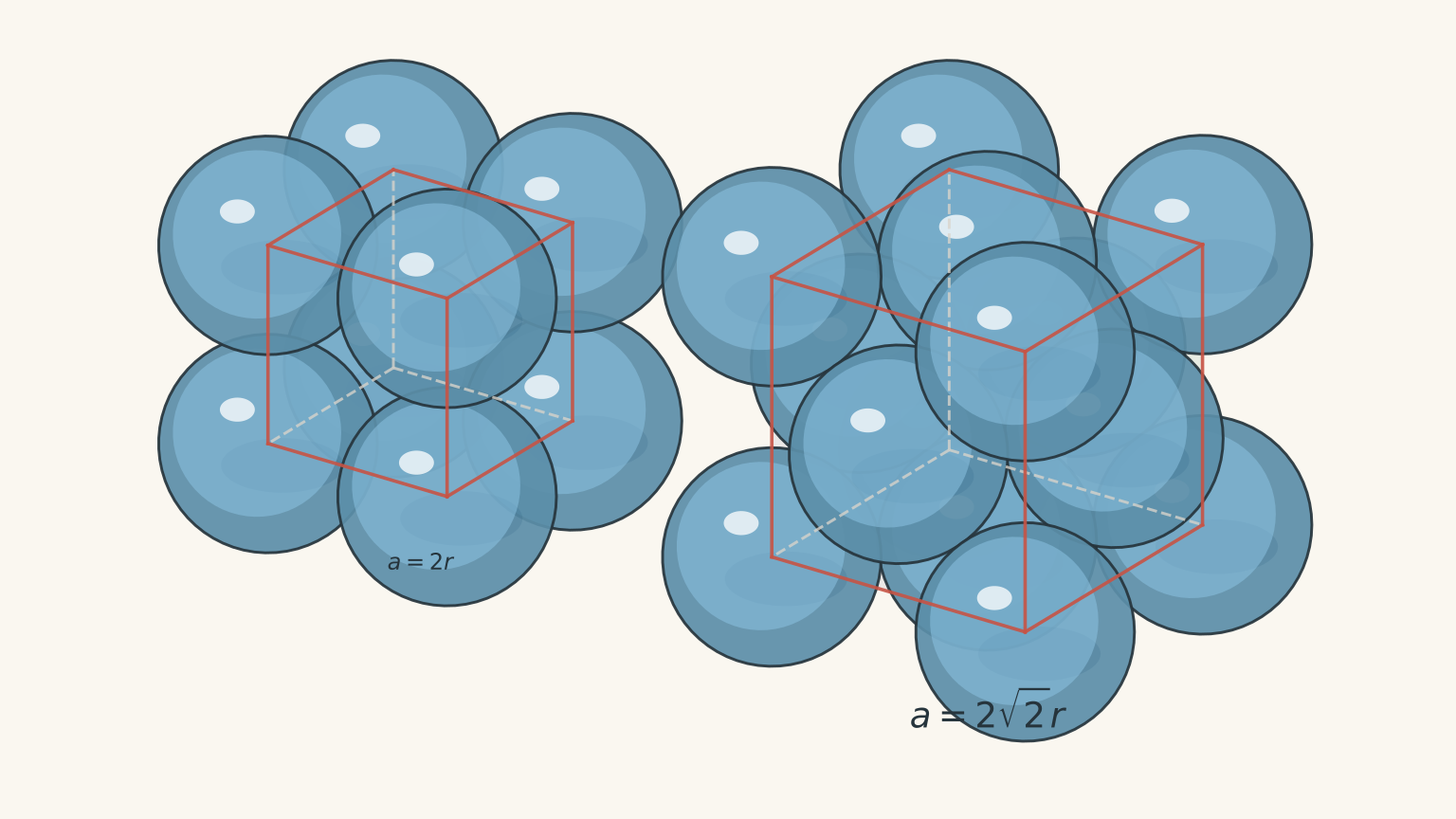
Due to technical limitations, this figure may display incorrectly or contain inaccuracies. Please check key details against your course materials.
A syllabus note: Crystal packing efficiency is an extension beyond the required content of the NSW Chemistry 11-12 Syllabus (2025). It is not a required assessment dot point. The Year 11 Properties and structure of matter material, particularly calculating relative atomic mass from isotopic composition, provides the prerequisite knowledge for this extension. The 2025 syllabus is scheduled to begin implementation for Year 11 in 2028.
01From relative atomic mass to occupied volume
In Year 11 Chemistry, you learn that naturally occurring elements can contain different isotopes. These isotopes have different masses, so the relative atomic mass is calculated using a weighted average.
The relationship is:
\[ A_r=\sum_i x_i m_i \]
Here:
- \(A_r\) is the relative atomic mass.
- \(x_i\) is the fractional abundance of isotope \(i\).
- \(m_i\) is the relative isotopic mass of isotope \(i\).
For example, if an element contains two isotopes with relative isotopic masses of 10 and 11, and fractional abundances of 0.75 and 0.25, respectively:
\[ A_r=0.75(10)+0.25(11) \]
\[ A_r=10.25 \]
The important idea is that each isotope contributes according to its proportion in the sample.
Crystal packing introduces a different kind of calculation. Instead of asking how much mass each isotope contributes, we ask how much volume the atoms occupy inside a repeating crystal structure.
To make the calculation manageable, we begin with a simplified model.
Treating atoms as spheres
Imagine every atom as an identical, solid sphere with radius \(r\).
This is called the hard-sphere model. The spheres cannot overlap, and neighbouring spheres are assumed to touch wherever the structure specifies contact.
Atoms are not literally solid billiard balls. Their electron clouds do not have perfectly defined outer surfaces. However, the hard-sphere model is useful for understanding the geometry of many crystal structures, particularly simple metallic structures.
A crystal can be described using a repeating block called a unit cell. Repeating this block in three dimensions generates the larger crystal structure.
The unit cell provides a convenient boundary within which we can count atoms and calculate occupied volume.
The quantity we want is the packing fraction, also called the atomic packing factor.
It is the fraction of the unit cell’s volume occupied by the modelled atomic spheres.
\[ \boxed{ \eta= \frac{\text{Total volume of atoms in cell}} {\text{Volume of unit cell}} } \]
For identical spherical atoms:
\[ \eta= \frac{N\left(\frac{4}{3}\pi r^3\right)} {V_{\text{cell}}} \]
Where:
- \(\eta\) is the packing fraction.
- \(N\) is the effective number of atoms in one unit cell.
- \(r\) is the radius of each spherical atom.
- \(V_{\text{cell}}\) is the total volume of the unit cell.
- \(\pi\) is the mathematical constant approximately equal to 3.14159.
To express packing efficiency as a percentage:
\[ \text{Packing efficiency}=\eta\times100\% \]
For example, a packing fraction of 0.60 means that 60% of the unit cell is occupied by the modelled atoms.
The remaining 40% is unoccupied geometric space.
There are two things we need to determine before using this equation:
- How many atoms actually belong to the unit cell?
- What is the relationship between the atomic radius and the unit cell dimensions?
These depend on the crystal structure.
02Three cubic crystal structures
Let’s compare three arrangements of identical spherical atoms:
- Simple cubic (SC).
- Body-centred cubic (BCC).
- Face-centred cubic (FCC).
The structures differ in where the atoms sit and which neighbouring atoms touch.
Before calculating anything, there is an important counting rule.
Counting atoms shared between unit cells
An atom positioned inside a unit cell belongs entirely to that cell.
However, atoms on boundaries are shared with neighbouring cells.
For cubic structures:
| Atom position | Fraction belonging to one cell |
|---|---|
| Corner | \(1/8\) |
| Edge centre | \(1/4\) |
| Face centre | \(1/2\) |
| Body centre | \(1\) |
Why does a corner atom contribute only one-eighth?
Eight cubic unit cells meet at each corner. Each cell therefore contains one-eighth of that corner atom.
Similarly, a face-centred atom is shared between two cells, so each cell receives half.
This is why simply counting every visible sphere as a complete atom gives the wrong answer.
1. Simple cubic structure
In a simple cubic structure, atoms occupy the eight corners of a cube.
Each corner contributes one-eighth of an atom.
Therefore, the effective number of atoms per unit cell is:
\[ N=8\times\frac18=1 \]
Now consider how neighbouring atoms touch.
In this arrangement, adjacent corner atoms touch along the cube’s edges.
The edge length is therefore equal to two atomic radii:
\[ a=2r \]
Here, \(a\) is the edge length of the cubic unit cell.
The volume of the unit cell is:
\[ V_{\text{cell}}=a^3=(2r)^3 \]
The total volume of atoms in the cell is:
\[ V_{\text{atoms}}= 1\times\frac43\pi r^3 \]
Substituting into the packing fraction equation:
\[ \eta= \frac{\frac43\pi r^3}{(2r)^3} \]
\[ \eta= \frac{\frac43\pi r^3}{8r^3} \]
The radius cancels:
\[ \boxed{\eta=\frac{\pi}{6}=0.5236} \]
Therefore:
\[ \boxed{\text{Packing efficiency}=52.4\%} \]
Almost half the unit cell’s volume is unoccupied by the modelled spheres.
Worked example: Simple cubic packing efficiency
A simple cubic crystal has a unit cell with an edge length of 0.400 nm. Assume that the atoms are identical hard spheres touching along the cube edges.
Calculate the packing efficiency.
Step 1: Count the effective number of atoms.
There are eight corner atoms, each contributing one-eighth:
\[ N=8\times\frac18=1 \]
Step 2: Calculate the atomic radius.
The atoms touch along the edge, so:
\[ a=2r \]
\[ r=\frac{0.400}{2} =0.200\text{ nm} \]
Step 3: Calculate the volume of the atoms.
\[ V_{\text{atoms}}= 1\times\frac43\pi(0.200)^3 \]
\[ V_{\text{atoms}}=0.03351\text{ nm}^3 \]
Step 4: Calculate the unit cell volume.
\[ V_{\text{cell}}=(0.400)^3 \]
\[ V_{\text{cell}}=0.0640\text{ nm}^3 \]
Step 5: Calculate the packing efficiency.
\[ \eta=\frac{0.03351}{0.0640} \]
\[ \eta=0.5236 \]
Therefore:
\[ \boxed{\text{Packing efficiency}=52.4\%} \]
The result means that just over half the unit cell is occupied by the idealised atomic spheres. The remaining 47.6% is geometric space between them.
Notice that the final percentage does not depend on the actual size of the atoms. If every atom and the unit cell were scaled up by the same factor, the packing efficiency would remain unchanged.
2. Body-centred cubic structure
Now imagine adding another atom to the centre of the cube.
This produces a body-centred cubic structure, or BCC.
There are still eight corner atoms, contributing one atom in total. However, the atom at the centre belongs entirely to the unit cell.
Therefore:
\[ N=8\times\frac18+1 \]
\[ \boxed{N=2} \]
The next step is identifying the correct direction in which the spheres touch.
In BCC, the corner atoms do not touch along the cube edges. Instead, contact occurs along the body diagonal, which passes through the central atom.
The body diagonal of a cube with edge length \(a\) is:
\[ d=\sqrt3a \]
This follows from applying Pythagoras’ theorem in three dimensions.
Along the body diagonal, there are two touching centre-to-centre distances, each equal to \(2r\).
Therefore:
\[ \sqrt3a=2r+2r \]
\[ \boxed{\sqrt3a=4r} \]
Rearranging:
\[ a=\frac{4r}{\sqrt3} \]
The unit cell volume is:
\[ V_{\text{cell}}= \left(\frac{4r}{\sqrt3}\right)^3 \]
The volume of the two atoms is:
\[ V_{\text{atoms}}= 2\times\frac43\pi r^3 \]
Substituting:
\[ \eta= \frac{\frac83\pi r^3} {\left(\frac{4r}{\sqrt3}\right)^3} \]
Simplifying:
\[ \boxed{\eta=\frac{\pi\sqrt3}{8}} \]
\[ \eta=0.6802 \]
Therefore:
\[ \boxed{\text{Packing efficiency}=68.0\%} \]
BCC packs more efficiently than simple cubic, even though it does not achieve the maximum packing efficiency for identical spheres.
Worked example: Body-centred cubic packing
A BCC crystal has a cubic unit cell with an edge length of 0.320 nm. Assume that all atoms are identical hard spheres and that neighbouring atoms touch along the body diagonal.
Calculate:
- The atomic radius.
- The packing efficiency.
Step 1: Calculate the body diagonal.
For a cube:
\[ d=\sqrt3a \]
Substitute the edge length:
\[ d=\sqrt3(0.320) \]
\[ d=0.5543\text{ nm} \]
Step 2: Calculate the atomic radius.
Four radii fit along the body diagonal:
\[ 4r=d \]
Therefore:
\[ r=\frac{0.5543}{4} \]
\[ \boxed{r=0.1386\text{ nm}} \]
Step 3: Calculate the number of atoms per unit cell.
There are eight corner atoms and one central atom:
\[ N=8\left(\frac18\right)+1 \]
\[ N=2 \]
Step 4: Calculate the volume of the atoms.
\[ V_{\text{atoms}}= 2\times\frac43\pi(0.1386)^3 \]
\[ V_{\text{atoms}}\approx0.0223\text{ nm}^3 \]
Step 5: Calculate the unit cell volume.
\[ V_{\text{cell}}=(0.320)^3 \]
\[ V_{\text{cell}}=0.03277\text{ nm}^3 \]
Step 6: Calculate the packing efficiency.
\[ \eta=\frac{0.0223}{0.03277} \]
\[ \eta\approx0.680 \]
Therefore:
\[ \boxed{\text{Packing efficiency}=68.0\%} \]
The BCC arrangement occupies approximately 68% of its unit cell volume. The other 32% is unoccupied geometric space.
Notice that the body diagonal was essential. Using the cube edge as \(2r\) would have produced the wrong radius because the corner atoms are not touching along the edges.
3. Face-centred cubic structure
The third cubic arrangement adds atoms to the centres of all six cube faces.
This is called face-centred cubic, or FCC.
The eight corner atoms contribute one atom in total:
\[ 8\times\frac18=1 \]
The six face-centred atoms each contribute half:
\[ 6\times\frac12=3 \]
Therefore:
\[ \boxed{N=1+3=4} \]
Again, the direction of contact is different.
In FCC, the atoms touch along the face diagonal rather than the cube edge.
The face diagonal has length:
\[ d=\sqrt2a \]
Four atomic radii fit along this diagonal:
\[ \sqrt2a=4r \]
Therefore:
\[ a=\frac{4r}{\sqrt2} \]
The unit cell volume is:
\[ V_{\text{cell}}= \left(\frac{4r}{\sqrt2}\right)^3 \]
The volume of the four atoms is:
\[ V_{\text{atoms}}= 4\times\frac43\pi r^3 \]
Substituting:
\[ \eta= \frac{\frac{16}{3}\pi r^3} {\left(\frac{4r}{\sqrt2}\right)^3} \]
After simplifying:
\[ \boxed{\eta=\frac{\pi}{3\sqrt2}} \]
\[ \eta\approx0.7405 \]
Therefore:
\[ \boxed{\text{Packing efficiency}=74.05\%} \]
This is significantly higher than the simple cubic and BCC arrangements.
There is an important detail here. In FCC, the corner atoms do not touch along the cube edges. The face-centred atoms sit between them and determine the actual contact geometry.
Using \(a=2r\) for FCC would therefore be incorrect.
Comparing the three cubic structures
The results can now be compared directly.
| Crystal structure | Effective atoms per cell | Contact direction | Packing efficiency |
|---|---|---|---|
| Simple cubic | 1 | Cube edge | 52.4% |
| BCC | 2 | Body diagonal | 68.0% |
| FCC | 4 | Face diagonal | 74.05% |
The FCC structure leaves the least unoccupied volume of the three.
However, there is another interesting structure that achieves exactly the same ideal packing efficiency.
It is called hexagonal close-packed.
03Why hexagonal close-packed and FCC have the same efficiency
Imagine arranging identical marbles in a flat layer.
The most compact arrangement is not a square grid. Instead, each marble sits in the gaps between neighbouring marbles.
This creates a triangular pattern in which every sphere touches six other spheres in the same layer.
Now add another layer.
Rather than placing each new sphere directly above a sphere in the first layer, place it in one of the triangular hollows.
Each sphere in the second layer then touches three spheres in the layer below.
This creates a compact three-dimensional arrangement.
The vertical separation between layers
We can calculate the vertical distance between two adjacent close-packed layers using Pythagoras’ theorem.
Consider three spheres in the bottom layer. Their centres form an equilateral triangle with side length \(2r\).
The centre of a sphere in the next layer sits directly above the triangle’s centroid.
The horizontal distance from the centroid to any one of the three lower sphere centres is:
\[ \frac{2r}{\sqrt3} \]
The distance between the centres of two touching spheres is \(2r\).
Let \(h\) represent the vertical separation between the two layers.
Using Pythagoras:
\[ h^2+( \frac{2r}{\sqrt3})^2=(2r)^2 \]
Therefore:
\[ h^2=4r^2-\frac{4r^2}{3} \]
\[ h^2=\frac{8r^2}{3} \]
Taking the square root:
\[ \boxed{h=2r\sqrt{\frac23}} \]
This is the ideal vertical distance between adjacent close-packed layers.
Two ways to stack close-packed layers
Once the first two layers are arranged, there are two possible positions for the third layer.
The choice determines the familiar FCC and HCP structures.
Hexagonal close-packed (HCP)
In HCP, the third layer sits directly above the first layer.
The sequence repeats:
\[ ABABAB\ldots \]
Face-centred cubic (FCC)
In FCC, the third layer occupies the other available set of hollows.
The sequence repeats:
\[ ABCABC\ldots \]
The letters represent the three possible lateral positions of a close-packed layer.
The stacking patterns are different, but both structures have the same packing efficiency.
To see why, we can calculate the HCP packing fraction.
Calculating HCP packing efficiency
The conventional HCP unit cell is a hexagonal prism.
It contains six effective atoms.
These come from:
- Twelve corner atoms, each contributing one-sixth.
- Two atoms at the centres of the top and bottom hexagonal faces, each contributing one-half.
- Three atoms completely inside the unit cell.
Therefore:
\[ N=12\left(\frac16\right) +2\left(\frac12\right)+3 \]
\[ \boxed{N=6} \]
Let:
- \(a\) be the side length of the hexagonal base.
- \(c\) be the height of the hexagonal prism.
- \(r\) be the atomic radius.
Within each close-packed layer, neighbouring atoms touch, so:
\[ a=2r \]
The vertical distance between adjacent layers is \(h\).
In HCP, the third layer returns to the position of the first layer, so the prism height covers two layer separations:
\[ c=2h \]
Substitute the expression for \(h\):
\[ c=4r\sqrt{\frac23} \]
Since \(a=2r\):
\[ \frac ca= \frac{4r\sqrt{2/3}}{2r} \]
Therefore:
\[ \boxed{\frac ca=\sqrt{\frac83}\approx1.633} \]
This is the ideal HCP axial ratio.
The base of the prism is a regular hexagon. Its area is:
\[ A=\frac{3\sqrt3}{2}a^2 \]
The unit cell volume is therefore:
\[ V_{\text{cell}}= \frac{3\sqrt3}{2}a^2c \]
Substituting \(a=2r\) and \(c=4r\sqrt{2/3}\):
\[ V_{\text{cell}}=24\sqrt2r^3 \]
The six atoms occupy:
\[ V_{\text{atoms}}= 6\times\frac43\pi r^3 \]
\[ V_{\text{atoms}}=8\pi r^3 \]
The packing fraction becomes:
\[ \eta= \frac{8\pi r^3}{24\sqrt2r^3} \]
Simplifying:
\[ \boxed{\eta=\frac{\pi}{3\sqrt2}} \]
\[ \boxed{\text{Packing efficiency}=74.05\%} \]
This is exactly the same ideal packing efficiency as FCC.
Both structures arrange identical spheres in close-packed layers. Their difference lies in how those layers are stacked, not in how much volume each sphere occupies or how far apart adjacent layers are.
04What packing efficiency does-and doesn’t-tell you
The four structures give us a useful comparison.
| Structure | Packing efficiency | Unoccupied volume |
|---|---|---|
| Simple cubic | 52.4% | 47.6% |
| BCC | 68.0% | 32.0% |
| FCC | 74.05% | 25.95% |
| Ideal HCP | 74.05% | 25.95% |
The FCC and HCP arrangements achieve the maximum packing fraction for identical, non-overlapping spheres in three dimensions.
That does not mean every real crystal has a packing efficiency of exactly 74.05%.
There are limitations to the model.
The hard-sphere model is an approximation
Real atoms are not rigid spheres with perfectly defined surfaces.
Their electron distributions overlap, and the effective atomic radius depends on the bonding environment.
The ideal calculations also assume:
- All atoms have the same radius.
- The crystal is perfectly ordered.
- There are no vacancies or missing atoms.
- Atoms touch along the specified directions.
- The ideal geometric relationships are maintained.
Real HCP structures, for example, do not always have the ideal \(c/a\) ratio of 1.633.
If the measured dimensions differ from the ideal geometry, the actual sphere-model packing fraction may also differ.
Packing efficiency is not density
This is another distinction worth remembering.
Packing efficiency describes the fraction of space occupied by the modelled atomic spheres.
Density describes mass per unit volume.
Two structures can have identical packing efficiencies but different densities because their atoms have different masses.
For example, ideal FCC and HCP both have a packing efficiency of 74.05%, but their unit cells have different geometries and may contain atoms of different masses in real materials.
To calculate density, we need both the mass of the atoms and the unit cell volume:
\[ \rho=\frac{\text{Mass of unit cell}} {\text{Volume of unit cell}} \]
This is where relative atomic mass becomes useful again.
The relative atomic mass helps determine the mass of the atoms in a unit cell. The packing model helps determine their arrangement and occupied volume.
The most tempting mistakes to avoid:
- Counting every visible atom as a complete atom, even when it is shared between cells.
- Assuming atoms touch along cube edges in every cubic structure.
- Using the body diagonal for FCC or the face diagonal for BCC.
- Assuming FCC and HCP must have different packing efficiencies because their stacking patterns differ.
- Treating packing efficiency as a measurement of density.
Once you keep atom counting, contact geometry, and cell volume separate, the calculations become much more straightforward.
05Questions and solutions
The following questions build from standard packing calculations to problems involving changes in geometry, isotopic composition, and alternative stacking arrangements.
Question 1
An ideal simple cubic crystal contains identical spherical atoms with a radius of 0.150 nm.
The atoms touch along the edges of the cubic unit cell.
Calculate:
a) The effective number of atoms per unit cell.
b) The unit cell edge length.
c) The packing efficiency.
d) The percentage of the unit cell volume that is unoccupied.
Solution 1
The simple cubic structure has a packing efficiency of 52.4%, with 47.6% of the unit cell volume unoccupied.
Step 1: Calculate the effective number of atoms.
There are eight corner atoms, each contributing one-eighth:
\[ N=8\times\frac18 \]
\[ \boxed{N=1} \]
Step 2: Calculate the unit cell edge length.
The atoms touch along the cube edges, so:
\[ a=2r \]
Substitute:
\[ a=2(0.150) \]
\[ \boxed{a=0.300\text{ nm}} \]
Step 3: Calculate the packing efficiency.
The packing fraction is:
\[ \eta= \frac{N\left(\frac43\pi r^3\right)}{a^3} \]
Substitute:
\[ \eta= \frac{1\times\frac43\pi(0.150)^3} {(0.300)^3} \]
\[ \eta=0.5236 \]
Therefore:
\[ \boxed{\text{Packing efficiency}=52.4\%} \]
Step 4: Calculate the unoccupied percentage.
The occupied and unoccupied fractions must add to 100%.
\[ 100-52.4=47.6\% \]
\[ \boxed{\text{Unoccupied volume}=47.6\%} \]
The simple cubic structure leaves almost half its unit cell volume unoccupied by the idealised atomic spheres.
Question 2
A hypothetical metal crystallises in an ideal BCC arrangement. Its cubic unit cell has an edge length of 0.330 nm.
a) Calculate the atomic radius.
b) Calculate the packing efficiency.
c) The crystal is now stretched uniformly in all three directions so that its unit cell edge increases by 2%. Assume that the atomic radius remains unchanged. Calculate the new packing efficiency.
d) Would the answer to part (c) change if the atomic radius also increased by 2%?
Solution 2
The original BCC crystal has an atomic radius of 0.143 nm and a packing efficiency of 68.0%. After the cell expands while the atomic radius remains fixed, the packing efficiency decreases to approximately 64.1%. If the radius expands by the same percentage, the packing efficiency remains unchanged.
Step 1: Calculate the atomic radius.
For BCC, contact occurs along the body diagonal:
\[ \sqrt3a=4r \]
Rearrange:
\[ r=\frac{\sqrt3a}{4} \]
Substitute:
\[ r=\frac{\sqrt3(0.330)}{4} \]
\[ \boxed{r=0.1429\text{ nm}} \]
Step 2: Calculate the original packing efficiency.
For BCC:
\[ \eta=\frac{\pi\sqrt3}{8} \]
\[ \eta=0.6802 \]
Therefore:
\[ \boxed{\eta=68.0\%} \]
Step 3: Calculate the new packing efficiency when the cell expands but the radius stays fixed.
The new edge length is:
\[ a_{\text{new}}=1.02a \]
The volume of the cell increases by a factor of:
\[ (1.02)^3=1.0612 \]
However, the atomic spheres have not changed size, so their total volume remains constant.
Therefore:
\[ \eta_{\text{new}}= \frac{\eta_{\text{original}}}{(1.02)^3} \]
\[ \eta_{\text{new}}= \frac{0.6802}{1.0612} \]
\[ \eta_{\text{new}}\approx0.6409 \]
Thus:
\[ \boxed{\eta_{\text{new}}=64.1\%} \]
The packing efficiency decreases because the unit cell has expanded without a corresponding increase in atomic volume.
The spheres no longer touch along the original body-diagonal contact distance. This is now an expanded BCC arrangement rather than the ideal touching-sphere BCC model.
Step 4: Consider what happens if the atomic radius also increases by 2%.
If both the atomic radius and unit cell dimensions increase by the same factor, the sphere volume increases by:
\[ (1.02)^3 \]
The unit cell volume also increases by:
\[ (1.02)^3 \]
Since the numerator and denominator increase by exactly the same factor, their ratio remains constant.
Therefore:
\[ \boxed{\eta=68.0\%} \]
This question highlights an important feature of packing efficiency: it depends on the relative geometry of the atoms and unit cell, not their absolute size.
Question 3
An ideal HCP crystal has identical spherical atoms with a radius of 0.140 nm.
Its conventional hexagonal prism unit cell contains six effective atoms.
Calculate:
a) The ratio \(c/a\).
b) The height \(c\) of the unit cell.
c) The volume of the unit cell.
d) The packing efficiency.
Use the regular hexagon base area:
\[ A=\frac{3\sqrt3}{2}a^2 \]
Solution 3
The ideal HCP cell has \(c/a=1.633\), a height of approximately 0.457 nm, a volume of approximately 0.0931 nm³, and a packing efficiency of 74.05%.
Step 1: Calculate the hexagonal base edge.
In a close-packed layer, adjacent atoms touch:
\[ a=2r \]
\[ a=2(0.140) \]
\[ \boxed{a=0.280\text{ nm}} \]
Step 2: Calculate the ideal axial ratio.
For HCP:
\[ \frac ca=\sqrt{\frac83} \]
Therefore:
\[ \boxed{\frac ca=1.633} \]
Step 3: Calculate the unit cell height.
Rearrange:
\[ c=a\sqrt{\frac83} \]
Substitute:
\[ c=0.280\sqrt{\frac83} \]
\[ \boxed{c=0.457\text{ nm}} \]
Step 4: Calculate the unit cell volume.
The hexagonal base area is:
\[ A=\frac{3\sqrt3}{2}(0.280)^2 \]
\[ A=0.2037\text{ nm}^2 \]
The prism volume is:
\[ V_{\text{cell}}=Ac \]
\[ V_{\text{cell}}=0.2037(0.4572) \]
\[ \boxed{V_{\text{cell}}\approx0.0931\text{ nm}^3} \]
Step 5: Calculate the total volume of the atoms.
There are six effective atoms:
\[ V_{\text{atoms}}= 6\times\frac43\pi(0.140)^3 \]
\[ V_{\text{atoms}}\approx0.06896\text{ nm}^3 \]
Step 6: Calculate the packing efficiency.
\[ \eta= \frac{0.06896}{0.0931} \]
\[ \eta\approx0.7405 \]
Therefore:
\[ \boxed{\text{Packing efficiency}=74.05\%} \]
The HCP structure achieves the same ideal packing efficiency as FCC, despite having a different unit cell shape and stacking sequence.
Question 4
A hypothetical element Q occurs naturally as two isotopes:
| Isotope | Relative isotopic mass | Fractional abundance |
|---|---|---|
| Q-63 | 62.93 | 0.70 |
| Q-65 | 64.93 | 0.30 |
The element forms an ideal FCC crystal with a cubic unit cell edge length of 0.360 nm.
Assume that:
- Both isotopes have the same effective atomic radius.
- All four effective atoms in the FCC unit cell contribute to its mass.
- Isotope-dependent changes to the lattice dimensions are negligible.
Use Avogadro’s constant:
\[ N_A=6.022\times10^{23}\text{ mol}^{-1} \]
Calculate:
a) The relative atomic mass of Q.
b) The packing efficiency.
c) The theoretical density of the crystal in g cm\(^{-3}\).
d) Explain whether increasing the abundance of the heavier isotope would change the packing efficiency, assuming the crystal geometry remains fixed.
Solution 4
The relative atomic mass is 63.53, the packing efficiency is 74.05%, and the theoretical density is approximately 9.05 g cm\(^{-3}\). Increasing the abundance of the heavier isotope changes the mass and therefore the density, but not the geometric packing efficiency under the stated assumptions.
Step 1: Calculate the relative atomic mass.
Use the weighted-average equation:
\[ A_r=\sum_i x_i m_i \]
Substitute:
\[ A_r=0.70(62.93)+0.30(64.93) \]
\[ A_r=44.051+19.479 \]
\[ \boxed{A_r=63.53} \]
The molar mass is therefore numerically equal to 63.53 g mol\(^{-1}\).
Step 2: Calculate the packing efficiency.
For an ideal FCC structure:
\[ \eta=\frac{\pi}{3\sqrt2} \]
\[ \eta=0.7405 \]
Therefore:
\[ \boxed{\text{Packing efficiency}=74.05\%} \]
Notice that the relative atomic mass is not needed for this calculation.
Packing efficiency depends on the number and volume of the modelled spheres relative to the unit cell volume.
Step 3: Calculate the unit cell volume in cubic centimetres.
Convert the edge length:
\[ 0.360\text{ nm}=3.60\times10^{-8}\text{ cm} \]
The unit cell volume is:
\[ V_{\text{cell}}=a^3 \]
\[ V_{\text{cell}}=(3.60\times10^{-8})^3 \]
\[ \boxed{V_{\text{cell}}=4.6656\times10^{-23}\text{ cm}^3} \]
Step 4: Calculate the mass of one unit cell.
An FCC unit cell contains four effective atoms.
One mole of Q has a mass of 63.53 g and contains Avogadro’s number of atoms.
Therefore:
\[ m_{\text{cell}}= \frac{4(63.53)}{6.022\times10^{23}} \]
\[ \boxed{m_{\text{cell}}=4.220\times10^{-22}\text{ g}} \]
Step 5: Calculate the theoretical density.
Density is mass divided by volume:
\[ \rho=\frac{m_{\text{cell}}}{V_{\text{cell}}} \]
Substitute:
\[ \rho= \frac{4.220\times10^{-22}} {4.6656\times10^{-23}} \]
\[ \boxed{\rho\approx9.05\text{ g cm}^{-3}} \]
Step 6: Explain the effect of changing isotope abundance.
Increasing the abundance of Q-65 increases the weighted-average relative atomic mass.
This increases the mass of each unit cell and therefore increases the theoretical density if the unit cell volume remains unchanged.
However, the packing efficiency is determined by the geometry:
\[ \eta= \frac{\text{Volume occupied by spheres}} {\text{Unit cell volume}} \]
Under the assumptions in the question, the atomic radii and lattice dimensions remain unchanged.
Therefore, the packing efficiency does not change.
This is an important distinction: mass and geometric volume are separate properties.
Question 5
An ideal crystal is constructed by stacking identical hard-sphere layers.
Each individual layer forms a triangular close-packed arrangement. Every new layer is placed in one of the two available sets of hollows in the layer immediately below it.
The crystal has a repeating seven-layer stacking sequence:
\[ ABACBAC \]
The sequence then repeats indefinitely.
A student argues:
“Only the ABAB sequence of HCP and the ABCABC sequence of FCC can achieve maximum packing efficiency. Any other stacking sequence must leave additional empty space.”
Determine whether the student’s claim is correct.
In your explanation:
a) Determine whether the given stacking sequence can form a valid close-packed structure.
b) Calculate the vertical separation between adjacent layers in terms of \(r\).
c) Calculate the volume of crystal available per atom, using the area occupied by one atom in a triangular layer.
d) Determine the packing efficiency.
e) State the coordination number of an atom in this ideal infinite structure.
Assume that all spheres have radius \(r\), every adjacent pair of layers is in contact, and the seven-layer sequence repeats perfectly without vacancies or distortions.
Solution 5
The student’s claim is incorrect. The given structure can achieve the maximum packing efficiency of 74.05%, with a coordination number of 12.
The key is that close packing requires each new layer to occupy one of the two available hollow positions relative to the layer immediately below it.
It does not require the entire crystal to follow only ABAB or ABCABC.
Step 1: Check whether the stacking sequence is valid.
The sequence is:
\[ A-B-A-C-B-A-C \]
For a valid close-packed arrangement, two consecutive layers cannot occupy the same lateral position.
Otherwise, the spheres in the upper layer would sit directly above those in the lower layer, producing overlap because their vertical separation is less than their diameter.
Check each transition:
- A to B: different positions.
- B to A: different positions.
- A to C: different positions.
- C to B: different positions.
- B to A: different positions.
- A to C: different positions.
- C to A at the repeating boundary: different positions.
Every adjacent pair occupies different positions.
Therefore, each new layer can fit into the available hollows without overlapping the layer immediately below it.
The sequence is valid.
Step 2: Calculate the vertical separation between adjacent layers.
Consider three touching spheres in one triangular layer.
Their centres form an equilateral triangle of side length \(2r\).
The horizontal distance from the triangle’s centroid to one vertex is:
\[ x=\frac{2r}{\sqrt3} \]
The centre of the sphere in the next layer is directly above the centroid.
Since the spheres touch, the centre-to-centre distance is \(2r\).
Using Pythagoras:
\[ h^2+x^2=(2r)^2 \]
Substitute:
\[ h^2+\frac{4r^2}{3}=4r^2 \]
\[ h^2=\frac{8r^2}{3} \]
Therefore:
\[ \boxed{h=2r\sqrt{\frac23}} \]
Every adjacent pair of layers has this same vertical separation.
Importantly, the stacking sequence does not change this geometry.
Step 3: Calculate the area occupied by one atom in a triangular layer.
The centres of neighbouring spheres form a triangular lattice with nearest-neighbour distance \(2r\).
A convenient repeating region is a rhombus with:
- Two sides of length \(2r\).
- An internal angle of \(60^\circ\).
Its area is:
\[ A_{\text{atom}}=(2r)^2\sin60^\circ \]
Since:
\[ \sin60^\circ=\frac{\sqrt3}{2} \]
We obtain:
\[ \boxed{A_{\text{atom}}=2\sqrt3r^2} \]
This is the area of the layer associated with one atom.
Step 4: Calculate the volume available per atom.
Each layer occupies an area of \(2\sqrt3r^2\) per atom.
The vertical separation between layers is:
\[ h=2r\sqrt{\frac23} \]
Therefore, the volume associated with one atom is:
\[ V_{\text{per atom}}=A_{\text{atom}}h \]
Substitute:
\[ V_{\text{per atom}}= 2\sqrt3r^2 \left(2r\sqrt{\frac23}\right) \]
Simplifying:
\[ \boxed{V_{\text{per atom}}=4\sqrt2r^3} \]
This result depends only on the sphere radius and the close-packed layer geometry.
It does not depend on whether the layers follow ABAB, ABCABC, or another valid stacking sequence.
Step 5: Calculate the packing efficiency.
The volume of one spherical atom is:
\[ V_{\text{sphere}}=\frac43\pi r^3 \]
The packing fraction is:
\[ \eta= \frac{V_{\text{sphere}}} {V_{\text{per atom}}} \]
Substitute:
\[ \eta= \frac{\frac43\pi r^3} {4\sqrt2r^3} \]
The radius cancels:
\[ \boxed{\eta=\frac{\pi}{3\sqrt2}} \]
Therefore:
\[ \boxed{\text{Packing efficiency}=74.05\%} \]
The unusual stacking sequence has exactly the same ideal packing efficiency as FCC and HCP.
Step 6: Determine the coordination number.
The coordination number is the number of nearest neighbouring atoms touching a particular atom.
Consider an atom in an interior layer of this infinite crystal.
It touches:
- Six atoms in its own triangular layer.
- Three atoms in the layer directly above.
- Three atoms in the layer directly below.
Therefore:
\[ CN=6+3+3 \]
\[ \boxed{CN=12} \]
The crystal has the same coordination number as ideal FCC and HCP.
Why the original prediction fails
The student’s mistake was assuming that only two particular repeating sequences can maintain close packing.
In reality, the local geometric requirement is much simpler: each new layer must occupy one of the two available hollow positions in the layer immediately below it.
The choice between those positions can change from one layer to the next.
As long as adjacent layers remain in valid hollow positions, the spheres retain the same local contact geometry and the same ideal packing efficiency.
The stacking sequence affects the crystal’s symmetry and periodic arrangement, but it does not necessarily reduce how efficiently the spheres occupy space.
This is the deeper distinction between the geometry of close packing and the symmetry of a particular crystal structure.
06What this lets you understand next
You can now calculate the occupied volume fraction for simple cubic, BCC, FCC, and ideal HCP structures.
More importantly, you can work backwards from a crystal diagram:
- Count the effective number of atoms in the unit cell.
- Identify the direction in which neighbouring atoms touch.
- Relate the atomic radius to the unit cell dimensions.
- Calculate the total atomic volume.
- Divide by the unit cell volume.
The next useful idea is understanding the spaces left between packed atoms.
Even the most efficient arrangements leave approximately 26% of their unit cell volume unoccupied by the modelled spheres. These spaces are not all the same size or shape.
In particular, close-packed structures contain tetrahedral and octahedral holes. Understanding their geometry helps explain how smaller atoms and ions fit into larger atomic arrangements.
That is where crystal packing connects directly to the structures of ionic solids.
07Sources and further reading
The geometric relationships and ideal packing fractions in this article are consistent with university-level materials science and chemistry teaching resources.
NSW Education Standards Authority – Chemistry 11-12 Syllabus (2025). Syllabus focus areas and implementation information.
California State Polytechnic University, Humboldt – Chapter 1: Atomistic Structure of Materials. Unit cell atom counting, simple cubic, BCC, FCC, and atomic packing factors.
Indian Institute of Technology Bombay – Crystal Structures, Voids and Pauling’s Rules. Hard-sphere models, close-packed layers, ideal HCP geometry, and comparisons between crystal structures.