
Crystal Unit Cells: Counting Atoms in Cubic Structures
Learn how particles are shared between neighbouring unit cells and how to calculate the number of atoms in simple cubic, body-centred cubic, and face-centred cubic structures. Includes worked examples and challenging practice questions.
Picture a cube with one atom at each of its eight corners. The obvious prediction is that the cube contains eight atoms. But in a simple cubic crystal, one conventional unit cell contains just one atom.
The difference comes down to sharing. Each corner atom belongs to eight neighbouring unit cells, so only one-eighth of it is assigned to any individual cell.
This is an extension beyond the required Year 11 Chemistry syllabus content, not an HSC assessment requirement. The Year 11 Properties and structure of matter focus area, including constructing electron-dot diagrams for discrete molecules and simple polyatomic ions, provides the assumed foundation. The 2025 NSW Chemistry syllabus is scheduled for implementation in Year 11 from 2028 (NESA syllabus overview). Year 11 is the prerequisite entry point for this resource, not an indication that crystal unit-cell counting is examinable.
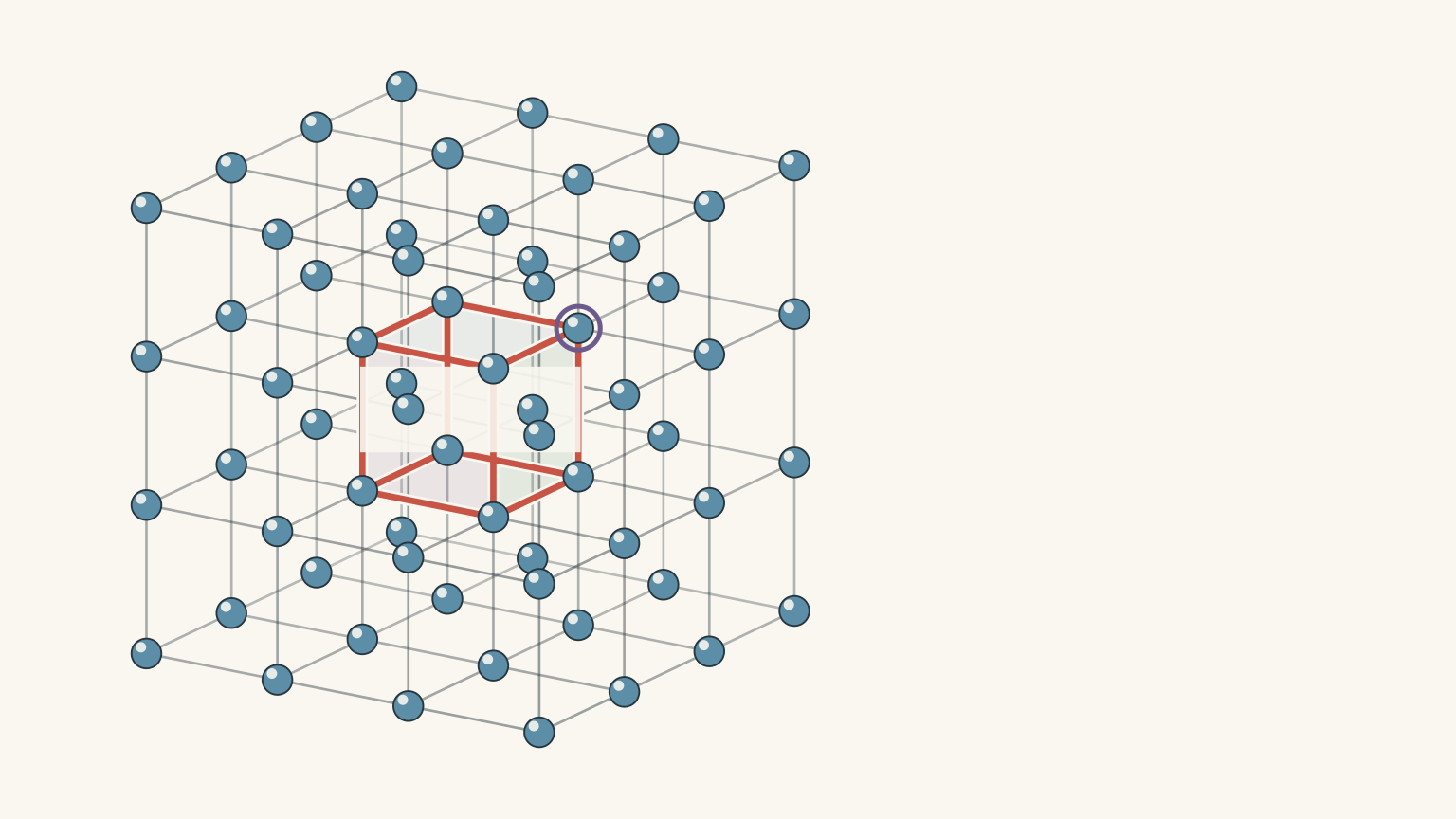
Due to technical limitations, this figure may display incorrectly or contain inaccuracies. Please check key details against your course materials.
01From electron-dot diagrams to crystal structures
In Year 11 Chemistry, electron-dot diagrams help you represent valence electrons and bonding within discrete molecules and simple polyatomic ions.
Crystal structures introduce a different way of thinking about matter.
Instead of examining one molecule at a time, we look at how particles are arranged throughout an entire solid. These particles might be:
- Atoms in a metallic crystal.
- Ions in an ionic crystal.
- Molecules in a molecular crystal.
A crystal has an ordered arrangement that repeats in three dimensions. This repeating arrangement is called a crystal lattice.
A unit cell is a three-dimensional block that can be repeated in all directions to reproduce the crystal’s arrangement. For this article, we will focus on conventional cubic unit cells, which have the shape of a cube.
Think of a floor covered in identical square tiles. One tile provides a pattern that can be repeated to cover the entire floor. A crystal does something similar in three dimensions.
There is one important complication: particles can sit on the boundaries between neighbouring unit cells. This means that not every particle drawn inside or on the outline of a cube belongs entirely to that cube.
The diagrams used to represent crystal structures show particle positions. They are simplified models, not literal pictures of atoms as hard spheres.
02Why particles are shared between unit cells
Imagine eight identical cubes meeting at one corner.
One corner is now shared by eight different cubes. If an atom sits at that position, it contributes only one-eighth of an atom to each cube.
The atom itself is not physically divided. The fraction is simply a counting method that ensures we do not count the same atom multiple times.
Three positions are particularly important.
| Particle position | Number of unit cells sharing it | Contribution to one unit cell |
|---|---|---|
| Corner | 8 | \(\frac{1}{8}\) |
| Face centre | 2 | \(\frac{1}{2}\) |
| Body centre (inside the cube) | 1 | \(1\) |
Let’s understand why each fraction is different.
Corner particles: one-eighth
A cube has eight corners.
Each corner is shared by eight neighbouring cubes because eight cubes meet at that point in three dimensions.
Therefore, the contribution from one corner is:
\[ \frac{1}{8}\text{ atom} \]
With eight corners, the total contribution is:
\[ 8\times\frac{1}{8}=1\text{ atom} \]
Face-centred particles: one-half
A cube has six faces.
Each face is shared by two neighbouring cubes. A particle at the centre of a face therefore contributes half an atom to each cube.
Its contribution is:
\[ \frac{1}{2}\text{ atom} \]
For six face-centred particles:
\[ 6\times\frac{1}{2}=3\text{ atoms} \]
Body-centred particles: one
A body-centred particle sits completely inside the cube.
No neighbouring unit cell shares it, so its entire contribution belongs to that cell.
Its contribution is:
\[ 1\text{ atom} \]
The key rule is simple: count the fraction of each particle that belongs to the unit cell, rather than counting every visible sphere as a whole particle.
This is the standard counting convention used in university chemistry, including Purdue University’s guide to unit cells.
03The three cubic unit-cell structures
There are three structures to recognise:
- Simple cubic (SC).
- Body-centred cubic (BCC).
- Face-centred cubic (FCC).
They differ in where their particles are positioned. Once you identify those positions, calculating the number of particles becomes straightforward.
1. Simple cubic (SC)
A simple cubic unit cell has particles at its eight corners and nowhere else.
There are no particles at the face centres or body centre.
Each of the eight corner particles contributes one-eighth of an atom.
Therefore:
\[ N=8\times\frac{1}{8} \]
\[ \boxed{N=1\text{ atom}} \]
A simple cubic unit cell contains one atom.
2. Body-centred cubic (BCC)
A body-centred cubic unit cell has:
- Eight corner particles.
- One particle at the centre of the cube.
The corner particles contribute:
\[ 8\times\frac{1}{8}=1 \]
The body-centred particle contributes:
\[ 1\times 1=1 \]
Adding these contributions:
\[ N=1+1 \]
\[ \boxed{N=2\text{ atoms}} \]
A body-centred cubic unit cell contains two atoms.
Notice that the central particle is not shared with neighbouring cells. This is why it contributes a whole atom.
3. Face-centred cubic (FCC)
A face-centred cubic unit cell has:
- Eight corner particles.
- Six face-centred particles.
- No body-centred particle.
The corner particles contribute:
\[ 8\times\frac{1}{8}=1 \]
The face-centred particles contribute:
\[ 6\times\frac{1}{2}=3 \]
Adding these contributions:
\[ N=1+3 \]
\[ \boxed{N=4\text{ atoms}} \]
A face-centred cubic unit cell contains four atoms.
Remember that there are six faces, not just the three visible in a perspective drawing. The rear and bottom faces count too.
Comparing the three structures
The results are worth memorising, but you should also understand where each number comes from.
| Structure | Corner contribution | Additional contribution | Total atoms per unit cell |
|---|---|---|---|
| Simple cubic (SC) | 1 | 0 | 1 |
| Body-centred cubic (BCC) | 1 | 1 body-centred atom | 2 |
| Face-centred cubic (FCC) | 1 | 3 from face centres | 4 |
Notice the pattern:
- SC has one atom per cell.
- BCC has one additional atom at the body centre.
- FCC has three additional atoms contributed by its six faces.
If you remember only the visible number of spheres, you will get these structures wrong. Always apply the sharing fractions.
04A subtle distinction: different particles at different positions
So far, we have assumed that every occupied position contains the same type of atom.
That assumption matters.
Consider a cubic crystal with one type of particle, X, at every corner and a different type, Y, at the body centre.
The number of X particles contributed by the corners is:
\[ 8\times\frac{1}{8}=1 \]
The body-centred Y particle contributes:
\[ 1\times1=1 \]
The unit cell therefore contains:
- 1 X particle.
- 1 Y particle.
There are two particles in total, but they are not two identical atoms.
This distinction appears in the structure of caesium chloride, CsCl. Although its arrangement looks similar to BCC, it is not a BCC lattice of identical particles. Translating a corner position to the body-centre position would exchange Cs and Cl, so the two positions are not equivalent lattice points.
It is more accurately described as a simple cubic lattice with a two-particle basis. The distinction is explained in the University of California, Santa Cruz crystal-structure notes.
For a crystal containing different species, count each species separately before determining the overall composition.
Also remember that the standard SC, BCC and FCC counts assume a perfect crystal with all specified positions occupied. Vacancies and substitutions would change the actual particle count.
05Worked examples
Worked example: Counting atoms in a BCC crystal
A metal crystallises in a body-centred cubic structure. A bulk model contains 75 conventional unit cells. Calculate the total number of atoms represented.
Step 1
There are eight corner atoms and one body-centred atom.
Step 2
\[ 8\times\frac{1}{8}=1\text{ atom} \]
Step 3
The body-centred atom is entirely within the cell, so it contributes one whole atom.
\[ N_{\text{cell}}=1+1=2 \]
Each unit cell contains two atoms.
Step 4
\[ N_{\text{total}}=75\times2 \]
\[ \boxed{N_{\text{total}}=150\text{ atoms}} \]
The bulk model represents 150 atoms across its 75 conventional unit cells.
Worked example: Working backwards from an FCC atom count
An ideal bulk crystal has a face-centred cubic structure and contains 1,440 atoms. Calculate the number of conventional unit cells in the crystal model.
Step 1
An FCC cell has eight corner atoms, each contributing one-eighth.
\[ 8\times\frac{1}{8}=1 \]
Step 2
There are six face-centred atoms, each contributing one-half.
\[ 6\times\frac{1}{2}=3 \]
Step 3
\[ N_{\text{cell}}=1+3=4 \]
Step 4
\[ N_{\text{cells}}= \frac{1440\text{ atoms}}{4\text{ atoms/cell}} \]
\[ \boxed{N_{\text{cells}}=360} \]
The crystal model contains 360 conventional FCC unit cells.
Notice that we divided rather than multiplied. When you know the total number of atoms and need the number of unit cells, divide by the number of atoms contributed by each cell.
06Questions and solutions
Question 1
A simple cubic unit cell contains identical atoms at all eight corners and nowhere else.
Calculate the number of atoms assigned to one conventional unit cell.
Solution 1
The unit cell contains one atom.
Each corner atom is shared by eight neighbouring unit cells, so each contributes one-eighth of an atom.
There are eight corners:
\[ N=8\times\frac{1}{8} \]
\[ \boxed{N=1\text{ atom}} \]
The important point is that eight visible corner atoms do not represent eight complete atoms belonging to the cell.
Question 2
An ideal bulk metal crystal contains 180 conventional BCC unit cells.
A student counts each of the eight corner atoms as a complete atom, then adds the body-centred atom. They conclude that each unit cell contains nine atoms.
Calculate:
(a) The correct total number of atoms in the crystal model.
(b) The number of atoms by which the student’s method overcounts the crystal.
Solution 2
The correct total is 360 atoms, and the student’s method overcounts by 1,260 atoms.
The student’s mistake is treating each corner atom as if it belongs entirely to one unit cell.
Step 1: Calculate the contribution from the eight corners.
\[ N_{\text{corners}}=8\times\frac{1}{8}=1 \]
Step 2: Include the body-centred atom.
The body-centred atom is not shared.
\[ N_{\text{body}}=1 \]
Therefore:
\[ N_{\text{cell}}=1+1=2 \]
Step 3: Calculate the correct total.
There are 180 conventional unit cells.
\[ N_{\text{correct}}=180\times2 \]
\[ \boxed{N_{\text{correct}}=360\text{ atoms}} \]
Step 4: Calculate the student’s incorrect total.
Their method gives nine atoms per cell.
\[ N_{\text{incorrect}}=180\times9 \]
\[ N_{\text{incorrect}}=1620\text{ atoms} \]
Step 5: Find the overcount.
\[ \text{Overcount}=1620-360 \]
\[ \boxed{\text{Overcount}=1260\text{ atoms}} \]
The student has counted every corner atom eight times across the repeating structure, rather than assigning one-eighth of each corner atom to each neighbouring cell.
Question 3
An ideal bulk FCC crystal is represented by 240 conventional unit cells.
(a) Calculate the total number of atoms represented.
(b) What percentage of the effective atom count per unit cell comes from the face-centred positions?
A student argues that an FCC unit cell contains 14 atoms because eight corner atoms and six face-centred atoms are visible.
Explain why this argument is incorrect.
Solution 3
The crystal model contains 960 atoms, and 75% of the effective atom count per cell comes from face-centred positions.
The student’s count of 14 treats every visible particle as belonging entirely to one unit cell.
We must account for sharing.
Step 1: Calculate the corner contribution.
\[ 8\times\frac{1}{8}=1 \]
Step 2: Calculate the face-centre contribution.
\[ 6\times\frac{1}{2}=3 \]
Step 3: Calculate the total atoms per unit cell.
\[ N_{\text{cell}}=1+3=4 \]
Step 4: Calculate the total atoms in 240 cells.
\[ N_{\text{total}}=240\times4 \]
\[ \boxed{N_{\text{total}}=960\text{ atoms}} \]
Step 5: Calculate the percentage contributed by face-centred particles.
The face-centred positions contribute three of the four effective atoms.
\[ \text{Percentage}=\frac{3}{4}\times100 \]
\[ \boxed{75\%} \]
The remaining 25% comes from the corner positions.
The diagram may show 14 complete spheres, but the unit cell is assigned only one-quarter of those 14 visible particle contributions in total: one atom from the corners and three from the faces.
Question 4
An ideal cubic crystal contains two different particle types, X and Y.
- X particles occupy all eight corners of each conventional unit cell.
- Y particles occupy the body centre.
- No face-centred positions are occupied.
A model contains 320 conventional unit cells.
(a) Calculate the total number of X particles.
(b) Calculate the total number of Y particles.
(c) State the X:Y composition ratio.
(d) A student describes the arrangement as BCC. Explain why this classification is misleading.
Solution 4
The crystal contains 320 X particles and 320 Y particles, giving an X:Y ratio of 1:1. However, it is not a BCC lattice of identical particles.
We need to count each particle type separately.
Step 1: Calculate the number of X particles contributed by the corners.
There are eight corner positions, each shared by eight unit cells.
\[ N_X=8\times\frac{1}{8}=1 \]
Each unit cell contributes one X particle.
Step 2: Calculate the Y contribution.
The body-centred particle is entirely inside the unit cell.
\[ N_Y=1 \]
Each unit cell contributes one Y particle.
Step 3: Calculate the total numbers in 320 cells.
For X:
\[ N_{X,\text{total}}=320\times1 \]
\[ \boxed{N_X=320} \]
For Y:
\[ N_{Y,\text{total}}=320\times1 \]
\[ \boxed{N_Y=320} \]
Step 4: Determine the composition ratio.
\[ X:Y=320:320 \]
Simplifying:
\[ \boxed{X:Y=1:1} \]
Step 5: Evaluate the BCC classification.
A genuine BCC lattice has identical particles at the corner and body-centre positions.
Here, the corner and body-centre particles are different species. Translating the structure from a corner position to the body centre would exchange X for Y, meaning the arrangement would not remain identical.
Therefore, this is better described as a simple cubic lattice with a two-particle basis, rather than a BCC lattice of identical particles.
The distinction matters because counting the total number of particles is not always enough. You must also identify which species occupy each position.
Question 5
Two ideal finite crystal blocks each contain a \(2\times2\times2\) arrangement of conventional cubic unit cells.
- Block A has a BCC structure.
- Block B has an FCC structure.
Every specified lattice position is occupied by an identical atom.
Assume that:
- All eight conventional cells are joined together without gaps.
- Every atom whose centre lies on or inside the outer boundary of the block is included.
- There are no neighbouring unit cells outside either block.
(a) Calculate the exact number of distinct atoms in Block A.
(b) Calculate the exact number of distinct atoms in Block B.
(c) Explain why multiplying eight by the standard number of atoms per conventional unit cell gives a different answer.
Solution 5
Block A contains 35 atoms, while Block B contains 63 atoms.
The tempting approach is to multiply the number of conventional cells by the standard bulk count:
- BCC: \(8\times2=16\) atoms.
- FCC: \(8\times4=32\) atoms.
Those calculations are correct for the effective number of atoms assigned to eight cells in an infinitely repeating crystal. They are not the exact counts for these finite blocks.
The difference comes from the outer boundaries.
Step 1: Count the distinct corner atoms in each block.
There are two unit cells along each direction.
This gives three corner positions along each direction: one at each end and one between the two cells.
Therefore, the number of distinct corner atoms is:
\[ N_{\text{corners}}=3\times3\times3 \]
\[ N_{\text{corners}}=27 \]
Both blocks contain 27 distinct corner atoms.
Step 2: Calculate the number of BCC body-centred atoms.
Each of the eight conventional cells contains one body-centred atom.
These atoms are entirely inside their respective cells, so none are shared.
\[ N_{\text{body}}=8\times1=8 \]
Add the corner atoms:
\[ N_{\text{BCC}}=27+8 \]
\[ \boxed{N_{\text{BCC}}=35\text{ atoms}} \]
Step 3: Calculate the number of FCC face-centred atoms.
Each of the eight conventional cells has six face-centred positions.
Initially, this gives:
\[ 8\times6=48 \]
However, some of these positions lie on internal faces shared by neighbouring cells.
In a \(2\times2\times2\) arrangement, there are 12 internal shared faces:
- Four internal faces in one direction.
- Four in the second direction.
- Four in the third direction.
Each shared face-centred atom has been counted twice in the total of 48.
We therefore subtract one duplicate for each of the 12 internal faces:
\[ N_{\text{face}}=48-12 \]
\[ N_{\text{face}}=36 \]
Step 4: Add the FCC corner atoms.
The FCC block has 27 distinct corner atoms and 36 distinct face-centred atoms.
\[ N_{\text{FCC}}=27+36 \]
\[ \boxed{N_{\text{FCC}}=63\text{ atoms}} \]
Step 5: Explain why the usual unit-cell multiplication gives different answers.
The standard counts of two BCC atoms and four FCC atoms per conventional cell assume an infinitely repeating crystal.
In that situation, corner and face-centred atoms are shared with neighbouring cells in every direction.
Our finite blocks have outer surfaces. There are no neighbouring cells beyond those surfaces, so the boundary atoms are not shared with missing cells.
Consequently, multiplying the standard bulk count by eight underestimates the actual number of atoms in these small finite blocks.
There is no contradiction between the two methods. They answer different questions:
- The standard unit-cell method gives the effective particle count per cell in a repeating bulk crystal.
- The finite-block method counts every distinct particle actually present, including those on the exposed boundaries.
For a very large crystal, surface atoms make up a relatively small proportion of the total. The standard unit-cell counts are therefore useful for describing the bulk structure.
07Where this leads next
You can now determine how many particles belong to a conventional unit cell, distinguish SC, BCC and FCC arrangements, and recognise when different particle types require separate counts.
That gives you a starting point for connecting crystal structure to physical properties.
For example, the arrangement of atoms in a solid influences how its electrons behave. This becomes particularly important when explaining why some materials conduct electricity while others act as insulators.
The natural next step is tutorgum’s guide to Band Theory: How Energy Bands Explain Electrical Conductivity, which connects the repeating structure of a solid to the movement and energy of its electrons.