
Amorphous Solids: How Glass Has Order Without Crystals
Discover how amorphous solids such as glass retain short-range atomic order without forming repeating crystal structures. Explore silica networks, glass formation, X-ray diffraction, isotope effects, and density through worked examples and challenging questions.
A window pane and a quartz crystal can both contain silicon dioxide, \(\ce{SiO2}\). Yet quartz has a highly organised, repeating atomic structure, while ordinary glass does not. Both are rigid solids. How can a material have a well-organised local structure without having an ordered arrangement across the entire solid?
Before reading on, predict what you would find if you could zoom in on glass until you could see individual atoms. Would the silicon and oxygen atoms be completely randomly distributed, or would they still have predictable neighbours?
The surprising answer is that glass retains considerable local atomic order. What it lacks is a repeating pattern extending over long distances. This is the central idea behind an amorphous solid.
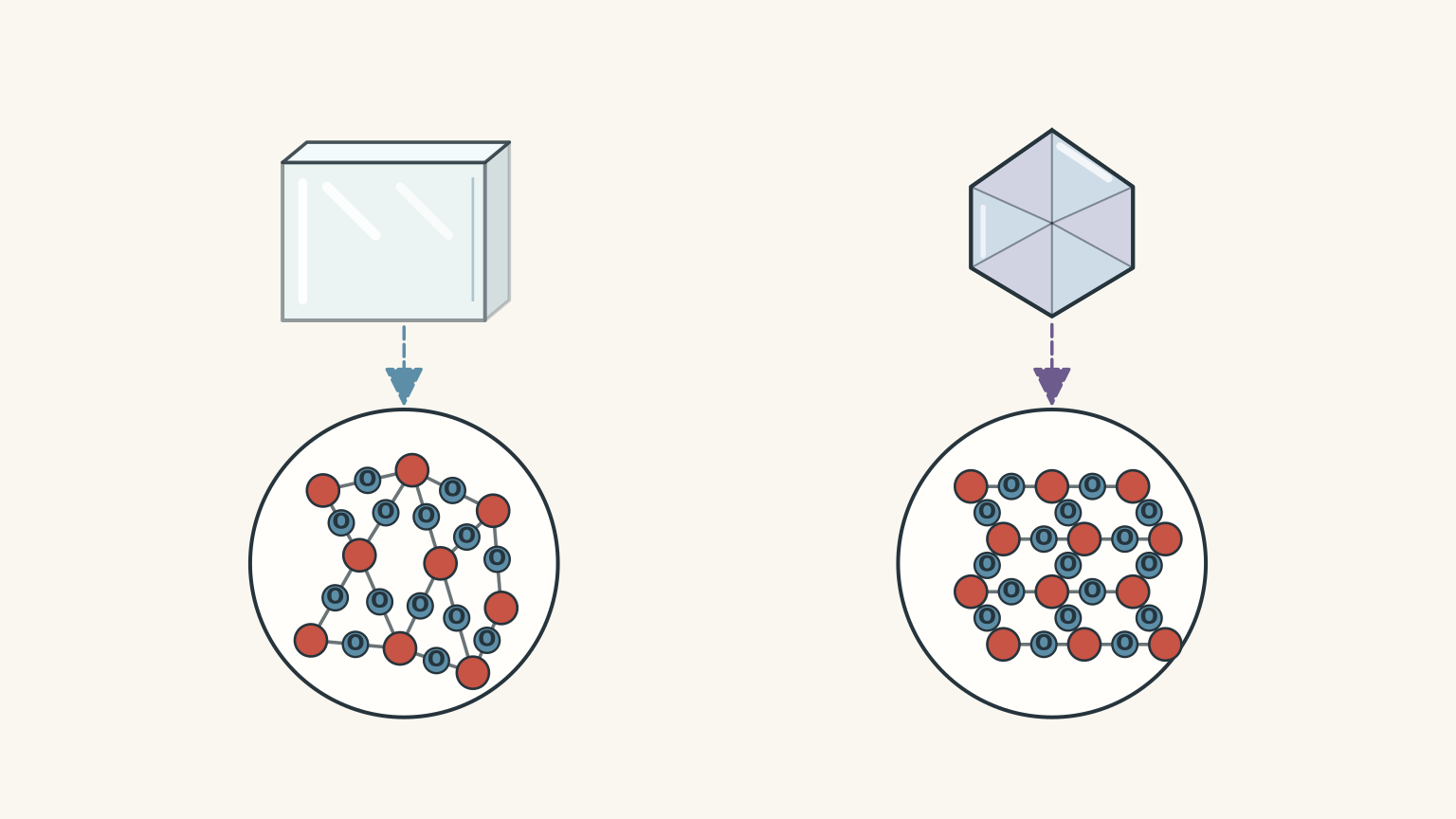
Due to technical limitations, this figure may display incorrectly or contain inaccuracies. Please check key details against your course materials.
Scope note: Amorphous solids are an extension beyond the required content of the NSW Chemistry 11-12 Syllabus (2025). Its Year 11 focus area, Properties and structure of matter, provides the prerequisite knowledge for this article; studying amorphous solids here is not an additional assessment requirement. The 2025 syllabus is scheduled for implementation from 2028, according to NESA.
01Start with what you know: atoms, isotopes, and density
Before looking at glass, it is worth revisiting an important distinction from atomic structure: chemical behaviour and physical properties are not determined by exactly the same features of an atom.
An isotope is an atom of an element with a particular number of neutrons. Isotopes of the same element have:
- The same number of protons.
- Different numbers of neutrons.
- Different atomic masses.
For neutral atoms, the number of electrons is also the same. This means isotopes of an element have the same electron configuration.
Why does this matter?
Chemical bonding is largely determined by the arrangement of electrons, particularly the valence electrons. Since isotopes have the same electronic arrangement, they generally form the same types of bonds and participate in similar chemical reactions.
However, their masses are different.
This can change physical properties, including density.
Density is the mass of a substance per unit volume:
\[ \rho=\frac{m}{V} \]
where:
- \(\rho\) is density, measured in \(\mathrm{g\,cm^{-3}}\) or \(\mathrm{kg\,m^{-3}}\).
- \(m\) is mass.
- \(V\) is volume.
If two samples occupy approximately the same volume but one contains heavier isotopes, the heavier sample will generally have a greater density.
An example: ordinary water and heavy water
Consider ordinary water, \(\ce{H2O}\), and heavy water, \(\ce{D2O}\).
The hydrogen in ordinary water is predominantly hydrogen-1, also called protium. Its nucleus contains one proton and no neutrons.
Deuterium, represented by D, is hydrogen-2. Its nucleus contains one proton and one neutron.
Both isotopes have one electron when neutral. Their electronic configurations are therefore the same, but deuterium is approximately twice as massive as protium.
Replacing both hydrogen atoms in a water molecule with deuterium produces heavy water.
At \(25^\circ\mathrm{C}\), the densities are approximately:
| Substance | Molar mass (\(\mathrm{g\,mol^{-1}}\)) | Density (\(\mathrm{g\,cm^{-3}}\)) |
|---|---|---|
| Ordinary water, H2O | 18.015 | 0.99701 |
| Heavy water, D2O | 20.028 | 1.1044 |
These values are consistent with the physical-property data published by the International Atomic Energy Agency.
The heavier isotopes increase the molecular mass, producing a higher density. The difference is not exactly proportional to the mass increase because molecular volume and intermolecular behaviour also change slightly.
There is another important qualification. Isotopes do not have perfectly identical chemical behaviour. Their different masses affect molecular vibrations and can alter reaction rates and equilibrium positions. These differences are called isotope effects. The IUPAC Gold Book formally defines the kinetic and equilibrium isotope effects.
The useful Year 11 model is therefore:
- Electronic structure largely determines the type of chemical behaviour.
- Nuclear mass influences physical properties such as density.
- Isotope substitution can also produce smaller changes in chemical reaction rates and equilibria.
Worked example: Comparing the density of ordinary and heavy water
A laboratory has \(100.0\ \mathrm{cm^3}\) samples of ordinary water and heavy water, both at \(25^\circ\mathrm{C}\).
Calculate the mass of each sample and determine the percentage increase in density when ordinary water is replaced by heavy water.
Step 1
Density is mass divided by volume, so rearranging gives:
\[ m=\rho V \]
Step 2
\[ \begin{aligned} m_{\ce{H2O}}&=0.99701\times100.0\\ &=99.701\ \mathrm{g} \end{aligned} \]
Step 3
\[ \begin{aligned} m_{\ce{D2O}}&=1.1044\times100.0\\ &=110.44\ \mathrm{g} \end{aligned} \]
Step 4
\[ \begin{aligned} \%\text{ increase} &=\frac{110.44-99.701}{99.701}\times100\\ &=10.77\% \end{aligned} \]
The heavy water sample has approximately \(10.8\%\) greater density.
Interpretation: Both samples occupy the same volume, but the heavy water contains more mass. The additional neutrons explain most of this difference.
Keep this example in mind. We will use the same density relationship again when comparing crystalline and amorphous forms of the same compound.
02Crystalline solids versus amorphous solids
The important question is no longer how much each atom weighs. It is how the atoms are arranged.
A crystalline solid has an ordered atomic arrangement that repeats over long distances.
An amorphous solid does not have this repeating long-range periodic structure.
This distinction is about atomic arrangement, not whether a material is hard, soft, rigid, or transparent.
What is long-range order?
Imagine a floor covered in identical square tiles.
Each tile occupies a predictable position relative to its neighbours. The same arrangement repeats across the entire floor.
This is a useful model for a crystal. Its constituent particles occupy positions in a repeating three-dimensional pattern.
The smallest repeating structural unit is called the unit cell. Repeating this unit throughout space produces the crystal lattice.
If you need to revisit how this works, see tutorgum’s guide to Crystal Unit Cells: Counting Atoms in Cubic Structures.
Now imagine a crowd of people standing together after a sporting event.
Each person has nearby neighbours, but there is no repeating arrangement of people across the entire crowd.
This is a useful analogy for an amorphous solid.
The analogy has a limitation: people can move independently, whereas atoms in a solid are held together by chemical bonds. The comparison is about spatial arrangement, not movement.
What is short-range order?
Short-range order means that particles have predictable arrangements of their nearest neighbours, even though the overall structure does not repeat periodically.
For example, an atom may consistently have:
- Four nearest-neighbour atoms.
- Similar bond lengths to those neighbours.
- A predictable local geometry.
These features can exist in both crystalline and amorphous materials.
The difference appears when you move further away.
In a crystal, the local arrangement continues in a repeating pattern. In an amorphous solid, the orientation and arrangement of neighbouring structural units gradually become irregular.
A useful comparison is:
| Property | Crystalline solid | Amorphous solid |
|---|---|---|
| Short-range order | Present | Present |
| Long-range periodicity | Present | Absent |
| Repeating unit cell | Present | Absent |
| Local atomic arrangement | Ordered | Often highly ordered |
| Overall atomic arrangement | Periodic | Non-periodic |
| Typical X-ray diffraction | Sharp peaks | Broad diffuse features |
One subtle point: amorphous materials can also have medium-range structural correlations. In glass, for example, connected groups of atoms can form characteristic ring arrangements. These correlations extend beyond the immediate neighbours, but they do not produce a repeating crystal lattice.
So amorphous does not mean completely random.
03Glass: short-range order without long-range periodicity
Glass is one of the clearest examples of an amorphous solid.
To understand its structure, we will use pure silica glass, also called fused silica, as our model.
Silica has the chemical formula \(\ce{SiO2}\).
Its basic structural unit is a silicon-oxygen tetrahedron.
The silicon-oxygen tetrahedron
A tetrahedron is a three-dimensional shape with four triangular faces.
In a silica network:
- One silicon atom sits at the centre.
- Four oxygen atoms surround it.
- The four oxygen atoms occupy the corners of the tetrahedron.
Each silicon atom is therefore bonded to four oxygen atoms.
However, these tetrahedra do not remain isolated.
Each oxygen atom is shared between two neighbouring silicon atoms. An oxygen atom that connects two silicon atoms is called a bridging oxygen.
This arrangement produces a continuous three-dimensional network.
This also explains why the chemical formula is \(\ce{SiO2}\), rather than \(\ce{SiO4}\).
Each silicon has four oxygen neighbours, but each oxygen is shared between two silicon atoms. Therefore, each silicon effectively accounts for:
\[ 4\times\frac{1}{2}=2 \]
oxygen atoms.
The resulting ratio is one silicon atom to two oxygen atoms.
Why is glass still amorphous?
Here is the crucial distinction.
The individual \(\ce{SiO4}\) tetrahedra can retain their local geometry, but their orientations and connections do not form a repeating pattern throughout the material.
The angles between neighbouring silicon-oxygen bonds can vary. The tetrahedra can rotate relative to one another, and the sizes of the connected atomic rings can differ.
The result is a continuous, strongly bonded network without long-range periodicity.
In other words:
- The local bonding arrangement is organised.
- The larger network is connected.
- The overall arrangement does not repeat.
This is short-range order without long-range periodicity.
The UNSW School of Materials Science and Engineering describes the three-dimensional tetrahedral network in silicate glasses and explains how fused silica forms without crystallising.
An important distinction: pure silica glass versus window glass
Our model uses pure silica glass because its structure is easier to understand.
Ordinary window glass is generally soda-lime glass. It contains silica alongside other oxides, particularly sodium oxide, \(\ce{Na2O}\), and calcium oxide, \(\ce{CaO}\).
These additional substances modify the silica network.
For example, sodium oxide can reduce the number of bridging oxygens by producing non-bridging oxygen sites. These are oxygen atoms bonded to only one silicon atom, with their negative charge balanced by nearby positive ions.
Calcium ions also participate in modifying and stabilising the network.
The exact structure is therefore more complicated than pure silica glass, but the central distinction remains: the network does not develop long-range periodicity.
We will return to this difference in the practice questions.
04How does a liquid become an amorphous solid?
Now consider molten silica.
At high temperatures, the atoms have enough thermal energy to rearrange as the material flows.
The local silicon-oxygen bonding arrangements can still exist, but the network is continuously changing.
What happens if the liquid cools without crystallising?
As the temperature decreases, the atoms have less ability to rearrange. The viscosity of the material increases, and structural rearrangements become progressively slower.
Eventually, the atoms cannot reorganise into a more ordered crystalline arrangement on the timescale of cooling.
The disordered network becomes trapped.
The glass transition
The temperature range over which a glass changes from a more mobile, soft state to a rigid amorphous state is associated with the glass transition.
The glass-transition temperature is represented by \(T_g\).
At this stage, structural rearrangements become so slow that the material behaves as a solid on the relevant observation timescale.
Unlike a crystalline substance, glass does not have one sharp melting point at which its entire structure changes abruptly from solid to liquid. It softens over a temperature range.
This also explains why glass is not simply an ordinary liquid that happens to flow slowly.
At room temperature, glass is rigid on everyday timescales. Its atoms vibrate, but the network cannot readily rearrange and flow.
Glass is also described as metastable. This means its disordered structure is trapped in a long-lived state rather than being the lowest-energy crystalline arrangement.
Does glass always need rapid cooling?
Rapid cooling is a common way to prevent crystallisation, but it is not a universal requirement for every glass-forming material.
The cooling rate needed depends on the substance and its ability to form a glass.
Silica has a strongly connected network, which makes crystallisation difficult. Some metallic materials, by contrast, require extremely rapid cooling to prevent atoms from organising into crystals.
The important condition is that crystallisation must be sufficiently suppressed for the disordered structure to become trapped.
05How can we identify an amorphous solid?
We have described the atomic structure of glass using a model. But how could we test whether an unknown solid is crystalline or amorphous?
One important technique is X-ray diffraction, commonly abbreviated to XRD.
X-rays interact with the atoms in a material. The scattered X-rays can interfere with one another, producing a pattern that provides information about the material’s atomic arrangement.
The key difference is how regularly the atoms are arranged.
Crystalline materials produce sharp diffraction peaks
In a crystalline solid, the repeating atomic arrangement creates regularly spaced planes of atoms.
X-rays scattered from these repeating planes can interfere constructively at particular angles.
This produces sharp diffraction peaks.
The positions of these peaks are related to the spacing between the crystal planes, so the pattern can help identify the crystalline structure.
Amorphous materials produce broad diffuse features
An amorphous solid does not contain the same repeating arrangement of atomic planes.
Instead, it has a distribution of atomic spacings and local arrangements.
Its diffraction pattern therefore generally contains broad, diffuse features called amorphous halos.
Importantly, the presence of a broad halo does not mean that the atoms have no order. It is consistent with the short-range order we have already discussed.
A useful summary:
| Observation in XRD | Likely structural interpretation |
|---|---|
| Several sharp, well-defined peaks | Long-range crystalline order |
| Broad diffuse halo | Amorphous structure |
| Sharp peaks superimposed on a broad halo | Crystalline and amorphous components may coexist |
That final row is particularly important.
A sample does not have to be completely crystalline or completely amorphous. It can contain both structures.
Also, the height of an individual diffraction peak cannot automatically tell you the percentage of crystalline material. Quantitative analysis requires consideration of the entire diffraction pattern and appropriate calibration.
06Worked example: Same formula, different density
We have seen that isotopes can change density by changing atomic mass.
But can density change even when the chemical formula stays exactly the same?
Yes. Atomic arrangement can change the volume occupied by a given amount of material.
Consider two forms of silicon dioxide:
- Crystalline quartz, with a density of approximately \(2.65\ \mathrm{g\,cm^{-3}}\).
- Amorphous fused silica, with a density of approximately \(2.20\ \mathrm{g\,cm^{-3}}\).
These approximate room-temperature values are reported in the NASA technical report on fused silica.
Both materials have the same chemical formula, \(\ce{SiO2}\), but their structures differ.
Calculate the volume occupied by \(100.0\ \mathrm{g}\) of each material. Determine the percentage increase in volume when crystalline quartz is replaced by fused silica.
Step 1
\[ \rho=\frac{m}{V} \]
Therefore:
\[ V=\frac{m}{\rho} \]
Step 2
\[ \begin{aligned} V_{\mathrm{quartz}} &=\frac{100.0}{2.65}\\ &=37.74\ \mathrm{cm^3} \end{aligned} \]
Step 3
\[ \begin{aligned} V_{\mathrm{glass}} &=\frac{100.0}{2.20}\\ &=45.45\ \mathrm{cm^3} \end{aligned} \]
Step 4
\[ \begin{aligned} \%\text{ increase} &=\frac{45.45-37.74}{37.74}\times100\\ &=20.5\% \end{aligned} \]
Fused silica occupies approximately \(20.5\%\) more volume than the same mass of quartz.
Its lower density is associated with the different average volume occupied by its atomic network.
Notice what this tells us.
The difference in density is not caused by a different chemical formula or a different number of atoms in each formula unit. It arises from the way the atoms are arranged.
This gives us two distinct reasons for changes in density:
- Changing isotopes can change mass while leaving the electronic structure essentially unchanged.
- Changing atomic arrangement can change the volume occupied by the same chemical composition.
Neither effect should be confused with the other.
Also, do not generalise that every amorphous solid must be less dense than its crystalline counterpart. Density depends on the particular composition and structure being compared.
07Questions and solutions
The questions below move from identifying short-range order to combining atomic structure, isotope effects, diffraction, and density. The final question requires you to distinguish two explanations for an unexpectedly high density.
Question 1
A sample of pure silica glass contains silicon atoms surrounded by four oxygen atoms. Each oxygen atom is shared between two neighbouring silicon atoms.
A student argues that this arrangement proves the material is crystalline because the atoms have a predictable local geometry.
Is the student’s conclusion correct? Explain the difference between short-range order and long-range periodicity in this example.
Solution 1
No. The predictable tetrahedral arrangement demonstrates short-range order, but it does not establish long-range periodicity.
Each silicon atom in the silica network has four oxygen neighbours, producing a recognisable local \(\ce{SiO4}\) tetrahedral arrangement. This is evidence of local structural organisation.
However, a crystalline solid requires its atomic arrangement to repeat periodically over large distances.
In amorphous silica, the tetrahedra are connected into a three-dimensional network, but their orientations, connecting angles, and ring arrangements do not repeat in a regular pattern.
The student’s mistake is assuming that local order automatically produces a crystal.
A material can have highly organised nearest-neighbour arrangements while remaining amorphous overall.
Question 2
An unknown silica-based sample is analysed using powder X-ray diffraction.
After correcting for background scattering from the sample holder, the diffraction pattern contains:
- A broad diffuse halo extending across a range of diffraction angles.
- Three narrow peaks at positions corresponding to a known crystalline silica phase.
A student concludes that the sample must be entirely crystalline because the three sharp peaks demonstrate the presence of a crystal lattice.
Evaluate this conclusion.
Explain what the two types of diffraction features indicate and whether the pattern establishes which structural component is present in the greater proportion.
Solution 2
The sample most likely contains both amorphous and crystalline components. The presence of sharp diffraction peaks does not establish that the entire sample is crystalline.
The two features provide different structural evidence.
The broad diffuse halo
The halo is consistent with an amorphous component.
Its atoms have local structural order, but their arrangement lacks the long-range periodicity required to produce sharp Bragg peaks.
The three narrow peaks
These indicate that at least some of the sample contains a crystalline phase.
The repeating arrangement of atoms in those crystalline regions produces constructive interference at particular diffraction angles.
The important issue is that both features occur in the same measured pattern.
Therefore, the best interpretation is a sample containing amorphous material alongside crystalline regions.
The student’s tempting argument is that sharp peaks prove crystallinity, which is partly correct. However, it incorrectly assumes that the presence of crystalline material means the entire sample must be crystalline.
The relative proportions cannot be determined reliably from the peak heights alone. A quantitative analysis would need to consider the full diffraction pattern, the scattering properties of the phases, and appropriate experimental calibration.
A sample can contain a substantial amorphous component even when distinct crystalline peaks are visible.
Question 3
Two identical samples of molten pure silica are cooled under different conditions.
- Sample A is held for an extended period in a temperature range where a crystalline silica phase can nucleate and grow. It is then cooled to room temperature.
- Sample B is cooled through the same temperature range quickly enough that crystal nucleation and growth are negligible.
Assume that the stated conditions are sufficient to produce crystallisation in A and prevent it in B.
Both samples are rigid at room temperature.
Predict the expected atomic arrangement and X-ray diffraction pattern of each sample.
Explain why sample B is still a solid despite lacking long-range periodicity. Also explain why extremely rapid cooling is not a universal requirement for forming every type of glass.
Solution 3
Sample A will contain a crystalline structure, while sample B will form an amorphous solid with short-range order but no long-range periodicity.
Their different cooling histories determine whether the atoms have sufficient opportunity to develop a repeating arrangement.
Sample A: Crystallisation
The extended hold gives atoms enough time and mobility to rearrange.
Crystalline regions can nucleate and grow, allowing a repeating atomic arrangement to develop.
Its X-ray diffraction pattern should therefore contain sharp peaks associated with the crystalline phase.
Sample B: Formation of glass
Rapid cooling suppresses the nucleation and growth of crystalline regions.
The local silicon-oxygen tetrahedral arrangements remain, but the network becomes rigid before it can develop long-range periodicity.
Its diffraction pattern should show broad diffuse features characteristic of amorphous silica.
Why is sample B still a solid?
A solid does not have to be crystalline.
The connected silicon-oxygen network provides strong bonding throughout the material. At room temperature, structural rearrangements are extremely slow, and the material behaves as a rigid solid.
The atoms still vibrate, but they cannot readily reorganise into a different arrangement.
Why is rapid cooling not always necessary?
The required cooling rate depends on the glass-forming ability of the substance.
Some materials resist crystallisation because of their bonding arrangements and network structures. Other materials crystallise readily and require much faster cooling to trap an amorphous arrangement.
The important condition is suppressing crystallisation long enough for the material to pass into the rigid glassy state.
A useful distinction is that cooling history influences the structure, while the final rigidity of the material does not depend on having a crystalline lattice.
Question 4
A student uses the pure silica model to explain the structure of ordinary soda-lime window glass.
They make two claims:
- Every oxygen atom must be shared between two silicon atoms.
- If some oxygen atoms are not shared between two silicon atoms, the entire three-dimensional network must fall apart.
Evaluate both claims.
In your response, explain the roles of \(\ce{Na2O}\) and \(\ce{CaO}\), and distinguish network connectivity from long-range periodicity.
Solution 4
Both claims are incorrect. Commercial soda-lime glass can contain non-bridging oxygen atoms while retaining a connected three-dimensional amorphous network.
The student’s first mistake is applying the pure silica model to a more complicated glass composition.
Claim 1: Every oxygen must be shared between two silicon atoms.
This is true for the idealised pure silica network, but not for all silicate glasses.
When sodium oxide is added to silica, it acts as a network modifier. Some existing silicon-oxygen-silicon connections are replaced by arrangements containing non-bridging oxygen atoms.
A non-bridging oxygen is bonded to one silicon atom rather than two.
The negative charge associated with these oxygen sites is balanced by nearby positive ions, particularly \(\mathrm{Na}^{+}\).
Calcium oxide also modifies the network. Its \(\mathrm{Ca}^{2+}\) ions can help balance the charge associated with two non-bridging oxygen sites.
Claim 2: Non-bridging oxygen destroys the entire three-dimensional network.
This is also incorrect.
Introducing non-bridging oxygen reduces the connectivity of the silica network, but it does not automatically disconnect the entire structure.
Many bridging oxygen atoms remain, allowing the network to maintain connections throughout the material.
The distinction is between the number of connections in the network and whether those connections form a periodic crystal lattice.
These are different structural questions.
A glass can have reduced network connectivity while remaining amorphous.
This is why the pure \(\ce{SiO2}\) model is an excellent starting point, but it must be adjusted when explaining commercial soda-lime glass.
Question 5
A materials scientist investigates a silica sample containing both amorphous fused silica and crystalline quartz.
However, there is an additional complication: every oxygen atom in both phases has been replaced with the heavier isotope oxygen-18, represented by \({}^{18}\mathrm{O}\). The silicon atoms retain their natural isotopic composition.
The measured density of the sample at room temperature is:
\[ \rho_{\mathrm{mix}}=2.50\ \mathrm{g\,cm^{-3}} \]
Its X-ray diffraction pattern contains a broad diffuse halo and sharp peaks matching crystalline quartz.
The scientist is asked to determine the mass percentage of crystalline quartz.
The following data are available:
| Property | Natural-isotope material |
|---|---|
| Density of fused silica | \(2.20\ \mathrm{g\,cm^{-3}}\) |
| Density of crystalline quartz | \(2.65\ \mathrm{g\,cm^{-3}}\) |
| Molar mass of natural-isotope \(\ce{SiO2}\) | \(60.08\ \mathrm{g\,mol^{-1}}\) |
| Molar mass of fully oxygen-18-enriched \(\ce{SiO2}\) | \(64.08\ \mathrm{g\,mol^{-1}}\) |
Assume:
- Both phases have the same oxygen-18 enrichment.
- Replacing oxygen-16 with oxygen-18 does not change the molar volume of either phase for this calculation.
- The sample contains only fused silica and crystalline quartz.
- There is no porosity, and the volumes of the two phases are additive.
- All densities refer to the same temperature.
Tasks:
a) Calculate the expected densities of fully oxygen-18-enriched fused silica and quartz.
b) Calculate the mass percentage of crystalline quartz in the sample.
c) Explain why comparing the measured density directly with the natural-isotope densities would lead to an incorrect conclusion about the sample’s crystallinity.
d) Explain how the diffraction pattern supports your calculated result.
Solution 5
The sample contains approximately 36% crystalline quartz by mass and 64% amorphous fused silica by mass under the stated assumptions.
The important complication is that the oxygen isotope substitution increases the mass of both phases without requiring a change in their atomic arrangements.
Consequently, we must correct the reference densities before estimating the crystalline fraction.
Part a): Calculate the isotope-corrected densities.
The natural-isotope formula mass is \(60.08\ \mathrm{g\,mol^{-1}}\), while the fully oxygen-18-enriched formula mass is \(64.08\ \mathrm{g\,mol^{-1}}\).
The ratio of their molar masses is:
\[ \frac{64.08}{60.08}=1.0666 \]
Because the question assumes that the molar volumes remain unchanged, the densities increase by the same factor.
For fused silica:
\[ \begin{aligned} \rho_g &=2.20\times1.0666\\ &=2.3465\ \mathrm{g\,cm^{-3}} \end{aligned} \]
For crystalline quartz:
\[ \begin{aligned} \rho_q &=2.65\times1.0666\\ &=2.8264\ \mathrm{g\,cm^{-3}} \end{aligned} \]
Here:
- \(\rho_g\) is the density of oxygen-18-enriched fused silica.
- \(\rho_q\) is the density of oxygen-18-enriched quartz.
Notice that both densities have increased, even though their underlying structural arrangements have not changed in our model.
Part b): Calculate the crystalline mass fraction.
We cannot simply take the arithmetic average of the two densities.
Instead, we must account for the fact that the volumes of the two phases add together.
Let \(w\) represent the mass fraction of crystalline quartz.
The remaining mass fraction, \(1-w\), represents amorphous fused silica.
For a mixture with additive volumes:
\[ \frac{1}{\rho_{\mathrm{mix}}} = \frac{1-w}{\rho_g} + \frac{w}{\rho_q} \]
The reciprocal of density represents volume per unit mass, which is why the mixture equation uses reciprocal densities.
Substitute the known values:
\[ \frac{1}{2.50} = \frac{1-w}{2.3465} + \frac{w}{2.8264} \]
Simplifying:
\[ 0.4000=0.4262(1-w)+0.3538w \]
Expand:
\[ 0.4000=0.4262-0.0724w \]
Rearrange:
\[ \begin{aligned} 0.0724w&=0.0262\\ w&=\frac{0.0262}{0.0724}\\ w&\approx0.362 \end{aligned} \]
Convert to a percentage:
\[ 0.362\times100=36.2\% \]
Therefore:
\[ \boxed{\text{Crystalline quartz}\approx36\%} \]
The amorphous mass fraction is:
\[ 100-36.2=63.8\% \]
So the sample is predominantly amorphous by mass.
Part c): Explain the incorrect density comparison.
The tempting approach is to compare the measured density of \(2.50\ \mathrm{g\,cm^{-3}}\) directly with the natural-isotope densities of \(2.20\) and \(2.65\ \mathrm{g\,cm^{-3}}\).
This ignores the extra mass contributed by oxygen-18.
If we incorrectly use the natural-isotope densities in the mixture equation, we obtain:
\[ \frac{1}{2.50} = \frac{1-w}{2.20} + \frac{w}{2.65} \]
Solving gives:
\[ w\approx0.707 \]
This would suggest approximately \(71\%\) crystalline quartz.
That conclusion is very different from the correct estimate of \(36\%\).
The error occurs because the reference densities describe materials with a different isotopic composition from the sample.
This is the key conceptual point: a higher density does not necessarily indicate greater crystallinity. Increasing the mass of the atoms can also increase density without creating long-range periodicity.
Part d): Interpret the diffraction pattern.
The broad diffuse halo supports the presence of amorphous fused silica.
The sharp peaks matching quartz indicate that crystalline quartz is also present.
Together, these features are consistent with a mixture containing both phases.
The diffraction pattern establishes the presence of crystalline and amorphous components, while the density calculation provides an estimate of their relative mass fractions under the specified assumptions.
The sharp peaks do not mean that most of the material must be crystalline.
There is also a limitation to the calculation: real isotope substitution can produce small changes in vibrational behaviour and molar volume. Real mixtures can also depart slightly from ideal volume additivity. The calculated fraction is therefore an estimate within the simplified model specified in the question.
This problem combines three ideas that are easy to confuse:
- Isotope composition affects atomic mass.
- Atomic arrangement affects structural order and can affect density.
- X-ray diffraction provides evidence of crystalline periodicity, independently of the mass contribution from isotopes.
Being able to separate these effects is much more important than simply recognising that glass is amorphous.
08Where to take this next
The central idea is that a material’s properties depend on more than its chemical formula.
Isotopes show how changing atomic mass can alter density without substantially changing electronic structure. Amorphous solids show how changing atomic arrangement can alter density and other physical properties without changing the basic chemical composition.
Glass makes this distinction particularly clear: its atoms can have highly predictable local bonding arrangements without forming a repeating crystal lattice.
The natural next step is to investigate how periodic arrangements produce the unit cells and packing patterns found in crystalline solids.
Two useful extensions are tutorgum’s guides to Crystal Unit Cells: Counting Atoms in Cubic Structures and Crystal Packing Efficiency: Calculating Atomic Packing Fractions.
Together, these topics explain why the difference between crystalline and amorphous solids is not simply whether atoms are organised. It is whether their organisation repeats.