
Crystal Defects: Vacancies, Interstitials and Substitution
Learn how vacancies, interstitials and substitutional defects form in crystal lattices and affect strength, diffusion and electrical conductivity. Explore worked examples, charge balancing and challenging extension questions with detailed solutions.
A piece of steel can be much harder to bend than pure iron, even though both are mostly iron. Where does the added carbon go? Does it replace some of the iron atoms, or squeeze into the gaps between them?
Much of the carbon dissolved in iron occupies gaps between regular iron positions. Those small atoms distort the surrounding structure, making permanent deformation more difficult. A tiny change in atomic arrangement can have a surprisingly large effect on a material’s properties.
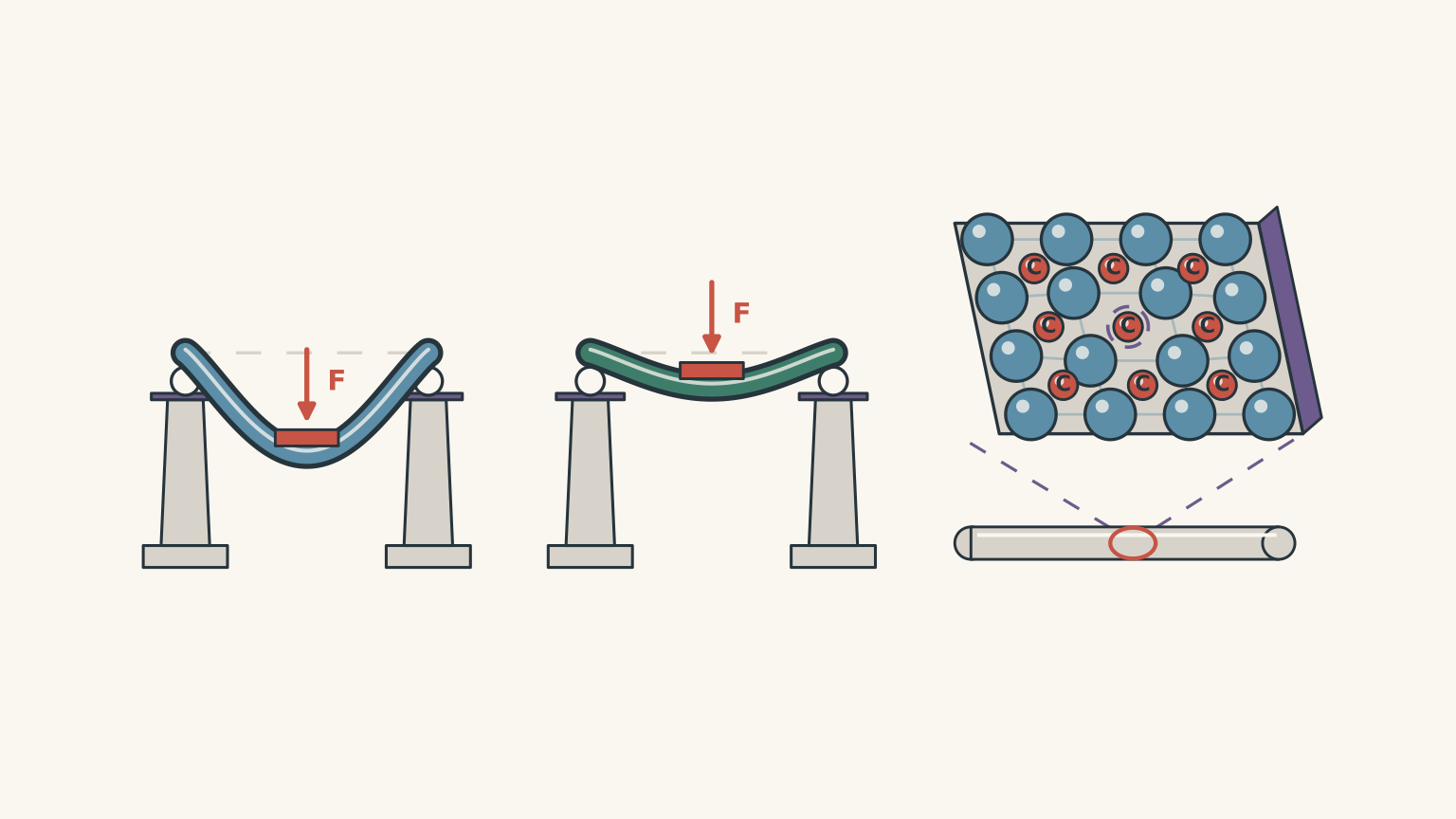
Due to technical limitations, this figure may display incorrectly or contain inaccuracies. Please check key details against your course materials.
This is extension chemistry, beyond the required content of the NSW Chemistry 11-12 Syllabus (2025). The syllabus, scheduled for Year 11 implementation from 2028, provides the foundation through Properties and structure of matter, including the periodic table and chemical bonding. Crystal defects take those ideas further: what happens when a solid’s repeating atomic structure isn’t perfectly regular?
01The crystal lattice: an orderly model with exceptions
In Year 11 Chemistry, you learn that atoms and ions can form repeating arrangements in solids.
In a crystalline solid, this repeating three-dimensional arrangement is called a crystal lattice. The regular positions occupied by atoms or ions are called lattice sites.
Imagine a cinema with seats arranged in neat rows. Each seat represents a regular lattice site, and each person represents an atom. You could change the arrangement in three ways:
- Leave a seat empty.
- Squeeze an extra person into the space between seats.
- Replace someone in a seat with a different person.
These correspond to three important types of crystal defect.
The analogy has a limit. Atoms are not people sitting in fixed chairs. They bond to neighbouring particles, vibrate, and shift their positions slightly. A defect can distort the arrangement around it.
A quick periodic table connection
Before examining defects, recall three ways of describing an element’s position in the periodic table.
| Feature | Meaning | What it helps predict |
|---|---|---|
| Period | A horizontal row | The highest occupied principal electron shell in a ground-state atom |
| Group | A vertical column | Similar outer-electron arrangements and chemical behaviour, especially for main-group elements |
| Block | The s-, p-, d-, or f-block | The subshell associated with the element’s position and electron configuration |
For example, silicon is in Period 3, Group 14, and the p-block. Phosphorus is also in Period 3 and the p-block, but belongs to Group 15.
That difference gives phosphorus one more valence electron than silicon. Later, we’ll see how placing phosphorus in a silicon crystal can change electrical conductivity.
Periodic-table position helps predict an atom’s electron arrangement and chemical behaviour. It doesn’t, by itself, determine whether an atom will replace another atom or occupy a gap in a crystal.
Atomic size, bonding, charge, and the geometry of the crystal also matter.
02Three types of crystal defect
A point defect is a local irregularity associated with one or a few atomic positions in a crystal.
The three types to recognise are vacancies, interstitials, and substitutional defects.
1. Vacancy: a missing atom or ion
A vacancy occurs when a regular lattice site is unoccupied.
Imagine a crystal made entirely of copper atoms. If one copper atom is absent from its normal position, that empty position is a vacancy.
The important distinction is that a vacancy is not simply any empty space between atoms. Crystals naturally contain gaps. A vacancy is specifically an unoccupied site that would normally contain a particle.
Vacancies can influence how particles move through a solid. A neighbouring atom may jump into an empty lattice site, leaving a new vacancy behind.
This is one mechanism of diffusion, the movement of particles through a material.
2. Interstitial defect: an atom in a gap
An interstitial defect occurs when an atom occupies a position between the usual lattice sites.
There are two possibilities:
- A self-interstitial is an extra atom of the same element as the host crystal.
- An interstitial impurity is an atom of a different element occupying a gap.
Carbon in iron is a familiar example of an interstitial impurity.
Carbon atoms are much smaller than iron atoms, so some can occupy spaces between iron atoms rather than replacing them. Those gaps are not always large enough to fit carbon without distortion.
The neighbouring iron atoms shift to accommodate the carbon.
3. Substitutional defect: an atom replacing another
A substitutional defect occurs when a different type of atom occupies a regular lattice site.
For example, in many copper-zinc alloys, zinc atoms occupy positions that would otherwise contain copper atoms.
The zinc atoms are not simply squeezed into gaps. They replace copper atoms in the regular arrangement.
A substitutional atom may be larger or smaller than the original atom. It may also have a different electron configuration or chemical charge.
These differences can affect strength, conductivity, and other properties.
The distinction worth remembering
| Defect | What happens? | Example |
|---|---|---|
| Vacancy | A normal lattice site is empty | Missing copper atom in copper |
| Interstitial | An atom occupies a gap between normal sites | Carbon atom in iron |
| Substitutional | A different atom occupies a normal lattice site | Phosphorus atom replacing silicon |
Notice that interstitial and substitutional defects both involve an atom occupying a position.
The difference is which position it occupies.
03How defects change a material’s properties
A defect matters because it changes the local environment of neighbouring atoms or ions.
Three main effects are worth understanding: distortion, particle movement, and changes in electrical behaviour.
Interstitial atoms can make metals harder to deform
Think about bending a metal wire.
For the wire to stay bent, parts of its crystal structure must undergo permanent deformation. This happens largely through the movement of irregularities called dislocations through the lattice.
A dislocation is a line defect that allows deformation to spread through a crystal without an entire plane of atoms sliding at once.
Now introduce a small carbon atom into an interstitial site in iron.
The carbon distorts the nearby arrangement. This distortion can make dislocations harder to move. Greater force is then needed to produce permanent deformation.
This is one reason dissolved carbon can strengthen iron. It is not the complete explanation of steel’s strength: the phases present, heat treatment, grain structure, and other defects also affect its mechanical properties.
The important mechanism is that a local atomic disturbance can change how easily the whole material deforms.
Vacancies can help particles move through a solid
Suppose an atom has an occupied lattice site immediately to its left and an empty normal site immediately to its right.
If the atom jumps to the empty site, what happens to the vacancy?
It appears to move left.
The atom moved right, but the empty position moved in the opposite direction.
This is an important distinction.
A vacancy isn’t a physical particle travelling through the crystal. It is an empty site whose position changes as neighbouring particles move.
The movement still requires energy. A particle must overcome an energy barrier to move from one position to another.
Increasing temperature generally makes these jumps more frequent, although the exact behaviour depends on the material.
A crystal may therefore contain plenty of vacancies but have very little particle movement at a low temperature.
Why ionic crystals need another rule
In a metal, we can initially picture a missing atom without worrying about ionic charges.
An ionic crystal is more complicated because the lattice contains positive and negative ions.
Consider sodium chloride, \(\ce{NaCl}\).
Its regular structure contains \(\mathrm{Na}^{+}\) and \(\mathrm{Cl}^{-}\) ions in a 1:1 ratio.
If a sodium ion is removed without any other change, the remaining ions have an excess of negative charge.
An overall neutral crystal must have some way of compensating for that imbalance.
Two arrangements illustrate how vacancies and interstitials can occur while preserving charge neutrality.
Schottky defect: A matching combination of positive and negative ions is missing. In \(\ce{NaCl}\), one missing \(\mathrm{Na}^{+}\) and one missing \(\mathrm{Cl}^{-}\) produces two vacancies without changing the overall charge balance.
Frenkel defect: An ion leaves its normal lattice site and moves into an interstitial position. This creates one vacancy and one interstitial defect, without removing the ion from the crystal.
These are useful models of charge-neutral defect combinations. They do not mean that every ionic crystal favours both arrangements equally.
Real crystals can also balance charges through other defects or electronic changes. For the calculations below, we’ll state explicitly which mechanisms are allowed.
04Worked example: How phosphorus changes silicon
An idealised silicon crystal contains 1,000,000 regular lattice sites. Twenty-five of these sites are occupied by phosphorus atoms rather than silicon atoms. All other normal sites contain silicon.
Assume every phosphorus atom acts as an electrically active donor, supplying one additional mobile electron.
Identify the defect, calculate the percentage of sites occupied by phosphorus, and determine the number of additional mobile electrons.
Step 1
Each phosphorus atom occupies a normal silicon lattice site.
Therefore, phosphorus produces a substitutional defect.
It is not an interstitial defect because phosphorus is replacing silicon rather than occupying an additional gap.
Step 2
Silicon is in Group 14 and has four valence electrons.
Phosphorus is in Group 15 and has five valence electrons.
When phosphorus substitutes for silicon in the crystal’s bonding network, four of its valence electrons participate in the surrounding bonds. The fifth electron is weakly bound and can be donated to the material.
This is called donor doping.
Step 3
\[ \begin{aligned} \%\text{ P sites} &=\frac{25}{1\,000\,000}\times100\\ &=0.0025\% \end{aligned} \]
Only 0.0025% of the regular lattice sites contain phosphorus.
Step 4
Under the stated assumption:
\[ 25\times1=25\text{ electrons} \]
The 25 phosphorus donors can supply 25 additional mobile electrons.
That may seem small, but the example shows how relatively few substituted atoms can change the electronic behaviour of a crystal.
In real silicon, the number of mobile electrons depends on temperature, dopant activation, and other defects. The simple one-electron-per-phosphorus model is most useful when the donor atoms are electrically active and compensation is negligible.
For now, notice the central idea: the defect changes the available charge carriers without replacing the crystal’s entire structure.
05Worked example: Why a missing ion can improve conductivity
Consider zirconium dioxide, \(\ce{ZrO2}\), also called zirconia.
Its ionic structure contains \(\mathrm{Zr}^{4+}\) and \(\mathrm{O}^{2-}\) ions.
In an idealised block containing 100 regular zirconium sites, there are 200 regular oxygen sites.
Suppose six \(\mathrm{Zr}^{4+}\) ions are replaced by \(\mathrm{Y}^{3+}\) ions.
Assume that all zirconium sites remain occupied, oxygen vacancies are the only charge-compensating defects, and no oxygen interstitials or electronic charge carriers contribute to charge compensation.
How many oxygen vacancies are needed to keep the block electrically neutral?
Step 1
The yttrium ions replace zirconium ions at their normal lattice positions.
This creates six substitutional defects.
But each \(\mathrm{Y}^{3+}\) carries one fewer positive elementary charge than the \(\mathrm{Zr}^{4+}\) ion it replaces.
The six substitutions therefore reduce the positive charge by six elementary charges.
Step 2
There are 94 zirconium ions and six yttrium ions.
Let \(Q_+\) be the total positive ionic charge and \(e\) be the elementary charge, the magnitude of the charge on one proton.
\[ \begin{aligned} Q_+&=94(4e)+6(3e)\\ &=376e+18e\\ &=394e \end{aligned} \]
The positive ions carry a combined charge of \(+394e\).
Step 3
Each oxide ion, \(\mathrm{O}^{2-}\), carries a charge of \(-2e\).
To balance \(+394e\), the block needs:
\[ \frac{394e}{2e}=197 \]
So 197 oxide ions are required.
Step 4
The perfect block would contain 200 oxide ions occupying 200 regular oxygen sites.
\[ 200-197=3\text{ vacancies} \]
The block therefore needs three oxygen vacancies.
The result gives a useful general rule for this model:
For every two \(\mathrm{Y}^{3+}\) ions replacing two \(\mathrm{Zr}^{4+}\) ions, one oxygen vacancy compensates for the charge difference.
This is a key feature of yttria-stabilised zirconia, usually abbreviated YSZ.
Why the vacancies are useful
At sufficiently high temperatures, an \(\mathrm{O}^{2-}\) ion can move into a neighbouring oxygen vacancy.
That jump leaves a vacancy at the ion’s old position. Repeated jumps allow oxide ions to move through the solid.
YSZ is therefore useful as a solid electrolyte in certain high-temperature electrochemical devices, including solid oxide fuel cells and oxygen sensors.
A solid electrolyte conducts ions through a solid material. In this case, the important mobile species are oxide ions, not the yttrium dopants.
There’s a subtle point here.
An oxygen vacancy is sometimes described as having an effective positive charge relative to the normal lattice. This is because removing an \(\mathrm{O}^{2-}\) ion leaves a site with two fewer negative elementary charges.
It does not mean that the empty site contains a real positively charged particle.
The oxide ions move. The vacancy’s apparent motion is the consequence.
06Why the type of defect isn’t enough to predict a property
It would be convenient if every vacancy increased conductivity and every interstitial increased hardness.
Materials don’t behave quite that simply.
Consider these three cases.
| Material | Important defect | Property affected | Why |
|---|---|---|---|
| Iron containing dissolved carbon | Interstitial carbon | Mechanical strength | Local lattice distortion can hinder dislocation movement |
| Silicon doped with phosphorus | Substitutional phosphorus | Electronic conductivity | Active donors can increase the number of mobile electrons |
| Yttria-stabilised zirconia | Substitutional yttrium and oxygen vacancies | Ionic conductivity | Charge compensation introduces vacancies that can assist oxide-ion movement |
The effect depends on more than the label attached to the defect.
It also depends on:
- Concentration: How many defects are present?
- Distribution: Are defects isolated, clustered, or associated with one another?
- Temperature: Can particles move between sites easily?
- Host material: How does the defect interact with the surrounding bonds, ions, and electrons?
For example, increasing oxygen-vacancy concentration may initially improve ionic transport. At higher concentrations, interactions between vacancies and other defects can restrict movement.
So more defects do not necessarily mean better conductivity.
Likewise, stronger metals are not automatically tougher. Strength describes resistance to permanent deformation, while toughness describes the ability to absorb energy before fracture. A change that raises one property may not improve the other.
The more useful question is not simply, “Which defect is present?”
It is, “What does this defect allow or prevent the surrounding particles from doing?”
The underlying mechanisms are described in MIT OpenCourseWare’s teaching material on crystal defects, Yale University’s explanation of semiconductor doping, and Pacific Northwest National Laboratory’s discussion of zirconia electrolytes. The numerical crystal models in this guide are teaching examples, not experimental measurements.
07Questions and solutions
These questions become progressively more demanding. The later problems require you to track several types of defects at once and distinguish what changes in the crystal from what merely moves within it.
Question 1
An idealised silicon crystal contains three local irregularities:
- A: One normal silicon lattice site is empty.
- B: One phosphorus atom occupies a normal silicon lattice site.
- C: An extra silicon atom occupies a gap between regular lattice sites, while the surrounding normal sites remain occupied.
Identify the type of point defect at A, B, and C.
Which irregularity introduces a different chemical element into the crystal?
Solution 1
A is a vacancy, B is a substitutional defect, and C is a self-interstitial. Only B introduces a different chemical element.
A is a vacancy because a normal lattice position that should contain silicon is empty.
B is substitutional because phosphorus occupies a position normally held by silicon. The identity of the atom has changed, but its location is still a regular lattice site.
C is a self-interstitial because the extra silicon atom occupies a gap rather than replacing another atom.
The tempting mistake is to call C a substitutional defect because it contains an extra atom. The defining feature of substitution is replacement, not simply the presence of another particle.
Question 2
Consider an idealised sodium chloride crystal that originally contains 100 regular \(\mathrm{Na}^{+}\) sites and 100 regular \(\mathrm{Cl}^{-}\) sites, all occupied.
After processing, the following defects are found:
- Two vacant sodium lattice sites.
- One vacant chloride lattice site.
- One additional sodium ion in an interstitial position.
There are no other defects or mobile electronic charges.
a) Calculate the number of sodium and chloride ions remaining and determine whether the crystal is electrically neutral.
b) Explain how the arrangement can be accounted for using Schottky and Frenkel defects.
c) Can the final arrangement tell you which type of defect formed first?
Solution 2
The crystal is electrically neutral. Its defects can be accounted for as one Schottky pair and one sodium Frenkel pair, but their formation order cannot be determined from the final arrangement.
Part a: Count the ions.
The two sodium vacancies remove two sodium ions from normal positions, while the sodium interstitial adds one sodium ion elsewhere in the structure.
\[ \begin{aligned} N_{\mathrm{Na}}&=100-2+1\\ &=99\text{ ions} \end{aligned} \]
Here, \(N_{\mathrm{Na}}\) is the total number of sodium ions.
There is one missing chloride ion:
\[ \begin{aligned} N_{\mathrm{Cl}}&=100-1\\ &=99\text{ ions} \end{aligned} \]
Here, \(N_{\mathrm{Cl}}\) is the total number of chloride ions.
The total positive ionic charge is \(+99e\), and the total negative ionic charge is \(-99e\).
\[ Q_{\mathrm{net}}=99e-99e=0 \]
The crystal remains neutral.
Part b: Account for the defect combinations.
One sodium vacancy and one chloride vacancy can be counted as a Schottky pair.
The remaining sodium vacancy and the sodium interstitial can be counted as a Frenkel pair.
The Schottky pair accounts for the net loss of one sodium ion and one chloride ion. The Frenkel pair changes positions without changing the number of sodium ions.
The tempting approach is to count two missing sodium ions and conclude that the crystal has an excess negative charge. That ignores the sodium interstitial.
Part c: Consider the history.
The final arrangement does not reveal the order in which the defects formed.
Counting defects as Schottky and Frenkel pairs is a way to explain the final structure and composition. It does not prove that particular ions moved together or that one process occurred before another.
Question 3
A silicon crystal initially contains 40 substitutional phosphorus atoms, each acting as an electrically active donor.
Consider a hypothetical rearrangement in which 15 phosphorus atoms leave their regular silicon sites and move into interstitial positions.
No atoms enter or leave the crystal, and all silicon atoms remain on their original sites.
For this model, assume:
- Each substitutional phosphorus atom supplies one mobile electron.
- Interstitial phosphorus atoms are electrically inactive.
- Vacancies do not supply or trap electrons.
- No other defects or mobile charge carriers affect the result.
a) Determine the number of substitutional phosphorus atoms, phosphorus interstitials, and vacancies after the rearrangement.
b) Calculate the number of additional mobile electrons before and after.
c) Explain why the crystal’s phosphorus content remains constant even though its electrical behaviour changes.
Solution 3
After rearrangement, there are 25 substitutional phosphorus atoms, 15 phosphorus interstitials, and 15 vacancies. The number of additional mobile electrons falls from 40 to 25 under the stated model, even though the total phosphorus content is unchanged.
Part a: Track every atom and site.
Originally, 40 phosphorus atoms occupy regular silicon positions.
Fifteen move into interstitial positions:
\[ 40-15=25 \]
There are now 25 substitutional phosphorus atoms.
Each phosphorus atom that leaves a regular silicon site creates a vacancy. Therefore, there are 15 new vacancies and 15 phosphorus interstitials.
An important constraint is that moving an atom to an interstitial position does not automatically fill its original site.
Part b: Count the active donors.
Initially, all 40 phosphorus atoms act as donors:
\[ N_{e,\mathrm{initial}}=40 \]
Afterwards, only the 25 substitutional phosphorus atoms remain active:
\[ N_{e,\mathrm{final}}=25 \]
Here, \(N_e\) is the number of additional mobile electrons supplied by active donors.
The reduction is:
\[ 40-25=15\text{ electrons} \]
The crystal has 15 fewer additional mobile electrons under this model.
Part c: Separate composition from arrangement.
The total phosphorus content remains 40 atoms:
\[ 25+15=40\text{ P atoms} \]
No phosphorus has been removed.
What changed is the location of the phosphorus atoms.
A student considering chemical composition alone might predict unchanged electrical behaviour. But electronic activity depends on where an impurity sits and how it interacts with the surrounding crystal.
In real silicon, interstitial phosphorus and vacancies can have more complicated electronic behaviour than the assumptions used here. The problem isolates the effect of changing lattice-site occupancy.
Even under this model, the electron count alone does not establish an exact conductivity ratio, because conductivity also depends on how easily electrons move.
Question 4
A region of yttria-stabilised zirconia contains eight \(\mathrm{Y}^{3+}\) ions substituting for \(\mathrm{Zr}^{4+}\) ions.
Assume oxygen vacancies provide all the required charge compensation, with no other charge-compensating defects.
At a sufficiently high temperature, an oxide ion at oxygen lattice site L moves one position to the right, into an adjacent vacant oxygen site R.
a) Calculate the number of oxygen vacancies required by the eight yttrium substitutions.
b) After the oxide ion moves, which site is vacant? State the direction of oxide-ion movement, apparent vacancy movement, and conventional electric current associated with the hop. Conventional current is defined as the direction positive charge would move.
c) Explain why the added yttrium ions are not the main moving charge carriers.
d) If the crystal is cooled while keeping its defect population fixed, predict the likely qualitative effect on oxygen-ion conductivity.
Solution 4
Four oxygen vacancies are required. When the oxide ion moves right, the vacancy shifts left, and the associated conventional current points left. The mobile particles are oxide ions, and cooling generally reduces their mobility.
Part a: Balance the charge difference.
Each substitution of \(\mathrm{Y}^{3+}\) for \(\mathrm{Zr}^{4+}\) reduces positive ionic charge by \(e\).
Eight substitutions reduce it by \(8e\).
Removing one \(\mathrm{O}^{2-}\) ion from a normal oxygen site produces an oxygen vacancy with an effective charge difference of \(+2e\) relative to the fully occupied lattice.
Therefore:
\[ N_{\mathrm{vac}}=\frac{8e}{2e}=4 \]
Four oxygen vacancies compensate for the eight yttrium substitutions.
Part b: Track the moving particle and empty site.
The oxide ion moves from L to R, so R becomes occupied.
Site L is now vacant.
Therefore:
- Oxide ion: moves right.
- Apparent vacancy: moves left.
- Conventional current: points left.
Why does current point left?
The moving oxide ion has a negative charge. Negative charge moving right is equivalent, for conventional current direction, to positive charge moving left.
The vacancy’s apparent movement is consistent with that direction, although the vacancy itself is not a moving positive particle.
Part c: Identify the charge carriers.
The yttrium ions occupy substitutional lattice sites. Their role in this model is to create a charge imbalance that is compensated by oxygen vacancies.
The oxide ions are the particles that move into those vacancies.
The tempting misconception is that the ions introduced to make the material conductive must be the ions carrying the current. In YSZ, the dopants help create the conditions for a different species to move.
Part d: Consider temperature.
Cooling generally reduces oxygen-ion conductivity because fewer oxide ions have enough thermal energy to overcome the barriers between sites.
The four vacancies may still exist, but the ions can move less readily.
This demonstrates that conductivity depends on both available transport sites and the rate of particle movement.
Question 5
Consider an idealised oxide crystal that would contain 100 \(\mathrm{A}^{4+}\) ions on 100 regular A sites and 200 \(\mathrm{O}^{2-}\) ions on 200 regular oxygen sites if it were perfect.
Four \(\mathrm{A}^{4+}\) ions have been replaced by \(\mathrm{B}^{3+}\) ions.
After processing, the crystal has the following defects:
- Four substitutional \(\mathrm{B}^{3+}\) ions on A sites.
- Five vacant regular oxygen sites.
- Three extra \(\mathrm{O}^{2-}\) ions occupying oxygen interstitial positions.
All remaining regular A sites are occupied by \(\mathrm{A}^{4+}\) ions. There are no other defects or electronic charge carriers.
The crystal is now sealed and annealed without exchanging ions with its surroundings. During annealing, an oxygen interstitial can fill an oxygen vacancy, eliminating both defects. Assume no new defects form.
Two students disagree.
Student A: “Five oxygen vacancies mean five oxide ions have been removed. The crystal cannot be electrically neutral.”
Student B: “After the three interstitials fill three vacancies, ordinary oxide-ion hops can eliminate the remaining two vacancies.”
Determine whether either student is correct.
Your explanation must establish the actual oxygen content and net ionic charge, the maximum number of vacancy-interstitial recombinations, the minimum number of oxygen vacancies remaining, and why ordinary hopping cannot remove the final vacancies.
Finally, explain whether a reduction in vacancy count alone proves that ionic conductivity must decrease during annealing.
Solution 5
Neither student is correct. The crystal is electrically neutral, contains 198 oxide ions, and can eliminate at most three vacancy-interstitial pairs without changing its composition. At least two oxygen vacancies must remain under the stated assumptions.
The key is that the number of empty lattice sites is not necessarily the same as the number of ions missing from the entire crystal.
Step 1: Count the actual oxide ions.
There are 200 normal oxygen sites.
Five are vacant, so 195 oxide ions occupy regular sites.
There are also three oxide ions in interstitial positions.
Therefore:
\[ \begin{aligned} N_{\mathrm O}&=200-5+3\\ &=198\text{ ions} \end{aligned} \]
The crystal contains 198 oxide ions, not 195.
Relative to the perfect crystal, it has only two fewer oxide ions.
Student A’s mistake is to ignore the three interstitial ions.
Step 2: Check charge neutrality independently.
There are 96 \(\mathrm{A}^{4+}\) ions and four \(\mathrm{B}^{3+}\) ions.
Their combined positive charge is:
\[ \begin{aligned} Q_+&=96(4e)+4(3e)\\ &=384e+12e\\ &=396e \end{aligned} \]
The 198 oxide ions contribute:
\[ Q_-=198(-2e)=-396e \]
So:
\[ \begin{aligned} Q_{\mathrm{net}} &=396e-396e\\ &=0 \end{aligned} \]
The crystal is neutral.
The charge calculation independently confirms that the oxide-ion count is consistent with the four \(\mathrm{B}^{3+}\) substitutions.
Step 3: Work out how many defect pairs can disappear.
Each vacancy-interstitial recombination involves one interstitial oxide ion moving into one vacant regular oxygen site.
This eliminates one vacancy and one interstitial.
There are three oxygen interstitials, so at most three such recombinations can occur.
After all three have recombined:
\[ \begin{aligned} N_{\mathrm{vac,final}}&=5-3=2\\ N_{\mathrm{int,final}}&=3-3=0 \end{aligned} \]
Here, \(N_{\mathrm{vac,final}}\) is the final vacancy count, and \(N_{\mathrm{int,final}}\) is the final interstitial count.
The oxygen content remains 198 ions throughout.
Step 4: Explain why the final vacancies cannot disappear by ordinary hopping.
Suppose an oxide ion jumps from an occupied regular site into one of the remaining vacancies.
The destination becomes occupied, but the ion’s original site becomes vacant.
One vacancy has moved. No vacancy has been eliminated.
To remove the final two vacancies while retaining full occupancy of the normal oxygen sites, the crystal would need two additional oxide ions.
But the crystal is sealed, its total oxygen content is fixed, and no new charge-compensating defects or electronic carriers are allowed.
There is another way to see the constraint.
If all 200 oxygen sites became occupied, the negative ionic charge would be \(-400e\).
The positive ionic charge remains \(+396e\).
The crystal would then have a net charge of \(-4e\), contradicting the charge-neutrality condition.
Student B’s mistake is to confuse moving a vacancy with eliminating a vacancy.
Step 5: Separate the required vacancies from removable defect pairs.
The four \(\mathrm{B}^{3+}\) substitutions reduce positive charge by \(4e\) compared with the perfect structure.
Two oxygen vacancies are required to compensate for that charge difference.
The crystal initially has five oxygen vacancies because it also contains three vacancy-interstitial pairs. Those pairs can recombine without changing the net oxygen content.
This gives a general result:
\[ \begin{aligned} N_{\mathrm{vac}} -N_{\mathrm{int}} =2 \end{aligned} \]
For this crystal, \(N_{\mathrm{vac}}\) is the number of oxygen vacancies and \(N_{\mathrm{int}}\) is the number of oxygen interstitials.
Initially, \(5-3=2\).
After complete recombination, \(2-0=2\).
The difference remains fixed because recombination removes one vacancy and one interstitial together.
Step 6: Consider the conductivity claim.
A reduction in vacancy count alone does not prove that ionic conductivity must decrease.
If temperature, ion mobility, and all other transport conditions stayed the same, fewer available vacancies could reduce vacancy-mediated transport.
But annealing also changes temperature and may alter the distribution of defects. Both affect how readily ions can move. Interstitials may also contribute to transport, depending on the material.
Without information about those effects, the conductivity change cannot be uniquely predicted.
This is the deeper lesson of the problem: charge neutrality constrains the difference between certain defect populations, while the total number of defects can change through recombination. Transport depends on how those defects interact with moving particles.
Once you can distinguish which sites are occupied, which are empty, and which particles can move, the next question is why some electrons or ions move easily while others cannot. For ions, that leads into diffusion and the energy barriers between lattice sites. For electrons, it leads into Band Theory: How Energy Bands Explain Electrical Conductivity – the next layer needed to understand how substitutional doping changes a semiconductor.