
Reaction Half-Life and Temperature: The Arrhenius Connection
Connect first-order half-life with the Arrhenius equation and calculate how temperature changes reaction rates in this chemistry extension guide.
At 350 K, a particular chemical reaction has a half-life of approximately 82 seconds. Raise the temperature to 375 K, and its half-life falls to just 7.8 seconds. A temperature increase of only 25 K has made the reaction more than ten times faster.
Why does such a modest temperature change have such a large effect?
And here’s another puzzle. You’ve probably learnt that a first-order reaction has a constant half-life. So why does its half-life change when the temperature changes?
The answer comes from combining two ideas: the first-order rate law, which describes how reactant concentration changes over time, and the Arrhenius equation, which describes how the rate constant changes with temperature.
This article develops that connection using a real gas-phase reaction.
Where this fits in the syllabus: This is an extension beyond the required Year 11 content of the NSW Chemistry 11-12 Syllabus (2025). That syllabus introduces reaction rates through collision theory, including the effects of concentration, temperature, surface area, and catalysts. Here, we take the temperature discussion further by introducing quantitative rate constants and temperature-dependent half-lives.
The 2025 syllabus is scheduled for implementation in Year 11 from 2028. Year 11 is the assumed knowledge level for this article, not an assessment requirement for the HSC.
01From collision theory to a temperature-dependent rate
Think about two identical samples of a reacting gas. One is kept at 300 K, and the other is heated to 350 K.
Which sample reacts faster?
The hotter sample. But the important question is why.
According to collision theory, particles must collide with sufficient energy to overcome the activation energy, \(E_a\), for a reaction to occur. They must also have a suitable molecular orientation.
Heating the gas increases the average kinetic energy of its particles. It also increases the proportion of particles with enough energy to overcome the activation energy barrier.
Imagine trying to get over a hill. The hill represents the activation energy. Giving the particles more kinetic energy means a greater proportion can get over it.
The analogy has a limitation: molecules don’t all move with the same energy, and the activation energy isn’t a literal physical hill. Instead, molecules have a distribution of energies.
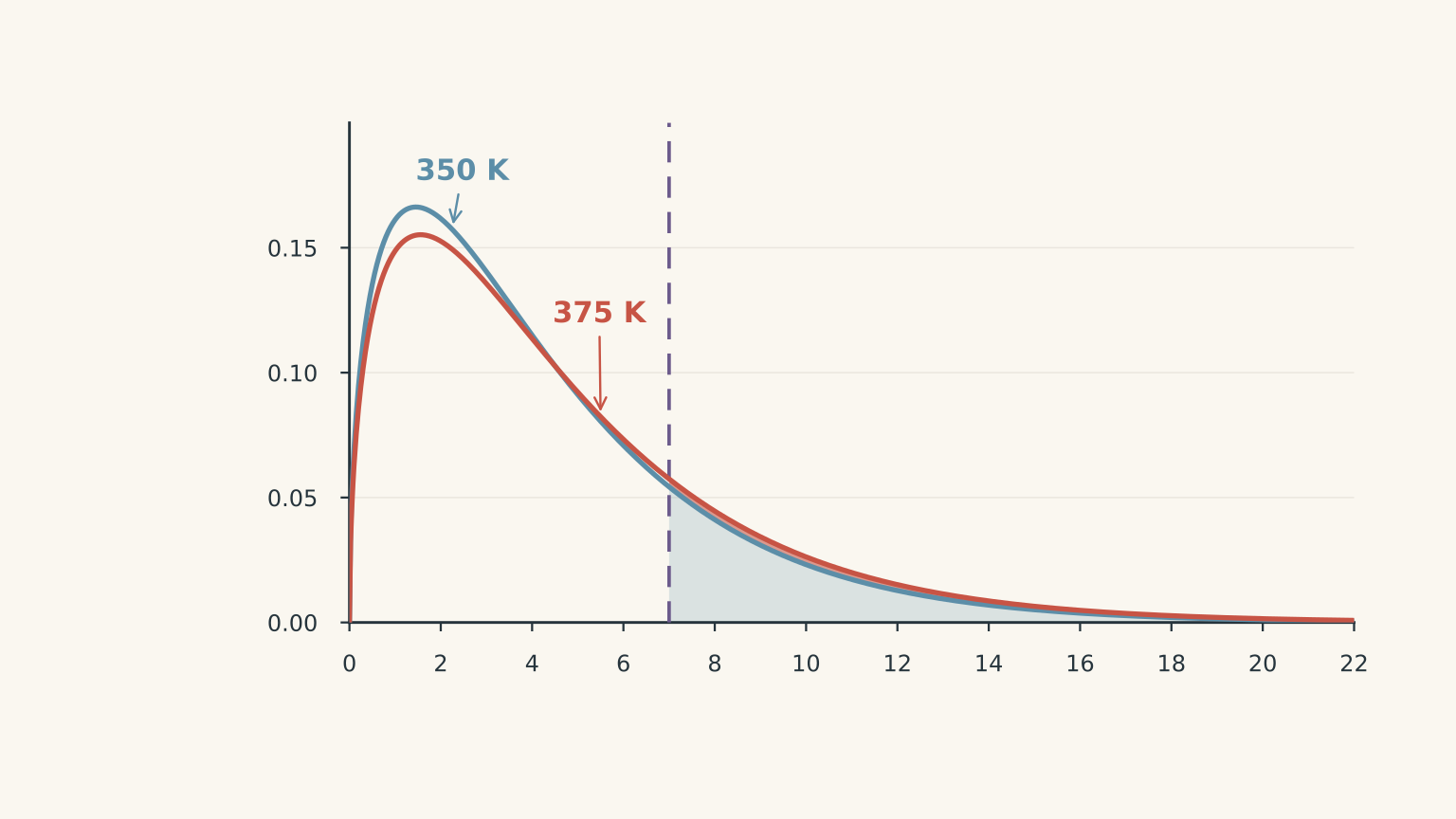
Due to technical limitations, this figure may display incorrectly or contain inaccuracies. Please check key details against your course materials.
The temperature increase affects reaction rate in two related ways:
- Particles move faster, increasing the frequency of collisions.
- A greater proportion of particles have enough energy to overcome the activation energy barrier.
The second effect is particularly important. The increase in successful collisions can be much larger than the increase in average kinetic energy.
This explains why reaction rates can increase dramatically over relatively small temperature intervals.
A quick reminder of the other factors
The Year 11 collision theory model also explains three other ways of changing reaction rates.
| Factor | Effect on reaction rate |
|---|---|
| Concentration | More particles per unit volume increases collision frequency. |
| Temperature | Increases particle kinetic energy and the fraction of sufficiently energetic particles. |
| Surface area | Exposes more solid reactant particles to collisions. |
| Catalyst | Provides an alternative reaction pathway with a lower activation energy. |
These factors can all change the observed reaction rate, but they don’t necessarily affect the rate constant in the same way.
Temperature is particularly interesting because it changes the rate constant itself.
To understand what that means for half-life, we first need a specific reaction model.
02A first-order reaction model
Consider the gas-phase dissociation of nitrogen pentoxide:
\[ \mathrm{N_2O_5(g)\rightarrow NO_2(g)+NO_3(g)} \]
This represents a specific unimolecular decomposition step. It has been experimentally investigated, and its measured rate law is first order with respect to nitrogen pentoxide under the reported conditions.
The rate law is:
\[ \text{Rate}=k[\mathrm{N_2O_5}] \]
Here:
- \(k\) is the first-order rate constant.
- \([\mathrm{N_2O_5}]\) is the molar concentration of nitrogen pentoxide.
- Rate describes how quickly the reactant concentration decreases.
Notice that the rate is directly proportional to the concentration.
If the concentration doubles while the temperature remains constant, the reaction rate doubles.
If the concentration falls by half, the reaction rate also falls by half.
This is the defining behaviour of a first-order reaction.
An important distinction: reaction order comes from the experimentally established rate law, not simply from the coefficients in a balanced chemical equation. For this particular elementary dissociation step, the measured kinetics are first order.
For more practice identifying reaction orders and writing rate laws, see Reaction Orders and Rate Laws: Using Initial-Rate Data.
03Why first-order reactions have a constant half-life
The half-life of a reaction, written \(t_{1/2}\), is the time required for the concentration of a reactant to decrease to half its starting value.
For a first-order reaction, the integrated rate law is:
\[ \ln\left(\frac{[A]_0}{[A]_t}\right)=kt \]
Where:
- \([A]_0\) is the initial concentration.
- \([A]_t\) is the concentration after time \(t\).
- \(k\) is the first-order rate constant.
- \(\ln\) represents the natural logarithm.
We can use this equation to derive the half-life.
At the half-life, the remaining concentration is half the initial concentration:
\[ [A]_t=\frac{[A]_0}{2} \]
Substitute this into the integrated rate law:
\[ \ln\left(\frac{[A]_0}{[A]_0/2}\right) =kt_{1/2} \]
The initial concentrations cancel:
\[ \ln 2=kt_{1/2} \]
Rearranging gives:
\[ \boxed{t_{1/2}=\frac{0.693}{k}} \]
This is one of the most useful results in first-order kinetics.
Notice what has disappeared: the initial concentration.
That means the half-life of a first-order reaction does not depend on how much reactant you started with.
For example, consider two samples at the same temperature:
- Sample 1 starts at 0.100 mol L\(^{-1}\).
- Sample 2 starts at 0.020 mol L\(^{-1}\).
If both follow the same first-order rate law, they have identical half-lives.
After one half-life, their concentrations become 0.050 mol L\(^{-1}\) and 0.010 mol L\(^{-1}\), respectively.
After another half-life, they become 0.025 mol L\(^{-1}\) and 0.005 mol L\(^{-1}\).
Each sample loses half of whatever remains, rather than losing the same absolute concentration every time.
Here’s the important qualification.
The half-life is constant only while the rate constant remains constant. At a fixed temperature, that is a reasonable assumption for this model.
Change the temperature, however, and the rate constant changes.
The half-life changes with it.
04Introducing the Arrhenius equation
We now need an equation that describes how the rate constant depends on temperature.
That equation is the Arrhenius equation:
\[ \boxed{k=Ae^{-E_a/(RT)}} \]
Each symbol has a specific meaning:
| Symbol | Meaning | Units |
|---|---|---|
| \(k\) | Rate constant | s\(^{-1}\) for a first-order reaction |
| \(A\) | Pre-exponential factor | s\(^{-1}\) for a first-order reaction |
| \(E_a\) | Activation energy | J mol\(^{-1}\) |
| \(R\) | Gas constant, 8.314 | J mol\(^{-1}\) K\(^{-1}\) |
| \(T\) | Absolute temperature | K |
The exponential term is the interesting part:
\[ e^{-E_a/(RT)} \]
As temperature increases, the value of \(E_a/(RT)\) decreases.
This makes the negative exponent less negative, increasing the value of \(k\).
Therefore:
\[ \boxed{\text{Higher temperature}\Rightarrow \text{larger }k} \]
And because:
\[ t_{1/2}=\frac{0.693}{k} \]
we also know:
\[ \boxed{\text{Higher temperature}\Rightarrow \text{shorter half-life}} \]
The Arrhenius equation gives us a quantitative version of the collision theory explanation.
It is worth understanding that the activation energy is not simply the average energy of the reacting particles. It represents the energy barrier associated with the reaction pathway.
The pre-exponential factor \(A\) accounts for other aspects of the reaction, including collision frequency and molecular orientation where relevant.
For the model developed here, we treat both \(A\) and \(E_a\) as constant over the temperature range considered.
Applying the Arrhenius equation to nitrogen pentoxide
Published measurements of the unimolecular decomposition of nitrogen pentoxide provide a useful example.
The National Institute of Standards and Technology (NIST) records the following Arrhenius expression for the measured reaction:
\[ k(T)=2.05\times10^{13} e^{-103099/(RT)} \]
For this expression:
- \(A=2.05\times10^{13}\ \mathrm{s^{-1}}\)
- \(E_a=103099\ \mathrm{J\,mol^{-1}}\)
- \(R=8.314\ \mathrm{J\,mol^{-1}\,K^{-1}}\)
The measurements apply to the gas-phase dissociation in a nitrogen bath gas at approximately 1.01 bar, over a temperature range of 338-396 K.
The following table gives rate constants recorded by NIST and the corresponding half-lives calculated using \(t_{1/2}=0.693/k\).
| Temperature (K) | Rate constant, \(k\) (s\(^{-1}\)) | Half-life (s) |
|---|---|---|
| 338 | \(2.39\times10^{-3}\) | 290 |
| 350 | \(8.42\times10^{-3}\) | 82.3 |
| 375 | \(8.93\times10^{-2}\) | 7.76 |
| 396 | \(5.16\times10^{-1}\) | 1.34 |
Look at the change between 350 K and 375 K.
The rate constant increases by approximately a factor of 10.6.
Consequently, the half-life decreases by approximately the same factor.
This is why temperature-dependent kinetics are interesting. A small temperature increase doesn’t necessarily produce a similarly small change in reaction rate.
Connecting the two equations
We now have everything needed to calculate a temperature-dependent half-life.
The first-order half-life equation is:
\[ t_{1/2}=\frac{0.693}{k} \]
The Arrhenius equation tells us:
\[ k=Ae^{-E_a/(RT)} \]
Substitute the Arrhenius expression into the half-life equation:
\[ \boxed{ t_{1/2}(T)= \frac{0.693}{Ae^{-E_a/(RT)}} } \]
This is the central relationship of this article.
It tells us that the half-life depends on temperature through the temperature-dependent rate constant.
At a fixed temperature, the half-life remains constant for the first-order model.
Across different temperatures, the half-life changes.
05Worked example: Finding the half-life at a known temperature
A sample of nitrogen pentoxide undergoes first-order dissociation at 350 K. Its experimentally measured rate constant is \(8.42\times10^{-3}\ \mathrm{s^{-1}}\).
The initial concentration is 0.0100 mol L\(^{-1}\).
Calculate:
(a) The half-life.
(b) The concentration remaining after three half-lives.
Solution
Step 1
Since this is a first-order reaction, use:
\[ t_{1/2}=\frac{0.693}{k} \]
Step 2
\[ t_{1/2}= \frac{0.693}{8.42\times10^{-3}} \]
\[ t_{1/2}=82.3\ \mathrm{s} \]
The half-life is 82.3 seconds.
Step 3
Each successive half-life halves the remaining concentration.
After three half-lives:
\[ [A]_t=[A]_0\left(\frac12\right)^3 \]
Substitute the initial concentration:
\[ [A]_t=0.0100\times\frac18 \]
\[ [A]_t=0.00125\ \mathrm{mol\,L^{-1}} \]
The final concentration is 0.00125 mol L\(^{-1}\).
Interpretation: The reaction has lost 87.5% of its initial nitrogen pentoxide concentration after three half-lives. The three half-lives take approximately 247 seconds.
06Worked example: Calculating a new half-life using temperature
The nitrogen pentoxide decomposition model has the following Arrhenius parameters:
\[ A=2.05\times10^{13}\ \mathrm{s^{-1}} \]
\[ E_a=103099\ \mathrm{J\,mol^{-1}} \]
Calculate the half-life at 365 K.
Solution
Step 1
\[ k=Ae^{-E_a/(RT)} \]
Step 2
\[ k=2.05\times10^{13} e^{-\frac{103099}{8.314\times365}} \]
First, calculate the exponent:
\[ \frac{103099}{8.314\times365} =33.97 \]
Therefore:
\[ k=2.05\times10^{13}e^{-33.97} \]
\[ k=0.0360\ \mathrm{s^{-1}} \]
Step 3
Now use the first-order half-life equation:
\[ t_{1/2}=\frac{0.693}{k} \]
\[ t_{1/2}=\frac{0.693}{0.0360} \]
\[ \boxed{t_{1/2}=19.2\ \mathrm{s}} \]
Interpretation: At 365 K, the nitrogen pentoxide concentration halves in approximately 19.2 seconds under the assumed first-order model.
Compare this with the half-life of 82.3 seconds at 350 K.
The 15 K increase has reduced the half-life by more than 75%.
07What this model can and cannot tell you
Before applying these equations to unfamiliar reactions, understand their assumptions.
1. The reaction must follow first-order kinetics
The equation:
\[ t_{1/2}=\frac{0.693}{k} \]
is specifically for a first-order reaction.
For a second-order reaction, the half-life generally depends on the initial concentration.
You cannot automatically use the first-order half-life equation just because a question mentions a reaction’s half-life.
2. The Arrhenius parameters must remain applicable
The simple Arrhenius model assumes that the activation energy and pre-exponential factor remain approximately constant across the temperature range.
If the reaction mechanism changes, a different pathway becomes important, or the physical conditions change significantly, the same expression may no longer describe the reaction accurately.
For nitrogen pentoxide, the quoted parameters apply to the specified experimental conditions and temperature range of 338-396 K.
Extrapolating them far outside that range is not justified simply because the equation produces a numerical answer.
3. The reaction pathway must remain the same
A catalyst can provide an alternative reaction pathway with a different activation energy.
If a catalyst is introduced, you cannot automatically keep using the original Arrhenius parameters.
Likewise, the model assumes that the forward first-order dissociation can be treated independently, without significant reverse association or competing reactions affecting the measured concentration.
The nitrogen pentoxide example is based on published gas-phase kinetic measurements, not instructions for preparing or handling the reactive substance.
4. Reaction rate and equilibrium are different ideas
One final distinction is particularly important in HSC Chemistry.
The Arrhenius equation describes how the rate constant changes with temperature. It tells us about reaction kinetics: how quickly a reaction proceeds.
The equilibrium constant, \(K_{\mathrm{eq}}\), describes the relative amounts of reactants and products at equilibrium.
Temperature can affect both, but they describe different properties of a chemical system.
A change in reaction rate does not automatically mean a change in equilibrium position.
For a closer look at the thermodynamic side, read How Temperature Changes Keq in Endothermic and Exothermic Reactions.
08Questions and solutions
The following questions build from straightforward half-life calculations to problems involving changing temperatures and competing reaction conditions.
Question 1
A first-order chemical reaction has a rate constant of \(4.00\times10^{-3}\ \mathrm{s^{-1}}\) at a particular temperature.
Calculate its half-life.
Solution 1
The half-life is 173 seconds.
For a first-order reaction:
\[ t_{1/2}=\frac{0.693}{k} \]
Substitute the rate constant:
\[ t_{1/2}= \frac{0.693}{4.00\times10^{-3}} \]
\[ \boxed{t_{1/2}=173\ \mathrm{s}} \]
The reaction takes approximately 173 seconds to reduce its initial reactant concentration by half.
The initial concentration is not required because the half-life of a first-order reaction is independent of the starting concentration.
Question 2
The first-order decomposition of a gas has the following measured half-lives:
| Temperature | Half-life |
|---|---|
| 350 K | 82.3 s |
| 375 K | 7.76 s |
Assuming the reaction follows a single Arrhenius relationship across this temperature interval, calculate its activation energy.
Explain why the ratio of the rate constants is the inverse of the ratio of the half-lives.
Solution 2
The activation energy is approximately \(103\ \mathrm{kJ\,mol^{-1}}\).
First, recall:
\[ t_{1/2}=\frac{0.693}{k} \]
Rearranging:
\[ k=\frac{0.693}{t_{1/2}} \]
For the two temperatures:
\[ \frac{k_2}{k_1} = \frac{t_{1/2,1}}{t_{1/2,2}} \]
Therefore:
\[ \frac{k_{375}}{k_{350}} = \frac{82.3}{7.76} \]
\[ \frac{k_{375}}{k_{350}}=10.6 \]
A shorter half-life corresponds to a larger rate constant.
Next, use the two-temperature form of the Arrhenius equation:
\[ \ln\left(\frac{k_2}{k_1}\right) = \frac{E_a}{R} \left(\frac{1}{T_1}-\frac{1}{T_2}\right) \]
Rearrange to make activation energy the subject:
\[ E_a= \frac{R\ln(k_2/k_1)} {(1/T_1)-(1/T_2)} \]
Substitute:
\[ E_a= \frac{8.314\ln(10.6)} {(1/350)-(1/375)} \]
\[ E_a\approx103071\ \mathrm{J\,mol^{-1}} \]
Convert to kilojoules:
\[ \boxed{E_a\approx103\ \mathrm{kJ\,mol^{-1}}} \]
The key relationship is that half-life and rate constant are inversely proportional for a first-order reaction. The rate constant increases as temperature increases, while the half-life decreases.
Question 3
Two samples of nitrogen pentoxide undergo first-order decomposition at 350 K.
The rate constant is:
\[ k=8.42\times10^{-3}\ \mathrm{s^{-1}} \]
Their initial concentrations are:
- Sample P: \(0.00800\ \mathrm{mol\,L^{-1}}\)
- Sample Q: \(0.0200\ \mathrm{mol\,L^{-1}}\)
(a) Calculate the initial reaction rate for each sample.
(b) Determine which sample reaches a concentration of \(0.00200\ \mathrm{mol\,L^{-1}}\) first.
(c) Compare their half-lives and explain why your answer to part (b) might seem surprising.
Solution 3
Sample P reaches the target concentration first, even though Sample Q has the greater initial reaction rate. Both samples have the same half-life of 82.3 seconds.
Part (a): Initial reaction rates
The first-order rate law is:
\[ \text{Rate}=k[\mathrm{N_2O_5}] \]
For Sample P:
\[ \text{Rate}_P= 8.42\times10^{-3}\times0.00800 \]
\[ \boxed{\text{Rate}_P= 6.74\times10^{-5}\ \mathrm{mol\,L^{-1}\,s^{-1}}} \]
For Sample Q:
\[ \text{Rate}_Q= 8.42\times10^{-3}\times0.0200 \]
\[ \boxed{\text{Rate}_Q= 1.68\times10^{-4}\ \mathrm{mol\,L^{-1}\,s^{-1}}} \]
Sample Q has an initial reaction rate 2.5 times greater than Sample P.
Part (b): Time to reach the target concentration
Use the integrated first-order rate law:
\[ t=\frac{1}{k}\ln\left(\frac{[A]_0}{[A]_t}\right) \]
For Sample P:
\[ t_P= \frac{1}{8.42\times10^{-3}} \ln\left(\frac{0.00800}{0.00200}\right) \]
\[ t_P=\frac{\ln4}{8.42\times10^{-3}} \]
\[ \boxed{t_P=164.6\ \mathrm{s}} \]
For Sample Q:
\[ t_Q= \frac{1}{8.42\times10^{-3}} \ln\left(\frac{0.0200}{0.00200}\right) \]
\[ t_Q=\frac{\ln10}{8.42\times10^{-3}} \]
\[ \boxed{t_Q=273.5\ \mathrm{s}} \]
Therefore, Sample P reaches the target concentration first.
Part (c): Comparing half-lives
For both samples:
\[ t_{1/2}=\frac{0.693}{8.42\times10^{-3}} \]
\[ \boxed{t_{1/2}=82.3\ \mathrm{s}} \]
The result might initially seem counterintuitive.
Sample Q starts with a greater reaction rate, so you might expect it to reach the target concentration sooner.
However, it also starts with considerably more reactant. It must undergo a greater fractional decrease to reach the same absolute concentration.
This illustrates an important distinction: a larger initial reaction rate does not necessarily mean a shorter time to reach a particular concentration.
Question 4
A sample of nitrogen pentoxide initially has a concentration of:
\[ [\mathrm{N_2O_5}]_0=0.0160\ \mathrm{mol\,L^{-1}} \]
It undergoes first-order decomposition under the following conditions:
- Initially, the temperature is maintained at 350 K.
- When the concentration reaches \(0.00400\ \mathrm{mol\,L^{-1}}\), the temperature is immediately increased to 375 K.
- The reaction continues until the concentration reaches \(0.000500\ \mathrm{mol\,L^{-1}}\).
The rate constants are:
\[ k_{350}=8.42\times10^{-3}\ \mathrm{s^{-1}} \]
\[ k_{375}=8.93\times10^{-2}\ \mathrm{s^{-1}} \]
Calculate the total time required to reach the final concentration.
Assume the reaction remains first order and the temperature change is instantaneous.
Solution 4
The total time is approximately 188 seconds.
The important detail is that the reaction experiences two different rate constants. We must calculate the time spent at each temperature separately.
Step 1: Calculate the number of half-lives required at 350 K.
The concentration decreases from:
\[ 0.0160\rightarrow0.00400 \]
This is a decrease by a factor of four:
\[ \frac{0.00400}{0.0160}=\frac14 \]
Therefore, two half-lives have passed.
The half-life at 350 K is:
\[ t_{1/2,350}= \frac{0.693}{8.42\times10^{-3}} \]
\[ t_{1/2,350}=82.3\ \mathrm{s} \]
The time for the first stage is:
\[ t_1=2(82.3) \]
\[ \boxed{t_1=164.6\ \mathrm{s}} \]
Step 2: Calculate the number of half-lives required at 375 K.
The concentration now decreases from:
\[ 0.00400\rightarrow0.000500 \]
The fraction remaining is:
\[ \frac{0.000500}{0.00400}=\frac18 \]
This requires three half-lives.
The half-life at 375 K is:
\[ t_{1/2,375}= \frac{0.693}{8.93\times10^{-2}} \]
\[ t_{1/2,375}=7.76\ \mathrm{s} \]
Therefore:
\[ t_2=3(7.76) \]
\[ \boxed{t_2=23.3\ \mathrm{s}} \]
Step 3: Calculate the total time.
\[ t_{\mathrm{total}}=t_1+t_2 \]
\[ t_{\mathrm{total}}=164.6+23.3 \]
\[ \boxed{t_{\mathrm{total}}=187.9\ \mathrm{s}} \]
The reaction requires approximately 188 seconds.
The trap here is applying the 375 K half-life to the entire reaction. The first two halvings occurred at 350 K, so they must be calculated using the lower-temperature rate constant.
Question 5
Three identical samples of nitrogen pentoxide begin with the same initial concentration.
All three undergo first-order decomposition under the same pressure and bath-gas conditions.
Their temperature schedules are:
- Sample P: 350 K for 10.0 seconds, followed by 375 K for 10.0 seconds.
- Sample Q: 375 K for 10.0 seconds, followed by 350 K for 10.0 seconds.
- Sample R: A constant temperature of 362.5 K for 20.0 seconds.
Assume:
- The reaction remains first order throughout.
- There is no significant reverse reaction or competing reaction.
- The Arrhenius parameters remain constant between 350 K and 375 K.
- Temperature changes are instantaneous.
The measured rate constants are:
\[ k_{350}=8.42\times10^{-3}\ \mathrm{s^{-1}} \]
\[ k_{375}=8.93\times10^{-2}\ \mathrm{s^{-1}} \]
Using the Arrhenius equation, the rate constant at 362.5 K is approximately:
\[ k_{362.5}=2.85\times10^{-2}\ \mathrm{s^{-1}} \]
(a) Calculate the fraction of the initial nitrogen pentoxide remaining in Samples P and Q after 20.0 seconds.
(b) Calculate the fraction remaining in Sample R.
(c) Explain why Samples P and Q finish with the same concentration, even though their temperature schedules are reversed.
(d) Explain why Sample R does not necessarily finish with the same concentration, despite all three samples experiencing the same average temperature.
Solution 5
Samples P and Q both finish with approximately 37.6% of their initial nitrogen pentoxide concentration remaining. Sample R finishes with approximately 56.6% remaining.
This problem combines first-order kinetics with the temperature dependence of the rate constant.
The important distinction is between the order of the temperature stages and the actual values of the rate constants during those stages.
Part (a): Samples P and Q
For a first-order reaction, the integrated rate law can be written:
\[ [A]_t=[A]_0e^{-kt} \]
When the temperature changes, we use the rate constant appropriate to each time interval.
For Sample P:
First, the sample spends 10.0 seconds at 350 K:
\[ \frac{[A]_1}{[A]_0} =e^{-(8.42\times10^{-3})(10)} \]
Then it spends 10.0 seconds at 375 K:
\[ \frac{[A]_2}{[A]_1} =e^{-(8.93\times10^{-2})(10)} \]
Multiply the two fractions:
\[ \frac{[A]_{20}}{[A]_0} = e^{-(0.00842)(10)} e^{-(0.0893)(10)} \]
Combining the exponents:
\[ =e^{-(0.0842+0.893)} \]
\[ =e^{-0.9772} \]
\[ \boxed{\frac{[A]_{20}}{[A]_0}=0.376} \]
Therefore, approximately 37.6% remains.
For Sample Q, the order of the two temperature stages is reversed.
However, the final expression is:
\[ e^{-(0.0893)(10)} e^{-(0.00842)(10)} \]
This produces exactly the same result:
\[ \boxed{\frac{[A]_{20}}{[A]_0}=0.376} \]
Samples P and Q finish with identical concentrations.
Part (b): Sample R
Sample R remains at a constant temperature of 362.5 K for 20.0 seconds.
Its rate constant is:
\[ k_{362.5}=2.85\times10^{-2}\ \mathrm{s^{-1}} \]
Use the first-order integrated rate law:
\[ \frac{[A]_{20}}{[A]_0}=e^{-kt} \]
Substitute:
\[ \frac{[A]_{20}}{[A]_0} =e^{-(0.0285)(20)} \]
\[ =e^{-0.570} \]
\[ \boxed{\frac{[A]_{20}}{[A]_0}=0.566} \]
Approximately 56.6% remains in Sample R.
Part (c): Why do Samples P and Q finish identically?
The order of the temperature stages does not affect the final concentration in this first-order model.
Each stage produces a fractional decrease determined by its own rate constant and duration.
The overall remaining fraction is the product of those two fractional changes:
\[ e^{-k_1t_1}e^{-k_2t_2} = e^{-k_1t_1-k_2t_2} \]
Multiplication is independent of the order of the factors.
The concentration entering the second stage is smaller, but that does not change the fractional decay law for a first-order reaction.
This is a subtle but important feature of first-order kinetics.
Part (d): Why is Sample R different?
The tempting prediction is that all three samples should finish identically because they experience the same average temperature of 362.5 K.
But this assumes that the rate constant changes linearly with temperature.
It does not.
The Arrhenius equation contains an exponential relationship:
\[ k=Ae^{-E_a/(RT)} \]
Consequently, the average of the rate constants at two temperatures is not generally equal to the rate constant at the average temperature.
For Samples P and Q, the average rate constant over the two equal time intervals is:
\[ k_{\mathrm{average}}= \frac{0.00842+0.0893}{2} \]
\[ k_{\mathrm{average}}=0.04886\ \mathrm{s^{-1}} \]
For Sample R, the rate constant at the average temperature is only:
\[ k_{362.5}=0.0285\ \mathrm{s^{-1}} \]
The alternating-temperature samples therefore experience a greater overall rate of decomposition.
This is why they finish with less nitrogen pentoxide remaining.
The deeper lesson is that the average temperature of a reaction does not determine its average rate constant.
You must account for the nonlinear Arrhenius relationship and the time spent at each temperature.
09Where to take this next
You now have a way to connect collision theory, first-order kinetics, and the Arrhenius equation.
The key relationship is:
\[ \boxed{ t_{1/2}(T)= \frac{0.693}{Ae^{-E_a/(RT)}} } \]
It explains why a first-order reaction can have a constant half-life at one temperature but a very different half-life at another.
It also gives you a useful starting point for more advanced chemical kinetics, particularly when comparing reaction mechanisms, activation energies, and the effects of catalysts.
The next natural step is to investigate how reaction mechanisms produce different rate laws. Once you understand that connection, you can determine not just how quickly a reaction proceeds, but why its rate responds to changing conditions in the way it does.
10Scientific sources
- NESA – Chemistry 11-12 Syllabus (2025). Syllabus content and implementation information.
- NIST Chemical Kinetics Database – Thermal decomposition of nitrogen pentoxide at high temperature. Experimental first-order reaction data and Arrhenius parameters from Johnston and Tao, Journal of the American Chemical Society (1951).
- OpenStax – Chemistry 2e: Integrated Rate Laws. First-order integrated rate law and half-life relationships.