
Consecutive Reactions: How Intermediates Form and Disappear
Explore how intermediates are formed and consumed in two-step reaction sequences. Learn to interpret concentration changes, compare reaction rates, and predict when an intermediate reaches its maximum concentration using worked examples.
Suppose a reaction starts with substance A and eventually produces substance C. You monitor the mixture and discover something unexpected: substance B appears, its concentration increases, reaches a maximum, and then decreases until almost none remains.
Why would a substance build up if it is being consumed in the same reaction?
The answer is that B is being formed and consumed simultaneously. Early in the reaction, it is produced faster than it is used up. Later, its consumption catches up and eventually overtakes its formation. This is the central idea behind consecutive reactions.
Scope: Consecutive-reaction kinetics is an extension beyond the required Year 11 Chemistry syllabus. The Year 11 Chemical reactions content provides the prerequisite understanding of energy changes, but this particular kinetic model is not an HSC assessment requirement. The 2025 NSW Chemistry 11-12 syllabus is scheduled to begin Year 11 implementation in 2028; the year level here is a learning starting point, not an assessment claim.
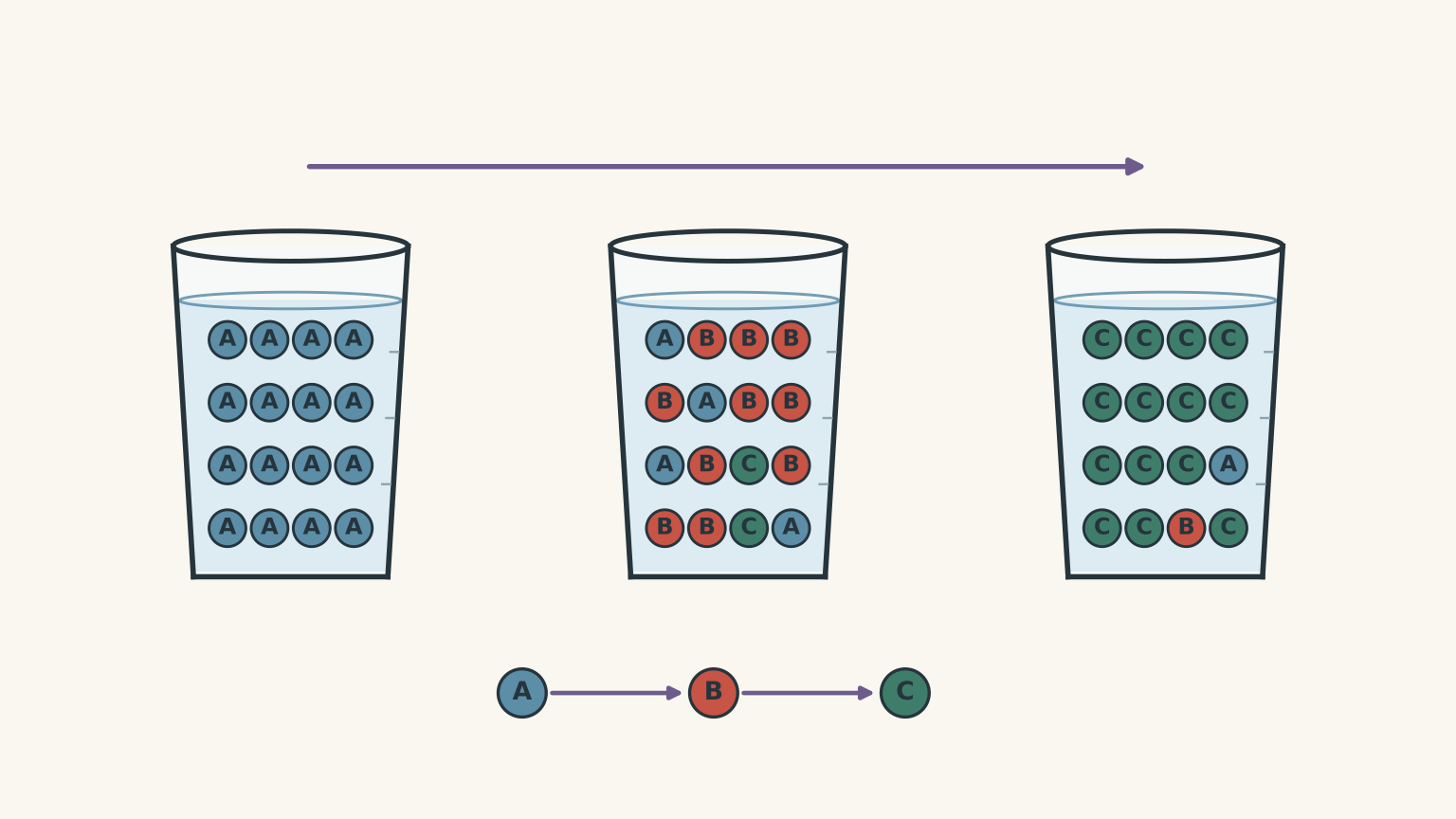
Due to technical limitations, this figure may display incorrectly or contain inaccuracies. Please check key details against your course materials.
01The energy changes behind a reaction sequence
Before looking at reaction rates, recall what happens to energy during a chemical reaction.
An exothermic reaction transfers energy from the reacting system to its surroundings. Its enthalpy change, written as \(\Delta H\), is negative.
An endothermic reaction absorbs energy from its surroundings. Its enthalpy change is positive.
This comes back to the energy involved in chemical bonds:
- Breaking chemical bonds requires energy.
- Forming chemical bonds releases energy.
- The overall enthalpy change depends on the balance between these two processes.
If you need to refresh the signs and energy diagrams, see Endothermic and Exothermic Reactions for HSC Chemistry.
What changes when a reaction has two steps?
Consider a reaction that occurs in two stages:
\[ \mathrm{A \longrightarrow B \longrightarrow C} \]
The first stage converts A into B. The second converts B into C.
Each stage has its own enthalpy change:
- \(\Delta H_1\) is the enthalpy change for A becoming B.
- \(\Delta H_2\) is the enthalpy change for B becoming C.
The overall enthalpy change is the sum:
\[ \Delta H_{\mathrm{overall}} = \Delta H_1+\Delta H_2 \]
This follows from Hess’s law: the overall enthalpy change depends on the initial and final states, not on the number of steps taken between them.
For example, suppose the first step absorbs \(+30\ \mathrm{kJ\,mol^{-1}}\), while the second releases \(-75\ \mathrm{kJ\,mol^{-1}}\).
Then:
\[ \begin{aligned} \Delta H_{\mathrm{overall}} &=+30-75\\ &=-45\ \mathrm{kJ\,mol^{-1}} \end{aligned} \]
The overall reaction is exothermic, even though its first step is endothermic.
The energy profile helps explain the energy changes, but it does not tell us how much B is present at a particular time.
That requires a different model.
A reaction can be exothermic overall and still proceed slowly. It can also contain an intermediate that accumulates substantially before becoming the final product. Energy changes and concentration changes describe different aspects of the reaction.
02Building the consecutive-reaction model
What exactly is an intermediate?
An intermediate is a chemical species that is formed in one reaction step and consumed in a subsequent step.
In our sequence:
\[ \mathrm{A \xrightarrow{k_1} B \xrightarrow{k_2} C} \]
B is the intermediate.
It is a product of the first step, but a reactant in the second. It does not appear in the overall reaction equation because it is produced and then used up.
This is different from a final product, which remains after the reaction sequence has finished.
Think of a busy train station. Passengers arrive on one train and leave on another. The number of people waiting on the platform increases when arrivals exceed departures. It decreases when departures exceed arrivals.
B behaves in a similar way:
- A to B represents arrivals.
- B to C represents departures.
- The concentration of B represents the number of passengers waiting.
The analogy is useful for understanding accumulation, although chemical reactions are not scheduled events. Their rates depend on the concentrations of reacting species and the conditions of the reaction.
Two processes happen at once
For now, make the following assumptions:
- Both reaction steps are irreversible.
- Each step follows first-order kinetics.
- One particle of A produces one particle of B, which produces one particle of C.
- The temperature and volume remain constant.
- Initially, only A is present.
First-order kinetics means that the rate of an individual step is directly proportional to the concentration of its reactant.
The rate of the first step is:
\[ r_1=k_1[A] \]
The rate of the second step is:
\[ r_2=k_2[B] \]
Here:
- \(r_1\) is the rate at which B is formed.
- \(r_2\) is the rate at which B is consumed.
- \(k_1\) is the first-order rate constant for A to B.
- \(k_2\) is the first-order rate constant for B to C.
- \([A]\) and \([B]\) are the concentrations of A and B.
The square brackets indicate concentration, usually measured in \(\mathrm{mol\,L^{-1}}\).
Because both steps are first order, both rate constants have units of inverse time, such as \(\mathrm{min^{-1}}\).
The important point is that the concentration of B depends on the difference between its formation rate and its consumption rate.
We can write:
\[ \boxed{ \text{Net rate of B formation} = k_1[A]-k_2[B] } \]
More formally:
\[ \frac{\mathrm{d}[B]}{\mathrm{d}t} = k_1[A]-k_2[B] \]
The left-hand side represents the instantaneous rate of change of B’s concentration.
This equation is the central model for consecutive reactions.
Predicting what happens to B
Let’s follow the reaction from the beginning.
At the start: Only A is present, so \([B]=0\).
The first step can form B, but the second step cannot consume B yet because there is none available.
Therefore:
\[ k_1[A]>k_2[B] \]
B begins to accumulate.
As the reaction continues: More B is produced. Its concentration increases, so the rate of the second step also increases.
Eventually, the two rates become equal.
\[ k_1[A]=k_2[B] \]
At this instant:
\[ \frac{\mathrm{d}[B]}{\mathrm{d}t}=0 \]
B has reached its maximum concentration.
After the maximum: The consumption rate exceeds the formation rate.
\[ k_1[A]<k_2[B] \]
B’s concentration decreases as it is converted into C.
Notice something important: the reaction has not stopped at the maximum. Both steps are still occurring. B is being formed and consumed at equal rates at that particular instant.
This is not chemical equilibrium. It is a temporary balance in the concentration of an intermediate.
The three concentration curves
The behaviour of each substance follows from its role in the sequence.
| Substance | What happens to its concentration? | Why? |
|---|---|---|
| A | Decreases | It is consumed to form B. |
| B | Increases, peaks, then decreases | It is formed from A and consumed to form C. |
| C | Increases | It is formed from B and is not consumed in this model. |
Because the reaction is assumed to have a one-to-one relationship between A, B, and C, and there are no side reactions, the total concentration is conserved:
\[ [A]+[B]+[C]=[A]_0 \]
Here, \([A]_0\) is the initial concentration of A.
This is a useful check when interpreting concentration data. If A, B, and C are the only species in the model, their concentrations must add to the initial concentration at every point in time.
03How the two rate constants affect the intermediate
The relative sizes of \(k_1\) and \(k_2\) strongly affect how much B accumulates.
Remember that both constants have the same units in our first-order model, so comparing their magnitudes is meaningful.
Case 1: The first step is much faster
Suppose:
\[ k_1\gg k_2 \]
A is converted into B quickly, but B is converted into C relatively slowly.
B is supplied faster than it can be removed. As a result, it accumulates to a relatively high concentration.
The second step is the slower step and limits how quickly C can be produced.
Case 2: The second step is much faster
Now suppose:
\[ k_2\gg k_1 \]
B is consumed very quickly after it is formed.
Its concentration remains relatively low because the second step removes it almost as quickly as the first step supplies it.
The first step now controls the overall supply of material through the sequence.
There is a tempting mistake here: assuming that a larger \(k_2\) automatically means B must be decreasing.
That is not correct.
The actual rates depend on both the rate constants and the concentrations:
\[ r_1=k_1[A] \]
\[ r_2=k_2[B] \]
Even if \(k_2\) is larger than \(k_1\), the first step can still be faster at a particular moment if there is much more A than B.
This distinction becomes important when interpreting experimental data.
A useful distinction: a peak versus a steady state
At the maximum concentration of B, its formation and consumption rates are equal at one instant.
A related idea is the steady-state approximation. It applies when an intermediate remains at a low, approximately constant concentration because it is consumed almost as quickly as it is formed over an extended period.
For the consecutive model, this can be a useful approximation when \(k_2\) is much greater than \(k_1\).
The two ideas are not interchangeable:
- At a peak, B’s concentration is momentarily not changing.
- At a steady state, B’s concentration changes very little over a period of time.
Neither situation means that the reaction steps have stopped.
04Predicting when the intermediate reaches its maximum
So far, we have used the rates to predict whether B is increasing or decreasing.
We can go further and calculate when its maximum occurs.
For the simple first-order model, with only A present initially, the concentration of A follows exponential decay:
\[ [A]=[A]_0e^{-k_1t} \]
Here:
- \(t\) is time.
- \(e\) is Euler’s number, approximately 2.718.
- \([A]_0\) is the initial concentration of A.
Solving the two first-order rate equations gives the following expression for B, provided \(k_1\ne k_2\):
\[ [B]=[A]_0 \frac{k_1}{k_2-k_1} \left(e^{-k_1t}-e^{-k_2t}\right) \]
You do not need to derive this expression using calculus to understand what it tells you. It combines the amount of B supplied by the first step with the amount removed by the second.
The time at which B reaches its maximum is:
\[ \boxed{ t_{\max}= \frac{\ln(k_2/k_1)}{k_2-k_1} } \]
The symbol \(\ln\) means the natural logarithm.
This result assumes that both steps are irreversible and first order, and that B and C are initially absent.
A particularly interesting feature is that the peak time does not depend on the initial concentration of A.
Doubling \([A]_0\) doubles the concentration of B at every time, but it does not change the time at which B reaches its maximum, provided the rate constants and conditions remain unchanged.
If the two rate constants are equal, the expression above cannot be used directly because its denominator becomes zero. The correct limiting expression is:
\[ [B]=[A]_0kte^{-kt} \]
where \(k=k_1=k_2\). In this special case, the intermediate reaches its maximum at \(t=1/k\).
What if B is already present at the start?
The familiar rising-and-falling curve assumes that \([B]_0=0\).
If some B is already present when the reaction begins, its initial concentration matters.
The more general expression is:
\[ \begin{aligned} [B](t)={}&[B]_0e^{-k_2t}\\ &+\frac{[A]_0k_1}{k_2-k_1} \left(e^{-k_1t}-e^{-k_2t}\right) \end{aligned} \]
The first term represents the B that was present initially and survives the second reaction step.
The second term represents the B formed from A during the reaction.
This changes an assumption students often make: an intermediate does not have to rise before it falls. If enough B is already present, it can decrease from the very beginning.
We can investigate this by comparing the rates at the start:
\[ r_1=k_1[A]_0 \]
\[ r_2=k_2[B]_0 \]
If \(r_2>r_1\), B initially decreases, even though the first step is still producing it.
For a more demanding check, define the concentration ratio:
\[ R=\frac{[B]}{[A]} \]
When \(k_2>k_1\), this ratio changes according to:
\[ \frac{\mathrm{d}R}{\mathrm{d}t} = k_1-(k_2-k_1)R \]
It moves towards the value \(k_1/(k_2-k_1)\).
However, B only increases when:
\[ R<\frac{k_1}{k_2} \]
This gives us a way to test whether B can ever start increasing later, rather than relying only on its initial rate.
We will use this idea in the final question.
05Worked examples
Worked example: Is B accumulating at this instant?
A reaction follows the sequence A to B to C. Both steps are irreversible and first order.
At a particular instant:
- \([A]=0.80\ \mathrm{mol\,L^{-1}}\)
- \([B]=0.10\ \mathrm{mol\,L^{-1}}\)
- \(k_1=0.20\ \mathrm{min^{-1}}\)
- \(k_2=0.50\ \mathrm{min^{-1}}\)
Calculate the formation rate and consumption rate of B. Determine whether its concentration is increasing or decreasing.
Step 1
\[ \begin{aligned} r_1&=k_1[A]\\ &=0.20\times0.80\\ &=0.160\ \mathrm{mol\,L^{-1}\,min^{-1}} \end{aligned} \]
Step 2
\[ \begin{aligned} r_2&=k_2[B]\\ &=0.50\times0.10\\ &=0.050\ \mathrm{mol\,L^{-1}\,min^{-1}} \end{aligned} \]
Step 3
\[ \begin{aligned} r_{\mathrm{net}}&=r_1-r_2\\ &=0.160-0.050\\ &=+0.110\ \mathrm{mol\,L^{-1}\,min^{-1}} \end{aligned} \]
The positive result means B is accumulating.
Notice that \(k_2\) is larger than \(k_1\), but B is still increasing. There is much more A available than B, so the first step is currently producing B faster than the second step consumes it.
Worked example: Calculate the time and concentration of the peak
A reaction follows the sequence:
\[ \mathrm{A \xrightarrow{k_1} B \xrightarrow{k_2} C} \]
Initially, \([A]_0=1.00\ \mathrm{mol\,L^{-1}}\), with no B or C present.
The rate constants are:
\[ k_1=0.10\ \mathrm{min^{-1}} \]
\[ k_2=0.40\ \mathrm{min^{-1}} \]
Calculate:
- The time at which B reaches its maximum concentration.
- The maximum concentration of B.
- The concentrations of A and C at that time.
Step 1
Use:
\[ t_{\max}= \frac{\ln(k_2/k_1)}{k_2-k_1} \]
Substitute the values:
\[ \begin{aligned} t_{\max} &=\frac{\ln(0.40/0.10)}{0.40-0.10}\\ &=\frac{\ln 4}{0.30}\\ &=\frac{1.3863}{0.30}\\ &=4.62\ \mathrm{min} \end{aligned} \]
B reaches its maximum concentration approximately 4.62 minutes after the reaction begins.
Step 2
Use the concentration expression:
\[ [B]=[A]_0 \frac{k_1}{k_2-k_1} \left(e^{-k_1t}-e^{-k_2t}\right) \]
Substitute \(t=4.62\ \mathrm{min}\):
\[ \begin{aligned} [B]_{\max} &=1.00\times\frac{0.10}{0.30}\\ &\quad\times \left(e^{-0.462}-e^{-1.848}\right)\\ &=0.1575\ \mathrm{mol\,L^{-1}} \end{aligned} \]
Step 3
\[ \begin{aligned} [A]&=[A]_0e^{-k_1t}\\ &=1.00e^{-0.10\times4.62}\\ &=0.630\ \mathrm{mol\,L^{-1}} \end{aligned} \]
Step 4
Use conservation of concentration:
\[ [A]+[B]+[C]=[A]_0 \]
Rearrange:
\[ \begin{aligned} [C]&=1.00-0.630-0.1575\\ &=0.2125\ \mathrm{mol\,L^{-1}} \end{aligned} \]
At the maximum concentration of B, the mixture contains approximately:
| Substance | Concentration (\(\mathrm{mol\,L^{-1}}\)) |
|---|---|
| A | 0.630 |
| B | 0.1575 |
| C | 0.2125 |
Step 5
At the peak:
\[ r_1=0.10\times0.630 =0.0630\ \mathrm{mol\,L^{-1}\,min^{-1}} \]
\[ r_2=0.40\times0.1575 =0.0630\ \mathrm{mol\,L^{-1}\,min^{-1}} \]
The rates match, confirming that B is at its maximum concentration.
C is still being formed at \(0.0630\ \mathrm{mol\,L^{-1}\,min^{-1}}\). The reaction has certainly not stopped.
06Common misconceptions
| Tempting conclusion | What the model actually tells you |
|---|---|
| B is at its maximum, so the reaction has stopped. | Formation and consumption are equal, but both steps continue. |
| B is decreasing, so it cannot still be forming. | It can be formed and consumed simultaneously. It decreases when consumption is faster. |
| A larger \(k_2\) always means B is decreasing. | The actual rates depend on both \(k\) and concentration. |
| An exothermic second step must be faster. | Enthalpy change does not determine the rate constant. Activation energy and other kinetic factors matter. |
| Every intermediate must rise before falling. | That familiar curve assumes the intermediate is initially absent. |
| The peak of B represents equilibrium. | It is an instantaneous rate balance in an irreversible sequence, not equilibrium. |
The model also has limits. It describes two irreversible first-order steps with no competing reactions. Real reaction mechanisms may contain reversible steps, additional intermediates, or rate laws that are not first order. Experimental evidence is needed before assuming that a real reaction follows this exact model.
07Questions and solutions
Question 1
A reaction follows the sequence A to B to C. Both steps are first order.
At a particular instant:
\[ [A]=0.40\ \mathrm{mol\,L^{-1}} \]
\[ [B]=0.15\ \mathrm{mol\,L^{-1}} \]
The rate constants are \(k_1=0.25\ \mathrm{min^{-1}}\) and \(k_2=0.50\ \mathrm{min^{-1}}\).
Calculate the net rate of change of B’s concentration and state whether B is accumulating or being depleted.
Solution 1
B is accumulating at a rate of \(0.025\ \mathrm{mol\,L^{-1}\,min^{-1}}\).
The formation rate is:
\[ \begin{aligned} r_1&=k_1[A]\\ &=0.25\times0.40\\ &=0.100\ \mathrm{mol\,L^{-1}\,min^{-1}} \end{aligned} \]
The consumption rate is:
\[ \begin{aligned} r_2&=k_2[B]\\ &=0.50\times0.15\\ &=0.075\ \mathrm{mol\,L^{-1}\,min^{-1}} \end{aligned} \]
The net rate is:
\[ \begin{aligned} r_{\mathrm{net}}&=r_1-r_2\\ &=0.100-0.075\\ &=+0.025\ \mathrm{mol\,L^{-1}\,min^{-1}} \end{aligned} \]
The positive sign indicates that B is increasing in concentration.
Although the second rate constant is twice the first, the concentration of A is sufficiently greater than the concentration of B for the first step to be faster at this instant.
Question 2
Two separate reactors contain the same consecutive reaction:
\[ \mathrm{A \xrightarrow{k_1} B \xrightarrow{k_2} C} \]
Both steps are irreversible and first order, and B and C are initially absent.
The rate constants are:
\[ k_1=0.08\ \mathrm{min^{-1}} \]
\[ k_2=0.32\ \mathrm{min^{-1}} \]
Reactor X starts with \([A]_0=0.50\ \mathrm{mol\,L^{-1}}\), while reactor Y starts with \([A]_0=1.50\ \mathrm{mol\,L^{-1}}\).
Calculate:
(a) The time at which B reaches its maximum in each reactor.
(b) The maximum concentration of B in each reactor.
(c) Explain why the initial concentration of A affects the maximum concentration of B but not the time at which it occurs.
Solution 2
Both reactors reach their maximum B concentration at approximately \(5.78\) minutes. Reactor Y reaches three times the maximum B concentration of reactor X.
(a) Time of maximum concentration
Use:
\[ t_{\max}= \frac{\ln(k_2/k_1)}{k_2-k_1} \]
Substitute:
\[ \begin{aligned} t_{\max} &=\frac{\ln(0.32/0.08)}{0.32-0.08}\\ &=\frac{\ln4}{0.24}\\ &=\frac{1.3863}{0.24}\\ &=5.78\ \mathrm{min} \end{aligned} \]
The expression contains no initial concentration of A. Therefore, both reactors reach their maximum at the same time.
(b) Maximum concentration of B
Use:
\[ [B]_{\max} = [A]_0\frac{k_1}{k_2-k_1} \left(e^{-k_1t_{\max}}-e^{-k_2t_{\max}}\right) \]
At the peak:
\[ e^{-k_1t_{\max}}=0.6300 \]
\[ e^{-k_2t_{\max}}=0.1575 \]
Therefore:
\[ \begin{aligned} [B]_{\max} &=[A]_0\times\frac{0.08}{0.24}\\ &\quad\times(0.6300-0.1575)\\ &=0.1575[A]_0 \end{aligned} \]
For reactor X:
\[ [B]_{\max}=0.1575\times0.50 \]
\[ \boxed{[B]_{\max}=0.0787\ \mathrm{mol\,L^{-1}}} \]
For reactor Y:
\[ [B]_{\max}=0.1575\times1.50 \]
\[ \boxed{[B]_{\max}=0.2362\ \mathrm{mol\,L^{-1}}} \]
(c) Explanation
The initial concentration determines the total amount of A available to supply B. Increasing \([A]_0\) scales up the concentration of every species throughout the reaction.
However, the relative timing of B’s formation and consumption is governed by \(k_1\) and \(k_2\). Since both reactors have the same rate constants and temperature, the balance between the two steps occurs at the same time.
This conclusion relies on both steps remaining first order. It should not automatically be applied to reaction systems with different rate laws.
Question 3
A reaction follows the irreversible first-order sequence A to B to C.
Initially, \([A]_0=1.000\ \mathrm{mol\,L^{-1}}\), and neither B nor C is present.
The rate constants are:
\[ k_1=0.20\ \mathrm{min^{-1}} \]
\[ k_2=0.10\ \mathrm{min^{-1}} \]
The following table contains model-generated concentration values, rounded to four decimal places.
| Time (min) | [A] (\(\mathrm{mol\,L^{-1}}\)) | [B] (\(\mathrm{mol\,L^{-1}}\)) | [C] (\(\mathrm{mol\,L^{-1}}\)) |
|---|---|---|---|
| 0 | 1.0000 | 0.0000 | 0.0000 |
| 2 | 0.6703 | 0.2968 | 0.0329 |
| 4 | 0.4493 | 0.4420 | 0.1087 |
| 6 | 0.3012 | 0.4952 | 0.2036 |
| 8 | 0.2019 | 0.4949 | 0.3032 |
| 10 | 0.1353 | 0.4651 | 0.3996 |
A student argues that B is the final product because it has the highest concentration at 6 minutes.
(a) Use the data to estimate when B reaches its maximum.
(b) Calculate the net rate of change of B at 6 minutes and at 8 minutes.
(c) Calculate the theoretical time of maximum B concentration using the rate constants.
(d) Explain why the student’s conclusion about B being the final product is incorrect.
Solution 3
B reaches its maximum at approximately \(6.93\) minutes. It is an intermediate, not the final product, even though it temporarily has the highest concentration.
(a) Estimate the peak time
The concentration of B increases from \(0.4420\ \mathrm{mol\,L^{-1}}\) at 4 minutes to \(0.4952\ \mathrm{mol\,L^{-1}}\) at 6 minutes.
It then decreases slightly to \(0.4949\ \mathrm{mol\,L^{-1}}\) at 8 minutes.
The maximum must therefore occur between 6 and 8 minutes.
(b) Calculate the net rates
At 6 minutes:
\[ \begin{aligned} r_1&=k_1[A]\\ &=0.20\times0.3012\\ &=0.06024\ \mathrm{mol\,L^{-1}\,min^{-1}} \end{aligned} \]
\[ \begin{aligned} r_2&=k_2[B]\\ &=0.10\times0.4952\\ &=0.04952\ \mathrm{mol\,L^{-1}\,min^{-1}} \end{aligned} \]
Therefore:
\[ \begin{aligned} r_{\mathrm{net}}&=0.06024-0.04952\\ &=+0.01072\ \mathrm{mol\,L^{-1}\,min^{-1}} \end{aligned} \]
B is still increasing at 6 minutes.
At 8 minutes:
\[ \begin{aligned} r_1&=0.20\times0.2019\\ &=0.04038\ \mathrm{mol\,L^{-1}\,min^{-1}} \end{aligned} \]
\[ \begin{aligned} r_2&=0.10\times0.4949\\ &=0.04949\ \mathrm{mol\,L^{-1}\,min^{-1}} \end{aligned} \]
Therefore:
\[ \begin{aligned} r_{\mathrm{net}}&=0.04038-0.04949\\ &=-0.00911\ \mathrm{mol\,L^{-1}\,min^{-1}} \end{aligned} \]
B is decreasing at 8 minutes.
The change from a positive net rate to a negative net rate confirms that the maximum occurs between these times.
(c) Calculate the theoretical peak time
\[ t_{\max}= \frac{\ln(k_2/k_1)}{k_2-k_1} \]
\[ \begin{aligned} t_{\max} &=\frac{\ln(0.10/0.20)}{0.10-0.20}\\ &=\frac{\ln(0.5)}{-0.10}\\ &=\frac{-0.6931}{-0.10}\\ &=6.93\ \mathrm{min} \end{aligned} \]
This agrees with the estimate from the table. The rounded concentration values make the maximum look almost flat between 6 and 8 minutes.
(d) Explain the role of B
A high concentration does not make a substance the final product.
B is still being consumed by the second step. Its concentration eventually decreases, while C continues to increase.
The table also satisfies conservation of concentration. For example, at 6 minutes:
\[ 0.3012+0.4952+0.2036=1.0000 \]
The intermediate can temporarily be the most abundant species while still being converted into the final product.
Question 4
A reaction occurs in two irreversible first-order steps:
\[ \mathrm{A \longrightarrow B \longrightarrow C} \]
The first step has an enthalpy change of \(+42\ \mathrm{kJ\,mol^{-1}}\), while the second has an enthalpy change of \(-95\ \mathrm{kJ\,mol^{-1}}\).
At the same temperature, their rate constants are:
\[ k_1=0.30\ \mathrm{min^{-1}} \]
\[ k_2=0.075\ \mathrm{min^{-1}} \]
Initially, only A is present.
A student argues:
“The second step releases much more energy, so it must be faster. Therefore, B should not accumulate.”
Evaluate this reasoning. Calculate the overall enthalpy change and explain which step limits the formation of C in this model.
Solution 4
The overall reaction is exothermic, but B accumulates because the first step is faster than the second. The student’s reasoning incorrectly uses enthalpy change to predict reaction rate.
Step 1: Calculate the overall enthalpy change.
By Hess’s law:
\[ \begin{aligned} \Delta H_{\mathrm{overall}} &=\Delta H_1+\Delta H_2\\ &=+42-95\\ &=-53\ \mathrm{kJ\,mol^{-1}} \end{aligned} \]
The overall reaction is exothermic.
Step 2: Compare the rate constants.
\[ \frac{k_1}{k_2} = \frac{0.30}{0.075} =4 \]
The first step has a rate constant four times larger than the second.
Because both steps are first order and the temperature is the same, this indicates that the first step is kinetically faster for comparable reactant concentrations.
B is supplied relatively quickly but consumed more slowly. It therefore accumulates.
Step 3: Identify the limiting step.
The second step, B to C, is slower in this model. Once B has accumulated, the rate at which C can be produced is limited by the conversion of B into C.
Step 4: Explain the student’s mistake.
The enthalpy change measures the difference in energy between the starting and ending states of a reaction step.
It does not directly measure the activation energy, which is the energy barrier that must be overcome for the reaction to proceed.
A strongly exothermic step can still be slow if it has a sufficiently high activation barrier.
Therefore, the enthalpy changes cannot be used to determine the relative reaction rates. The supplied rate constants provide the relevant kinetic information.
Question 5
A reaction vessel contains material left over from an earlier stage of a process. It does not begin with pure A.
The reaction follows:
\[ \mathrm{A \xrightarrow{k_1} B \xrightarrow{k_2} C} \]
Both steps are irreversible and first order. The volume and temperature remain constant, and there are no side reactions.
The initial concentrations are:
\[ [A]_0=0.50\ \mathrm{mol\,L^{-1}} \]
\[ [B]_0=0.20\ \mathrm{mol\,L^{-1}} \]
\[ [C]_0=0 \]
The rate constants are:
\[ k_1=0.10\ \mathrm{min^{-1}} \]
\[ k_2=0.50\ \mathrm{min^{-1}} \]
A student makes two claims:
- Claim 1: If B’s concentration decreases, B cannot still be forming.
- Claim 2: Since B is an intermediate, the second step must be slower whenever B is being depleted.
Investigate both claims.
(a) Calculate the initial formation rate and consumption rate of B. Determine its initial net rate of change.
(b) Calculate the concentrations of A, B, and C after 5.0 minutes.
(c) Determine whether B can begin increasing at a later time, even if it initially decreases. Prove your conclusion using the concentration ratio \(R=[B]/[A]\).
(d) Explain how C can initially be formed faster than A disappears without violating conservation of concentration.
Solution 5
Both claims are incorrect. B is still being formed while its concentration decreases, and C can be produced faster than A disappears because the vessel contains an initial supply of B.
(a) Compare the initial rates
The formation rate of B is:
\[ \begin{aligned} r_1&=k_1[A]_0\\ &=0.10\times0.50\\ &=0.050\ \mathrm{mol\,L^{-1}\,min^{-1}} \end{aligned} \]
The consumption rate of B is:
\[ \begin{aligned} r_2&=k_2[B]_0\\ &=0.50\times0.20\\ &=0.100\ \mathrm{mol\,L^{-1}\,min^{-1}} \end{aligned} \]
The net rate is:
\[ \begin{aligned} r_{\mathrm{net}}&=0.050-0.100\\ &=-0.050\ \mathrm{mol\,L^{-1}\,min^{-1}} \end{aligned} \]
B is decreasing initially because it is being consumed twice as quickly as it is formed.
However, the first step is still producing B at \(0.050\ \mathrm{mol\,L^{-1}\,min^{-1}}\).
A negative net rate does not mean that formation has stopped.
(b) Calculate the concentrations after 5.0 minutes
First calculate A:
\[ \begin{aligned} [A]&=[A]_0e^{-k_1t}\\ &=0.50e^{-0.10\times5.0}\\ &=0.3033\ \mathrm{mol\,L^{-1}} \end{aligned} \]
Now calculate B using the expression for a non-zero initial concentration of B:
\[ \begin{aligned} [B](t)={}&[B]_0e^{-k_2t}\\ &+\frac{[A]_0k_1}{k_2-k_1} \left(e^{-k_1t}-e^{-k_2t}\right) \end{aligned} \]
Substitute:
\[ \begin{aligned} [B](5)={}&0.20e^{-2.5}\\ &+\frac{0.50\times0.10}{0.50-0.10}\\ &\quad\times(e^{-0.5}-e^{-2.5}) \end{aligned} \]
Therefore:
\[ \boxed{[B]=0.0820\ \mathrm{mol\,L^{-1}}} \]
Finally, calculate C using conservation of concentration.
The initial total concentration is:
\[ [A]_0+[B]_0+[C]_0=0.70\ \mathrm{mol\,L^{-1}} \]
Therefore:
\[ \begin{aligned} [C]&=0.70-0.3033-0.0820\\ &=0.3147\ \mathrm{mol\,L^{-1}} \end{aligned} \]
The concentrations after 5.0 minutes are:
| Substance | Concentration (\(\mathrm{mol\,L^{-1}}\)) |
|---|---|
| A | 0.3033 |
| B | 0.0820 |
| C | 0.3147 |
The initial supply of B has been reduced, but B is still being produced from A.
(c) Determine whether B can ever start increasing
This is the most important part of the problem.
Define:
\[ R=\frac{[B]}{[A]} \]
Initially:
\[ R_0=\frac{0.20}{0.50}=0.40 \]
For this first-order sequence:
\[ \frac{\mathrm{d}R}{\mathrm{d}t} = k_1-(k_2-k_1)R \]
Substituting the rate constants:
\[ \frac{\mathrm{d}R}{\mathrm{d}t} = 0.10-0.40R \]
The ratio approaches a limiting value where its rate of change becomes zero:
\[ \begin{aligned} 0&=0.10-0.40R\\ R&=0.25 \end{aligned} \]
Since the initial ratio is \(0.40\), it decreases towards \(0.25\), remaining above \(0.25\) throughout the reaction.
But B only increases when its formation rate exceeds its consumption rate:
\[ k_1[A]>k_2[B] \]
Rearranging:
\[ \frac{[B]}{[A]}<\frac{k_1}{k_2} \]
For this reaction:
\[ \frac{k_1}{k_2} = \frac{0.10}{0.50} =0.20 \]
Therefore, B can only increase if \(R\) falls below \(0.20\).
It never does. The ratio approaches \(0.25\), which is still greater than \(0.20\).
Consequently, B decreases throughout the reaction. It never turns upwards.
This is a subtle but important result. The shape of an intermediate’s concentration curve depends not only on the rate constants, but also on the initial concentrations.
(d) Explain the rate of C formation
Initially, A disappears at:
\[ -\frac{\mathrm{d}[A]}{\mathrm{d}t} = k_1[A] = 0.050\ \mathrm{mol\,L^{-1}\,min^{-1}} \]
C forms at:
\[ \frac{\mathrm{d}[C]}{\mathrm{d}t} = k_2[B] = 0.100\ \mathrm{mol\,L^{-1}\,min^{-1}} \]
C is therefore being produced twice as quickly as A is disappearing.
This does not violate conservation of concentration. The extra material comes from the initial supply of B.
At the start:
- A disappears at \(0.050\ \mathrm{mol\,L^{-1}\,min^{-1}}\).
- B decreases at \(0.050\ \mathrm{mol\,L^{-1}\,min^{-1}}\).
- C increases at \(0.100\ \mathrm{mol\,L^{-1}\,min^{-1}}\).
The changes balance:
\[ -0.050-0.050+0.100=0 \]
The reaction is using both newly formed B and B that was already present.
The first step has the smaller rate constant, so it is intrinsically slower for equal concentrations. However, the initial supply of B allows the second step to produce C faster than A is converted into B.
The student has confused the rate constant of a step with its actual rate under the current reaction conditions.
08Scientific references
The kinetic model and its restrictions are consistent with established treatments of consecutive first-order reactions.
- IUPAC Gold Book: Consecutive reactions – terminology for reactions occurring in sequence.
- IUPAC Gold Book: Intermediate – definition of a reaction intermediate.
- Dr Claire Vallance, University of Oxford: Reaction Kinetics – Section 10 develops the irreversible first-order sequence, its concentration equations, and the limiting cases where one step is much faster than the other.
- NESA: Chemistry 11-12 Syllabus (2025) – syllabus content and implementation schedule.
09Where to go next
Once you can track the formation and consumption of an intermediate, the next challenge is working out whether a proposed sequence of reaction steps actually explains the observed reaction rate.
That leads to reaction mechanisms and rate-determining steps: how chemists use kinetic evidence to test possible mechanisms and identify which elementary step controls the overall reaction.
Continue with Reaction Mechanisms and Rate-Determining Steps.