
Thermodynamic and Conditional Equilibrium Constants
Explore the difference between thermodynamic and conditional equilibrium constants, and discover why pH, ionic strength, and chemical speciation can change measured equilibrium values without changing the underlying thermodynamic constant. Includes worked examples and challenging extension questions.
Two laboratories measure the same metal-ligand reaction at 25 °C. One reports an equilibrium constant thousands of times larger than the other. Have they made a mistake?
Not necessarily. They might be reporting two different kinds of equilibrium constants: a thermodynamic equilibrium constant and a conditional equilibrium constant.
The distinction is subtle but important. One describes the underlying thermodynamic equilibrium of a specified reaction. The other describes how that equilibrium appears under particular experimental conditions, such as a fixed pH or ionic strength.
Before going further, consider this prediction: if we increase the pH of a solution without changing its temperature, must its equilibrium constant change?
The answer depends on which equilibrium constant we mean. The thermodynamic constant for the same reaction, using the same standard states, remains unchanged. A conditional constant can change substantially.
This is an extension beyond the required Year 12 Chemistry equilibrium content. It uses the NSW Chemistry 11-12 Syllabus (2025) Equilibrium focus area as its prerequisite, rather than presenting this specialist distinction as an HSC assessment requirement. The 2025 syllabus is scheduled for implementation from 2028.
01Start with the equilibrium model you already know
Consider a reversible reaction:
\[ \mathrm{A \rightleftharpoons B} \]
Suppose we begin with a container containing only A.
At first, the forward reaction is rapid because there is plenty of A available. As B forms, the reverse reaction becomes faster. Eventually, the forward and reverse reaction rates become equal.
What happens to the concentrations?
They stop changing.
But this does not mean the reactions have stopped. A is still converting into B, and B is still converting into A. They simply do so at equal rates.
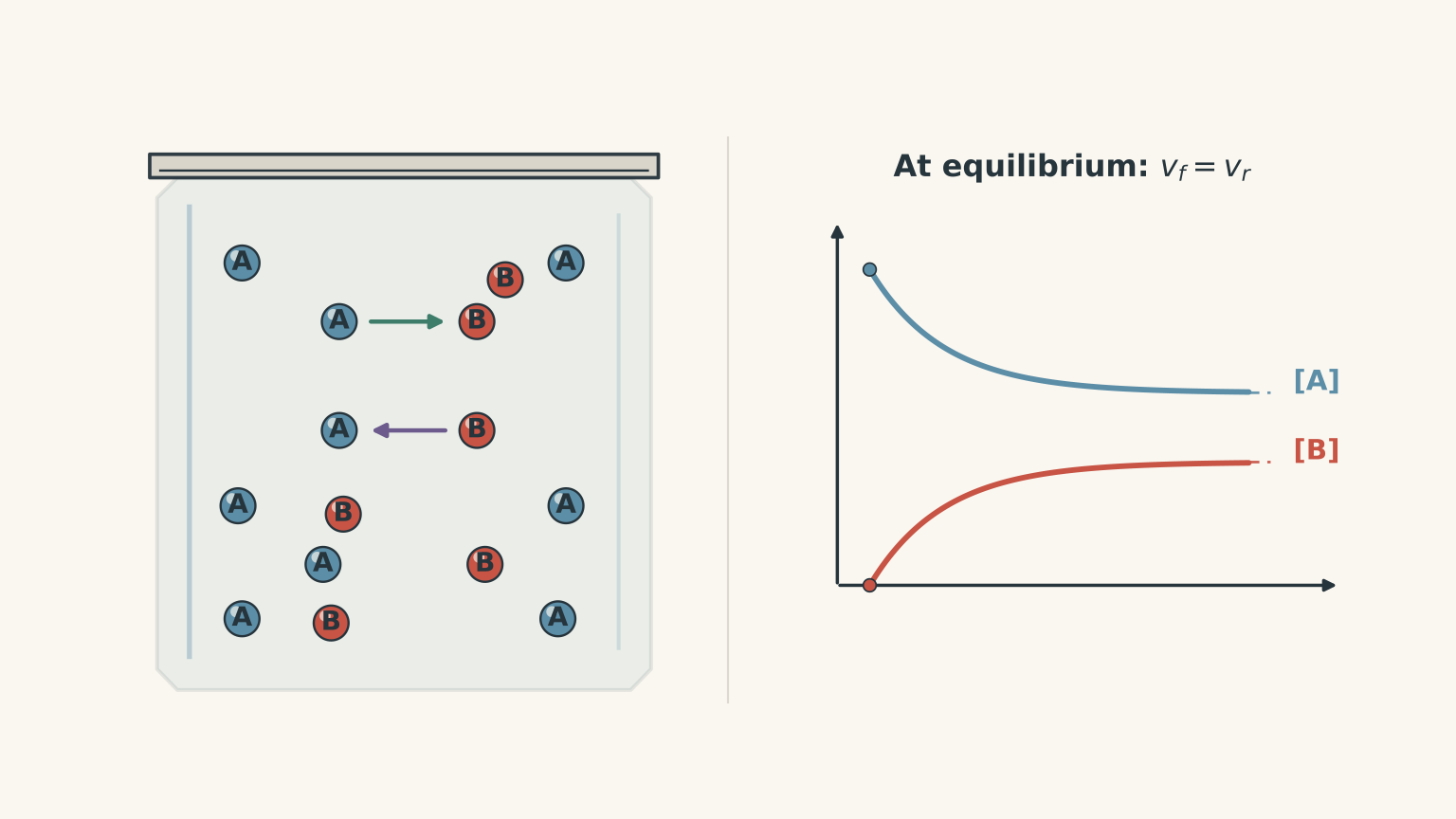
Due to technical limitations, this figure may display incorrectly or contain inaccuracies. Please check key details against your course materials.
This is called dynamic equilibrium.
A useful analogy is two people moving between two rooms. If one person leaves Room A every second while another enters it every second, the number of people in Room A stays constant. Movement continues, but there is no net change in the population.
The analogy is not a literal description of molecular reactions, but it captures the important idea: equal opposing rates produce a constant macroscopic result.
The NSW syllabus defines dynamic equilibrium in terms of equal forward and reverse reaction rates and constant amounts of reactants and products. See the NESA Chemistry glossary.
Notice two things:
- Equilibrium concentrations are constant, but they do not have to be equal.
- The concentrations depend on the reaction and the conditions under which equilibrium is established.
For a general reaction:
\[ a\mathrm{A}+b\mathrm{B} \rightleftharpoons c\mathrm{C}+d\mathrm{D} \]
the familiar concentration equilibrium expression is:
\[ K_c= \frac{[\mathrm{C}]^c[\mathrm{D}]^d} {[\mathrm{A}]^a[\mathrm{B}]^b} \]
Here, square brackets represent molar concentrations, and the lowercase coefficients represent the stoichiometric coefficients in the balanced equation.
At equilibrium, the reaction quotient \(Q_c\) equals \(K_c\).
This is the model you already use in Year 12 Chemistry. It is extremely useful, particularly for calculating equilibrium concentrations.
However, there is a deeper question.
What does concentration actually tell us about how a chemical species behaves?
It turns out that concentration and chemical effectiveness are not always the same thing.
02The thermodynamic equilibrium constant
Concentration is not quite the whole story
Imagine two aqueous solutions containing the same concentration of dissolved ions.
In the first solution, there are relatively few other dissolved particles. In the second, there are many other ions surrounding them.
The concentrations might be identical, but the ions experience different electrical interactions with their surroundings.
Consequently, their chemical behaviour can differ.
This is why thermodynamics uses a quantity called activity.
Activity describes the effective concentration of a chemical species when interactions between particles are taken into account.
For a dissolved species \(i\), its activity is written:
\[ a_i=\gamma_i\frac{[i]}{c^\circ} \]
where:
- \(a_i\) is the dimensionless activity of species \(i\).
- \(\gamma_i\) is its dimensionless activity coefficient.
- \([i]\) is its molar concentration.
- \(c^\circ\) is the standard concentration, conventionally \(1\ \mathrm{mol\,L^{-1}}\).
The activity coefficient, \(\gamma_i\), accounts for the effects of interactions between particles.
In a sufficiently dilute solution, these interactions become less significant and:
\[ \gamma_i\approx 1 \]
Therefore:
\[ a_i\approx\frac{[i]}{c^\circ} \]
This is why concentration-based equilibrium calculations are often good approximations for dilute solutions.
For more concentrated or strongly ionic solutions, the approximation becomes less reliable.
Defining the thermodynamic constant
The thermodynamic equilibrium constant uses activities instead of raw concentrations.
For the reaction:
\[ a\mathrm{A}+b\mathrm{B} \rightleftharpoons c\mathrm{C}+d\mathrm{D} \]
the thermodynamic equilibrium constant is:
\[ K= \frac{a_{\mathrm C}^{c}a_{\mathrm D}^{d}} {a_{\mathrm A}^{a}a_{\mathrm B}^{b}} \]
Every activity is evaluated at equilibrium.
There are a few useful conventions:
- For dissolved species, activities are defined relative to a standard concentration.
- For ideal gases, activity is approximated by partial pressure divided by the standard pressure of 1 bar.
- Pure solids and pure liquids have an activity of 1 in their standard states.
Because activities are dimensionless, the thermodynamic equilibrium constant is also dimensionless.
The formal thermodynamic relationship comes from Gibbs free energy:
\[ \Delta_rG=\Delta_rG^\circ+RT\ln Q \]
where:
- \(\Delta_rG\) is the Gibbs energy change for the reaction under the actual conditions.
- \(\Delta_rG^\circ\) is the standard Gibbs energy change for the reaction.
- \(R\) is the gas constant, \(8.314\ \mathrm{J\,mol^{-1}\,K^{-1}}\).
- \(T\) is the absolute temperature in kelvin.
- \(Q\) is the reaction quotient calculated using activities.
At equilibrium:
\[ \Delta_rG=0 \]
and:
\[ Q=K \]
Substituting gives:
\[ 0=\Delta_rG^\circ+RT\ln K \]
Rearranging:
\[ \boxed{K=e^{-\Delta_rG^\circ/RT}} \]
This is the thermodynamic definition of the equilibrium constant. It is also given in the IUPAC Gold Book.
The important consequence is that, for a specified reaction and fixed standard-state convention, the thermodynamic equilibrium constant depends on temperature.
It does not change simply because you add more reactant, increase the pressure, or introduce a catalyst.
Those changes can affect the equilibrium composition or the speed at which equilibrium is reached. They do not change the thermodynamic \(K\) at the same temperature.
There is one qualification: changing the reference solvent or standard-state convention can change the numerical value being reported. That is why the reference conditions must be specified when comparing thermodynamic data.
Why this is more fundamental than \(K_c\)
The familiar concentration expression is a practical approximation to the activity-based expression.
For sufficiently dilute solutions, the activity coefficients approach 1, so the two descriptions become closely related.
But when particle interactions become significant, the concentration quotient can change even though the underlying thermodynamic equilibrium constant remains the same.
This is the foundation of the distinction we are developing.
03The conditional equilibrium constant
A thermodynamic equilibrium constant describes a specified chemical reaction using activities.
A conditional equilibrium constant describes an equilibrium using a concentration-based expression that is valid under particular experimental conditions.
It is often written:
\[ K' \]
Other conventions include \(K_{\mathrm{cond}}\) and \(K_{\mathrm{eff}}\).
The symbol is less important than the definition. Always check which species and conditions are included.
The International Union of Pure and Applied Chemistry (IUPAC) describes conditional constants as concentration quotients that apply when the concentration or activity of one or more species is fixed at a specified value. Its Analytical Compendium, section 3.2.6, gives fixed pH as an important example.
Common conditions that affect a conditional constant include:
- pH
- Ionic strength
- Solvent composition
- Background electrolyte concentration
- The definition of the total uncomplexed ligand or metal concentration
The distinction can be summarised as follows.
| Feature | Thermodynamic \(K\) | Conditional \(K'\) |
|---|---|---|
| Based on | Activities of specified species | An operational concentration quotient |
| Temperature | Affects its value | Affects its value |
| pH | Does not directly change \(K\) for the same reaction | Can change \(K'\) |
| Ionic strength | Accounted for through activities | Can change the concentration quotient |
| Species included | Explicitly specified chemical species | May combine several chemical forms into one measured pool |
| Validity | Defined for its reaction and standard states | Restricted to its specified experimental conditions |
A conditional constant is not an incorrect version of a thermodynamic constant.
It answers a different question.
For example, a chemist might not be interested in the concentration of one particular form of a ligand. They might want to know how much of the total uncomplexed ligand pool is available to bind a metal under a particular pH.
A conditional constant makes that calculation possible without tracking every individual species separately.
The trade-off is that the constant is only transferable to systems with matching conditions and definitions.
04How pH changes a conditional constant
Let’s build a specific example.
Consider ammonia dissolved in water.
Ammonia exists in equilibrium with its protonated form, the ammonium ion:
\[ \mathrm{NH_4^+\rightleftharpoons H^++NH_3} \]
The two forms are chemically different.
- \(\mathrm{NH_3}\) is uncharged ammonia.
- \(\mathrm{NH_4^+}\) is the positively charged ammonium ion.
Suppose we are studying a metal ion that binds to ammonia.
Which form is available to participate in the complex formation reaction?
In the model we will use, it is \(\mathrm{NH_3}\).
The ammonium ion must first lose a proton to become ammonia.
Introducing the ammonia fraction
The acid dissociation constant of ammonium is:
\[ K_a= \frac{a_{\mathrm{H^+}}a_{\mathrm{NH_3}}} {a_{\mathrm{NH_4^+}}} \]
The \(pK_a\) is defined as:
\[ pK_a=-\log_{10}K_a \]
At approximately 25 °C in dilute aqueous solution:
\[ pK_a\approx9.25 \]
This value is an approximation for the specified temperature and medium, rather than a universal value. See the NCBI reference on ammonia.
For dilute solutions, we can use the Henderson-Hasselbalch relationship:
\[ pH=pK_a+ \log_{10}\left( \frac{[\mathrm{NH_3}]} {[\mathrm{NH_4^+}]} \right) \]
Now make a prediction.
What happens to the proportion of ammonia present as \(\mathrm{NH_3}\) when the pH increases?
The proportion increases because the solution becomes less favourable to the protonated form.
At \(pH=pK_a\):
\[ [\mathrm{NH_3}]=[\mathrm{NH_4^+}] \]
Therefore, half of the uncomplexed ammonia pool exists as \(\mathrm{NH_3}\).
We can describe the fraction of uncomplexed ammonia present as \(\mathrm{NH_3}\) using:
\[ \alpha_{\mathrm{NH_3}} = \frac{[\mathrm{NH_3}]} {[\mathrm{NH_3}]+[\mathrm{NH_4^+}]} \]
Rearranging the Henderson-Hasselbalch equation gives:
\[ \boxed{ \alpha_{\mathrm{NH_3}} = \frac{1}{1+10^{pK_a-pH}} } \]
The symbol \(\alpha_{\mathrm{NH_3}}\) is a fraction, so it must lie between 0 and 1.
Consider these three conditions.
| pH | Fraction as NH3 | Approximate percentage |
|---|---|---|
| 8.25 | 0.0909 | 9.09% |
| 9.25 | 0.500 | 50.0% |
| 10.25 | 0.909 | 90.9% |
A change of just two pH units has changed the fraction of available ammonia from approximately 9% to 91%.
This change becomes particularly important when a metal requires several ammonia molecules to form a complex.
The formation of a metal complex
Consider the overall formation reaction:
\[ \mathrm{Cu^{2+}+4NH_3 \rightleftharpoons [Cu(NH_3)_4]^{2+}} \]
A copper(II) ion combines with four ammonia molecules to form the tetraamminecopper(II) complex.
The thermodynamic overall formation constant is:
\[ \beta_4= \frac{ a_{\mathrm{[Cu(NH_3)_4]^{2+}}} }{ a_{\mathrm{Cu^{2+}}} a_{\mathrm{NH_3}}^4 } \]
The symbol \(\beta_4\) represents the overall formation constant for a complex containing four ammonia ligands.
It is an activity-based thermodynamic constant.
But suppose an analytical method measures the total uncomplexed ammonia pool rather than distinguishing between \(\mathrm{NH_3}\) and \(\mathrm{NH_4^+}\).
Define that pool as:
\[ L_T=[\mathrm{NH_3}]+[\mathrm{NH_4^+}] \]
Here, \(L_T\) is the total concentration of uncomplexed ammonia in both acid-base forms.
Only a fraction of this pool is present as the active ligand, \(\mathrm{NH_3}\).
Therefore:
\[ [\mathrm{NH_3}]=\alpha_{\mathrm{NH_3}}L_T \]
Substituting this relationship into the formation expression gives the simplified conditional formation constant:
\[ \boxed{ \beta_4'=\beta_4\alpha_{\mathrm{NH_3}}^4 } \]
This expression assumes:
- The solution is sufficiently dilute for activity coefficients to be approximated as 1.
- The pH is fixed.
- Only the specified copper complex is considered.
- Free \(\mathrm{Cu^{2+}}\) is the relevant uncomplexed metal species.
- The uncomplexed ammonia pool contains only \(\mathrm{NH_3}\) and \(\mathrm{NH_4^+}\).
The crucial feature is the fourth power.
Only one fraction of the total ammonia pool is available, but four ammonia molecules are needed for each complex.
The effect of pH is therefore amplified.
This is a simplified model of copper-ammonia complex formation. Real aqueous copper(II) systems can contain several ammine complexes and hydrolysed copper species. We will account for that limitation later.
Worked example: A two-unit pH change
A simplified copper-ammonia system has a thermodynamic formation constant of \(\beta_4=2.00\times10^{12}\) at 25 °C. Assume the solution behaves ideally, the ammonium \(pK_a\) is 9.25, and no other copper species form.
Calculate the conditional formation constant at pH 8.25 and pH 10.25. Determine how much it changes.
Step 1
Using:
\[ \alpha_{\mathrm{NH_3}} = \frac{1}{1+10^{pK_a-pH}} \]
At pH 8.25:
\[ \alpha_1= \frac{1}{1+10^{9.25-8.25}} =\frac{1}{11} \]
\[ \alpha_1=0.0909 \]
At pH 10.25:
\[ \alpha_2= \frac{1}{1+10^{9.25-10.25}} =\frac{10}{11} \]
\[ \alpha_2=0.909 \]
Step 2
Use:
\[ \beta_4'=\beta_4\alpha_{\mathrm{NH_3}}^4 \]
At pH 8.25:
\[ \begin{aligned} \beta_{4,1}'&= 2.00\times10^{12} \left(\frac{1}{11}\right)^4\\ &=1.37\times10^8 \end{aligned} \]
At pH 10.25:
\[ \begin{aligned} \beta_{4,2}'&= 2.00\times10^{12} \left(\frac{10}{11}\right)^4\\ &=1.37\times10^{12} \end{aligned} \]
These are dimensionless values using the standard-concentration convention.
Step 3
\[ \frac{\beta_{4,2}'}{\beta_{4,1}'} = \frac{1.37\times10^{12}} {1.37\times10^8} \]
\[ \boxed{ \frac{\beta_{4,2}'}{\beta_{4,1}'} =10^4 } \]
The conditional formation constant increases by a factor of 10,000.
The thermodynamic formation constant has not changed.
The difference comes entirely from the changing proportion of ammonia available to bind the copper ion.
This is the central idea: when several molecules of a ligand are involved, a relatively modest change in ligand speciation can produce a very large change in the conditional equilibrium constant.
05Ionic strength creates another kind of conditionality
So far, we have focused on pH.
However, pH is not the only condition that can change a conditional equilibrium constant.
Consider a solution containing dissolved ions.
Each ion experiences electrical interactions with other charged particles in the solution. As the concentration of dissolved ions increases, these interactions become more significant.
We describe the overall electrostatic environment using a quantity called ionic strength.
It is defined as:
\[ I=\frac12\sum_i c_i z_i^2 \]
where:
- \(I\) is the ionic strength in \(\mathrm{mol\,L^{-1}}\).
- \(c_i\) is the molar concentration of ion \(i\).
- \(z_i\) is the charge number of ion \(i\).
- The summation includes all dissolved ions.
Notice the squared charge.
A divalent ion contributes more strongly to ionic strength than a monovalent ion at the same concentration.
For example, a solution containing substantial amounts of \(\mathrm{Mg^{2+}}\) can have a different ionic strength from a solution containing the same concentration of \(\mathrm{Na^+}\).
Why ionic strength changes a concentration quotient
Recall:
\[ a_i=\gamma_i\frac{[i]}{c^\circ} \]
The activity coefficient \(\gamma_i\) depends on the solution environment, including ionic strength.
Consequently, the relationship between activity and concentration changes when the ionic strength changes.
For a reaction:
\[ \mathrm{M^{2+}+L^{2-}\rightleftharpoons ML} \]
the thermodynamic formation constant is:
\[ K= \frac{a_{\mathrm{ML}}} {a_{\mathrm{M^{2+}}}a_{\mathrm{L^{2-}}}} \]
Substituting the activity expressions gives:
\[ K= \frac{\gamma_{\mathrm{ML}}} {\gamma_{\mathrm{M^{2+}}}\gamma_{\mathrm{L^{2-}}}} \frac{ [\mathrm{ML}]/c^\circ }{ ([\mathrm{M^{2+}}]/c^\circ) ([\mathrm{L^{2-}}]/c^\circ) } \]
Rearranging:
\[ \boxed{ K_c= K\frac{ \gamma_{\mathrm{M^{2+}}}\gamma_{\mathrm{L^{2-}}} }{ \gamma_{\mathrm{ML}} } } \]
Here, \(K_c\) is the dimensionless concentration quotient using concentrations normalised by the standard concentration.
If raw molar concentrations are used instead, the concentration quotient can carry units.
The important point is that the activity coefficients can change with ionic strength.
Therefore, \(K_c\) can change even when the thermodynamic \(K\) remains constant.
For a deeper treatment of this relationship, see tutorgum’s Activities and Activity Coefficients in Non-Ideal Solutions.
One important restriction: simple activity-coefficient models such as the Debye-Hückel limiting law are designed for dilute ionic solutions. They should not be applied indiscriminately to concentrated electrolyte solutions. In more complicated media, more suitable models or experimentally determined activity coefficients are required.
Worked example: The same thermodynamic constant in two ionic environments
A metal ion and a ligand form a neutral complex:
\[ \mathrm{M^{2+}+L^{2-}\rightleftharpoons ML} \]
The thermodynamic formation constant is:
\[ K=80.0 \]
At the same temperature, two different ionic environments produce the following illustrative activity coefficients.
| Species | Medium A | Medium B |
|---|---|---|
| \(\gamma_{\mathrm{M^{2+}}}\) | 0.25 | 0.10 |
| \(\gamma_{\mathrm{L^{2-}}}\) | 0.25 | 0.10 |
| \(\gamma_{\mathrm{ML}}\) | 1.00 | 1.00 |
Calculate the concentration quotient in each medium and compare them.
Step 1
\[ K_c= K\frac{ \gamma_{\mathrm{M^{2+}}} \gamma_{\mathrm{L^{2-}}} }{ \gamma_{\mathrm{ML}} } \]
Step 2
\[ K_{c,A}= 80.0\times \frac{0.25\times0.25}{1.00} \]
\[ \boxed{K_{c,A}=5.00} \]
Step 3
\[ K_{c,B}= 80.0\times \frac{0.10\times0.10}{1.00} \]
\[ \boxed{K_{c,B}=0.800} \]
Step 4
\[ \frac{K_{c,A}}{K_{c,B}} = \frac{5.00}{0.800} \]
\[ \boxed{ \frac{K_{c,A}}{K_{c,B}}=6.25 } \]
The concentration quotient is 6.25 times larger in Medium A.
Yet the thermodynamic equilibrium constant is still 80.0 in both cases.
The supplied activity coefficients account for the difference.
The values in this example are illustrative model inputs, not experimental measurements.
06How would an experiment distinguish the two constants?
Now consider the problem from an analytical chemist’s perspective.
Suppose you want to determine how strongly a metal binds a ligand in two different solutions.
You measure the amount of complex formed, but the results appear inconsistent.
Is the metal actually binding differently, or have the experimental conditions changed the apparent equilibrium constant?
This is the measurement problem that conditional constants help solve.
The apparatus and original prediction
Imagine two sealed sample cells containing the same total amounts of copper and ammonia.
Both are held at 25 °C.
One solution is maintained at pH 8.25, while the other is maintained at pH 10.25. Their ionic strengths are also controlled to be equal.
Each sample sits in a temperature-controlled holder. A beam of light passes through the solution, and a detector measures the light absorbed by the copper-ammonia complex.
A pH electrode monitors the solution, while separate analytical measurements establish the free copper concentration and the total uncomplexed ammonia concentration.
What should the model predict?
The thermodynamic formation constant should be the same in both cells because the reaction and temperature are unchanged.
However, the conditional constants should differ because the fraction of ammonia present as \(\mathrm{NH_3}\) differs.
The previous calculation predicts a factor of 10,000 between the conditional constants under the simplified model.
That is a prediction about the calculated equilibrium quotients, not necessarily a 10,000-fold difference in raw absorbance or complex concentration. Those also depend on the available free metal and ligand concentrations.
What the first experimental design misses
Suppose the original experiment measures only total uncomplexed ammonia.
The two samples could contain identical total ammonia concentrations, but very different proportions of \(\mathrm{NH_3}\) and \(\mathrm{NH_4^+}\).
Using total ammonia as if it were entirely available ligand would give an incorrect interpretation.
The same issue arises if the experiment measures complex concentration without establishing the free metal concentration.
A formation constant is a ratio involving all relevant reactants and products. Measuring only one species is insufficient.
Revising the measurement
The revised design therefore needs to:
- Maintain a known temperature.
- Measure and control pH.
- Keep ionic strength constant or account for its effect on activities.
- Distinguish free ligand from total uncomplexed ligand.
- Distinguish free metal ions from other uncomplexed metal species.
- Measure the equilibrium concentration of the complex.
The predicted result is now much easier to interpret.
The underlying thermodynamic formation constant remains the same, while the conditional concentration quotient reflects the chosen experimental conditions.
This is the practical reason conditional constants exist.
They allow chemists to describe complicated equilibrium systems using measurements that are useful for a particular analytical task.
The distinction is not merely mathematical. It determines whether equilibrium data from one experiment can be applied to another.
07A further complication: More than one species can interfere
The ammonia example initially assumed that the only relevant uncomplexed copper species was \(\mathrm{Cu^{2+}}\).
Real aqueous metal-ion systems are often more complicated.
For example, copper ions can also react with hydroxide ions to form hydrolysed species.
One possible equilibrium is:
\[ \mathrm{Cu^{2+}+H_2O \rightleftharpoons CuOH^++H^+} \]
This introduces another competing equilibrium.
Increasing the pH can have two opposing effects:
- It increases the proportion of ammonia present as \(\mathrm{NH_3}\), making more ligand available.
- It can increase the proportion of copper present as hydrolysed species, reducing the concentration of free \(\mathrm{Cu^{2+}}\).
The first effect favours ammonia complex formation.
The second can oppose it.
This is why a conditional constant must be defined carefully.
It is not enough to state the pH. You must also establish which metal species and ligand species are included in the measured concentration pools.
For more on this mechanism, see tutorgum’s Complex-Ion Equilibria: How Ligands Change Solubility.
08Questions and solutions
Question 1
A metal ion M forms a 1:1 complex with a ligand L:
\[ \mathrm{M+L\rightleftharpoons ML} \]
The thermodynamic formation constant is \(K=2.4\times10^5\).
At a particular fixed pH, only 40.0% of the total uncomplexed ligand pool exists as the active form L. The remaining ligand is present as HL, which does not form the complex.
Assuming ideal solution behaviour, calculate the conditional formation constant \(K'\) using the total uncomplexed ligand concentration in its denominator.
Solution 1
The conditional formation constant is \(9.6\times10^4\).
The important detail is that the reaction uses L, not the entire uncomplexed ligand pool.
For a 1:1 complex, the conditional constant is:
\[ K'=K\alpha_L \]
where \(\alpha_L\) is the fraction of uncomplexed ligand present as L.
Substituting:
\[ K'=2.4\times10^5\times0.400 \]
Therefore:
\[ \boxed{K'=9.6\times10^4} \]
The thermodynamic constant has not changed. We have simply included the inactive protonated form in the experimentally defined ligand pool.
A common mistake is to use the total ligand concentration as though every ligand molecule were available to react.
That would overestimate the apparent ability of the ligand to form the complex.
Question 2
Consider the formation reaction:
\[ \mathrm{Cu^{2+}+4NH_3 \rightleftharpoons [Cu(NH_3)_4]^{2+}} \]
At 25 °C, the ammonium \(pK_a\) is 9.25.
Two experiments are performed:
- Experiment A maintains pH 9.25.
- Experiment B maintains pH 10.25.
Assume ideal behaviour, no competing copper species, and the same thermodynamic formation constant in both experiments.
Calculate the ratio:
\[ \frac{\beta'_{4,B}}{\beta'_{4,A}} \]
Explain why the thermodynamic formation constant does not change.
Solution 2
The conditional formation constant is approximately 10.9 times larger in Experiment B.
The relevant expression is:
\[ \beta_4'=\beta_4\alpha_{\mathrm{NH_3}}^4 \]
Step 1: Calculate the ammonia fraction in Experiment A.
At pH 9.25:
\[ \alpha_A=\frac{1}{1+10^0} \]
\[ \alpha_A=0.500 \]
Step 2: Calculate the ammonia fraction in Experiment B.
At pH 10.25:
\[ \alpha_B=\frac{1}{1+10^{-1}} \]
\[ \alpha_B=0.909 \]
Step 3: Calculate the ratio of conditional constants.
The thermodynamic constant cancels because it is identical in both experiments.
\[ \frac{\beta'_{4,B}}{\beta'_{4,A}} = \left(\frac{\alpha_B}{\alpha_A}\right)^4 \]
Substituting:
\[ = \left(\frac{0.909}{0.500}\right)^4 \]
\[ \boxed{ \frac{\beta'_{4,B}}{\beta'_{4,A}} \approx10.9 } \]
The conditional constant increases because a greater proportion of the total uncomplexed ammonia exists as the active ligand.
The tempting mistake is to assume that a change in the conditional constant means the intrinsic metal-ligand interaction has changed.
It has not. The reaction and temperature are unchanged. Only the distribution of ammonia between its protonated and unprotonated forms has changed.
Question 3
Consider the equilibrium:
\[ \mathrm{M^{2+}+L^{2-}\rightleftharpoons ML} \]
At a fixed temperature, the thermodynamic equilibrium constant is:
\[ K=120.0 \]
Two different ionic environments have the following activity coefficients:
| Species | Medium A | Medium B |
|---|---|---|
| \(\gamma_{\mathrm{M^{2+}}}\) | 0.30 | 0.12 |
| \(\gamma_{\mathrm{L^{2-}}}\) | 0.30 | 0.12 |
| \(\gamma_{\mathrm{ML}}\) | 0.90 | 0.90 |
Calculate the concentration quotient in each medium, using standard-concentration normalisation.
Determine the ratio of the two concentration quotients and explain the significance of your result.
Solution 3
The concentration quotient is 12.0 in Medium A and 1.92 in Medium B.
The ratio is 6.25.
Use:
\[ K_c= K\frac{ \gamma_{\mathrm{M^{2+}}} \gamma_{\mathrm{L^{2-}}} }{ \gamma_{\mathrm{ML}} } \]
Step 1: Calculate the quotient in Medium A.
\[ K_{c,A} = 120.0\times \frac{0.30\times0.30}{0.90} \]
\[ \boxed{K_{c,A}=12.0} \]
Step 2: Calculate the quotient in Medium B.
\[ K_{c,B} = 120.0\times \frac{0.12\times0.12}{0.90} \]
\[ \boxed{K_{c,B}=1.92} \]
Step 3: Compare the results.
\[ \frac{K_{c,A}}{K_{c,B}} = \frac{12.0}{1.92} \]
\[ \boxed{ \frac{K_{c,A}}{K_{c,B}}=6.25 } \]
The concentration quotient is 6.25 times larger in Medium A.
The underlying thermodynamic equilibrium constant is still 120.0 in both environments.
The mistake would be to treat the concentration quotient as though it were independent of the solution environment.
Activity coefficients account for interactions that are not represented by concentration alone.
Question 4
Consider the simplified copper-ammonia equilibrium:
\[ \mathrm{Cu^{2+}+4NH_3 \rightleftharpoons [Cu(NH_3)_4]^{2+}} \]
In this model, uncomplexed copper exists in two forms:
\[ \mathrm{Cu^{2+}} \quad\text{and}\quad \mathrm{CuOH^+} \]
Only \(\mathrm{Cu^{2+}}\) forms the ammonia complex.
Define the fraction of uncomplexed copper present as \(\mathrm{Cu^{2+}}\) as:
\[ f_{\mathrm{Cu^{2+}}} = \frac{[\mathrm{Cu^{2+}}]} {[\mathrm{Cu^{2+}}]+[\mathrm{CuOH^+}]} \]
The following information is supplied:
| Condition | pH 9.25 | pH 10.25 |
|---|---|---|
| Fraction of ammonia as NH3 | 0.500 | 0.909 |
| Fraction of uncomplexed copper as Cu2+ | 0.800 | 0.200 |
Assume ideal behaviour, and define the conditional constant using the total uncomplexed copper and total uncomplexed ammonia pools.
Calculate the ratio of the conditional constants at pH 10.25 and pH 9.25.
Explain why considering ammonia speciation alone would give an incorrect result.
Solution 4
The conditional constant at pH 10.25 is approximately 2.73 times the conditional constant at pH 9.25.
We must account for both ligand availability and metal-ion availability.
Step 1: Write the conditional constant.
The thermodynamic formation constant uses only free \(\mathrm{Cu^{2+}}\) and \(\mathrm{NH_3}\).
However, the conditional expression uses the total uncomplexed pools.
Therefore:
\[ \boxed{ \beta_4'= \beta_4 f_{\mathrm{Cu^{2+}}} \alpha_{\mathrm{NH_3}}^4 } \]
Step 2: Calculate the conditional constant at pH 9.25.
\[ \frac{\beta'_{4,1}}{\beta_4} = 0.800(0.500)^4 \]
\[ \frac{\beta'_{4,1}}{\beta_4} =0.0500 \]
Step 3: Calculate the conditional constant at pH 10.25.
\[ \frac{\beta'_{4,2}}{\beta_4} = 0.200(0.909)^4 \]
\[ \frac{\beta'_{4,2}}{\beta_4} \approx0.1366 \]
Step 4: Calculate the ratio.
\[ \frac{\beta'_{4,2}}{\beta'_{4,1}} = \frac{0.1366}{0.0500} \]
\[ \boxed{ \frac{\beta'_{4,2}}{\beta'_{4,1}} \approx2.73 } \]
Why isn’t the answer 10.9, as in Question 2?
Because the fraction of copper available as \(\mathrm{Cu^{2+}}\) has decreased from 0.800 to 0.200.
That is a fourfold decrease in available metal ion.
The increase in available ammonia favours complex formation, but the decrease in available copper opposes it.
The net effect is an increase of approximately 2.73, rather than 10.9.
This question demonstrates why conditional constants become more complicated when multiple equilibria operate simultaneously.
Question 5
Two sealed aqueous systems contain identical initial total concentrations of copper and ammonia.
Both are initially at 25 °C and pH 9.25. They have the same ionic strength, and there are no other metal-binding ligands or significant competing metal species.
Both systems undergo the complex formation reaction:
\[ \mathrm{Cu^{2+}+4NH_3 \rightleftharpoons [Cu(NH_3)_4]^{2+}} \]
However, there is one important difference.
- System A contains a non-complexing buffer with sufficient capacity to maintain pH 9.25 throughout the reaction.
- System B contains no added buffer. Assume the ammonia/ammonium pair is its only significant acid-base buffer system.
Assume neither system loses ammonia to the surroundings.
A student claims:
“Both systems have the same temperature, thermodynamic formation constant, initial pH, and initial concentrations. Therefore, they must form the same final concentration of complex.”
Assess this claim.
Your response must:
- Explain whether the two systems necessarily reach the same final complex concentration.
- Predict which system contains more complex at equilibrium.
- Explain how complex formation affects the ammonia/ammonium equilibrium in System B.
- Explain why the initial conditional formation constant cannot automatically be used throughout the reaction in System B.
- Identify the additional information needed to calculate the exact final equilibrium concentrations.
Solution 5
The student’s claim is incorrect. Under the stated assumptions, System A forms more copper-ammonia complex than System B at equilibrium.
The subtle issue is that the initial pH is not necessarily the final pH.
Step 1: Identify what is initially identical.
Both systems begin at:
\[ pH=9.25 \]
Since:
\[ pH=pK_a \]
the initial ammonia distribution is:
\[ [\mathrm{NH_3}]=[\mathrm{NH_4^+}] \]
Both systems therefore begin with the same ammonia fraction:
\[ \alpha_{\mathrm{NH_3}}=0.500 \]
Their initial conditional formation constants are also identical, assuming the same activity conditions.
At this point, the student’s reasoning appears sensible.
But the argument assumes that the pH remains constant throughout both reactions.
That is only guaranteed in System A.
Step 2: Consider what happens when the copper complex forms.
The formation reaction consumes ammonia:
\[ \mathrm{Cu^{2+}+4NH_3 \rightleftharpoons [Cu(NH_3)_4]^{2+}} \]
As free \(\mathrm{NH_3}\) is consumed, the ammonia/ammonium equilibrium responds:
\[ \mathrm{NH_4^+\rightleftharpoons H^++NH_3} \]
The removal of \(\mathrm{NH_3}\) favours the forward direction of this acid dissociation equilibrium.
Consequently, more \(\mathrm{NH_4^+}\) dissociates to replace the ammonia being consumed.
This releases additional hydrogen ions.
Step 3: Compare the effect in each system.
In System A, the buffer absorbs the additional hydrogen ions.
The pH remains at 9.25, so the ammonia fraction remains approximately 0.500.
The conditional formation constant therefore remains valid at its original value, under the other stated assumptions.
In System B, there is no added buffer to absorb the released hydrogen ions.
The hydrogen-ion concentration increases, so the pH decreases.
A lower pH shifts the ammonia/ammonium distribution towards \(\mathrm{NH_4^+}\).
The fraction of ammonia available as \(\mathrm{NH_3}\) consequently decreases.
Step 4: Determine the consequence for complex formation.
The conditional formation constant is:
\[ \beta_4'= \beta_4\alpha_{\mathrm{NH_3}}^4 \]
As the pH falls in System B:
\[ \alpha_{\mathrm{NH_3}}\downarrow \]
Therefore:
\[ \beta_4'\downarrow \]
The conditional formation constant is no longer the same as its initial value.
The unbuffered system becomes progressively less favourable for forming the ammonia complex.
System A maintains a higher availability of the active ligand, so it forms more complex at equilibrium.
Step 5: Identify the information needed for an exact calculation.
The initial pH and the thermodynamic formation constant are not sufficient to calculate the final concentrations.
We would also need:
- The initial total copper concentration.
- The initial total ammonia concentration.
- The relevant spectator-ion concentrations and initial acid-base balance.
- The buffer composition and capacity for System A.
- The relevant activity coefficients or a suitable model for the solution environment.
If additional copper hydrolysis reactions were included, their equilibrium constants would also be required.
The final equilibrium must satisfy the copper mass balance, ammonia mass balance, acid-base equilibrium, and the relevant charge balance.
The deeper lesson is that a conditional equilibrium constant assumes its defining conditions remain fixed.
An initial pH is not the same thing as a controlled pH.
That is the constraint that invalidates the student’s confident prediction.
09Choosing the right equilibrium constant
When you encounter an equilibrium problem involving different solution conditions, use the following decision process.
Use a thermodynamic equilibrium constant when:
- You want the activity-based equilibrium relationship for a specified reaction.
- You are comparing the same reaction at the same temperature and standard-state convention.
- You need to account properly for non-ideal behaviour.
Use a conditional equilibrium constant when:
- The experiment is performed at a specified pH or ionic strength.
- Several chemical forms are grouped into one measured concentration pool.
- You want to predict equilibrium concentrations under particular experimental conditions.
- You need a practical constant for a particular analytical environment.
Always check three things before using a reported equilibrium constant:
- What exact reaction and chemical species does it describe?
- Which experimental conditions were fixed?
- Which species are included in the measured concentration pools?
If any of these differ between two experiments, their reported conditional constants may not be directly comparable.
Remember the central distinction:
- The thermodynamic equilibrium constant describes the underlying equilibrium using activities.
- The conditional equilibrium constant describes an operational concentration relationship under specified conditions.
Both are useful. They simply answer different questions.
The next step is to combine these ideas in a full chemical speciation calculation, where acid-base equilibria, metal complex formation, hydrolysis, and activity coefficients all operate together. That is where distinguishing the two constants stops being a matter of terminology and becomes essential to getting the chemistry right.