
Acid-Base Catalysis
Ethyl ethanoate reacts with water to form ethanoic acid and ethanol. The reaction is slow without assistance, but adding a small amount of acid can make it proceed much faster.
Ethyl ethanoate reacts with water to form ethanoic acid and ethanol. The reaction is slow without assistance, but adding a small amount of acid can make it proceed much faster. Here is the interesting part: the acid does not appear in the overall reaction equation.
How can a substance speed up a reaction by donating a proton without being used up? It changes chemical form during the reaction, then returns to its original form through another proton transfer. This is the central idea behind acid-base catalysis.
This article goes beyond the required NSW HSC Chemistry 2025 syllabus. It assumes you have studied the Year 12 Acid/base Reactions content, which provides the background for understanding the extension. Acid-base catalysis itself is not an additional HSC assessment requirement.
01Why Arrhenius’s theory was not enough
Before exploring catalysis, it helps to understand why chemists needed a broader model of acids and bases.
The Arrhenius theory describes acids and bases through their behaviour in water:
- An Arrhenius acid increases the concentration of hydrogen ions, \(\mathrm{H^+}\), in aqueous solution.
- An Arrhenius base increases the concentration of hydroxide ions, \(\mathrm{OH^-}\), in aqueous solution.
For example, hydrochloric acid ionises in water:
\[ \ce{HCl + H2O -> H3O+ + Cl-} \]
Sodium hydroxide dissociates in water:
\[ \ce{NaOH -> Na+ + OH-} \]
This model is useful for understanding many familiar reactions, particularly neutralisation. However, it has an important limitation: it relies on aqueous solutions and the formation of hydrogen or hydroxide ions.
Consider what happens when gaseous ammonia reacts with gaseous hydrogen chloride:
\[ \ce{NH3(g) + HCl(g) -> NH4Cl(s)} \]
There is no water present. There are no aqueous hydroxide ions, either.
Yet an acid-base reaction has clearly occurred. Hydrogen chloride transfers a proton to ammonia, producing ammonium and chloride ions.
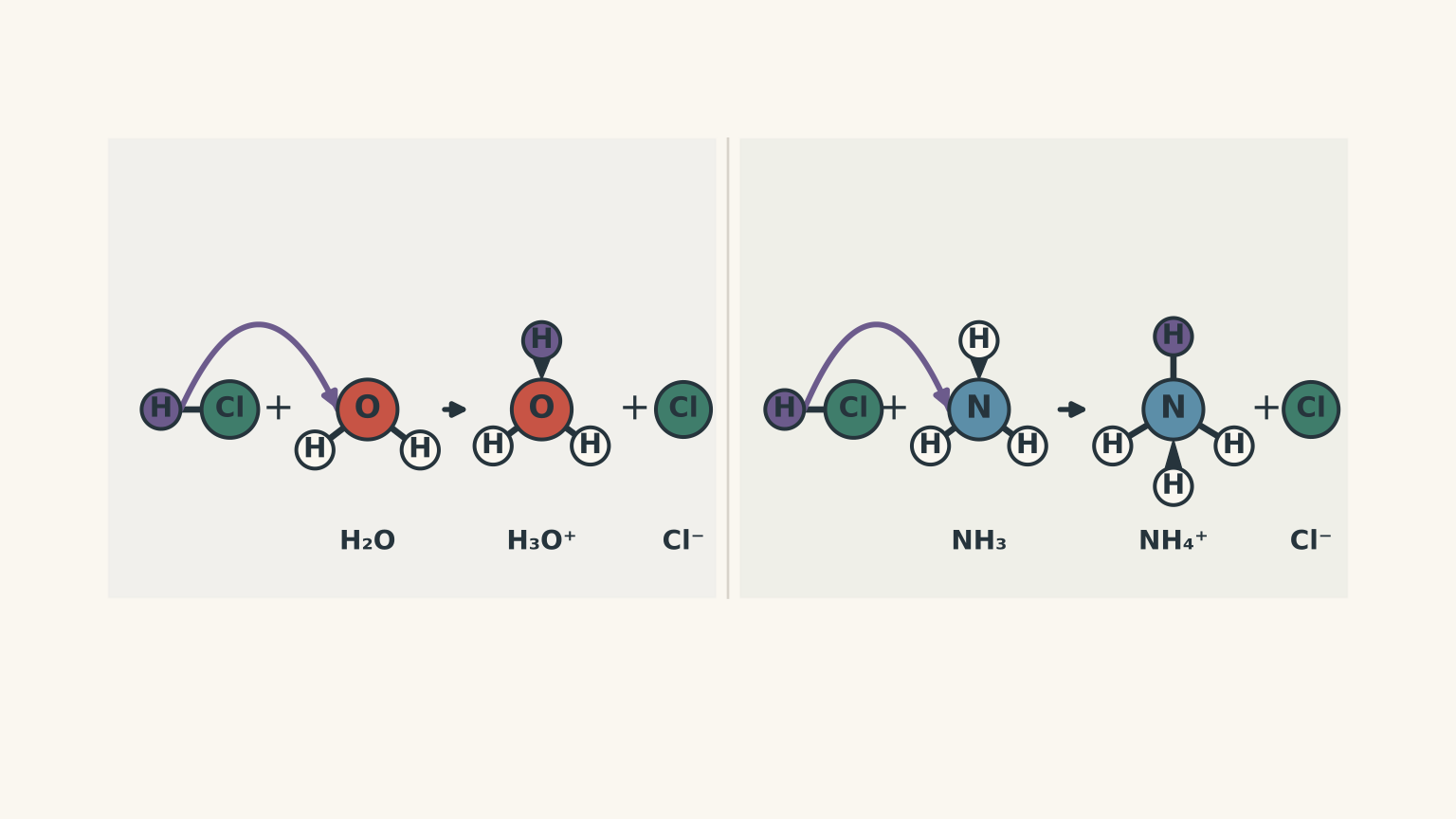
Due to technical limitations, this figure may display incorrectly or contain inaccuracies. Please check key details against your course materials.
The Brønsted-Lowry improvement
In 1923, Johannes Brønsted and Thomas Lowry independently proposed a definition based on proton transfer.
According to the Brønsted-Lowry theory:
- An acid is a proton donor.
- A base is a proton acceptor.
This definition explains the ammonia reaction without requiring water.
\[ \ce{HCl + NH3 -> Cl- + NH4+} \]
HCl donates a proton, so it is the acid. NH3 accepts the proton, so it is the base.
The products also form a conjugate acid-base pair:
- \(\mathrm{Cl}^{-}\) is the conjugate base of \(\ce{HCl}\).
- \(\ce{NH4+}\) is the conjugate acid of \(\ce{NH3}\).
Conjugate acid-base pairs differ by one proton.
The Brønsted-Lowry model is particularly useful for understanding acid-base catalysis because it lets us follow proton transfers between reactants, intermediates, and catalysts.
It is not a universal theory of every acid-base reaction, though. Reactions involving electron-pair donation without proton transfer require a broader model, such as Lewis acid-base theory.
For a refresher on the original model, see Arrhenius Acid-Base Theory for HSC Chemistry.
02What actually makes a reaction acid-base catalysed?
A catalyst increases the rate of a chemical reaction without being consumed overall.
It does this by providing an alternative reaction pathway with a lower activation energy. The catalyst may participate in several individual steps, changing its chemical form along the way.
In acid-base catalysis, these steps involve the donation or acceptance of protons.
There are two main possibilities.
1. Acid catalysis: donating a proton
Imagine a molecule of acid, represented by \(\mathrm{HA}\), interacting with a substrate, represented by \(\mathrm{S}\).
A substrate is the molecule that undergoes the chemical transformation.
The acid donates a proton:
\[ \mathrm{HA + S \rightleftharpoons A^- + SH^+} \]
Here:
- \(\mathrm{HA}\) is the acid catalyst.
- \(\mathrm{S}\) is the substrate.
- \(\mathrm{A^-}\) is the conjugate base formed when the acid donates its proton.
- \(\mathrm{SH^+}\) is the protonated substrate.
The protonation step can make the substrate more reactive. For example, it might make a particular atom more susceptible to attack by another reactant.
After the substrate undergoes further chemical changes, a later intermediate can donate a proton to \(\mathrm{A^-}\).
\[ \mathrm{A^- + IH^+ \rightleftharpoons HA + P} \]
Here, \(\mathrm{I}\) represents an intermediate, a species formed during the reaction, and \(\mathrm{P}\) represents the product.
The acid catalyst has now been regenerated.
The important point is that \(\mathrm{HA}\) participates in the mechanism but cancels out when the individual reaction steps are combined into the overall equation.
2. Base catalysis: accepting a proton
Base catalysis follows the opposite pattern.
A base accepts a proton from the substrate:
\[ \mathrm{B + HS \rightleftharpoons BH^+ + S^-} \]
Here:
- \(\mathrm{B}\) is the base catalyst.
- \(\mathrm{HS}\) is the substrate.
- \(\mathrm{BH^+}\) is the conjugate acid formed when the base accepts a proton.
- \(\mathrm{S^-}\) is the deprotonated substrate.
Removing the proton can produce a more reactive species, allowing the substrate to participate in a subsequent reaction.
Eventually, the conjugate acid \(\mathrm{BH^+}\) can donate a proton to a later intermediate:
\[ \mathrm{I^- + BH^+ \rightarrow P + B} \]
The original base, \(\mathrm{B}\), is regenerated.
Think of the catalyst as a reusable proton shuttle
A useful analogy is a courier carrying a parcel.
The acid catalyst delivers a proton to the substrate, changes into its conjugate base, and later collects another proton. It returns to its original chemical form and can participate in another reaction.
The analogy is not exact: protons can exchange through surrounding water molecules, so the hydrogen atom returned to the catalyst does not necessarily have to be the identical atom it donated initially.
What matters is that the catalyst’s original chemical form is restored.
This gives us a practical test:
If a substance participates in the reaction mechanism and is regenerated by the end of the catalytic cycle, it can act as a catalyst.
Merely appearing in an intermediate equation does not make a substance a reactant in the overall reaction.
03Acid catalysis: activating an ester
Let’s apply this idea to the hydrolysis of an ester.
Hydrolysis is a reaction in which a substance reacts with water, breaking a chemical bond.
For example, ethyl ethanoate reacts with water to produce ethanoic acid and ethanol:
\[ \ce{CH3COOCH2CH3 + H2O <=> CH3COOH + CH3CH2OH} \]
Without a catalyst, this reaction is relatively slow under ordinary conditions.
Why?
The ester contains a carbonyl group, \(\ce{C=O}\). The carbon atom in this group is electrophilic, meaning it is attracted to electron-rich species.
Water is a relatively weak nucleophile, meaning it is not particularly effective at attacking the carbonyl carbon without assistance.
An acid catalyst helps by making that carbonyl group more reactive.
How the acid-catalysed pathway works
Step 1: Protonation of the carbonyl oxygen
Hydronium ions, \(\ce{H3O+}\), donate a proton to the ester carbonyl oxygen.
This increases the polarisation of the carbonyl bond, making the carbonyl carbon more electrophilic.
Step 2: Water attacks the carbonyl carbon
A water molecule acts as a nucleophile and attacks the carbonyl carbon.
This produces a tetrahedral intermediate, in which the carbon that previously formed the carbonyl double bond is now bonded to four groups.
Step 3: Proton transfers prepare the leaving group
Further proton transfers occur within the intermediate.
One important change is the protonation of the ethoxy group. This converts it into a much better leaving group because it can depart as a neutral ethanol molecule.
Step 4: The intermediate breaks down
The tetrahedral intermediate collapses, reforming the carbonyl bond and releasing ethanol.
Step 5: The acid catalyst is regenerated
The protonated carboxylic acid loses a proton to water.
This produces ethanoic acid and regenerates hydronium ions.
The catalyst is therefore available to participate in another reaction.
The overall reaction still contains only the ester and water as reactants.
The acid appears in the mechanism but cancels out of the net equation.
The standard acid-catalysed ester hydrolysis pathway is described in OpenStax’s Chemistry of Esters.
Worked example: identifying the role of an acid catalyst
Ethyl ethanoate undergoes hydrolysis in dilute aqueous acid.
Explain how hydronium ions accelerate the reaction without being consumed overall.
Step 1
The hydronium ion acts as a Brønsted-Lowry acid by donating a proton to the carbonyl oxygen of the ester.
The ester accepts the proton and acts as a Brønsted-Lowry base.
Step 2
Protonation increases the electrophilic character of the carbonyl carbon.
Water can now attack this carbon more readily, allowing the reaction to proceed through a tetrahedral intermediate.
Step 3
The intermediate undergoes proton transfers that convert the ethoxy group into a suitable leaving group.
Ethanol is then released as the intermediate collapses.
Step 4
The protonated carboxylic acid loses a proton to water, regenerating \(\ce{H3O+}\).
Step 5
Hydronium ions accelerate ester hydrolysis by providing an alternative pathway involving protonation and subsequent deprotonation.
They are regenerated, so they do not appear in the overall reaction equation.
One important qualification: acid-catalysed ester hydrolysis is reversible. The acid catalyst also accelerates the reverse esterification reaction. Adding acid changes the reaction rate, not the equilibrium constant.
04Base catalysis: creating a more reactive molecule
Now consider a different type of reaction.
Aldehydes and ketones can undergo reactions in which a new carbon-carbon bond forms. One example is the aldol addition reaction.
Consider two molecules of ethanal, \(\ce{CH3CHO}\), reacting in aqueous hydroxide solution.
The overall reaction is:
\[ \ce{2CH3CHO <=> CH3CH(OH)CH2CHO} \]
The product is 3-hydroxybutanal.
What does hydroxide actually do?
It removes a proton from the carbon next to the carbonyl group.
This carbon is called the alpha carbon.
How the base-catalysed pathway works
Step 1: Hydroxide accepts an alpha proton
The hydroxide ion accepts a proton from the alpha carbon of ethanal.
This produces water and an enolate ion.
An enolate is a reactive species in which negative charge is distributed between the alpha carbon and the oxygen atom.
Its two important resonance representations are:
\[ \ce{^-CH2-CH=O <-> CH2=CH-O^-} \]
The negative charge is delocalised rather than being permanently located on one atom.
The carbon end of the enolate can now form a new carbon-carbon bond.
Step 2: The enolate attacks another ethanal molecule
The enolate reacts with the carbonyl carbon of a second ethanal molecule.
A new carbon-carbon bond forms, and the carbonyl oxygen of the second ethanal becomes an alkoxide ion.
This produces the carbon skeleton of the aldol product.
Step 3: Water donates a proton
The alkoxide ion accepts a proton from water.
This forms the hydroxyl group in 3-hydroxybutanal.
Water becomes hydroxide in the process.
Step 4: The base catalyst is regenerated
The hydroxide ion has returned to its original form.
It can now remove another alpha proton from another ethanal molecule.
Notice something important about the first step.
Only a small proportion of ethanal needs to exist as the enolate at any instant. As the enolate reacts with another ethanal molecule, more can form through the reversible deprotonation equilibrium.
This allows the reaction to proceed without requiring hydroxide to convert all the ethanal into enolate first.
The aldol mechanism is discussed in Purdue University’s organic chemistry teaching material.
Worked example: identifying base catalysis in an aldol addition
Two ethanal molecules react in dilute aqueous hydroxide solution to form 3-hydroxybutanal.
Explain the role of hydroxide and show how it is regenerated.
Step 1
Hydroxide acts as a Brønsted-Lowry base by accepting a proton from the alpha carbon of ethanal.
It becomes water, while ethanal forms an enolate ion.
Step 2
The enolate has a reactive carbon end that can attack the carbonyl carbon of another ethanal molecule.
This forms a new carbon-carbon bond, which is essential for producing the four-carbon aldol product.
Step 3
The attack produces an alkoxide ion.
This negatively charged oxygen accepts a proton from water, forming the hydroxyl group in the final product.
Step 4
When water donates its proton to the alkoxide, it becomes \(\mathrm{OH}^{-}\).
The hydroxide ion is therefore regenerated.
Step 5
Hydroxide catalyses the aldol addition by accepting a proton during enolate formation and being regenerated during protonation of the alkoxide intermediate.
It does not appear in the overall reaction equation.
A useful restriction: under suitable low-temperature conditions, the aldol addition product can be obtained. Higher temperatures can promote a subsequent dehydration reaction, producing an alpha,beta-unsaturated carbonyl compound. That is a further reaction, not part of the basic proton-shuttle cycle described here.
05Specific and general acid-base catalysis
There is another useful distinction.
Not all acid-base catalysts have to be hydronium or hydroxide ions.
Chemists distinguish between specific acid-base catalysis and general acid-base catalysis.
| Type | What participates in proton transfer? |
|---|---|
| Specific acid catalysis | Hydronium ions, \(\ce{H3O+}\) |
| General acid catalysis | Another proton donor, such as \(\ce{HA}\) |
| Specific base catalysis | Hydroxide ions, \(\mathrm{OH}^{-}\) |
| General base catalysis | Another proton acceptor, such as \(\ce{B}\) |
In specific acid catalysis, the reaction rate depends on the hydronium ion concentration.
In general acid catalysis, another acid directly donates a proton during a rate-influencing step.
Similarly, in general base catalysis, a base other than hydroxide directly accepts a proton during a rate-influencing step.
Why buffers can act as catalysts
A buffer usually contains a weak acid and its conjugate base.
We can represent these as:
\[ \ce{HA <=> H+ + A^-} \]
A buffer is normally introduced to resist changes in pH. However, its components can also participate directly in a reaction mechanism.
This creates an interesting experimental possibility.
Suppose you investigate a reaction at constant pH. You keep the ratio of \(\ce{HA}\) to \(\mathrm{A}^{-}\) constant but increase the total buffer concentration.
Both buffer components increase in concentration, while the pH remains approximately unchanged.
What would you predict if the buffer were acting only as a pH-control system?
The reaction rate should not increase simply because more buffer is present, provided other conditions are controlled.
But if the rate increases with buffer concentration, this suggests that one or both buffer components are participating directly in the catalytic pathway.
That is evidence for general acid-base catalysis.
This is a useful way to distinguish specific from general acid-base catalysis experimentally. The dependence of reaction rate on buffer concentration is discussed in Addison Ault’s Journal of Chemical Education article on general acid and general base catalysis.
However, an increasing rate alone does not establish whether \(\ce{HA}\) or \(\mathrm{A}^{-}\) is responsible. Further experiments must distinguish proton donation from proton acceptance.
An application in enzymes
Enzymes frequently use acid-base catalysis to accelerate reactions.
An enzyme’s active site may contain chemical groups that can donate or accept protons. These groups help stabilise reactive intermediates and make particular reaction steps easier.
For example, one group may donate a proton to a substrate while another group accepts a proton during a later step.
The groups are regenerated as the reaction proceeds.
This also helps explain why enzyme activity can depend strongly on pH. Changing pH changes the proportion of enzyme groups that are protonated or deprotonated.
A group that needs to donate a proton must be in its protonated form. A group that needs to accept a proton must be in a form capable of accepting one.
If the pH changes too far, the catalytic cycle can become less effective.
06A catalyst changes the pathway, not the equilibrium
It is tempting to think that adding a catalyst must produce more product.
That is not necessarily true.
A catalyst changes the reaction pathway by providing a lower activation-energy route. The activation energy is the energy barrier that reactants must overcome to reach a transition state.
The catalysed pathway may contain several intermediate steps, but its highest energy barrier is lower than the corresponding barrier without the catalyst.
There are three important consequences:
- The reaction can proceed faster because the activation-energy barrier is reduced.
- The overall energy difference between reactants and products remains unchanged.
- The equilibrium constant and final equilibrium composition remain unchanged.
Why does the equilibrium position not change?
A catalyst accelerates both the forward and reverse reactions. It allows the system to reach equilibrium more quickly, but it does not favour one equilibrium position over another.
This distinction is important when interpreting experimental results. A faster reaction does not automatically mean a greater equilibrium yield.
For a further explanation of this principle, see OpenStax’s section on catalysis.
07Catalyst strength: why the strongest acid may not be the best
There is one more interesting consequence of proton-transfer catalysis.
You might assume that the strongest possible acid would always make the best acid catalyst.
That prediction sounds reasonable: a stronger acid is more willing to donate a proton.
But a catalytic cycle needs more than proton donation. It also needs catalyst regeneration.
Consider a simplified acid-catalysed mechanism:
First step: The catalyst donates a proton to the substrate.
\[ \ce{HA + S <=> A^- + SH+} \]
Final step: The conjugate base accepts a proton from a later intermediate.
\[ \ce{A^- + IH+ <=> HA + P} \]
The acid must be strong enough to protonate the substrate.
However, its conjugate base must also be sufficiently strong to accept a proton from the intermediate.
These requirements compete.
Understanding the pKa relationship
The acid dissociation constant, \(K_a\), measures the extent to which an acid donates protons in solution.
The related quantity \(pK_a\) is defined as:
\[ pK_a=-\log_{10}K_a \]
A lower \(pK_a\) indicates a stronger acid.
For a proton-transfer reaction, the proton tends to move from the stronger acid to the stronger base, producing the weaker acid and weaker base.
In our simplified catalytic cycle, this gives two requirements.
For the first proton transfer to favour protonation of the substrate:
\[ pK_a(\ce{HA}) < pK_a(\ce{SH+}) \]
For the final proton transfer to regenerate the catalyst:
\[ pK_a(\ce{IH+}) < pK_a(\ce{HA}) \]
Combining these conditions gives:
\[ \boxed{ pK_a(\ce{IH+}) < pK_a(\ce{HA}) < pK_a(\ce{SH+}) } \]
The catalyst needs an acid strength that sits between the acidity of the protonated intermediate and the protonated substrate.
This is a simplified thermodynamic model in which both proton-transfer steps are assumed to be favourable. Real catalytic mechanisms can still operate when an individual protonation equilibrium is unfavourable, provided subsequent reaction steps pull the pathway forward.
The key lesson remains: a good acid catalyst needs the right balance between proton donation and regeneration.
For more on the relationship between molecular structure and acid strength, see Acid Strength and Resonance Stabilisation in Organic Acids.
08Questions and solutions
The following questions move from identifying a catalytic cycle to evaluating whether a proposed mechanism can actually regenerate its catalyst.
Question 1
A proposed reaction mechanism contains the following steps:
\[ \begin{aligned} \mathrm{HA + S} &\rightleftharpoons \mathrm{A^- + SH^+}\\ \mathrm{SH^+ + X} &\rightarrow \mathrm{IH^+}\\ \mathrm{IH^+ + A^-} &\rightarrow \mathrm{P + HA} \end{aligned} \]
Here, \(\mathrm{S}\) and \(\mathrm{X}\) are reactants, \(\mathrm{I}\) is an intermediate, and \(\mathrm{P}\) is the final product.
Identify the Brønsted-Lowry acid and base in the first step. Explain why \(\mathrm{HA}\) acts as a catalyst rather than a net reactant.
Solution 1
\(\mathrm{HA}\) is the Brønsted-Lowry acid, and \(\mathrm{S}\) is the Brønsted-Lowry base.
In the first step, HA donates a proton to S. This produces its conjugate base, \(\mathrm{A^-}\), and the conjugate acid of S, \(\mathrm{SH^+}\).
The subsequent reaction produces the intermediate \(\mathrm{IH^+}\).
In the final step, \(\mathrm{A^-}\) accepts a proton from \(\mathrm{IH^+}\), regenerating \(\mathrm{HA}\).
When the three steps are added, the intermediate species and the catalyst cancel:
\[ \mathrm{S + X \rightarrow P} \]
Therefore, HA participates in the reaction mechanism but is regenerated. It is a catalyst, not a net reactant.
The tempting mistake is to classify HA as a reactant simply because it appears on the left side of the first equation. You must follow the species through the entire mechanism before deciding its overall role.
Question 2
Ethyl ethanoate undergoes hydrolysis in aqueous acid:
\[ \ce{CH3COOCH2CH3 + H2O <=> CH3COOH + CH3CH2OH} \]
A student claims that hydronium ions must be reactants because they protonate the carbonyl oxygen at the beginning of the mechanism.
Explain why this claim is incorrect.
Your answer should also explain:
- Why protonation makes the ester more reactive.
- How the acid catalyst is regenerated.
- Whether adding more acid changes the equilibrium composition.
Solution 2
Hydronium ions act as catalysts because they are regenerated at the end of the reaction mechanism.
The student’s mistake is treating an individual reaction step as though it represents the entire reaction.
Step 1: Explain the initial proton transfer.
Hydronium donates a proton to the ester carbonyl oxygen.
This increases the electrophilic character of the carbonyl carbon, making it more susceptible to nucleophilic attack by water.
Step 2: Explain the subsequent reaction.
Water attacks the carbonyl carbon, producing a tetrahedral intermediate.
Further proton transfers convert the ethoxy group into a suitable leaving group.
Step 3: Explain catalyst regeneration.
The intermediate collapses, releasing ethanol and forming a protonated carboxylic acid.
Deprotonation by water produces ethanoic acid and regenerates hydronium ions.
Step 4: Consider the equilibrium.
Adding more acid increases the rate of the acid-catalysed reaction.
However, the acid does not change the equilibrium constant. It accelerates both the forward hydrolysis and the reverse esterification reaction.
The final equilibrium composition is determined by the reaction conditions and equilibrium constant, not by the presence of the catalyst.
Question 3
A reaction is investigated using a buffer containing a weak acid, \(\ce{HA}\), and its conjugate base, \(\mathrm{A}^{-}\).
The following conditions are maintained:
- Temperature remains constant.
- Substrate concentration remains constant.
- pH remains constant.
- Ionic strength remains constant.
- The ratio \([\ce{HA}]:[\mathrm{A}^{-}]\) remains constant.
The total buffer concentration is doubled, and the reaction rate increases.
(a) Does this observation support specific acid catalysis or general acid-base catalysis?
(b) Why is the unchanged pH important when interpreting the result?
(c) Can the observation alone establish whether \(\ce{HA}\) or \(\mathrm{A}^{-}\) is the active catalyst? Explain what additional comparison would help.
Solution 3
The observation supports general acid-base catalysis, although it does not identify which buffer component is responsible.
(a) Identify the type of catalysis.
At constant pH, the hydronium ion concentration remains approximately constant.
If the reaction rate increases when the total buffer concentration increases, the buffer must be influencing the reaction beyond simply controlling pH.
This supports a general acid-base catalytic pathway.
The buffer acid could donate a proton directly, or the conjugate base could accept a proton during a rate-influencing step.
(b) Explain the significance of constant pH.
If the pH had increased or decreased, the hydronium ion concentration would also have changed.
An increase in reaction rate could then be explained by a change in specific acid catalysis.
Holding pH constant removes that particular explanation.
By also controlling ionic strength, the experiment reduces another possible source of rate variation.
(c) Identify the limitation of the evidence.
Doubling the total buffer concentration increases the concentrations of both \(\ce{HA}\) and \(\mathrm{A}^{-}\).
Therefore, the experiment cannot distinguish between general acid and general base catalysis.
A useful follow-up would compare different buffer systems at the same pH and ionic strength, examining whether the rate tracks the concentration of the proton-donating form or the proton-accepting form.
If the rate depends on the acid form, this supports general acid catalysis.
If it depends on the base form, this supports general base catalysis.
The important distinction is that constant pH does not mean the buffer is chemically inactive.
Question 4
Consider two reactions carried out in aqueous hydroxide solution.
Reaction A: Aldol addition
\[ \ce{2CH3CHO <=> CH3CH(OH)CH2CHO} \]
Reaction B: Ester hydrolysis
\[ \ce{CH3COOCH2CH3 + OH^- -> CH3COO^- + CH3CH2OH} \]
A student argues that hydroxide must be acting as a catalyst in both reactions because it participates in the reaction mechanisms.
Determine whether this conclusion is correct.
Explain the different roles of hydroxide in the two reactions by following its chemical changes through each mechanism.
Solution 4
The student’s conclusion is incorrect. Hydroxide is a catalyst in the aldol addition but a stoichiometric reactant in the ester hydrolysis reaction.
The difference is whether hydroxide is regenerated.
Reaction A: Aldol addition
Hydroxide accepts an alpha proton from ethanal, forming water and an enolate ion.
The enolate attacks a second ethanal molecule, forming a carbon-carbon bond and an alkoxide intermediate.
The alkoxide accepts a proton from water.
This regenerates hydroxide.
Therefore, hydroxide participates in the mechanism but is absent from the overall reaction equation.
It acts as a catalyst.
Reaction B: Ester hydrolysis
In base-promoted ester hydrolysis, hydroxide attacks the ester carbonyl carbon.
This forms a tetrahedral intermediate, which subsequently breaks down and releases an alkoxide ion.
The resulting carboxylic acid is deprotonated, producing a carboxylate ion.
The overall reaction is:
\[ \ce{CH3COOCH2CH3 + OH^- -> CH3COO^- + CH3CH2OH} \]
Hydroxide appears as a reactant in the net equation. It is consumed rather than regenerated.
This reaction is called saponification.
The carboxylate product is relatively stable, helping drive the reaction towards completion under suitable conditions.
The key lesson is that participating in a proton-transfer step does not automatically make a substance a catalyst. You must track its chemical identity through the complete reaction.
Question 5
A chemist proposes a simplified acid-catalysed rearrangement involving the following catalytic cycle:
Step 1: Protonation of the substrate
\[ \ce{HA + S <=> A^- + SH+} \]
Step 2: Rearrangement
\[ \ce{SH+ -> IH+} \]
Step 3: Catalyst regeneration
\[ \ce{IH+ + A^- <=> P + HA} \]
The chemist is considering three possible acid catalysts.
All pKa values are measured in the same solvent and at the same temperature.
| Species | pKa |
|---|---|
| Protonated substrate, \(\ce{SH+}\) | 7 |
| Protonated intermediate, \(\ce{IH+}\) | 3 |
| Candidate catalyst A, \(\ce{HA}\) | 1 |
| Candidate catalyst B, \(\ce{HA}\) | 5 |
| Candidate catalyst C, \(\ce{HA}\) | 9 |
Assume that both proton-transfer steps must be thermodynamically favourable enough to contribute to the proposed catalytic cycle. Assume all other factors, including the ability to undergo the rearrangement, are equivalent.
(a) Which candidate acid can complete both proton-transfer steps and regenerate the catalyst?
(b) Explain why the strongest acid is not necessarily the most effective catalyst.
(c) Suppose the pKa of the protonated intermediate changes from 3 to 6, while all other values remain unchanged. Can any of the three candidate catalysts still satisfy both proton-transfer requirements? Justify your answer.
Solution 5
Only candidate B, with a pKa of 5, can complete both proton-transfer steps under the assumptions given.
The reason is that an effective acid catalyst must be strong enough to donate a proton initially, but its conjugate base must also be strong enough to accept a proton later.
(a) Determine which catalyst can complete both steps.
Start with the first proton transfer:
\[ \ce{HA + S <=> A^- + SH+} \]
For this transfer to favour protonation of the substrate, HA must be a stronger acid than \(\ce{SH+}\).
A stronger acid has a lower pKa.
Therefore:
\[ pK_a(\ce{HA}) < 7 \]
This eliminates candidate C, which has a pKa of 9.
Candidates A and B can satisfy the first requirement.
Now consider the final proton transfer:
\[ \ce{IH+ + A^- <=> P + HA} \]
For this step to favour catalyst regeneration, \(\ce{IH+}\) must be a stronger acid than HA.
Therefore:
\[ pK_a(\ce{IH+}) < pK_a(\ce{HA}) \]
Since the pKa of \(\ce{IH+}\) is 3:
\[ pK_a(\ce{HA}) > 3 \]
This eliminates candidate A, which has a pKa of 1.
Candidate B, with a pKa of 5, satisfies both conditions:
\[ 3 < 5 < 7 \]
It can donate a proton during the initial step and be regenerated during the final step.
(b) Explain why the strongest acid is not necessarily the best catalyst.
Candidate A is the strongest acid because it has the lowest pKa.
It can readily donate a proton to the substrate. However, this leaves behind a very weak conjugate base.
That conjugate base is not sufficiently strong to accept a proton from the intermediate under the assumptions of the question.
Consequently, the catalyst cannot complete its cycle efficiently.
Candidate C has the opposite problem. It is too weak an acid to protonate the substrate effectively.
Candidate B has the appropriate balance.
This demonstrates why catalyst selection depends on the entire reaction mechanism, rather than just the first proton-transfer step.
(c) Consider the change in intermediate acidity.
The pKa of \(\ce{IH+}\) is now 6.
The first proton transfer still requires:
\[ pK_a(\ce{HA}) < 7 \]
The final proton transfer now requires:
\[ pK_a(\ce{HA}) > 6 \]
Combining the conditions gives:
\[ 6 < pK_a(\ce{HA}) < 7 \]
None of the three available candidates satisfies this requirement.
Candidate A is too strong, candidate C is too weak, and candidate B is not sufficiently weak to allow the final proton transfer to be favourable.
Therefore, none of the listed catalysts can satisfy both conditions in the simplified model.
A suitable replacement would need a pKa between 6 and 7.
This is the conceptual difficulty in the question: making the first proton transfer easier can make the final regeneration step harder. A catalyst must be suitable for the complete cycle, not just one reaction step.
The next useful connection is enzyme activity and pH. Once you can track proton donation, proton acceptance, and catalyst regeneration, you can begin predicting how changing pH affects the availability of catalytic groups and, consequently, the rate of an enzyme-controlled reaction.