
Acid Rain Neutralisation Capacity
Learn how acid-neutralising capacity (ANC) measures a freshwater sample's resistance to incoming acid. Explore bicarbonate chemistry, titration calculations, and why total neutralising capacity does not always predict short-term pH changes.
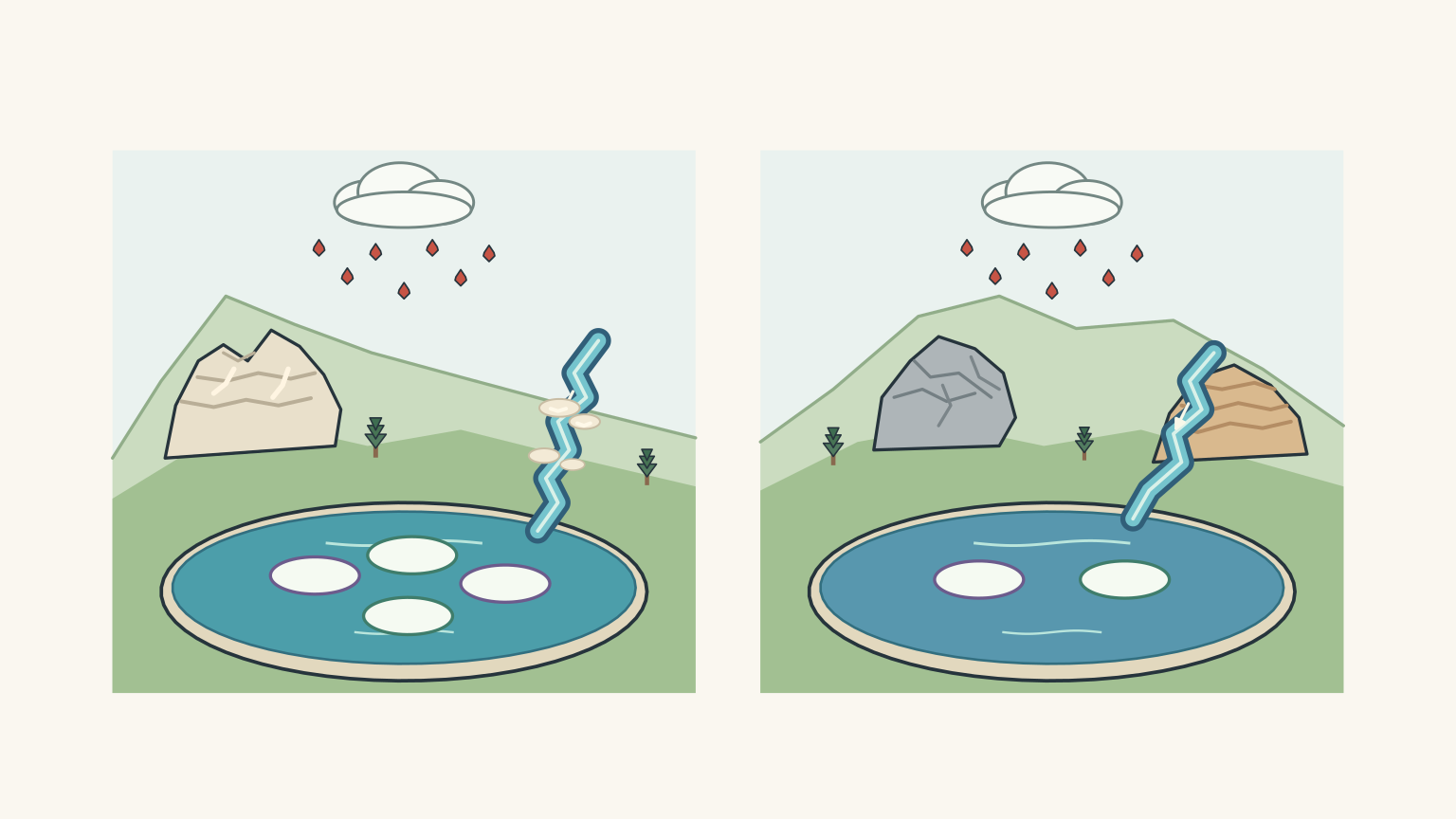
Two freshwater lakes receive the same acidic rainfall. Both have an initial pH of 7.0. After a storm, however, one lake experiences a substantial drop in pH while the other changes very little.
If the rainfall is the same, what explains the difference?
The answer may lie in how much acid-neutralising material each lake contains. A lake with a larger reserve of neutralising substances can absorb more incoming acid before its chemistry changes significantly. Chemists and environmental scientists quantify this property using acid-neutralising capacity (ANC).
This article develops ANC as an extension of the Year 12 Chemistry acid-base content. It goes beyond the required 2025 Year 12 Chemistry syllabus, so the syllabus material is a prerequisite entry point, not an additional HSC assessment requirement.
Due to technical limitations, this figure may display incorrectly or contain inaccuracies. Please check key details against your course materials.
01Why pH alone cannot predict acidification
Acid rain is associated with the formation of sulfuric acid and nitric acid in the atmosphere.
Sulfur dioxide (\(\ce{SO2}\)) and nitrogen oxides (\(\ce{NO_x}\)) react with water, oxygen, and other atmospheric substances to produce acidic compounds. These return to the Earth’s surface through wet deposition, such as rain and snow, and dry deposition, such as acidic particles and gases.
When these substances enter a lake or stream, they introduce an additional acid load.
However, knowing the pH of the incoming rain does not tell us how much acid a whole rainfall event delivers.
Consider two separate measurements:
- pH describes the current hydrogen ion activity in a solution. It tells us how acidic the solution is at the time of measurement.
- Acid load describes the total amount of acid delivered to an environment. It depends on the quantity of deposited material and its acid-equivalent content.
A small quantity of strongly acidic rain and a large quantity of moderately acidic rain can deliver different total amounts of acid.
This distinction matters because a lake must neutralise the incoming acid, not simply respond to the pH reading of the rain.
To compare acid inputs with a lake’s neutralising capacity, we need to count acid equivalents, rather than relying on pH alone.
02The chemistry behind natural acid neutralisation
Before calculating ANC, we need to understand which substances in natural water can accept incoming protons.
This builds directly on Brønsted-Lowry acid-base theory.
If you need to revise the underlying theory, see Acid-Base Reactions: Proton Transfer and Neutralisation.
Bicarbonate as an acid-neutralising substance
Many natural waters contain dissolved bicarbonate ions, \(\mathrm{HCO_{3}}^{-}\).
Bicarbonate is particularly useful because it can accept a proton from an incoming acid.
For example, when hydronium ions enter the water:
\[ \ce{HCO3^- + H3O+ -> H2CO3 + H2O} \]
The bicarbonate ion accepts a proton and becomes carbonic acid.
The carbonic acid can then participate in the equilibrium:
\[ \ce{H2CO3 <=> CO2(aq) + H2O} \]
The incoming acid has therefore reacted with bicarbonate, reducing the amount of unneutralised acid in the water.
Notice the Brønsted-Lowry conjugate pair:
\[ \ce{H2CO3/HCO3^-} \]
The bicarbonate ion is the conjugate base of carbonic acid.
It is also amphiprotic, meaning it can act as either an acid or a base.
When it accepts a proton, it forms carbonic acid:
\[ \ce{HCO3^- + H3O+ -> H2CO3 + H2O} \]
When it donates a proton to a base such as hydroxide, it forms carbonate:
\[ \ce{HCO3^- + OH^- -> CO3^2- + H2O} \]
The second conjugate pair is:
\[ \ce{HCO3^-/CO3^2-} \]
This amphiprotic behaviour is important because the chemical species present in natural water can change as acid is introduced.
Where does bicarbonate come from?
One important source is the surrounding geology.
Rainwater and soil water contain dissolved carbon dioxide. When this water passes through limestone, which consists mainly of calcium carbonate, chemical reactions can produce dissolved calcium and bicarbonate ions.
A simplified overall reaction is:
\[ \ce{CaCO3(s) + CO2(aq) + H2O(l)} \]
\[ \ce{<=> Ca^2+(aq) + 2HCO3^-(aq)} \]
The resulting bicarbonate ions contribute to the water’s ability to neutralise incoming acid.
Limestone can also react directly with acid:
\[ \ce{CaCO3(s) + 2H3O+(aq)} \]
\[ \ce{-> Ca^2+(aq) + CO2(aq) + 3H2O(l)} \]
Each mole of calcium carbonate can consume two moles of hydronium ions when the reaction proceeds to the stated products.
This explains an important environmental pattern:
- Lakes draining limestone-rich catchments often have relatively high acid-neutralising capacity.
- Lakes draining granite-rich or sandstone-rich catchments often have less naturally available neutralising material.
The surrounding geology can therefore influence how sensitive a lake is to acid deposition.
03What is acid-neutralising capacity?
Acid-neutralising capacity (ANC) is the amount of strong acid that a water sample can neutralise per unit volume, measured relative to a defined titration endpoint.
It provides a way to quantify the water’s reserve against incoming acid.
A high ANC means more acid must be added before the sample reaches the specified endpoint. A low ANC means the reserve is smaller, so a relatively modest acid input may exhaust it.
ANC is commonly expressed in:
- Milliequivalents per litre, \(\mathrm{meq\,L^{-1}}\).
- Microequivalents per litre, \(\mathrm{\mu eq\,L^{-1}}\).
- Milligrams per litre expressed as calcium carbonate, \(\mathrm{mg\,L^{-1}}\) as \(\ce{CaCO3}\).
Understanding acid equivalents
An equivalent is a way of counting the amount of acid or base according to its proton-transfer capacity.
For the reactions considered here, one mole of \(\mathrm{H}^{+}\) represents one mole of acid equivalents.
For example:
- One mole of \(\mathrm{HCO_{3}}^{-}\) can accept one mole of \(\mathrm{H}^{+}\).
- One mole of \(\mathrm{CO_{3}}^{2-}\) can accept two moles of \(\mathrm{H}^{+}\) if it is converted fully to carbonic acid.
This means we must account for the number of protons transferred, not simply count the number of molecules.
The useful unit conversions are:
\[ 1\ \mathrm{meq\,L^{-1}} = 1000\ \mathrm{\mu eq\,L^{-1}} \]
For monovalent hydrogen ions, one millimole of hydrogen ion equivalents per litre is one milliequivalent per litre.
ANC is also often reported as calcium carbonate equivalents:
\[ 1\ \mathrm{meq\,L^{-1}} = 50.0\ \mathrm{mg\,L^{-1}} \text{ as }\ce{CaCO3} \]
Why 50.0?
Calcium carbonate has a molar mass of approximately \(100.0\ \mathrm{g\,mol^{-1}}\), and one mole can neutralise two moles of hydrogen ions.
Its equivalent mass is therefore approximately:
\[ \frac{100.0}{2} = 50.0\ \mathrm{g\,equivalent^{-1}} \]
Reporting ANC as calcium carbonate is a convenient way to compare different water samples. It does not mean that all the neutralising material in the water is actually calcium carbonate.
How is ANC measured?
A common approach is an acidimetric titration.
A measured volume of environmental water is placed in a suitable vessel. A calibrated pH electrode monitors the sample while a standardised strong acid is added in measured increments.
The important observations are:
- Initially, neutralising substances such as bicarbonate react with the added acid.
- As more acid is added, the available neutralising capacity decreases.
- As the neutralising reserve is exhausted, additional acid causes a more substantial pH change.
- The titration data are used to identify the relevant equivalence point and calculate ANC.
For a simplified calculation, we can treat the equivalence point as already identified and count the acid equivalents delivered to reach it.
In professional water-quality analysis, the endpoint requires more care. The US Geological Survey describes inflection-point titration and Gran function methods for determining ANC. A fixed endpoint of pH 4.5 is not a universally reliable substitute, particularly for low-alkalinity samples or water containing significant organic acids.
There is another useful distinction:
- Alkalinity is determined using a filtered sample and measures the acid-neutralising capacity of dissolved substances.
- ANC, in standard USGS terminology, is determined using an unfiltered sample and includes contributions from dissolved substances and reactive particles.
For samples without significant reactive particles, the two measurements may be effectively equivalent.
Most natural-water ANC comes from bicarbonate and carbonate, although hydroxide, silicate, borate, and certain organic substances can also contribute.
04Calculating ANC from titration data
For a simplified titration using hydrochloric acid, the calculation follows the same mole-accounting principles used in ordinary neutralisation problems.
The general relationship is:
\[ \mathrm{ANC} = \frac{n_{\mathrm{acid\ equivalents}}} {V_{\mathrm{sample}}} \]
For a monoprotic strong acid such as HCl:
\[ \boxed{ \mathrm{ANC} = \frac{C_aV_a}{V_s} } \]
Where:
- \(C_a\) is the acid concentration in \(\mathrm{mol\,L^{-1}}\).
- \(V_a\) is the volume of acid added in litres.
- \(V_s\) is the original sample volume in litres.
- ANC is expressed in \(\mathrm{mol\,equivalents\,L^{-1}}\).
This expression assumes that each mole of HCl supplies one mole of hydrogen ion equivalents.
For an acid that supplies more than one proton per molecule, its equivalent concentration must be used instead of simply its molecular molarity.
Worked example: Calculating the ANC of a stream sample
An unfiltered \(100.0\ \mathrm{mL}\) stream-water sample requires \(6.00\ \mathrm{mL}\) of \(0.00400\ \mathrm{mol\,L^{-1}}\) HCl to reach the specified titration endpoint.
Assume suspended particles make a negligible contribution to the result.
Calculate the ANC in:
a) \(\mathrm{mol\,L^{-1}}\)
b) \(\mathrm{\mu eq\,L^{-1}}\)
c) \(\mathrm{mg\,L^{-1}}\) as \(\ce{CaCO3}\).
Step 1
Using:
\[ n=cV \]
Substitute the values:
\[ n(\ce{HCl}) = 0.00400\times0.00600 \]
\[ =2.40\times10^{-5}\ \mathrm{mol} \]
Because HCl is monoprotic, this is also the amount of hydrogen ion equivalents delivered.
Step 2
Convert the sample volume:
\[ 100.0\ \mathrm{mL}=0.1000\ \mathrm{L} \]
Then:
\[ \mathrm{ANC} = \frac{2.40\times10^{-5}}{0.1000} \]
\[ =2.40\times10^{-4}\ \mathrm{mol\,L^{-1}} \]
Step 3
Since one mole of HCl supplies one equivalent:
\[ 2.40\times10^{-4}\ \mathrm{mol\,L^{-1}} \]
\[ =0.240\ \mathrm{meq\,L^{-1}} \]
Therefore:
\[ \boxed{\mathrm{ANC}=240\ \mathrm{\mu eq\,L^{-1}}} \]
Step 4
Using the conversion factor:
\[ \mathrm{ANC\ as\ CaCO3} = 0.240\times50.0 \]
\[ \boxed{ =12.0\ \mathrm{mg\,L^{-1}} } \]
The stream sample therefore has an ANC of \(240\ \mathrm{\mu eq\,L^{-1}}\), equivalent to \(12.0\ \mathrm{mg\,L^{-1}}\) as calcium carbonate.
This tells us how much strong acid the sample can neutralise before reaching the specified endpoint. It does not, by itself, tell us the sample’s initial pH.
05From a water sample to an entire lake
So far, we have calculated ANC per litre.
But environmental scientists are often interested in the capacity of an entire lake.
The calculation requires one additional step: multiply the ANC concentration by the total water volume.
This is similar to calculating the total amount of dissolved material in a solution from its concentration and volume.
Worked example: Estimating a lake’s remaining neutralising capacity
A freshwater lake has:
- Volume: \(2.0\times10^5\ \mathrm{m^3}\).
- Initial ANC: \(0.15\ \mathrm{meq\,L^{-1}}\).
Following a storm, runoff introduces \(6.0\times10^3\) moles of hydrogen ion equivalents into the lake.
Assume:
- The lake is completely mixed.
- Its volume remains constant.
- All the incoming acid reaches the water.
- No additional neutralisation or acid input occurs through other processes.
Calculate the remaining ANC after the storm.
Step 1
\[ 1\ \mathrm{m^3}=1000\ \mathrm{L} \]
Therefore:
\[ V=2.0\times10^5\times1000 \]
\[ =2.0\times10^8\ \mathrm{L} \]
Step 2
\[ 0.15\ \mathrm{meq\,L^{-1}} = 0.15\ \mathrm{mmol\,L^{-1}} \]
Therefore:
\[ =1.5\times10^{-4}\ \mathrm{mol\,L^{-1}} \]
Step 3
\[ n_{\mathrm{reserve}} = \mathrm{ANC}\times V \]
\[ =1.5\times10^{-4} \times2.0\times10^8 \]
\[ \boxed{ =3.0\times10^4\ \mathrm{mol} } \]
The lake initially contains \(30\,000\) moles of hydrogen ion equivalents worth of neutralising capacity.
Step 4
The storm contributes \(6.0\times10^3\) moles of acid equivalents.
Distributed throughout the lake:
\[ \mathrm{Acid\ dose} = \frac{6.0\times10^3}{2.0\times10^8} \]
\[ =3.0\times10^{-5}\ \mathrm{mol\,L^{-1}} \]
Converting:
\[ =30\ \mathrm{\mu eq\,L^{-1}} \]
Step 5
\[ \mathrm{ANC}_{\mathrm{remaining}} = \mathrm{ANC}_{\mathrm{initial}} - \mathrm{Acid\ dose} \]
\[ =150-30 \]
\[ \boxed{ =120\ \mathrm{\mu eq\,L^{-1}} } \]
The lake retains \(120\ \mathrm{\mu eq\,L^{-1}}\) of neutralising capacity.
The storm has consumed:
\[ \frac{30}{150}\times100 = 20\% \]
of the initial reserve.
This is a useful environmental estimate, but it is not an exact prediction of the lake’s final pH. That requires information about the chemical species present and how the acid-base equilibria respond as acid is added.
06What ANC tells you, and what it doesn’t
ANC is a valuable measurement, but it is important not to treat it as a complete description of water chemistry.
Three related concepts need to be kept separate.
| Measurement or property | What it tells us |
|---|---|
| pH | The current acidity of the water |
| ANC | The total strong-acid neutralising capacity per unit volume to a defined endpoint |
| Buffer capacity | How strongly the water resists a pH change when a relatively small amount of acid or base is added |
ANC and buffer capacity are related, but they are not interchangeable.
Think of ANC as the total amount of water stored in a tank. Buffer capacity describes how effectively that supply can respond to a particular demand.
Two tanks can contain the same amount of water but have different outlet rates. Similarly, two samples can have identical ANC but respond differently to an initial acid addition.
The analogy has a limit: chemical neutralisation depends on equilibrium, species distribution, and reaction rates, rather than a literal outlet.
Why the shape of the titration curve matters
Imagine two water samples with identical ANC.
One sample might contain a large amount of bicarbonate that provides effective buffering around its initial pH.
The other might contain neutralising substances that become more effective at lower pH values.
Both samples could consume the same total amount of acid before reaching the titration endpoint. However, the second sample could experience a much larger initial pH drop.
The total capacity is the same, but the distribution of that capacity across the pH range is different.
This is why a complete titration curve can reveal information that a single ANC value cannot.
For a closer examination of this distinction, see Buffer Capacity Curves: Measuring Resistance to pH Change.
Why environmental scientists care about low ANC
When a lake has a low ANC, its neutralising reserve is relatively small.
Continued acid deposition can therefore cause substantial changes in water chemistry.
This matters because aquatic organisms are sensitive to changes in pH. Acidification can also increase the mobilisation of metals such as aluminium from surrounding soils, creating additional stress for aquatic ecosystems.
Geology, soil composition, water movement, and the availability of reactive minerals all influence how an ecosystem responds.
A lake’s ANC is therefore one useful indicator of its sensitivity to acidification, rather than a complete measure of ecological health.
07Questions and solutions
The following questions move from routine ANC calculations towards more demanding problems involving acid-base equilibria, buffer behaviour, and reaction rates.
All numerical datasets are illustrative rather than measurements from actual lakes or streams.
Question 1
A \(100.0\ \mathrm{mL}\) freshwater sample requires \(6.00\ \mathrm{mL}\) of \(0.00400\ \mathrm{mol\,L^{-1}}\) HCl to reach its specified ANC titration endpoint.
Assume HCl is monoprotic and that the sample contains no significant titratable suspended particles.
Calculate:
a) The ANC in \(\mathrm{mol\,L^{-1}}\).
b) The ANC in \(\mathrm{\mu eq\,L^{-1}}\).
c) The ANC in \(\mathrm{mg\,L^{-1}}\) as \(\ce{CaCO3}\).
Solution 1
The sample has an ANC of \(240\ \mathrm{\mu eq\,L^{-1}}\), equivalent to \(12.0\ \mathrm{mg\,L^{-1}}\) as calcium carbonate.
Step 1: Calculate the moles of HCl added.
\[ n=cV \]
\[ =0.00400\times0.00600 \]
\[ =2.40\times10^{-5}\ \mathrm{mol} \]
Step 2: Calculate ANC per litre.
\[ \mathrm{ANC} = \frac{2.40\times10^{-5}}{0.1000} \]
\[ =2.40\times10^{-4}\ \mathrm{mol\,L^{-1}} \]
Step 3: Convert to microequivalents.
\[ 2.40\times10^{-4}\ \mathrm{mol\,L^{-1}} = 0.240\ \mathrm{meq\,L^{-1}} \]
\[ \boxed{240\ \mathrm{\mu eq\,L^{-1}}} \]
Step 4: Convert to calcium carbonate equivalents.
\[ 0.240\times50.0 = \boxed{12.0\ \mathrm{mg\,L^{-1}}} \]
The result describes the sample’s total acid-neutralising reserve per litre, not its initial pH.
Question 2
A freshwater lake has a volume of \(4.0\times10^5\ \mathrm{m^3}\) and an initial ANC of \(0.18\ \mathrm{meq\,L^{-1}}\).
A storm introduces \(1.2\times10^4\) moles of hydrogen ion equivalents into the lake.
Assume complete mixing, constant volume, and no other acid-base reactions or inputs.
a) Calculate the lake’s initial total neutralising capacity in moles of hydrogen ion equivalents.
b) Calculate the acid input per litre in \(\mathrm{\mu eq\,L^{-1}}\).
c) Calculate the remaining ANC.
d) Can the lake’s exact final pH be determined from the information provided? Explain.
Solution 2
The lake initially contains \(72\,000\) moles of neutralising equivalents. After the storm, its remaining ANC is \(150\ \mathrm{\mu eq\,L^{-1}}\). Its exact final pH cannot be calculated from the supplied information.
Step 1: Convert the lake volume into litres.
\[ V=4.0\times10^5\times1000 \]
\[ =4.0\times10^8\ \mathrm{L} \]
Step 2: Convert the initial ANC into moles per litre.
\[ 0.18\ \mathrm{meq\,L^{-1}} = 0.18\ \mathrm{mmol\,L^{-1}} \]
\[ =1.8\times10^{-4}\ \mathrm{mol\,L^{-1}} \]
Step 3: Calculate the total neutralising capacity.
\[ n=CV \]
\[ =1.8\times10^{-4}\times4.0\times10^8 \]
\[ \boxed{ =7.2\times10^4\ \mathrm{mol} } \]
Step 4: Calculate the acid dose per litre.
\[ \mathrm{Acid\ dose} = \frac{1.2\times10^4}{4.0\times10^8} \]
\[ =3.0\times10^{-5}\ \mathrm{mol\,L^{-1}} \]
Therefore:
\[ \mathrm{Acid\ dose} = 30\ \mathrm{\mu eq\,L^{-1}} \]
Step 5: Calculate the remaining ANC.
The initial ANC was:
\[ 0.18\ \mathrm{meq\,L^{-1}} = 180\ \mathrm{\mu eq\,L^{-1}} \]
Subtract the acid dose:
\[ \mathrm{ANC}_{\mathrm{remaining}} = 180-30 \]
\[ \boxed{ =150\ \mathrm{\mu eq\,L^{-1}} } \]
Step 6: Explain why the final pH cannot be calculated.
ANC tells us the total amount of acid that can be neutralised before the specified endpoint.
It does not tell us the precise distribution of bicarbonate, carbonate, carbonic acid, and other acid-base species.
To calculate the final pH, we would need additional equilibrium information and the sample’s chemical composition.
A common mistake is to treat a decrease in ANC as a directly proportional decrease in pH. There is no general linear relationship between the two.
Question 3
A freshwater sample contains \(0.40\ \mathrm{mmol}\) of dissolved bicarbonate ions in \(1.00\ \mathrm{L}\) of water.
An acid input introduces \(0.25\ \mathrm{mmol}\) of hydrogen ion equivalents.
Assume bicarbonate is the only rapidly reacting neutralising substance and that the proton-transfer reaction proceeds to completion.
a) Write the net ionic equation for the reaction between bicarbonate and hydronium.
b) Identify the conjugate acid-base pair involved.
c) Calculate the amount of bicarbonate remaining after the acid input.
d) Explain why bicarbonate is amphiprotic and describe what can happen to the carbonic acid formed.
Solution 3
The acid is completely neutralised, leaving \(0.15\ \mathrm{mmol}\) of bicarbonate in the sample. Bicarbonate is amphiprotic because it can both accept and donate protons.
Step 1: Write the proton-transfer reaction.
\[ \ce{HCO3^- + H3O+ -> H2CO3 + H2O} \]
Hydronium donates a proton, so it acts as the Brønsted-Lowry acid.
Bicarbonate accepts that proton, so it acts as the Brønsted-Lowry base.
Step 2: Identify the conjugate acid-base pair.
The conjugate pair is:
\[ \ce{H2CO3/HCO3^-} \]
The two species differ by one proton.
Step 3: Calculate the bicarbonate remaining.
The mole ratio between bicarbonate and hydronium is \(1:1\).
Therefore:
\[ n(\mathrm{HCO_{3}}^{-})_{\mathrm{remaining}} = 0.40-0.25 \]
\[ \boxed{ =0.15\ \mathrm{mmol} } \]
Step 4: Explain the amphiprotic behaviour.
Bicarbonate can also donate a proton to a base such as hydroxide:
\[ \ce{HCO3^- + OH^- -> CO3^2- + H2O} \]
In this reaction, bicarbonate acts as the Brønsted-Lowry acid.
The second conjugate pair is:
\[ \ce{HCO3^-/CO3^2-} \]
This confirms that bicarbonate can act in either role, depending on the substance with which it reacts.
Step 5: Describe the fate of carbonic acid.
The carbonic acid produced during neutralisation can participate in the equilibrium:
\[ \ce{H2CO3 <=> CO2(aq) + H2O} \]
Some dissolved carbon dioxide may subsequently exchange with the atmosphere.
The important point is that the incoming acid has converted bicarbonate into a more protonated carbon-containing species. The neutralising reserve has been consumed even though the total amount of carbon-containing material has not simply disappeared.
Question 4
Two freshwater samples, A and B, have the same initial pH and identical measured ANC values of \(300\ \mathrm{\mu eq\,L^{-1}}\).
Their illustrative titration results are shown below.
| Acid added per litre | Sample A pH | Sample B pH |
|---|---|---|
| \(0\ \mathrm{\mu eq\,L^{-1}}\) | 7.5 | 7.5 |
| \(50\ \mathrm{\mu eq\,L^{-1}}\) | 7.3 | 6.6 |
| \(150\ \mathrm{\mu eq\,L^{-1}}\) | 7.0 | 6.3 |
Both samples reach the same titration endpoint after the same total acid addition.
A student argues:
“Because the ANC values are identical, both samples must have the same resistance to acid rain.”
Evaluate this statement.
Your response should distinguish total acid-neutralising capacity from resistance to an initial pH change.
Solution 4
The student’s statement is incorrect. Both samples have the same total ANC, but sample A has greater resistance to the initial pH change.
Step 1: Compare their total neutralising capacities.
Both samples have:
\[ \mathrm{ANC}=300\ \mathrm{\mu eq\,L^{-1}} \]
This means the same total amount of strong acid must be added per litre to reach their common endpoint.
Neither sample has a greater total neutralising capacity according to this measurement.
Step 2: Compare their responses to the initial acid addition.
After \(50\ \mathrm{\mu eq\,L^{-1}}\) of acid has been added:
- Sample A has fallen from pH 7.5 to pH 7.3.
- Sample B has fallen from pH 7.5 to pH 6.6.
The pH change is:
\[ \Delta\mathrm{pH}_A=0.2 \]
\[ \Delta\mathrm{pH}_B=0.9 \]
Sample B experiences a much larger initial pH change.
Therefore, sample A is more effective at resisting an initial pH change around its starting pH.
Step 3: Explain the chemical difference.
ANC measures the total amount of acid that can be neutralised to a defined endpoint.
However, the chemical species responsible for that neutralisation do not necessarily provide equal buffering at every pH.
Sample A may contain a greater proportion of species that buffer effectively around pH 7.5.
Sample B may contain a larger proportion of neutralising species that become more effective as the pH falls.
The total reserve can therefore be identical even though the early response is different.
Step 4: Explain the misconception.
The tempting assumption is that equal ANC must mean equal resistance to every acid input.
That confuses the total amount of acid that can be consumed with the amount required to produce a particular pH change.
The titration curve provides the missing information.
A flatter region indicates that more acid can be added for a relatively small pH change. A steeper region indicates that a smaller acid addition produces a larger pH change.
ANC describes the total capacity, while the curve describes how that capacity is distributed across the pH range.
Question 5
Two freshwater lakes, A and B, each have a volume of \(1.00\times10^6\ \mathrm{m^3}\).
Both have:
- An initial pH of 7.0.
- A measured whole-water ANC of \(200\ \mathrm{\mu eq\,L^{-1}}\).
A laboratory titration is performed slowly, allowing sufficient time for all acid-reactive substances in each sample to react.
However, the chemical composition of the lakes differs.
Lake A
All \(200\ \mathrm{\mu eq\,L^{-1}}\) of its ANC comes from dissolved bicarbonate ions.
Lake B
Its ANC consists of:
- \(100\ \mathrm{\mu eq\,L^{-1}}\) from dissolved bicarbonate.
- \(100\ \mathrm{\mu eq\,L^{-1}}\) from suspended calcium carbonate particles.
The particles in Lake B dissolve slowly. During a sudden 30-minute acid input, assume their contribution to neutralisation is negligible. After 24 hours, assume the particles have dissolved sufficiently to react with any remaining acid.
A storm delivers \(1.50\times10^5\) moles of hydrogen ion equivalents into each lake.
Assume:
- Both lakes are completely mixed within 30 minutes.
- No acid or neutralising material enters or leaves either lake during the 24-hour period.
- The suspended particles remain accessible and do not settle out.
- Any remaining acid can react with the particles in Lake B after the initial 30-minute period.
Answer the following:
a) Calculate the acid input per litre in each lake.
b) Determine the remaining immediately available ANC in Lake A after 30 minutes.
c) Determine the acid-equivalent excess in Lake B after 30 minutes.
d) Calculate the final ANC of each lake after 24 hours.
e) Explain why identical laboratory ANC values do not establish identical resistance to a sudden acid input. In your explanation, distinguish total capacity from the rate at which neutralising material becomes available.
Solution 5
Lake A retains \(50\ \mathrm{\mu eq\,L^{-1}}\) of immediately available ANC after 30 minutes. Lake B has an initial acid-equivalent excess of \(50\ \mathrm{\mu eq\,L^{-1}}\), but its suspended calcium carbonate eventually neutralises that excess, leaving the same final ANC as Lake A after 24 hours.
The crucial difference is the rate at which the neutralising substances can react.
Step 1: Convert the lake volume into litres.
\[ V=1.00\times10^6\times1000 \]
\[ =1.00\times10^9\ \mathrm{L} \]
Step 2: Calculate the acid input per litre.
The incoming acid load is:
\[ n=1.50\times10^5\ \mathrm{mol} \]
Therefore:
\[ \mathrm{Acid\ dose} = \frac{1.50\times10^5}{1.00\times10^9} \]
\[ =1.50\times10^{-4}\ \mathrm{mol\,L^{-1}} \]
Converting into microequivalents:
\[ \boxed{ \mathrm{Acid\ dose} = 150\ \mathrm{\mu eq\,L^{-1}} } \]
This is the acid-equivalent concentration introduced into each lake.
Step 3: Calculate Lake A’s remaining ANC.
Lake A has \(200\ \mathrm{\mu eq\,L^{-1}}\) of dissolved bicarbonate.
The incoming acid consumes:
\[ 150\ \mathrm{\mu eq\,L^{-1}} \]
Therefore:
\[ \mathrm{ANC}_{A,\mathrm{remaining}} = 200-150 \]
\[ \boxed{ =50\ \mathrm{\mu eq\,L^{-1}} } \]
Lake A retains a positive neutralising reserve immediately after the acid pulse.
Its dissolved bicarbonate reacts with the incoming acid without requiring the dissolution of additional solid material.
Step 4: Calculate Lake B’s immediate acid-neutralising balance.
Lake B has only:
\[ 100\ \mathrm{\mu eq\,L^{-1}} \]
of immediately available dissolved bicarbonate capacity.
However, the incoming acid dose is:
\[ 150\ \mathrm{\mu eq\,L^{-1}} \]
The dissolved bicarbonate is therefore insufficient to neutralise the entire pulse.
The acid-equivalent excess is:
\[ 150-100 \]
\[ \boxed{ =50\ \mathrm{\mu eq\,L^{-1}} } \]
At this stage, Lake B still contains its suspended calcium carbonate particles, representing another \(100\ \mathrm{\mu eq\,L^{-1}}\) of total neutralising capacity.
However, those particles cannot contribute significantly within the first 30 minutes under the stated assumptions.
This is the important distinction: having neutralising material present does not guarantee that it can react quickly enough to prevent an immediate change in water chemistry.
The \(50\ \mathrm{\mu eq\,L^{-1}}\) acid-equivalent excess is not a direct measurement of free hydronium concentration. The resulting pH depends on the complete acid-base equilibrium of the water.
Step 5: Calculate Lake B’s remaining capacity after 24 hours.
After 24 hours, the suspended calcium carbonate has dissolved sufficiently to react with the remaining acid.
The particles initially contribute:
\[ 100\ \mathrm{\mu eq\,L^{-1}} \]
The remaining acid-equivalent excess is:
\[ 50\ \mathrm{\mu eq\,L^{-1}} \]
Therefore, the amount of particulate neutralising capacity consumed is:
\[ 50\ \mathrm{\mu eq\,L^{-1}} \]
The remaining particulate capacity is:
\[ 100-50 \]
\[ =50\ \mathrm{\mu eq\,L^{-1}} \]
Consequently:
\[ \boxed{ \mathrm{ANC}_{B,\mathrm{final}} = 50\ \mathrm{\mu eq\,L^{-1}} } \]
Step 6: Compare the two lakes.
| Property | Lake A | Lake B |
|---|---|---|
| Initial whole-water ANC | 200 | 200 |
| Immediately available ANC | 200 | 100 |
| Acid input | 150 | 150 |
| ANC remaining after 30 minutes | 50 | Exhausted |
| Acid-equivalent excess after 30 minutes | 0 | 50 |
| Final ANC after 24 hours | 50 | 50 |
All ANC and acid-input values in the table are in \(\mathrm{\mu eq\,L^{-1}}\).
Step 7: Explain why the laboratory measurements do not establish identical short-term resistance.
The laboratory titration allows the calcium carbonate particles in Lake B sufficient time to react with the added acid.
Consequently, the measured whole-water ANC includes both dissolved bicarbonate and particulate calcium carbonate.
However, the natural acid pulse occurs over a much shorter period.
Lake A has its entire neutralising reserve in dissolved bicarbonate, which can react rapidly with the incoming acid.
Lake B has only half its total reserve immediately available. Its remaining capacity depends on the slower dissolution of suspended particles.
Therefore, Lake A provides greater immediate protection against the sudden acid input, even though both lakes have identical measured whole-water ANC.
After 24 hours, the slower reaction allows Lake B to use its remaining reserve and reach the same final ANC.
This problem demonstrates a limitation of treating ANC as a complete measure of environmental resistance.
ANC measures the total acid-neutralising capacity under the specified measurement conditions. It does not automatically describe how quickly that capacity can be accessed during a real environmental event.
A laboratory result can therefore describe the total chemical reserve correctly while failing to predict the full short-term response of an ecosystem.
08Where to go next
Acid-neutralising capacity provides a way to quantify how much acid a natural water sample can absorb. But it does not tell us exactly how the pH will respond throughout that process.
To make that prediction, we need to examine the distribution of acid-base species and how their relative concentrations change as acid is added.
That leads naturally to acid-base speciation and buffer capacity curves.
The next useful step is understanding how to interpret a titration curve: not just how much acid a sample can neutralise, but how effectively it resists a pH change at each stage.
09Scientific references and further reading
The environmental chemistry and measurement principles in this article are supported by the following scientific and government sources.
U.S. Geological Survey – Alkalinity and Acid Neutralizing Capacity (2012).
Rounds, S. A., and Wilde, F. D., Techniques of Water-Resources Investigations, Book 9, Chapter A6.6.
A technical reference covering ANC definitions, filtered and unfiltered samples, titration methods, equivalence points, and carbonate speciation.
https://pubs.usgs.gov/twri/twri9a6/twri9a66.pdf
U.S. Environmental Protection Agency – What is Acid Rain?
Explains the atmospheric formation of sulfuric and nitric acids, wet and dry deposition, and the environmental pathways of acid deposition.
https://www.epa.gov/acidrain/what-acid-rain
U.S. Geological Survey – Alkalinity and Water.
Explains the relationship between alkalinity, geological conditions, limestone weathering, and the resistance of natural waters to acid inputs.
https://www.usgs.gov/water-science-school/science/alkalinity-and-water
U.S. Environmental Protection Agency – Indicators: Acidification.
Discusses ANC as an indicator of aquatic acidification and explains its relevance to water quality and aquatic organisms.
https://www.epa.gov/national-aquatic-resource-surveys/indicators-acidification
Cantrell, K. J., Serkiz, S. M., and Perdue, E. M. (1990). Evaluation of acid neutralizing capacity data for solutions containing natural organic acids. Geochimica et Cosmochimica Acta, 54, 1247-1254.
A research paper examining how natural organic acids can affect the interpretation of ANC titration results.
https://doi.org/10.1016/0016-7037(90)90150-J