
Amino-Acid Titration Curves: Glycine’s Two Buffering Regions
Explore how glycine loses two protons in sequence to produce two distinct buffering regions on its titration curve. Learn to interpret pKa values, identify the zwitterion, calculate the isoelectric point, and solve challenging titration problems.
Add sodium hydroxide to an acidified glycine solution and something interesting happens: the pH curve has two distinct buffering regions, one around pH 2.34 and another around pH 9.60. A typical monoprotic weak acid has only one.
Why does glycine produce two?
The answer is that glycine can lose two protons, but it loses them from different functional groups and at very different pH values. Understanding this gives us a way to connect familiar weak-acid titration curves to the acid-base behaviour of amino acids.
This is an extension beyond the required HSC Chemistry acid-base content. Year 12 Acid-base reactions provides the prerequisite knowledge, but amino-acid titration curves are not a separate HSC assessment requirement.
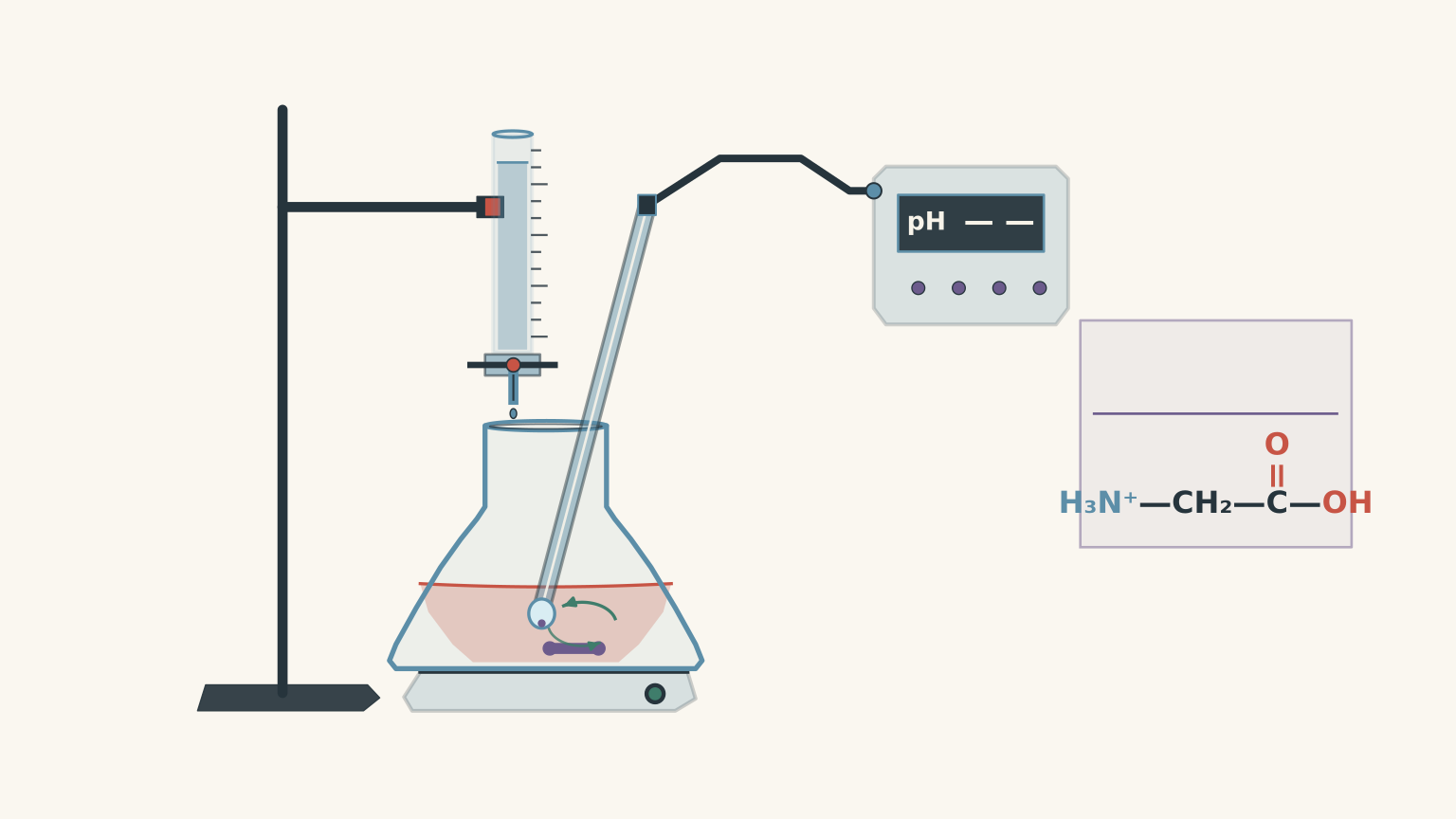
Due to technical limitations, this figure may display incorrectly or contain inaccuracies. Please check key details against your course materials.
01Start with the monoprotic model
You already know how a weak monoprotic acid behaves when titrated with a strong base.
Consider a generic weak acid, represented by \(HA\). It loses one proton when reacting with hydroxide ions:
\[ \mathrm{HA + OH^- \rightarrow A^- + H_2O} \]
As sodium hydroxide is added, the concentration of \(HA\) decreases and the concentration of its conjugate base, \(A^-\), increases.
There are three important features:
- Initially, most of the acid remains as \(HA\).
- During the buffer region, both \(HA\) and \(A^-\) are present in appreciable amounts.
- At the equivalence point, the original acid has been neutralised stoichiometrically.
At the half-equivalence point, half the original acid has reacted. The concentrations of the acid and conjugate base are equal.
This gives the familiar relationship:
\[ \boxed{\mathrm{pH=p}K_a} \]
The curve therefore has one main buffering region centred on one \(pK_a\).
If you need to refresh how this relationship is used to read a weak-acid titration curve, see How to Find pKa from a Weak-Acid Titration Curve.
The important idea is that the monoprotic model still works for glycine. We simply need to apply it twice.
02Glycine loses two protons in sequence
Glycine is the simplest amino acid. Its structure contains two important functional groups:
- A carboxylic acid group, \(-\mathrm{COOH}\).
- An amino group, which can exist as the protonated ammonium group, \(-\mathrm{NH_3^+}\).
Unlike some other amino acids, glycine has no ionisable side chain. This makes it particularly useful for understanding the basic mechanism.
Imagine starting with glycine in a sufficiently acidic solution.
The amino group is protonated, and the carboxyl group retains its hydrogen. The resulting molecule has an overall charge of \(+1\).
Its structure is:
\[ \mathrm{H_3N^+-CH_2-COOH} \]
Now begin adding sodium hydroxide.
First proton loss: the carboxyl group
The carboxyl group loses its proton first.
\[ \begin{aligned} &\mathrm{H_3N^+-CH_2-COOH}\\ &\rightleftharpoons \mathrm{H_3N^+-CH_2-COO^-+H^+} \end{aligned} \]
Notice what has changed:
- The carboxyl group becomes \(-\mathrm{COO^-}\).
- The amino group remains protonated as \(-\mathrm{NH_3^+}\).
- The overall molecular charge becomes zero.
This middle structure is called a zwitterion.
A zwitterion contains both positive and negative charges, but its overall charge is zero.
The first proton loss is associated with:
\[ pK_{a1}\approx 2.34 \]
Second proton loss: the ammonium group
Continue adding sodium hydroxide.
The solution becomes more alkaline, and eventually the ammonium group loses its proton.
\[ \begin{aligned} &\mathrm{H_3N^+-CH_2-COO^-}\\ &\rightleftharpoons \mathrm{H_2N-CH_2-COO^-+H^+} \end{aligned} \]
The resulting molecule has an overall charge of \(-1\).
The second proton loss is associated with:
\[ pK_{a2}\approx 9.60 \]
The complete sequence is therefore:
| Solution conditions | Predominant glycine form | Net charge |
|---|---|---|
| Strongly acidic | \(\mathrm{H_3N^+-CH_2-COOH}\) | +1 |
| Intermediate pH | \(\mathrm{H_3N^+-CH_2-COO^-}\) | 0 |
| Strongly alkaline | \(\mathrm{H_2N-CH_2-COO^-}\) | −1 |
The first proton leaves the carboxyl group because it is the more acidic of the two groups. Its \(pK_a\) is much lower.
The second proton leaves the ammonium group at a considerably higher pH.
Think of glycine as having two separate proton-release switches. The first responds in acidic conditions, while the second responds in alkaline conditions. The analogy is useful, but neither switch flips all at once: each proton-loss step is an equilibrium, so different molecular forms coexist around each \(pK_a\).
What exactly does pKa tell us here?
The acid dissociation constant, \(K_a\), describes the extent to which an acid releases a proton.
Its logarithmic form is:
\[ pK_a=-\log_{10}(K_a) \]
A lower \(pK_a\) means a stronger acid and a greater tendency to release a proton.
For glycine:
| Ionisable group | Approximate pKa | Relative acidity |
|---|---|---|
| Carboxyl, \(-\mathrm{COOH}\) | 2.34 | More acidic |
| Ammonium, \(-\mathrm{NH_3^+}\) | 9.60 | Less acidic |
These are representative reference values for free glycine in water at approximately 25 °C. The 0.10 M glycine titration curve and corresponding values are documented in IGNOU’s amino-acid teaching unit. The NPTEL Bio-Organic Chemistry module also describes the two ionisation stages and their buffering regions.
Actual measured values can shift somewhat with temperature and solution conditions.
03Why are there two buffering regions?
This is where the connection to monoprotic acid titration becomes particularly useful.
Each proton-loss step creates its own conjugate acid-base pair.
For the first stage, the pair is:
\[ \mathrm{H_3N^+-CH_2-COOH} \]
and
\[ \mathrm{H_3N^+-CH_2-COO^-} \]
For the second stage, the pair is:
\[ \mathrm{H_3N^+-CH_2-COO^-} \]
and
\[ \mathrm{H_2N-CH_2-COO^-} \]
The zwitterion appears in both pairs. It can accept a proton in the first equilibrium and donate a proton in the second.
This is why glycine can act as a buffer in two different pH regions.
Applying the Henderson-Hasselbalch equation
The familiar Henderson-Hasselbalch equation describes the relationship between pH and the concentrations of a conjugate acid-base pair:
\[ \mathrm{pH}=pK_a+ \log_{10}\left(\frac{[\text{base}]}{[\text{acid}]}\right) \]
We can apply it separately to the two glycine equilibria.
To keep the equations readable, define:
- \(C^+\): fully protonated glycine.
- \(Z\): zwitterionic glycine.
- \(A^-\): fully deprotonated glycine.
Square brackets indicate equilibrium molar concentrations.
For the first proton-loss step:
\[ \mathrm{pH}=pK_{a1}+ \log_{10}\left(\frac{[Z]}{[C^+]}\right) \]
For the second proton-loss step:
\[ \mathrm{pH}=pK_{a2}+ \log_{10}\left(\frac{[A^-]}{[Z]}\right) \]
These concentration-based equations are approximations for dilute solutions, where concentrations can be used in place of activities.
Now consider what happens at each \(pK_a\).
At the first \(pK_a\):
\[ [Z]=[C^+] \]
Therefore:
\[ \mathrm{pH}=pK_{a1} \]
At the second \(pK_a\):
\[ [A^-]=[Z] \]
Therefore:
\[ \mathrm{pH}=pK_{a2} \]
The same rule you learnt for a monoprotic weak acid applies to both stages.
04Reading the complete amino-acid titration curve
There is one more important detail: the horizontal axis.
For the standard glycine titration curve, we assume the starting solution contains fully protonated glycine and that sodium hydroxide is added progressively.
The horizontal axis is often expressed as equivalents of hydroxide ions per mole of glycine.
Define:
\[ x=\frac{n(\mathrm{OH^-})}{n(\text{glycine})} \]
Here, \(n\) represents the amount of substance in moles.
One equivalent means one mole of hydroxide ions has been added for every mole of glycine.
This gives us four important positions.
| OH⁻ equivalents | pH or feature | What is happening? |
|---|---|---|
| 0.50 | \(pK_{a1}=2.34\) | Equal amounts of cation and zwitterion |
| 1.00 | \(pI=5.97\) | First equivalence point; zwitterion predominates |
| 1.50 | \(pK_{a2}=9.60\) | Equal amounts of zwitterion and anion |
| 2.00 | Second equivalence point | Both ionisable protons have been removed stoichiometrically |
What is the isoelectric point?
The point at which glycine has zero average net charge is called its isoelectric point, represented by \(pI\).
For an amino acid without an ionisable side chain, it is calculated using the average of its two \(pK_a\) values:
\[ pI=\frac{pK_{a1}+pK_{a2}}{2} \]
For glycine:
\[ \begin{aligned} pI&=\frac{2.34+9.60}{2}\\ &=\boxed{5.97} \end{aligned} \]
At this pH, the zwitterion is the predominant form of glycine.
There is an important distinction here.
The isoelectric point is not necessarily pH 7. It describes the average electrical charge of the amino acid, not whether the surrounding solution is chemically neutral.
Also, \(pI\) is not a third \(pK_a\), and it does not represent a third buffering region.
The two buffering regions remain centred around pH 2.34 and pH 9.60.
The starting form changes what you see
There is a subtle experimental detail that can make two apparently different glycine titration curves both correct.
The standard two-stage curve starts with fully protonated glycine.
But what if you start with glycine already dissolved near its isoelectric point?
At approximately pH 5.97, most glycine is already present as the zwitterion.
If you now add sodium hydroxide, you only need to remove the remaining proton from the ammonium group.
You will observe the second buffering region, around pH 9.60.
The first buffering region, around pH 2.34, will not appear because you are not travelling through the first proton-loss stage.
To observe that region from the zwitterionic starting form, you would instead add a strong acid. This reverses the first proton-loss equilibrium.
This is an important point when interpreting experimental data. A missing buffering region does not necessarily mean an ionisable group is absent. It may simply mean the titration started after that group had already lost its proton.
05Worked examples
Worked example: Finding the titrant volumes at important points
A 20.0 mL solution contains 0.100 mol L⁻¹ fully protonated glycine. It is titrated with 0.100 mol L⁻¹ sodium hydroxide. Calculate the volume of sodium hydroxide required to reach the pH corresponding to each of the following:
- The first \(pK_a\).
- The isoelectric point.
- The second \(pK_a\).
Use \(pK_{a1}=2.34\) and \(pK_{a2}=9.60\).
Step 1
Use:
\[ n=cV \]
\[ \begin{aligned} n(\text{glycine}) &=0.100\times0.0200\\ &=0.00200\ \mathrm{mol} \end{aligned} \]
There are 0.00200 mol of glycine.
Step 2
At the first half-equivalence point, 0.50 equivalents of hydroxide have been added.
\[ \begin{aligned} n(\mathrm{OH^-}) &=0.50\times0.00200\\ &=0.00100\ \mathrm{mol} \end{aligned} \]
Calculate the volume using \(V=n/c\):
\[ V=\frac{0.00100}{0.100} =0.0100\ \mathrm{L} \]
\[ \boxed{V=10.0\ \mathrm{mL}} \]
The pH at this point is 2.34.
Step 3
The isoelectric point occurs at one equivalent of hydroxide per mole of glycine.
\[ n(\mathrm{OH^-})=1.00\times0.00200 \]
\[ n(\mathrm{OH^-})=0.00200\ \mathrm{mol} \]
Therefore:
\[ V=\frac{0.00200}{0.100} \]
\[ \boxed{V=20.0\ \mathrm{mL}} \]
At this point, the predominant form is the zwitterion, and the pH is approximately 5.97.
Step 4
The second half-equivalence point occurs at 1.50 equivalents.
\[ \begin{aligned} n(\mathrm{OH^-}) &=1.50\times0.00200\\ &=0.00300\ \mathrm{mol} \end{aligned} \]
Therefore:
\[ V=\frac{0.00300}{0.100} \]
\[ \boxed{V=30.0\ \mathrm{mL}} \]
The pH at this point is approximately 9.60.
The three important volumes are therefore 10.0 mL, 20.0 mL, and 30.0 mL.
Notice the pattern: the two half-equivalence points are separated by one equivalent of hydroxide, with the isoelectric point between them.
Worked example: Calculating pH in the second buffering region
A 10.0 mmol sample of fully protonated glycine is titrated with 0.200 mol L⁻¹ sodium hydroxide.
After 80.0 mL of sodium hydroxide has been added, calculate the pH.
Use \(pK_{a2}=9.60\).
Step 1
\[ n=cV \]
\[ \begin{aligned} n(\mathrm{OH^-}) &=0.200\times0.0800\\ &=0.0160\ \mathrm{mol}\\ &=16.0\ \mathrm{mmol} \end{aligned} \]
The sample contains 10.0 mmol of glycine, so the number of equivalents added is:
\[ \frac{16.0}{10.0}=1.60 \]
We are therefore in the second buffering region.
Step 2
The first 10.0 mmol of hydroxide removes the carboxyl protons.
This converts the original 10.0 mmol of fully protonated glycine into 10.0 mmol of zwitterion.
There are then 6.0 mmol of hydroxide remaining:
\[ 16.0-10.0=6.0\ \mathrm{mmol} \]
This removes protons from the ammonium groups.
Consequently:
- Zwitterion remaining: 4.0 mmol.
- Anion formed: 6.0 mmol.
Step 3
For the second buffering region:
\[ \mathrm{pH}=pK_{a2}+ \log_{10}\left(\frac{[A^-]}{[Z]}\right) \]
The two species occupy the same solution, so their concentration ratio equals their mole ratio.
Substitute:
\[ \begin{aligned} \mathrm{pH} &=9.60+\log_{10}\left(\frac{6.0}{4.0}\right)\\ &=9.60+\log_{10}(1.5)\\ &=9.60+0.176 \end{aligned} \]
\[ \boxed{\mathrm{pH}=9.78} \]
The pH is approximately 9.78.
The anionic form is now more abundant than the zwitterionic form. This makes sense because the solution has passed the second half-equivalence point, where the two forms would have been present in equal amounts.
06Common mistakes when interpreting amino-acid curves
| Tempting interpretation | What is actually happening |
|---|---|
| Two buffering regions mean two different amino acids are present. | One glycine molecule has two ionisable groups. |
| The isoelectric point must be pH 7. | It is the pH at which the amino acid has zero average net charge. |
| A zwitterion has no electrical charges. | It has both positive and negative charges, but its overall charge is zero. |
| The \(pK_a\) occurs at the equivalence point. | Each \(pK_a\) occurs at the half-equivalence point of its respective proton-loss stage. |
| A curve with one buffer region proves there is only one ionisable group. | The starting protonation state may mean only one stage is being observed. |
07Questions and solutions
Question 1
A fully protonated glycine sample is titrated with sodium hydroxide.
At 0.50 equivalents of hydroxide added per mole of glycine, the pH is 2.34. At 1.50 equivalents, the pH is 9.60.
Identify:
- The functional group losing a proton at each point.
- The predominant molecular form between the two \(pK_a\) values.
- The net charge of glycine below, between, and above the two \(pK_a\) values.
Solution 1
The carboxyl group loses the first proton, and the ammonium group loses the second. The predominant molecular forms have net charges of +1, 0, and −1 as the pH increases.
At the first half-equivalence point:
\[ pK_{a1}=2.34 \]
The carboxyl group changes from \(-\mathrm{COOH}\) to \(-\mathrm{COO^-}\).
The resulting zwitterion is:
\[ \mathrm{H_3N^+-CH_2-COO^-} \]
At the second half-equivalence point:
\[ pK_{a2}=9.60 \]
The ammonium group changes from \(-\mathrm{NH_3^+}\) to \(-\mathrm{NH_2}\).
The resulting anion is:
\[ \mathrm{H_2N-CH_2-COO^-} \]
The predominant forms are:
| pH range | Predominant form | Net charge |
|---|---|---|
| Below 2.34 | Fully protonated glycine | +1 |
| Between 2.34 and 9.60 | Zwitterion | 0 |
| Above 9.60 | Fully deprotonated glycine | −1 |
The transitions are gradual, so mixtures of neighbouring forms exist around each \(pK_a\). The table describes which form predominates, rather than an instantaneous change at a particular pH.
Question 2
A 4.00 mmol sample of fully protonated glycine is titrated with 0.200 mol L⁻¹ sodium hydroxide.
At a particular point in the first buffering region, the measured pH is 3.04.
Given:
\[ pK_{a1}=2.34 \]
Calculate:
- The ratio of zwitterion to fully protonated glycine.
- The amount of hydroxide added.
- The volume of sodium hydroxide added.
Assume the second deprotonation is negligible at this pH.
Solution 2
The zwitterion-to-cation ratio is approximately 5.01:1, requiring 3.33 mmol of hydroxide, or 16.7 mL of sodium hydroxide.
Step 1: Apply the Henderson-Hasselbalch equation to the first buffering region.
\[ \mathrm{pH}=pK_{a1}+ \log_{10}\left(\frac{[Z]}{[C^+]}\right) \]
Rearrange:
\[ \frac{[Z]}{[C^+]} =10^{\mathrm{pH}-pK_{a1}} \]
Substitute:
\[ \begin{aligned} \frac{[Z]}{[C^+]} &=10^{3.04-2.34}\\ &=10^{0.70}\\ &=5.01 \end{aligned} \]
Therefore:
\[ \boxed{[Z]:[C^+]=5.01:1} \]
Step 2: Calculate the amount of each species.
The total glycine amount is 4.00 mmol.
Let the amount of fully protonated glycine be \(n_C\).
The amount of zwitterion is \(5.01n_C\).
Therefore:
\[ n_C+5.01n_C=4.00 \]
\[ 6.01n_C=4.00 \]
\[ n_C=0.666\ \mathrm{mmol} \]
The amount of zwitterion is:
\[ n_Z=4.00-0.666 \]
\[ n_Z=3.33\ \mathrm{mmol} \]
Step 3: Calculate the hydroxide added.
Each mole of hydroxide converts one mole of fully protonated glycine into the zwitterion.
Therefore:
\[ n(\mathrm{OH^-})=3.33\ \mathrm{mmol} \]
Step 4: Calculate the sodium hydroxide volume.
Convert the concentration into mmol per mL:
\[ 0.200\ \mathrm{mol\,L^{-1}} =0.200\ \mathrm{mmol\,mL^{-1}} \]
Then:
\[ V=\frac{3.33}{0.200} \]
\[ \boxed{V=16.7\ \mathrm{mL}} \]
The result is consistent with the first buffering region: most glycine has converted into the zwitterion, but some fully protonated glycine remains.
Question 3
At the first equivalence point of a glycine titration, the pH is approximately 5.97.
A student makes the following statement:
“The glycine molecules have zero net charge at this point, so the solution must be neutral.”
Evaluate this statement.
Explain the difference between the isoelectric point of glycine and the neutral pH of a solution.
Solution 3
The statement is incorrect. The glycine has zero average net charge at its isoelectric point, but the solution is still acidic at pH 5.97 when measured at 25 °C.
The distinction is between the electrical charge of a dissolved molecule and the pH of the surrounding solution.
At the isoelectric point, glycine predominantly exists as:
\[ \mathrm{H_3N^+-CH_2-COO^-} \]
This molecule contains:
- One positively charged ammonium group.
- One negatively charged carboxylate group.
The two charges cancel, giving an overall molecular charge of zero.
However, this does not mean the solution has a pH of 7.
At 25 °C:
- A neutral aqueous solution has a pH of approximately 7.
- An acidic solution has a pH below 7.
- A basic solution has a pH above 7.
Since 5.97 is below 7, the solution is acidic.
The isoelectric point describes the average charge of the amino acid molecules. The pH describes the hydrogen ion activity of the solution.
These are different properties, and one cannot be used as a substitute for the other.
Question 4
Two 6.00 mmol aliquots of glycine are initially adjusted to their isoelectric point of approximately 5.97. For the purpose of this calculation, assume both samples consist entirely of zwitterionic glycine.
The first aliquot is titrated with 0.300 mol L⁻¹ sodium hydroxide until the pH reaches 9.60.
The second aliquot is titrated with 0.300 mol L⁻¹ hydrochloric acid until the pH reaches 2.34.
Calculate the volume of titrant required for each aliquot.
Explain why each titration produces only one buffering region, even though glycine has two ionisable groups.
Solution 4
Each aliquot requires 3.00 mmol of titrant, corresponding to 10.0 mL of solution. The sodium hydroxide titration shows the second buffering region, while the hydrochloric acid titration shows the first.
Step 1: Identify the starting form.
Both aliquots initially contain 6.00 mmol of zwitterionic glycine.
For the sodium hydroxide titration, the ammonium group loses its proton:
\[ Z\rightleftharpoons A^-+\mathrm{H^+} \]
For the hydrochloric acid titration, the carboxylate group accepts a proton:
\[ Z+\mathrm{H^+}\rightleftharpoons C^+ \]
Step 2: Calculate the amount of titrant required.
At pH 9.60, the zwitterion and anion concentrations are equal.
Therefore, half of the original 6.00 mmol of zwitterion must be converted into anion.
\[ n(\mathrm{OH^-})=\frac{6.00}{2} \]
\[ n(\mathrm{OH^-})=3.00\ \mathrm{mmol} \]
The same reasoning applies to the acid titration. At pH 2.34, equal amounts of zwitterion and fully protonated glycine are present.
Thus:
\[ n(\mathrm{H^+})=3.00\ \mathrm{mmol} \]
Step 3: Calculate each titrant volume.
Both titrants have a concentration of:
\[ 0.300\ \mathrm{mol\,L^{-1}} =0.300\ \mathrm{mmol\,mL^{-1}} \]
Therefore:
\[ V=\frac{3.00}{0.300} \]
\[ \boxed{V=10.0\ \mathrm{mL}} \]
Both aliquots require 10.0 mL of their respective titrants.
Step 4: Explain the different curves.
The sodium hydroxide titration begins with the zwitterion and moves towards the anion. It therefore passes through the second buffering region, centred on pH 9.60.
The hydrochloric acid titration begins with the same zwitterion but moves towards the fully protonated cation. It therefore passes through the first buffering region, centred on pH 2.34.
Neither experiment passes through both stages.
To observe both buffering regions in a single titration with sodium hydroxide, the starting solution must contain fully protonated glycine.
The important principle is that the number of buffering regions observed depends on both the molecule’s ionisable groups and the initial protonation state.
Question 5
At 25 °C, glycine has the following approximate acid dissociation values:
\[ pK_{a1}=2.34 \]
\[ pK_{a2}=9.60 \]
Let:
- \(C^+\) represent fully protonated glycine.
- \(Z\) represent zwitterionic glycine.
- \(A^-\) represent fully deprotonated glycine.
A student argues:
“The isoelectric point is halfway between the two pKa values. Therefore, at the isoelectric point, all three molecular forms should be present in equal concentrations.”
Is this reasoning correct?
Using the two Henderson-Hasselbalch equations:
- Show that the concentrations of \(C^+\) and \(A^-\) must be equal at the isoelectric point.
- Derive the relationship between the isoelectric point and the two pKa values.
- Calculate the ratio of zwitterion to fully protonated glycine at the isoelectric point.
- Estimate the percentage of glycine present as the zwitterion.
Assume a dilute ideal solution containing only these three glycine forms.
Solution 5
The student’s reasoning is incorrect. At the isoelectric point, the concentrations of the positively charged and negatively charged forms are equal, but the zwitterion is overwhelmingly predominant.
For glycine, approximately 99.95% of the molecules are zwitterionic at the isoelectric point under the stated assumptions.
Step 1: Establish the charge condition at the isoelectric point.
The three molecular forms have charges:
| Form | Net charge |
|---|---|
| \(C^+\) | +1 |
| \(Z\) | 0 |
| \(A^-\) | −1 |
At the isoelectric point, the average net charge is zero.
Therefore, the positive and negative contributions must balance:
\[ [C^+]-[A^-]=0 \]
Rearranging:
\[ \boxed{[C^+]=[A^-]} \]
This is the crucial condition.
It does not require the three molecular forms to have equal concentrations.
Step 2: Use the Henderson-Hasselbalch equations.
For the first equilibrium:
\[ \mathrm{pH}=pK_{a1} +\log_{10}\left(\frac{[Z]}{[C^+]}\right) \]
For the second equilibrium:
\[ \mathrm{pH}=pK_{a2} +\log_{10}\left(\frac{[A^-]}{[Z]}\right) \]
Add the two equations:
\[ \begin{aligned} 2\mathrm{pH} ={}&pK_{a1}+pK_{a2}\\ &+\log_{10}\left(\frac{[A^-]}{[C^+]}\right) \end{aligned} \]
At the isoelectric point:
\[ [A^-]=[C^+] \]
Therefore:
\[ \log_{10}\left(\frac{[A^-]}{[C^+]}\right) =\log_{10}(1)=0 \]
The relationship becomes:
\[ 2pI=pK_{a1}+pK_{a2} \]
Hence:
\[ \boxed{pI=\frac{pK_{a1}+pK_{a2}}{2}} \]
Substituting glycine’s values:
\[ pI=\frac{2.34+9.60}{2} \]
\[ \boxed{pI=5.97} \]
The familiar arithmetic mean is therefore a consequence of the charge balance and the two acid-base equilibria.
Step 3: Calculate the zwitterion-to-cation ratio.
Return to the first Henderson-Hasselbalch equation:
\[ \mathrm{pH}=pK_{a1} +\log_{10}\left(\frac{[Z]}{[C^+]}\right) \]
Rearrange:
\[ \frac{[Z]}{[C^+]} =10^{\mathrm{pH}-pK_{a1}} \]
Substitute the isoelectric pH:
\[ \begin{aligned} \frac{[Z]}{[C^+]} &=10^{5.97-2.34}\\ &=10^{3.63}\\ &\approx4266 \end{aligned} \]
Therefore:
\[ \boxed{[Z]:[C^+]\approx4266:1} \]
Because the concentrations of \(C^+\) and \(A^-\) are equal, the zwitterion-to-anion ratio is also approximately 4266:1.
Step 4: Calculate the percentage of zwitterion.
For every one unit of cation, there are approximately 4266 units of zwitterion and one unit of anion.
The total relative concentration is:
\[ 4266+1+1=4268 \]
The zwitterion fraction is:
\[ \frac{4266}{4268}\times100 \]
\[ \boxed{99.95\%} \]
The result explains the apparent paradox.
At the isoelectric point, glycine has zero average net charge because its small positive and negative populations balance each other. The zwitterion makes up almost all the remaining population.
This is why the isoelectric point must be understood through charge balance, rather than by assuming that a midpoint on a pH scale represents equal concentrations of all possible species.
08Where this leads next
The glycine model works because glycine has two ionisable groups and no ionisable side chain.
Other amino acids can have additional ionisable groups in their side chains. These introduce extra proton-loss stages, additional \(pK_a\) values, and potentially a third buffering region.
For example, glutamic acid has an additional carboxylic acid group, while lysine has an additional basic amino group.
The important adjustment is that you can no longer automatically calculate the isoelectric point by averaging just the two alpha-group pKa values. Instead, you must identify the two successive pKa values that surround the net-zero-charge form.
This is a natural next step into more complex amino-acid titration curves and species-distribution diagrams. The Acid-Base Speciation Diagrams: Reading Species vs pH resource develops the complementary skill of identifying which molecular species predominates at different pH values.
One final restriction is worth remembering: this article models free glycine in aqueous solution. Amino-acid groups incorporated into proteins experience a different chemical environment, and their acid-base behaviour can change.
The central principle remains the same: count the ionisable protons, follow their loss in sequence, and connect each equilibrium to its own buffering region.