
Asymmetric Catalysis: How Chiral Catalysts Favour One Enantiomer
Discover how chiral catalysts favour the formation of one enantiomer over another. Explore transition-state energies, enantiomeric excess, and why asymmetric catalysis does not guarantee complete selectivity.
Hydrogenate a flat, prochiral alkene and you can create a carbon atom attached to four different groups. That new chiral centre can form in either of two mirror-image arrangements, R or S. Without any chiral influence, the two products are usually formed in equal amounts. But introduce a chiral catalyst, and one enantiomer can become much more likely than the other. Why does the catalyst favour one product without necessarily producing it exclusively?
This is the central idea behind asymmetric catalysis. It is an extension beyond the required HSC Chemistry syllabus, not an additional assessment requirement. Year 12 Organic chemistry provides the prerequisite knowledge for this article; the asymmetric catalysis material goes further.
A syllabus timing note: the NSW Chemistry 11-12 Syllabus (2025) is scheduled to begin Year 12 implementation in Term 4 2028. In 2026, Year 12 students remain on the 2017 syllabus. This article uses the 2025 Organic chemistry foundation as its starting point.
01The organic chemistry starting point
Before looking at catalysts, it helps to understand why alkanes, alkenes, and alkynes belong to different homologous series.
A homologous series is a family of organic compounds with a shared structural feature, similar chemical properties, and a general molecular formula. Each successive member differs from the previous member by a \(\ce{CH2}\) unit.
The defining difference between these three hydrocarbon families is the bonding between their carbon atoms.
| Homologous series | Characteristic carbon-carbon bonding | General formula* | Example |
|---|---|---|---|
| Alkanes | Single bonds only | \(\ce{C_nH_{2n+2}}\) | Ethane, \(\ce{C2H6}\) |
| Alkenes | At least one double bond | \(\ce{C_nH_{2n}}\) | Ethene, \(\ce{C2H4}\) |
| Alkynes | At least one triple bond | \(\ce{C_nH_{2n-2}}\) | Ethyne, \(\ce{C2H2}\) |
These general formulae apply to acyclic compounds containing exactly one double or triple bond in the case of alkenes and alkynes.
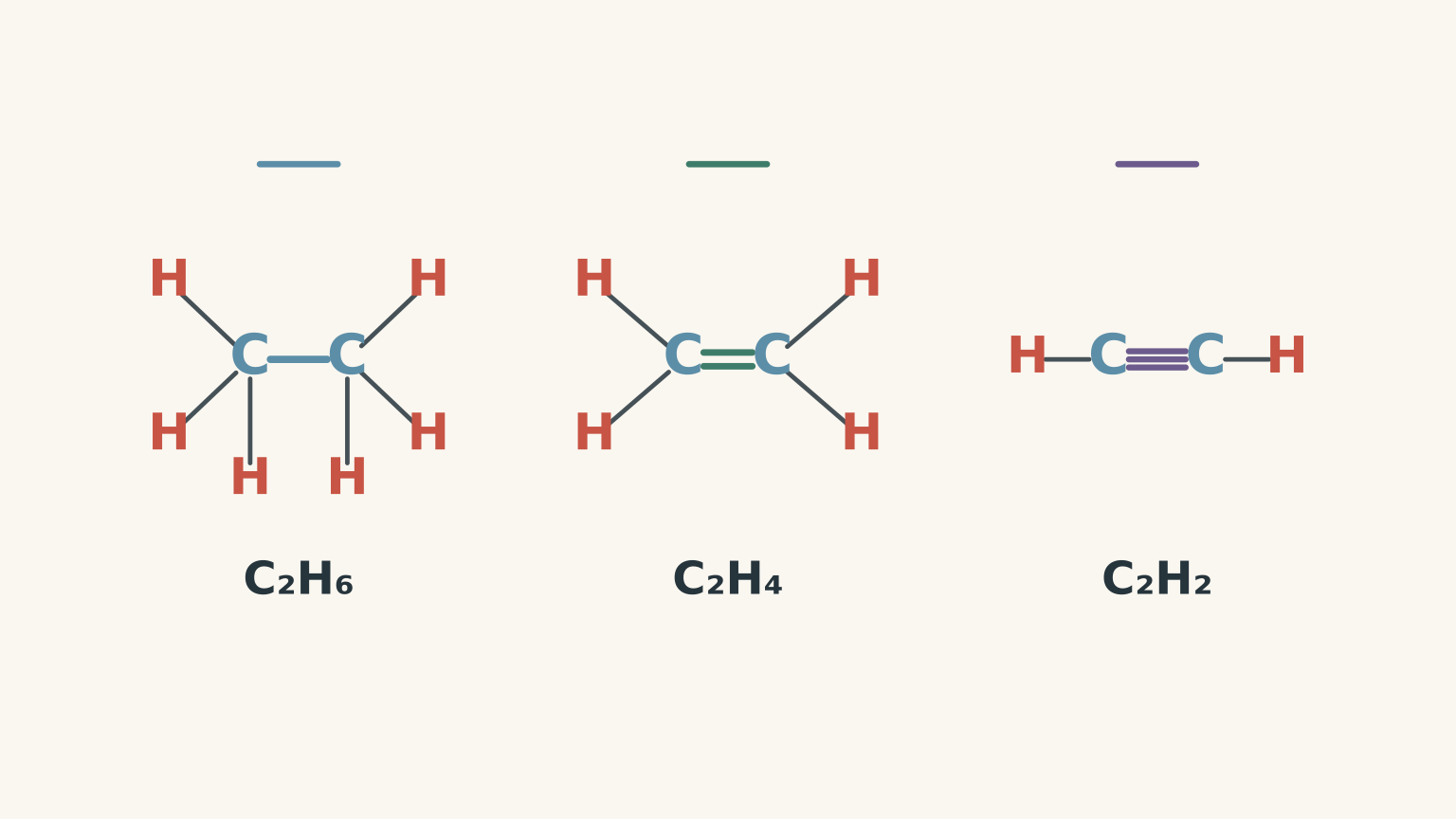
Due to technical limitations, this figure may display incorrectly or contain inaccuracies. Please check key details against your course materials.
Consider how the molecules change as their carbon chains grow:
- Ethane, \(\ce{C2H6}\), becomes propane, \(\ce{C3H8}\), when another \(\ce{CH2}\) unit is added.
- Ethene, \(\ce{C2H4}\), becomes propene, \(\ce{C3H6}\).
- Ethyne, \(\ce{C2H2}\), becomes propyne, \(\ce{C3H4}\).
The defining bonding pattern remains the same within each series. This is why members of a homologous series have similar characteristic chemical reactions.
The distinction becomes important when we consider alkenes. Their carbon-carbon double bond allows addition reactions, in which atoms are added across the double bond.
One such reaction is hydrogenation: the addition of hydrogen across a carbon-carbon double bond.
This reaction can do something particularly interesting. It can create a chiral centre.
02How an alkene can produce two enantiomers
Imagine a simplified alkene with the structure:
\[ \ce{R^1R^2C=CH2} \]
Here, \(R^1\) and \(R^2\) represent two different groups attached to the same carbon atom.
During hydrogenation, hydrogen is added across the double bond:
\[ \ce{R^1R^2C=CH2 + H2} \]
\[ \longrightarrow \ce{R^1R^2CH-CH3} \]
The carbon that was originally part of the double bond changes from a trigonal planar arrangement to a tetrahedral arrangement.
After hydrogenation, it is attached to four different groups:
- \(R^1\)
- \(R^2\)
- H
- \(\ce{CH3}\)
It is now a chiral centre.
But there is a problem. The original alkene is planar at this carbon. Hydrogen can be added from either face of the double bond.
Addition from one face produces one configuration. Addition from the opposite face produces its mirror image.
The two products are enantiomers.
The starting molecule is called prochiral. This means it is not itself chiral, but a chemical reaction can convert it into a chiral molecule.
Now make a prediction.
If the alkene reacts in an environment containing only achiral substances, which face should react faster?
Neither.
The two possible approaches are mirror-related. In an achiral environment, they have identical energy. There is no chemical reason for one pathway to be preferred.
Under conditions where product formation is controlled by reaction rates, both pathways occur equally often.
The result is:
\[ 50\% \ R + 50\% \ S \]
This is a racemic mixture.
So how could we change that outcome?
03How a chiral catalyst creates a preference
A chiral catalyst provides an asymmetric environment around the reacting molecule.
A common design uses a metal atom surrounded by molecules called ligands. A ligand is an ion or molecule that attaches to a central metal atom or ion.
In asymmetric catalysis, at least one of these ligands is chiral.
The ligand creates a three-dimensional environment around the metal centre. The substrate interacts with this environment as it approaches and reacts.
The catalyst is not simply blocking one face of the alkene. Instead, it makes the two possible reaction pathways energetically different.
Think of two corridors through a crowded room. One corridor has furniture positioned so that people can pass relatively easily. The other requires them to squeeze around obstacles.
Both routes remain possible, but one is easier to travel through.
A chiral ligand creates a similar difference between the two possible reaction pathways.
The analogy is simplified. Real catalysts can distinguish between approaches through several interactions, including:
- Steric repulsion, where atoms or groups crowd one another.
- Attractive non-covalent interactions between parts of the catalyst and substrate.
- Electronic interactions that affect how bonds form and break.
Steric effects are particularly useful for developing an initial mental model, but they are not the only source of selectivity.
University of Alabama chemistry lecturer Kevin Shaughnessy’s organometallic chemistry notes discuss how these catalyst-substrate interactions produce different energies for competing stereochemical pathways.
Why the transition states matter
To understand the actual mechanism, we need one more concept: the transition state.
A transition state is the temporary, highest-energy arrangement of atoms along a particular reaction pathway. It is not an isolable product or a stable intermediate.
For our alkene, there are two possible transition states:
- One leads to the R enantiomer.
- The other leads to the S enantiomer.
When the catalyst is achiral, these transition states are mirror-related and have equal energies, assuming the substrate and remaining reaction environment are also achiral.
When the catalyst is chiral, the two arrangements become diastereomeric transition states.
Unlike enantiomers, diastereomers do not necessarily have identical energies.
The catalyst can therefore make one transition state lower in energy than the other.
The lower-energy transition state requires less energy to reach.
Consequently, the reaction proceeds faster along that pathway, producing more of its corresponding enantiomer.
This is called enantioselectivity: the preferential formation of one enantiomer over the other.
When a catalyst produces this preference, the process is called asymmetric catalysis.
Notice what has changed. The catalyst has not changed which atoms are added to the alkene. It has changed the relative rates of the two possible three-dimensional outcomes.
That is the key idea.
04Why asymmetric catalysis does not guarantee 100% selectivity
You might expect a chiral catalyst to produce only the preferred enantiomer.
After all, one transition state is lower in energy. Why would the other pathway still occur?
The answer is that the higher-energy pathway is still accessible.
At a given temperature, molecules have a distribution of thermal energies. The lower-energy pathway is more favourable, but the higher-energy pathway has not become impossible.
The catalyst changes the relative likelihood of the two pathways. It does not necessarily eliminate one of them.
A useful way to describe the result is through the enantiomeric ratio and enantiomeric excess.
Enantiomeric ratio
The enantiomeric ratio, abbreviated \(er\), compares the amounts of the two enantiomers.
For example:
\[ R:S=9:1 \]
means there are nine parts of R for every one part of S.
Enantiomeric excess
The enantiomeric excess, abbreviated \(ee\), measures how much one enantiomer exceeds the other as a percentage of the total mixture.
\[ ee= \frac{n_{\text{major}}-n_{\text{minor}}} {n_{\text{major}}+n_{\text{minor}}} \times100\% \]
Here, \(n_{\text{major}}\) and \(n_{\text{minor}}\) are the amounts, in moles, of the major and minor enantiomers.
For example, a 9:1 enantiomeric ratio corresponds to:
\[ ee=\frac{9-1}{9+1}\times100 \]
\[ ee=80\% \]
Notice that a 9:1 ratio does not mean 90% ee.
The mixture contains 90% of the major enantiomer, but its enantiomeric excess is only 80%.
For a more detailed explanation of this calculation, see tutorgum’s guide to Enantiomeric Excess: Calculating ee from Optical Rotation.
Worked example: Calculate enantiomeric excess from product amounts
A catalytic reaction produces 0.72 mol of the R enantiomer and 0.18 mol of the S enantiomer. Calculate the enantiomeric ratio and enantiomeric excess.
Step 1
\[ R:S=0.72:0.18 \]
Divide both amounts by 0.18:
\[ R:S=4:1 \]
Step 2
\[ ee=\frac{0.72-0.18}{0.72+0.18}\times100 \]
\[ ee=\frac{0.54}{0.90}\times100 \]
\[ \boxed{ee=60\%} \]
The reaction produces four times as much R as S.
The major enantiomer makes up 80% of the product, while the minor enantiomer makes up 20%. The resulting mixture has 60% ee.
The energy difference controls the ratio
We can go one step further and connect the product ratio to the difference between the transition-state energies.
The relevant quantity is the difference in activation Gibbs free energy, written as:
\[ \Delta\Delta G^\ddagger \]
This is the difference between the activation free energy of the higher-energy pathway and that of the lower-energy pathway.
A larger difference generally produces greater enantioselectivity.
For a simplified kinetic model, the relationship is:
\[ \frac{k_{\text{major}}}{k_{\text{minor}}} \approx \exp\left( \frac{\Delta\Delta G^\ddagger} {R_{\text{gas}}T} \right) \]
Where:
- \(k_{\text{major}}\) is the rate constant for forming the major enantiomer.
- \(k_{\text{minor}}\) is the rate constant for forming the minor enantiomer.
- \(\Delta\Delta G^\ddagger\) is the activation free-energy difference, in J mol\(^{-1}\).
- \(R_{\text{gas}}\) is the universal gas constant, \(8.314\ \mathrm{J\,mol^{-1}\,K^{-1}}\).
- \(T\) is the absolute temperature, in kelvin.
- \(\exp\) represents the exponential function.
This relationship assumes competing pathways under kinetic control, with comparable rate prefactors. It is an extension model, not a formula you need to memorise for the HSC.
The interesting result is how little energy difference is needed to create a noticeable preference.
At approximately 298 K, a difference of just 5.7 kJ mol\(^{-1}\) produces roughly a 10:1 reaction rate ratio.
That corresponds to approximately 81.8% ee.
A relatively small difference between two transition states can therefore have a substantial effect on the final product composition.
Worked example: Estimate selectivity from an energy difference
At 298 K, the activation free energy for forming the minor enantiomer is 5.7 kJ mol\(^{-1}\) higher than that for forming the major enantiomer.
Estimate the enantiomeric ratio and enantiomeric excess. Assume irreversible product formation and similar rate prefactors.
Step 1
\[ \Delta\Delta G^\ddagger=5.7\ \mathrm{kJ\,mol^{-1}} \]
\[ =5700\ \mathrm{J\,mol^{-1}} \]
Step 2
\[ \frac{k_{\text{major}}}{k_{\text{minor}}} = \exp\left( \frac{5700}{8.314\times298} \right) \]
\[ =\exp(2.30) \]
\[ \approx10:1 \]
Therefore, the predicted enantiomeric ratio is approximately 10:1.
Step 3
The total number of parts is:
\[ 10+1=11 \]
Major enantiomer:
\[ \frac{10}{11}\times100=90.9\% \]
Minor enantiomer:
\[ \frac{1}{11}\times100=9.1\% \]
Step 4
\[ ee=\frac{10-1}{10+1}\times100 \]
\[ \boxed{ee=81.8\%} \]
A difference of only 5.7 kJ mol\(^{-1}\) has created a strong preference for one enantiomer.
However, the higher-energy pathway still contributes approximately 9.1% of the product.
This is why a chiral catalyst can be highly selective without being completely selective.
05A real application: Making L-DOPA
Asymmetric catalysis is more than an interesting way to control molecular geometry. It has played an important role in pharmaceutical manufacturing.
A famous example is the industrial synthesis of L-DOPA, a medicine used to treat symptoms of Parkinson’s disease.
William Knowles developed a rhodium-based catalyst containing a chiral phosphine ligand called DiPAMP.
The catalyst was used to hydrogenate an enamide precursor, producing a protected amino acid intermediate with approximately 95% enantiomeric excess. A subsequent hydrolysis step produced L-DOPA.
The work was a major development in industrial asymmetric synthesis and contributed to the 2001 Nobel Prize in Chemistry.
The Nobel Prize’s advanced scientific account describes this development and reports the 95% ee obtained in the key hydrogenation step.
There is an important detail in that result.
An ee of 95% does not mean that 95% of the product is the desired enantiomer.
Using the relationship:
\[ \text{Major percentage} = \frac{100+ee}{2} \]
\[ =\frac{100+95}{2} \]
\[ =97.5\% \]
The remaining 2.5% is the minor enantiomer.
Even a highly successful asymmetric catalytic reaction can therefore produce some unwanted stereoisomer.
This is not necessarily a failure. The goal is to make the desired enantiomer substantially more abundant, while maintaining a useful reaction rate and product yield.
06When the simple transition-state model is not enough
The transition-state model gives us a strong starting point, but real catalytic reactions can involve several stages.
One important complication is that the most abundant catalyst-substrate arrangement does not always produce the major product.
Consider a chiral catalyst that can bind a substrate in two different orientations.
Call these arrangements A and B.
They are diastereomeric catalyst-substrate complexes, so they may have different energies. They can also interconvert before reacting.
Suppose A is much more abundant than B. It would be tempting to predict that A must produce most of the product.
But there is another factor: how quickly each arrangement reacts.
A less abundant complex may react much faster than the more abundant complex.
The rate of product formation from each arrangement depends on both its concentration and its rate constant:
\[ \text{Rate}=k[\text{complex}] \]
Here, \(k\) is the rate constant and \([\text{complex}]\) is the concentration of the catalyst-substrate arrangement.
If the two arrangements interconvert rapidly, the product ratio depends on the competing reaction rates, not simply on which arrangement is most abundant.
This behaviour is related to the Curtin-Hammett principle, an advanced concept in reaction kinetics.
The distinction is important:
- If two arrangements interconvert rapidly, product formation depends on the rates of their competing pathways.
- If they cannot interconvert, their starting populations can determine the final product ratio when both react completely and irreversibly.
The most stable intermediate and the most productive intermediate are not necessarily the same thing.
This is one reason why understanding asymmetric catalysis requires more than simply drawing the lowest-energy structure.
The detailed catalyst-substrate interactions, reaction rates, and conditions all matter. As discussed in Hopmann’s review of asymmetric reactions, predicting selectivity can require understanding the full reaction pathway and the interactions within competing transition states.
07Questions and solutions
Question 1
A hypothetical asymmetric catalytic reaction produces 0.84 mol of the R enantiomer and 0.16 mol of the S enantiomer.
Calculate:
(a) The enantiomeric ratio.
(b) The enantiomeric excess.
(c) The percentage of the product that is the major enantiomer.
Solution 1
The enantiomeric ratio is 21:4, the ee is 68%, and the major enantiomer makes up 84% of the product.
Part (a): Enantiomeric ratio
\[ R:S=0.84:0.16 \]
Dividing both values by 0.04:
\[ \boxed{R:S=21:4} \]
Part (b): Enantiomeric excess
\[ ee=\frac{0.84-0.16}{0.84+0.16}\times100 \]
\[ =\frac{0.68}{1.00}\times100 \]
\[ \boxed{ee=68\%} \]
Part (c): Major enantiomer percentage
The R enantiomer is the major product.
\[ \frac{0.84}{1.00}\times100 \]
\[ \boxed{84\%} \]
The distinction matters: the reaction produces 84% R, but its enantiomeric excess is only 68%.
Question 2
A planar prochiral alkene undergoes catalytic hydrogenation.
Under achiral conditions, the reaction produces equal quantities of the R and S enantiomers.
When an enantiopure chiral ligand is introduced around the metal catalyst, the product ratio becomes 9:1 in favour of R.
(a) Explain why the chiral ligand changes the product ratio.
(b) Calculate the enantiomeric excess.
(c) Predict what would happen if the mirror-image version of the chiral ligand were used instead. State the assumption required for your prediction.
Solution 2
The chiral ligand makes the two reaction pathways energetically unequal, producing an excess of R. The resulting ee is 80%. An ideal mirror-image ligand would favour S instead.
Part (a): Why the product ratio changes
Without a chiral ligand, the two faces of the planar alkene experience equivalent reaction environments.
The transition states leading to R and S are mirror-related and have equal activation free energies.
The result is a 1:1 product mixture.
Introducing an enantiopure chiral ligand changes the three-dimensional environment around the metal centre.
The substrate can now interact with the catalyst in two different orientations. These form diastereomeric transition states rather than equivalent mirror-related transition states.
One orientation experiences more favourable interactions and has a lower activation free energy.
Its reaction pathway is faster, so more R is produced.
Importantly, the catalyst does not prevent the S pathway from occurring. It simply makes that pathway less favourable.
Part (b): Calculate ee
Given:
\[ R:S=9:1 \]
\[ ee=\frac{9-1}{9+1}\times100 \]
\[ \boxed{ee=80\%} \]
The major enantiomer represents 90% of the mixture, while the minor enantiomer represents 10%.
Part (c): Using the mirror-image ligand
Under otherwise achiral and identical conditions, the mirror-image ligand would be expected to favour S instead of R.
This is because reversing the catalyst’s chirality reverses the spatial relationships that distinguish the two reaction pathways.
For an ideal pair of exact mirror-image catalysts, the selectivity magnitude would be the same, but the preferred enantiomer would switch.
This prediction assumes the substrate, solvent, and other reaction components do not introduce an additional chiral influence.
Question 3
Two different chiral catalysts are tested in separate hypothetical hydrogenation reactions at 298 K.
Both reactions are irreversible and produce no subsequent racemisation.
Catalyst X produces an enantiomeric ratio of 19:1 in favour of R.
Catalyst Y produces an enantiomeric ratio of 4:1 in favour of R.
Assume similar rate prefactors for the two competing pathways.
(a) Calculate the ee for each catalyst.
(b) Calculate the approximate activation free-energy difference between the two pathways for each catalyst.
(c) Determine how much greater the activation free-energy difference is for catalyst X.
Use:
\[ R_{\text{gas}}=8.314\ \mathrm{J\,mol^{-1}\,K^{-1}} \]
Solution 3
Catalyst X produces 90% ee, while catalyst Y produces 60% ee. The activation free-energy differences are approximately 7.30 kJ mol\(^{-1}\) and 3.43 kJ mol\(^{-1}\), respectively. Catalyst X has an energy difference approximately 3.87 kJ mol\(^{-1}\) greater.
Part (a): Calculate ee
For catalyst X:
\[ ee_X=\frac{19-1}{19+1}\times100 \]
\[ \boxed{ee_X=90\%} \]
For catalyst Y:
\[ ee_Y=\frac{4-1}{4+1}\times100 \]
\[ \boxed{ee_Y=60\%} \]
Catalyst X is more enantioselective.
Part (b): Calculate the activation free-energy differences
Rearrange the rate relationship:
\[ \Delta\Delta G^\ddagger = R_{\text{gas}}T\ln \left( \frac{k_{\text{major}}}{k_{\text{minor}}} \right) \]
For catalyst X:
\[ \Delta\Delta G_X^\ddagger = 8.314\times298\times\ln(19) \]
\[ =7295\ \mathrm{J\,mol^{-1}} \]
\[ \boxed{\Delta\Delta G_X^\ddagger \approx7.30\ \mathrm{kJ\,mol^{-1}}} \]
For catalyst Y:
\[ \Delta\Delta G_Y^\ddagger = 8.314\times298\times\ln(4) \]
\[ =3434\ \mathrm{J\,mol^{-1}} \]
\[ \boxed{\Delta\Delta G_Y^\ddagger \approx3.43\ \mathrm{kJ\,mol^{-1}}} \]
Part (c): Compare the energy differences
\[ 7.30-3.43=3.87 \]
\[ \boxed{3.87\ \mathrm{kJ\,mol^{-1}}} \]
Catalyst X has an activation free-energy difference approximately 3.87 kJ mol\(^{-1}\) greater than catalyst Y.
This explains why X produces a stronger preference for one enantiomer.
The important point is that enantioselectivity depends on the difference between competing pathways, not simply on how much energy the catalyst saves overall.
Question 4
A chiral catalyst initially produces a product mixture with 90% ee in favour of R.
During subsequent processing, 25% of the total product undergoes complete racemisation. The remaining 75% retains its original enantiomeric composition.
Assume there is no decomposition or selective loss of either enantiomer.
Calculate:
(a) The final amounts of R and S as percentages of the total product.
(b) The final enantiomeric excess.
(c) The final enantiomeric ratio.
Explain why the final ee is lower than the initial ee.
Solution 4
The final mixture contains 83.75% R and 16.25% S, giving an ee of 67.5% and an enantiomeric ratio of 67:13.
Part (a): Calculate the final amounts
First, convert the initial 90% ee into the actual percentages of each enantiomer.
\[ R=\frac{100+90}{2}=95\% \]
\[ S=\frac{100-90}{2}=5\% \]
The product is divided into two portions.
The first portion, representing 75% of the total, retains its original composition.
Its R contribution is:
\[ 0.75\times95=71.25\% \]
Its S contribution is:
\[ 0.75\times5=3.75\% \]
The second portion represents 25% of the total product. Complete racemisation gives equal quantities of R and S.
Its R contribution is:
\[ 0.25\times50=12.5\% \]
Its S contribution is:
\[ 0.25\times50=12.5\% \]
Add the contributions.
\[ R=71.25+12.5 \]
\[ \boxed{R=83.75\%} \]
\[ S=3.75+12.5 \]
\[ \boxed{S=16.25\%} \]
Part (b): Calculate the final ee
\[ ee=\frac{83.75-16.25}{100}\times100 \]
\[ \boxed{ee=67.5\%} \]
Part (c): Calculate the final enantiomeric ratio
\[ R:S=83.75:16.25 \]
Dividing both quantities by 1.25:
\[ \boxed{R:S=67:13} \]
The final mixture has a ratio of approximately 5.15:1.
The decrease in ee occurs because racemisation converts part of the original enantiomerically enriched mixture into a 50:50 mixture.
The catalyst’s original selectivity has not changed. Instead, the product’s stereochemical composition has changed after it was formed.
This distinction is important when evaluating asymmetric catalytic reactions: the selectivity during product formation and the enantiomeric purity of the isolated product are not necessarily identical.
Question 5
A chiral metal catalyst binds a prochiral alkene in two different orientations, A and B.
These catalyst-substrate complexes are diastereomeric and can interconvert.
At equilibrium, their relative populations are:
\[ A:B=9:1 \]
Each complex can react irreversibly to produce a different enantiomer:
- Complex A produces R, with a first-order rate constant of \(1.0\ \mathrm{s^{-1}}\).
- Complex B produces S, with a first-order rate constant of \(20\ \mathrm{s^{-1}}\).
Assume that each complex produces only its assigned enantiomer, and that there is no subsequent racemisation.
(a) If A and B interconvert much faster than either reacts, calculate the product enantiomeric ratio and ee. Identify the major enantiomer.
(b) Now suppose interconversion is completely stopped immediately after the 9:1 equilibrium mixture has formed. Both complexes are allowed to react fully and irreversibly. Calculate the final enantiomeric ratio and ee.
(c) Explain why the major product changes between the two situations, even though the initial equilibrium mixture is identical.
Solution 5
With rapid interconversion, S is the major product, with an enantiomeric ratio of 20:9 and an ee of approximately 37.9%. Without interconversion, R becomes the major product, with a 9:1 ratio and 80% ee.
The difference comes from whether the catalyst-substrate complexes can exchange orientations while reacting.
Part (a): Rapid interconversion
When A and B interconvert much faster than they react, the equilibrium population ratio is maintained throughout the reaction.
For convenience, consider nine relative units of A and one relative unit of B.
The rate of R formation is proportional to the concentration of A multiplied by its rate constant.
\[ v_R=9\times1.0 \]
\[ v_R=9 \]
The rate of S formation is:
\[ v_S=1\times20 \]
\[ v_S=20 \]
Therefore, the relative product formation rates are:
\[ R:S=9:20 \]
The S enantiomer is produced faster and becomes the major product.
\[ \boxed{S:R=20:9} \]
Calculate the ee:
\[ ee=\frac{20-9}{20+9}\times100 \]
\[ =\frac{11}{29}\times100 \]
\[ \boxed{ee\approx37.9\%} \]
The surprising result is that the less abundant complex produces the major product.
Complex B is only 10% of the equilibrium population, but it reacts 20 times faster than A.
Its greater reaction rate more than compensates for its lower concentration.
Part (b): Interconversion stopped
Now the two complexes cannot exchange orientations.
The initial populations remain:
- Nine units of A.
- One unit of B.
Each complex reacts irreversibly to form its assigned enantiomer.
All nine units of A eventually produce R.
All one unit of B eventually produces S.
Therefore:
\[ \boxed{R:S=9:1} \]
The enantiomeric excess is:
\[ ee=\frac{9-1}{9+1}\times100 \]
\[ \boxed{ee=80\%} \]
R is now the major product.
Notice that the different rate constants affect how quickly the products form, but not the final amounts when both complexes are allowed to react completely without interconversion.
Part (c): Explain the change in selectivity
The difference is whether the two catalyst-substrate arrangements can exchange before reacting.
With rapid interconversion, molecules repeatedly move between A and B.
Although A is more abundant at any instant, B reacts much faster. The product distribution is therefore determined by the relative product formation rates.
Without interconversion, the original 9:1 population is effectively locked in place.
Each complex can only produce its assigned product, so the original population ratio determines the final product ratio.
This is an important extension of the basic asymmetric catalysis model.
The most abundant intermediate does not necessarily produce the major product. You must also consider how quickly each intermediate reacts and whether the intermediates can interconvert.
The key distinction is between how much of an intermediate exists and how quickly that intermediate produces product.
08What to understand next
Asymmetric catalysis connects three important ideas:
- Chirality determines whether two molecular arrangements are mirror images or diastereomeric.
- Different transition-state energies produce different reaction rates and therefore different enantiomeric ratios.
- The final product composition can also depend on reaction reversibility, intermediate interconversion, and racemisation.
The next useful step is to connect these reaction pathways to the actual three-dimensional structures of the products.
If you need to revise the foundations, continue with tutorgum’s guides to Chirality: Chiral Centres, Enantiomers and Optical Activity and Enantiomeric Excess: Calculating ee from Optical Rotation.
Together, these ideas explain not just which enantiomer a reaction produces, but why a particular catalyst favours that outcome.