
Atropisomerism: How Restricted Bond Rotation Creates Chirality
Discover how restricted rotation around a carbon-carbon bond can create chirality without a tetrahedral stereocentre. Explore axial chirality, rotational energy barriers, racemisation, and the role of atropisomers in asymmetric synthesis.
Two benzene rings are joined by a single carbon-carbon bond. You would expect one ring to rotate around that bond, just as a wheel turns around an axle. But what happens if you surround the bond with bulky groups that make rotation extremely difficult?
The rings can become locked into a twisted arrangement. More surprisingly, that arrangement can be chiral: its mirror image is a different, non-superimposable structure, even though the molecule contains no tetrahedral carbon attached to four different groups.
This phenomenon is called atropisomerism. It introduces an important idea in stereochemistry: molecular chirality can arise from restricted rotation around a bond, rather than from a chiral centre.
Atropisomerism goes beyond the required Year 12 Organic Chemistry content. This is an extension topic, not an HSC assessment requirement. The Year 12 chemistry knowledge is the assumed starting point, rather than an indication that this topic is examinable.
The 2025 NSW Chemistry 11-12 syllabus is scheduled for implementation from 2028, with its first HSC examination in 2029. Its organic chemistry foundation includes constructing reaction pathways for ester synthesis, including multi-step pathways. That work trains you to track changes in molecular connectivity. Atropisomerism explores something different: how a molecule can retain the same connectivity but adopt distinct, isolable three-dimensional arrangements.
01Start with a rotating bond
Consider biphenyl, a molecule consisting of two benzene rings connected directly by a carbon-carbon single bond.
The connecting bond acts as an axis of rotation. Each benzene ring can rotate relative to the other without breaking that bond.
The positions immediately beside the connecting bond are called the ortho positions. In ordinary biphenyl, these positions contain hydrogen atoms.
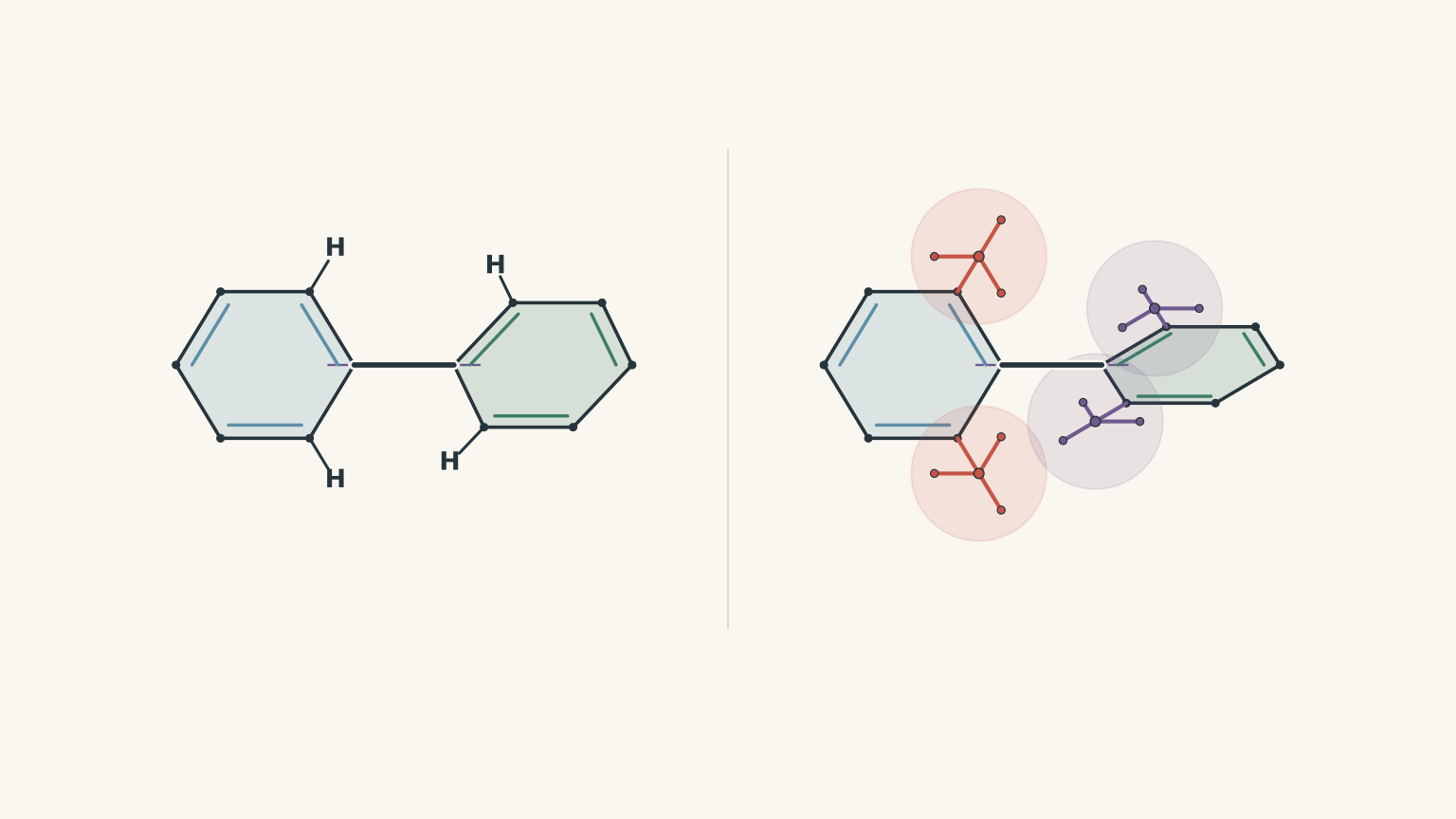
Due to technical limitations, this figure may display incorrectly or contain inaccuracies. Please check key details against your course materials.
Predict what happens if we replace those hydrogen atoms with much larger groups.
The larger groups begin to interfere with one another as the rings rotate. In particular, bringing the rings towards a coplanar arrangement can create substantial steric repulsion.
Steric repulsion is the repulsive interaction that occurs when atoms or groups are forced too close together.
Imagine two people wearing oversized backpacks trying to pass each other in a narrow school corridor. The backpacks make turning and passing difficult. In a crowded biphenyl, the ortho substituents play the role of the backpacks, while the central bond is the axis around which the rings must turn.
The analogy has a limit: molecular rotation is not physically blocked by a wall. Instead, the molecule must pass through a higher-energy arrangement to change its orientation.
The result is a restricted rotational process.
Why do the rings twist?
Two competing effects influence the arrangement of the rings:
- Steric repulsion: Bulky ortho substituents favour arrangements that keep them apart.
- Conjugation: The two aromatic rings can interact through their overlapping π systems. Greater overlap generally favours a more coplanar arrangement.
The actual molecular structure reflects a compromise between these effects.
The rings are therefore often twisted relative to each other, although the exact angle depends on the substituents and molecular structure. They are not automatically perpendicular.
The important point is that rotating one ring into the opposite twisted arrangement may require overcoming a substantial energy barrier.
However, restricted rotation alone does not guarantee atropisomerism. We also need to consider the symmetry of the molecule.
02How can restricted rotation create chirality?
You probably know the usual way a molecule becomes chiral.
A tetrahedral carbon attached to four different groups can form a chiral centre. Its two possible arrangements are non-superimposable mirror images.
You can revise that model in Chirality: Chiral Centres, Enantiomers and Optical Activity.
But a tetrahedral stereocentre is not the only way to produce chirality.
In a suitably substituted biphenyl, chirality can arise from the arrangement of groups around the central bond.
This is called axial chirality.
The chirality axis
Imagine looking along the central bond connecting the two aromatic rings.
At each end of the axis, there are two ortho substituents. Label the groups on the first ring A and B, and those on the second ring C and D.
For the simple non-bridged biaryl model considered here, the conditions for axial chirality are:
\[ A\ne B \]
and
\[ C\ne D \]
In other words, the two ortho substituents must be distinguishable at each end of the axis.
When the rings are twisted, these four groups occupy an asymmetric three-dimensional arrangement.
The two structures are mirror images, but they cannot be superimposed by simply rotating or translating one molecule.
They are therefore a pair of enantiomers.
Notice what has happened: no tetrahedral carbon stereocentre was required. The chirality comes from the overall arrangement of the groups around the rotational axis.
IUPAC describes this as axial chirality, where stereoisomerism results from the non-planar arrangement of groups around a chirality axis. You may encounter the descriptors \(R_{\mathrm{a}}\) and \(S_{\mathrm{a}}\), which identify the two axial configurations.
Not every restricted rotamer is an atropisomer
There are two separate requirements to check.
| Requirement | What it achieves |
|---|---|
| Restricted rotation | Allows different conformations to persist as separate chemical species. |
| An asymmetric three-dimensional arrangement | Allows the structure to be chiral. |
Both matter.
A biphenyl can have bulky ortho substituents that make rotation slow, but if its arrangement retains an appropriate symmetry element, it may still be achiral.
Likewise, a molecule can have a chiral twisted conformation but rotate so rapidly that the two mirror-image forms cannot be isolated separately.
This is why it is useful to distinguish ordinary conformational isomerism from atropisomerism. Atropisomers are a special class of conformers whose restricted rotation makes their different arrangements sufficiently persistent to be isolated.
The Conformational Isomerism: Understanding Molecular Shape guide covers the underlying idea of different molecular arrangements arising from bond rotation.
03The rotational energy barrier
So why can one molecule rotate easily while another remains in a particular twisted arrangement?
The answer is the energy required for rotation.
Think about rotating one ring relative to the other. Initially, the molecule sits in a relatively stable twisted arrangement.
To reach the opposite arrangement, it must pass through a less favourable geometry. Steric repulsion and changes in π overlap can make this process energetically demanding.
The energy difference between the stable arrangement and the transition state is called the activation free energy.
For rotational interconversion, it can be written as:
\[ \Delta G^\ddagger_{\mathrm{rot}} \]
Here:
- \(\Delta\) means a change.
- \(G\) represents Gibbs free energy.
- \(\ddagger\) indicates the transition state.
- The subscript \(\mathrm{rot}\) identifies the rotational process.
A larger rotational activation barrier generally means slower interconversion at a given temperature.
The diagram represents a simplified energy landscape.
The two minima correspond to the two twisted arrangements. The energy maximum represents the difficult part of the rotational pathway.
The real energy landscape can be more complicated, with multiple possible rotational pathways and transition geometries. The lowest-energy accessible pathway determines the rate of interconversion.
Does a high barrier mean the molecule can never rotate?
No.
This is an important distinction.
Atropisomers are not necessarily permanently locked. They can still interconvert through thermal motion.
Increasing the temperature generally increases the rate of rotation because a greater proportion of molecules can overcome the activation barrier.
Consequently, a compound might be stable enough to isolate at room temperature but racemise much more rapidly when heated.
Racemisation is the process in which an enantiomerically enriched sample loses its excess of one enantiomer as the two forms interconvert.
If you begin with a pure sample of one atropisomer, continued racemisation in an achiral environment will eventually produce a 50:50 mixture of the two enantiomers.
The molecule has not necessarily undergone a chemical reaction. Its connectivity can remain unchanged throughout the process.
How do chemists investigate this?
Chemists need to establish whether the two arrangements are genuinely stable on the timescale of an experiment.
Three useful approaches include:
- Kinetic monitoring: Measure how the enantiomeric excess changes over time.
- Dynamic high-performance liquid chromatography (HPLC): Investigate the separation and interconversion of atropisomers during chromatography.
- Variable-temperature nuclear magnetic resonance (NMR): Examine how molecular exchange changes as temperature increases or decreases.
A 2023 Nature Protocols paper, Interrogating the configurational stability of atropisomers, discusses these experimental approaches.
The key idea is that atropisomerism is not simply about whether a molecule can rotate. It is about how quickly that rotation occurs under specified conditions.
04Worked examples
Worked example: Does this biphenyl form atropisomers?
A hypothetical biphenyl has the following ortho substituents:
- First benzene ring: a methyl group and an ethyl group.
- Second benzene ring: an isopropyl group and a tert-butyl group.
Assume that all four substituents are sufficiently bulky to make rotation around the central C-C bond slow enough for the twisted arrangements to be isolated at 25 °C.
Determine whether this molecule can form a pair of atropisomers.
Step 1
The central C-C single bond joining the two benzene rings is the rotational axis.
Rotation around this bond does not require breaking the bond.
Step 2
All four ortho substituents are bulky.
The steric repulsion between these groups makes rotation difficult. We are also told that the rotational barrier is sufficiently high for the twisted arrangements to be isolated at 25 °C.
The kinetic requirement is therefore satisfied.
Step 3
On the first ring:
\[ \mathrm{CH_3}\ne\mathrm{CH_2CH_3} \]
On the second ring:
\[ \mathrm{CH(CH_3)_2}\ne\mathrm{C(CH_3)_3} \]
Both ends of the axis therefore have two different substituents.
There is no symmetry that makes the twisted structure superimposable on its mirror image.
Step 4
The molecule can exist as two non-superimposable mirror-image arrangements.
These are enantiomeric atropisomers.
The important observation is that the molecule achieves chirality through restricted rotation around a single bond, not through a tetrahedral stereocentre.
Worked example: How quickly does an atropisomer racemise?
An isolated atropisomer has an initial enantiomeric excess of 80%.
At 40 °C, its enantiomeric excess decreases to 20% after 6.0 hours.
Assuming first-order decay of enantiomeric excess at this constant temperature, calculate:
- The half-life of the enantiomeric excess.
- The enantiomeric excess after 18.0 hours.
Step 1
Enantiomeric excess, abbreviated as \(ee\), measures the difference between the percentages of the major and minor enantiomers.
For example:
- 100% ee represents a pure enantiomer.
- 80% ee represents a 90:10 mixture.
- 0% ee represents a 50:50 racemic mixture.
An 80% ee sample is not an 80:20 mixture. Its two components differ by 80 percentage points.
Step 2
The initial ee is 80%, and the final ee after 6.0 hours is 20%.
Therefore:
\[ \frac{20}{80}=\frac14 \]
The enantiomeric excess has decreased to one-quarter of its initial value.
One-quarter corresponds to two successive halvings:
\[ 80\%\rightarrow40\%\rightarrow20\% \]
Therefore, two half-lives have elapsed in 6.0 hours.
Step 3
\[ t_{1/2}=\frac{6.0}{2} \]
\[ \boxed{t_{1/2}=3.0\text{ h}} \]
The enantiomeric excess takes 3.0 hours to halve at 40 °C.
Step 4
The relationship between ee and time for this model is:
\[ ee(t)=ee_0\left(\frac12\right)^{t/t_{1/2}} \]
Here:
- \(ee(t)\) is the enantiomeric excess after time \(t\).
- \(ee_0\) is the initial enantiomeric excess.
- \(t\) is the elapsed time.
- \(t_{1/2}\) is the half-life of the enantiomeric excess.
Substitute the known values:
\[ ee(18)=80\left(\frac12\right)^{18/3} \]
\[ =80\left(\frac12\right)^6 \]
\[ =\frac{80}{64} \]
\[ \boxed{ee(18)=1.25\%} \]
Step 5
After 18 hours, the sample has an ee of only 1.25%.
Its composition is approximately:
\[ \text{Major}=\frac{100+1.25}{2} =50.625\% \]
\[ \text{Minor}=\frac{100-1.25}{2} =49.375\% \]
The sample is now very close to racemic.
Notice that the total amount of material has not necessarily changed. It is the balance between the two enantiomers that has changed.
This half-life model assumes constant temperature, symmetrical interconversion, and no competing decomposition or chemical reaction.
05Why atropisomerism matters in real chemistry
Atropisomerism is more than an interesting exception to the usual chiral-centre model.
It is useful in designing molecules whose three-dimensional shapes influence chemical reactions.
One important example is BINAP, an axially chiral biaryl compound used as a ligand in asymmetric catalysis.
A ligand is a molecule that binds to a metal centre. BINAP contains two phosphorus-containing groups that coordinate to a metal, while its twisted biaryl structure provides a persistent chiral environment.
Why is this useful?
Imagine a catalyst that can produce either of two enantiomers of a product.
If its environment is chiral, the two possible reaction pathways may no longer be equally favourable. The catalyst can favour the formation of one product enantiomer.
This is important in asymmetric synthesis, where chemists aim to produce a particular stereoisomer rather than an unwanted mixture.
Atropisomerism also matters in medicinal chemistry. Biological molecules such as proteins are chiral, so two atropisomers of a drug can interact differently with a biological target. Their activity and other properties may therefore differ.
A further consequence: Dynamic kinetic resolution
There is another interesting possibility.
Suppose two atropisomers, A and B, interconvert:
\[ A\rightleftharpoons B \]
Now introduce a chiral catalyst that reacts much faster with A than with B.
If A and B cannot interconvert during the reaction, the catalyst can only consume the available A. Starting with a 50:50 mixture, the theoretical maximum yield of product from A is 50%.
But what happens if interconversion becomes rapid?
As the catalyst consumes A, some of the remaining B converts into A. The catalyst can then consume that newly formed A as well.
The initially unreactive atropisomer is effectively feeding the reactive one.
This process is called dynamic kinetic resolution.
The difference is important:
- In ordinary kinetic resolution, the two enantiomers remain separate during the reaction. Only the more reactive one is consumed.
- In dynamic kinetic resolution, the enantiomers interconvert while the reaction proceeds. Both can ultimately contribute to the product.
This approach is particularly relevant to axially chiral biaryl compounds. The relationship between atropisomerisation and dynamic resolution is discussed in the review Atroposelective transformation of axially chiral (hetero)biaryls.
We will use this idea in the final question.
06Questions and solutions
Question 1
A chemist isolates a sample of a twisted biaryl atropisomer. Initially, the sample rotates plane-polarised light.
After heating the sample in an achiral solvent, its optical rotation decreases to zero. Analysis confirms that the molecular connectivity has not changed and that no decomposition has occurred.
Explain the most likely reason for the loss of optical rotation.
Solution 1
The most likely explanation is racemisation: the two enantiomeric atropisomers have interconverted until they form a 50:50 mixture.
Initially, the sample contains an excess of one atropisomer. It therefore has a non-zero optical rotation.
Heating increases the rate of rotation around the central bond. Molecules can interconvert between the two mirror-image arrangements.
In an achiral environment, the two enantiomers have equal energies. If sufficient time is allowed, the mixture approaches equal proportions.
The two enantiomers rotate plane-polarised light by equal amounts in opposite directions under the same conditions.
Consequently, their optical rotations cancel in a 50:50 mixture.
The important distinction is that the individual molecules have not necessarily become achiral. The sample has become racemic.
Question 2
Three hypothetical biphenyl compounds are investigated at 25 °C. Assume that none contains another stereogenic element.
| Compound | Substituents and rotational behaviour |
|---|---|
| A | All four ortho substituents are bulky, and rotation is slow. However, the two ortho substituents on the first ring are identical, leaving a mirror plane in the twisted structure. |
| B | Both rings have two different ortho substituents, and the twisted arrangement is asymmetric. However, the substituents are small enough that rotation occurs rapidly. |
| C | Both rings have two different bulky ortho substituents. The twisted arrangement has no mirror plane, and rotation is sufficiently slow for the two forms to be isolated. |
Which compound can exist as a pair of isolable enantiomeric atropisomers at 25 °C?
Explain why the other two compounds do not satisfy the necessary conditions.
Solution 2
Compound C is the only one that satisfies both requirements for isolable enantiomeric atropisomers.
To understand why, consider the two independent conditions.
Compound A: Restricted rotation but no axial chirality.
The bulky substituents make rotation slow, so the kinetic requirement is satisfied.
However, the identical substituents on the first ring leave a mirror plane in the twisted structure.
The molecule is therefore achiral in the arrangement described. Restricted rotation cannot compensate for the lack of chirality.
Compound B: Axial chirality but insufficient rotational stability.
The two different substituents at each end of the axis create an asymmetric arrangement.
However, the small substituents do not provide a sufficiently high rotational barrier.
The two mirror-image arrangements interconvert rapidly. They cannot be isolated as separate atropisomers under the stated conditions.
Compound C: Both conditions are satisfied.
The bulky substituents restrict rotation, while the different groups at each end of the axis produce an asymmetric twisted arrangement.
The molecule can therefore exist as two isolable, non-superimposable mirror images.
The trap is to assume that bulky substituents automatically create chirality, or that an asymmetric structure automatically produces stable atropisomers.
You need both geometric asymmetry and sufficiently slow interconversion.
Question 3
An enantioenriched biaryl sample is analysed using a chiral HPLC column.
At 10 °C, the chromatogram shows two sharp, well-separated peaks.
At 50 °C, the peaks become broader and begin to merge.
A control compound with a stable chiral structure remains well separated at both temperatures. The biaryl sample also shows no evidence of decomposition.
Explain the most likely molecular process responsible for the change in the chromatogram.
What does this observation suggest about the rotational barrier? What can you not determine from this observation alone?
Solution 3
The most likely process is temperature-accelerated interconversion between the two atropisomers during chromatography.
At 10 °C, the two forms interconvert slowly enough that they remain distinct while passing through the column.
The chiral stationary phase interacts differently with the two enantiomers, allowing them to be separated into two peaks.
At 50 °C, rotation around the central bond becomes faster.
The molecules can now interconvert while moving through the column. A molecule that initially belongs to one peak may change into the other atropisomer before reaching the detector.
This exchange produces broader peaks and can eventually cause them to merge.
The unchanged control compound supports the interpretation that the broadening is caused by interconversion in the biaryl sample rather than simply a loss of column resolution at higher temperature.
The result tells us that the rotational barrier is finite and that the rate of interconversion increases with temperature.
However, the chromatogram alone does not give the exact value of the rotational activation free energy.
To calculate that barrier, chemists would need more detailed kinetic information, such as interconversion rates measured at controlled temperatures.
This is why dynamic chromatography and variable-temperature NMR are useful experimental methods.
Question 4
A chemist isolates a pure sample of atropisomer A.
At 70 °C, the enantiomeric excess has a half-life of 2.0 hours.
The sample is heated at 70 °C for 6.0 hours and then rapidly cooled to 25 °C.
At 25 °C, interconversion is negligible over the following seven days.
Assume:
- Enantiomeric excess decays according to a first-order model at 70 °C.
- No decomposition occurs.
- The two atropisomers have equal energies in the achiral solvent.
Calculate:
(a) The final enantiomeric excess after heating.
(b) The final percentages of atropisomers A and B.
(c) Whether cooling the sample restores the original pure atropisomer.
Solution 4
The final sample has 12.5% ee, containing 56.25% A and 43.75% B. Cooling does not restore the original pure atropisomer.
(a) Calculate the final ee.
The initial sample is pure A, so:
\[ ee_0=100\% \]
The half-life is 2.0 hours, and the sample is heated for 6.0 hours.
The number of half-lives is:
\[ n=\frac{6.0}{2.0}=3 \]
Therefore:
\[ ee=100\left(\frac12\right)^3 \]
\[ \boxed{ee=12.5\%} \]
(b) Calculate the final composition.
The two atropisomers together make up 100% of the sample.
The difference between their percentages is 12.5 percentage points.
Therefore:
\[ A=\frac{100+12.5}{2} \]
\[ \boxed{A=56.25\%} \]
Similarly:
\[ B=\frac{100-12.5}{2} \]
\[ \boxed{B=43.75\%} \]
(c) Does cooling restore pure A?
No.
This is the important conceptual point.
Heating allows molecules of A to interconvert into B, reducing the enantiomeric excess.
Cooling slows the interconversion process, but it does not reverse the changes that have already occurred.
Because the two enantiomers have equal energies in an achiral environment, there is no thermodynamic preference that would drive the sample back towards pure A.
The sample simply becomes much more stable against further racemisation at 25 °C.
Cooling preserves the new composition; it does not restore the original composition.
Question 5
A racemic mixture of two biaryl atropisomers, A and B, is treated with a chiral catalyst.
The catalyst converts A into a single product enantiomer, P. It reacts with B negligibly.
Two experiments are performed.
Experiment 1: 25 °C
- The initial mixture contains 50% A and 50% B.
- The half-life of the enantiomeric excess for A-B interconversion is 300 days.
- The reaction runs for 24 hours.
- The catalyst consumes essentially all the available A during this period.
- Interconversion during the reaction is negligible.
Experiment 2: 70 °C
- The initial mixture again contains 50% A and 50% B.
- The half-life of the enantiomeric excess for A-B interconversion is 5 minutes.
- The catalyst is unchanged and remains perfectly selective for A.
- Interconversion is much faster than the selective reaction.
- The reaction runs for 2 hours, which is sufficient to consume all the starting material if A is continually replenished.
- Product P does not racemise, and no side reactions occur.
For each experiment, determine:
(a) The maximum theoretical percentage yield of P.
(b) The expected enantiomeric purity of P.
(c) Why the 50% yield limitation changes between the experiments.
Solution 5
Experiment 1 has a maximum theoretical product yield of approximately 50%, while Experiment 2 can approach 100% yield. Under the stated perfect-selectivity assumption, the product is enantiomerically pure in both experiments.
The difference is whether the two atropisomers can interconvert while the reaction takes place.
(a) Maximum product yield
In Experiment 1, the initial mixture contains equal quantities of A and B.
The catalyst reacts with A but essentially ignores B.
Because interconversion is negligible over 24 hours, the B molecules cannot significantly replenish the A molecules.
The catalyst therefore consumes the available 50% of A, leaving approximately 50% of B unreacted.
Thus:
\[ \boxed{\text{Maximum yield}\approx50\%} \]
In Experiment 2, the situation changes.
The atropisomers interconvert rapidly compared with the rate at which the catalyst consumes A.
As A is converted into P, the concentration of A decreases. This allows B to interconvert into A, replenishing the reactive atropisomer.
The catalyst can continue consuming A while B supplies additional material.
Given the stated assumptions, almost all the starting material can eventually pass through A and form P.
Therefore:
\[ \boxed{\text{Maximum yield}\approx100\%} \]
(b) Enantiomeric purity of the product
In both experiments, the catalyst is assumed to convert A into a single product enantiomer.
B does not directly produce the opposite product enantiomer.
Therefore, the product is theoretically 100% enantiomerically pure in both experiments.
The difference is the amount of product that can be obtained, not the selectivity of the catalyst.
(c) Explain the change in the 50% limitation.
The tempting answer is that a racemic mixture contains only 50% of the desired starting enantiomer, so the maximum yield must always be 50%.
That conclusion is correct only when interconversion is negligible.
In Experiment 1, A and B behave as separate starting materials during the reaction. The catalyst can consume only the initial A.
In Experiment 2, the two atropisomers are continuously interconverting. As the catalyst removes A, B can become A and enter the reaction.
This is dynamic kinetic resolution.
The reaction effectively draws material from both starting enantiomers, even though the catalyst reacts selectively with only one.
The crucial condition is that interconversion must be sufficiently rapid relative to the selective reaction. If the catalyst consumed A faster than B could replenish it, the process would not achieve the same theoretical yield.
This is the deeper significance of atropisomerism: molecular shape is not simply a static property. The rate at which molecules change shape can determine whether they can be separated, how long they retain their chirality, and how efficiently they participate in chemical reactions.
The next useful step is to connect this idea with enantiomeric excess and stereoselective reaction pathways. Once you understand both molecular configuration and the rate of interconversion, you can begin predicting not only which stereoisomer forms, but also whether it will remain that way long enough to be useful.