
Chiral Resolution: Separating Enantiomers and Making One Selectively
Learn how chemists separate enantiomers from racemic mixtures and how asymmetric synthesis uses chiral catalysts to favour one molecular configuration. Explore diastereomeric salt formation, Pasteur's experiment, and why dynamic resolution can overcome the usual 50% yield limit.
Imagine you carry out an organic reaction that creates a carbon atom bonded to four different groups. The molecular formula is correct, the bonds are correct, and the reaction has worked. There is just one problem: your product contains two forms that are mirror images of each other.
If you only need one of those forms, what do you do?
You could separate the two after the reaction. Or you could change the reaction so that it produces one form preferentially in the first place. These approaches are called chiral resolution and enantioselective synthesis.
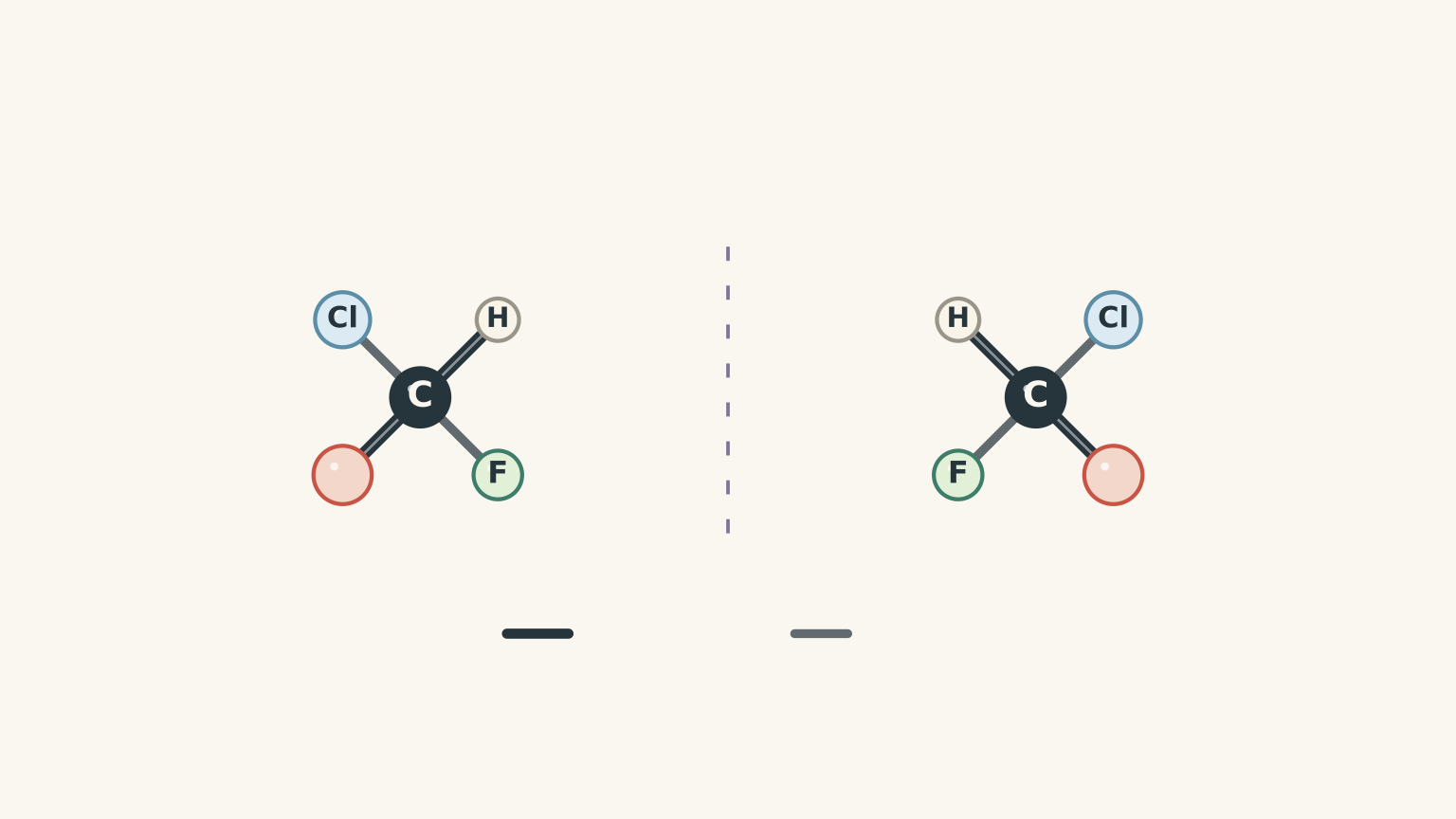
Due to technical limitations, this figure may display incorrectly or contain inaccuracies. Please check key details against your course materials.
Chiral resolution is an extension beyond the required NSW Year 12 Chemistry syllabus content. The Year 12 organic chemistry knowledge is the starting point for this article, not an indication that chiral resolution is an HSC assessment requirement. The NSW Chemistry 11-12 Syllabus (2025) is scheduled for implementation from 2028, according to NESA.
01Starting point: from organic reactions to molecular handedness
Your comparison of the chemical properties of alkanes and alkenes provides a useful starting point.
In a familiar alkane-versus-alkene experiment, an alkene reacts with bromine under suitable conditions because its carbon-carbon double bond can undergo an addition reaction. An alkane does not react in the same way under those conditions, although it can undergo substitution reactions under different conditions.
The important idea is that molecular structure affects chemical behaviour.
Chiral resolution takes this idea further. It considers molecules with the same connectivity and bonding but different three-dimensional arrangements.
What makes a molecule chiral?
A molecule is chiral if its mirror image cannot be superimposed on the original molecule.
A common source of chirality is a carbon atom attached to four different groups. This carbon is called a chiral centre.
For example, imagine a carbon attached to:
- A hydrogen atom
- A hydroxyl group
- A methyl group
- An ethyl group
Because all four attached groups are different, the carbon has two possible three-dimensional arrangements.
These arrangements are mirror images, but they cannot be rotated into exactly the same structure.
The two molecules are called enantiomers.
Enantiomers have some particularly interesting properties.
In an ordinary, non-chiral environment, they have identical:
- Melting points
- Boiling points
- Densities
- Solubilities in achiral solvents
However, they rotate plane-polarised light in opposite directions.
They can also interact differently with biological molecules, enzymes, and other chiral substances.
The two configurations are commonly labelled R and S using the Cahn-Ingold-Prelog priority rules. These labels describe the arrangement of atoms in space.
One important distinction: R does not automatically mean positive optical rotation, and S does not automatically mean negative optical rotation. The R/S designation and the direction of optical rotation describe different things.
If you need to revise the three-dimensional foundations, see Chirality: Chiral Centres, Enantiomers and Optical Activity.
What is a racemate?
A racemate is a mixture containing equal amounts of two enantiomers.
For example, a racemate might contain:
- 50% of the R enantiomer
- 50% of the S enantiomer
Each enantiomer rotates plane-polarised light by the same magnitude, but in opposite directions.
Their rotations cancel when measured together.
Consequently, a racemate has zero net optical rotation.
This does not mean that the individual molecules are achiral. Both enantiomers are still chiral. Their optical effects simply cancel.
Why do ordinary reactions often produce racemates?
Consider an achiral, flat molecule that can react from either side to form a new chiral centre.
Predict what happens if the reaction environment is completely achiral.
The two possible approaches are mirror images of each other. If the starting material, reagents, catalyst, and surrounding environment are all achiral, neither approach is favoured.
The two reaction pathways have equal energies, so the products form in equal amounts under these assumptions.
The result is a racemate.
A molecule that is initially achiral but can become chiral through a chemical transformation is called prochiral.
This is particularly important in reactions involving planar groups, because a reaction can approach different faces of the same molecule and create opposite configurations.
The challenge is now clear: how can a chemist obtain just one enantiomer?
One answer comes from an experiment conducted by Louis Pasteur in 1848.
02Pasteur’s experiment: the first major resolution of enantiomers
In the nineteenth century, chemists knew that some substances rotated plane-polarised light.
They also knew that certain tartaric acid salts were optically active, while related racemic materials showed no net optical rotation.
The problem was understanding why.
Did the optically inactive material contain molecules that were individually incapable of rotating light? Or did it contain two different forms whose opposite rotations cancelled?
These explanations predict the same result for a bulk sample, so measuring the original solution was not enough.
The original measurement
To understand Pasteur’s investigation, first picture the equipment used to measure optical rotation.
A polarimeter measures how much a substance rotates plane-polarised light.
The light travels through the apparatus in this order:
- A light source produces light.
- A polariser filters the light so that it is plane-polarised.
- The light passes through a tube containing the sample solution.
- An analyser measures the direction of the emerging polarised light.
- The angle of rotation is recorded.
If the sample is optically active, the plane of polarisation changes as the light passes through it.
The original racemic solution produced no net rotation.
However, this observation could not distinguish between two possibilities:
- The solution contained genuinely achiral molecules.
- The solution contained equal amounts of two enantiomers with opposite optical rotations.
Pasteur needed a way to separate the possible components before measuring them.
The revised experiment: separate the crystals
Pasteur investigated sodium ammonium tartrate, a salt associated with tartaric acid.
He prepared a concentrated aqueous solution and allowed it to crystallise under suitable temperature conditions. Below approximately 28 °C, this particular racemic salt could form two distinct types of crystals.
The crystals were nonsuperimposable mirror images.
Pasteur noticed that their external shapes differed in a consistent way. Using tweezers, he carefully separated the two crystal types into different groups.
He then dissolved each group separately and measured the optical rotation of the resulting solutions using Biot’s polarising apparatus.
Consider what each explanation predicted.
If the original substance contained genuinely achiral molecules, separating the crystals should not produce two optically active solutions.
However, if the original sample contained two enantiomers, the separated groups should rotate light in opposite directions.
That second prediction matched the observation.
The two groups produced optical rotations of equal magnitude but opposite sign.
What did Pasteur actually establish?
Pasteur demonstrated that the optically inactive racemic material could be separated into two optically active forms.
The original inactivity was caused by cancellation between the two forms, rather than an absence of optical activity in the individual molecules.
His experiment was a landmark in the development of stereochemistry, the study of how molecular properties depend on the three-dimensional arrangement of atoms.
There is an important distinction between the historical observation and the modern explanation.
Pasteur did not have the modern model of tetrahedral carbon atoms available to him. His conclusions came from the relationship between crystal shape and optical rotation. The molecular explanation developed through later work on stereochemistry.
Why can’t we use Pasteur’s method for every racemate?
Pasteur’s success depended on a particular type of crystal formation.
His sample formed what is now called a racemic conglomerate.
A racemic conglomerate consists of separate crystals, with each crystal containing predominantly one enantiomer. The two types of crystals have mirror-image structures.
This made physical separation possible.
However, not all racemates behave this way.
A racemic compound contains both enantiomers in a regular arrangement within the same crystal lattice. Each individual crystal contains both forms.
You cannot simply pick out the R crystals and leave the S crystals behind because neither type of crystal exists separately.
This limitation led chemists to develop more general methods of resolution.
03Classical chiral resolution: turning enantiomers into diastereomers
The central difficulty in separating enantiomers is that they have identical physical properties in an achiral environment.
Ordinary crystallisation usually cannot distinguish them.
However, there is a way around this problem.
Instead of trying to separate two enantiomers directly, chemists can react them with the same enantiopure chiral substance.
The products are then diastereomers.
Diastereomers are stereoisomers that are not mirror images of each other. Unlike enantiomers, they can have different physical properties, including solubility and melting point.
This difference creates an opportunity for separation.
Step 1: Introduce a chiral resolving agent
A resolving agent is an enantiopure substance used to convert a racemic compound into a pair of diastereomeric compounds.
Consider a racemic amine.
Let:
- \(A_R\) represent the R enantiomer of the amine.
- \(A_S\) represent the S enantiomer of the amine.
- \(B_R\) represent an enantiopure chiral acid with R configuration.
The amine reacts with the acid to form salts.
The two possible combinations are:
\[ A_R+B_R\rightleftharpoons A_R\cdot B_R \]
\[ A_S+B_R\rightleftharpoons A_S\cdot B_R \]
The dot represents the salt association, not a new covalent bond.
Notice that the resolving agent has the same configuration in both combinations.
The resulting salts are therefore diastereomers, not enantiomers.
Step 2: Use their different solubilities
The two diastereomeric salts can have different solubilities in a chosen solvent.
Suppose the salt containing the R-amine is less soluble than the salt containing the S-amine.
As the solution cools or becomes more concentrated, the less-soluble salt may crystallise first.
The more-soluble salt remains predominantly in the solution.
This process is called fractional crystallisation.
It separates compounds by exploiting differences in their solubilities.
Importantly, the less-soluble salt is not automatically the one containing R. The result depends on the resolving agent, solvent, temperature, and molecular structures.
Chemists must identify a suitable combination that produces a useful solubility difference.
Step 3: Recover the original enantiomer
Once the diastereomeric salts have been separated, the original amine can be released.
For example, a suitable acid-base treatment can break apart the ammonium salt and regenerate the free amine.
The resulting amine retains its original configuration, provided the work-up does not cause racemisation.
The resolving agent may also be recovered and reused.
The final result is an enantioenriched or, after sufficiently effective separation, essentially enantiopure amine.
The important point is that the resolving agent did not magically change the original amine’s configuration. It made the two enantiomers easier to distinguish by converting them into compounds with different physical properties.
The 50% yield limitation
Classical resolution has a major limitation.
A racemate contains equal quantities of both enantiomers.
If you begin with 100 mol of a racemate, you have:
- 50 mol of R
- 50 mol of S
If your target is the R enantiomer, there are only 50 mol of R available in the original mixture.
Even a perfect separation cannot produce more R than was present initially.
Therefore, the maximum theoretical yield of one enantiomer from a simple, one-pass resolution is 50% of the starting racemate.
This assumes there is no racemisation, recycling, or other process that converts the unwanted enantiomer into the desired one.
The other 50% is not necessarily useless. It may be recovered as the opposite enantiomer.
Worked example: maximum recovery from a racemate
A chemist begins with 0.80 mol of a racemic amine. A classical resolution separates the R enantiomer with a recovery of 85% of the R originally present.
Calculate the amount of R-amine recovered and its percentage yield relative to the original racemate.
Step 1
Because the mixture is racemic, it contains equal quantities of R and S.
\[ n(R)=\frac{0.80}{2} \]
\[ n(R)=0.40\text{ mol} \]
Step 2
The recovery is 85% of the original R-amine.
\[ n(R)_{\text{recovered}} =0.40\times0.85 \]
\[ =0.34\text{ mol} \]
Step 3
\[ \text{Yield}= \frac{0.34}{0.80}\times100 \]
\[ \text{Yield}=42.5\% \]
The chemist recovers 0.34 mol of R-amine, giving an overall yield of 42.5%.
Notice that the 85% recovery is not the same as an 85% yield from the original racemate. The original material contained only 0.40 mol of the desired enantiomer.
04Making one enantiomer selectively: asymmetric synthesis
What if you could avoid producing the unwanted enantiomer in the first place?
This is the idea behind enantioselective synthesis, also called asymmetric synthesis.
Rather than starting with a racemate and separating its components, chemists start with an achiral or prochiral material and influence the reaction so that one enantiomer forms preferentially.
A particularly important way to achieve this is with a chiral catalyst.
How does a chiral catalyst influence the reaction?
Return to the planar prochiral molecule discussed earlier.
Without a chiral influence, the two faces of the molecule are equivalent. Reaction from either face produces one of two enantiomers.
Now introduce a chiral catalyst.
A catalyst is a substance that increases the rate of a reaction without being consumed overall.
In this case, the catalyst has a three-dimensional chiral structure. It creates an environment in which the two possible approaches to the substrate are no longer equivalent.
The two reaction pathways now pass through diastereomeric transition states.
A transition state is the short-lived, high-energy arrangement of atoms that occurs as reactants become products.
Because the transition states are diastereomeric, they do not have to possess the same energy.
One pathway can have a lower activation energy than the other.
The lower-energy pathway is generally faster under kinetic control, so it produces more of one enantiomer.
Think of the catalyst as a specially shaped environment that makes one approach easier than the other.
The catalyst does not need to become part of the final product. It provides the temporary chiral environment that influences how the reaction occurs.
There are several important assumptions behind this model:
- The substrate must be capable of forming the desired stereoisomers.
- The catalyst must interact differently with the two possible reaction pathways.
- The reaction must have sufficient selectivity to favour one pathway.
- The product must not undergo substantial racemisation afterwards.
A chiral catalyst does not guarantee a single enantiomer. It can still produce a mixture, just with one enantiomer in greater quantity.
The important advantage is that there is no inherent 50% yield ceiling from starting with a racemate, because the starting material does not already contain equal quantities of both product enantiomers.
Historical application: William Knowles and asymmetric hydrogenation
One of the major developments in asymmetric synthesis came from the work of William Knowles.
In the 1960s, chemists were interested in producing particular enantiomers of pharmaceutical compounds.
One important target was L-DOPA, a form of the amino acid 3,4-dihydroxyphenylalanine used in the treatment of Parkinson’s disease.
The challenge was producing the desired enantiomer efficiently.
Knowles recognised that a chiral catalyst might control which enantiomer formed during hydrogenation.
He and his colleagues developed rhodium catalysts containing chiral phosphine ligands.
A ligand is a molecule or ion that binds to a central metal atom or ion. In this case, the chiral ligand helped create an asymmetric environment around the rhodium metal.
The reaction involved hydrogenating an enamide precursor to an amino acid derivative.
Hydrogenation adds hydrogen across a carbon-carbon double bond. In this reaction, the transformation also established the required stereochemistry at a new chiral centre.
The important difference from an ordinary hydrogenation was the catalyst.
The chiral rhodium complex made reaction from one face of the substrate more favourable than reaction from the other face.
The results were significant.
The Nobel Prize’s scientific background reports that a key hydrogenation step in the industrial L-DOPA synthesis produced the protected amino acid in quantitative chemical yield and 95% enantiomeric excess.
The Monsanto process became the first commercialised catalytic asymmetric synthesis using a chiral transition-metal complex and was operating from 1974.
Knowles and Ryoji Noyori later shared half of the 2001 Nobel Prize in Chemistry for their work on chirally catalysed hydrogenation reactions.
This development demonstrated that chemists could use deliberately designed catalysts to achieve high levels of stereochemical control.
It also provides a useful connection to your organic chemistry foundation: hydrogenation is an addition reaction involving a carbon-carbon double bond, but the chiral catalyst introduces an additional layer of control over the three-dimensional product.
05Resolution versus asymmetric synthesis
The two approaches solve the same broad problem, but they operate at different stages of a chemical process.
| Feature | Classical resolution | Asymmetric synthesis |
|---|---|---|
| Starting material | Racemic mixture | Achiral or prochiral material |
| Main objective | Separate existing enantiomers | Preferentially form one enantiomer |
| Source of selectivity | Different properties of diastereomeric compounds | Different reaction pathways in a chiral environment |
| Common method | Diastereomeric salt formation and crystallisation | Chiral catalysis, chiral reagents, or enzymes |
| Role of the chiral substance | Resolving agent used to form diastereomers | Catalyst or reagent that controls stereochemistry |
| Theoretical yield of one enantiomer | Usually limited to 50% in a simple resolution | Can approach 100% |
| Main limitation | Unwanted enantiomer is already present | Suitable catalyst and reaction conditions must be developed |
There is another useful distinction.
A chiral catalyst can also be used to separate the behaviour of two enantiomers that already exist in a racemic starting material.
For example, an enzyme might react much faster with the R form of a racemic alcohol than with the S form.
This is called kinetic resolution.
The faster-reacting enantiomer is converted into a product, while the slower-reacting enantiomer remains in the original material.
Both fractions can become enantioenriched.
However, ordinary kinetic resolution still has a 50% theoretical yield limit for a single enantiomeric product. The catalyst is selecting between molecules that already have different configurations; it is not creating additional starting molecules of the desired configuration.
That distinction becomes especially important when considering more advanced resolution methods.
06Measuring how selectively a reaction works
Producing one enantiomer preferentially is useful, but chemists need a way to measure how successful the process has been.
The standard measure is enantiomeric excess, abbreviated to \(ee\).
Enantiomeric excess describes the difference between the percentages of the major and minor enantiomers.
\[ ee=\%\text{major}-\%\text{minor} \]
For a mixture containing only two enantiomers:
\[ \%\text{major}=\frac{100+ee}{2} \]
\[ \%\text{minor}=\frac{100-ee}{2} \]
An enantiomeric excess of:
- 0% means a 50:50 racemate.
- 50% means an 75:25 mixture.
- 90% means a 95:5 mixture.
- 100% means a single enantiomer.
The key point is that an \(ee\) value is not the percentage of the major enantiomer.
For example, 90% ee does not mean 90% of the sample is the major enantiomer. It means the major enantiomer exceeds the minor one by 90 percentage points.
Worked example: converting enantiomeric excess into mole amounts
An asymmetric reaction produces 0.75 mol of an organic product. Analysis shows that the product has an enantiomeric excess of 88% in favour of the S enantiomer.
Calculate the amounts of R and S present.
Step 1
\[ \%\text{major}=\frac{100+88}{2} \]
\[ =94\% \]
Therefore, the mixture contains 94% S.
Step 2
\[ \%\text{minor}=100-94 \]
\[ =6\% \]
Therefore, the mixture contains 6% R.
Step 3
For S:
\[ n(S)=0.75\times0.94 \]
\[ n(S)=0.705\text{ mol} \]
For R:
\[ n(R)=0.75\times0.06 \]
\[ n(R)=0.045\text{ mol} \]
The final mixture contains 0.705 mol of S and 0.045 mol of R.
The difference is 0.660 mol, which represents 88% of the total product.
This confirms that the calculated composition is consistent with the stated enantiomeric excess.
You can explore this measurement in more detail in Enantiomeric Excess: Calculating ee from Optical Rotation.
07Can resolution ever exceed the 50% limit?
The 50% limit applies to a simple resolution where the two enantiomers cannot interconvert.
But what if the unwanted enantiomer could change into the desired one while the separation is happening?
This introduces an important extension called dynamic kinetic resolution.
Imagine a racemic solution containing equal quantities of R and S.
A selective reaction consumes R much faster than S.
Under ordinary kinetic resolution, the S material remains behind. However, suppose the S material can also undergo racemisation.
Racemisation is the process of converting an enantiomerically enriched substance into a mixture of both enantiomers.
If S can continuously convert into R, the selective reaction can consume the newly formed R.
As R is removed, more S can convert into R and become available for reaction.
The process can therefore use material that originally existed in either configuration.
Under ideal conditions, dynamic kinetic resolution can approach 100% theoretical yield of the desired product.
This requires several conditions:
- The unwanted substrate enantiomer must racemise sufficiently quickly.
- The selective reaction must favour one enantiomer strongly.
- The product must remain stable and avoid racemisation.
- The racemisation process must not destroy the substrate or interfere with the selective reaction.
The exact mechanism of racemisation depends on the molecule. It is not something that can be assumed to happen simply by mixing two enantiomers or changing the temperature.
Crystallisation-induced asymmetric transformation
A related process combines diastereomeric salt formation, racemisation, and selective crystallisation.
Suppose a racemic amine forms two diastereomeric salts with a single-enantiomer chiral acid.
One salt is much less soluble and crystallises from solution.
If the dissolved amine can racemise, the unwanted enantiomer can continuously convert into the enantiomer that forms the less-soluble salt.
As the desired salt crystallises and is removed, more material can enter the same crystallisation pathway.
The result can be recovery of considerably more than 50% of one enantiomer.
This is known as crystallisation-induced asymmetric transformation.
It is not the same as simply sorting the crystals from a static racemate. The crucial difference is that the dissolved molecules can interconvert while crystallisation removes one diastereomer.
The process is described in the IUPAC Gold Book entry on asymmetric transformation.
08Questions and solutions
The following questions progress from straightforward resolution calculations to situations where crystallisation, reaction selectivity, and racemisation interact.
Question 1
A chemist has 0.72 mol of a racemic organic compound.
The chemist performs a perfect classical resolution, with no racemisation or recycling of the unwanted enantiomer.
What is the maximum amount of one enantiomer that can be recovered?
Explain why this is the theoretical limit.
Solution 1
The maximum amount of one enantiomer is 0.36 mol.
A racemate contains equal amounts of its two enantiomers.
Therefore:
\[ n(R)=n(S)=\frac{0.72}{2} \]
\[ n(R)=0.36\text{ mol} \]
A classical resolution separates enantiomers that already exist in the starting material. It cannot create additional molecules of the desired configuration.
Therefore, even with perfect separation and no material losses, the maximum amount of either enantiomer is 0.36 mol.
This represents a theoretical yield of 50% relative to the original racemate.
Question 2
A chemist wants to resolve a racemic amine using an enantiopure chiral acid with R configuration.
The starting material contains 0.60 mol of racemic amine.
Two diastereomeric salts form:
| Salt | Solubility at 25 °C |
|---|---|
| (R)-amine · (R)-acid | 0.8 g per 100 mL |
| (S)-amine · (R)-acid | 6.4 g per 100 mL |
Assume the salts have the same molar mass, form in a 1:1 ratio, and can be separated completely under the chosen crystallisation conditions.
There is no racemisation.
(a) Which salt is expected to crystallise preferentially?
(b) Which amine enantiomer can be recovered from those crystals?
(c) Calculate the maximum amount of this amine enantiomer that can be recovered.
(d) Explain why the two salts can have different solubilities even though the original amine enantiomers have identical physical properties in an achiral environment.
Solution 2
The (R)-amine · (R)-acid salt crystallises preferentially, allowing up to 0.30 mol of R-amine to be recovered.
(a) The R-amine salt has the lower solubility.
Its solubility is 0.8 g per 100 mL, compared with 6.4 g per 100 mL for the S-amine salt.
The less-soluble salt is therefore more likely to crystallise first under the stated conditions.
(b) The crystals contain the R-amine paired with the R-configured resolving acid.
After the salt is broken apart, the original R-amine can be recovered.
The acid-base treatment does not need to change the configuration of the amine’s chiral centre.
(c) The starting racemate contains equal quantities of R and S.
\[ n(R)=\frac{0.60}{2} \]
\[ n(R)=0.30\text{ mol} \]
Therefore, the maximum amount of R-amine recoverable is 0.30 mol.
(d) The original R-amine and S-amine are enantiomers, so they have identical physical properties in an achiral environment.
However, both are now paired with the same chiral acid.
The two resulting salts are diastereomers, not mirror images.
Diastereomers can have different molecular interactions and different crystal packing arrangements. This can produce different solubilities.
The resolving agent has therefore converted a pair of difficult-to-separate enantiomers into a pair of compounds that can be separated using an ordinary physical method.
Question 3
An achiral prochiral organic substrate undergoes hydrogenation using a chiral catalyst.
The reaction produces 0.84 mol of chiral product from 1.00 mol of starting material.
The isolated product has an enantiomeric excess of 80% in favour of the S enantiomer.
Assume the product contains only the two enantiomers and no other chiral influence is present.
(a) Calculate the percentage of each enantiomer in the product.
(b) Calculate the amount of each enantiomer produced.
(c) Explain why this reaction is not subject to the 50% theoretical yield limit of a classical resolution.
(d) Predict the stereochemical outcome if an otherwise equivalent reaction were carried out using an achiral catalyst.
Solution 3
The product contains 0.756 mol of S and 0.084 mol of R.
(a) Calculate the percentage of the major enantiomer.
\[ \%\text{major}=\frac{100+80}{2} \]
\[ =90\% \]
Therefore:
\[ \%\text{S}=90\% \]
\[ \%\text{R}=10\% \]
(b) The total product is 0.84 mol.
For S:
\[ n(S)=0.84\times0.90 \]
\[ =0.756\text{ mol} \]
For R:
\[ n(R)=0.84\times0.10 \]
\[ =0.084\text{ mol} \]
The amounts add to 0.84 mol, confirming that the calculation accounts for all the product.
(c) The reaction starts with an achiral prochiral substrate, not a racemate.
The two product enantiomers are formed through different approaches to the substrate.
The chiral catalyst makes the two pathways energetically different, favouring formation of S.
There is no initial 50:50 mixture of R and S product molecules that must be separated. The catalyst controls which product forms.
Consequently, the reaction can theoretically produce close to 100% of the desired enantiomer if its chemical yield and enantioselectivity are sufficiently high.
(d) An achiral catalyst would not distinguish between the two faces of the prochiral substrate under the stated assumptions.
The two pathways would be mirror images and have equal energies.
The reaction would therefore produce a racemate, with approximately equal quantities of R and S.
The difference between the two reactions is the chiral environment provided by the catalyst.
Question 4
A chemist performs a kinetic resolution on 120 mmol of a racemic chiral ester.
Initially, the mixture contains:
- 60 mmol of R-ester
- 60 mmol of S-ester
A chiral enzyme catalyses the hydrolysis of the ester. The reaction retains the configuration of the chiral centre.
At a particular time, the following amounts are measured:
| Substance | R form | S form |
|---|---|---|
| Alcohol product | 54 mmol | 6 mmol |
| Unreacted ester | 6 mmol | 54 mmol |
(a) Calculate the enantiomeric excess of the alcohol product.
(b) Calculate the enantiomeric excess of the unreacted ester.
(c) Explain why the two fractions are enriched in opposite enantiomers.
(d) Predict what happens to the product’s enantiomeric excess if the reaction continues until all the ester has been hydrolysed.
(e) What is the maximum possible amount of R-alcohol that can be obtained from this starting material?
Solution 4
The alcohol product has 80% ee in favour of R, while the unreacted ester has 80% ee in favour of S.
(a) The total amount of alcohol is:
\[ n(\text{alcohol})=54+6 \]
\[ =60\text{ mmol} \]
The enantiomeric excess is:
\[ ee=\frac{54-6}{60}\times100 \]
\[ ee=80\% \]
The alcohol is therefore enriched in R.
(b) The total amount of unreacted ester is:
\[ n(\text{ester})=6+54 \]
\[ =60\text{ mmol} \]
Its enantiomeric excess is:
\[ ee=\frac{54-6}{60}\times100 \]
\[ ee=80\% \]
The unreacted ester is enriched in S.
(c) The enzyme reacts faster with the R-ester.
Consequently, a greater proportion of the original R molecules have been converted into alcohol.
The S-ester reacts more slowly, so it becomes enriched in the unreacted fraction.
This produces two fractions with opposite enantiomeric excesses.
The enzyme has not changed the initial configurations of the molecules. It has selectively changed their reaction rates.
(d) If the reaction continues until all the ester is hydrolysed, the remaining S-ester will eventually contribute S-alcohol.
At complete conversion, all 60 mmol of R-ester and all 60 mmol of S-ester will have become their corresponding alcohols.
The final alcohol mixture will contain:
\[ 60\text{ mmol R}+60\text{ mmol S} \]
Therefore:
\[ ee=0\% \]
The product mixture becomes racemic.
This demonstrates an important feature of kinetic resolution: increasing conversion can reduce the enantiomeric excess of the product because the slower-reacting enantiomer eventually contributes more product.
(e) The maximum possible amount of R-alcohol is 60 mmol.
The starting material contained only 60 mmol of R-ester, and the reaction retains its configuration.
Even with perfect selectivity, no more than the original 60 mmol of R molecules can become R-alcohol.
The other 60 mmol initially had S configuration.
This is the 50% theoretical yield limitation of a simple kinetic resolution.
Question 5
A chemist is investigating a more advanced resolution process involving a racemic organic amine, A.
Initially, 1.00 mol of A is present in solution:
- 0.50 mol of R-A
- 0.50 mol of S-A
When crystallised directly, A forms a racemic compound. Each crystal contains both enantiomers, so the original crystals cannot be separated by hand into pure R and S forms.
The chemist instead adds 1.00 mol of an enantiopure chiral acid, B, with R configuration.
Two diastereomeric salts form reversibly:
- R-A · R-B
- S-A · R-B
The R-A · R-B salt is poorly soluble and is continuously removed from the solution as crystals. The S-A · R-B salt remains dissolved.
There is an additional feature that changes the problem:
Free A rapidly racemises in solution, but the crystallised R-A · R-B salt does not racemise. Salt formation is reversible, the acid is not limiting, and neither the substrate nor product decomposes.
A student argues:
“The starting material is racemic, so the maximum amount of R-A that can ever be recovered must be 0.50 mol. Resolution cannot overcome the 50% limit.”
Evaluate this argument.
In your response:
(a) Explain why directly crystallising the original racemate does not produce separable R and S crystals.
(b) Determine the ideal theoretical maximum amount of R-A that could be recovered after the crystalline salt is broken apart.
(c) Explain how the dissolved S-A can contribute to the formation of additional R-A salt.
(d) Identify the condition that, if removed, would restore the ordinary 50% theoretical yield limit.
Solution 5
The ideal theoretical yield approaches 1.00 mol of R-A, not 0.50 mol. The student’s argument incorrectly assumes that the two original enantiomers cannot interconvert.
(a) The original racemate forms a racemic compound.
This means each individual crystal contains both R-A and S-A in its crystal lattice.
It is not a conglomerate containing separate R-only and S-only crystals.
Therefore, manually separating the original crystals cannot produce pure enantiomers.
This is precisely why Pasteur’s method cannot be applied to every racemic compound.
(b) The ideal theoretical recovery approaches 1.00 mol of R-A.
The original mixture contains only 0.50 mol of R-A, but the additional 0.50 mol of S-A is not permanently locked into that configuration.
The free amine can racemise in solution.
Because the R-A · R-B salt crystallises selectively, the R-A is continuously removed from the solution.
This allows additional dissolved S-A to become available for conversion into R-A.
(c) Consider what happens as crystallisation proceeds.
Initially, 0.50 mol of R-A and 0.50 mol of S-A are present.
The R-A reacts with the resolving acid to form the poorly soluble R-A · R-B salt.
As this salt crystallises and is removed, the dissolved system loses R-A.
However, the remaining free amine can racemise.
Some S-A therefore converts into R-A, which can then form more R-A · R-B salt.
The process repeats.
The key is that the solid product is removed from the solution and does not racemise. This prevents the isolated material from simply returning to a 50:50 mixture.
The combination of reversible salt formation, racemisation, and selective crystallisation can therefore draw almost all the original amine into the desired crystalline salt.
After the salt is broken apart, the R-A can be recovered.
This is a crystallisation-induced asymmetric transformation.
(d) The crucial condition is the ability of the dissolved amine to racemise.
If racemisation stops, the original 0.50 mol of S-A cannot become R-A.
The crystallisation process can then recover only the 0.50 mol of R-A that was originally present.
The ordinary 50% theoretical yield limit returns.
This question illustrates why the 50% rule is not a universal law governing every resolution process. It applies to static separation without interconversion, not to systems in which the unwanted enantiomer can continuously replenish the desired one.
09Where this chemistry leads next
Chiral resolution and asymmetric synthesis solve the same problem in fundamentally different ways.
Resolution separates enantiomers that already exist. Asymmetric synthesis controls which enantiomer forms during a reaction.
The most useful distinction is to identify where the stereochemical preference enters the process:
- During crystallisation or separation, the chemist is resolving an existing mixture.
- During a reaction, the chemist may be using a chiral catalyst or reagent to favour one product.
- During a dynamic process, racemisation can replenish the preferred enantiomer and overcome the usual 50% resolution limit.
There is one further question worth considering when analysing an actual synthesis: does the product retain its configuration during subsequent reactions?
A reaction may produce an excellent enantiomeric excess initially, only for a later step to destroy that stereochemical information.
Understanding that possibility connects chiral resolution to reaction mechanisms, stereochemical control, and the practical design of multi-step organic synthesis.
10Scientific sources and further reading
The historical and scientific explanations in this article draw on the following university, scientific, and authoritative resources.
NESA – Chemistry 11-12 Syllabus (2025). Official syllabus implementation schedule.
University of Illinois – Louis Pasteur’s 1848 research. Historical account of the separation of sodium ammonium tartrate crystals and their optical activity.
Chemistry LibreTexts – Resolution (Separation) of Enantiomers. University-level teaching material explaining diastereomeric salt formation and crystallisation.
IUPAC Gold Book – Resolution. Formal definition of resolution as the separation of a racemate into its component enantiomers.
IUPAC Gold Book – Asymmetric Transformation. Explanation of processes that can convert a racemate into an enantiomerically enriched or pure product through interconversion and selective crystallisation.
The Nobel Prize in Chemistry 2001 – Scientific background. Historical and technical account of Knowles’s asymmetric hydrogenation and the industrial synthesis of L-DOPA.
University of Oxford – Introduction to Stereoselective Organic Synthesis. Teaching material explaining asymmetric induction and the energy differences between diastereomeric transition states.