
Anti-Periplanar Elimination: Understanding E2 Geometry
Explore how molecular conformation controls E2 elimination through the anti-periplanar requirement. Learn to analyse Newman projections, cyclohexane conformations, trans-diaxial arrangements, and stereochemical outcomes through worked examples and challenging practice questions. This is an extension topic beyond the required NSW HSC Chemistry syllabus.
Take 2-bromobutane. A strong base can remove a hydrogen from a carbon next to the carbon bonded to bromine, allowing a carbon-carbon double bond to form. That sounds straightforward. But there’s a catch: in the usual E2 mechanism, the hydrogen and bromine must be oriented in a particular way before the reaction can proceed efficiently.
Rotate the carbon-carbon single bond, and the molecule can move from an unreactive arrangement into one that is ready to eliminate.
Why should a simple change in molecular shape make such a difference?
This is the idea behind anti-periplanar elimination.
A note about syllabus requirements: This article is an extension beyond the required NSW HSC Chemistry syllabus. It assumes the Year 12 Organic chemistry foundation, but anti-periplanar stereoelectronic analysis is not an additional HSC assessment requirement. The NESA Chemistry 11-12 Syllabus (2025) is scheduled for implementation from 2028, with its first HSC examination in 2029. The year 2025 refers to the syllabus publication year, not the first examination year. NESA syllabus information.
The aim here is to understand how molecular shape influences whether an E2 elimination can occur, particularly when a molecule cannot freely rotate.
01First, why are alkanes, alkenes and alkynes different homologous series?
Before looking at elimination, recall the three familiar hydrocarbon families.
They all contain carbon and hydrogen, but they differ in the bonds between their carbon atoms.
| Homologous series | Characteristic carbon bonding | General formula | Example |
|---|---|---|---|
| Alkanes | C-C single bonds only | \(C_nH_{2n+2}\) | Propane, \(C_3H_8\) |
| Alkenes | One C=C double bond | \(C_nH_{2n}\) | Propene, \(C_3H_6\) |
| Alkynes | One C≡C triple bond | \(C_nH_{2n-2}\) | Propyne, \(C_3H_4\) |
Here, \(n\) represents the number of carbon atoms. These general formulae apply to open-chain compounds containing either no multiple bonds, one double bond, or one triple bond, as appropriate.
A homologous series is a family of organic compounds with the same characteristic bonding pattern and a consistent general formula. Consecutive members differ by one \(\ce{CH2}\) unit and have similar chemical properties.
For example:
- Propane and butane belong to the alkane series.
- Propene and butene belong to the alkene series.
- Propyne and butyne belong to the alkyne series.
Notice something important: propane, propene, and propyne all contain three carbon atoms, but they belong to different homologous series.
Their different carbon-carbon bonds produce different structures and chemical behaviour.
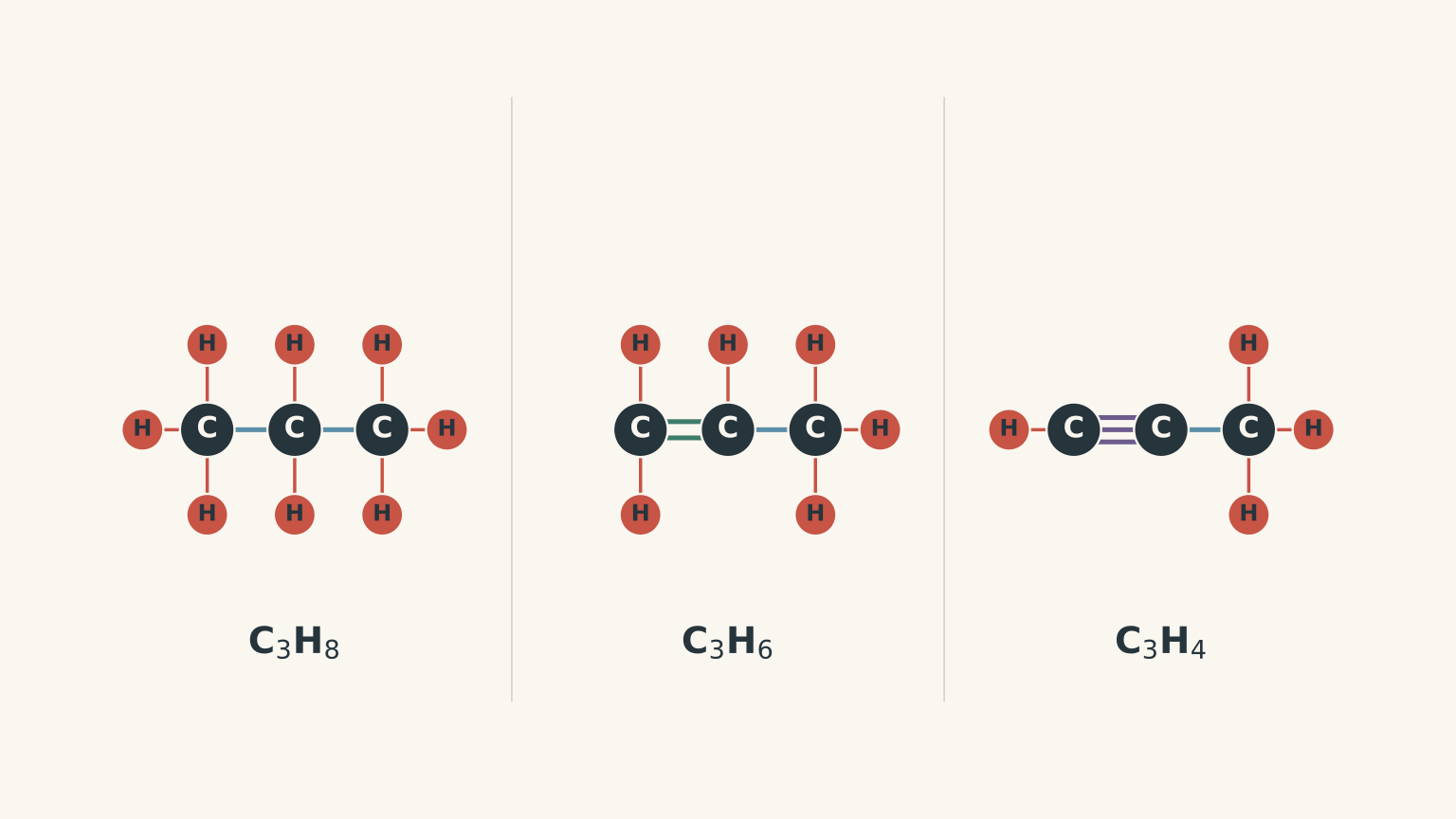
Due to technical limitations, this figure may display incorrectly or contain inaccuracies. Please check key details against your course materials.
This distinction becomes relevant when we consider elimination reactions.
An E2 elimination can convert a haloalkane into an alkene by removing a hydrogen and a leaving group from neighbouring carbon atoms. The reaction creates a new C=C double bond.
The question is how the molecule must be arranged for that bond to form.
02E2 elimination: what actually happens?
In an E2 reaction, a base removes a hydrogen atom from one carbon while a leaving group departs from the neighbouring carbon.
These events happen simultaneously in a single reaction step.
There are three important changes:
- A base removes a hydrogen as a proton, \(H^+\).
- The electrons from the carbon-hydrogen bond contribute to forming a carbon-carbon double bond.
- The leaving group departs with the electrons from its carbon-leaving group bond.
There is no carbocation intermediate.
To describe which atoms are involved, organic chemists use two labels.
- Alpha carbon (\(C_\alpha\)): The carbon directly bonded to the leaving group.
- Beta carbon (\(C_\beta\)): A carbon directly attached to the alpha carbon.
- Beta hydrogen (\(\beta\)-H): A hydrogen attached to the beta carbon.
For an E2 elimination, the base removes a beta hydrogen.
The name E2 stands for elimination, bimolecular. The base and the haloalkane both participate in the same rate-determining reaction step.
If you need to revisit the overall difference between E1 and E2, see E1 and E2 Reactions: Mechanisms, Conditions and Products.
So far, this sounds like a simple matter of finding a hydrogen next to the leaving group.
But is any beta hydrogen suitable?
No. The beta hydrogen must have the correct spatial orientation relative to the leaving group for the common E2 pathway.
This is where molecular conformation becomes important.
03What does anti-periplanar actually mean?
Consider the single bond connecting the alpha and beta carbons.
Before elimination, this is a carbon-carbon single bond. It can rotate, allowing the atoms attached to either carbon to move into different spatial arrangements.
These different arrangements are called conformations.
A useful way to examine them is with a Newman projection. This is a drawing made by looking directly along a particular carbon-carbon bond.
Imagine looking down the \(C_\beta-C_\alpha\) bond.
The beta carbon is at the front, and the alpha carbon is at the back. You can now compare the positions of the beta hydrogen and the leaving group.
The angle between the relevant bonds is called a dihedral angle.
We represent it using the symbol \(\phi\), defined as the dihedral angle:
\[ \phi = \angle(\mathrm{H}-C_\beta-C_\alpha-X) \]
Here, \(X\) represents the leaving group.
Two important arrangements are possible.
Anti-periplanar arrangement
Preferred arrangement
The beta hydrogen and leaving group are on opposite sides when viewed along the alpha-beta carbon bond.
Their dihedral angle is:
\[ \boxed{\phi=180^\circ} \]
The four atoms H-\(C_\beta\)-\(C_\alpha\)-X lie in the same plane.
This is called an anti-periplanar arrangement.
The word periplanar means that the relevant bonds lie in the same plane. Anti means that the hydrogen and leaving group point in opposite directions in the Newman projection.
Syn-periplanar arrangement
In this arrangement, the beta hydrogen and leaving group lie on the same side.
Their dihedral angle is:
\[ \boxed{\phi=0^\circ} \]
The four relevant atoms are still coplanar, but the hydrogen and leaving group are aligned on the same side.
For the usual E2 pathway, the anti-periplanar arrangement is preferred.
Why?
04Why does the anti arrangement favour E2?
There are two connected reasons.
1. The orbitals are correctly aligned
A carbon-hydrogen single bond contains a bonding molecular orbital called a sigma (\(\sigma\)) orbital.
A carbon-leaving group bond also has an antibonding orbital, called a sigma-star (\(\sigma^*\)) orbital.
For the elimination to proceed, electron density from the breaking C-H bond must interact with the antibonding orbital of the C-X bond.
This interaction helps weaken the bonds being broken while allowing the new carbon-carbon pi (\(\pi\)) bond to develop.
The anti-periplanar arrangement provides favourable orbital alignment for this process.
Think about what is happening:
- The C-H bond is beginning to break.
- The C-X bond is beginning to break.
- The new C=C bond is beginning to form.
All three changes occur together.
The correct orientation makes this concerted electron movement more favourable.
2. The anti arrangement is more stable than the syn arrangement
Remember staggered and eclipsed conformations.
A staggered conformation generally has lower torsional strain than an eclipsed conformation.
The anti-periplanar arrangement is staggered, whereas the syn-periplanar arrangement is eclipsed.
This makes the anti arrangement energetically more favourable.
The combination of favourable orbital alignment and lower conformational strain explains why anti-periplanar elimination is so common.
The orbital explanation is developed in OpenStax Organic Chemistry, Section 11.8.
One qualification matters: anti-periplanar geometry is the preferred arrangement for the common E2 pathway, not an absolute rule that every conceivable E2 reaction must follow. Syn-periplanar elimination is also known, particularly in certain constrained systems, but is generally less favourable.
For the problems in this article, we will focus on the usual anti-periplanar pathway.
05Worked example: Can 1-bromopropane reach the required geometry?
1-bromopropane, \(\ce{CH3CH2CH2Br}\), undergoes an E2 elimination. Identify the alpha and beta carbons, explain how the molecule reaches the reactive conformation, and determine the alkene product.
Step 1
The terminal carbon bonded to bromine is the alpha carbon.
The neighbouring middle carbon is the beta carbon.
Therefore:
- \(C_\alpha\) is the carbon in \(\ce{CH2Br}\).
- \(C_\beta\) is the adjacent \(\ce{CH2}\) carbon.
- The hydrogen removed comes from the middle carbon.
Step 2
The molecule can rotate around the bond connecting the alpha and beta carbons.
This changes the dihedral angle between a beta C-H bond and the C-Br bond.
Rotation allows one of the beta hydrogens to reach the anti-periplanar arrangement:
\[ \phi=180^\circ \]
The molecule now has the preferred geometry for E2 elimination.
Step 3
The base removes the beta hydrogen.
At the same time, the C-H electrons form the new C=C bond, and bromine leaves as a bromide ion.
Step 4
The new double bond forms between the first and second carbon atoms.
The product is propene:
\[ \ce{CH3CH2CH2Br -> CH3CH=CH2} \]
The product is a terminal alkene, so it does not have E/Z geometric isomerism.
The important point is that 1-bromopropane can rotate into the required geometry because its alpha-beta bond is a flexible single bond.
Now consider a molecule where rotation is much more restricted.
06Cyclohexane: the trans-diaxial requirement
Cyclohexane provides a particularly useful example of anti-periplanar elimination.
You already know that cyclohexane adopts a chair conformation to minimise strain.
In this arrangement, substituents can occupy two positions:
- Axial: Approximately vertical, pointing alternately up and down around the ring.
- Equatorial: Pointing outwards around the sides of the ring.
A ring flip exchanges axial and equatorial positions.
However, there is an important detail: the up or down direction of each substituent does not change during a ring flip.
For an E2 reaction to follow the usual anti-periplanar pathway in a cyclohexane chair, the leaving group and beta hydrogen must occupy axial positions on adjacent carbons and point in opposite directions.
This arrangement is called trans-diaxial.
Why does this matter?
If the leaving group is equatorial, the required anti-periplanar arrangement is not available in that chair.
A ring flip might move the leaving group into an axial position, making elimination possible. But the ring flip can also move other substituents into axial positions, potentially blocking the beta hydrogen needed for the reaction.
This is why simply identifying a beta hydrogen is not enough.
You must check whether the correct hydrogen and leaving group can actually adopt the required arrangement in the same conformation.
OpenStax discusses this restriction in its treatment of E2 reactions and cyclohexane conformation.
07Worked example: Bromocyclohexane and a ring flip
Bromocyclohexane initially occupies its lowest-energy chair conformation, with bromine in an equatorial position.
Under conditions where E2 elimination occurs, explain the conformational change required and identify the alkene product.
Step 1
In the lowest-energy chair, bromine is equatorial.
The molecule cannot undergo the usual anti-periplanar elimination directly from this conformation.
Step 2
The ring flips, converting the equatorial bromine into an axial bromine.
The axial hydrogens on the neighbouring carbon atoms now point in the opposite direction to bromine.
The required trans-diaxial arrangement is available.
Step 3
A base removes an appropriately aligned axial beta hydrogen.
The C-H bond electrons form the new carbon-carbon double bond while the C-Br bond breaks.
Step 4
Elimination from either adjacent carbon produces the same symmetrical alkene:
\[ \boxed{\text{Cyclohexene}} \]
The ring-flipped conformation is the reactive one.
This example demonstrates an important distinction: the most stable conformation is not necessarily the conformation from which a reaction occurs most readily.
The molecule can move between conformations, and the reactive conformation can be populated even if it is less stable.
08Common misconceptions
| Tempting assumption | What actually happens |
|---|---|
| Any beta hydrogen can be removed. | The hydrogen must have the correct orientation relative to the leaving group. |
| Anti-periplanar just means opposite sides in a flat drawing. | It refers to a specific three-dimensional arrangement measured along the C-C bond. |
| Every E2 reaction must use an anti arrangement. | Anti is strongly preferred, but syn-periplanar pathways are also possible in certain systems. |
| The most stable conformation must be the reactive one. | A less stable conformation may be the only one with the required geometry. |
| Every E2 reaction produces an E alkene. | The starting stereochemistry and reactive conformation determine the alkene geometry. |
One final distinction is worth remembering.
E1 and E2 are both elimination mechanisms, but the same geometric restriction does not apply to them in the same way.
E2 is concerted: the hydrogen is removed and the leaving group departs in the same step.
E1 forms a carbocation first. The intermediate allows greater conformational freedom before the hydrogen is removed, so E1 does not have the same strict anti-periplanar requirement.
09Questions and solutions
The following questions move from identifying the required geometry to predicting what happens when conformational restrictions compete with the expected alkene product.
Question 1
1-bromobutane, \(\ce{CH3CH2CH2CH2Br}\), undergoes an E2 elimination.
(a) Identify the alpha and beta carbons when the reaction forms but-1-ene.
(b) State the required dihedral angle between the beta C-H bond and the alpha C-Br bond.
(c) Write the structural formula of the alkene product.
Assume the base removes a hydrogen from C2 and that E2 is the reaction pathway.
Solution 1
The product is but-1-ene, and the required dihedral angle is \(180^\circ\).
The reasoning follows directly from the anti-periplanar requirement.
(a) Identify the carbons.
C1 is the alpha carbon because it is directly bonded to bromine.
C2 is the beta carbon because it is adjacent to C1 and supplies the hydrogen being removed.
(b) Determine the angle.
The beta C-H bond must be anti-periplanar to the alpha C-Br bond.
Therefore:
\[ \phi=180^\circ \]
The four atoms H-C2-C1-Br must lie in the same plane.
(c) Determine the product.
Elimination forms a double bond between C1 and C2.
The product is:
\[ \ce{CH2=CHCH2CH3} \]
This is but-1-ene.
A common mistake is to remove a hydrogen from C3. That would involve a different beta carbon and produce a different double-bond position. The question specifically identifies C2 as the hydrogen source.
Question 2
Consider the two stereoisomers of 1-bromo-2-methylcyclohexane:
- cis-1-bromo-2-methylcyclohexane, where bromine and methyl are on the same face of the ring.
- trans-1-bromo-2-methylcyclohexane, where bromine and methyl are on opposite faces.
Both compounds undergo E2 elimination.
Determine whether each isomer can form 1-methylcyclohexene through elimination between C1 and C2.
Explain your answer using chair conformations and the trans-diaxial requirement.
Assume the usual anti-periplanar pathway and allow ring flipping. Do not consider E1 or syn-periplanar elimination.
Solution 2
Only the cis isomer can form 1-methylcyclohexene through the specified C1-C2 elimination pathway.
The difference comes from which groups occupy the axial positions in the reactive chair.
Cis isomer
For the cis isomer, one chair conformation has the methyl group equatorial and bromine axial.
This is particularly useful because the beta hydrogen on C2 is also axial.
The axial hydrogen and axial bromine point in opposite directions, giving the required trans-diaxial arrangement.
E2 elimination can therefore form a double bond between C1 and C2.
The product is 1-methylcyclohexene.
Trans isomer
The most stable chair of the trans isomer can place both bromine and methyl in equatorial positions.
A ring flip produces a chair where both substituents are axial.
Although bromine is now axial, the methyl group also occupies the axial position on C2.
There is therefore no axial beta hydrogen available on C2.
The required trans-diaxial arrangement for forming the C1-C2 double bond cannot be achieved.
The trans isomer may still undergo elimination from the other adjacent carbon, C6, if an appropriate axial beta hydrogen is available. However, it cannot form the specified C1-C2 alkene through the ordinary anti pathway.
The tempting prediction is that both isomers should form the more substituted alkene because it is generally more stable.
But product stability cannot overcome a geometric restriction. The required hydrogen must be available in the correct orientation before elimination can occur.
Question 3
Two acyclic haloalkanes, A and B, rapidly interconvert between different conformations.
A conformational model gives the following proportions of molecules in the reactive anti-periplanar conformation:
| Haloalkane | Fraction in anti-periplanar conformation |
|---|---|
| A | 30% |
| B | 5% |
Both reactions occur at the same temperature and have:
- The same total substrate concentration.
- The same base concentration.
- The same intrinsic rate constant for reaction from the anti-periplanar conformation.
Assume all non-anti conformations are unreactive in this simplified model.
Calculate the ratio of the initial E2 rates for A and B.
Explain why the two substrates can react at different rates even though both can reach the required geometry.
Solution 3
Haloalkane A reacts six times as fast as haloalkane B under the stated assumptions.
Only molecules in the reactive conformation contribute to the E2 reaction in this simplified model.
The observed rate is therefore proportional to the fraction of molecules in that conformation.
Let:
- \(v_A\) = initial reaction rate of A.
- \(v_B\) = initial reaction rate of B.
- \(f_A\) = fraction of A in the anti-periplanar conformation.
- \(f_B\) = fraction of B in the anti-periplanar conformation.
Because the other reaction conditions and intrinsic rate constants are identical:
\[ \frac{v_A}{v_B}=\frac{f_A}{f_B} \]
Substituting:
\[ \frac{v_A}{v_B} = \frac{0.30}{0.05} \]
\[ \boxed{\frac{v_A}{v_B}=6} \]
Therefore:
\[ \boxed{v_A:v_B=6:1} \]
A is six times faster in this model.
The important distinction is between being able to reach a reactive conformation and how frequently that conformation is populated.
Both substrates can undergo E2 elimination, but A spends a greater proportion of its time in the required arrangement.
This calculation relies on the stated assumptions. Real substrates can also differ in steric effects, electronic effects, and the intrinsic rate of the elimination step.
Question 4
A substituted cyclohexane has the following structure:
- Bromine is attached to C1 and points upwards.
- Methyl groups are attached to C2 and C6, both pointing downwards.
- Each of C2 and C6 contains one beta hydrogen.
The molecule has two chair conformations:
- In the first chair, bromine and both methyl groups are axial.
- After a ring flip, all three substituents become equatorial.
Assume the molecule reacts only through its two chair conformations and that the usual anti-periplanar E2 pathway is being considered.
Can this molecule undergo E2 elimination?
Explain your answer, accounting for both possible chair conformations.
Solution 4
No ordinary anti-periplanar E2 pathway is available in either of the two chair conformations.
The key is that the beta hydrogens and leaving group must be axial at the same time.
First chair: all three substituents axial
Bromine is axial at C1, which initially looks promising.
However, the methyl groups occupy the axial positions at C2 and C6.
The beta hydrogens on those carbons must therefore be equatorial.
The molecule has an axial leaving group but no adjacent axial beta hydrogen.
The required trans-diaxial arrangement is absent.
Second chair: all three substituents equatorial
After the ring flip, bromine becomes equatorial.
The beta hydrogens on C2 and C6 become axial because their methyl groups have moved into equatorial positions.
This also fails the requirement.
The beta hydrogens are axial, but the leaving group is equatorial.
This question exposes a subtle mistake.
A student might confidently identify two beta hydrogens and conclude that elimination must be possible.
But having the correct atoms is not enough. They must occupy the correct positions in the same conformation.
Under the assumptions given, neither chair provides the required geometry.
Question 5
This final problem combines conformational analysis with stereochemistry.
Consider the E2 elimination of exactly one molecule of HBr from three stereoisomeric forms of 2,3-dibromobutane:
- The meso isomer, \((2R,3S)\)-2,3-dibromobutane.
- The \((2R,3R)\) isomer.
- The \((2S,3S)\) isomer.
The last two are an enantiomeric pair and can be combined to form a racemic mixture.
Assume that:
- Elimination occurs through the usual anti-periplanar E2 pathway.
- Exactly one HBr molecule is eliminated from each substrate molecule.
- No subsequent E/Z isomerisation occurs.
- The retained bromine remains attached to the alkene product.
Answer the following:
(a) Predict whether the meso isomer produces the E or Z form of 2-bromobut-2-ene.
(b) Predict whether the \((2R,3R)\) and \((2S,3S)\) isomers produce the E or Z form.
(c) Does the racemic mixture produce two enantiomeric alkene products, or does it produce the same alkene stereoisomer from both starting enantiomers?
Justify your predictions using anti-periplanar conformations and the priority rules for assigning E/Z configurations.
Solution 5
The meso isomer produces the E alkene, while both members of the enantiomeric pair produce the Z alkene.
The two enantiomers therefore produce the same Z product, not a pair of enantiomeric products.
This is a particularly important consequence of the stereospecific nature of E2 elimination.
(a) The meso isomer
The meso \((2R,3S)\) isomer produces:
\[ \boxed{(E)\text{-2-bromobut-2-ene}} \]
The substrate can adopt an anti-periplanar conformation in which the beta hydrogen and leaving bromine are separated by \(180^\circ\).
As elimination occurs, the C-H and C-Br bonds break while the C=C bond forms.
The remaining substituents retain their relative arrangement as the alkene develops.
This places the higher-priority groups on opposite sides of the new double bond.
The product is therefore E.
(b) The two enantiomers
Both \((2R,3R)\) and \((2S,3S)\) produce:
\[ \boxed{(Z)\text{-2-bromobut-2-ene}} \]
Their stereochemistry determines the arrangement of substituents in the available anti-periplanar conformations.
Although the starting molecules are mirror images, both lead to the same relative arrangement of groups in the alkene product.
(c) Why the products are not enantiomers
This is the most interesting part of the problem.
First, consider how E/Z configuration is assigned.
In 2-bromobut-2-ene:
- On C2, bromine has higher priority than the methyl group.
- On C3, the methyl group has higher priority than hydrogen.
Therefore:
- E means bromine and the higher-priority methyl group are on opposite sides.
- Z means they are on the same side.
The anti-periplanar arrangement of the starting material determines which of these arrangements forms.
The crucial point is that rotation around the original carbon-carbon single bond can change the conformation before elimination, but once the double bond forms, free rotation is no longer possible.
The original stereochemistry therefore controls which alkene geometry is produced.
The two starting enantiomers are related by reflection, but the symmetry of this particular substrate means that their E2 reactions lead to the same Z alkene.
The stereocentres in the starting material are destroyed during elimination. The product is described by E/Z geometry rather than the original R/S configurations.
This is an example of stereospecific elimination: the stereochemistry of the reactant determines the stereochemical outcome of the reaction.
The relationship between the stereoisomers and their E2 products is also treated in the University of California, Santa Barbara’s Organic Chemistry by Neuman, Section 9.1C.
The next useful step is to combine anti-periplanar analysis with alkene stability and E/Z assignment. When predicting an E2 product, you need to consider not only which alkene is most stable, but also which alkene the starting molecule’s three-dimensional structure actually allows it to form.