
The Penning Trap: How Electric and Magnetic Fields Confine Ions
Discover how a Penning trap combines electric confinement and magnetic steering to hold charged particles. Explore its three characteristic motions, radial stability, and worked examples applying the physics.
A charged particle can circle inside a magnetic field without ever slowing down, yet that doesn’t mean it is trapped. It can still escape along the magnetic field, and an electric field that holds it in one direction can push it out in another. How do you stop a charged particle escaping in any direction?
A Penning trap solves this problem by combining two fields: a uniform magnetic field and a carefully shaped electric field. The magnetic field steers the particle’s sideways motion, while the electric field confines its motion along the magnetic field axis. Together, they can keep a charged particle near the centre of a small region for extended periods.
The Penning trap is an extension beyond the required NSW HSC Physics 2025 syllabus. Year 12 Electromagnetism is the assumed starting point, not an additional assessment requirement. The aim is to take familiar ideas about gravitational, electric, and magnetic fields and combine them into a more sophisticated application.
01Four types of particle motion you need to understand
Before looking inside a Penning trap, it helps to compare four situations. They all involve forces changing an object’s path, but the direction of the force relative to its velocity makes a crucial difference.
Masses in uniform gravitational fields
Imagine rolling a ball horizontally off a table. Once it leaves the edge, gravity accelerates it vertically downwards while its horizontal velocity remains constant (ignoring air resistance).
The result is a parabolic trajectory.
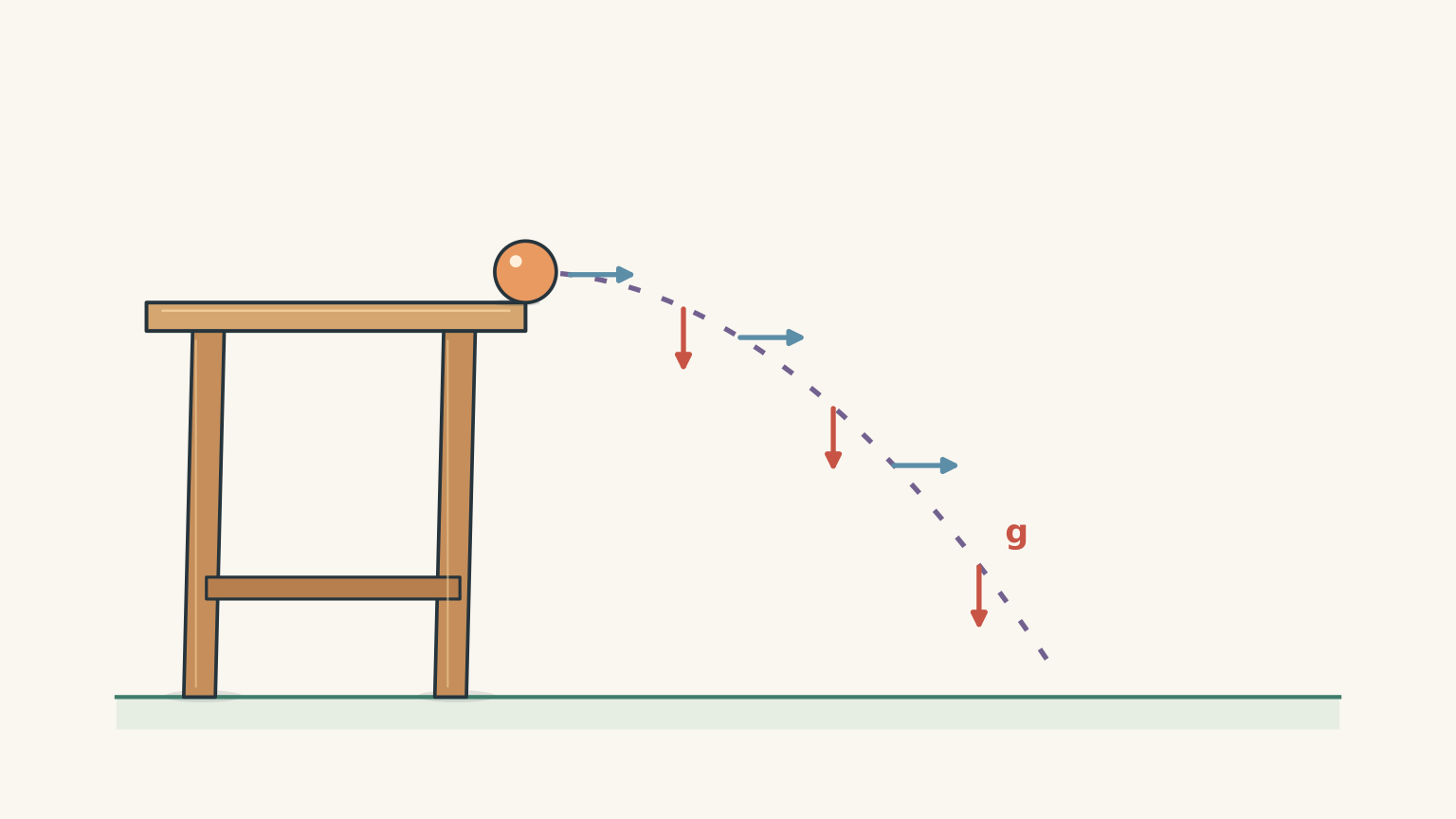
Due to technical limitations, this figure may display incorrectly or contain inaccuracies. Please check key details against your course materials.
The important feature is that gravitational acceleration is constant in a uniform gravitational field:
\[ F_g=mg \]
Using Newton’s second law, \(F=ma\):
\[ a=g \]
Here, \(m\) is the object’s mass, \(g\) is gravitational field strength, and \(a\) is acceleration.
Notice that mass cancels. If air resistance is negligible, a heavy ball and a light ball released with the same initial velocity follow the same trajectory.
Satellites in orbit
Now consider a satellite travelling around Earth. Is it escaping gravity because it is moving sideways rather than falling towards the ground?
No. It is continuously falling towards Earth, but its sideways velocity means that Earth’s curved surface falls away beneath it.
Gravity supplies the centripetal force needed to keep the satellite moving around Earth:
\[ F_g=F_c \]
For a circular orbit:
\[ \frac{GMm}{r^2}=\frac{mv^2}{r} \]
Here, \(G\) is the gravitational constant, \(M\) is Earth’s mass, \(m\) is the satellite’s mass, \(r\) is its distance from Earth’s centre, and \(v\) is its orbital speed.
Unlike the ball near Earth’s surface, the satellite experiences a gravitational field whose direction and strength change with position. Its circular trajectory is therefore not an example of motion in a uniform gravitational field.
Charged particles in uniform electric fields
A charged particle in an electric field experiences a force:
\[ F_E=qE \]
Here, \(q\) is the particle’s electric charge and \(E\) is electric field strength.
For a uniform electric field, the force and acceleration are constant:
\[ a=\frac{qE}{m} \]
This resembles the gravitational case. If a particle enters the field with a velocity perpendicular to the field direction, it follows a parabolic path.
There is one important difference: gravitational acceleration acts in the same direction for ordinary masses, whereas electric acceleration depends on the sign of the charge.
A positive particle accelerates in the direction of the electric field. A negative particle accelerates in the opposite direction.
Moving charged particles in magnetic fields
Now introduce a magnetic field. A moving charged particle experiences a magnetic force:
\[ F_B=|q|vB\sin\theta \]
Here, \(v\) is particle speed, \(B\) is magnetic field strength, and \(\theta\) is the angle between the particle’s velocity and the magnetic field.
Predict what happens if the particle travels perpendicular to a uniform magnetic field.
The magnetic force is always perpendicular to its instantaneous velocity. It changes the direction of motion, but not the particle’s speed. The particle therefore follows a circular path.
The magnetic force supplies the centripetal force:
\[ |q|vB=\frac{mv^2}{r} \]
Rearranging gives:
\[ r=\frac{mv}{|q|B} \]
A stronger magnetic field produces a smaller circular radius. A more massive particle produces a larger radius if the other quantities remain unchanged.
But what if the particle enters at an angle rather than exactly perpendicular to the field?
Its velocity can be split into two components:
- \(v_\perp\), perpendicular to the magnetic field.
- \(v_\parallel\), parallel to the magnetic field.
The perpendicular component produces circular motion. The parallel component remains unchanged because the magnetic force has no component along the field.
The combined trajectory is a helix.
This gives us a useful comparison:
| Situation | Force and acceleration | Resulting motion |
|---|---|---|
| Mass in a uniform gravitational field | Constant downward acceleration | Parabola for horizontal launch |
| Satellite in circular orbit | Gravity towards Earth’s centre | Circular orbit |
| Charge in a uniform electric field | Constant acceleration parallel or antiparallel to the field | Parabola for perpendicular entry |
| Charge in a uniform magnetic field | Force perpendicular to velocity | Circle or helix |
The key distinction is that an electric or gravitational force can change a particle’s speed, while a magnetic force acting alone cannot. Magnetic forces steer; they do not transfer kinetic energy to or from the particle.
That steering property is one of the ingredients that makes a Penning trap possible.
02Why one field is not enough
Imagine trying to keep a positively charged ion near the centre of a small region using only an electric field.
You could arrange electrodes so that the ion experiences a restoring force along the vertical axis. Displace it slightly upwards, and the electric force pulls it back down. Displace it downwards, and the force pulls it back up.
That sounds like a stable arrangement.
But now consider moving the ion slightly sideways. The same electric field arrangement produces a force that pushes it further away from the centre.
The electric potential has the shape of a saddle rather than a three-dimensional bowl.
This is not simply a problem with choosing the wrong electrode arrangement. In a region without electric charge, electrostatic potential must satisfy Laplace’s equation:
\[ \nabla^2\Phi=0 \]
This means that the curvature of the potential cannot point towards a stable minimum in every direction at once.
The general result is known as Earnshaw’s theorem: static electric fields cannot produce a stable three-dimensional equilibrium for a free charged particle.
A magnetic field alone does not solve the whole problem either. It can bend motion perpendicular to the field, but it cannot stop a charged particle travelling along the field lines.
So we need to combine the two.
03How a Penning trap combines the two fields
A conventional Penning trap uses three main electrodes:
- Two endcap electrodes, positioned above and below the centre.
- One ring electrode, surrounding the centre.
- A strong, uniform magnetic field directed along the axis joining the endcaps.
The electrodes create an electric field with a special shape called a quadrupole field. The magnetic field is aligned with its axis of symmetry.
For a positive ion, the endcaps are held at a higher electric potential than the ring electrode. The electric field then pulls the ion towards the centre along the vertical axis.
However, there is a catch: the electric field also pushes the ion outwards in the radial direction, towards the ring electrode.
The magnetic field prevents this outward motion from becoming an escape route. Its Lorentz force continually changes the direction of the ion’s velocity, producing bounded motion in the radial plane.
Let’s make that more precise.
The electric potential inside the trap
An ideal Penning trap has an electrostatic potential of the form:
\[ \Phi(r,z)=\frac{U_0}{2d^2} \left(z^2-\frac{r^2}{2}\right) \]
Here:
- \(\Phi\) is electric potential, measured in volts.
- \(U_0\) is the voltage difference between the endcaps and ring electrode.
- \(z\) is displacement along the magnetic field axis, measured in metres.
- \(r\) is radial distance from that axis, where \(r=\sqrt{x^2+y^2}\).
- \(d\) is a characteristic length determined by the electrode geometry.
We are using the sign convention \(U_0>0\) for a positively charged ion, with the endcaps at a higher potential than the ring.
Look at the two squared terms. They have opposite signs.
Along the axial direction, the potential increases as the ion moves away from the centre. A positive ion therefore experiences a restoring force.
In the radial direction, the potential decreases as the ion moves towards the ring. A positive ion experiences an outward force.
The corresponding electric field components are:
\[ E_z=-\frac{U_0z}{d^2} \]
\[ E_r=\frac{U_0r}{2d^2} \]
Using \(F=qE\), where \(q\) is the positive ion’s charge, gives:
\[ F_z=-\frac{qU_0}{d^2}z \]
\[ F_r=+\frac{qU_0}{2d^2}r \]
The negative sign in the axial equation means the force acts towards the centre. The positive sign in the radial equation means the force acts away from the centre.
This is the important detail: the electric field confines the ion axially but actively destabilises its radial position.
The magnetic field provides radial stability
The magnetic field points along the \(z\)-axis:
\[ \vec B=B\hat z \]
Here, \(B\) is magnetic field strength in tesla.
A moving ion experiences the Lorentz force:
\[ \vec F_B=q(\vec v\times\vec B) \]
The cross product tells us that this force is perpendicular to both the velocity and magnetic field.
The magnetic force does not simply cancel the outward electric force. Instead, it continually redirects the ion’s sideways velocity.
The resulting radial motion is a combination of two circular motions:
- A fast motion called the modified cyclotron motion.
- A much slower drift around the trap axis called the magnetron motion.
The combination keeps the ion within a bounded radial region, provided the magnetic field is sufficiently strong.
The ion is not stationary at the centre. It continues moving in all three modes. Being trapped means its motion remains confined to the trap rather than carrying it into an electrode.
04The three characteristic frequencies
The ideal Penning trap has three characteristic angular frequencies. Understanding what each one represents is more useful than memorising the equations without context.
An angular frequency describes how quickly an oscillation or rotation progresses. It is measured in radians per second.
Axial frequency: motion along the magnetic field
Along the \(z\)-axis, the electric force is:
\[ F_z=-\frac{qU_0}{d^2}z \]
Compare this with the restoring force in simple harmonic motion:
\[ F=-m\omega^2x \]
The equations have the same structure. The ion therefore performs simple harmonic motion along the magnetic field axis.
Its axial angular frequency is:
\[ \boxed{\omega_z=\sqrt{\frac{qU_0}{md^2}}} \]
Here, \(m\) is the ion’s mass, and \(q\) is its charge.
The axial frequency depends on the charge, mass, and applied voltage, as well as the trap geometry.
Notice that the magnetic field does not appear in this equation. This is because the axial velocity is parallel to the magnetic field, so the magnetic force has no axial component.
Free cyclotron frequency: the magnetic reference
Before considering the radial electric field, recall the circular motion of a charged particle in a uniform magnetic field.
For a particle moving perpendicular to the field:
\[ |q|vB=\frac{mv^2}{r} \]
Rearranging gives:
\[ \frac{v}{r}=\frac{|q|B}{m} \]
Since angular velocity is \(v/r\), the free cyclotron angular frequency is:
\[ \boxed{\omega_c=\frac{|q|B}{m}} \]
This is the frequency the particle would have in a uniform magnetic field without the quadrupole electric field.
It provides a useful reference, but it is not quite the actual fast radial frequency inside a Penning trap.
Modified cyclotron frequency: the fast radial motion
Inside the trap, the radial electric field also acts on the ion. It modifies the magnetic circular motion.
The fast radial frequency becomes:
\[ \boxed{ \omega_+=\frac{1}{2} \left(\omega_c+\sqrt{\omega_c^2-2\omega_z^2}\right) } \]
This is the modified cyclotron angular frequency.
It is slightly lower than the free cyclotron frequency because of the additional electric field.
Magnetron frequency: the slow radial drift
The other radial frequency is:
\[ \boxed{ \omega_-=\frac{1}{2} \left(\omega_c-\sqrt{\omega_c^2-2\omega_z^2}\right) } \]
This is the magnetron angular frequency.
It describes the slow drift of the ion around the trap axis. It arises from the combination of the radial electric field and the axial magnetic field, often described as an \(\vec E\times\vec B\) drift.
For a strong magnetic field compared with the radial electric-field effect, the magnetron frequency is much smaller than the modified cyclotron frequency.
For an ideal trap, the two radial frequencies satisfy:
\[ \omega_++\omega_-=\omega_c \]
This is a useful relationship. The electric field splits the original cyclotron motion into two characteristic radial motions, but their frequencies still add to the free cyclotron frequency.
When is the trap stable?
There is one more important condition.
The expression under the square root in the radial frequency equations must be positive:
\[ \omega_c^2-2\omega_z^2>0 \]
Therefore:
\[ \boxed{\omega_c^2>2\omega_z^2} \]
Or, equivalently:
\[ \boxed{\omega_c>\sqrt{2}\omega_z} \]
This is the ideal Penning trap’s radial stability condition.
The magnetic field must be strong enough to maintain bounded radial motion against the outward electric force.
If the magnetic field is too weak, the radial frequencies are no longer real, and stable radial confinement is lost.
This creates an interesting trade-off. Increasing the trapping voltage strengthens axial confinement, but it also strengthens the outward radial electric force. The magnetic field must be strong enough to accommodate that change.
05Worked examples
Worked example: Calculate the axial frequency
A singly ionised calcium-40 ion, \(\ce{^{40}Ca+}\), has a mass of \(6.64\times10^{-26}\,\text{kg}\) and a charge of \(+1.60\times10^{-19}\,\text{C}\). It is placed in an ideal Penning trap with an applied voltage of \(10.0\,\text{V}\) and a characteristic length of \(1.00\,\text{cm}\).
Calculate its axial angular frequency and ordinary frequency.
Step 1
The question asks about axial motion, which occurs along the magnetic field axis.
We therefore use:
\[ \omega_z=\sqrt{\frac{qU_0}{md^2}} \]
Step 2
\[ d=1.00\,\text{cm}=1.00\times10^{-2}\,\text{m} \]
Step 3
\[ \begin{aligned} \omega_z&=\sqrt{ \frac{(1.60\times10^{-19})(10.0)} {(6.64\times10^{-26})(1.00\times10^{-2})^2} }\\ &=\sqrt{2.41\times10^{11}}\\ &=4.91\times10^5\,\text{rad s}^{-1} \end{aligned} \]
Step 4
Using \(f=\omega/(2\pi)\):
\[ \begin{aligned} f_z&=\frac{4.91\times10^5}{2\pi}\\ &=7.81\times10^4\,\text{Hz} \end{aligned} \]
Final answer
\[ \boxed{f_z=78.1\,\text{kHz}} \]
The ion completes approximately 78,100 axial oscillations each second. Its motion is simple harmonic, and its axial frequency is independent of the magnetic field strength in the ideal model.
Worked example: Calculate all three frequencies and test stability
The same calcium ion is placed in a Penning trap with:
- \(U_0=10.0\,\text{V}\)
- \(d=1.00\times10^{-2}\,\text{m}\)
- \(B=2.00\,\text{T}\)
Calculate the free cyclotron, modified cyclotron, and magnetron angular frequencies. Determine whether the trap is stable.
Step 1
Use:
\[ \omega_c=\frac{qB}{m} \]
Substituting:
\[ \begin{aligned} \omega_c&=\frac{(1.60\times10^{-19})(2.00)} {6.64\times10^{-26}}\\ &=4.82\times10^6\,\text{rad s}^{-1} \end{aligned} \]
Step 2
From the previous example:
\[ \omega_z=4.91\times10^5\,\text{rad s}^{-1} \]
Step 3
\[ \begin{aligned} \omega_+&=\frac{1}{2} \left(\omega_c+\sqrt{\omega_c^2-2\omega_z^2}\right)\\ &=\frac{1}{2} \left(4.82\times10^6+ \sqrt{(4.82\times10^6)^2-2(4.91\times10^5)^2} \right)\\ &\approx4.79\times10^6\,\text{rad s}^{-1} \end{aligned} \]
Step 4
\[ \begin{aligned} \omega_-&=\frac{1}{2} \left(\omega_c-\sqrt{\omega_c^2-2\omega_z^2}\right)\\ &\approx2.5\times10^4\,\text{rad s}^{-1} \end{aligned} \]
Step 5
The trap is stable when:
\[ \omega_c^2>2\omega_z^2 \]
Substituting:
\[ 2.32\times10^{13}>4.82\times10^{11} \]
The condition is satisfied.
Final answer
| Motion | Angular frequency |
|---|---|
| Free cyclotron | \(4.82\times10^6\,\text{rad s}^{-1}\) |
| Modified cyclotron | \(4.79\times10^6\,\text{rad s}^{-1}\) |
| Axial | \(4.91\times10^5\,\text{rad s}^{-1}\) |
| Magnetron | \(2.5\times10^4\,\text{rad s}^{-1}\) |
The trap is stable because the magnetic field is sufficiently strong.
The frequency hierarchy is:
\[ \boxed{\omega_+>\omega_z>\omega_-} \]
The ion has a fast radial motion, a slower axial oscillation, and a very slow radial drift. All three motions contribute to its overall trajectory.
06What the ideal model leaves out
The equations above describe an ideal Penning trap. Real equipment is more complicated.
The model assumes:
- A perfectly uniform magnetic field.
- An accurately aligned magnetic and electric field axis.
- A purely quadrupole electric potential.
- A single ion whose motion stays close to the centre of the trap.
- No collisions with background gas particles.
Real electrodes have finite dimensions and cannot reproduce a perfect quadrupole potential everywhere. Their geometry can introduce additional electric-field components that shift the oscillation frequencies.
Multiple ions also interact through electrostatic repulsion. Instead of behaving as independent particles, they can form organised rotating ion clouds and crystals.
High vacuum is important because collisions with background gas particles can disturb the trapped ions and cause them to escape. Researchers also use cooling techniques to control their motion.
One particularly important distinction is that satisfying the stability condition does not guarantee that every possible trajectory remains inside a real device. The condition establishes stable radial modes in the ideal mathematical model. The actual trap has finite dimensions and can lose particles through collisions, field imperfections, or sufficiently large excursions.
Why trap a particle in the first place?
A particle travelling through a detector gives researchers only a limited opportunity to measure its properties. A trapped particle can be observed repeatedly.
This is particularly useful for precision measurements.
For example, the free cyclotron frequency is:
\[ \omega_c=\frac{|q|B}{m} \]
If the charge and magnetic field are known, measuring the cyclotron frequency allows researchers to determine the particle’s mass.
In an ideal Penning trap, the two radial frequencies also provide the relationship:
\[ \omega_c=\omega_++\omega_- \]
This makes it possible to recover the free cyclotron frequency from the two radial modes.
Penning traps are used in precision measurements of ion masses and fundamental particle properties. They are also important in experiments involving trapped-ion quantum systems.
07Questions and solutions
The following questions move from calculating an individual motion to reasoning about the interaction between the electric and magnetic fields.
Question 1
A singly charged positive ion has:
- Mass \(m=6.64\times10^{-26}\,\text{kg}\).
- Charge \(q=+1.60\times10^{-19}\,\text{C}\).
- Applied trap voltage \(U_0=8.0\,\text{V}\).
- Characteristic trap length \(d=1.00\times10^{-2}\,\text{m}\).
Calculate its axial angular frequency and ordinary frequency.
Solution 1
The axial frequency is approximately \(69.9\,\text{kHz}\).
The axial motion is simple harmonic motion, so:
\[ \omega_z=\sqrt{\frac{qU_0}{md^2}} \]
Substitute:
\[ \begin{aligned} \omega_z&=\sqrt{ \frac{(1.60\times10^{-19})(8.0)} {(6.64\times10^{-26})(1.00\times10^{-2})^2} }\\ &=\sqrt{1.93\times10^{11}}\\ &=4.39\times10^5\,\text{rad s}^{-1} \end{aligned} \]
Convert to ordinary frequency:
\[ \begin{aligned} f_z&=\frac{\omega_z}{2\pi}\\ &=\frac{4.39\times10^5}{2\pi}\\ &=6.99\times10^4\,\text{Hz} \end{aligned} \]
Therefore:
\[ \boxed{f_z=69.9\,\text{kHz}} \]
The magnetic field does not affect this frequency in the ideal model because the axial motion is parallel to the field.
Question 2
Two different singly charged positive ions, A and B, are separately placed in the same ideal Penning trap.
The electric and magnetic fields, as well as the electrode geometry, remain unchanged.
Their measured axial frequencies are:
\[ f_{z,A}=90.0\,\text{kHz} \]
\[ f_{z,B}=60.0\,\text{kHz} \]
(a) Determine the ratio of their masses, \(m_A:m_B\).
(b) If the free cyclotron frequency of ion A is \(1.80\,\text{MHz}\), determine the free cyclotron frequency of ion B.
(c) Explain why the axial and free cyclotron frequencies have different relationships with particle mass.
Solution 2
(a) Ion A has four-ninths the mass of ion B.
Start with the axial frequency equation:
\[ \omega_z=\sqrt{\frac{qU_0}{md^2}} \]
Since both ions have the same charge and experience the same fields and geometry:
\[ f_z\propto\frac{1}{\sqrt m} \]
Therefore:
\[ \frac{f_{z,A}}{f_{z,B}} =\sqrt{\frac{m_B}{m_A}} \]
Rearrange:
\[ \begin{aligned} \frac{m_A}{m_B} &=\left(\frac{f_{z,B}}{f_{z,A}}\right)^2\\ &=\left(\frac{60.0}{90.0}\right)^2\\ &=\frac{4}{9} \end{aligned} \]
Thus:
\[ \boxed{m_A:m_B=4:9} \]
Ion B is 2.25 times as massive as ion A.
(b) Ion B has a free cyclotron frequency of \(0.800\,\text{MHz}\).
The free cyclotron frequency is:
\[ \omega_c=\frac{qB}{m} \]
For equal charge and magnetic field strength:
\[ f_c\propto\frac{1}{m} \]
Therefore:
\[ \begin{aligned} \frac{f_{c,B}}{f_{c,A}} &=\frac{m_A}{m_B}\\ &=\frac{4}{9} \end{aligned} \]
Substitute:
\[ \begin{aligned} f_{c,B}&=\frac{4}{9}(1.80\,\text{MHz})\\ &=0.800\,\text{MHz} \end{aligned} \]
(c) The axial frequency depends on the inverse square root of mass, whereas the free cyclotron frequency depends on the inverse of mass.
The difference comes from the underlying motion.
The axial motion is simple harmonic motion, where frequency depends on the square root of the ratio between restoring force per unit displacement and mass.
The cyclotron frequency comes from equating magnetic and centripetal forces. One factor of mass remains in the denominator after rearrangement.
This means that doubling the mass reduces the axial frequency by a factor of \(\sqrt{2}\), but halves the free cyclotron frequency.
Question 3
A positive calcium ion is held in an ideal Penning trap.
Its mass is \(6.64\times10^{-26}\,\text{kg}\), its charge is \(+1.60\times10^{-19}\,\text{C}\), and its axial angular frequency is:
\[ \omega_z=4.00\times10^5\,\text{rad s}^{-1} \]
The magnetic field is reduced to \(0.200\,\text{T}\).
(a) Calculate the free cyclotron angular frequency.
(b) Determine whether the trap remains radially stable.
(c) Calculate the minimum magnetic field strength required for stable radial confinement.
(d) Explain why the axial oscillation can continue even when radial stability has been lost.
Solution 3
(a) The free cyclotron angular frequency is \(4.82\times10^5\,\text{rad s}^{-1}\).
Use:
\[ \omega_c=\frac{qB}{m} \]
Substitute:
\[ \begin{aligned} \omega_c&=\frac{(1.60\times10^{-19})(0.200)} {6.64\times10^{-26}}\\ &=4.82\times10^5\,\text{rad s}^{-1} \end{aligned} \]
(b) The trap is not radially stable.
The stability condition is:
\[ \omega_c>\sqrt{2}\omega_z \]
Calculate the required cyclotron frequency:
\[ \begin{aligned} \sqrt{2}\omega_z &=\sqrt{2}(4.00\times10^5)\\ &=5.66\times10^5\,\text{rad s}^{-1} \end{aligned} \]
Compare:
\[ 4.82\times10^5<5.66\times10^5 \]
The condition is not satisfied.
The magnetic field is too weak to maintain stable radial motion against the outward electric force.
(c) The magnetic field must be greater than approximately \(0.235\,\text{T}\).
Substitute the cyclotron frequency equation into the stability condition:
\[ \frac{qB}{m}>\sqrt{2}\omega_z \]
Rearrange:
\[ B>\frac{m\sqrt{2}\omega_z}{q} \]
Substitute:
\[ \begin{aligned} B&>\frac{(6.64\times10^{-26}) \sqrt{2}(4.00\times10^5)} {1.60\times10^{-19}}\\ B&>0.235\,\text{T} \end{aligned} \]
The magnetic field must be greater than approximately \(0.235\,\text{T}\). Equality is the limiting boundary, not a stable operating condition.
(d) The axial motion remains independently confined by the electric field.
The axial restoring force is:
\[ F_z=-\frac{qU_0}{d^2}z \]
This force still points towards the centre when the ion is displaced along the \(z\)-axis.
The magnetic field does not appear in the axial equation of motion. Therefore, losing radial stability does not automatically eliminate axial simple harmonic motion.
This is an important distinction: stability in one direction does not guarantee stability in every direction.
Question 4
A Penning trap is initially configured to confine positive ions.
The sign convention is:
- Positive ions have \(q=+e\).
- The endcaps are at a higher potential than the ring, so \(U_0>0\).
- The magnetic field points in the positive \(z\)-direction.
A researcher wants to replace the positive ion with a negative ion of the same mass and charge magnitude.
The researcher first reverses the magnetic field but leaves the electrode voltages unchanged.
(a) Will the negative ion remain axially confined? Explain.
(b) What electrical change is necessary to restore axial confinement?
(c) If both the electrode voltage and magnetic field are reversed, compare the three frequency magnitudes and the direction of radial circulation with those of the original positive ion.
Solution 4
(a) No. Reversing the magnetic field does not restore axial confinement.
The axial restoring force depends on the product of charge and applied voltage:
\[ F_z=-\frac{qU_0}{d^2}z \]
Initially:
\[ qU_0=(+e)(+U_0)>0 \]
This produces a restoring force.
After replacing the ion with a negative ion while leaving the voltage unchanged:
\[ qU_0=(-e)(+U_0)<0 \]
The force now points away from the trap centre along the axial direction.
Reversing the magnetic field cannot fix this. A magnetic force has no component parallel to the magnetic field, so it cannot provide the missing axial restoring force.
(b) The electrode voltage must be reversed.
The condition for axial confinement is:
\[ qU_0>0 \]
For a negative ion, we therefore require:
\[ q<0,\qquad U_0<0 \]
The endcaps must now be at a lower potential than the ring electrode.
(c) Reversing both the voltage and magnetic field restores the original frequency magnitudes and radial circulation direction.
Consider the three frequency relationships.
The axial frequency depends on:
\[ \omega_z=\sqrt{\frac{qU_0}{md^2}} \]
Reversing both \(q\) and \(U_0\) leaves their product unchanged. The axial frequency therefore has the same magnitude.
The free cyclotron frequency depends on:
\[ \omega_c=\frac{|q|B}{m} \]
Its magnitude is unchanged because the charge and magnetic field strengths have not changed in magnitude.
The modified cyclotron and magnetron frequencies consequently also retain their original magnitudes.
Finally, the direction of radial circulation depends on the relative signs of the charge, magnetic field, and electric field. Reversing both \(q\) and \(B\), while also reversing the electrode polarity, restores the original radial circulation direction.
The important lesson is that changing the magnetic field direction and changing the electrode polarity perform different jobs. The former changes magnetic steering; the latter determines whether the electric field confines the particle axially.
Question 5
Extension challenge
An ion is trapped in the stable ideal Penning trap described in Worked Example 2.
Its initial radial position is:
\[ x=a=0.500\,\text{mm},\qquad y=0 \]
It is released from rest, with zero radial velocity.
At the instant of release, the magnetic force is zero because the ion has no radial velocity. The radial electric force points outwards.
A student argues:
“The ion must escape. The electric force pushes it away from the centre, and the magnetic force cannot pull it back because magnetic forces never act towards the centre unless the ion is already moving in a circle.”
The student’s first observation is correct. Their conclusion may not be.
For this ideal trap, the radial motion can be expressed as a superposition of two circular modes:
\[ u(t)=A_+e^{-i\omega_+t}+A_-e^{-i\omega_-t} \]
where:
- \(u=x+iy\) represents the radial position.
- \(A_+\) and \(A_-\) are constants determined by the initial conditions.
- \(\omega_+\) is the modified cyclotron angular frequency.
- \(\omega_-\) is the magnetron angular frequency.
Use the values:
\[ \omega_c=4.82\times10^6\,\text{rad s}^{-1} \]
\[ \omega_z=4.91\times10^5\,\text{rad s}^{-1} \]
(a) Determine whether the ion escapes in the ideal model.
(b) Apply the initial position and velocity conditions to determine \(A_+\) and \(A_-\).
(c) Calculate the minimum and maximum radial distances reached by the ion.
(d) Explain precisely why the student’s prediction fails, despite the initial electric force genuinely pointing outwards.
Solution 5
(a) The ion remains radially bounded in the ideal trap. It does not escape.
The trap satisfies the stability condition:
\[ \omega_c^2>2\omega_z^2 \]
The two radial frequencies are therefore real, and the radial motion consists of bounded oscillations and rotations.
However, simply quoting the stability condition does not fully answer the question. We need to use the initial conditions to establish how far the ion actually travels.
(b) The two radial-mode amplitudes are fixed by the initial position and zero velocity.
Start with:
\[ u(t)=A_+e^{-i\omega_+t} +A_-e^{-i\omega_-t} \]
At \(t=0\), the exponential terms both equal one.
The initial position is \(u(0)=a\), giving:
\[ A_++A_-=a \]
Differentiate the position equation:
\[ \frac{du}{dt} =-i\omega_+A_+e^{-i\omega_+t} -i\omega_-A_-e^{-i\omega_-t} \]
The initial radial velocity is zero:
\[ \omega_+A_++\omega_-A_-=0 \]
Solving the two simultaneous equations gives:
\[ \boxed{ A_+=-\frac{a\omega_-}{\omega_+-\omega_-} } \]
\[ \boxed{ A_-=\frac{a\omega_+}{\omega_+-\omega_-} } \]
Notice the negative sign in the first amplitude. It means the two radial-mode contributions initially point in opposite directions.
Their relative phase subsequently changes, causing the distance from the trap centre to vary.
(c) The radial distance varies between \(0.500\,\text{mm}\) and approximately \(0.505\,\text{mm}\).
The minimum radial distance occurs when the two mode contributions point in opposite directions.
Their difference in magnitude gives:
\[ \begin{aligned} r_{\min} &=\frac{a(\omega_+-\omega_-)} {\omega_+-\omega_-}\\ &=a \end{aligned} \]
Therefore:
\[ \boxed{r_{\min}=0.500\,\text{mm}} \]
The maximum radial distance occurs when the two contributions point in the same direction.
Adding their magnitudes:
\[ r_{\max} =\frac{a(\omega_++\omega_-)} {\omega_+-\omega_-} \]
Recall the two useful relationships:
\[ \omega_++\omega_-=\omega_c \]
and:
\[ \omega_+-\omega_-= \sqrt{\omega_c^2-2\omega_z^2} \]
Therefore:
\[ r_{\max}= \frac{a\omega_c} {\sqrt{\omega_c^2-2\omega_z^2}} \]
Substitute the supplied values:
\[ \begin{aligned} r_{\max} &=0.500 \frac{4.82} {\sqrt{4.82^2-2(0.491)^2}} \,\text{mm}\\ &\approx0.505\,\text{mm} \end{aligned} \]
Hence:
\[ \boxed{ 0.500\,\text{mm}\leq r\leq0.505\,\text{mm} } \]
The ion remains within a very narrow radial range around its initial displacement.
(d) The student’s mistake is treating the initial outward force as proof of continuous outward acceleration.
At the instant of release, the magnetic force is indeed zero. The electric force accelerates the ion outwards.
But as soon as the ion gains sideways velocity, the magnetic force becomes non-zero. It redirects the motion and produces the coupled radial modes.
The ion does not simply accelerate in a straight radial line. Its trajectory is the superposition of two circular motions with different frequencies.
The radial distance therefore oscillates rather than increasing indefinitely.
The subtle point is that a force can initially accelerate an object outwards without producing an unbounded trajectory. The subsequent motion depends on how the forces interact as the velocity changes.
This is exactly why the Penning trap needs both fields.
08The next connection: measuring the mass of a particle
The most useful result from this topic is not just that two electromagnetic fields can confine an ion.
It is that the confined ion has measurable characteristic frequencies that depend on its charge-to-mass ratio.
The free cyclotron relationship,
\[ \omega_c=\frac{|q|B}{m} \]
shows how a particle’s mass affects its motion in a known magnetic field.
The Penning trap makes it possible to measure that motion repeatedly and with great precision. Researchers can use these measurements to determine ion masses, investigate fundamental particle properties, and study controlled collections of charged particles.
The next natural concept is therefore cyclotron resonance and precision mass spectrometry: how scientists measure the frequencies of trapped ions and use them to distinguish particles with extremely similar masses.
09Further reading
The following scientific and university resources support the physical models and applications discussed in this article.
- Imperial College London – The Penning Trap – electrode configuration, characteristic frequencies, and trapped-ion research.
- National Institute of Standards and Technology – Trapped ion physics in a Penning trap – detailed treatment of the ideal trap, radial stability, ion motion, and real experimental limitations. Based on Kevin A. Gilmore’s 2020 University of Colorado doctoral thesis.
- University of Sydney – Year 12 Electromagnetism – background on charged particles in uniform electric and magnetic fields and their comparison with projectile motion.
- Nobel Prize – Hans G. Dehmelt’s Nobel Lecture – historical development and precision experiments involving particles confined in Penning traps.