
Synchrotron Radiation: Why Circular Accelerators Lose Energy
Explore why accelerating electrons emit electromagnetic radiation, how synchrotron radiation drains energy from circular particle accelerators, and how RF cavities compensate for these losses. An accessible extension beyond the Year 12 Physics syllabus.
A simple DC motor draws its largest current when it first starts turning. Once it reaches speed, the current falls. Put a heavier load on the shaft, and the motor slows slightly before drawing more current again.
The reason is that a moving motor generates its own voltage, called back emf. This voltage changes the current flowing through the motor as its speed changes.
Now consider a much stranger situation. An electron travels around a circular accelerator at almost the speed of light. Its speed barely changes, but its direction changes continuously. That change in direction causes the electron to emit electromagnetic radiation, carrying energy away from the particle.
This radiation is called synchrotron radiation. It creates a significant engineering challenge for circular particle accelerators, particularly those that accelerate electrons to very high energies.
The Year 12 Electromagnetism material provides the starting point for this article. Synchrotron radiation itself is an extension beyond the required 2025 NSW Physics syllabus, not an additional HSC assessment requirement.
01Back emf: how a DC motor controls its current
Start with a simple brushed DC motor. A coil of wire sits between the north and south poles of a magnet. When current flows through the coil, the magnetic field exerts forces on its sides, producing a turning effect.
As the coil rotates, it moves through the magnetic field. This changes the magnetic flux through the coil, inducing an electromotive force (emf).
According to Lenz’s law, the induced emf opposes the change that produces it. In a motor, this induced voltage acts against the applied supply voltage.
It is called back emf.
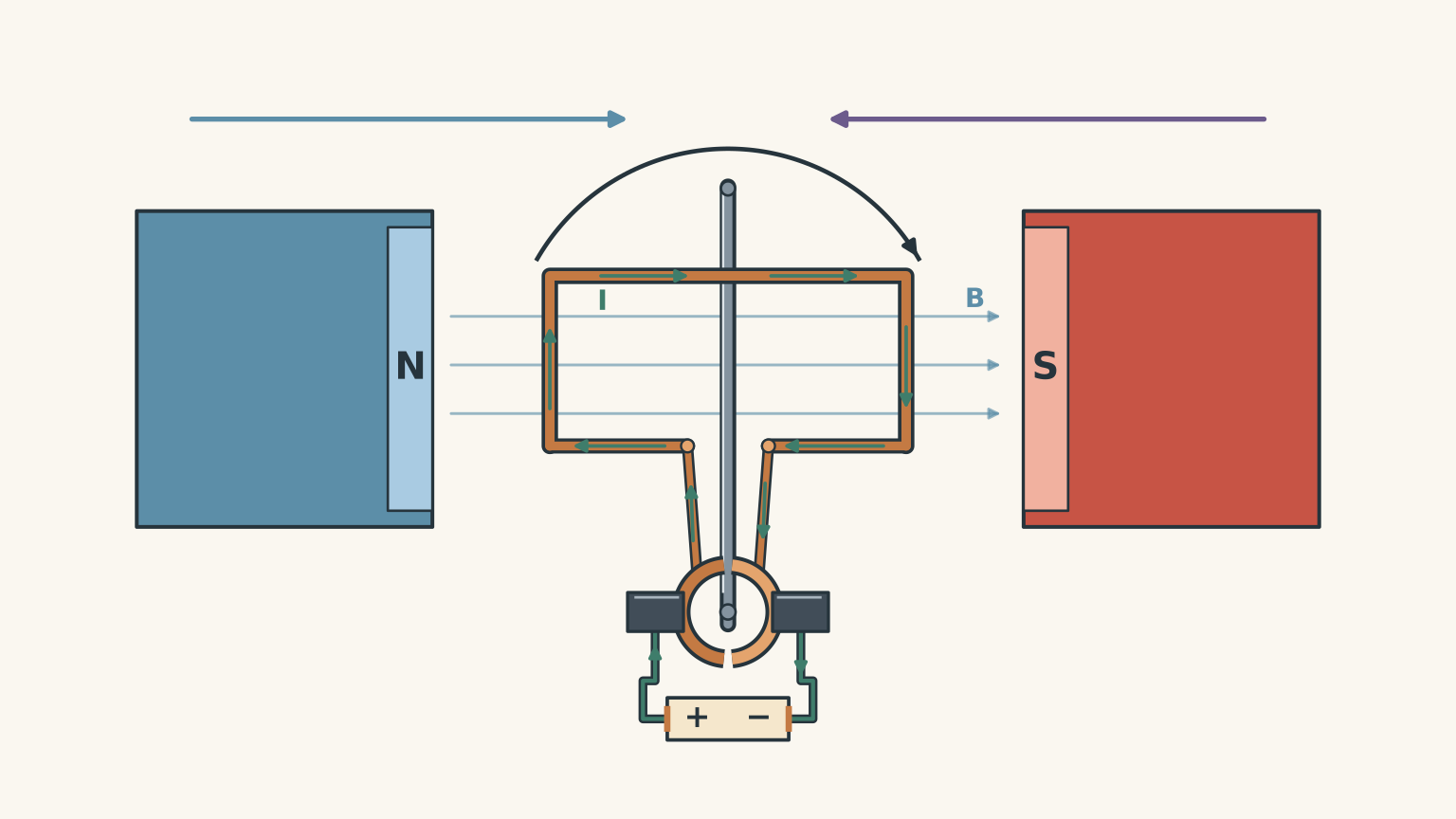
Due to technical limitations, this figure may display incorrectly or contain inaccuracies. Please check key details against your course materials.
Predict what happens when the motor starts
Imagine connecting a DC motor to a 24 V supply.
Before the motor starts rotating, there is no rotational motion to produce back emf. What do you predict happens to the current?
It is initially large because the full supply voltage acts across the resistance of the motor’s windings.
Once the motor begins rotating, its coil generates back emf. This reduces the net voltage driving the current, so the current falls.
For a simple motor operating at steady speed, we can model this using:
\[ V_s=E_b+IR \]
where:
- \(V_s\) is the applied supply voltage, in volts (V)
- \(E_b\) is the back emf, in volts (V)
- \(I\) is the current through the motor, in amperes (A)
- \(R\) is the resistance of the motor windings, in ohms (\(\Omega\))
Rearranging:
\[ I=\frac{V_s-E_b}{R} \]
The important relationship is that increasing back emf decreases the current.
The back emf also increases with rotational speed. For a simple motor model:
\[ E_b=k_e\omega \]
Here, \(k_e\) is the motor’s back-emf constant, and \(\omega\) is its angular velocity in radians per second.
What happens when the motor speeds up?
Follow the sequence:
- The motor starts with zero rotational speed, so its back emf is initially zero.
- The supply produces a large current through the windings.
- The current produces torque, causing the motor to accelerate.
- As rotational speed increases, back emf increases.
- The net voltage across the winding resistance decreases, reducing the current.
- The motor eventually reaches a steady operating speed.
The motor’s torque is approximately proportional to its current:
\[ \tau=k_t I \]
where \(\tau\) is the motor’s torque in newton metres, and \(k_t\) is its torque constant in newton metres per ampere.
This means that as the motor speeds up, its current and torque generally decrease until the available torque balances the load and other opposing effects.
What if the motor has to do more work?
Suppose the motor is turning a wheel, and you suddenly increase the load on that wheel.
The motor initially slows down. Its back emf falls because its rotational speed has decreased.
With a smaller back emf, more of the supply voltage is available to drive current through the windings. The current increases, producing more torque.
The motor can then settle at a new operating speed, usually with a higher current.
| Motor condition | Back emf | Current |
|---|---|---|
| Starting from rest | Zero initially | High |
| Accelerating | Increasing | Decreasing |
| Running at steady speed | Relatively large | Lower |
| Load suddenly increases | Initially decreases | Increases |
This is an important form of natural feedback. The motor responds to changes in its load without requiring a separate controller to directly adjust the current.
Worked example: calculating back emf and motor current
A DC motor has a supply voltage of 24 V and a winding resistance of 2.0 Ω.
When running at a particular speed, its back emf is 18 V.
Calculate:
(a) The current while the motor is running.
(b) The current if the motor is stationary.
Assume the winding inductance and brush voltage drops can be neglected, and consider the stationary condition after any initial electrical transient has passed.
Step 1
\[ V_s=E_b+IR \]
Rearrange to make current the subject:
\[ I=\frac{V_s-E_b}{R} \]
Step 2
Substitute the given values:
\[ I=\frac{24-18}{2.0} \]
\[ I=3.0\ \mathrm{A} \]
The motor draws 3.0 A while running at the specified speed.
Step 3
When the motor is stationary, its rotational speed is zero. Therefore, its back emf is zero.
\[ I=\frac{24-0}{2.0} \]
\[ I=12\ \mathrm{A} \]
The stationary motor draws 12 A in this simplified model, four times its running current.
Interpretation: The motor’s own rotation reduces the current flowing through its windings. This is why a motor can draw a much larger current during starting than during normal operation.
If you want to explore how these relationships determine a motor’s operating speed under different loads, see Motor Torque-Speed Curves.
02A charge can accelerate without changing speed
Now move away from motors and consider a charged particle travelling around a circular path.
Imagine an electron moving around a circular accelerator. Its speed remains almost constant, so you might initially conclude that it is not accelerating.
That conclusion is incorrect.
Remember that velocity is a vector. It describes both speed and direction.
An object moving around a circle at constant speed continuously changes the direction of its velocity. Therefore, its velocity changes, which means it accelerates.
This is called centripetal acceleration.
For circular motion:
\[ a=\frac{v^2}{\rho} \]
where:
- \(a\) is centripetal acceleration, in metres per second squared (\(\mathrm{m\,s^{-2}}\))
- \(v\) is the particle’s speed, in metres per second (\(\mathrm{m\,s^{-1}}\))
- \(\rho\) is the radius of its circular path, in metres (m)
Notice that acceleration depends on speed and radius, not on whether the particle is getting faster.
A car travelling around a roundabout at a constant speed provides a familiar example. Its speedometer might remain at 30 km/h, but its velocity is changing because its direction is changing.
A charged particle behaves similarly, with one additional consequence.
An accelerating electric charge emits electromagnetic radiation.
The radiation carries energy away from the particle.
This is the physical idea behind synchrotron radiation.
Why does an accelerating charge emit radiation?
A charged particle produces an electric field around itself. When the particle accelerates, its electromagnetic field changes in a way that produces outward-travelling electromagnetic waves.
These waves carry energy away from the particle.
For a slowly moving point charge, the classical relationship between acceleration and radiated power is described by the Larmor formula:
\[ P=\frac{q^2a^2}{6\pi\epsilon_0c^3} \]
where:
- \(P\) is the radiated power, in watts (W)
- \(q\) is the particle’s electric charge, in coulombs (C)
- \(a\) is its acceleration, in \(\mathrm{m\,s^{-2}}\)
- \(\epsilon_0\) is the permittivity of free space
- \(c\) is the speed of light in a vacuum, approximately \(3.00\times10^8\ \mathrm{m\,s^{-1}}\)
The equation reveals two useful relationships:
- Increasing the magnitude of the charge increases the radiated power.
- Increasing acceleration increases radiated power with the square of acceleration.
However, there is an important limitation.
The Larmor formula applies to non-relativistic motion. It is not sufficient for describing electrons travelling extremely close to the speed of light.
For that, we need a relativistic model.
03What makes synchrotron radiation different?
In a particle accelerator, electrons can travel extremely close to the speed of light.
At these speeds, relativistic effects become important. One of the quantities used to describe them is the Lorentz factor:
\[ \gamma=\frac{1}{\sqrt{1-v^2/c^2}} \]
Here, \(\gamma\) is the Lorentz factor, \(v\) is the particle’s speed, and \(c\) is the speed of light.
As \(v\) approaches \(c\), the Lorentz factor increases rapidly.
For a relativistic particle undergoing acceleration perpendicular to its direction of motion, the classical relativistic expression for radiated power is:
\[ P=\frac{q^2\gamma^4a^2} {6\pi\epsilon_0c^3} \]
This equation applies to the transverse acceleration produced when a particle follows a curved path.
Compare it with the non-relativistic Larmor formula. The additional factor of \(\gamma^4\) makes a substantial difference.
For a highly relativistic particle moving in a circular path, its speed is approximately \(c\), so:
\[ a\approx\frac{c^2}{\rho} \]
Substituting this into the relativistic expression gives:
\[ P\approx\frac{q^2c\gamma^4} {6\pi\epsilon_0\rho^2} \]
The most important relationship is:
\[ \boxed{P\propto\frac{\gamma^4}{\rho^2}} \]
For the same particle, increasing its energy dramatically increases the power it radiates.
The fourth-power dependence is particularly important. Doubling the Lorentz factor increases the radiated power by a factor of 16 if the bending radius stays constant.
Why is the radiation directed forwards?
There is another unusual feature of synchrotron radiation.
At relativistic speeds, electromagnetic radiation is concentrated into a narrow cone pointing approximately in the direction of the particle’s instantaneous motion.
The approximate angular width of this cone is:
\[ \theta\approx\frac{1}{\gamma} \]
where \(\theta\) is measured in radians.
As the electron follows its curved path, this narrow radiation beam sweeps around with it.
The radiation therefore travels approximately tangentially to the electron’s circular trajectory.
This concentrated radiation can be extremely useful.
Synchrotron radiation includes a range of electromagnetic frequencies, depending on the particle energy and bending conditions. It can include infrared, visible light, ultraviolet radiation, and X-rays.
Modern synchrotron light sources deliberately use this radiation to produce intense beams of light for scientific research.
The European Synchrotron Radiation Facility (ESRF), for example, operates a storage ring containing high-energy electrons and extracts synchrotron radiation for experiments. Its explanation of how a synchrotron works describes how bending magnets produce radiation that is directed towards experimental beamlines.
04How synchrotron radiation affects circular particle accelerators
A circular particle accelerator uses two main types of electromagnetic components to control the particles.
1. Dipole magnets
These magnets bend the paths of charged particles, forcing them to travel around the accelerator.
Without the magnets, the particles would continue travelling approximately in straight lines.
2. Radiofrequency (RF) cavities
These structures generate oscillating electric fields. When a particle bunch passes through an RF cavity at the correct time, the electric field transfers energy to the particles.
This increases their energy and helps maintain the required beam energy.
CERN describes this division of work in its guide to how particle accelerators operate: electric fields accelerate particles, while magnetic fields steer and focus them.
But there is a problem.
The dipole magnets force the electrons to change direction. This means the electrons are accelerating, even when their speed remains almost constant.
Consequently, they emit synchrotron radiation and lose energy.
The RF cavities must replace that lost energy if the accelerator is to maintain a stable beam energy.
Where does the lost energy come from?
A magnetic force acts perpendicular to the instantaneous velocity of a charged particle moving through a uniform magnetic field.
Because the force is perpendicular to the motion, it does no work on the particle.
However, the particle is still accelerating because its direction is changing, and it emits electromagnetic radiation.
The emitted radiation carries energy away from the particle. The particle’s energy must therefore be replenished by the electric fields in the RF cavities.
This is why the accelerator needs an RF system even when its purpose is primarily to keep particles circulating at a particular energy.
The ESRF describes this process directly: electrons lose energy as they pass through bending magnets and insertion devices, and RF cavities restore the energy to maintain the beam’s nominal energy.
How much energy does an electron lose per revolution?
We can estimate the energy lost by an electron during one complete revolution.
The power radiated is related to the energy lost per turn through:
\[ U_0=PT \]
where:
- \(U_0\) is the energy radiated per revolution, in joules
- \(P\) is the average radiated power, in watts
- \(T\) is the time taken for one revolution, in seconds
For an ultra-relativistic electron moving around a circular path:
\[ T\approx\frac{2\pi\rho}{c} \]
Combining this with the relativistic radiation relationship gives:
\[ U_0\propto\frac{\gamma^4}{\rho} \]
This is an important result.
Power depends on the inverse square of the bending radius, but energy lost per revolution depends on the inverse first power of the bending radius.
The reason is that a larger circular path also takes longer to complete.
For an ultra-relativistic electron in a ring with the same bending radius throughout its dipole magnets, a useful practical approximation is:
\[ U_0\approx88.5\ \mathrm{keV} \frac{(E/1\ \mathrm{GeV})^4} {\rho/1\ \mathrm{m}} \]
Here:
- \(U_0\) is the energy lost per revolution, in kiloelectronvolts (keV)
- \(E\) is the electron’s total energy, in gigaelectronvolts (GeV)
- \(\rho\) is the bending radius inside the dipole magnets, in metres (m)
This approximation assumes ultra-relativistic electrons, classical synchrotron radiation, and a uniform bending radius in the dipole sections. It is not a universal formula for every accelerator.
If the bending radius varies around the ring, the energy loss depends on the distribution of curvature along the path. In particular, the average radius of the entire ring cannot automatically replace the bending radius of its magnets.
Worked example: energy lost by an electron in a storage ring
An electron travels around a storage ring with a total energy of 3.0 GeV.
The bending magnets have a constant bending radius of 30 m.
Calculate the energy lost by the electron during one complete revolution.
Step 1
\[ U_0=88.5\ \mathrm{keV} \frac{(E/1\ \mathrm{GeV})^4} {\rho/1\ \mathrm{m}} \]
Step 2
\[ U_0=88.5 \frac{3.0^4}{30}\ \mathrm{keV} \]
Calculate the fourth power:
\[ 3.0^4=81 \]
Therefore:
\[ U_0=\frac{88.5\times81}{30} \]
\[ U_0=238.95\ \mathrm{keV} \]
Step 3
\[ \boxed{U_0\approx239\ \mathrm{keV}} \]
The electron loses approximately 239 keV of energy during each revolution.
The RF cavities must replace this energy, on average, if the electron is to maintain its nominal energy.
Although 239 keV is small compared with the electron’s total energy of 3.0 GeV, the loss occurs repeatedly. An electron can complete millions of revolutions, making the cumulative energy loss substantial.
Worked example: comparing two accelerator designs
Consider two electron storage rings.
| Property | Ring A | Ring B |
|---|---|---|
| Electron energy | 3.0 GeV | 4.0 GeV |
| Bending radius | 20 m | 30 m |
Calculate the ratio of energy lost per revolution in Ring B compared with Ring A.
Step 1
The electron energy increases from 3.0 GeV to 4.0 GeV.
The bending radius also increases from 20 m to 30 m.
Both changes must be included.
Step 2
For electrons in the same type of ring:
\[ U_0\propto\frac{E^4}{\rho} \]
Therefore:
\[ \frac{U_B}{U_A} = \left(\frac{E_B}{E_A}\right)^4 \frac{\rho_A}{\rho_B} \]
Step 3
\[ \frac{U_B}{U_A} = \left(\frac{4.0}{3.0}\right)^4 \frac{20}{30} \]
Simplifying:
\[ =\frac{256}{81}\times\frac{2}{3} \]
\[ =\frac{512}{243} \]
\[ \frac{U_B}{U_A}\approx2.11 \]
Step 4
\[ \boxed{U_B\approx2.11U_A} \]
Ring B loses approximately 2.11 times as much energy per electron per revolution as Ring A.
Notice that the larger bending radius reduces radiation losses, but it does not compensate fully for the increase in electron energy.
This is the key design challenge: the fourth-power dependence on energy can overwhelm improvements made by increasing the bending radius.
05Why electrons lose more energy than protons
You might now wonder why circular accelerators often use protons when they need to reach extremely high particle energies.
The answer is closely related to particle mass.
Consider an electron and a proton travelling around the same circular path, with the same total energy and the same magnitude of electric charge.
Both particles are accelerated by the changing direction of their motion.
However, the electron has a much smaller rest mass.
The Lorentz factor is approximately:
\[ \gamma\approx\frac{E}{mc^2} \]
for a highly relativistic particle.
At the same total energy, the lighter electron therefore has a much larger Lorentz factor than the proton.
Since synchrotron radiation power depends on \(\gamma^4\), this produces an enormous difference.
The electron-to-proton mass ratio is approximately:
\[ \frac{m_p}{m_e}=1836 \]
For equal charge magnitudes, equal total energies, and equal bending radii, the ratio of their radiated powers is approximately:
\[ \frac{P_e}{P_p} = \left(\frac{m_p}{m_e}\right)^4 \]
\[ P_e/P_p\approx1836^4 \]
\[ \boxed{\frac{P_e}{P_p}\approx1.1\times10^{13}} \]
Under these conditions, the electron radiates approximately 11 trillion times as much power as the proton.
This does not mean protons produce no synchrotron radiation. They do. However, their much larger rest mass makes the radiation losses dramatically smaller at the same energy and bending radius.
This difference has major consequences for accelerator design.
- Electron accelerators are particularly affected by synchrotron radiation at high energies.
- Proton accelerators can reach very high energies in circular machines with much smaller relative radiation losses.
- Increasing the bending radius reduces radiation losses, but requires a physically larger accelerator.
- Linear accelerators avoid repeatedly bending the particles around a circular path, although acceleration in a straight line can still produce radiation.
Synchrotron radiation was initially recognised as an unwanted energy loss in particle accelerators. It is now also deliberately produced and extracted as an extremely useful source of electromagnetic radiation.
06Questions and solutions
The following questions build from straightforward energy-loss calculations to more complicated accelerator-design decisions.
Question 1
An electron travels around a circular accelerator with a total energy of 2.0 GeV. The bending magnets have a constant bending radius of 10 m.
Calculate the energy lost by the electron per revolution.
Explain why an RF cavity is needed to maintain the electron’s energy.
Solution 1
The electron loses approximately 141.6 keV per revolution, and the RF cavity must replace this energy to maintain its nominal energy.
Step 1: Apply the energy-loss equation.
\[ U_0=88.5\ \mathrm{keV} \frac{(E/1\ \mathrm{GeV})^4} {\rho/1\ \mathrm{m}} \]
Step 2: Substitute the values.
\[ U_0=88.5\frac{2.0^4}{10} \]
\[ U_0=\frac{88.5\times16}{10} \]
\[ U_0=141.6\ \mathrm{keV} \]
Step 3: Explain the role of the RF cavity.
The electron changes direction continuously as it travels around the accelerator.
This means it experiences centripetal acceleration and emits synchrotron radiation.
The radiation carries energy away from the electron. An RF cavity supplies energy through an electric field to compensate for this loss.
Without this replacement energy, the electron’s energy would decrease as it circulates.
Question 2
An electron storage ring is upgraded so that its electron energy increases from 2.5 GeV to 5.0 GeV.
The bending radius remains constant at 20 m, and the circulating beam current remains unchanged.
(a) Calculate the factor by which the energy lost per electron per revolution increases.
(b) Determine the factor by which the total average synchrotron radiation power increases.
(c) Explain why the RF system must supply more power after the upgrade.
Solution 2
The energy lost per electron per revolution increases by a factor of 16, and the total average synchrotron radiation power also increases by a factor of 16.
Step 1: Identify the relevant proportionality.
\[ U_0\propto\frac{E^4}{\rho} \]
The bending radius is unchanged, so:
\[ \frac{U_{\mathrm{new}}}{U_{\mathrm{old}}} = \left(\frac{5.0}{2.5}\right)^4 \]
\[ =2^4 \]
\[ \boxed{16} \]
The energy lost per electron per revolution increases by a factor of 16.
Step 2: Consider the total beam power.
For a circulating beam with a constant current, the number of electron passages through a given point per second remains constant.
Therefore, increasing the energy lost per electron per revolution by a factor of 16 also increases the total average radiation power by a factor of 16.
Step 3: Explain the RF requirement.
The electrons now lose much more energy during each revolution.
The RF cavities must provide this additional energy to maintain the beam’s nominal energy.
Consequently, the accelerator needs a substantially more powerful RF system.
The important trap is assuming that doubling electron energy only doubles radiation losses. The fourth-power dependence makes the increase much larger.
Question 3
A circular accelerator is being designed to operate with either electrons or protons.
Both types of particle will have:
- A total energy of 1.0 TeV.
- The same bending radius.
- The same magnitude of electric charge.
Assume both particles are highly relativistic.
(a) Which particle produces more synchrotron radiation?
(b) Estimate the ratio of the radiated powers.
(c) Explain why the difference occurs, even though both particles have the same energy and follow the same circular path.
Solution 3
The electron produces substantially more synchrotron radiation. Its radiated power is approximately \(1.1\times10^{13}\) times the proton’s radiated power under the stated conditions.
Step 1: Identify the relevant relationship.
For transverse acceleration:
\[ P\propto q^2\gamma^4a^2 \]
Both particles have the same charge magnitude and bending radius. Their speeds are both approximately the speed of light, so their centripetal accelerations are approximately equal.
Therefore:
\[ \frac{P_e}{P_p} = \left(\frac{\gamma_e}{\gamma_p}\right)^4 \]
Step 2: Compare the Lorentz factors.
For highly relativistic particles:
\[ \gamma\approx\frac{E}{mc^2} \]
Since both particles have the same total energy:
\[ \frac{\gamma_e}{\gamma_p} \approx\frac{m_p}{m_e} \]
Using the proton-to-electron mass ratio:
\[ \frac{\gamma_e}{\gamma_p}\approx1836 \]
Step 3: Calculate the power ratio.
\[ \frac{P_e}{P_p}=1836^4 \]
\[ \boxed{\frac{P_e}{P_p}\approx1.1\times10^{13}} \]
Step 4: Explain the physical significance.
The electron has a much smaller rest mass, so it has a much larger Lorentz factor at the same total energy.
The fourth-power dependence makes the resulting radiation difference enormous.
The tempting assumption is that equal particle energies and equal trajectories should produce equal radiation. However, particle mass also affects the relativistic radiation power.
This is one reason proton accelerators are attractive when extremely high energies are required in circular machines.
Question 4
Two electron storage rings, A and B, have the same circumference of 600 m.
Both operate with:
- An electron energy of 4.0 GeV.
- The same circulating beam current.
- Dipole magnets that provide all the bending of the electron trajectory.
Ring A has a bending radius of 50 m, while Ring B has a bending radius of 25 m.
The remaining sections of each ring are straight. Ignore radiation associated with the small longitudinal acceleration in the RF cavities.
(a) Calculate the ratio of energy lost per revolution in Ring B compared with Ring A.
(b) Calculate the ratio of total average synchrotron radiation power in Ring B compared with Ring A.
(c) Explain why having the same total circumference does not result in the same radiation losses.
Solution 4
Ring B loses twice as much energy per electron per revolution as Ring A. Since the beam currents are equal, its total average synchrotron radiation power is also twice as large.
Step 1: Identify the relevant relationship.
For the same electron energy:
\[ U_0\propto\frac{1}{\rho} \]
Therefore:
\[ \frac{U_B}{U_A} = \frac{\rho_A}{\rho_B} \]
Step 2: Substitute the bending radii.
\[ \frac{U_B}{U_A} = \frac{50}{25} \]
\[ \boxed{\frac{U_B}{U_A}=2} \]
Ring B loses twice as much energy per electron per revolution.
Step 3: Compare the total radiation power.
The average radiation power for a circulating beam is:
\[ P_{\mathrm{beam}}=\frac{I}{e}U_0 \]
where \(I\) is the circulating beam current, and \(e\) is the magnitude of the elementary charge.
Since both rings have the same beam current:
\[ \frac{P_B}{P_A} = \frac{U_B}{U_A} \]
Therefore:
\[ \boxed{\frac{P_B}{P_A}=2} \]
Ring B produces twice the total average radiation power.
Step 4: Explain the role of the straight sections.
The key difference is the local curvature of the electron’s path.
Ring B uses tighter bending magnets. This produces greater centripetal acceleration and therefore greater radiation power while the electrons pass through those magnets.
The straight sections do not produce the same bending radiation because the electron’s direction is not changing there.
The overall circumference alone does not determine synchrotron radiation losses.
The tempting approach is to compare the two rings using their equal circumferences. However, the radiation depends on how sharply the particles are bent, not simply on the total distance around the accelerator.
Question 5
An accelerator operates with a fixed number of electrons circulating around a circular orbit.
Initially, the electron energy is 2.0 GeV, and the bending radius is 10 m.
Engineers consider an upgrade that doubles the electron energy to 4.0 GeV.
However, the dipole magnets cannot increase their magnetic field strength. Assume the magnetic field remains constant, so the bending radius doubles.
The accelerator is an ideal circular ring, and the electrons travel at approximately the speed of light before and after the upgrade.
Ignore collective beam effects and assume classical synchrotron radiation.
A student argues:
“The electron energy doubles, so the synchrotron radiation power must increase by a factor of 16 because it depends on the fourth power of energy.”
Assess this claim by determining:
(a) The factor by which the energy lost per electron per revolution increases.
(b) The factor by which the revolution frequency changes.
(c) The factor by which the total average synchrotron radiation power changes, given that the number of circulating electrons remains constant.
(d) How the answer in part (c) would change if the beam current, rather than the number of circulating electrons, were kept constant.
Solution 5
The energy lost per electron per revolution increases by a factor of 8, but the total average synchrotron radiation power increases by only a factor of 4 when the number of circulating electrons is held constant.
The student’s factor of 16 describes the energy dependence alone. It ignores the changes in bending radius and revolution frequency.
Step 1: Determine how the bending radius changes.
For a charged particle moving perpendicular to a uniform magnetic field:
\[ \rho=\frac{p}{|q|B} \]
where:
- \(p\) is the particle’s momentum
- \(q\) is its electric charge
- \(B\) is the magnetic field strength
- \(\rho\) is the bending radius
For an ultra-relativistic electron:
\[ p\approx\frac{E}{c} \]
Therefore, if the magnetic field remains constant:
\[ \rho\propto E \]
Doubling the electron energy doubles the bending radius:
\[ \rho_{\mathrm{new}}=20\ \mathrm{m} \]
Step 2: Calculate the energy loss per revolution.
The relevant relationship is:
\[ U_0\propto\frac{E^4}{\rho} \]
Therefore:
\[ \frac{U_{\mathrm{new}}}{U_{\mathrm{old}}} = \left(\frac{4.0}{2.0}\right)^4 \frac{10}{20} \]
\[ =16\times\frac{1}{2} \]
\[ \boxed{\frac{U_{\mathrm{new}}}{U_{\mathrm{old}}}=8} \]
The energy lost per electron per revolution increases by a factor of 8.
For reference, the actual losses are:
Initial accelerator:
\[ U_{\mathrm{old}} = 88.5\frac{2.0^4}{10} \]
\[ U_{\mathrm{old}}=141.6\ \mathrm{keV} \]
Upgraded accelerator:
\[ U_{\mathrm{new}} = 88.5\frac{4.0^4}{20} \]
\[ U_{\mathrm{new}}=1132.8\ \mathrm{keV} \]
The upgraded electron loses approximately 1.13 MeV per revolution.
Step 3: Determine the change in revolution frequency.
The circumference of a circular orbit is:
\[ C=2\pi\rho \]
Since the bending radius doubles, the circumference also doubles.
The electrons travel at approximately the same speed, close to \(c\), before and after the upgrade.
The revolution frequency is:
\[ f_{\mathrm{rev}}=\frac{v}{C} \]
Therefore, doubling the circumference halves the revolution frequency:
\[ \boxed{\frac{f_{\mathrm{new}}}{f_{\mathrm{old}}} =\frac{1}{2}} \]
Each electron now completes half as many revolutions per second.
Step 4: Calculate the total average radiation power.
If \(N\) electrons circulate in the ring, the total average radiation power is:
\[ P_{\mathrm{beam}}=Nf_{\mathrm{rev}}U_0 \]
where:
- \(N\) is the number of circulating electrons
- \(f_{\mathrm{rev}}\) is the revolution frequency
- \(U_0\) is the energy lost per electron per revolution
The number of electrons remains constant, so:
\[ \frac{P_{\mathrm{new}}}{P_{\mathrm{old}}} = \frac{f_{\mathrm{new}}}{f_{\mathrm{old}}} \frac{U_{\mathrm{new}}}{U_{\mathrm{old}}} \]
Substitute:
\[ =\frac{1}{2}\times8 \]
\[ \boxed{\frac{P_{\mathrm{new}}}{P_{\mathrm{old}}}=4} \]
The total average synchrotron radiation power increases by a factor of 4.
Step 5: Consider what happens if the beam current stays constant instead.
The circulating beam current is:
\[ I=Ne f_{\mathrm{rev}} \]
where \(e\) is the magnitude of the elementary charge.
If the revolution frequency halves but the beam current remains constant, the number of circulating electrons must double.
Consequently, the total average radiation power becomes:
\[ \frac{P_{\mathrm{new}}}{P_{\mathrm{old}}} = \frac{U_{\mathrm{new}}}{U_{\mathrm{old}}} =8 \]
The total radiation power would then increase by a factor of 8 rather than 4.
Final interpretation: There are three separate quantities to keep track of:
- Energy lost per revolution: increases by a factor of 8.
- Revolutions per second: decreases by a factor of 2.
- Total average radiation power, with a fixed number of electrons: increases by a factor of 4.
This is why the student’s original answer is incomplete. The fourth-power energy relationship is important, but the radius, revolution frequency, and number of circulating particles also affect the accelerator’s total radiation losses.
07Where this leads next
Synchrotron radiation connects several ideas that initially seem unrelated: electromagnetic induction, circular motion, relativistic energy, and conservation of energy.
The DC motor provides a useful starting point. Its back emf changes the current as the motor’s speed changes. In a circular accelerator, the changing direction of a charged particle causes electromagnetic radiation, and the resulting energy loss must be replaced by an external electric field.
The next useful step is to understand how accelerator engineers balance particle energy, magnetic field strength, bending radius, and RF power when designing a storage ring.
For a real synchrotron, these quantities cannot be chosen independently. Changing one can alter the radiation losses, the required magnet strength, and the power needed to keep the particle beam circulating.
Further reading
- NESA: Physics 11-12 Syllabus (2025) – syllabus context and course structure.
- CERN: How an accelerator works – the roles of magnetic fields and RF cavities.
- European Synchrotron Radiation Facility: How does a synchrotron work? – how synchrotron radiation is produced and used.
- Michigan State University: Accelerator Physics eNotes – Synchrotron Radiation – the relativistic radiation model and accelerator energy-loss relationships.